
Life, 1892-01-07 · page 7 of 16
Life — January 7, 1892 — page 7: what you’re looking at
What you’re looking at
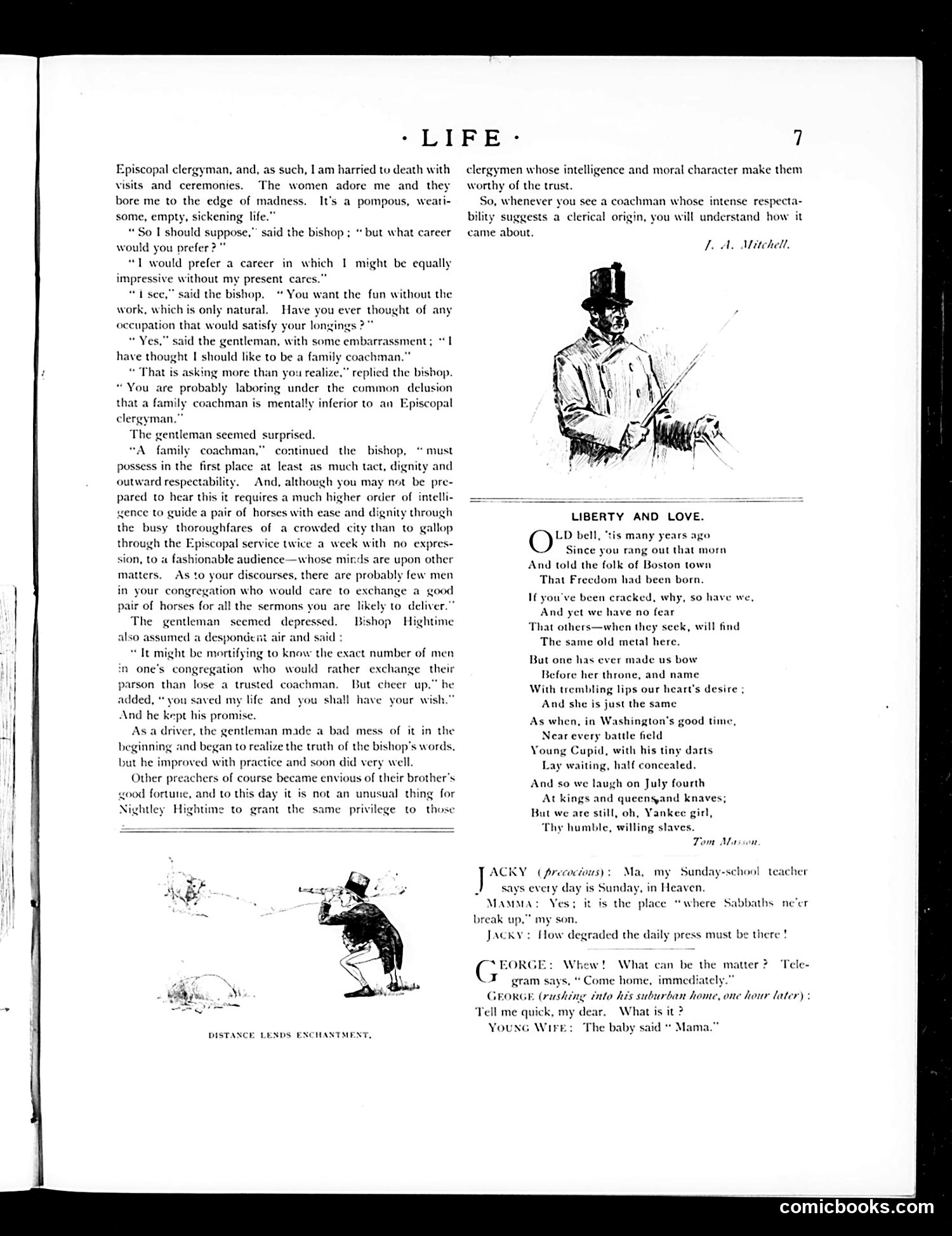
This page contains two distinct pieces: **Upper section:** A dialogue between a bishop and a gentleman about career choices. The bishop argues that a "family coachman" requires significant skill and dignity—managing horses through city traffic demands intelligence comparable to leading an Episcopal congregation. The satire mocks both the bishop's pomposity and social pretension, suggesting clergy inflate their importance while undervaluing working-class professions. **"Liberty and Love"** poem celebrates American freedom and independence, referencing Boston and the Revolutionary War ("Freedom had been born"). **Lower cartoons:** Simple illustrated vignettes labeled "Distance Lends Enchantment" showing figures at a distance—likely satirizing how perspective distorts perception or reality. The overall page satirizes class hierarchies and professional snobbery typical of Gilded Age American society.
📄 Transcribed text from this page (OCR, searchable)
Machine-transcribed from the original scan — historical spelling and the odd misread are preserved.
‘LIFE: 7 Episcopal clergyman, and, as such, | am harried to death with visits and ceremonies. The women adore me and they bore me to the edge of madness. It’s a pompous, weati- some, empty, sickening life.” “ So I should suppose,” said the bishop ; “ but what career would you prefer?” “1 would prefer a career in which I might be equally impressive without my present cares.” “see,” said the bishop.“ You want the fun without the work, which is only natural. Have you ever thought of any occupation that would satisfy your longings ?” “Yes,” said the gentleman, with some embarrassment; “1 have thought I should like to be a family coachman.” is asking more than you realize,” replied the bishop. “You are probably laboring under the common delusion that a family coachman is mentally inferior to an Episcopal clergyman.” The gentleman seemed surprised. “A family coachman,” continued the possess in the first place at least as much tact, dignity and outward respectability, And, although you may not be pre- pared to hear this it requires a much higher order of intelli- gence to guide a pair of horses with nd dignity through the busy thoroughfares of a crowded city than to gallop bishop, “must through the Episcopal service twice a week with no expre: sion, to a fashionable audience—whose mirds are upon other matters. As to your discourses, there are probably few men in your congregation who would care to exchange a good pair of horses for all the sermons you are likely to deliver. The gentleman scemed depressed. Hightime also assumed a desponde “Tt might be mortifying to know the exact number of men in one’s congregation who would rather exchange their parson than lose a trusted coachman. But cheer up,” be added, “ you saved my life and you shall have your wish.” And he kept his promise. As a driver, the gentleman made a bad mess of it in the beginning and began to realize the truth of the bishop's words, but he improved with practice and soon did very well. Bishop ir and said : Other preachers of course became envious of their brother's good fortune, and to this day it is not an unusual thing for Nightley Hightime to grant the same privilege to those DISTANCE LENDS ENCHANTMENT, clergymen whose ir worthy of the trust. So, whenever you see a coachman whose intense respecta- bility sugg in, you will understand how it came about. elligence and moral character make them sa clerical ori J. AL Mitchell. LIBERTY AND LOVE. LD bell, ‘tis many years a Since you rang out that morn And told the folk of Boston town That Freedom had been born. If you've been cracked, why, so have we, And yet we have no fear That others—when they seek, will find The same old metal here. But one has ever made us bow Before her throne, and name With trembling lips our heart's desire ; And she is just the same As when, in Washington's good time, Near every battle field Young Cupid, with his tiny darts Lay waiting, half concealed. And so we laugh on July fourth At kings and queenyand knaves; But we are still, oh, Yankee girl, Thy humble, willing slaves. Tom Mascon ACKY (precocious): Ma, my Sunday-scho says every day is Sunday, in Heaven. MaMMa: Yes; break up," my son, teacher it is the place “where Sabbaths ne'er Jacky: How degraded the daily press must be there ! *EORGE: Whew! What can be the matter? Tele J gram says, “ Come home, immediately. SEORGE (rushing into his suburban home, one hour later) : Tell me quick, my dear, What is it ? YounG Wire: The baby said * Mama.” comicbooks.com