
A complete issue · 14 pages · 1891
Life — November 26, 1891
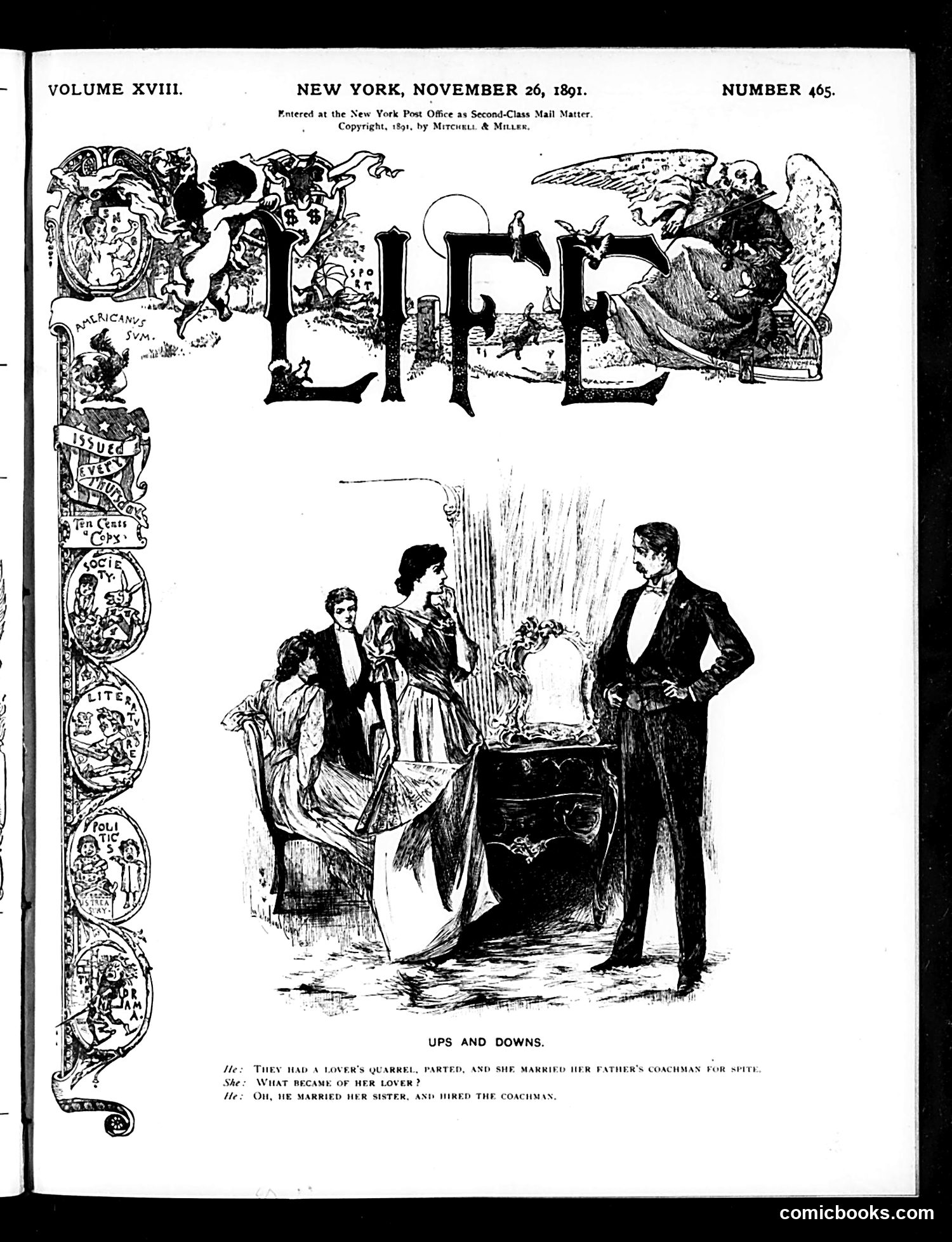
This page from *Life* magazine (November 26, 1891) presents a satirical domestic scene titled "Ups and Downs." The dialogue reveals a marital drama: a couple had a lover's quarrel, parted, and the husband married the woman's father's coachman out of spite. The punchline—that the woman then married the coachman's sister—suggests absurd escalation through revenge marriages crossing class boundaries. The cartoon satirizes Victorian romantic melodrama and social pretension, where spurned lovers engage in increasingly ridiculous acts of spite. The formal dress and interior setting emphasize how the characters' dramatic passions override social convention, with the coachman's family becoming unexpectedly central to the upper-class drama. The humor lies in the escalating absurdity of revenge through marriage.
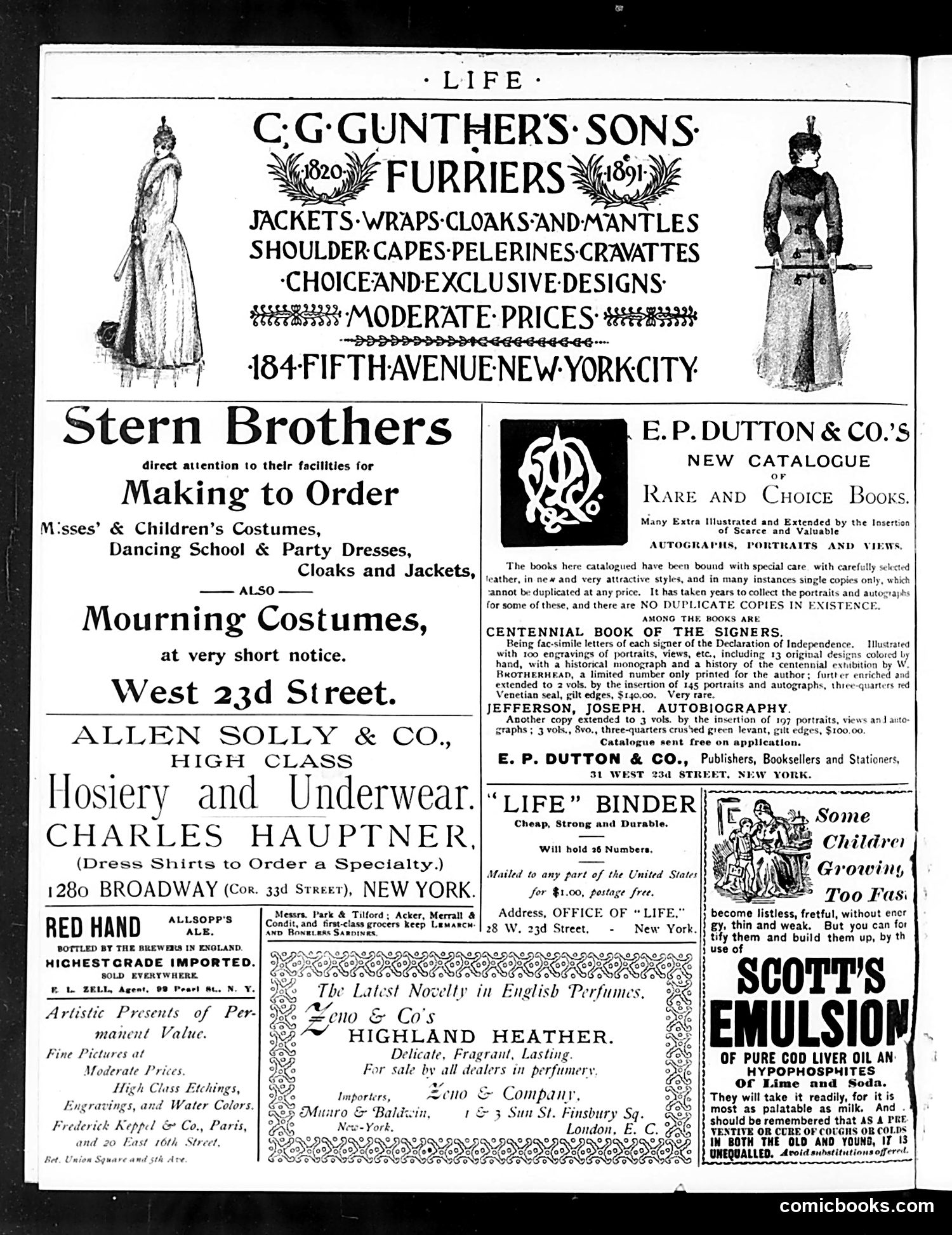
This page is **primarily advertising**, not satirical content. It contains multiple commercial advertisements from late 19th-century New York businesses, including: - C.G. Gunther's Sons (furriers) - Stern Brothers (costume makers) - E.P. Dutton & Co. (rare books) - Allen Solly & Co. (hosiery) - Charles Hauptner (dress shirts) - Red Hand Ale - Zeno & Co.'s Highland Heather perfume - Scott's Emulsion (cod liver oil tonic) The two fashion illustrations at the top show women in period dress typical of 1890s advertisements. There is **no political cartoon or satire visible**—this is a standard advertising page from *Life* magazine, reflecting how publications of this era monetized space through commercial endorsements.
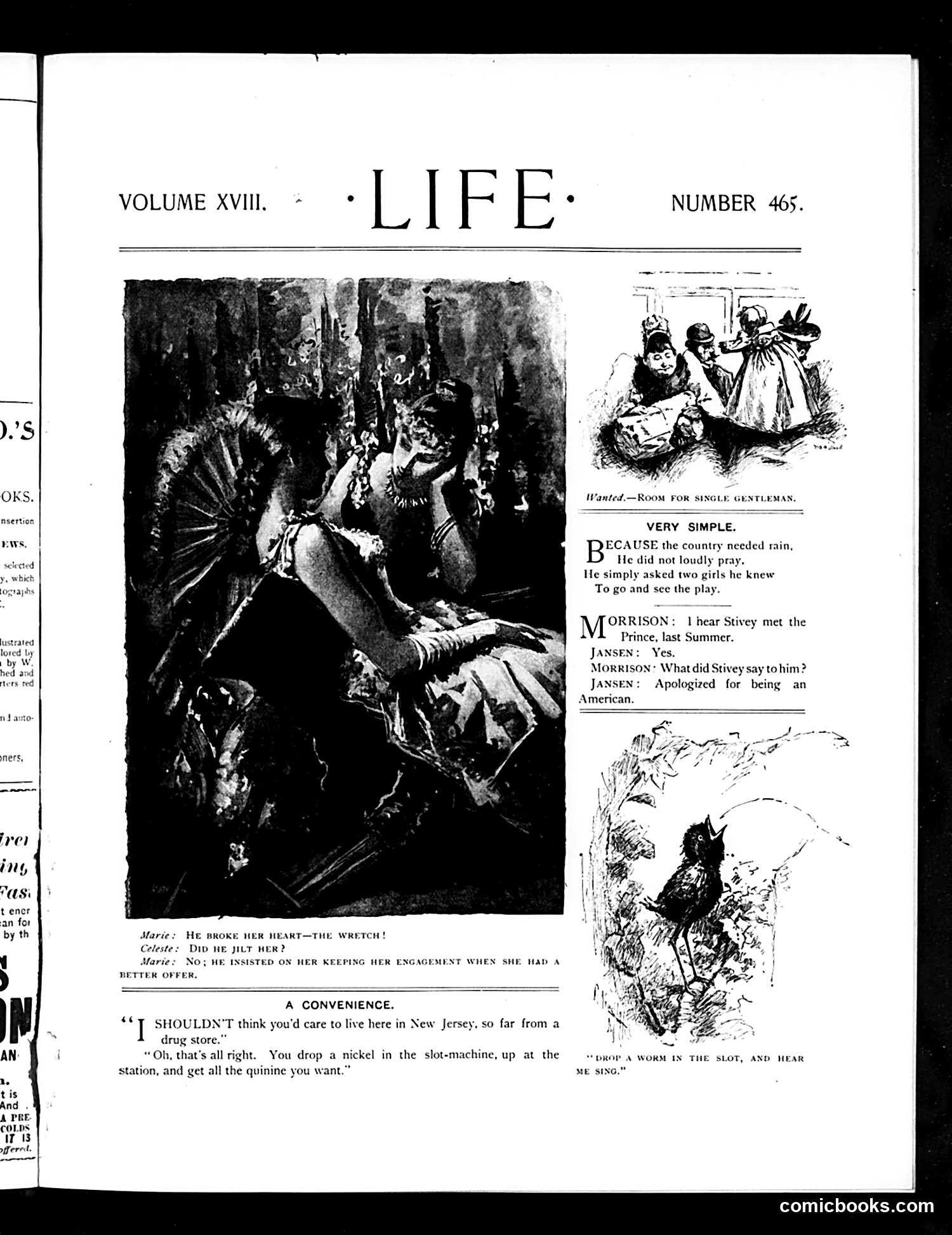
This page contains several brief satirical pieces typical of Life's humor format: **"Very Simple"** mocks religious hypocrisy—a man asks God for rain through a play rather than prayer, suggesting faith in entertainment over genuine devotion. **"A Convenience"** jokes about New Jersey's proximity to New York City, implying residents can easily access vice (drugs via slot machines at train stations) rather than settling in the suburbs for wholesome living. This reflects 1920s-30s anxieties about urban corruption spreading to residential areas. The dialogue snippets appear to reference social situations—one mentions meeting a Prince and apologizing for being American, suggesting contemporary class consciousness or international embarrassment about American behavior. The illustrations are decorative rather than specifically political cartoons, typical of Life's mixed-content format blending satire with visual humor.
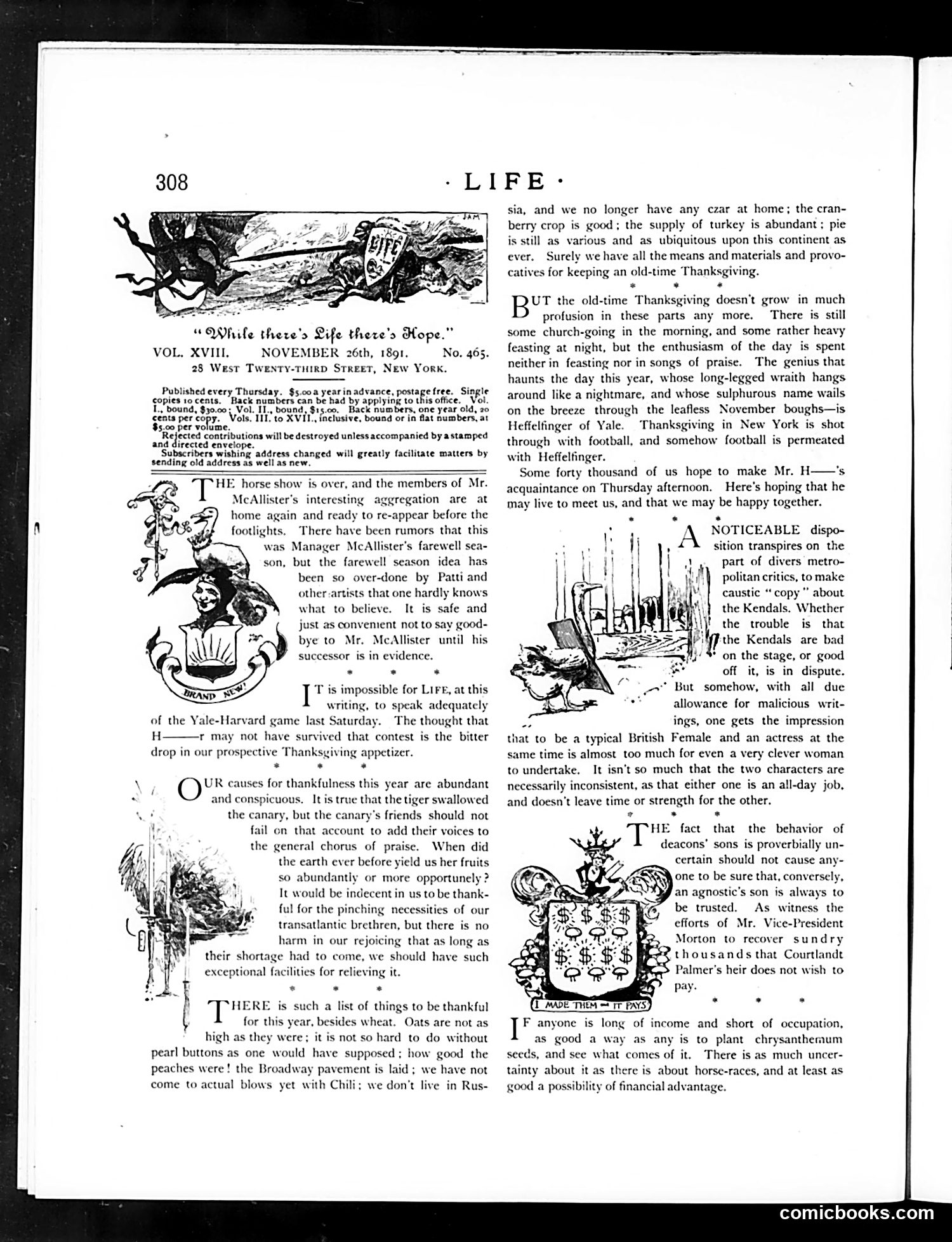
This page contains satirical commentary on Thanksgiving rather than explicit political cartoons. The text critiques the decline of old-fashioned Thanksgiving celebrations in New York, noting that the holiday now emphasizes football over traditional feasting and praise. The decorative illustrations (a horse, theatrical figures, and heraldic designs) appear to be ornamental rather than satirical. One section mocks the Kendal theatrical family's recent disputes, suggesting they're generating "copy" for critics. Another briefly discusses Vice-President Morton's efforts to recover unpaid court fees from the Palmer family. The final item humorously suggests that growing chrysanthemums might provide income for those facing financial hardship—practical satire about economic uncertainty rather than political commentary.
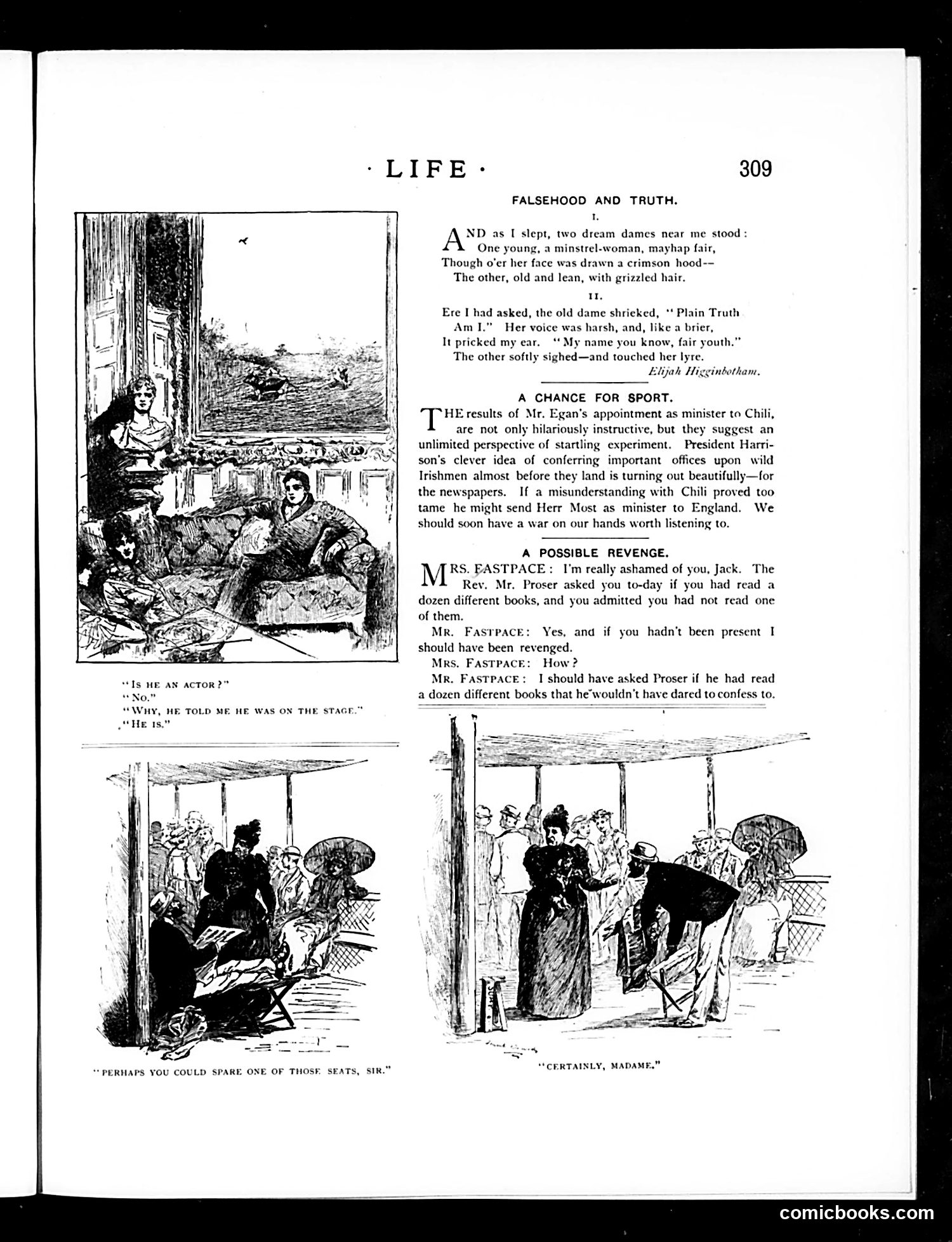
This page contains three distinct pieces of satirical humor: 1. **"Falsehood and Truth"** (top): A poem by Elijah Wiccinisthetane depicting two dream women—one young and beautiful, one old and lean—representing contrasting moral concepts. 2. **"A Chance for Sport"** (middle): Political satire about Mr. Egan's appointment as U.S. minister to Chile, joking that his diplomatic duties could provide amusing opportunities, possibly through misunderstandings with Chile. 3. **"A Possible Revenge"** (bottom): A dialogue between Mrs. Fastpace and Mr. Fastpace mocking intellectual pretension. She shames him for claiming to have read books he hasn't; he retorts he'd have asked the Reverend Proser about them to expose similar dishonesty. The accompanying illustrations show Victorian-era social scenes depicting this exchange.
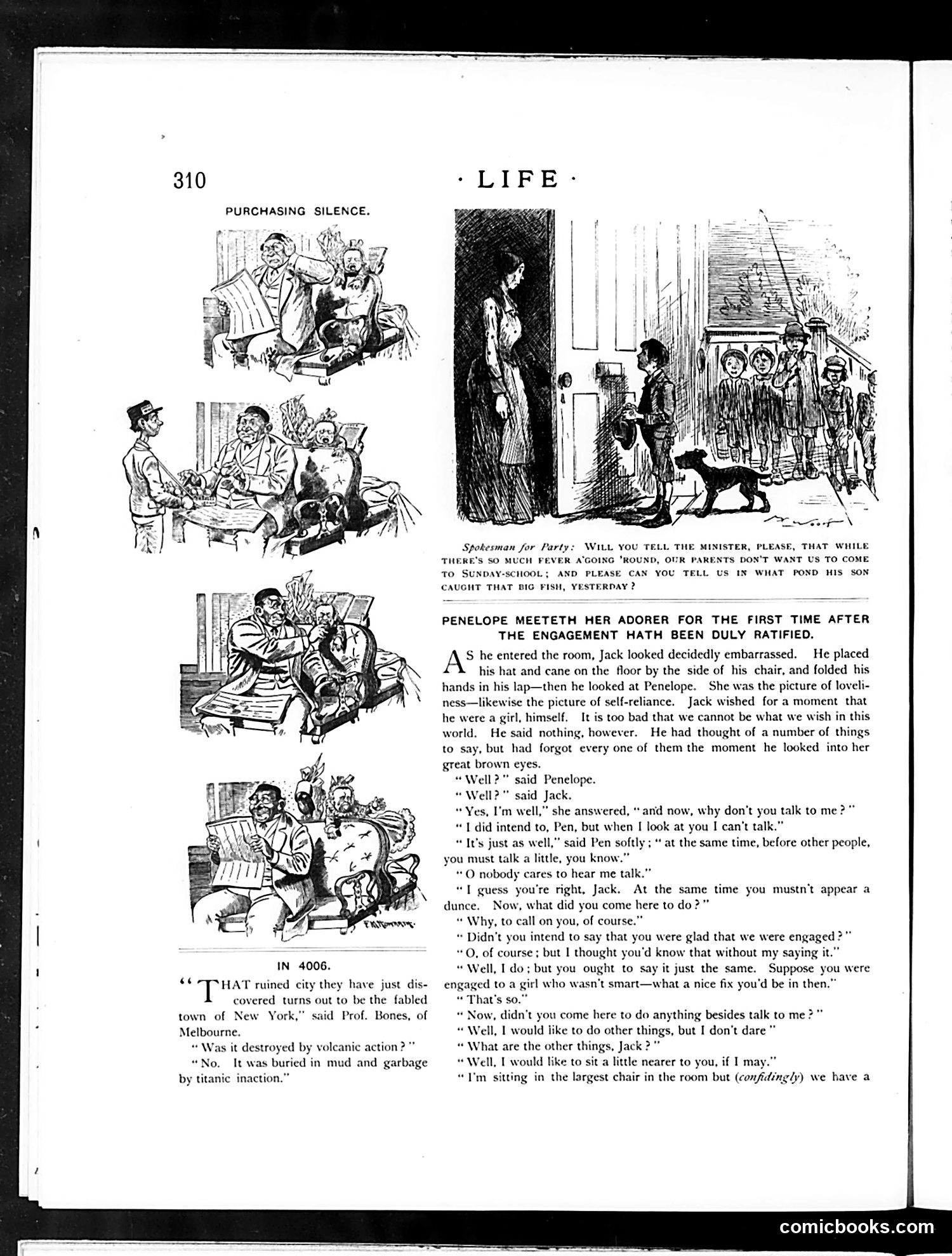
**"Purchasing Silence"** (left panels): This four-panel cartoon depicts a man repeatedly offering money to what appears to be a woman and child to keep quiet about something—likely an affair or scandal. The progression shows escalating payments as a form of hush money, satirizing how the wealthy use financial coercion to suppress damaging information. **"In 4006"** (bottom left): A brief comedic dialogue between characters discussing the fictional destruction of New York City, apparently by "titanic inaction"—likely satirizing contemporary political inaction or neglect. **Main story** (right): "Penelope Meeteth Her Adorer" depicts an awkward social encounter between an engaged couple, Jack and Penelope, exploring themes of social propriety, embarrassment, and the expectations placed on engaged individuals in early 20th-century society.
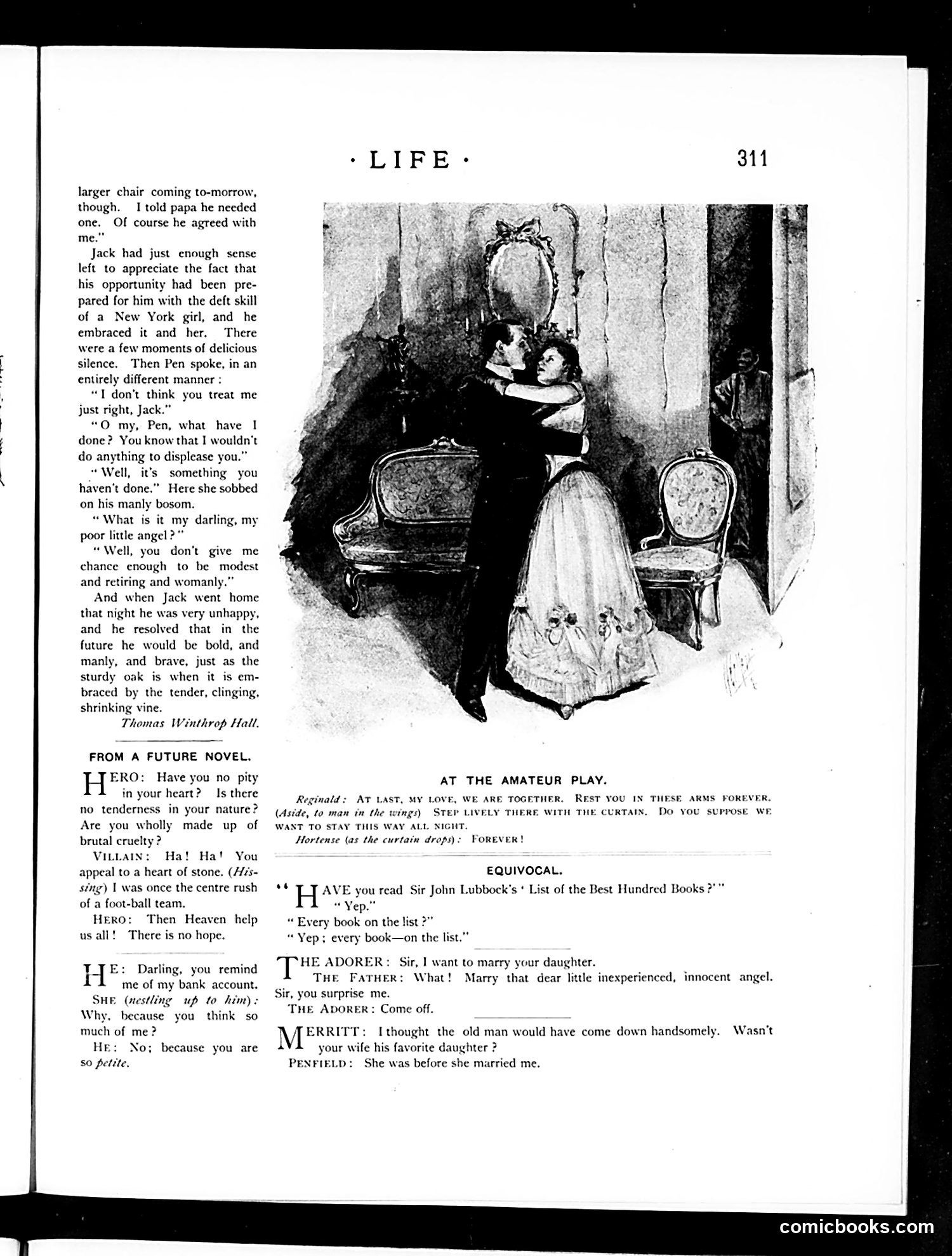
The page contains two distinct satirical pieces: **"At the Amateur Play"** (illustrated scene): A romantic theatrical moment where actors perform melodramatic dialogue about love and eternal devotion. The satire mocks the overwrought sentimentality of amateur theatrical productions—the earnest, exaggerated emotions typical of community theater performances of the era. **"From a Future Novel"** (text dialogues): Three brief comedic exchanges satirizing common character types and social pretensions. They mock theatrical villains ("heart of stone"), class consciousness (the "petite" insult), and the clichéd plotting of novels—poking fun at predictable literary tropes and social climbing. The overall theme targets the pretentiousness and melodrama of amateur and popular entertainment, along with society's obsession with romantic and class-based narratives.
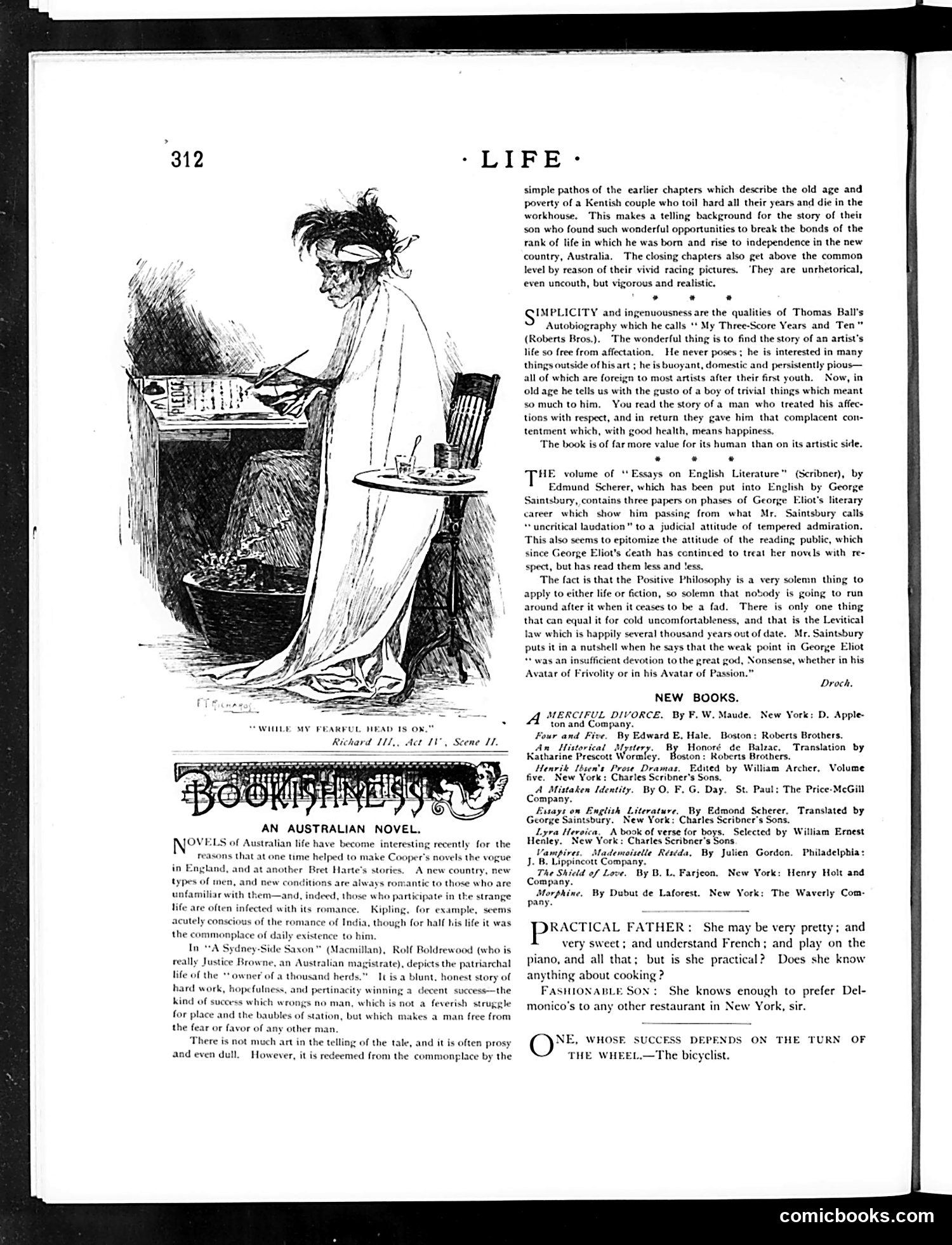
This page features a sketch titled "While My Fleshly Head Is On," credited to Richard Felton Outlaw II, Scene II. The illustration depicts a bearded man in classical or biblical-style robes, sitting and reading or writing, appearing contemplative or melancholic. The accompanying text discusses Australian novels and literary works, reviewing books about colonial life and social struggle. The satire appears gentle rather than pointed—critiquing the earnestness of Australian fiction writers and their treatment of hardship themes. Below the literary discussion, brief satirical exchanges mock social pretension (references to a "Fashionable Son" preferring restaurants) and contain a joke about bicycle success depending on "the turn of the wheel." The page blends book criticism with light social humor typical of Life magazine's literary section.
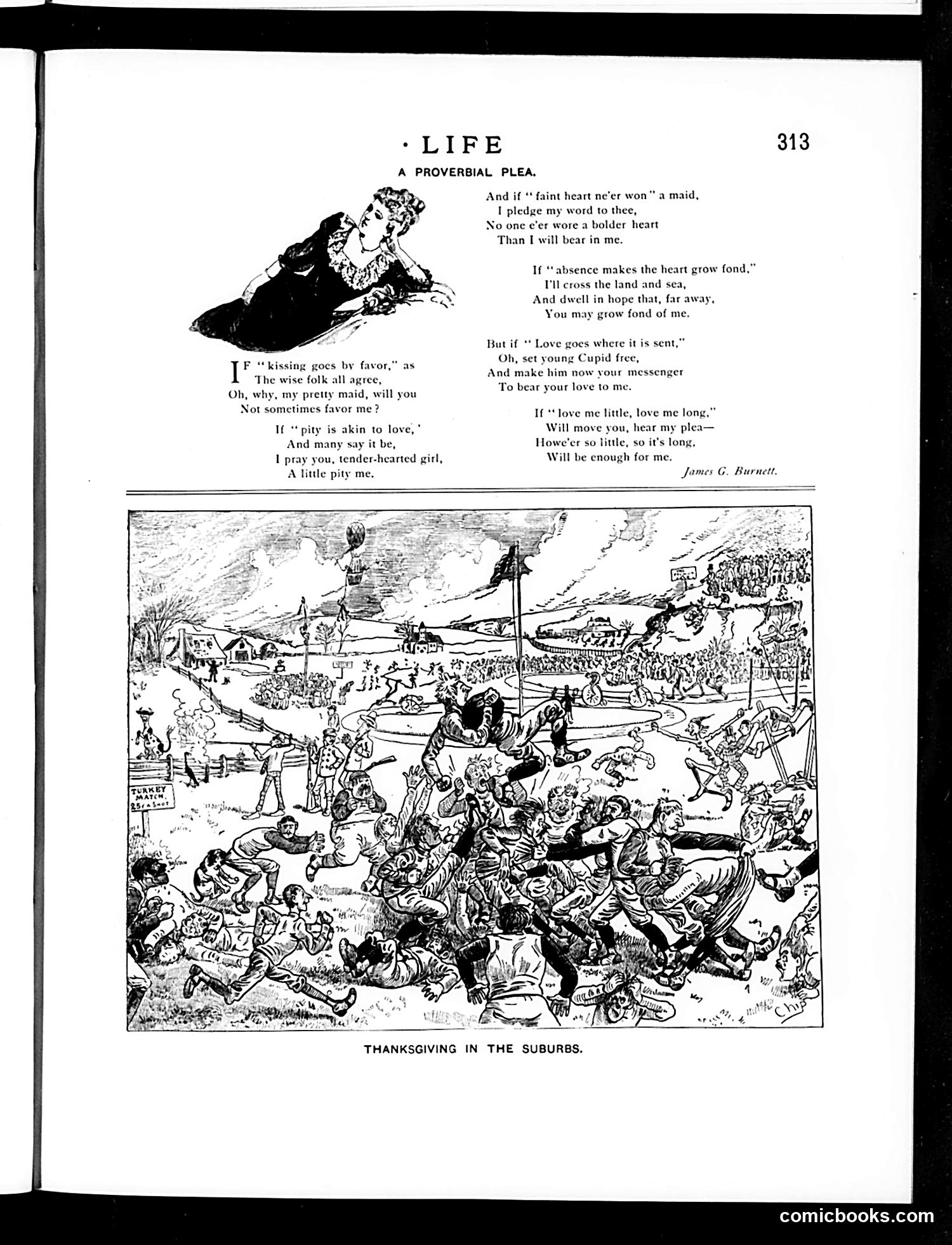
The page contains a romantic poem by James G. Burnett featuring an illustration of a reclining woman, followed by a chaotic cartoon depicting a suburban Thanksgiving celebration. The cartoon satirizes early 20th-century suburban leisure culture. It shows numerous people engaged in recreational activities—games, sports, socializing—in what appears to be a public park or common area. The "Thanksgiving in the Suburbs" caption suggests this depicts how modern suburban residents celebrate the holiday: through active entertainment and social gathering rather than traditional family-centered observance. The scene's crowded, anarchic energy mocks both the commercialization of the holiday and the suburban aspiration toward genteel, leisured living. The cartoon critiques how suburban culture transforms traditional occasions into organized public spectacles.
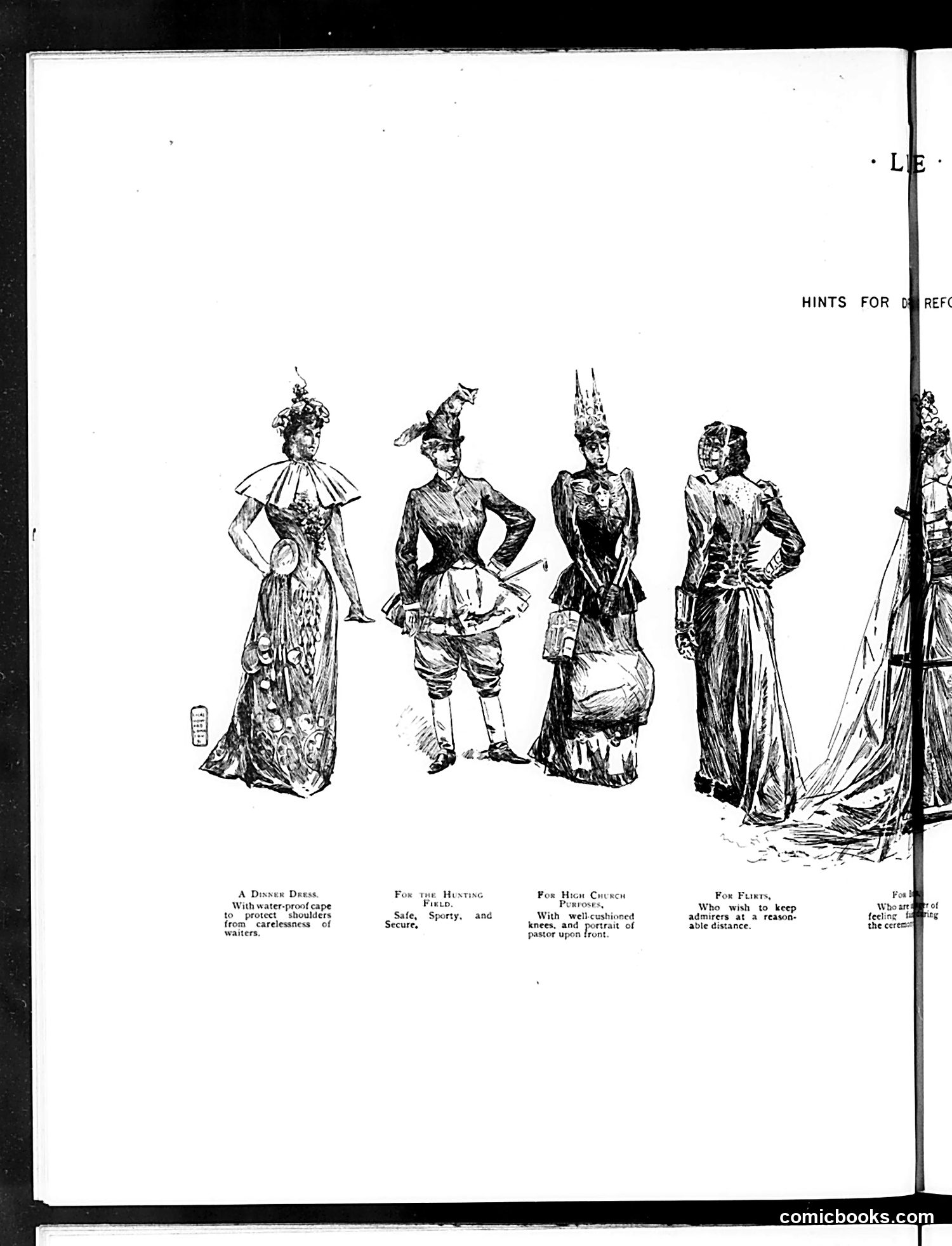
This page shows five female fashion illustrations with accompanying dress advice for different occasions. From left to right, the captions describe outfits for: 1. **A Dress Drive** - with water-proof cape for shoulder protection from carriages 2. **Fox Hunting** - practical sporting attire with safe, secure elements 3. **Formal Church Purposes** - featuring well-cushioned knees and proper front-facing posture 4. **Women Wishing to Keep Admirers at a Reasonable Distance** - a formal gown designed to discourage suitors 5. Partially visible figure on right edge (text cut off) The satire humorously presents women's fashion as functional tools for specific social situations, treating dress choice as strategic rather than merely decorative. This reflects turn-of-the-century concerns about women's propriety and social positioning.
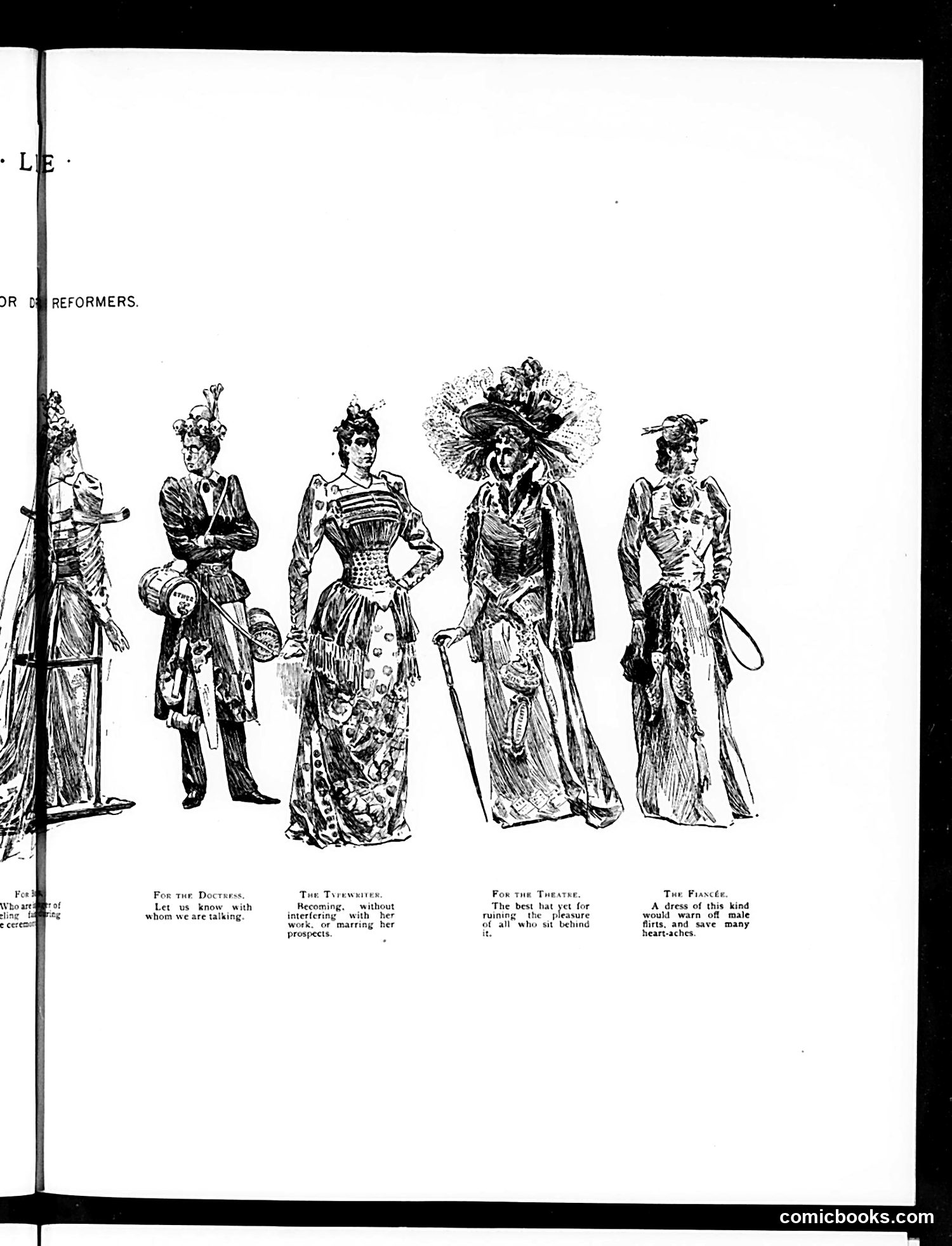
This page shows five illustrated female figures in elaborate Edwardian-era clothing, labeled as "DRESS FOR REFORMERS." Each figure is captioned with satirical commentary about women reformers and their fashion choices. The satire targets women's reform movements—likely suffrage, temperance, or other progressive causes—by mocking their appearance rather than their arguments. The captions suggest that reformers are hypocritical: they advocate for social change while wearing expensive, decorative dresses that contradict their reform messages about practicality or women's equality. The central figure, with her prominent corseted silhouette and ornate hat, appears to be the primary target. This reflects common anti-reform rhetoric of the era that dismissed female activists as vain or ridiculous, using ridicule of their appearance to undermine their credibility.
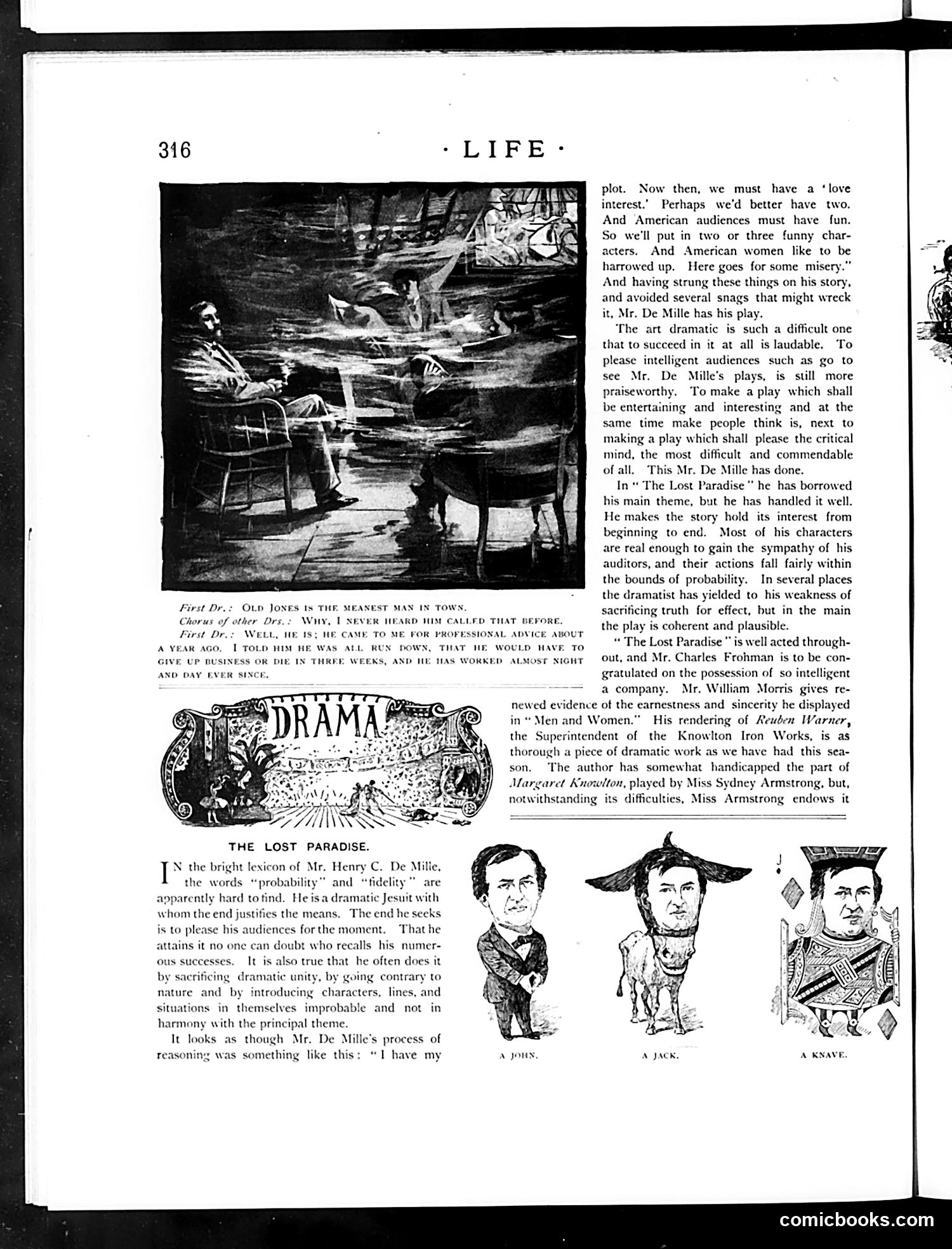
This page reviews Henry C. De Mille's play "The Lost Paradise," critiquing his dramatic methods. The text accuses De Mille of being a "dramatic Jesuit" who sacrifices artistic integrity to please audiences momentarily—adding love interests, comic relief characters, and melodrama regardless of whether they serve the plot. The three small caricatures at bottom (labeled "A John," "A Jack," "A Knave") appear to represent stock character types De Mille allegedly relied upon. The dialogue snippet above shows doctors gossiping about "Old Jones," illustrating the kind of trivial comedic banter typical of popular theater. The larger photograph shows a scene from the play itself. The review concludes that despite these flaws, De Mille succeeds here: the play is coherent, the acting solid (praising William Morris), and emotionally effective—though achieved through formula rather than genuine dramatic artistry.
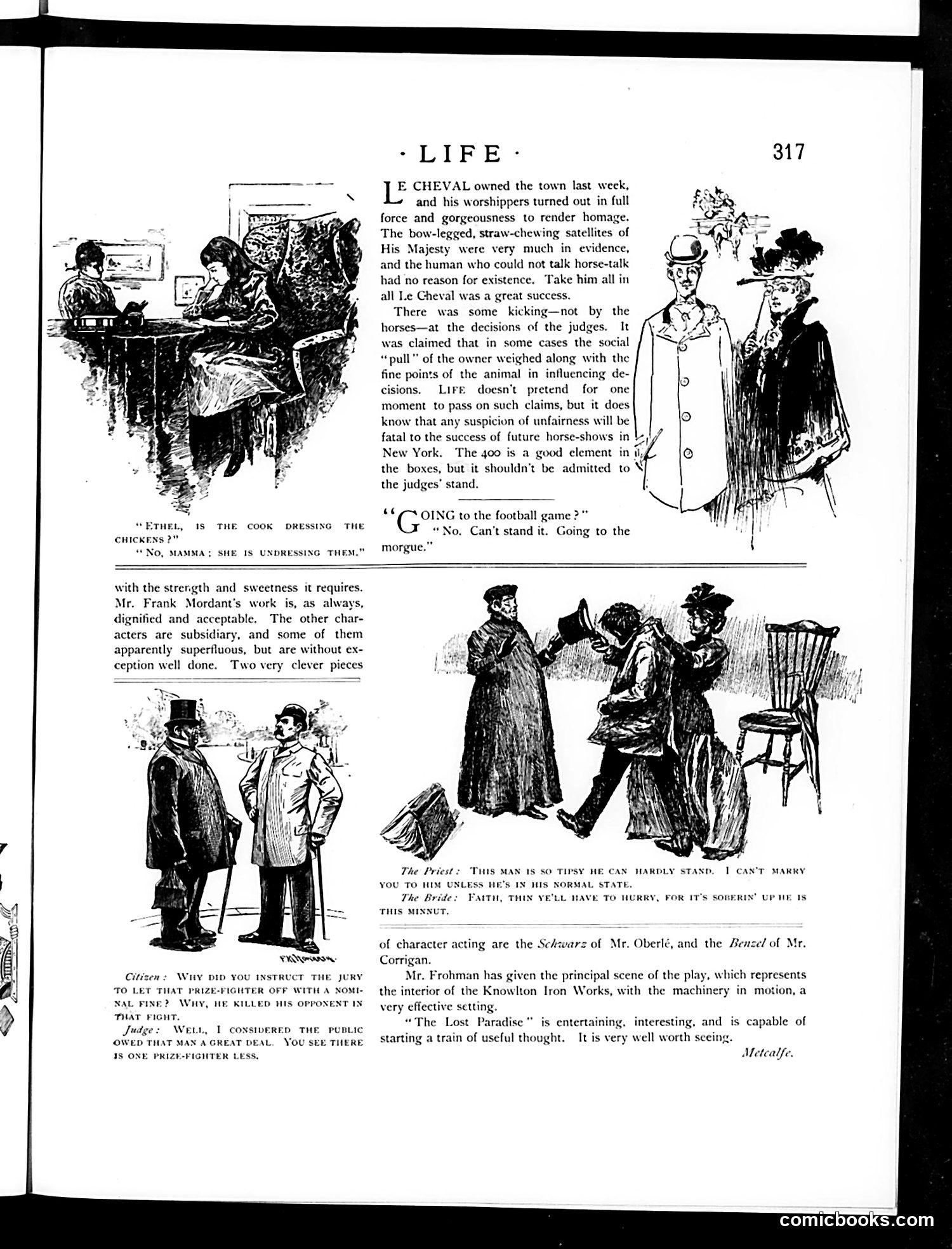
This page contains several social satires typical of Life magazine's humor: **Top cartoon**: A domestic joke about a cook undressing chickens for dinner—the child's innocent misunderstanding of "dressing" (preparing) poultry. **Le Cheval section**: Satirizes New York's wealthy elite ("the 400") and their obsession with horse shows. The piece mocks how social status and owner connections influence judges' decisions rather than merit alone, warning that such favoritism threatens the credibility of future shows. **Lower cartoons**: Social commentary on justice and propriety—a judge excusing a prize-fighter's homicide as beneficial population control; a drunken groom barely capable of marrying; and a citizen questioning jury instruction. **Theater review**: Discusses "The Lost Paradise" play, praising its acting and industrial-era setting. The overall tone critiques wealthy society's hypocrisy, judicial corruption, and moral inconsistencies—classic Life magazine satire targeting Gilded Age American institutions.
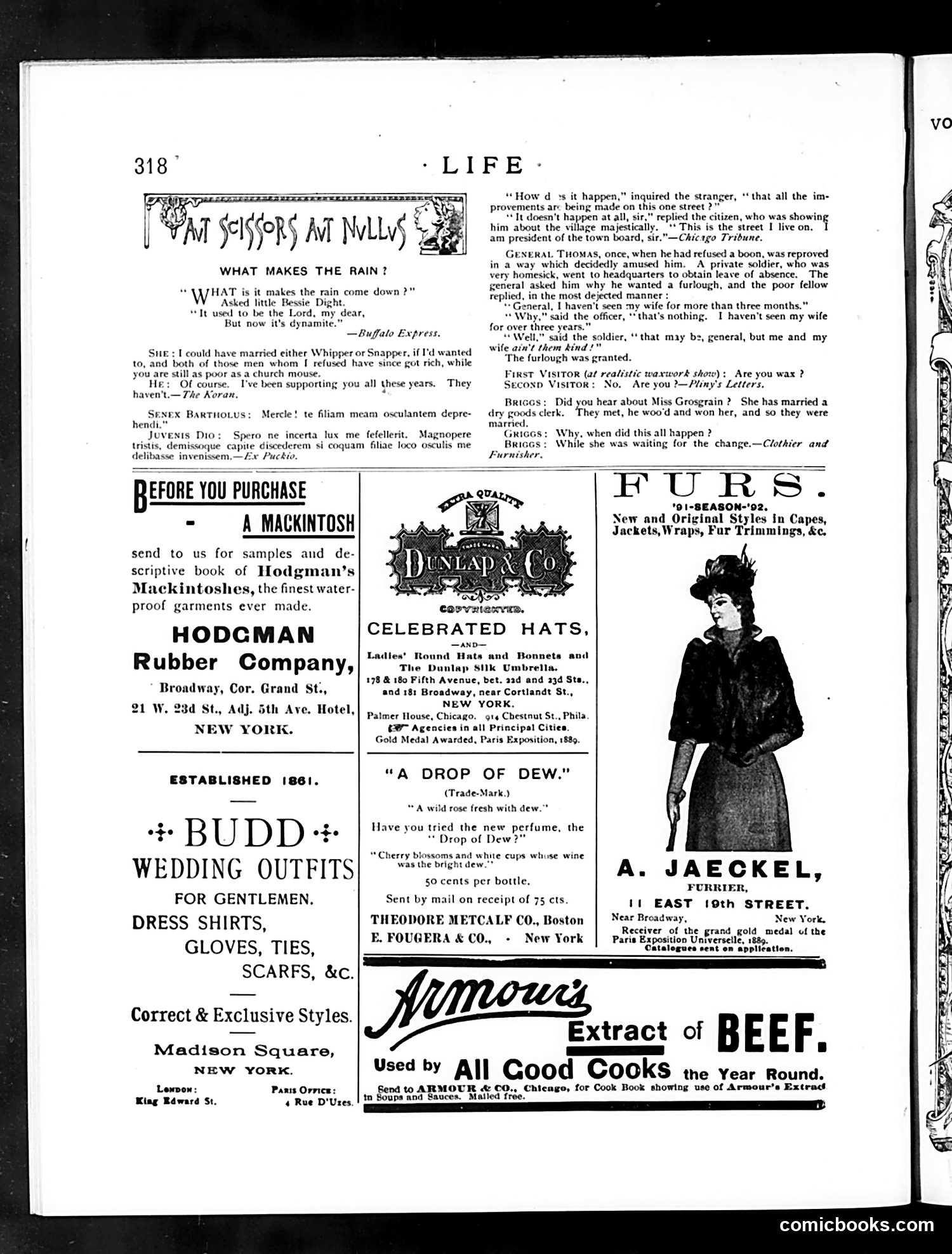
This page consists primarily of **brief humorous anecdotes and advertisements**, rather than political cartoons requiring historical context. The jokes exploit late-19th-century anxieties and social attitudes: 1. **"What Makes the Rain?"** satirizes anxiety about industrial progress—dynamite (explosives used in construction/mining) is now blamed instead of divine providence. 2. **The marriage anecdote** jokes about gender economics: a woman regrets rejecting wealthy suitors for a poor husband she's supported for years. 3. **The General Thomas story** uses military hierarchy for humor about marital dynamics and working-class authenticity. 4. **The wax museum and dry goods jokes** are simple wordplay with no deeper political meaning. The page is **primarily a vehicle for period advertisements** (Mackintoshes, hats, perfume, beef extract) aimed at urban, middle-class readers. The content reflects turn-of-the-century consumer culture and conventional social values rather than political satire requiring external historical knowledge.