
Life, 1891-11-26 · page 12 of 14
Life — November 26, 1891 — page 12: what you’re looking at
What you’re looking at
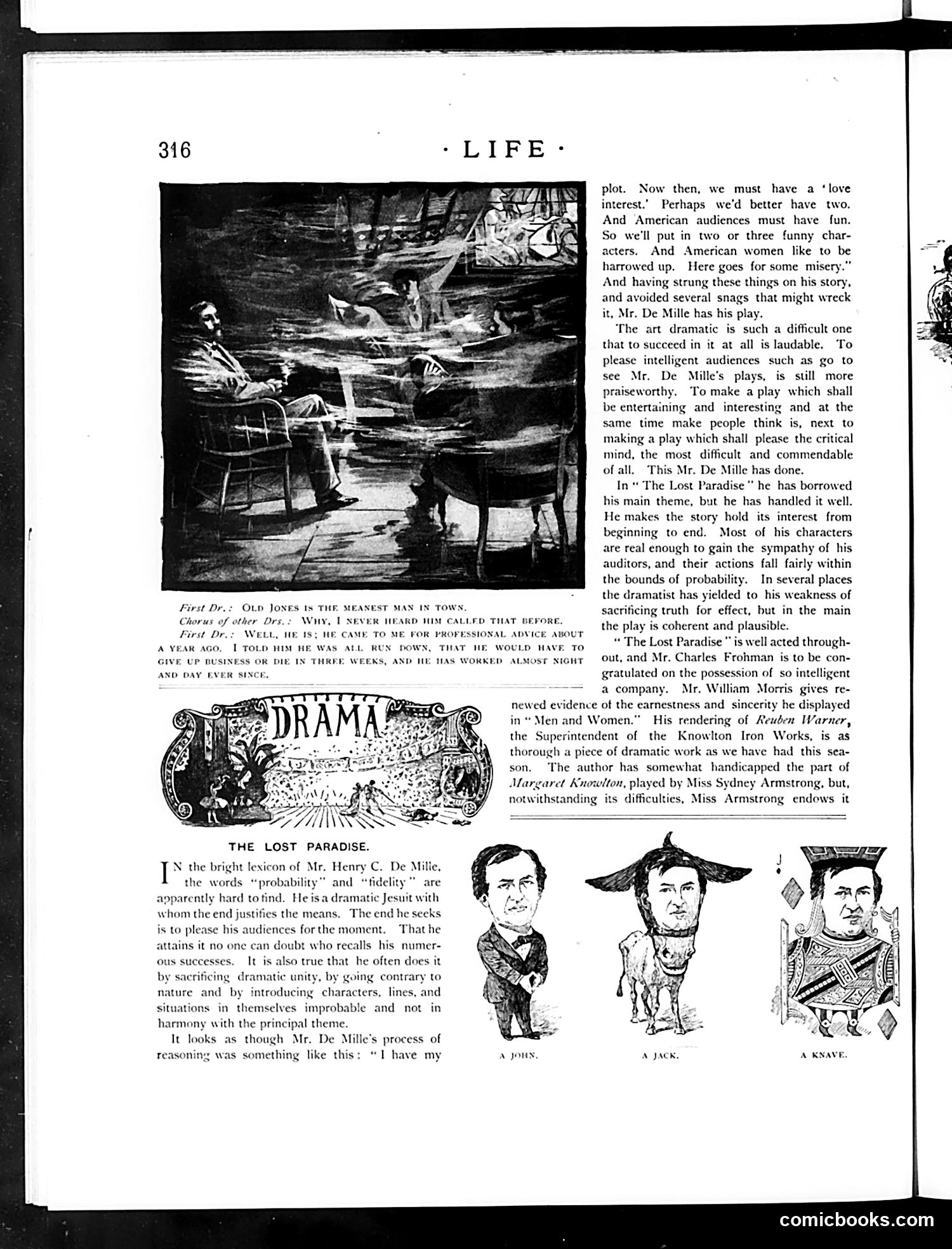
This page reviews Henry C. De Mille's play "The Lost Paradise," critiquing his dramatic methods. The text accuses De Mille of being a "dramatic Jesuit" who sacrifices artistic integrity to please audiences momentarily—adding love interests, comic relief characters, and melodrama regardless of whether they serve the plot. The three small caricatures at bottom (labeled "A John," "A Jack," "A Knave") appear to represent stock character types De Mille allegedly relied upon. The dialogue snippet above shows doctors gossiping about "Old Jones," illustrating the kind of trivial comedic banter typical of popular theater. The larger photograph shows a scene from the play itself. The review concludes that despite these flaws, De Mille succeeds here: the play is coherent, the acting solid (praising William Morris), and emotionally effective—though achieved through formula rather than genuine dramatic artistry.
📄 Transcribed text from this page (OCR, searchable)
Machine-transcribed from the original scan — historical spelling and the odd misread are preserved.
Now then, we must have a ‘love Perhaps we'd better have two. And American audiences must have fun. So we'll put in two or three funny char- acters. And American women like to be harrowed up. Here goes for some misery.” And having strung these things on his story, and avoided several snags that might wreck it, Mr. De Mille has his play. The art dramatic is such a difficult one that to succeed in it at all is laudable. To please intelligent audiences such as go to see Mr. De Mille’s plays, sull more praiseworthy. To make a play which shall be entertaining and interesting and at the same time make people think is, next to making a play which shall please the critical mind, the most difficult and commendable of all. This Mr. De Mille has done. In“ The Lost Paradise” he has borrowed his main theme, but he has handled it well. He makes the story hold its interest from beginning to end. Most of his characters are real enough to gain the sympathy of his auditors, and their actions fall fairly within the bounds of probability. In several places the dramatist has yielded to his weakness of First Dr.: Otb JONES 1s THE MEANEST MAN IN TOWN, sacrificing truth for effect, but in the main Chorus of other Ors. WAY, 1 NEVER HEARD IM CALLFD THAT BEFORE. the play is coherent and plausible. First Dr: WELL, WE 1S; HE CAME TO ME FOR PROFESSIONAL ADVICE ABOUT penis A YEAR AGO, [TOLD HIM HE WAS ALL RUN DOWN, THAT HE WOULD HAVE TO “ The Lost Paradise "is well acted through- GIVE UP BUSINESS OR DIE IN THREE WEEKS, AND HE TAS WORKED atatosr xicut — OUt, and Mr. Charles Frohman is to be con- AND DAY EVER SINCE. grtatulated on the possession of so intelligent a company. Mr. William Morris gives re- newed evidence of the earnestness and sincerity he displayed in “ Men and Women.” His rendering of Reuben Warner, the Superintendent of the Knowlton Iron Works, is as thorough a piece of dramatic work as we have had this sea- son. ‘The author has somewhat handicapped the part of Margaret Knowlton, played by Miss Sydney Armstrong, but, notwithstanding its difficulties, Miss Armstrong endows it THE LOST PARADISE. N the bright lexicon of Mr. Henry C. De Mille, the words “probability” and y" are arently hard to tind. He isa dramatic Jesuit with whom the end justifies the means. The end he seeks is to please his audiences forthe moment. That he attains it no one can doubt who recalls his numer- ous successes. It is also true that he often does it by sacrificing dramatic unity, by y nature and by introducing characters, lines, and situations in themselves improbable and not in harmony with the principal theme. It looks as though Mr. De Mille’s process of reasoning was something like this: “1 have my youn. A KNAVE comicbooks.com