
Life, 1891-11-26 · page 8 of 14
Life — November 26, 1891 — page 8: what you’re looking at
What you’re looking at
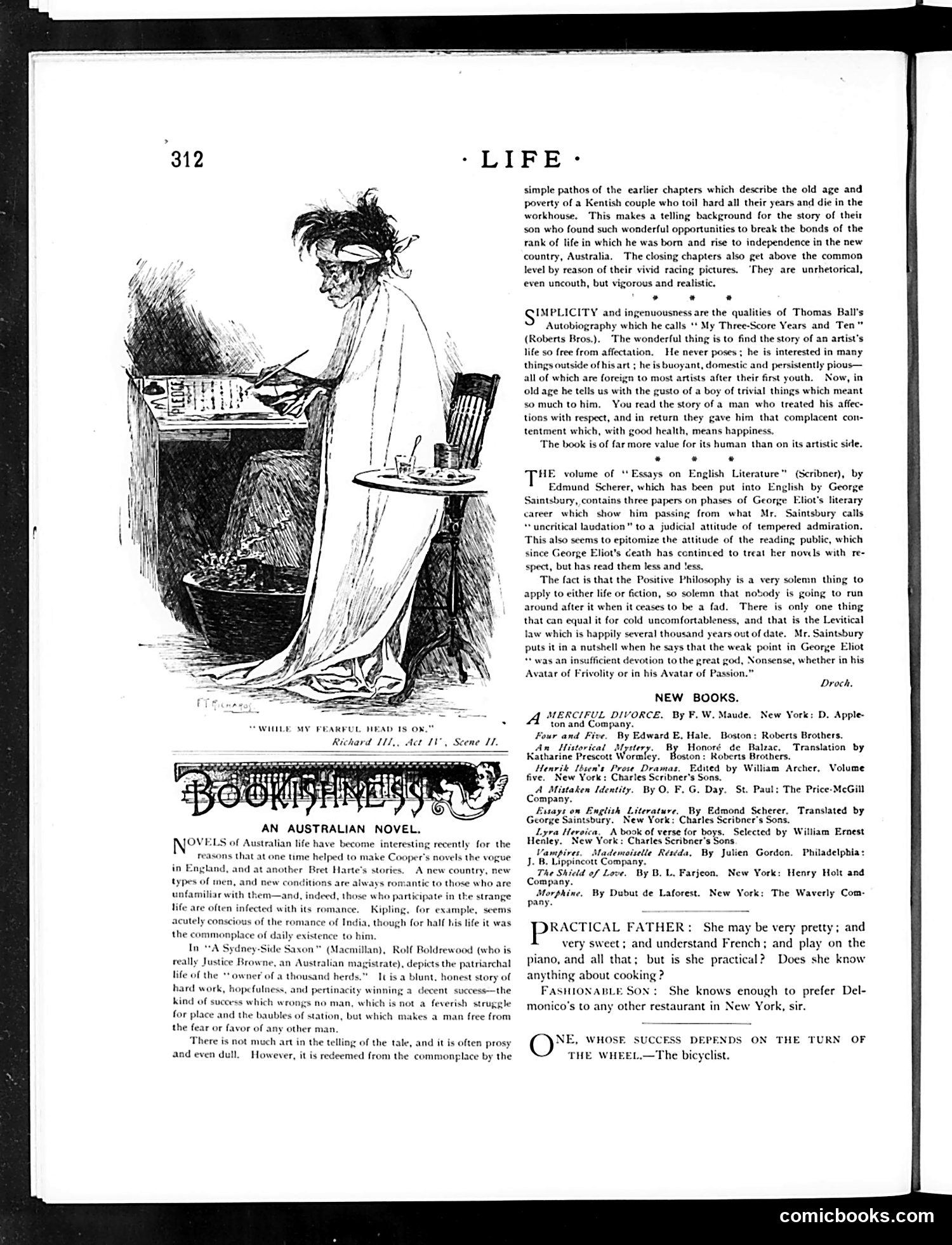
This page features a sketch titled "While My Fleshly Head Is On," credited to Richard Felton Outlaw II, Scene II. The illustration depicts a bearded man in classical or biblical-style robes, sitting and reading or writing, appearing contemplative or melancholic. The accompanying text discusses Australian novels and literary works, reviewing books about colonial life and social struggle. The satire appears gentle rather than pointed—critiquing the earnestness of Australian fiction writers and their treatment of hardship themes. Below the literary discussion, brief satirical exchanges mock social pretension (references to a "Fashionable Son" preferring restaurants) and contain a joke about bicycle success depending on "the turn of the wheel." The page blends book criticism with light social humor typical of Life magazine's literary section.
📄 Transcribed text from this page (OCR, searchable)
Machine-transcribed from the original scan — historical spelling and the odd misread are preserved.
- LIFE: “WLILE MY PEARFUL MEAD IS On, AN AUSTRALIAN NOVEL, NOVELS of Australian life have become interesting recently for the reasons that at one time helped to make Cooper's no gland, and at another Bret Harte’s stories. A new country, new types of men, and new conditions are always romantic to those who are els the vogue unfamiliar with them—and, indeed, those who participate in the strange life are often infected with its romance. acute Kipling, for example, seems of India, though for half his life it was daily existence to him, axon” (Macmillan), Rolf Boldrewood (who is really Justice Browne, an Australian magistrate), depicts the patriarchal life of the * owner of a thousand herds.” It is a blunt, honest story of hard work, hopefulness, and pertinacity winning a decent success—the kind of success which wre for place the f conscious of the romance mmonplac In va thec ydney-Side $ KS no man, which is not a feverish struggle ind the baubles of station, but which makes a man free from or favor of any other man, There is not much art in the telling of the tale, and it is often prosy and even dull. However, it is redeemed from the commonglace by the simple pathos of the earlier chapters which describe the old age and poverty of a Kentish couple who toil hard all their years and die in the workhouse. ‘This makes a telling background for the story of their son who found such wonderful opportunities to break the bonds of the rank of life in which he was born and rise to independence in the new country, Australia, The closing chapters also get above the common level by reason of their vivid racing pictures. ‘They are unrhetorical, even uncouth, but vigorous and realistic. > * * IMPLICITY and ingenuousness are the qualities of Thomas Ball's Autobiography which he calls ** My Three-Score Years and Ten” (Roberts Bros.). ‘The wonderful thing is to find the story of an artist's life so free from affectation. He never poses ; he is interested in many things outside of his art ; he is buoyant, domestic and persistently pious— all of which are foreign to most artists after their first youth. Now, in old age he tells us with the gusto of a boy of trivial things which meant so much to him, You read the story of a man who treated his affec- tions with respect, and in return they gave him that complacent con- tentment which, with good health, means happiness. ‘The book is of far more value for its human than on its artistic side. . . . HE volume of “Essays on English Literature” (Scribner), by Edmund Scherer, which has been put into English by George Saintsbury, contains three papers on phases of George Eliot's literary him passing from what Mr. Saintsbury calls “uncritical laudation” to a judicial attitude of tempered admiration, This also seems to epitomize the attitude of the reading public, which since George Eliot's ceath has continved to treat her novels with re- spect, but has read them less and !ess. The fact is that the Positive Philosophy is a very solemn thing to apply to either life or fiction, so solemn that nobody is going to run around after it when it ceases to be a fad. There is only one thing that can equal it for cold uncomfortableness, and that is the Levitical law which is happily several thousand years out of date. Mr. Saintsbury puts it ina nutshell when he says that the weak point in George Eliot ++ was an insufficient devotion to the great god, Nonsense, whether in his Avatar of Frivolity or in his Avatar of Passion.” career which show Droch, NEW BOOKS. A MERCIFUL DIVORCE. By F.W. Maude. ton and Company. Four and By Edward E, Hale, Boston: Roberts Brothers. An Historical Mystery. By Honoré de Balzac. Translation by Katharine Prescott Wormley. Boston: Roberts Brothers, Henrik Ibsen's Prose Dramas. Edited by William Archer, Volume five. New York: Charles Scribner's Sons. A Mistaken Identity. By O. F, G. Day. St. Paul: The Price-McGill Company. Essays on English Literature, By Edmond Scherer. George Saintsbury. New York: Charles Scribner's Sons, Lyra Hersica. A book of verse for boys. Selected by William Ernest Henley. New York: Charles Scribner's Sons Vampires. Mademoiselle Résdda, By Julien Gordon. J. B. Lippincott Company, The Shield of Love. By B, L, Farjeon, Company. Morphine. pany. New York: D. Apple- Translated by Philadelphia : New York: Henry Holt and By Dubut de Laforest. New York: The Waverly Com- PRACTICAL FATHER: She may be very pretty; and very sweet; and understand French; and play on the piano, and all that; but is she practical? Does she know anything about cooking ? FASHIONABLE S' She knows enough to prefer Del- monico’s to any other restaurant in New York, sir. NE, WHOSE SUCCESS DEPENDS ON THE TURN OF THE WHE! ‘| comicbooks.com