
A complete issue · 18 pages · 1891
Life — November 5, 1891
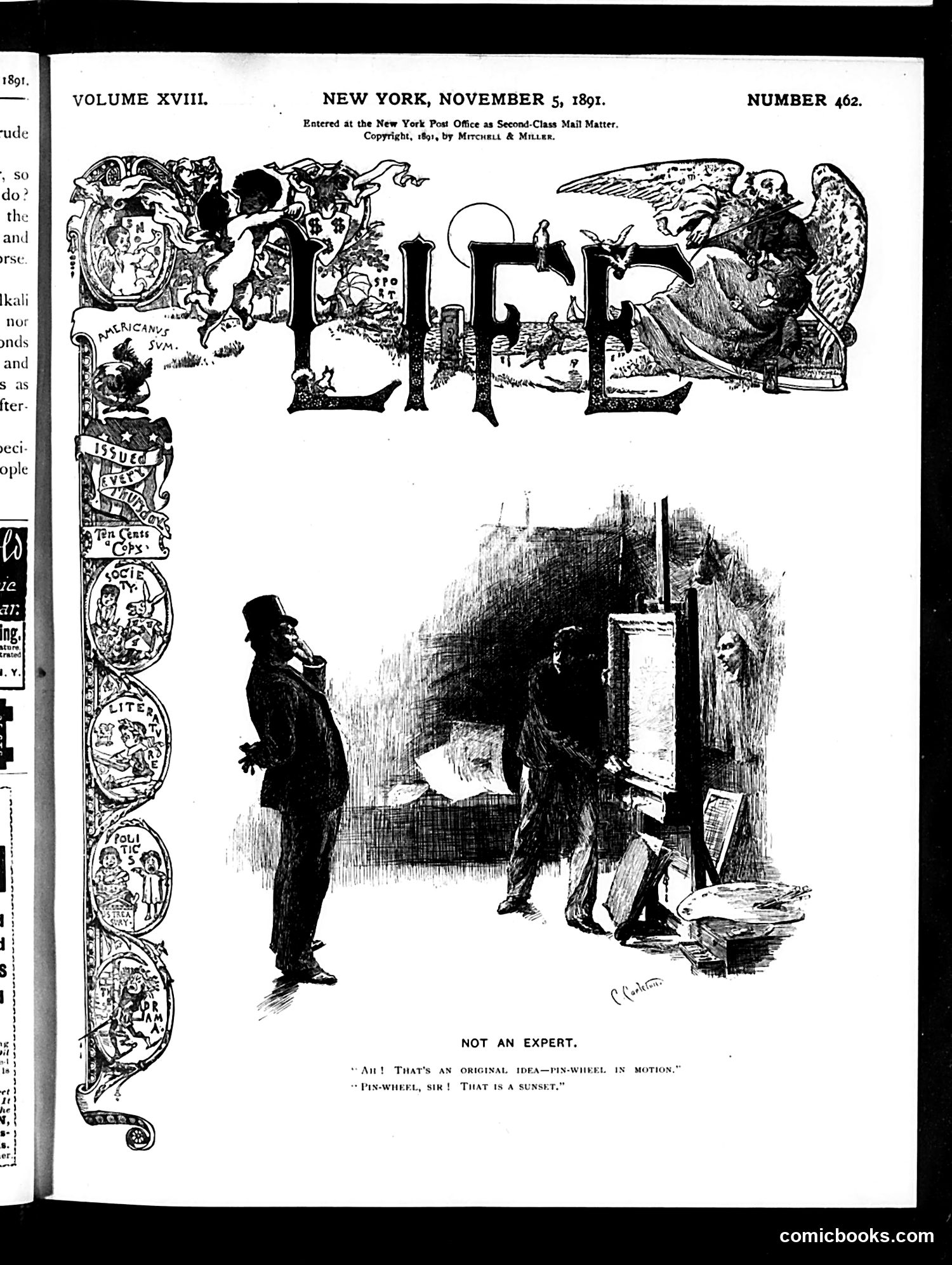
This cartoon satirizes someone's misunderstanding of a mechanical invention. The caption dialogue reads: "Ah! That's an original idea—pin-wheel in motion" and "Pin-wheel, sir! That is a sunset." The humor hinges on a visual confusion: what the well-dressed gentleman on the left mistakes for an innovative "pin-wheel" mechanism is actually just a sunset painting or view. The cartoon mocks his lack of expertise—he confidently misidentifies something commonplace as novel technology. The title "Not an Expert" reinforces this theme of someone speaking authoritatively about something they don't actually understand. This reflects turn-of-the-century satirical humor about class pretension and pseudo-intellectual posturing among the wealthy or aspirational classes.
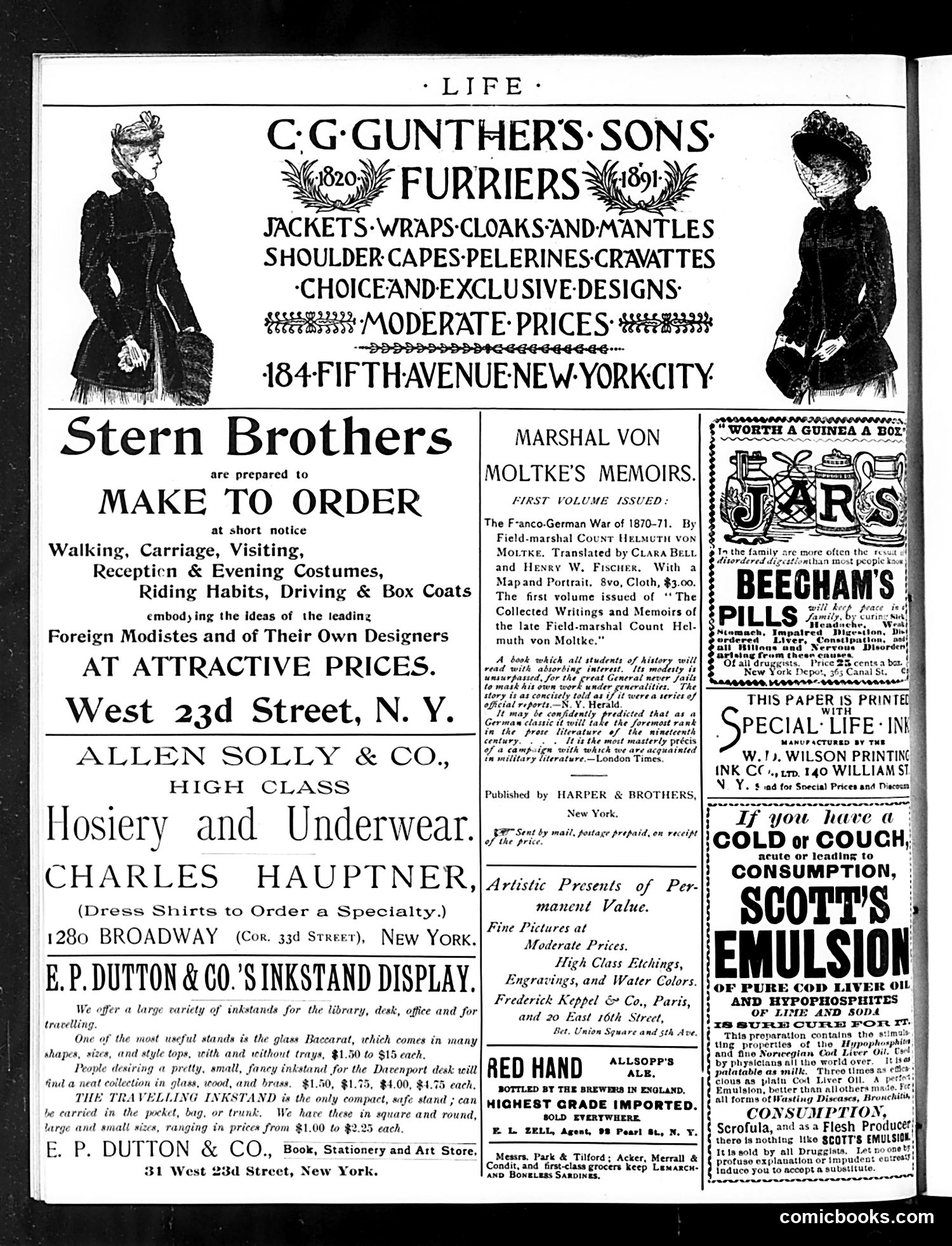
This page is primarily **advertising**, not political satire or editorial content. It features multiple commercial advertisements from the 1890s era, including: - **C.G. Gunther's Sons**: A furrier advertising jackets, wraps, cloaks, and mantles at "moderate prices" (184 Fifth Avenue) - **Stern Brothers**: Custom tailoring for walking, carriage, and evening costumes - **Allen Solly & Co.**: High-class hosiery and underwear - **Charles Hauptner**: Dress shirts to order - **E.P. Dutton & Co.**: Inkstand displays and books - **Scott's Emulsion**: Patent medicine for colds and consumption The illustrated figures are fashion models showcasing women's Victorian-era clothing. There is no political cartoon or satire present—this is a standard advertising page typical of Life magazine's revenue model during this period.
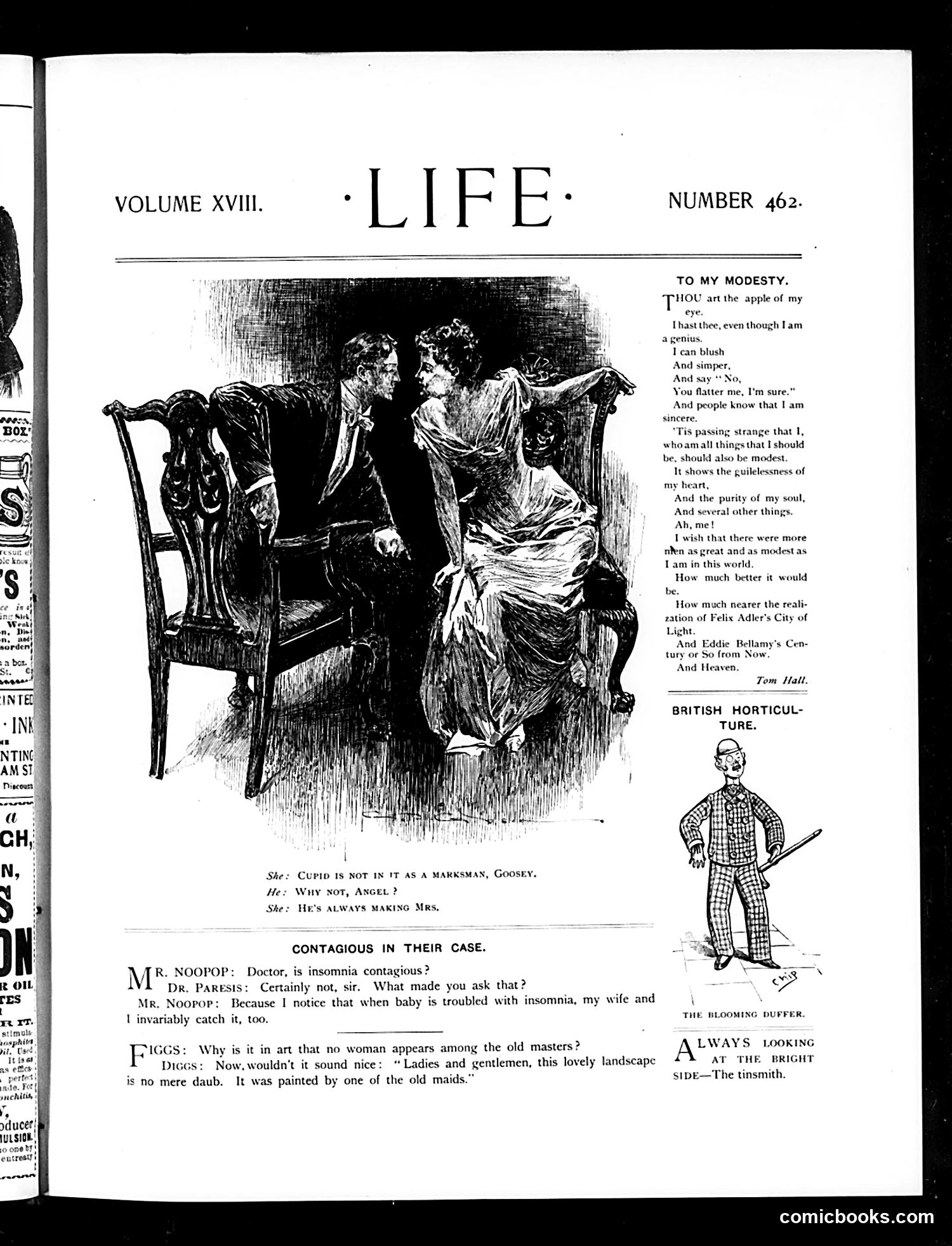
The main cartoon depicts a couple in conversation, with the caption "She: Cupid is not in it as a marksman, Goosev. / She: He's always making Mrs."—a joke about Cupid's poor aim in romantic matchmaking, contrasting with his apparent success at creating marriages (and thus "Mrs." titles). The poem "To My Modesty" appears to be self-deprecating humor about the author's own vanity despite claims of modesty. Below are brief comic exchanges about insomnia being contagious between spouses, and a discussion about why old master paintings lack female subjects—suggesting historical bias in art. The "British Horticulture" section with "The Blooming Duffer" appears to be a humor feature about gardening. Overall, this is typical turn-of-century American satirical magazine content mixing romantic comedy, social observation, and light wordplay.
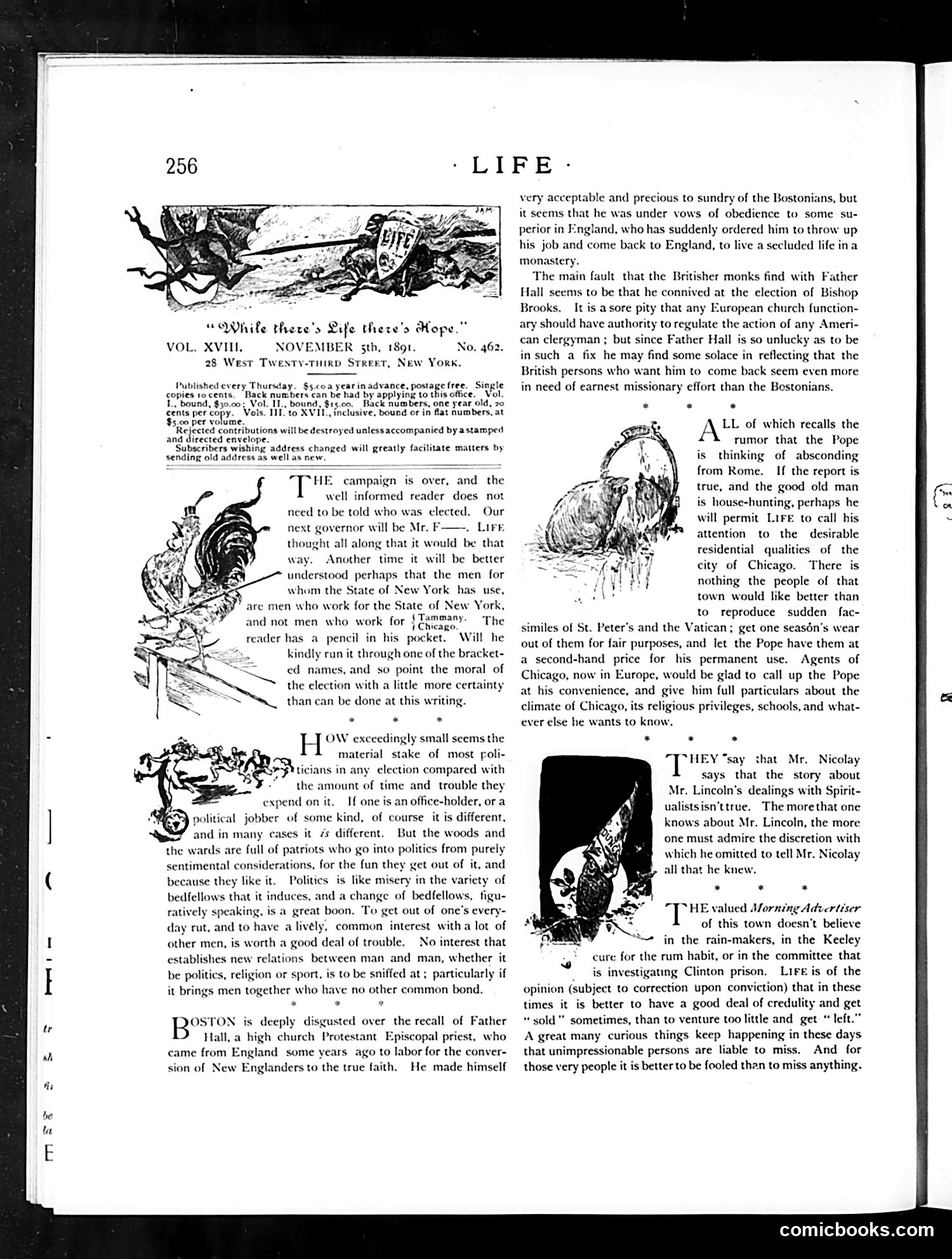
This page contains editorial commentary rather than political cartoons. The main topics discussed are: 1. **The election**: The editor discusses how voters care less about who wins than understanding that New York needs men who work for the state, not for "Tammany" (the corrupt Democratic political machine). 2. **Father Hall controversy**: Boston's Episcopal priest Father Hall, who came from England to convert New Englanders, has suddenly quit and returned to England to join a monastery. The piece suggests he was uncomfortable with American church authority and criticizes his lack of commitment. 3. **General political observations**: The editor notes how small the material stakes are in most political debates compared to the time and trouble expended on them. The page uses satirical commentary rather than visual caricature to make its points about American politics and religion.
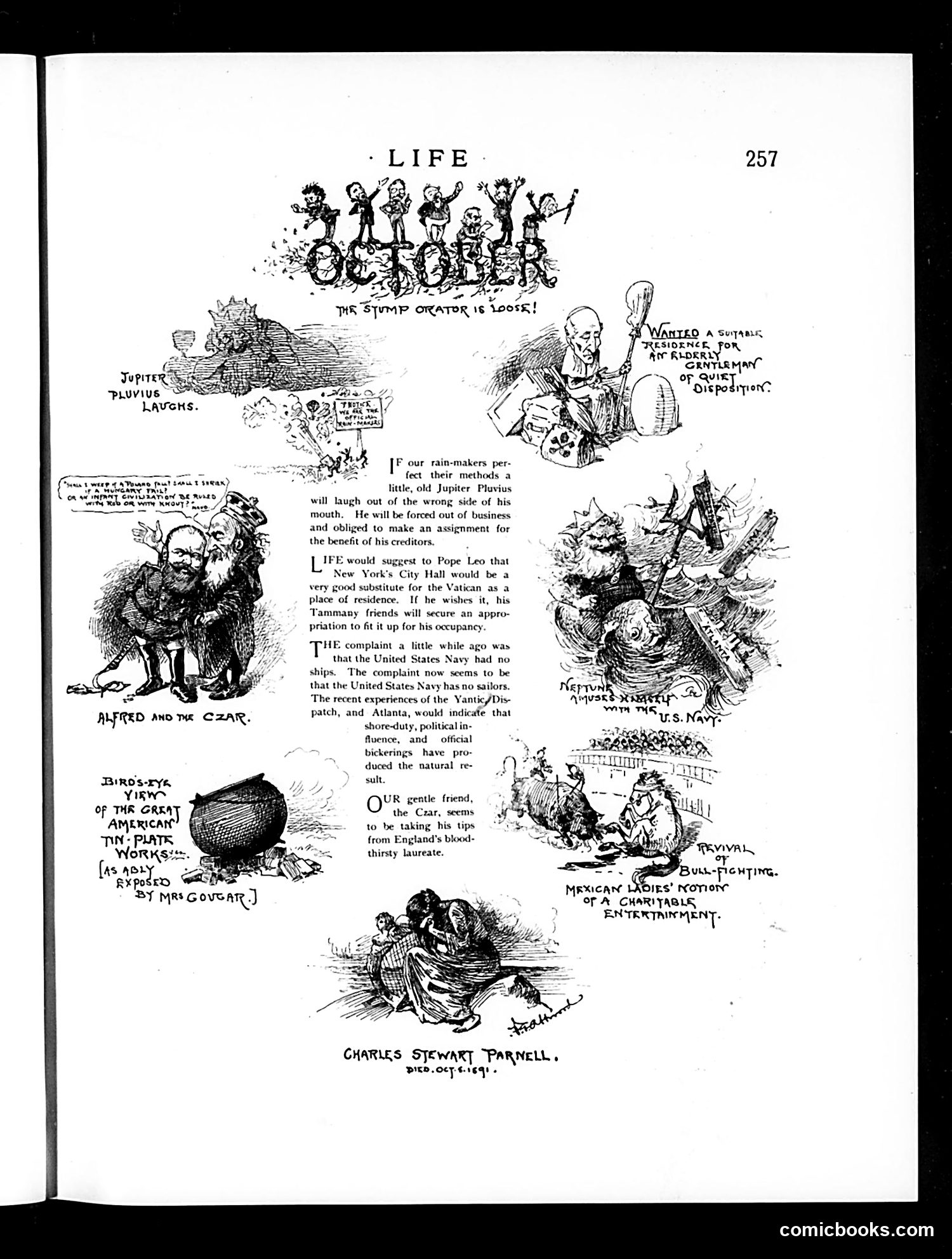
This satirical page from Life magazine features several political cartoons mocking contemporary figures and issues: **"Jupiter Pluvius Laughs"** mocks rain-making schemes, depicting Jupiter (Roman god of rain) laughing at fraudulent rain-making operators. **"Alfred and the Czar"** appears to reference diplomatic relations, though the specific context is unclear without additional historical information. **The Stump Orator cartoon** at top satirizes political speechmaking. **Navy and charitable entertainment cartoons** on the right mock U.S. naval readiness and Mexican entertainment practices. The page includes commentary on Pope Leo's potential residence in New York City and criticisms of various social and political conditions. At bottom is a death notice for Charles Stewart Parnell (died Oct. 6, 1891), the Irish nationalist politician. The overall tone is sharply satirical of contemporary politics, institutions, and public figures.
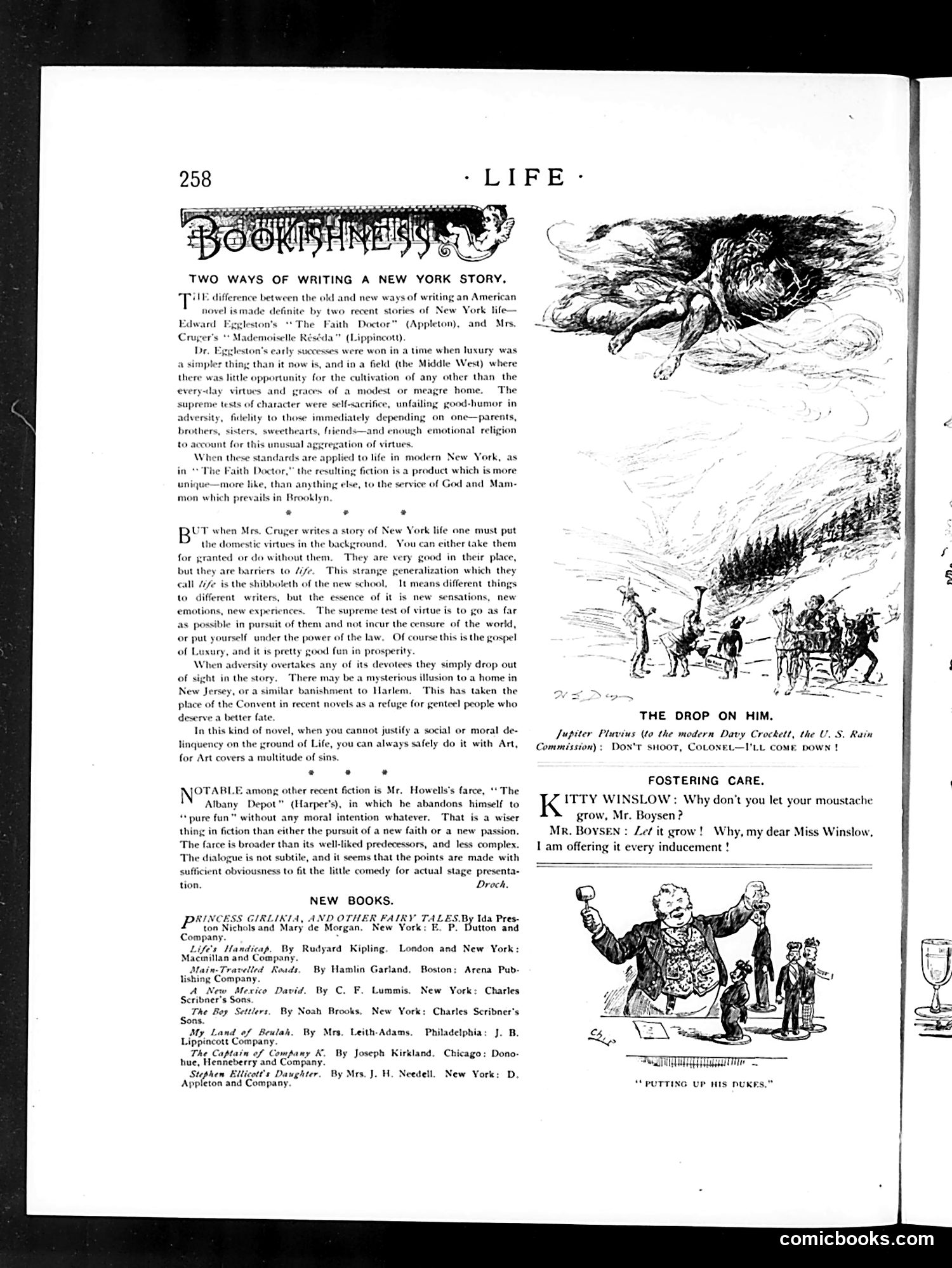
This page from *Life* magazine contains two distinct sections: **"Bookishness" Editorial**: A lengthy discussion comparing old and new ways of writing New York stories, contrasting Edward Eggleston's "The Faith Doctor" with Mrs. Crager's "Mademoiselle Réseda." The piece argues modern New York fiction should pursue sensations and experiences rather than moral lessons. **Two Cartoons**: 1. "The Drop on Him" — A sketch of a Rough Rider figure (likely referencing Theodore Roosevelt's cavalry unit) shooting at someone, with the caption playing on the phrase's double meaning. 2. "Fostering Care" / "Putting Up His Dukes" — Shows a man with a mustache in a boxing stance, with dialogue about growing a mustache as an "inducement." This appears to be gentle domestic humor rather than political satire. The page is primarily literary criticism with incidental humorous illustrations.
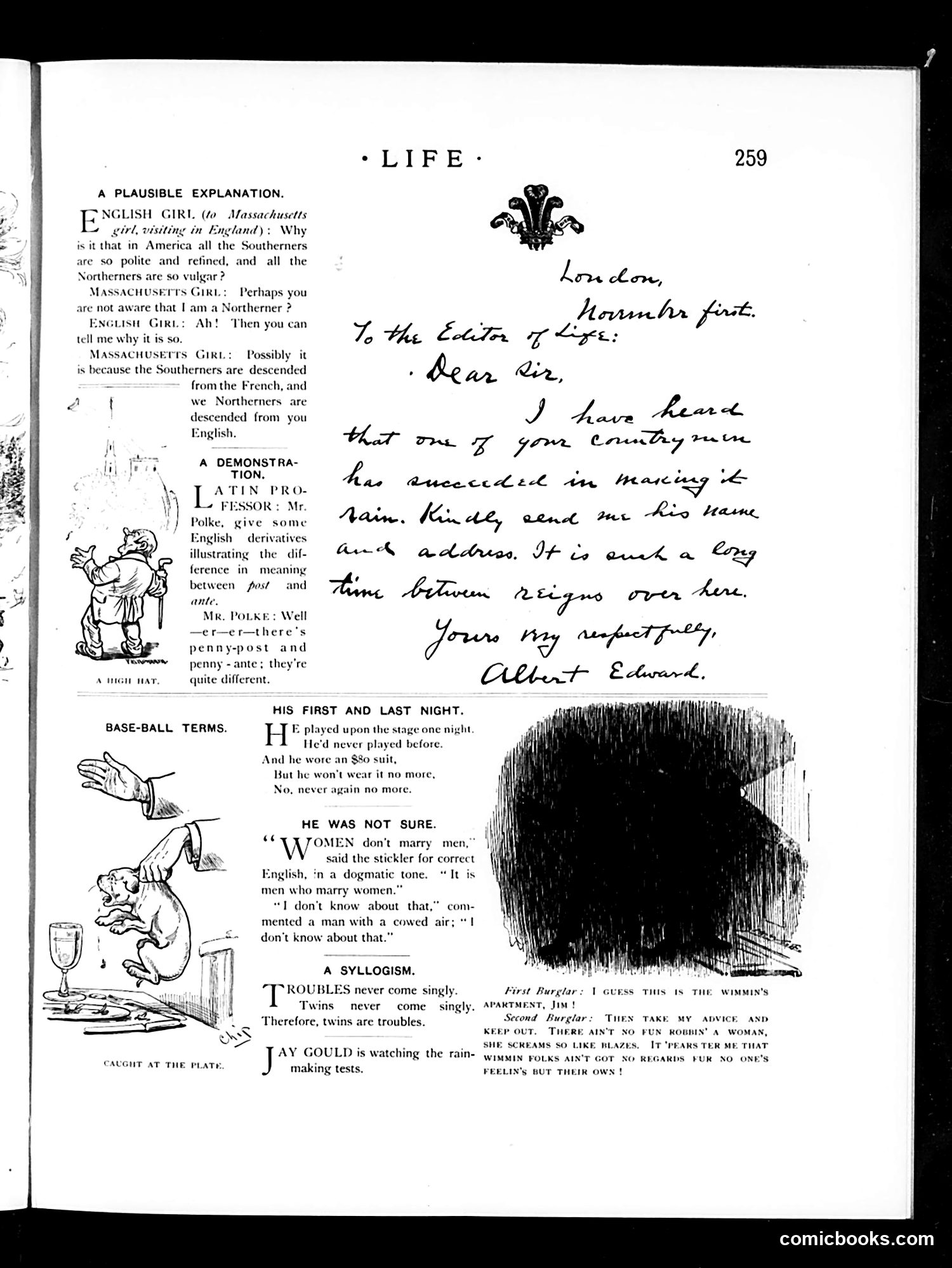
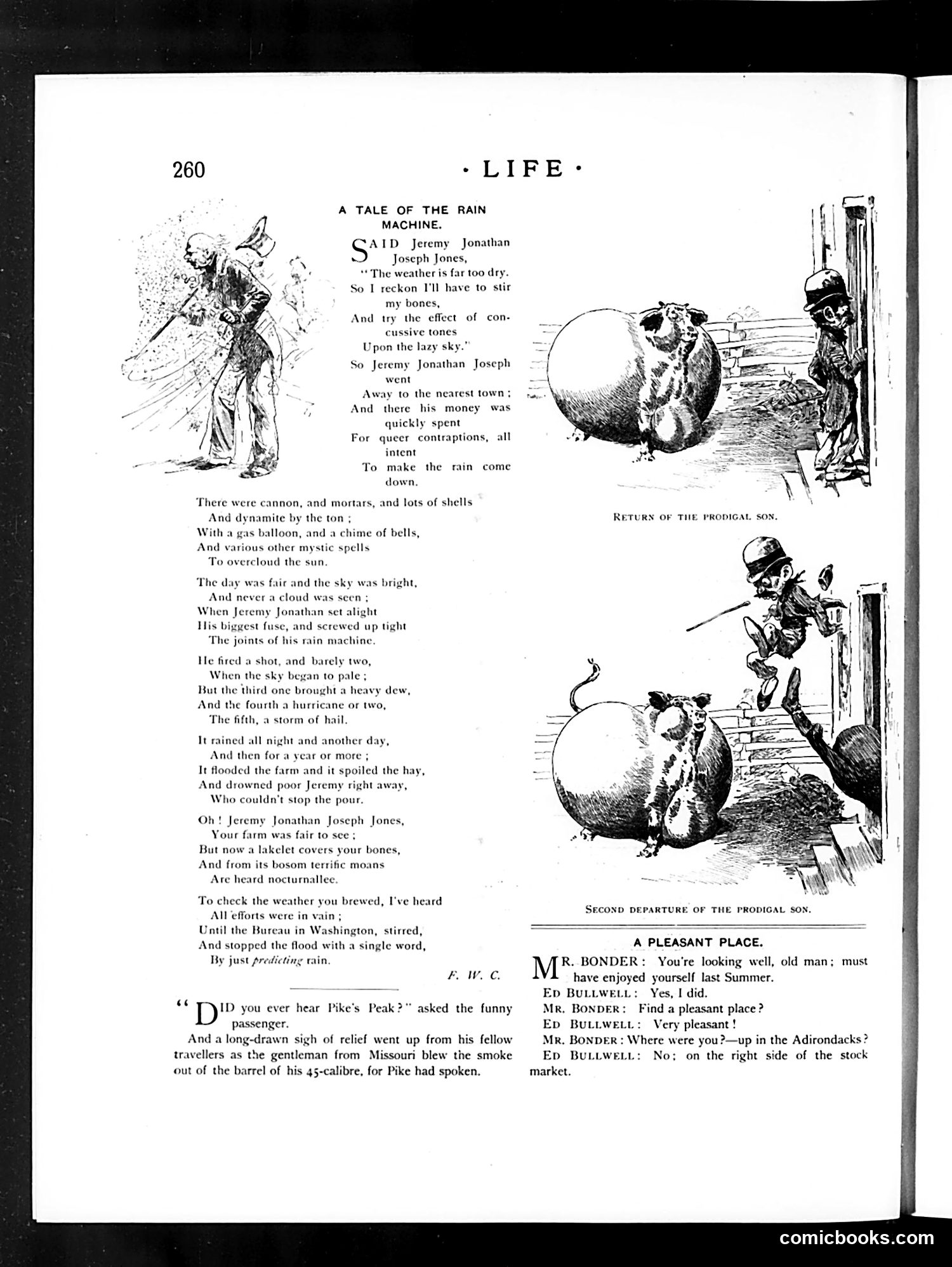
This page satirizes a man named Jeremy Jonathan Joseph Jones who attempts to artificially induce rainfall during a drought by firing cannons, mortars, and shells skyward while performing various "mystic spells." The accompanying verse mockingly describes his failed experiment: despite his elaborate efforts, rain falls continuously for over a year, destroying his farm entirely. The cartoon illustrations show Jones's contraptions and the resulting chaos with oversized water balloons and destruction. The satire targets pseudoscientific "rain-making" schemes that were apparently popular in late 19th/early 20th-century America—mocking both the charlatan promoters and the public's desperate belief in such unproven methods during agricultural crises.
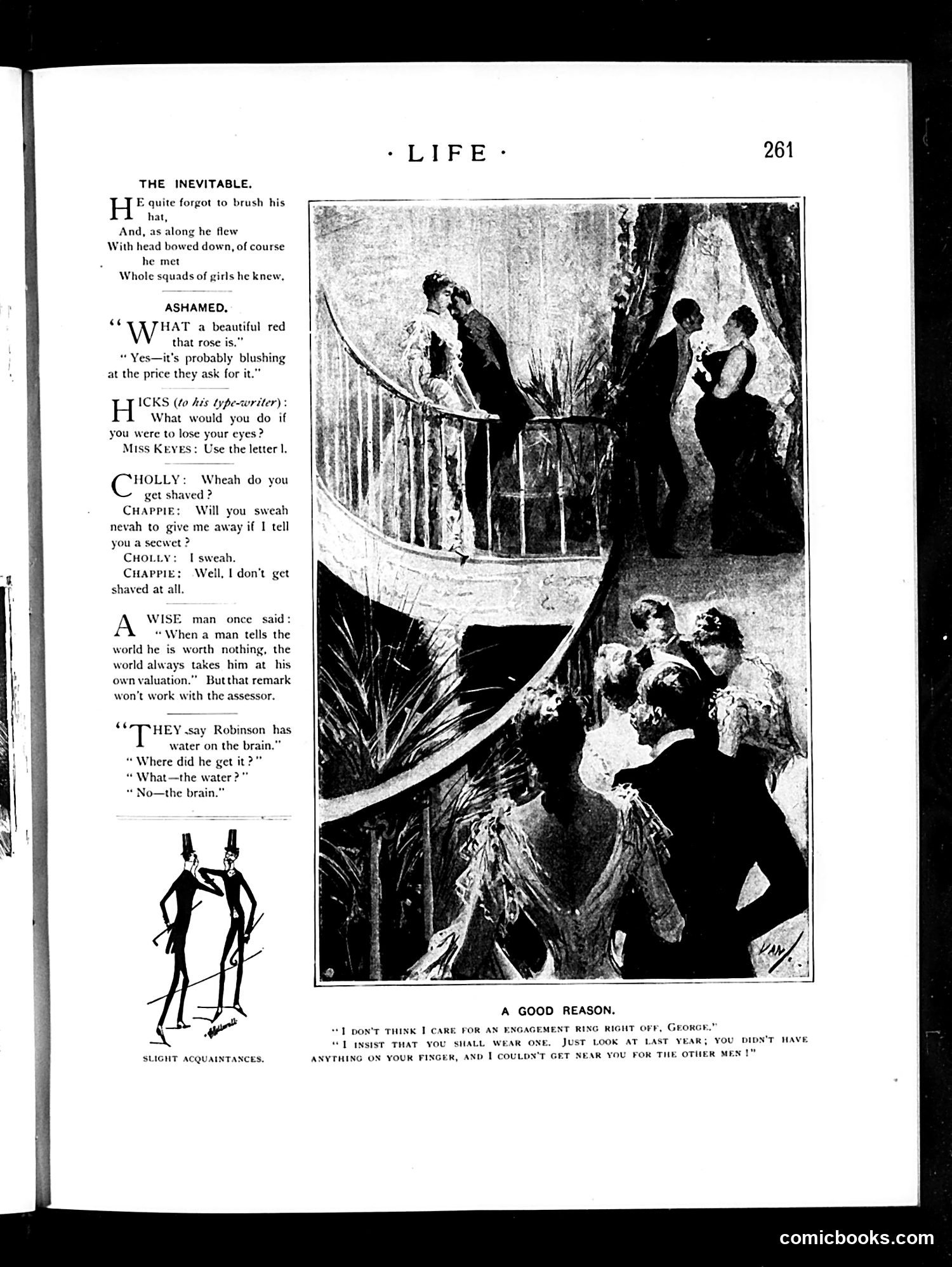
This page contains humorous short jokes and anecdotes rather than political cartoons. The content includes: - **"The Inevitable"**: A joke about a young man meeting girls while disheveled - **"Ashamed"**: A quip about rose prices - **"Hicks to his Type-writer"**: A dialogue joke about losing one's eyes - **"Cholly" dialogue**: A brief exchange about shaving and secrets - **"A Wise Man Once Said"**: Commentary on self-valuation - **"They Say Robinson Has Water on the Brain"**: A pun-based joke playing on the phrase - **"Slight Acquaintances"**: A simple illustration at bottom The main illustration shows a social scene with well-dressed figures in what appears to be an interior setting, captioned "A Good Reason," discussing an engagement ring. The page reflects early 20th-century humor focused on social customs, romantic entanglements, and wordplay rather than political satire.
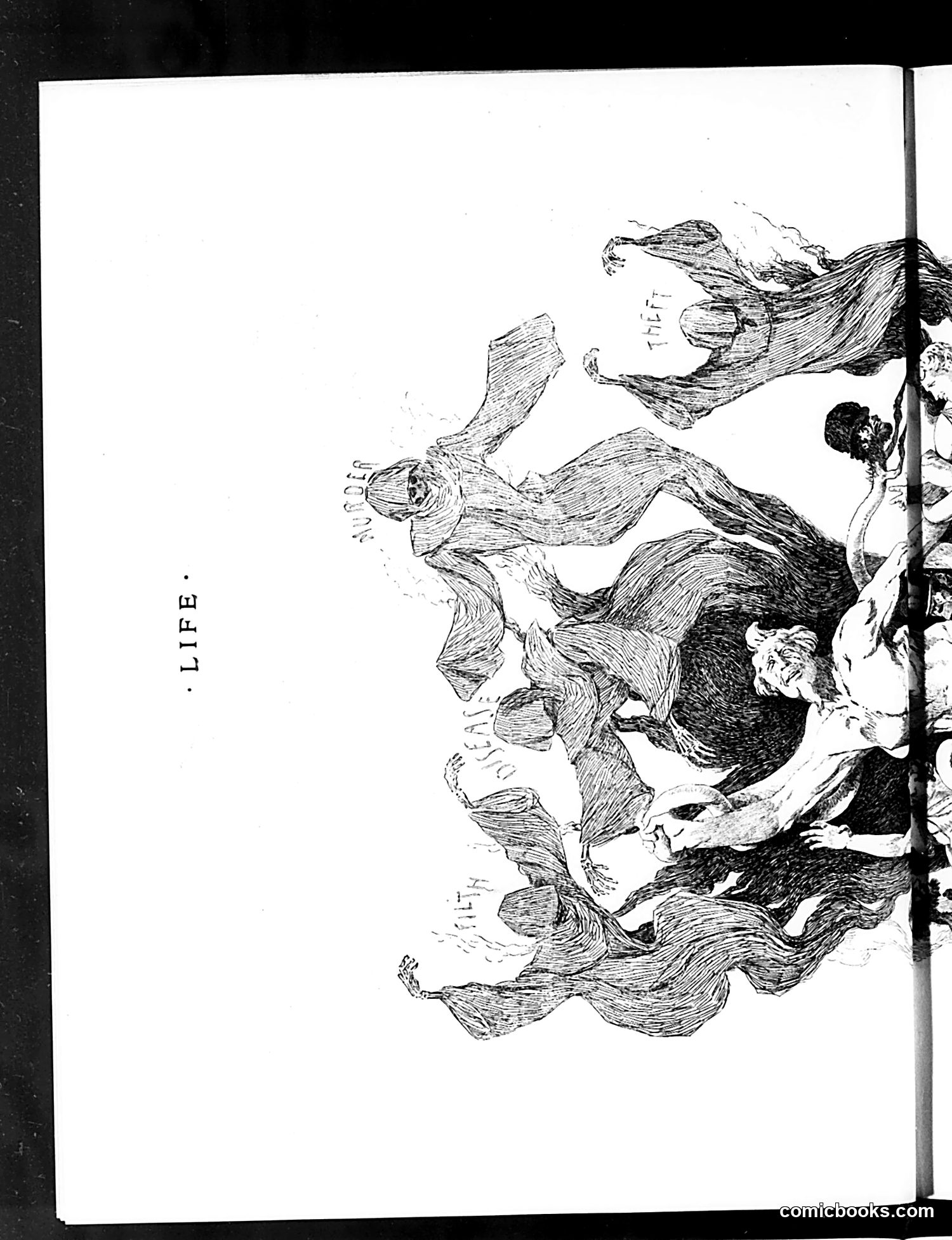
This page contains a single ink sketch showing multiple figures in flowing garments arranged in a circular composition, oriented sideways on the page. The word "LIFE" appears vertically on the left margin. The image appears to be a satirical illustration, likely depicting a social or political scene from the late 19th or early 20th century based on the drawing style. However, without clearer text identifying the specific figures, events, or context being satirized, I cannot definitively identify the particular caricatures or explain the precise point of satire with confidence. The flowing drapery and multiple interacting figures suggest this may lampoon a particular social gathering, political gathering, or cultural moment, but the specific subject remains unclear from the image alone.
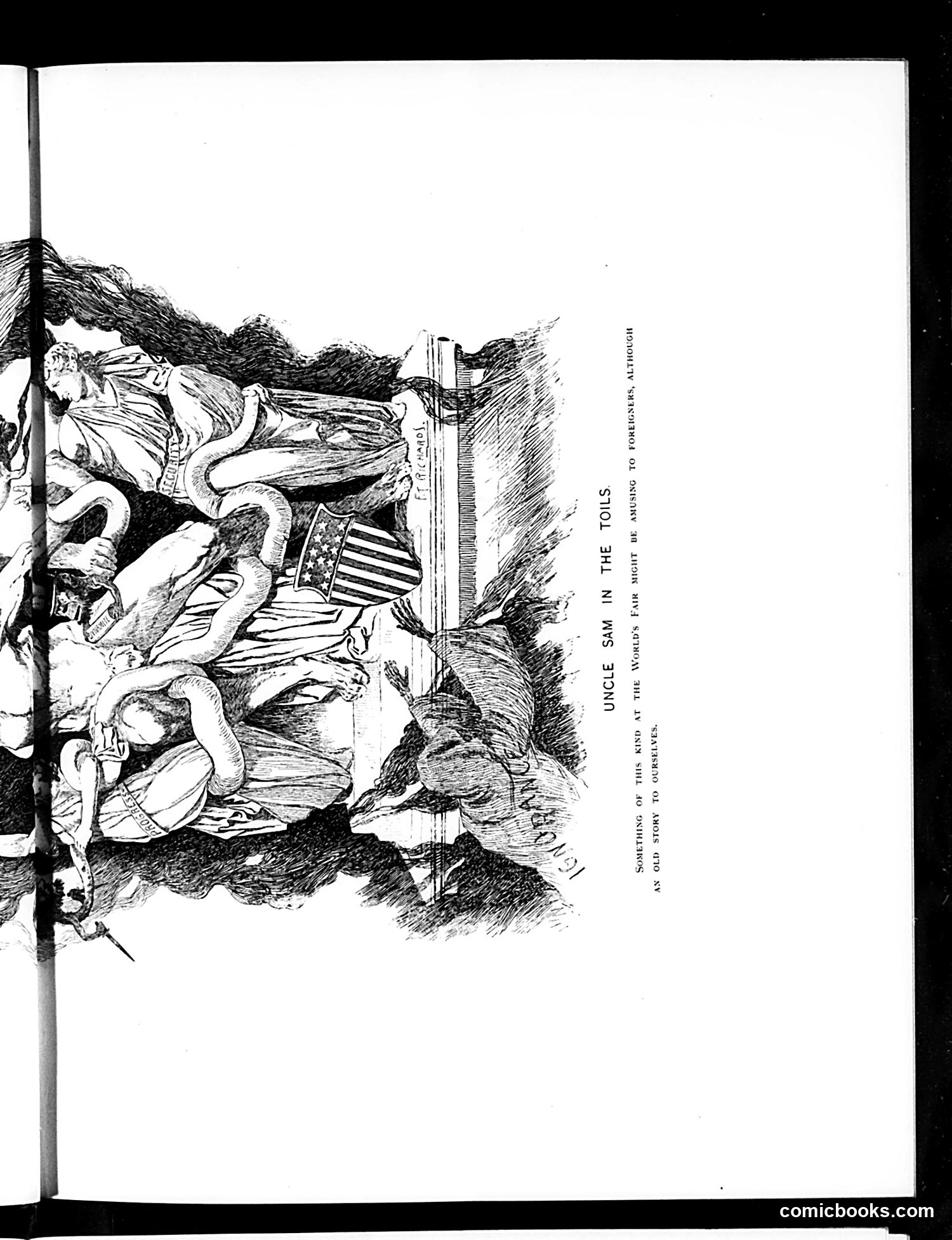
This political cartoon depicts **Uncle Sam** (the bearded figure in the center, identifiable by his star-spangled clothing) caught in the coils of a large **octopus**. The octopus's tentacles ensnare him, suggesting he is trapped or being strangled by some powerful force. The caption reads: "Sketches of his kind at the World's Fair, and to prophesy as to observers." This appears to be **Gilded Age-era satire** criticizing powerful monopolistic interests or trusts—commonly depicted as octopuses in American political cartoons—that were perceived as strangling the nation. The reference to the "World's Fair" likely grounds this in a specific historical moment, though the exact fair and date require additional context to confirm.
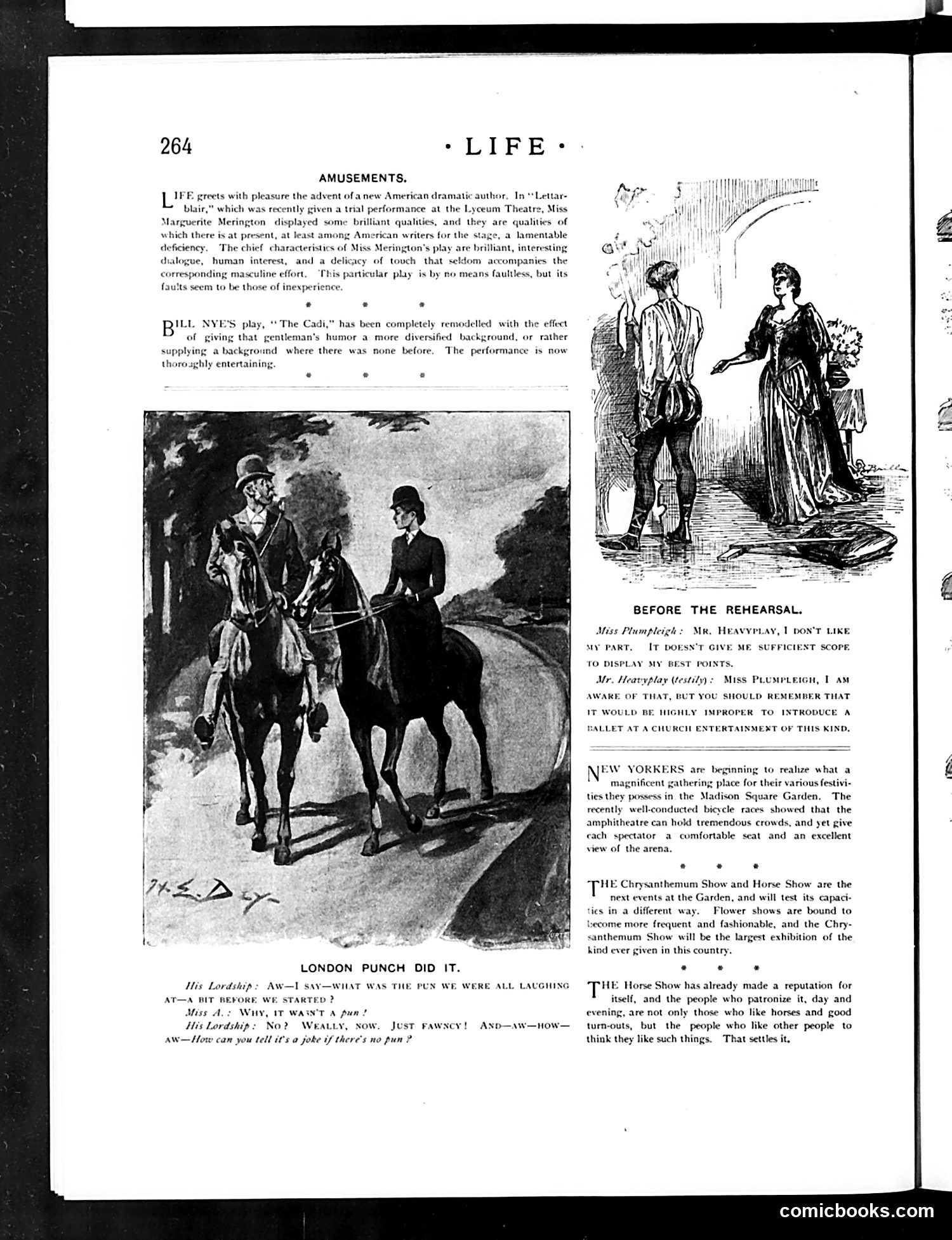
This page contains theater reviews and satirical dialogue from an American satirical magazine (Life). The main cartoons mock theatrical pretension: **"London Punch Did It"** shows a lord unable to explain why something was funny—he assumed there was a pun but realizes there wasn't one. The joke satirizes upper-class audiences who laugh at performances without understanding them, blindly following social cues. **"Before the Rehearsal"** depicts an actress (Miss Plumpleigh) complaining her part lacks scope to show off her talents. The director (Mr. Heavyplay) sarcastically reminds her that introducing a ballet into a church entertainment would be "highly improper"—mocking actors' vanity and their tendency to prioritize showy performances over appropriateness. The text reviews new American plays and discusses Madison Square Garden's upcoming shows, including Horse and Chrysanthemum exhibitions. A final jab notes Horse Show attendees aren't necessarily horse enthusiasts—they attend to be *seen* attending, satirizing status-conscious social climbing.
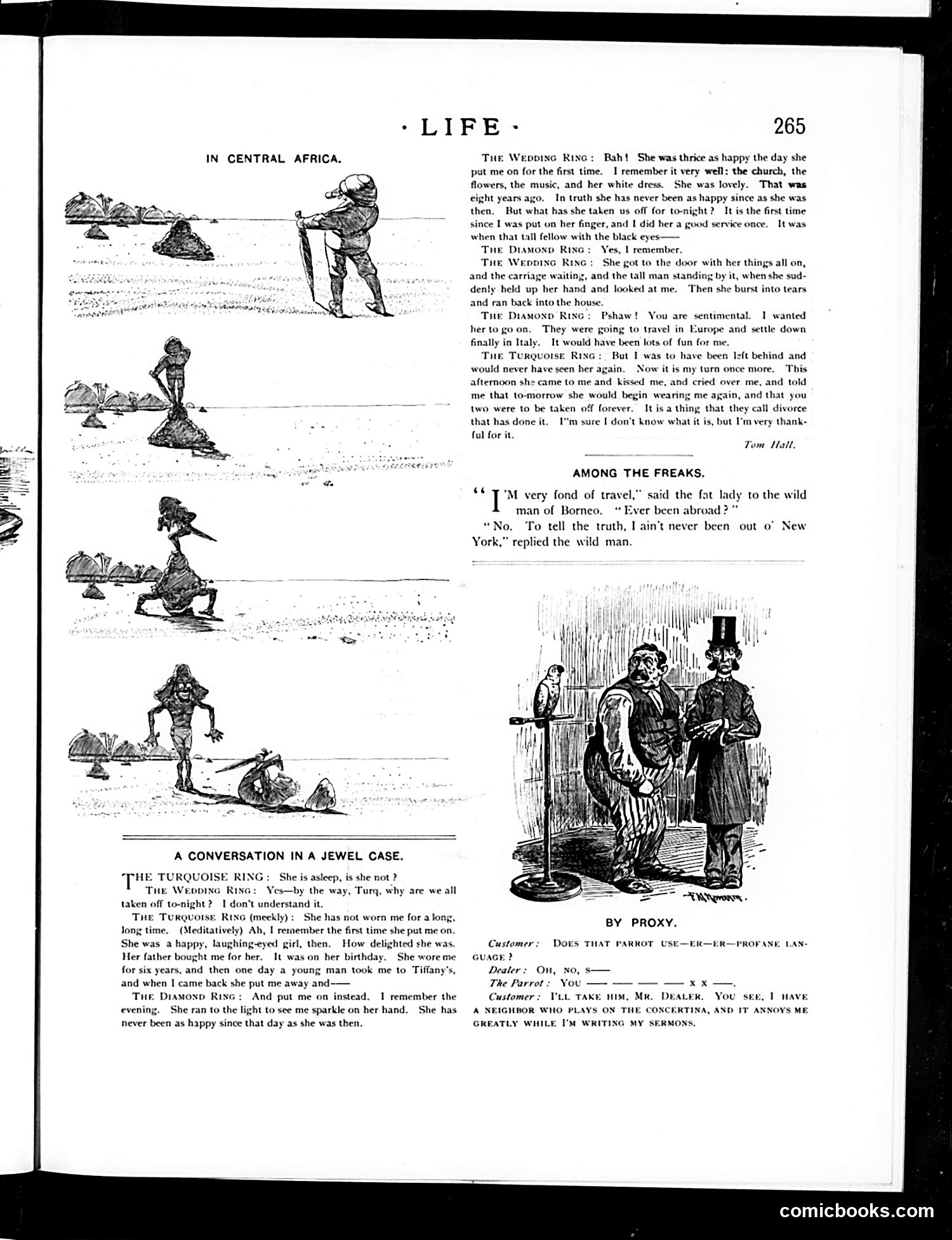
This page contains three distinct satirical pieces: **"A Conversation in a Jewel Case"** depicts three of a woman's rings—Turquoise, Wedding, and Diamond—discussing her life stages. Each ring represents a different relationship phase: the turquoise from her carefree youth, the wedding ring from her happy marriage, and the diamond from a later affair. The rings are being removed tonight because she's getting divorced. The satire critiques how material possessions and romantic relationships define women's happiness and identity, with the rings serving as passive witnesses to her emotional trajectory. **"Among the Freaks"** is a brief joke about a "fat lady" and "wild man of Borneo"—common carnival/sideshow attractions—discussing travel. **"By Proxy"** shows a customer buying a parrot specifically to annoy his neighbor's concertina playing. The joke relies on the parrot's ability to mimic profanity loudly enough to disrupt the neighbor's music practice and the customer's sermon-writing.
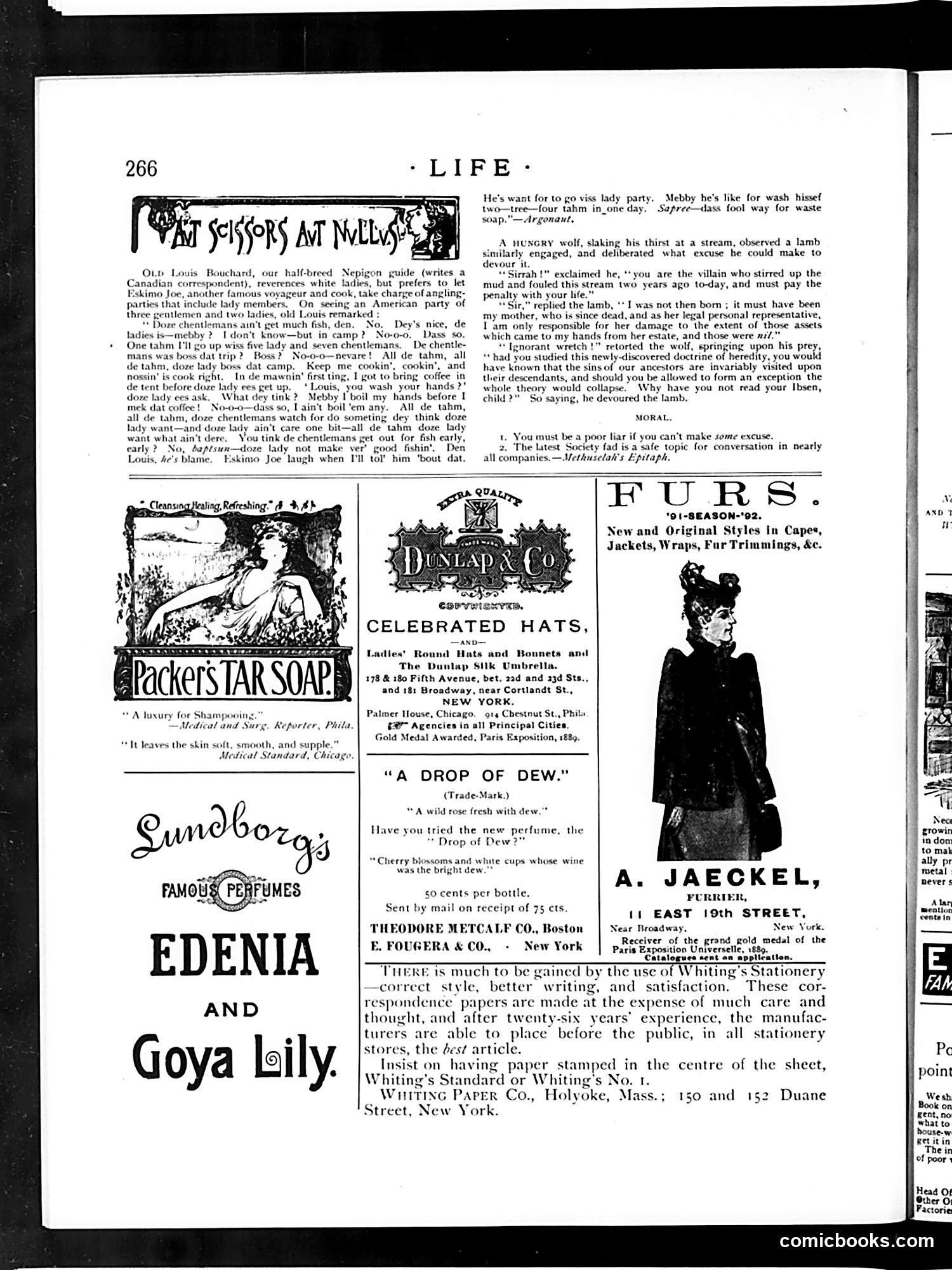
The main cartoon features **Louis Bouchard**, a half-breed Nepigon guide and Canadian correspondent for Life magazine, recounting a humorous anecdote about camping dynamics. The satire mocks gender roles and frontier masculinity: When an American fishing party brings five women and seven men, confusion erupts over who's "boss." Louis humorously observes that while the gentlemen expect to fish, the lady boss runs the camp and demands the men perform domestic duties (cooking, fetching coffee, washing hands). The punchline ridicules the gentlemen's incompetence and emasculation when confronted with women's authority in wilderness settings. The secondary **Aesop's Fable** cartoon satirizes Victorian intellectualism and modern philosophy. A wolf devours a lamb by invoking "newly-discovered doctrine of heredity" and referencing Ibsen—claiming the lamb is responsible for ancestral sins. The moral mocks pseudo-intellectual excuses and society's obsession with fashionable ideas as conversation topics, regardless of logic. The page is primarily **advertisements** for period products (soap, perfume, hats, fur trimmings, stationery).
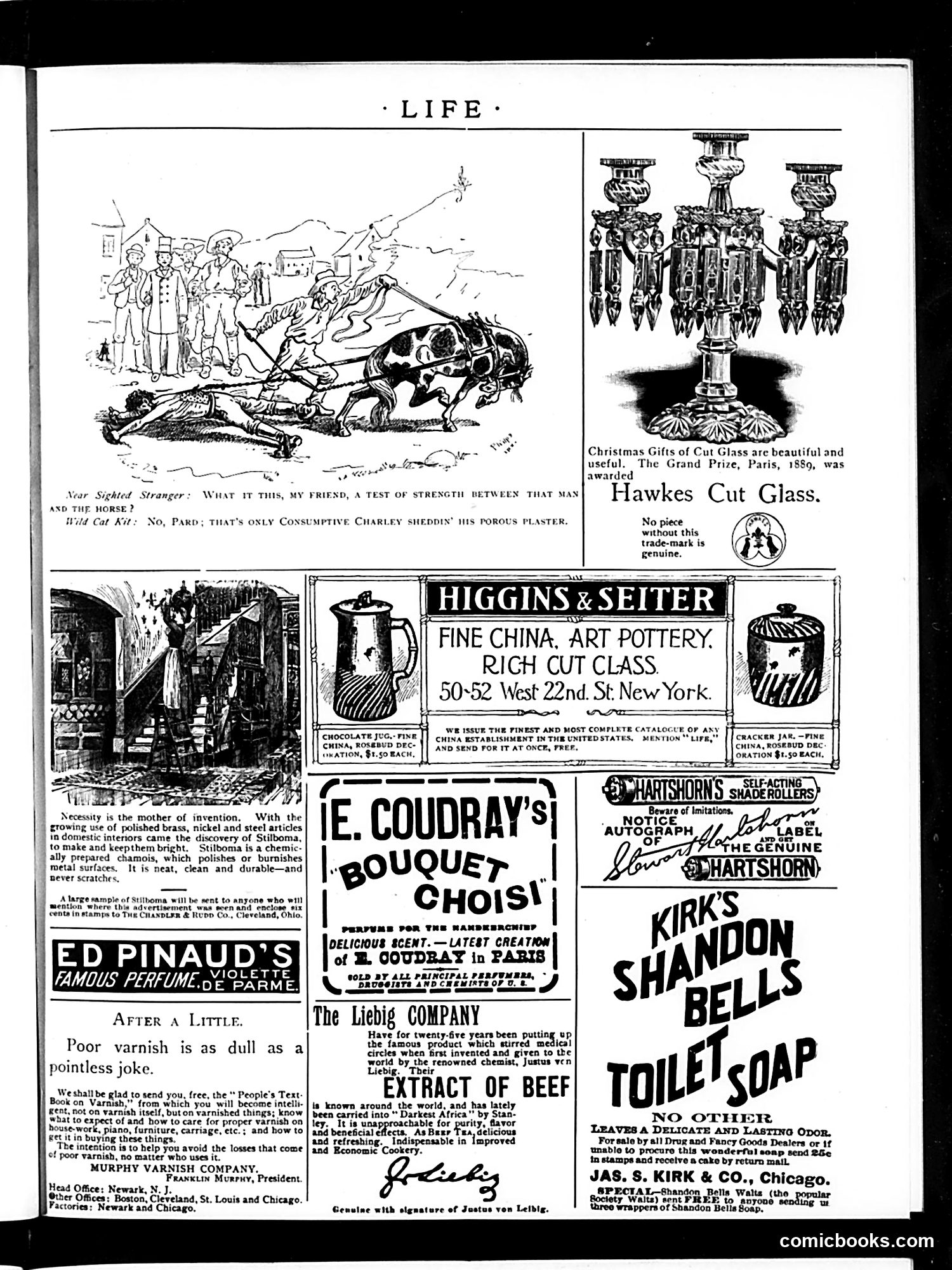
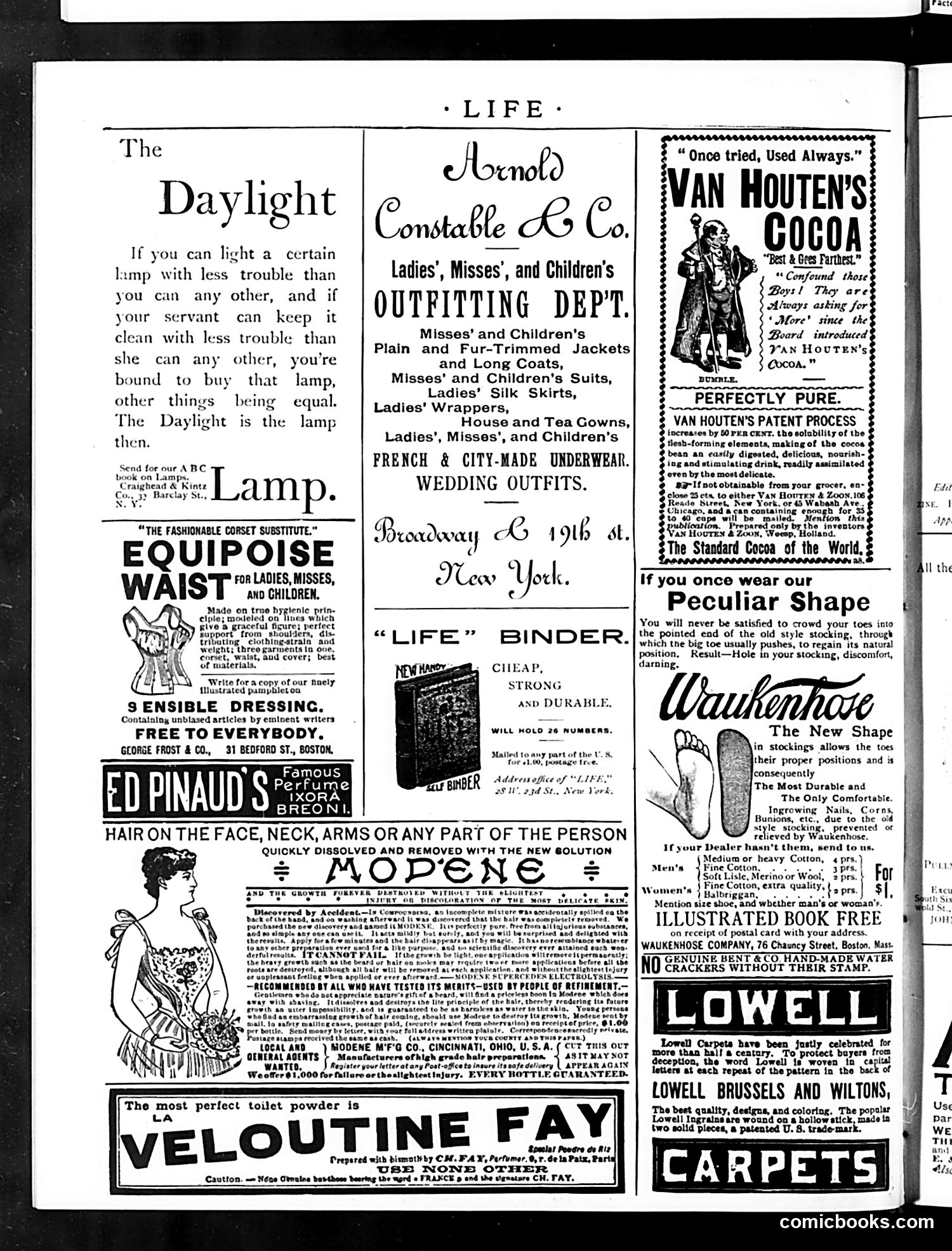
This is primarily an **advertising page** with no political cartoons or satirical content requiring historical context. The page consists entirely of commercial advertisements typical of early 20th-century magazines, promoting: - **Household products**: lamps, corsets, cocoa, carpet - **Clothing retailers**: Arnold Constable & Co. (a major New York department store) - **Personal care items**: perfume, toilet powder, hair removal solution (Modene) - **Practical goods**: stockings, binders, crackers The one illustration—showing a woman in classical dress for the Modene hair removal ad—is purely decorative marketing, not satirical commentary. **For modern readers**: These ads reflect turn-of-century consumer culture, including now-obsolete products (corset substitutes, specific perfume brands) and dated beauty standards. The emphasis on "hygiene" and "sensible" clothing shows evolving attitudes toward women's fashion and health, though corsetry remained standard. No political satire or cartoon analysis is applicable to this page.
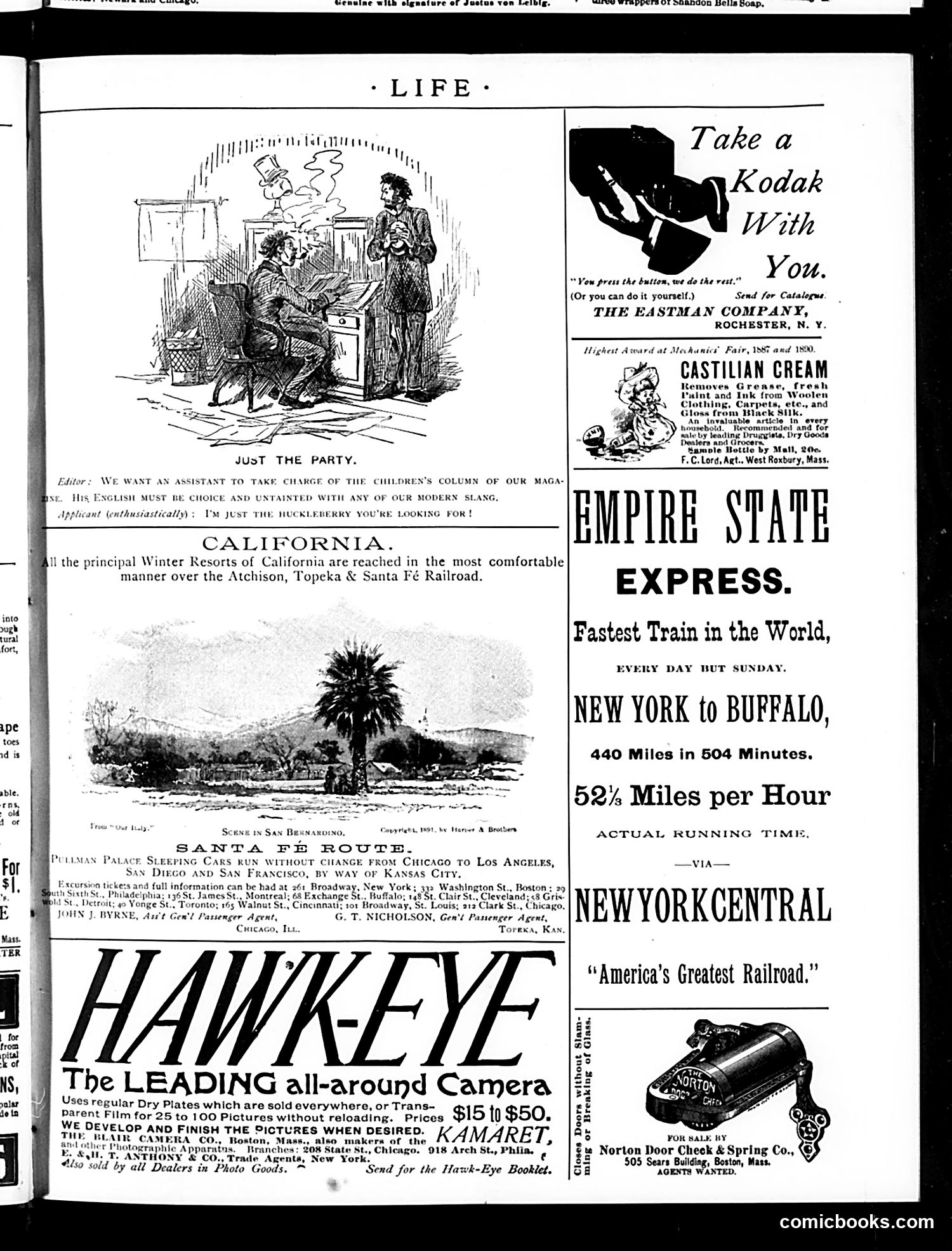
This single-panel cartoon satirizes the gap between formal language ideals and modern colloquial speech. An editor seeks an assistant for the children's column, demanding "choice" English "untainted" with modern slang. The applicant eagerly responds: "I'm just the huckleberry you're looking for!"—which is itself precisely the kind of contemporary American slang the editor wanted to avoid. "Huckleberry" was period slang meaning "the right person for the job." The satire works through ironic self-contradiction: the applicant demonstrates his unfitness by speaking in exactly the colloquial manner being rejected. This reflects late-19th-century anxieties about American English becoming "corrupted" by vernacular usage, particularly among younger generations. The joke targets both the editor's stuffy prescriptivism and the applicant's oblivious confidence. The page is otherwise dominated by period advertisements for cameras, railroads, and cleaning products.
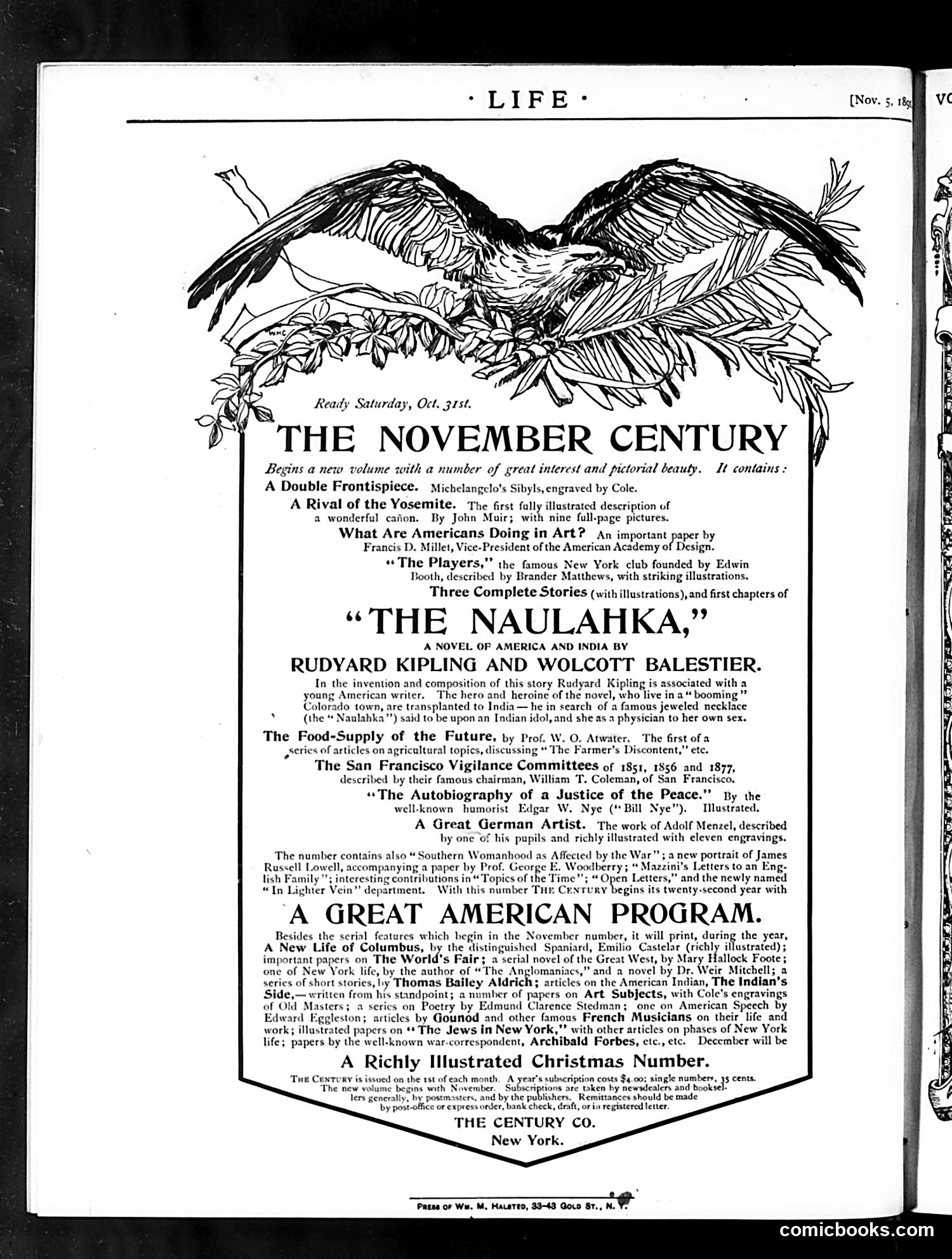
This is primarily a **table of contents and advertising page** for *The Century* magazine's November issue, not a political cartoon page. The decorative header features a **bird illustration** (appears to be an eagle or similar), which is typical ornamental design for period publications—not satire. The content advertised reflects late-19th-century literary and artistic interests: Rudyard Kipling's serialized novel *The Naulahka* (co-written with an American), articles on American art and Indian affairs, profiles of famous figures like James Russell Lowell, and coverage of the upcoming World's Fair. The page's "satire" value, if any, is implicit in *Life's* role as a humor magazine—it's satirizing the *Century's* earnest, high-minded editorial approach by presenting it as parody advertising. However, the actual content shown is straightforward literary promotion, not political commentary or caricature.