
Life, 1891-11-05 · page 6 of 18
Life — November 5, 1891 — page 6: what you’re looking at
What you’re looking at
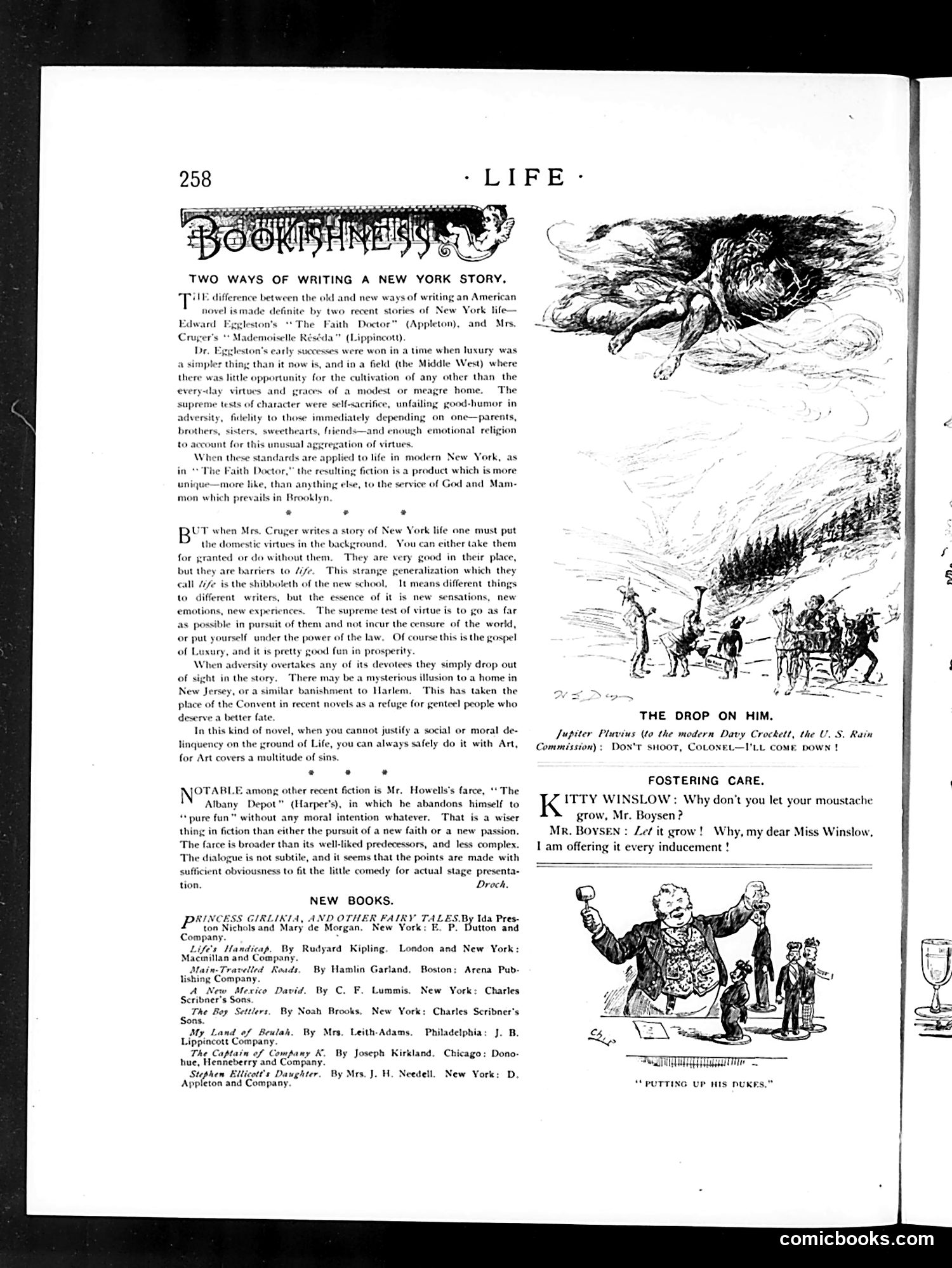
This page from *Life* magazine contains two distinct sections: **"Bookishness" Editorial**: A lengthy discussion comparing old and new ways of writing New York stories, contrasting Edward Eggleston's "The Faith Doctor" with Mrs. Crager's "Mademoiselle Réseda." The piece argues modern New York fiction should pursue sensations and experiences rather than moral lessons. **Two Cartoons**: 1. "The Drop on Him" — A sketch of a Rough Rider figure (likely referencing Theodore Roosevelt's cavalry unit) shooting at someone, with the caption playing on the phrase's double meaning. 2. "Fostering Care" / "Putting Up His Dukes" — Shows a man with a mustache in a boxing stance, with dialogue about growing a mustache as an "inducement." This appears to be gentle domestic humor rather than political satire. The page is primarily literary criticism with incidental humorous illustrations.
📄 Transcribed text from this page (OCR, searchable)
Machine-transcribed from the original scan — historical spelling and the odd misread are preserved.
TWO WAYS OF WRITING A NEW YORK STORY. TilE difference between the okt and new ways of writing an American hove ade definite by two recent stories of New York life— Edward Eg oT ith Doctor” (Appleton), and Mrs, * (Lippincott) arly successes were won in a time when luxury was than it now is, and in a field (the Middle West) where was little opportunity for the cultivation of any other than the rtues and graces of a modest or meagre home. The supreme tests of character were self-sacrifice, unfailing good-humor in adversity, fidelity to those immediately depending on one—parents, brothers, sisters, sweethearts, f nd enough emotional relig’ to account for this unusual aggregation of virtues When these standards are applied to life in modern New York, as in * The Faith Doctor,” the resulting fiction is a product which is more unique—more like, than anything else, e service of God and Mam- mon which prevails in Brooklyn * . . UT when Mrs. Cruger writes a story of New York life one must put the domestic virtues in the background, You can either take them for granted or do without them. They are very good in their place, but they are barriers to 4/e. This strange generalization which th call “fe is the shibboleth of the new school, It means different things to different writers, but the essence of itis new sensations, new emotions, new experiences. ‘The supreme test of virtue is to go as far as possible in pursuit of them and not incur the censure of the world, or put yourself under the power of the law. Of course this is the gospel of Luxury, and it is pretty good fun in prosperity. When adversity overtal y of its devotees they simply drop out of sight in the story, ‘There may be a mysterious illusion to a home in New Jersey, or a similar banishment to Harlem, ‘This has taken the place of the Convent in recent novels as a refuge for genteel people who deserve a better fate In this kind of novel, when you cannot justify a social or moral de- linquency on the ground of Life, you can always safely do it with Art, for Art covers a multitude of sins. * ° * NOTABLE among other recent fiction is Mr. Howells's farce, ** The Albany Depot” (Harper's), in which he abandons himself to “pure fun” without any moral intention whatever. That is a wiser thing in fiction than either the pursuit of a new faith or a new passion. ‘The farce is broader than its well-liked predecessors, and less complex. ‘The dialogue is not subtile, and it seems that the points are made with sufficient obviousness to fit the little comedy for actual stage presenta- tion, Droch. NEW BOOKS. S GIRLIKIA, AND OTHER FAIRY TALES.By Ida Pres- hols and Mary de Morgan. New York: E. P. Dutton and Company. : Life's Handicap. By Rudyard Kipling. London and New York: Macinillan and Company. Main-Travelted Roads. By Hamlin Garland, Boston: Arena Pub- lishing Company. A New Mexico David. By C. F. Lummis, New York: Charles Scribner's Sons. goZbe fer Settlers. By Noah Brooks. New Vork: Charles Scribner's ons. My Land ef Beulah. By Mrs. Leith-Adams. Philadelphia: J. B. Lippincott Company The Captain of Company K. By Joseph Kirkland. Chicago: Dono- hue, Heaneberry and Company. Stephen Ellicott’s Daughter. By Mrs. J. H. Needell. New York: D. Appleton and Company. THE DROP ON HIM. Jupiter Pluvius (to the modern Davy Crockett, the U.S. Rain Commission): DON'T suooT, COLONEL—I'LL COME DOWN ! FOSTERING CARE. ITTY WINSLOW: Why don’t you let your moustache grow, Mr. Boysen ? MR. Boysen : Lef it grow! Why, my dear Miss Winslow, I am offering it every inducement ! “PUTTING UP IIS DUKES,” comicbooks.com