
A complete issue · 16 pages · 1891
Life — October 29, 1891
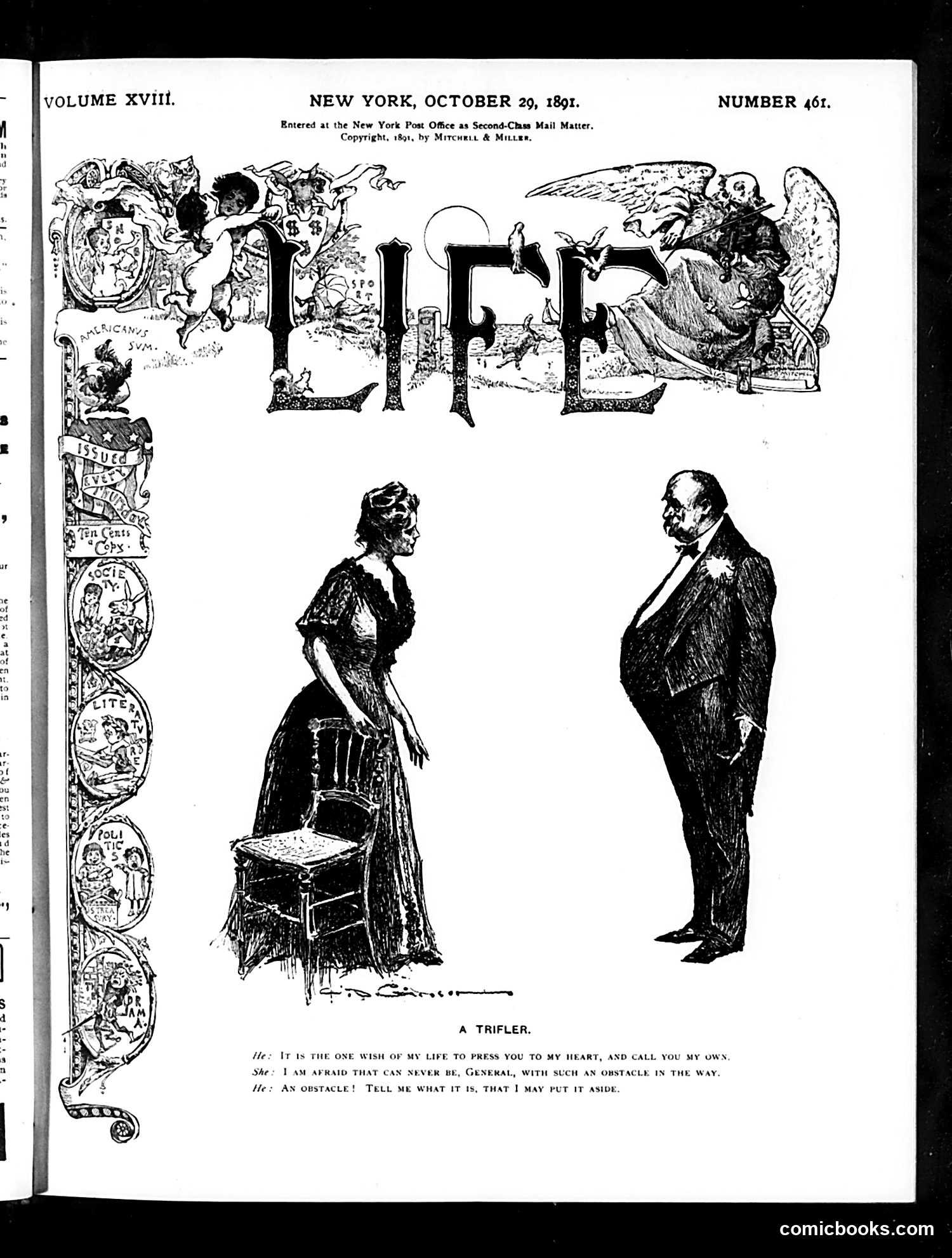
This cartoon depicts a romantic conflict. A woman sits on a chair, looking away from a man standing beside her. The dialogue reveals the situation: The man declares his wish to "press you to my heart, and call you my own." The woman responds she fears "that can never be, General, with such an obstacle in the way." When he demands to know what obstacle exists, she replies: "An obstacle! Tell us what it is, that I may put it aside." The humor lies in the man's apparent blindness—he cannot see an obvious barrier between them (likely their social positions, existing commitments, or his own character flaws). The title "A Trifler" suggests he's a shallow romantic who doesn't recognize genuine impediments to their relationship, or that he treats love casually.
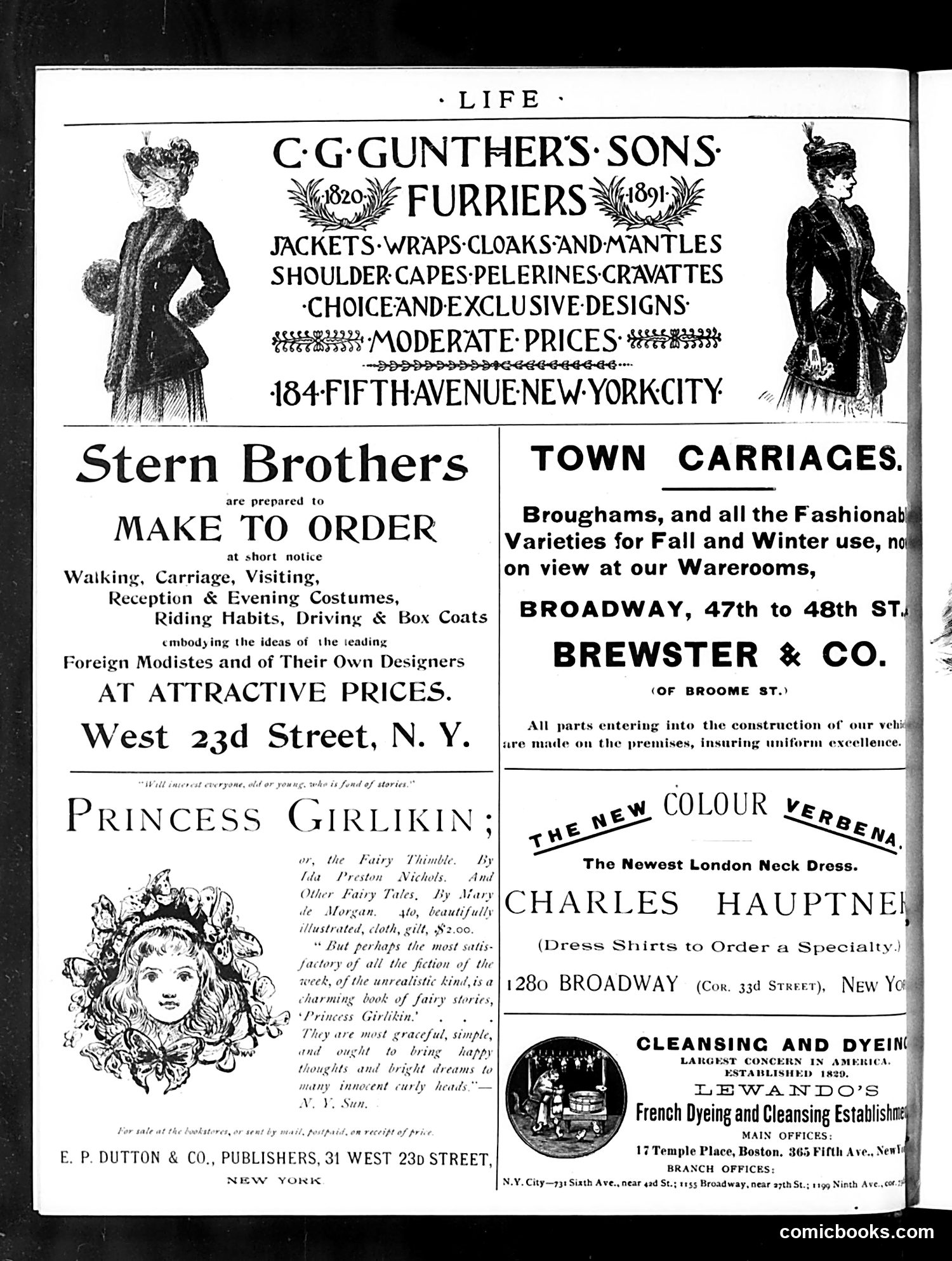
This page is **primarily advertisements** with no political cartoons or satirical content visible. The ads showcase late 19th-century New York businesses: C.G. Gunthers Sons (furriers), Stern Brothers (custom clothing), Brewster & Co. (carriages), and Charles Hauptner (dress shirts). There is one illustrated children's book advertisement for "Princess Girlikin," a fairy tale published by E.P. Dutton & Co. The only illustration with potential satirical intent is the small circular vignette for Lewando's French Dyeing and Cleansing Establishment, showing workers at their trade—likely meant to demonstrate the business's activity rather than make a social or political point. The page reflects 1890s consumer culture and advertiser-supported magazine publishing rather than editorial satire.
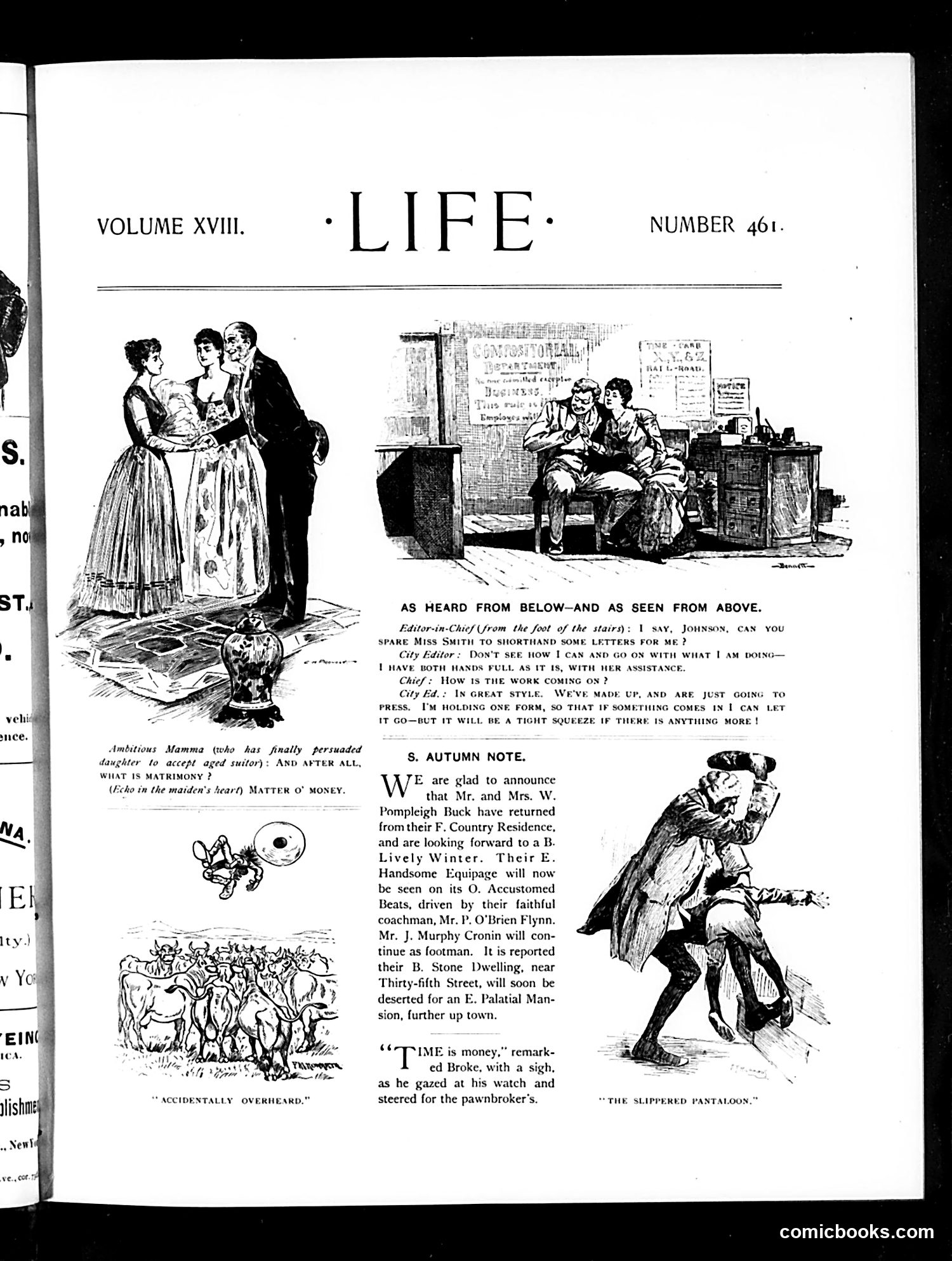
This page contains three satirical sketches with social commentary: **Top Panel ("As Heard From Below—And As Seen From Above"):** A newspaper office scene satirizing the disconnect between an editor's grand ambitions and practical constraints. The Editor-in-Chief demands impressive work, but the City Editor protests he's overwhelmed, holding "one form" to squeeze out content—mocking the gap between editorial vision and newsroom reality. **"S. Autumn Note":** A society column announcement about Mr. and Mrs. W. Pompleugh Buck's return from their country residence, with details about their household staff and social activities—typical upper-class gossip content. **Scattered Illustrations:** Small captioned drawings ("Accidentally Overheard," "The Slippered Pantaloons") providing humorous vignettes, likely social observations about contemporary manners or relationships. The page represents typical Life magazine satirical humor targeting journalism practices and high-society pretension.
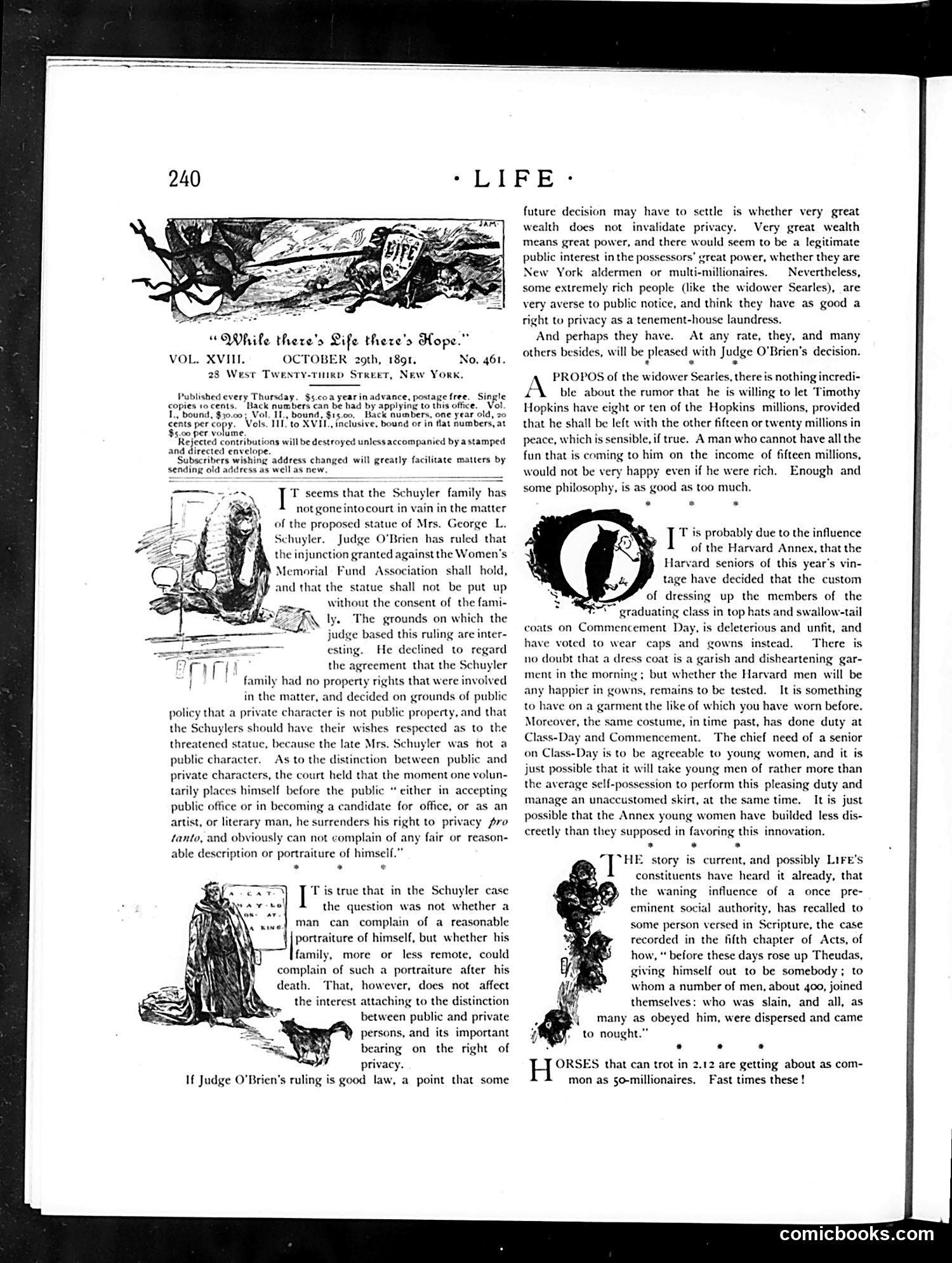
This page discusses the Schuyler family statue controversy and Harvard dress code reforms—both reflecting 1890s debates about propriety and public versus private matters. The **Schuyler case** involved whether a widow could erect a statue honoring her late husband without family consent. Judge O'Brien ruled the private character claim overrode public memorial concerns, establishing legal precedent for privacy rights. The **Harvard Annex** (Radcliffe College) story concerns seniors voting to wear academic caps and gowns instead of elaborate dress coats on Commencement Day. The satire mocks this as an unnecessary innovation, questioning whether young women really need such "unaccustomed" formal attire—poking fun at emerging women's education and evolving social conventions. Both items satirize contemporary anxieties about changing social norms and institutional traditions.
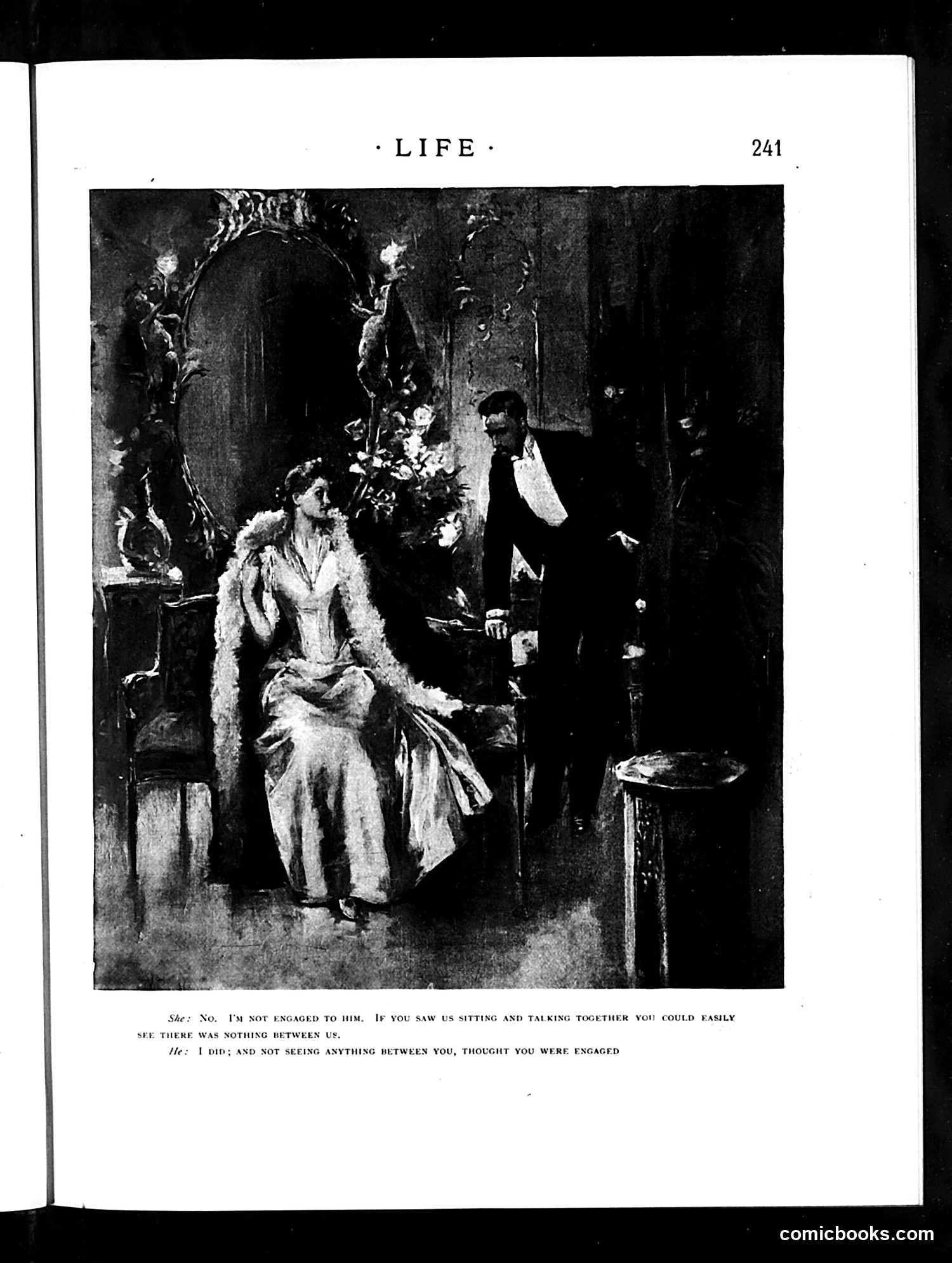
This appears to be a satirical scene from an early 20th-century Life magazine depicting a romantic misunderstanding. A woman seated at a vanity mirror tells a man, "No; I'm not engaged to him. If you saw us sitting and talking together you could easily see there was nothing between us." The man responds: "I did; and not seeing anything between you, thought you were engaged." The joke plays on social conventions about proper distance and decorum between unmarried people. In this era, a couple sitting close together with visible physical proximity was considered evidence of romantic involvement or engagement. The humor derives from the paradox: her denying engagement by claiming *no* closeness, while he assumed *no* visible space between them *proved* engagement.
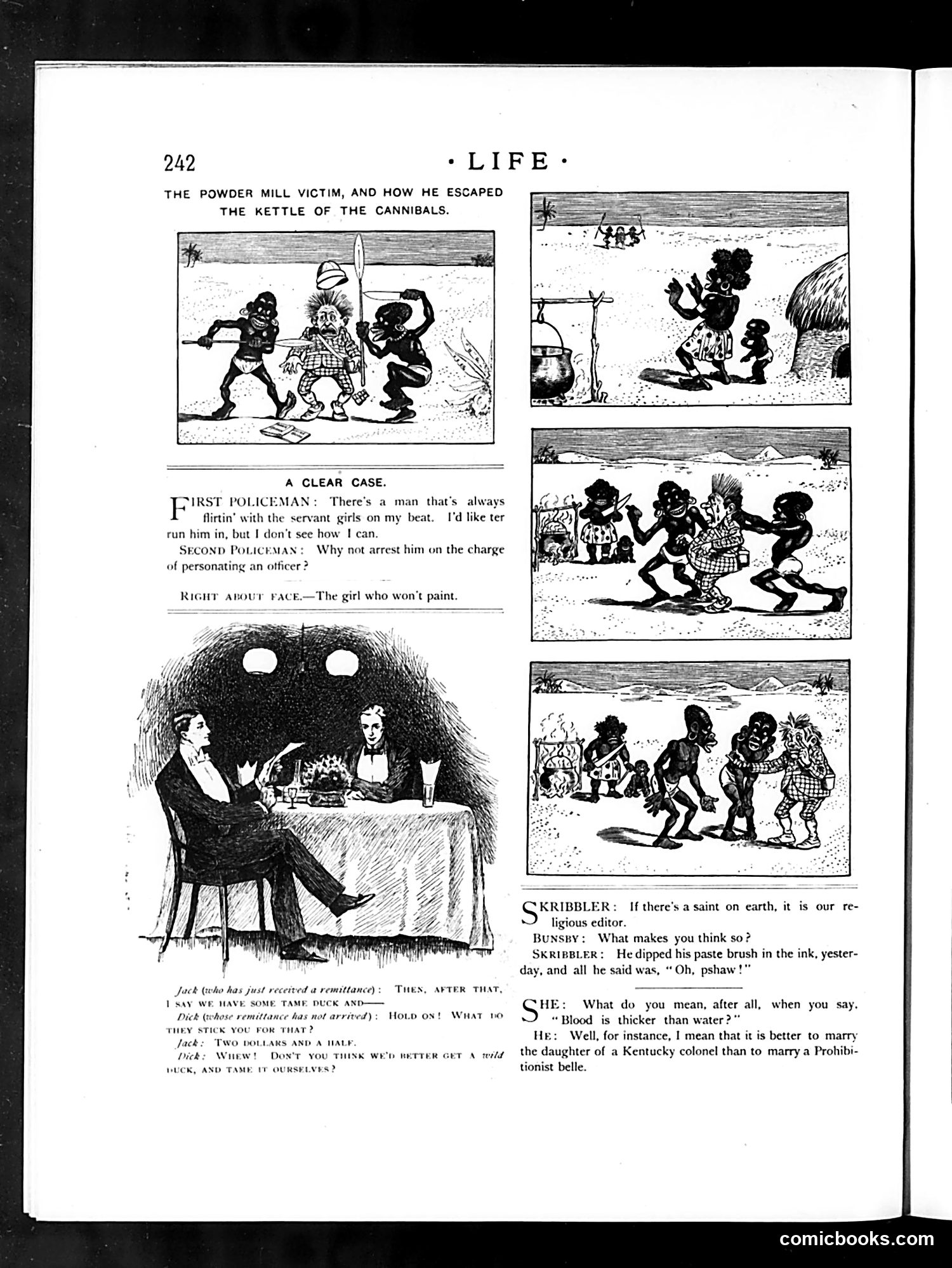
**Main Comic Strip (right side):** "The Powder Mill Victim, and How He Escaped the Kettle of the Cannibals" depicts a white man's rescue from indigenous people. This reflects early 20th-century adventure fiction tropes, using racist caricature to portray non-Europeans as savage "cannibals." **"A Clear Case" (left side):** A police conversation joke where officers debate arrest procedures. The punchline—"Right about face.—The girl who won't paint"—appears to reference a woman resisting cosmetics, though the satirical point is unclear without fuller context. **Bottom dialogue:** Exchanges between "Scribbler," "Bunsby," and "She"/"He" mock literary pretension and social conventions around marriage and class. The page exemplifies early Life magazine's blend of satirical commentary on contemporary manners with period-typical racist imagery.
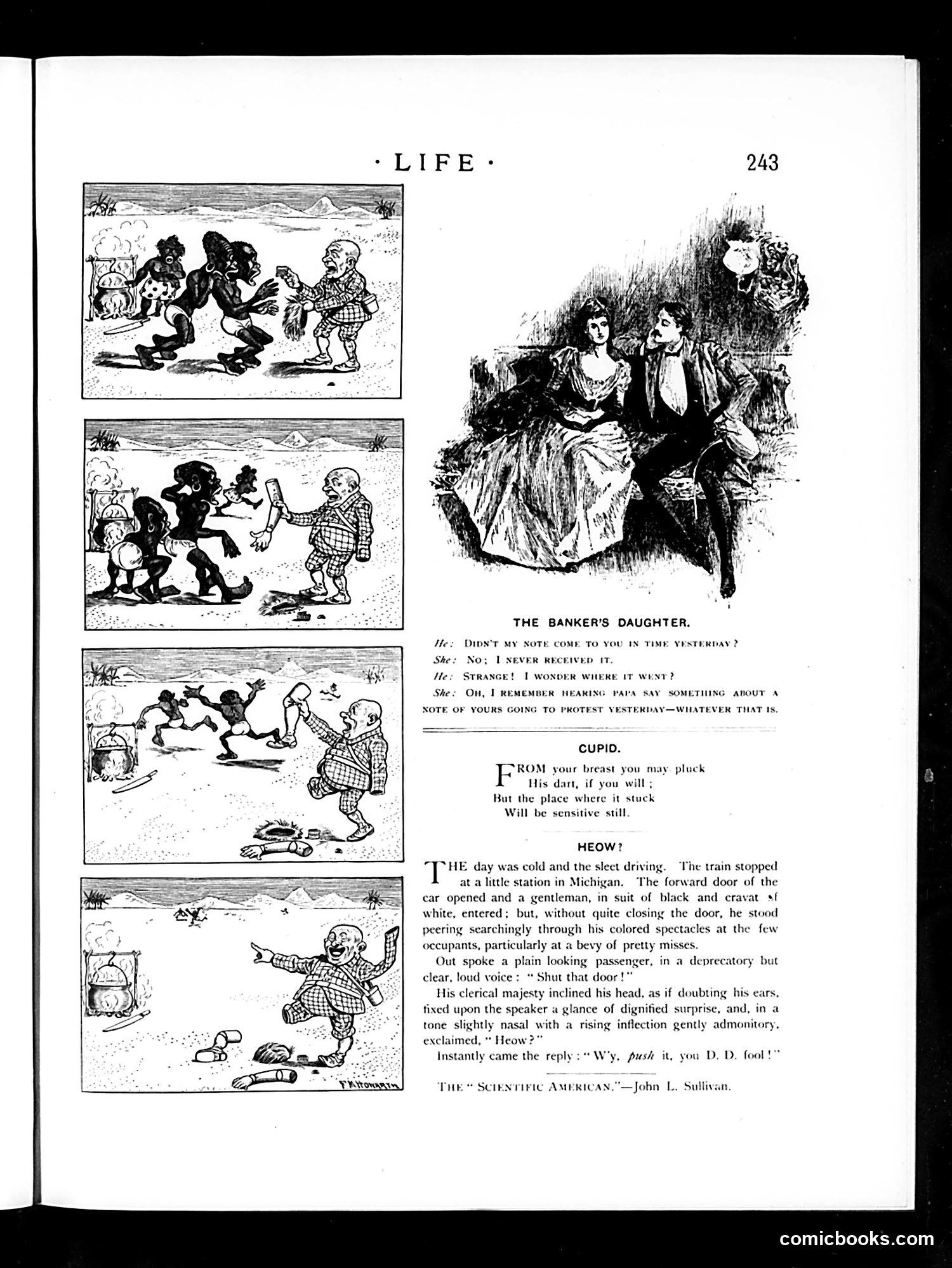
The page contains four sequential cartoon panels on the left showing slapstick comedy involving what appear to be minstrel or blackface performers and a man in checkered clothing engaged in physical altercation and pratfalls. On the right, "The Banker's Daughter" depicts a flirtation scene with dialogue about a missing note, likely satirizing romantic melodrama of the era. Below that, "Cupid" presents a brief poem about love's wounds. The final section "HEOW?" describes a train encounter where a gentleman enters a car and someone loudly asks "Shut that door!" The man responds with "Heow?" (appearing to mock an accent), prompting the retort "Wy, push, you D.D. fool!"—satirizing either regional dialect or class-based rudeness among passengers. The humor relies on period-typical physical comedy and social observation.
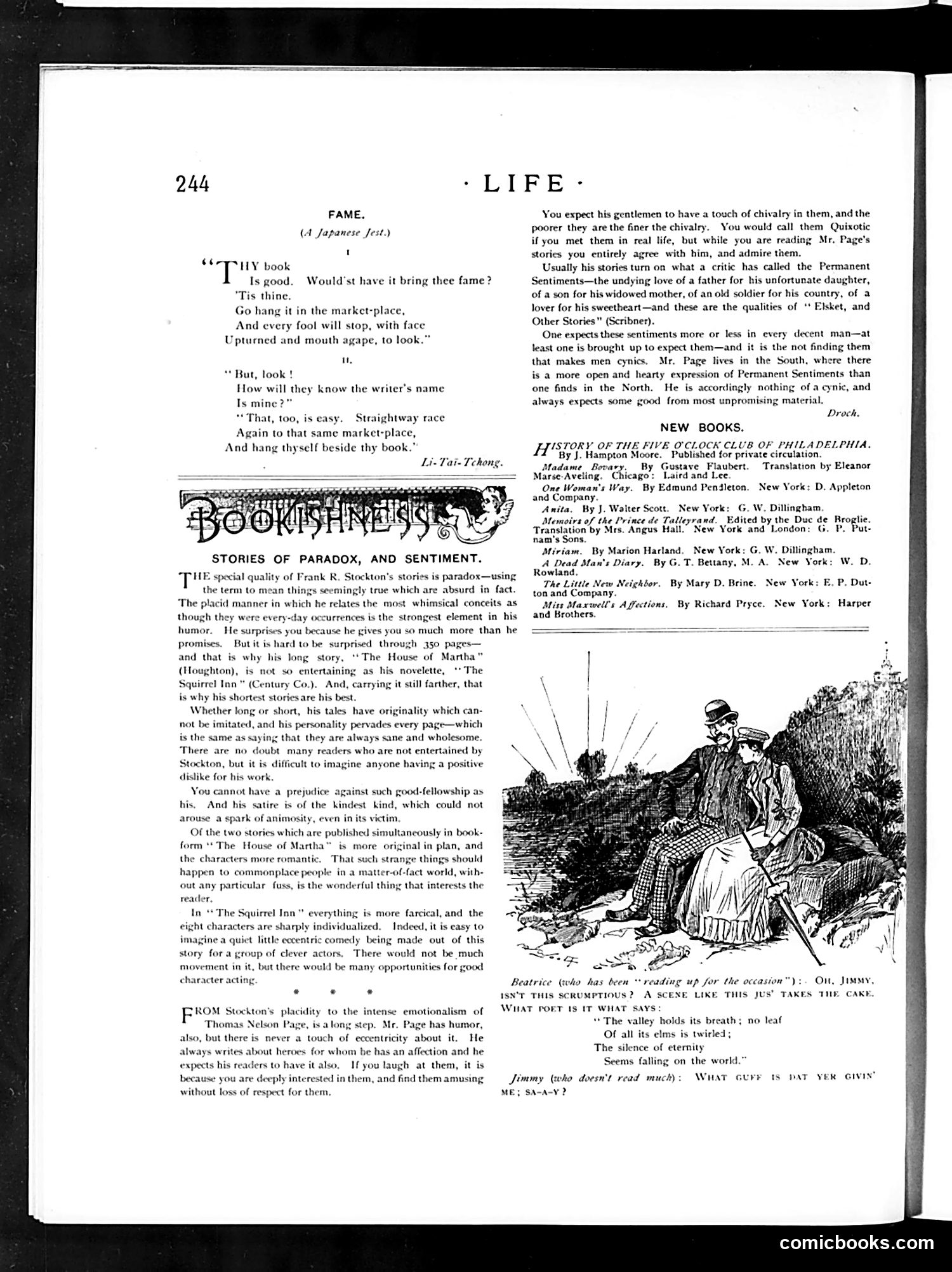
This page discusses **Frank R. Stockton's short stories**, praising their originality and humor. The main illustration depicts a romantic scene: a man and woman in period dress sitting outdoors, with the woman reading aloud. The caption indicates this illustrates a poem or story excerpt about a couple, with humorous dialogue where the woman teases the man about his inattention ("What guy is it what says: 'The valley holds its breath; no leaf / Of all its trees is stirred'"). The page is primarily **literary criticism and book reviews** rather than political satire. It celebrates Stockton's ability to create entertaining, character-driven narratives that appeal to readers seeking genuine human emotion and humor—a notable contrast to more sensational contemporary fiction.
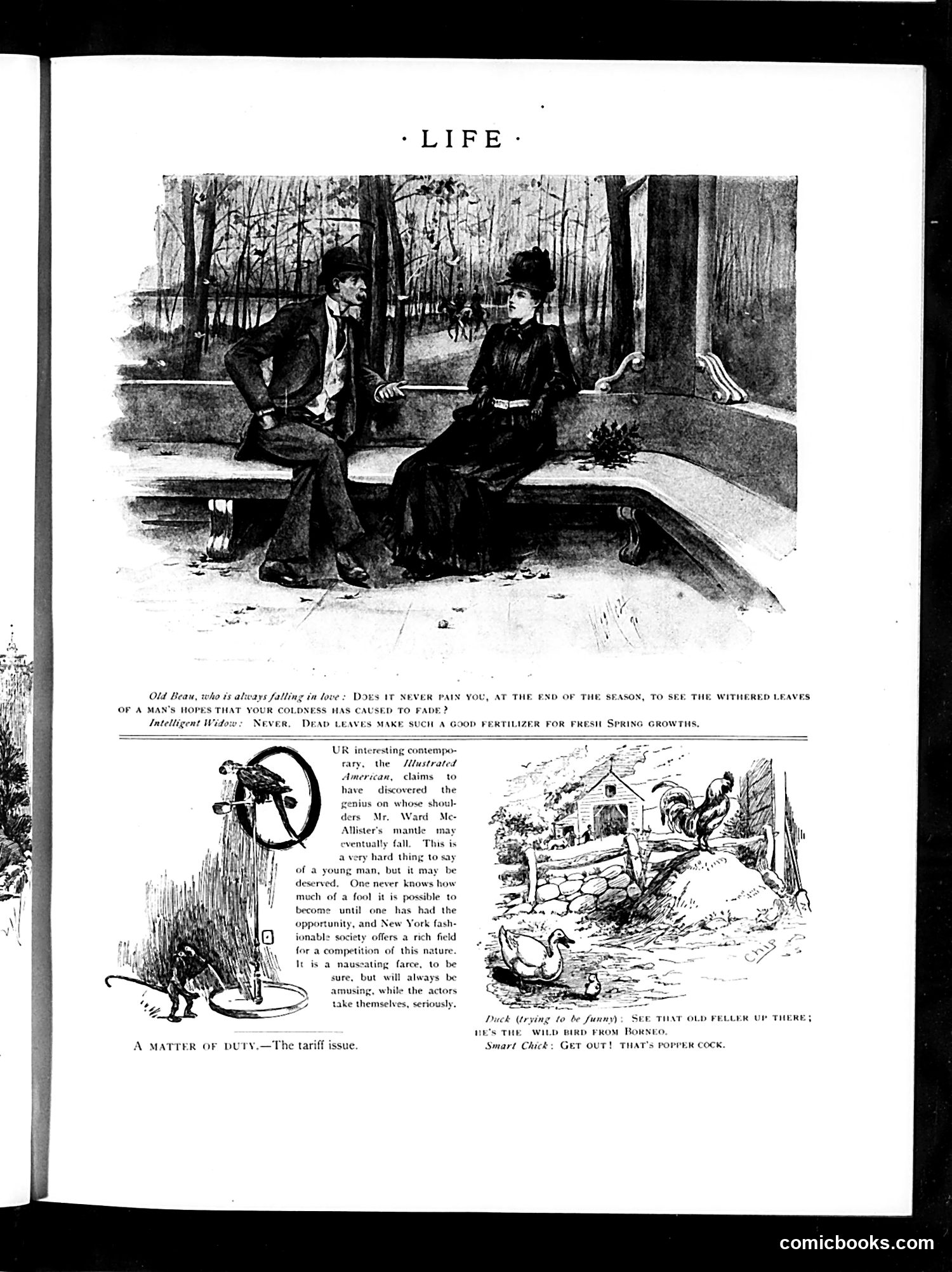
**Top Illustration**: A man and woman sit on a bench in a park. The caption sarcastically addresses "Old Bean" about romantic rejection, suggesting coldness has withered his hopes like autumn leaves—a commentary on unrequited love and social awkwardness in courtship. **"A Matter of Duty"**: This cartoon depicts tariff politics. The bicycle with large wheel represents the tariff issue itself; the figure struggling with it suggests difficulty managing this political burden. The text indicates this relates to Ward McMillen's political "mantle"—likely referencing a contemporary politician's contested leadership on tariff policy. **Bottom Right**: A rural farmyard scene with comic dialogue between ducks, using them to satirize social pretension or absurdity. The page satirizes both romantic and political misadventures of the era.
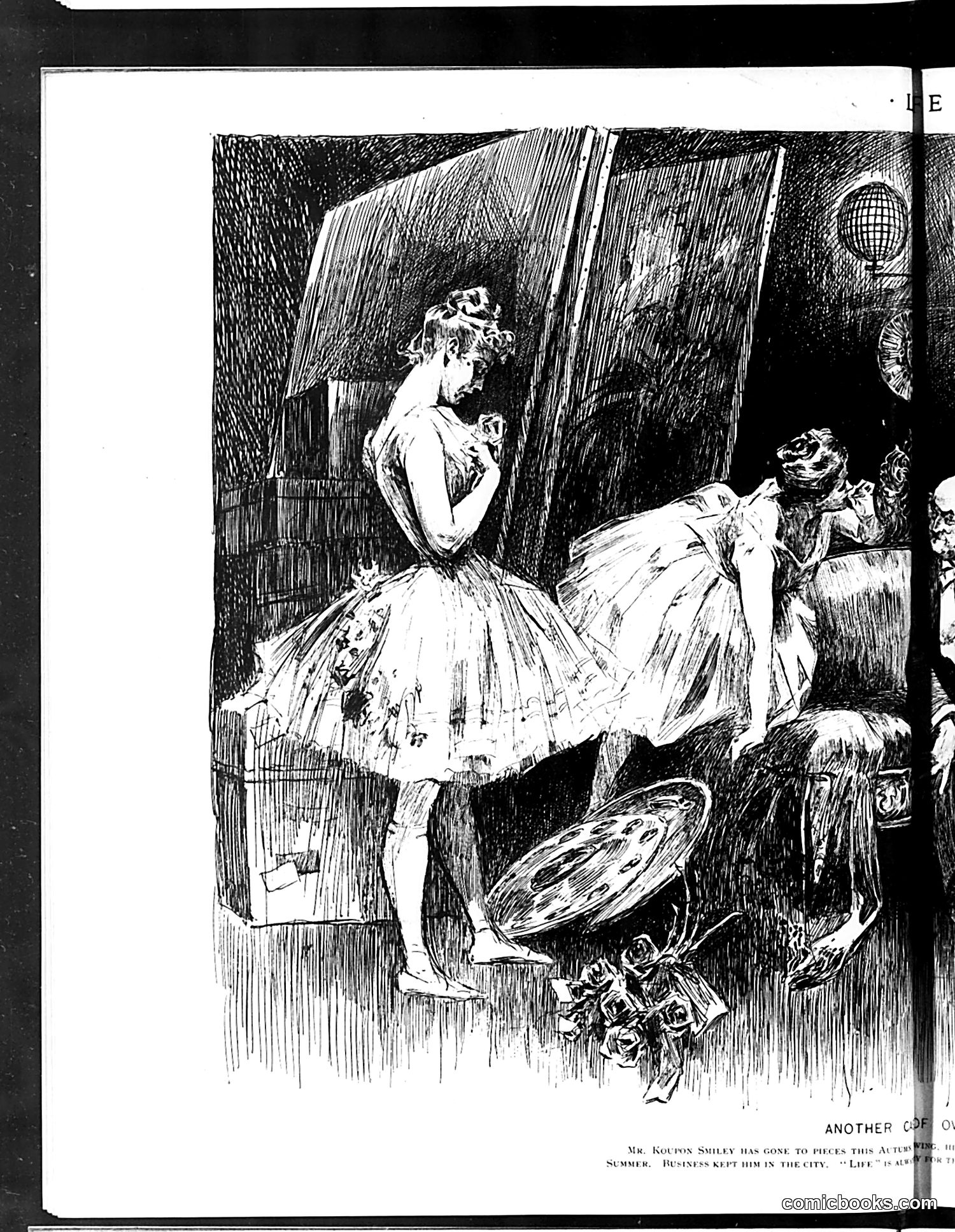
This appears to be a theatrical or backstage scene illustration from *Life* magazine. The image shows elegantly dressed women in ballet tutus in what seems to be a dressing room, with one woman prominently featured adjusting her costume while viewing herself (likely in a mirror). The partially visible caption at bottom references "Mr. Koutox Shirley has gone to pieces this autumn" and mentions "Business kept him in the city" and "'Life' is always like this." Without the complete caption text, the precise satirical point is unclear, but the illustration likely satirizes either theatrical life, the social pretensions of performers, or the contrast between summer leisure and urban life obligations. The style and subject matter suggest early 20th-century commentary on theatrical culture and society.
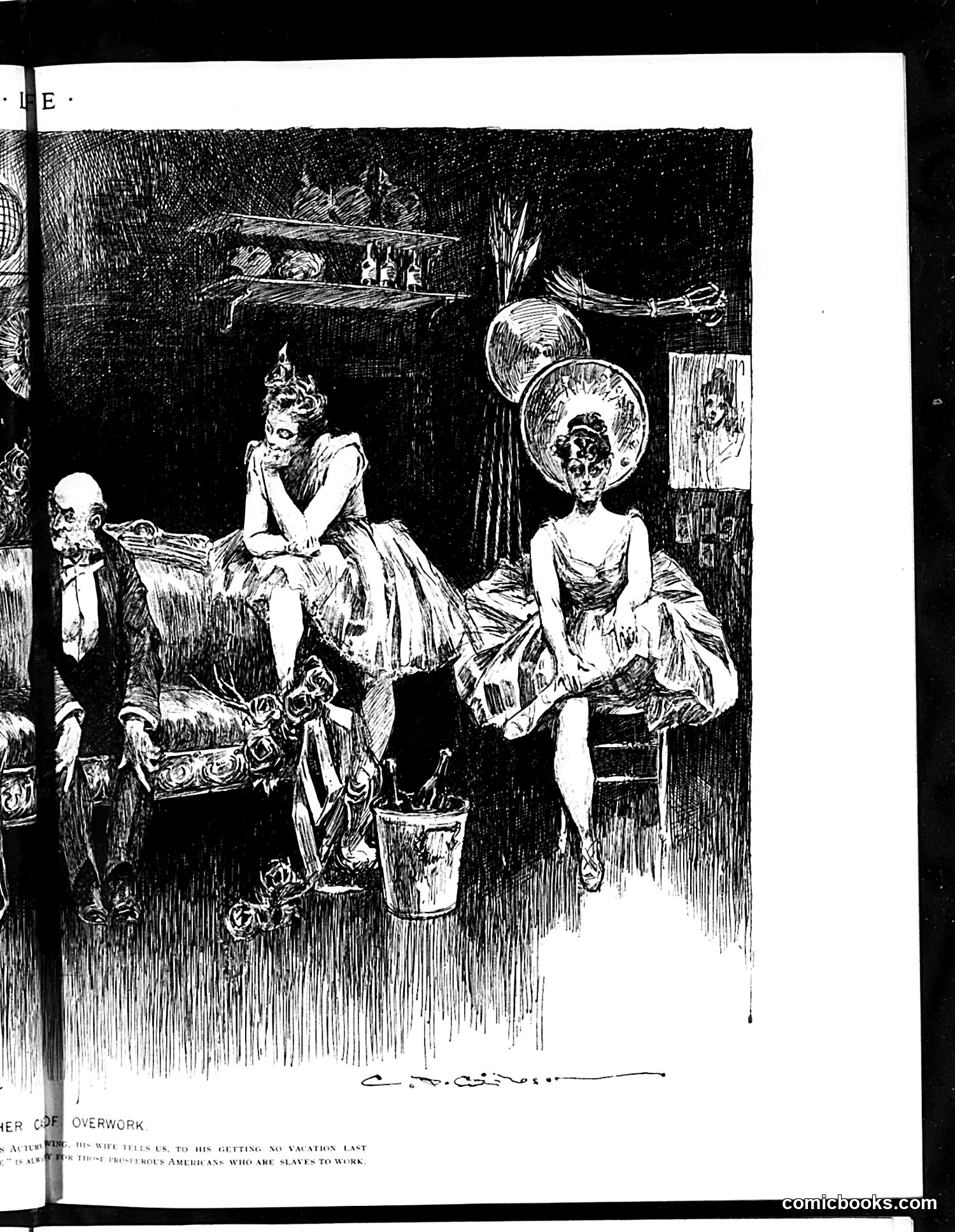
This appears to be a satirical cartoon from Life magazine criticizing American labor practices. The image depicts an elegant domestic scene with servants attending to wealthy figures, but the caption's reference to "getting no vacation last" and "those frivolous Americans who are slaves to work" suggests ironic commentary on American work culture. The cartoon likely contrasts European leisure and servant-based lifestyles with American workaholism, mocking wealthy Americans who lack the refined leisure time of European aristocracy. The exaggerated formal dress and domestic service setup emphasize this class-based satire. Without the complete caption visible, the specific political target remains unclear, but the overall point appears to critique American attitudes toward work versus rest.
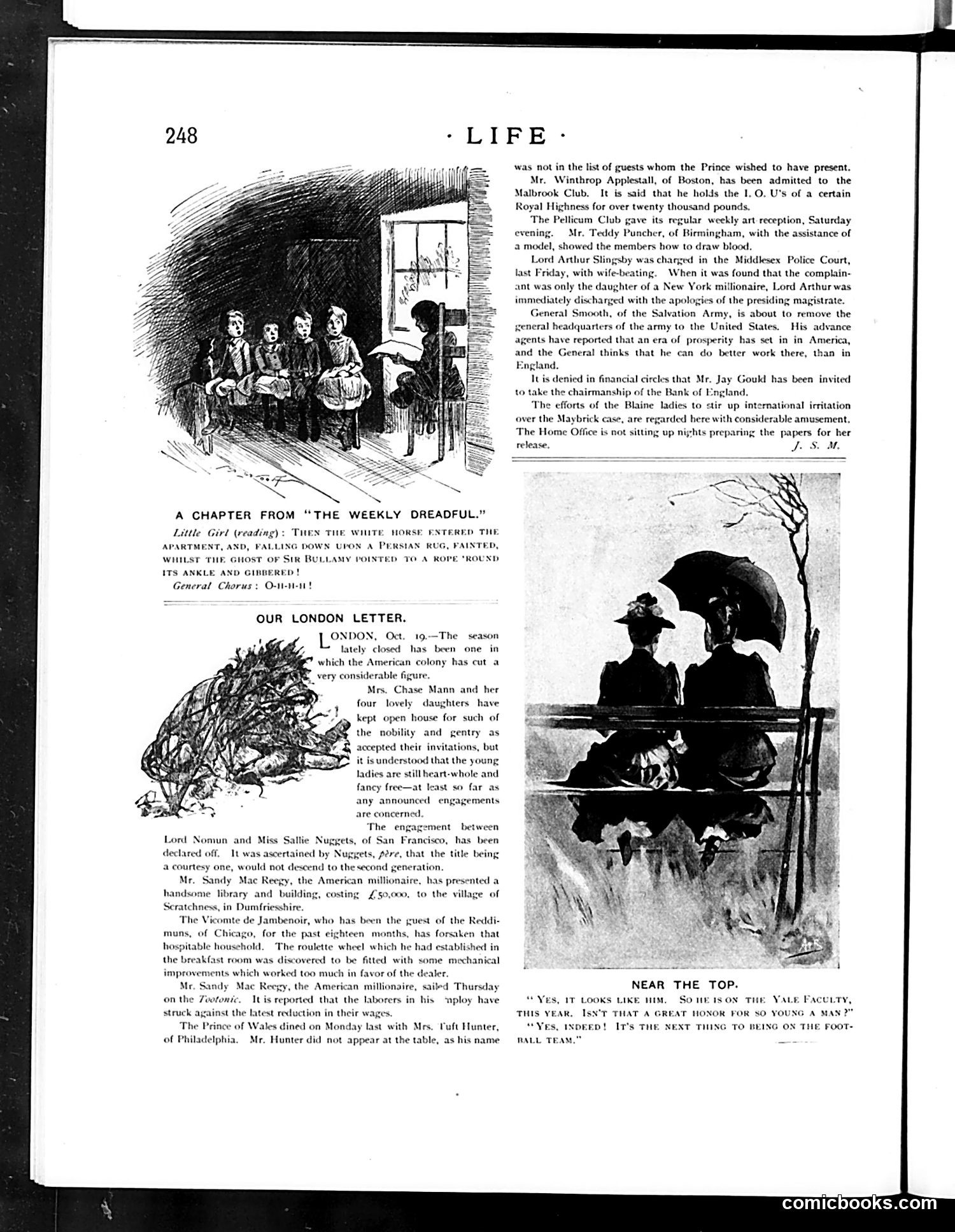
This page from *Life* magazine's "London Letter" column satirizes wealthy Americans' social climbing in late-19th-century British high society. The humor targets American millionaires desperately seeking prestige through titles, donations, and marriage alliances with British nobility. Key satirical targets include: - **American heiresses marrying for titles**: Lord Nomun breaks his engagement with San Francisco heiress Sallie Nuggets upon learning his title won't pass to heirs—exposing the transactional nature of these matches. - **Nouveau-riche philanthropy**: Sandy Mac Reegy's £50,000 library donation to a small Scottish village is mocked as ostentatious wealth-flaunting. - **Cheating aristocrats**: A British lord caught wife-beating is immediately discharged from court once the victim's identified as a New York millionaire's daughter—satirizing how wealth trumps justice. The cartoons mock American social pretension, particularly how wealthy Americans assume their money grants automatic entrée to British society and nobility, while exposing the cynicism and hypocrisy on both sides of the Atlantic.
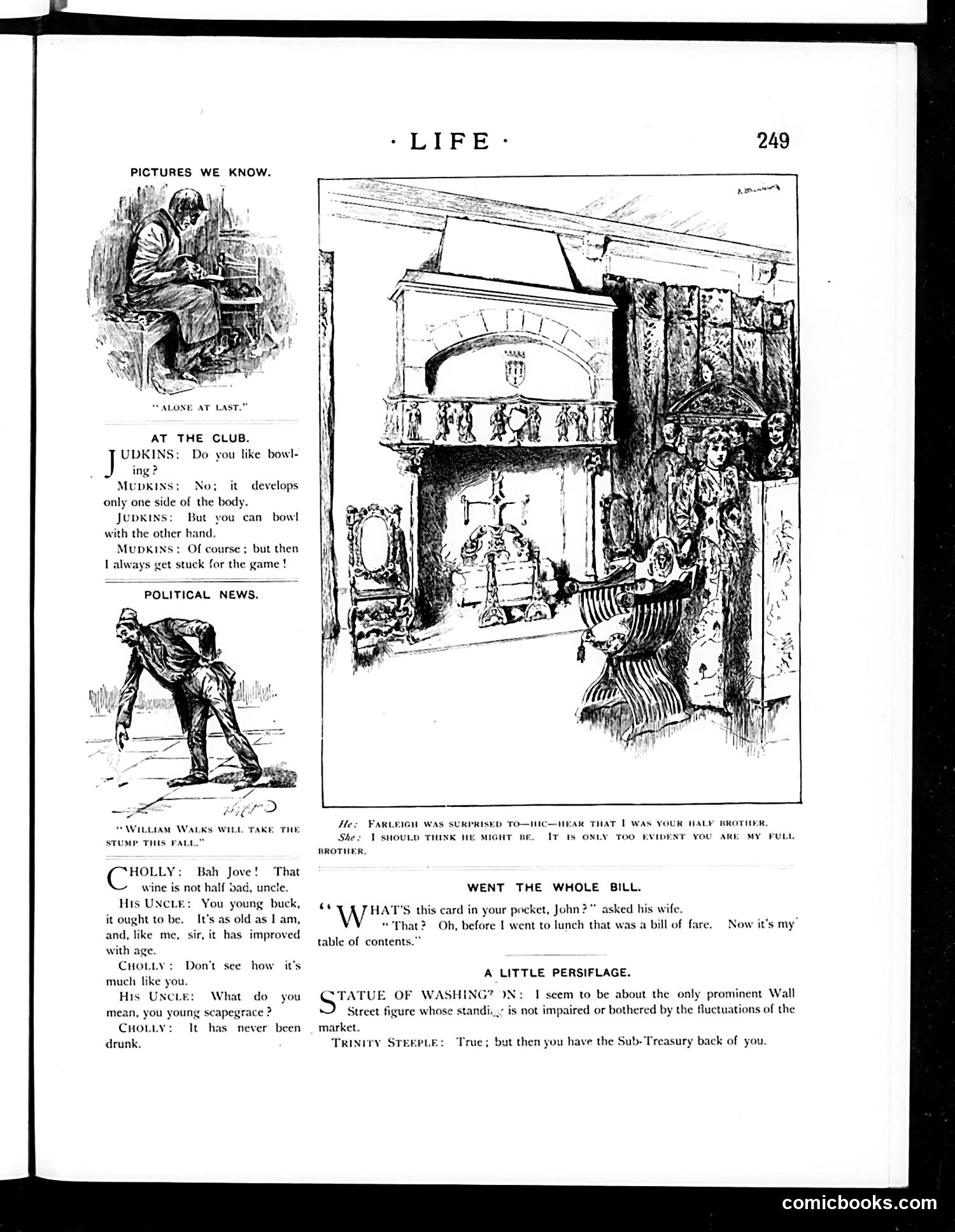
This page from *Life* magazine contains several brief comedic sketches targeting upper-class social behavior and contemporary politics: **"At the Club"** mocks wealthy men's casual conversation about bowling—a joke about physical asymmetry and incompetence. **"William Walks Will Take the Stump This Fall"** appears to reference a political figure (unclear which), depicted as a bent-over politician—likely mockery of a public figure's upcoming campaign. **The wine exchange** satirizes pretentious gentlemen claiming aged items improve with age, despite obvious contradictions. **"Went the Whole Bill"** jokes about a restaurant menu becoming a bill—a pun on expense. **"A Little Persiflage"** offers political satire: a Wall Street statue claims stability while the market fluctuates, but Trinity Steeple (the church) responds that it only appears stable because the Sub-Treasury (federal financial institution) backs it up—mocking Wall Street's dependence on government support during economic uncertainty.
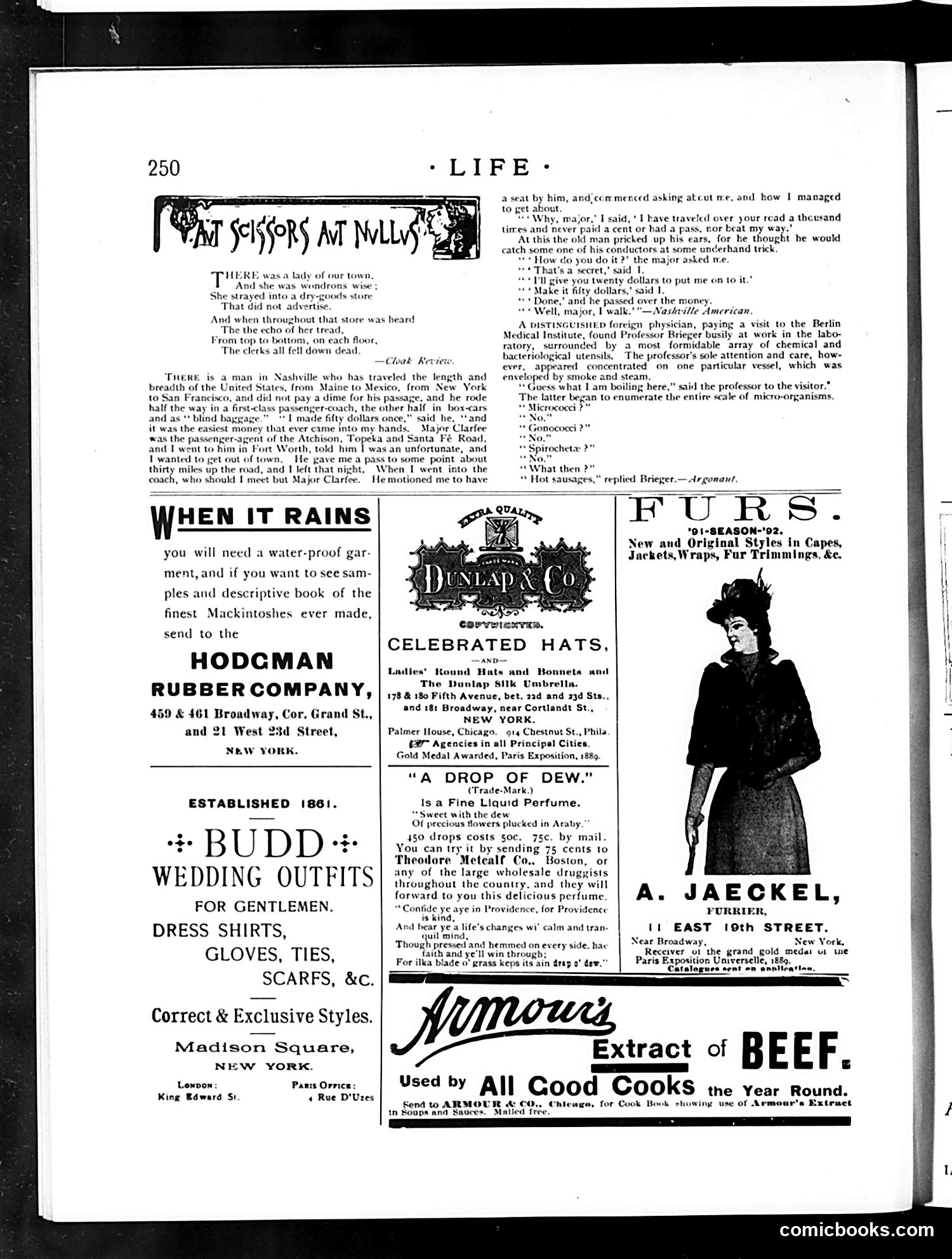
This page is primarily **advertisements** interspersed with two narrative pieces. The main illustrated content is "Scissors at Willis'" — a humorous poem about a woman so famously frugal that her mere presence in an unadvertised store causes clerks to faint in anticipation of her bargaining. Below that is a prose anecdote about a Nashville man who travels free by walking alongside trains rather than paying fares, which he reveals to a railroad major for fifty dollars. A third piece describes a Berlin professor boiling microorganisms in his laboratory. The page is otherwise dominated by period advertisements for rubber raincoats, celebrated hats, wedding attire, perfume, beef extract, and furs — typical late-19th-century *Life* magazine content. The humor is gentle social satire: poking fun at miserliness and clever drifters, typical of the magazine's light, observational comedy style.
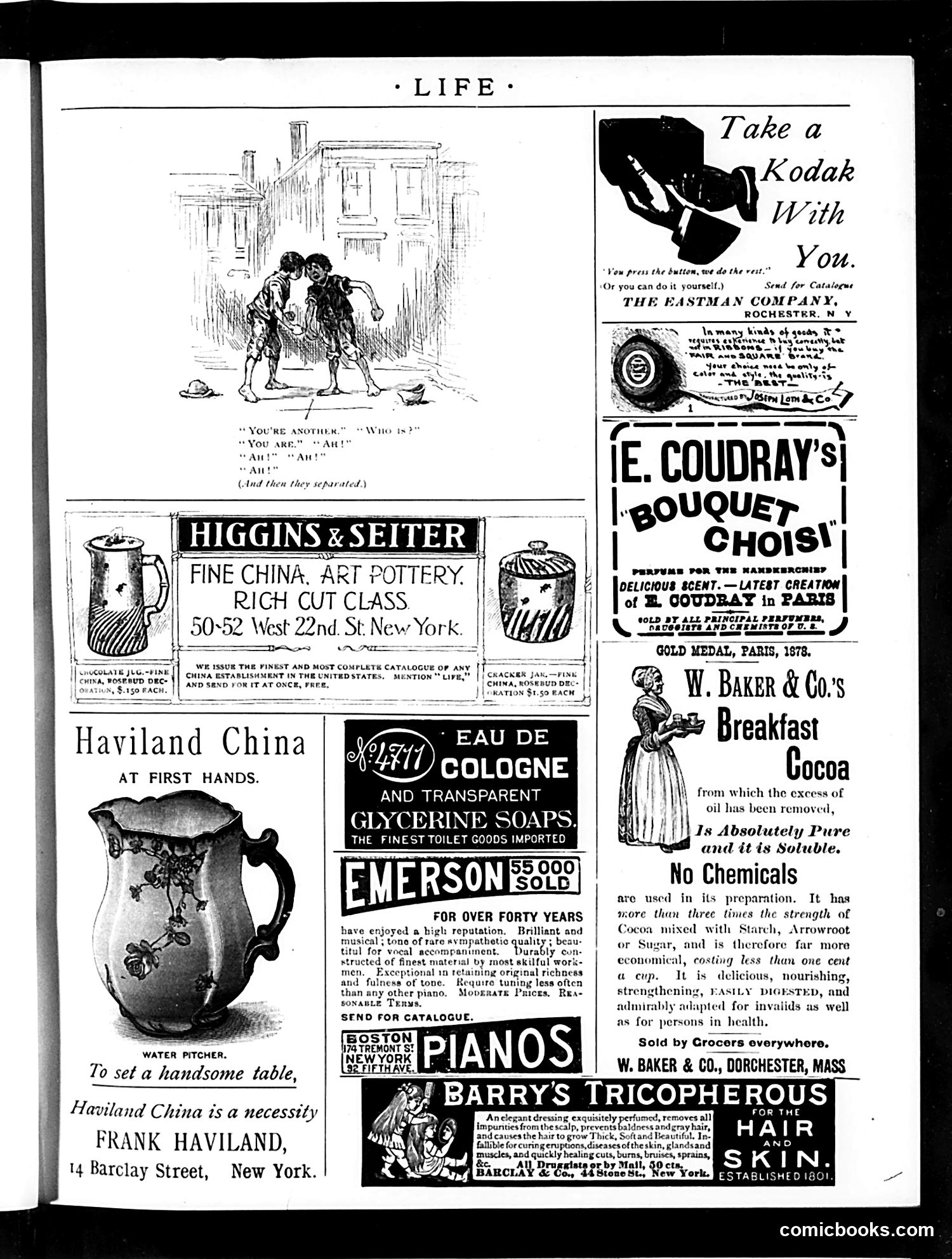
This page is primarily **advertisements** with one small cartoon at the top. ## The Cartoon The sketch shows two ragged street children in what appears to be confrontational posture. The caption reads: "You're another." "Who is?" "You are." "Ah!" "Ah!" "(And then they separated.)" This is a **humorous depiction of childish quarreling**—the joke being the circular, pointless nature of children's arguments where neither can articulate what they're actually disagreeing about. It's gentle social comedy rather than political satire. ## The Advertisements The page features vintage product ads typical of early-20th-century Life magazine: china, pianos, breakfast cocoa, perfume, hair treatment, and photography equipment (Kodak). These ads reveal period consumer culture and typical product claims (purity, health benefits, quality craftsmanship). The Kodak tagline "You press the button, we do the rest" reflects the democratization of photography in this era.
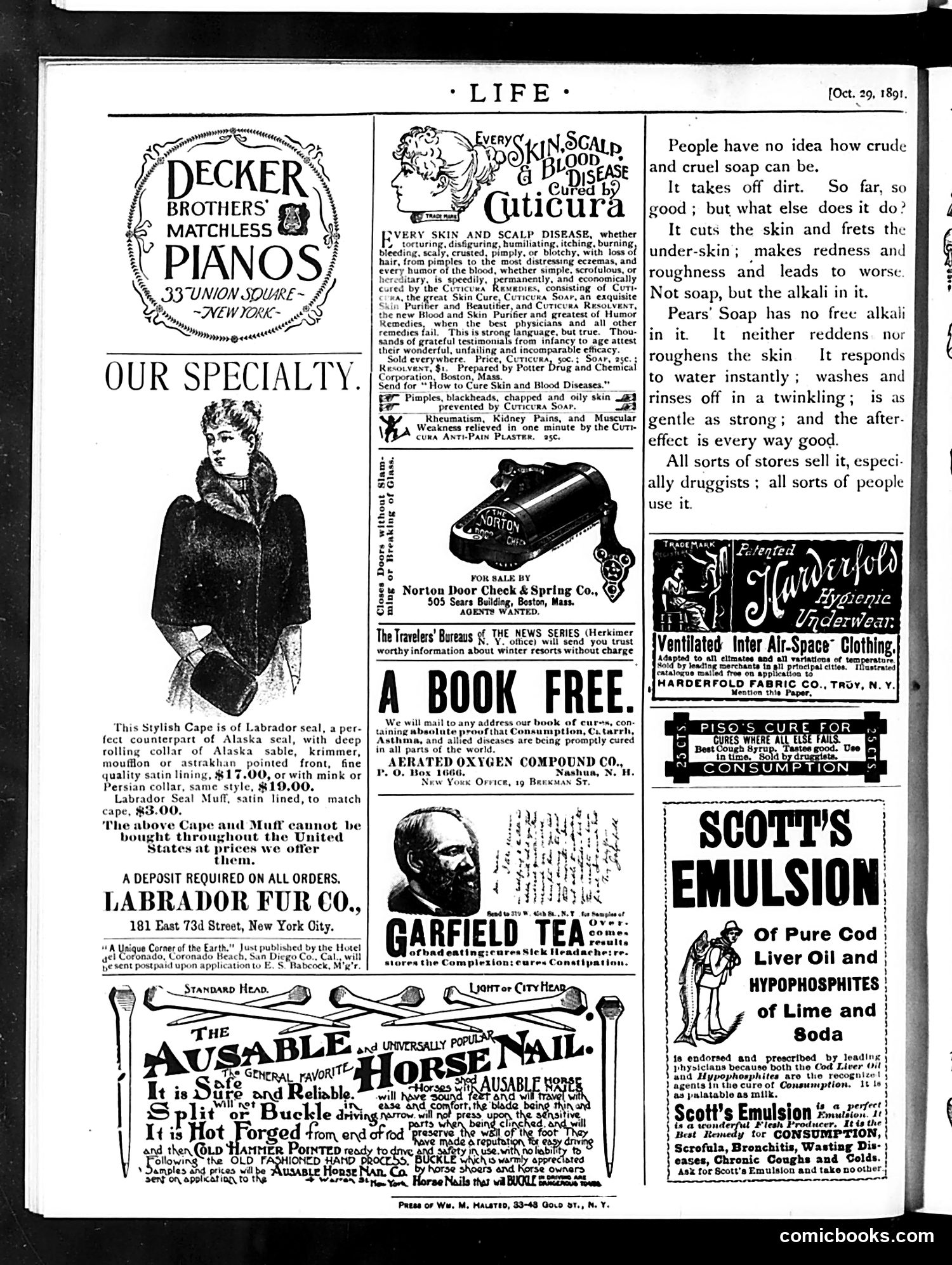
This is primarily an **advertising page** with no political cartoons or satire. The content reflects late-Victorian commercial culture and medical claims typical of the 1890s. Notable advertisements include: **Cuticura products** — claiming to cure "every skin and scalp disease" from pimples to eczema. These patent medicines made sweeping, unregulated health claims common in the era before FDA oversight. **Pears' Soap** — contrasts itself with competitors, claiming it contains "no free alkali" and won't irritate skin (a legitimate selling point, as many soaps were caustic). **Scott's Emulsion** — cod liver oil supplement marketed as a cure-all for consumption and other ailments. **Garfield Tea** — promised to cure constipation and headaches. The page also advertises luxury furs (Labrador seal capes), pianos, and horse nails. The tone reflects an era of unsubstantiated medical advertising and conspicuous consumption for the wealthy, not satire.