
Life, 1891-10-29 · page 4 of 16
Life — October 29, 1891 — page 4: what you’re looking at
What you’re looking at
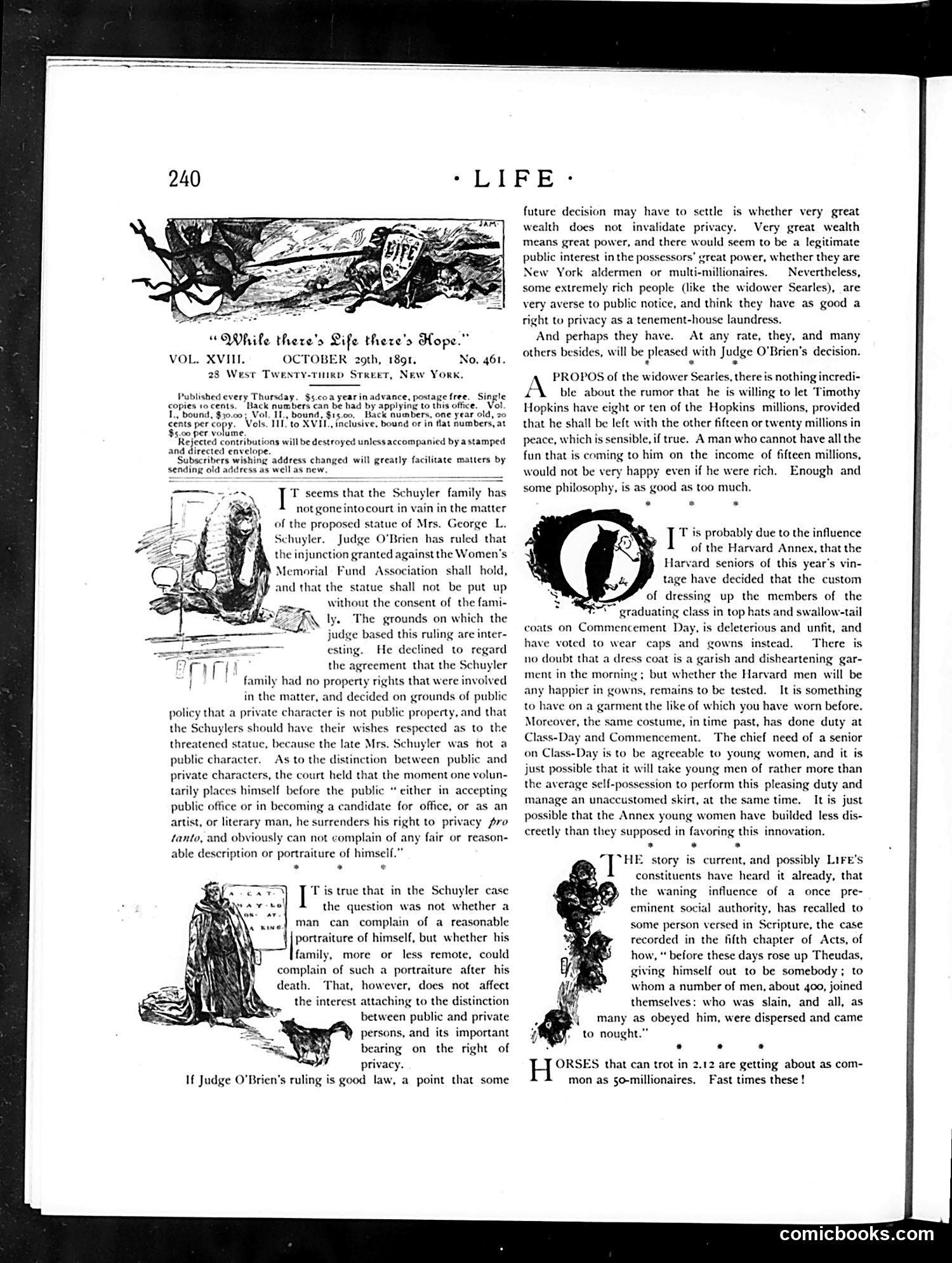
This page discusses the Schuyler family statue controversy and Harvard dress code reforms—both reflecting 1890s debates about propriety and public versus private matters. The **Schuyler case** involved whether a widow could erect a statue honoring her late husband without family consent. Judge O'Brien ruled the private character claim overrode public memorial concerns, establishing legal precedent for privacy rights. The **Harvard Annex** (Radcliffe College) story concerns seniors voting to wear academic caps and gowns instead of elaborate dress coats on Commencement Day. The satire mocks this as an unnecessary innovation, questioning whether young women really need such "unaccustomed" formal attire—poking fun at emerging women's education and evolving social conventions. Both items satirize contemporary anxieties about changing social norms and institutional traditions.
📄 Transcribed text from this page (OCR, searchable)
Machine-transcribed from the original scan — historical spelling and the odd misread are preserved.
* LIFE: “While there's Life there's Hope.” VOL. XVIII. OCTOBER 2gth, 1891. No, 461. 28 West Twexty-tinrp Street, New York. Published every Thursday. $5.coa year in advance, postage free. Single copies rocents. Back numbers can be had by applying to this office. Vol. 1,, bound, $30.00; Vol. IT., bound, $15.00, Back numbers, one year old, 20 gents per copy. Vols. IT’ to XVIT., inclusive, bound or in flat numbers, at $5.00 per volume. Rejected contributions will be destroyed unlessaccompanied by a stamped. and directed envelope. Subscribers wishing address changed will greatly facilitate matters by sending old address as well as new. T seems that the Schuyler family has not gone intocourt in vain in the matter of the proposed statue of Mrs. George L. Schuyler. Judge O’Brien has ruled that the injunction granted against the Women’s Memorial Fund Association shall hold, and that the statue shall not be put up without the consent of the fami- \, ly. The grounds on which the judge based this ruling are inter- esting, He declined to regard the agreement that the Schuyler family had no property rights that were involved in the matter, and decided on grounds of public policy that a private character is not public property, and that the Schuylers should have their wishes respected as to the threatened statue, because the late Mrs. Schuyler was not a public character. As to the distinction between public and private characters, the court held that the moment one volun- tarily places himself before the public “either in accepting public office or in becoming a candidate for office, or as an artist, or literary man, he surrenders his right to privacy fro tanto, and obviously can not complain of any fair or reason- able description or portraiture of himself.” T is true that in the Schuyler case the question was not whether a man can complain of a reasonable portraiture of himself, but whether his family, more or less remote, could complain of such a portraiture after his death. That, however, does not affect the interest attaching to the distinction between public and private persons, and its important bearing on the right of privacy. If Judge O'Brien's ruling is good law, a point that some future decision may have to settle is whether very great wealth does not invalidate privacy. Very great wealth means great power, and there would seem to be a legitimate public interest in the possessors’ great power, whether they are New York aldermen or multi-millionair Nevertheless, some extremely rich people (like the widower Searles), are very averse to public notice, and think they have as good a right to privacy as a tenement-house laundress. At any rate, they, and many will be pleased with Judge O'Brien's decision. * . * And perhaps they have. others beside: PROPOS of the widower Searles, there is nothing incredi- A ble about the rumor that he is willing to let Timothy Hopkins have cight or ten of the Hopkins millions, provided that he shall be left with the other fifteen or twenty millions in peace, which is sensible, if true. A man who cannot have all the fun that is coming to him on the income of fifteen millions, would not be very happy even if he were rich. Enough and some philosophy, is as good as too much. * . T is probably due to the influence of the Harvard Annex, that the Harvard seniors of this year’s vin- tage have decided that the custom of dressing up the members of the eraduating class in top hats and swallow-tail coats on Commencement Day, is deleterious and unfit, and have voted to wear caps and gowns instead. There is no doubt that a dress coat is a garish and disheartening gar- ment in the morning ; but whether the Harvard men will be any happier in gowns, remains to be tested. It is something to have on a garment the like of which you have worn before. Moreover, the same costume, in time past, has done duty at Class-Day and Commencement. The chief need of a senior on Class-Day is to be agreeable to young women, and it is just possible that it will take young men of rather more than the average self-possession to perform this pleasing duty and manage an unaccustomed skirt, at the same time. It is just possible that the Annex young women have builded le: creetly than they supposed in favoring this innovation. * * * “THE story is current, and possibly Lire's constituents have heard it already, that the waning a once pre- eminent social authority, has recalled to some person versed in Scripture, the case recorded in the fifth chapter of Acts, of how, “ before these days rose up Theudas, giving himself out to be somebody; to whom a number of men, about 400, joined themselves: who was slain, and all, as many as obeyed him, were dispersed and came s dis- influence of * * . ORSES that can trot in 2.12 are getting about as com- mon as 50-millionaires. Fast times these ! comicbooks.com