
Life, 1891-10-29 · page 8 of 16
Life — October 29, 1891 — page 8: what you’re looking at
What you’re looking at
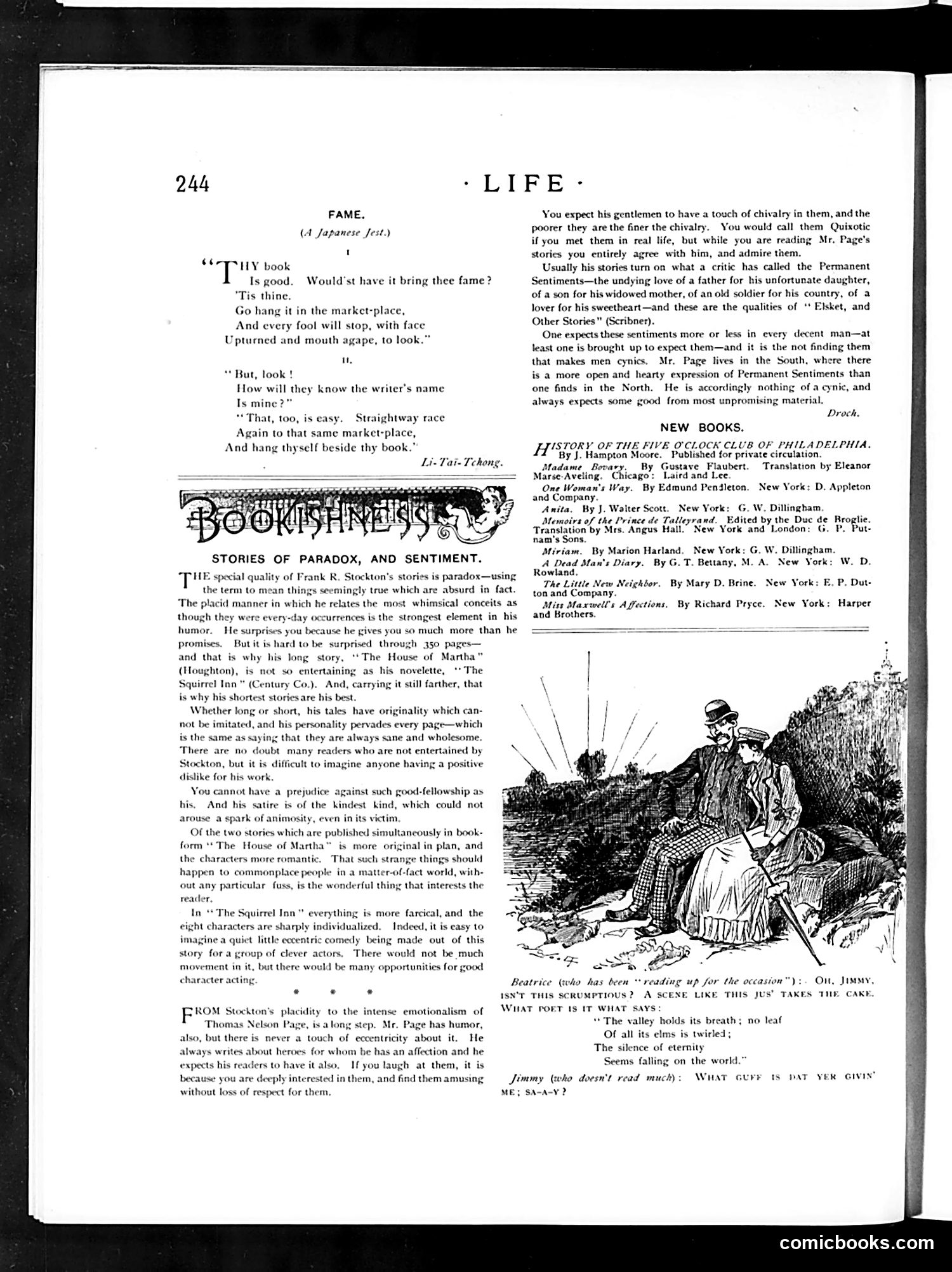
This page discusses **Frank R. Stockton's short stories**, praising their originality and humor. The main illustration depicts a romantic scene: a man and woman in period dress sitting outdoors, with the woman reading aloud. The caption indicates this illustrates a poem or story excerpt about a couple, with humorous dialogue where the woman teases the man about his inattention ("What guy is it what says: 'The valley holds its breath; no leaf / Of all its trees is stirred'"). The page is primarily **literary criticism and book reviews** rather than political satire. It celebrates Stockton's ability to create entertaining, character-driven narratives that appeal to readers seeking genuine human emotion and humor—a notable contrast to more sensational contemporary fiction.
📄 Transcribed text from this page (OCR, searchable)
Machine-transcribed from the original scan — historical spelling and the odd misread are preserved.
-LIFE- FAME. (A Japanese Jest.) 1 HY book Is good. ‘Tis thine. Go hang it in And every fool will st Would’st have it bring thee fame? marketplace, with fa Upturned and mouth agape, to look. n * But, look ! How will they know the writer's name Is mine?” “That, too, is easy. Straightway race Again to that same market-placi And hang thyself beside thy book.” ‘ai- Tchong. STORIES OF PARADOX, AND SENTIMENT. THE special quality of Frank R. § the term to mean things seemingly true which are absurd in fact. ‘The placid manner in which he relates the most whimsical conceits as though they were every-day occurrences is the strongest element in his He surprises you because he gives you so much more than he kton’s stories is paradox—using humor. promises, Butit is hard to be surprised through 350 pages— and that is why his long “The House of Marth: (Houghton), is not so entertaining as his novelett The Squirrel Inn” (Century Co.). And, carrying it still farther, that is why his shortest storiesare his best Whether long or short, his tales have originality which can- not be imitated, and his personality pervades every page—which is the same story s saying that they are always sane and wholesome. ‘There are no doubt many readers who are not entertained by Stockton, but it is difficult to imagine anyone having a posit dislike for his work. You cannot have a prejudice against such good-fellowship as his, And his satire is of the kindest kind, which could not arouse a spark of animosity, even in its victim. Of the two stories which are published simultancously in book- form “The House of Martha” the characters more romant happen to © is more original in plan, and at such strange things should matter-of-fact world, with- mmonplace people in out any particular fuss, is the wonderful thing that interests the Phe Squirrel Inn everything is more farcical, and the ‘ht characters are sharply individualized. Indeed, it is easy 10 imagine a quict little eccentric comedy being made out of this clever actors, There would not be much sld be many opportunities for good character acting. . . ROM Stockton’s placidity to the intense emotionalism of Thomas Nelson Pa Mr. Page has humor, also, but there is never a touch of eccentricity about it. He always writes about heroes for whom be has an affection and he is along expects his readers to have it also, If you laugh at them, it is because you are deeply interested in them, and find them amusing without loss of respect for them, ME; S Beatrice (who has been ISN'T THIS SCRUMPTIOUS ? WHAT PORT 18 IT WHAT SAY Jimmy (who doesn't read much): You expect his gentlemen to have a touch of chivalry in them, and the poorer they are the finer the chivalry. You would call them Quixotic if you met them in real life, but while you are reading Mr. Page's stories you entirely agree with him, and admire them, Usually his stories turn on what a critic has called the Permanent Sentiments—the undying love of a father for his unfortunate daughter, of a son for his widowed mother, of an old soldier for his country, of a lover for his sweetheart—and these are the qualities of * Elsket, and Other Stories” (Scribner). One expects these sentiments more or less in every decent man—at least one is brought up to expect them—and it is the not finding them that makes men cynics. Mr. Page lives in the South, where there is a more open and hearty expression of Permanent Sentiments than one finds in the North. He is accordingly nothing of a cynic, and always expects some good from most unpromising material, Droch. NEW BOOKS. HUSTORY OF THE FIVE O'CLOCK CLUB OF PHILADELPHIA. By J. Hampton Moore. Published for private circulation. Madame Bovary. By Gustave Flaubert. Translation by Eleanor Marse-Aveling. Chicago: Laird and Lee One Woman's Way. By Edmund Pendleton. and Company. Anita, By J. Walter Scott, New York: G, W. Dillingham Memoirs of the Prince de Talleyrand. Edited by the Duc de Broglie. Translation by Mrs. Angus Hall. New York and London: G. P. Pure nam’s Sons. Miriam. By Marion Harland, New York: G. W. Dillingham. A Dead fan's Diary. By G.T. Bettany, M. A. New York: W. D. Rowland. The Little New Neighbor. ton and Company. Miss Maxwell's Affections. and Brothers. New Yor: D. Appleton By Mary D. Brine. New York: E. P. Dut- By Richard Pryce. New York: Harper “reading up for the occasion”): OM, Jimmy, A SCENE LIKE THIS JUS’ TAKES THE CAKE ‘The valley holds its breath; no leaf Of all its elms is twirled ; The silence of eternity Seems falling on the world.” WHAT GUFF IS DAT YER GIVIN’ > comicbooks.com