
A complete issue · 14 pages · 1891
Life — October 1, 1891
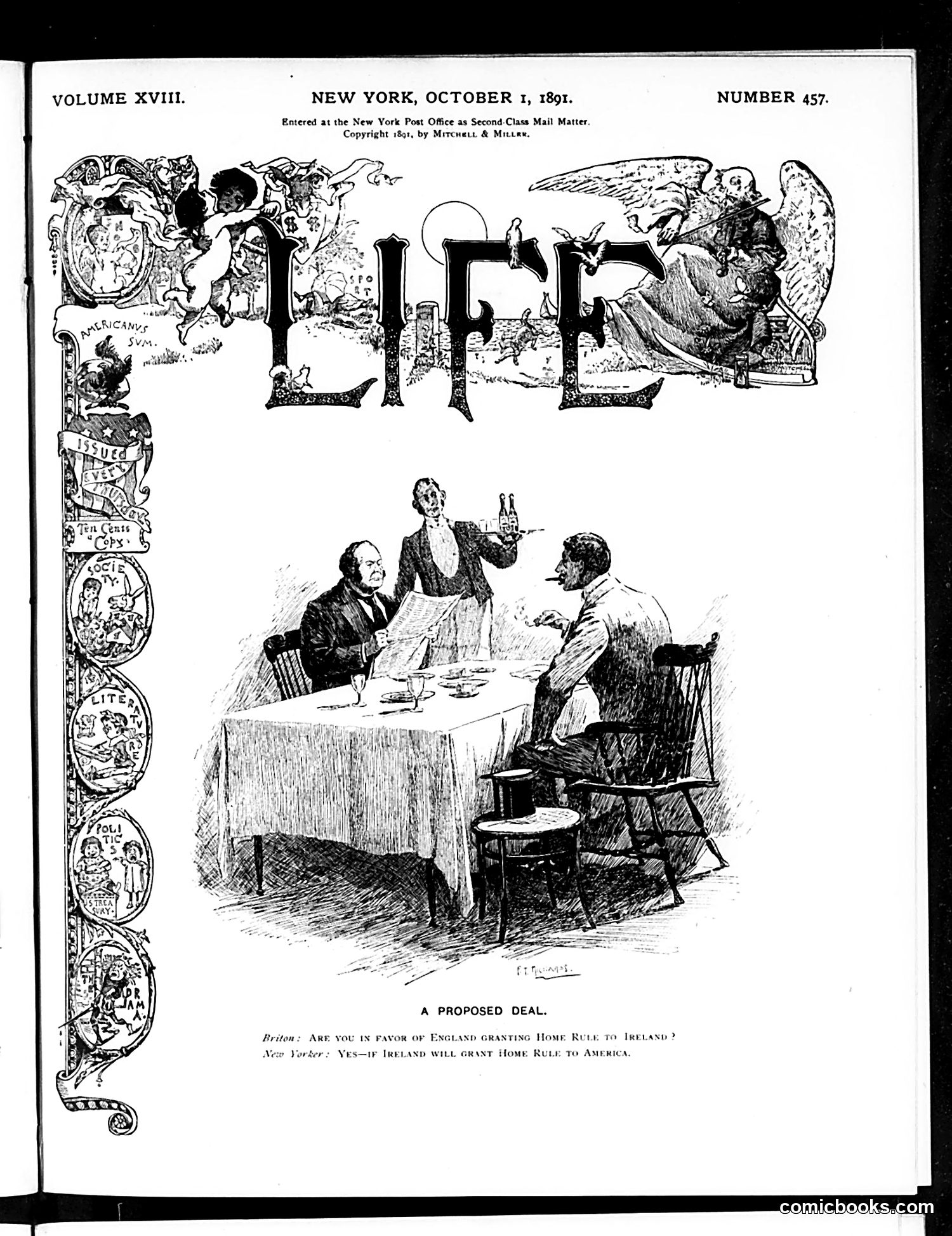
This political cartoon depicts a negotiation between a British figure (left) and an American figure (right), with a server presenting drinks. The caption presents a satirical exchange: **Britain**: "Are you in favor of England granting Home Rule to Ireland?" **New Yorker**: "Yes—if Ireland will grant Home Rule to America." The joke satirizes American-Irish political tensions. Irish immigration to America (particularly New York) created a large constituency sympathetic to Irish independence from British rule. The cartoon mocks this sentiment by suggesting Americans demanding reciprocal independence from Britain—implying the Irish-American position was hypocritical or absurd. It plays on the Irish-American political influence in American cities like New York during this period of intense Home Rule debate in British politics.
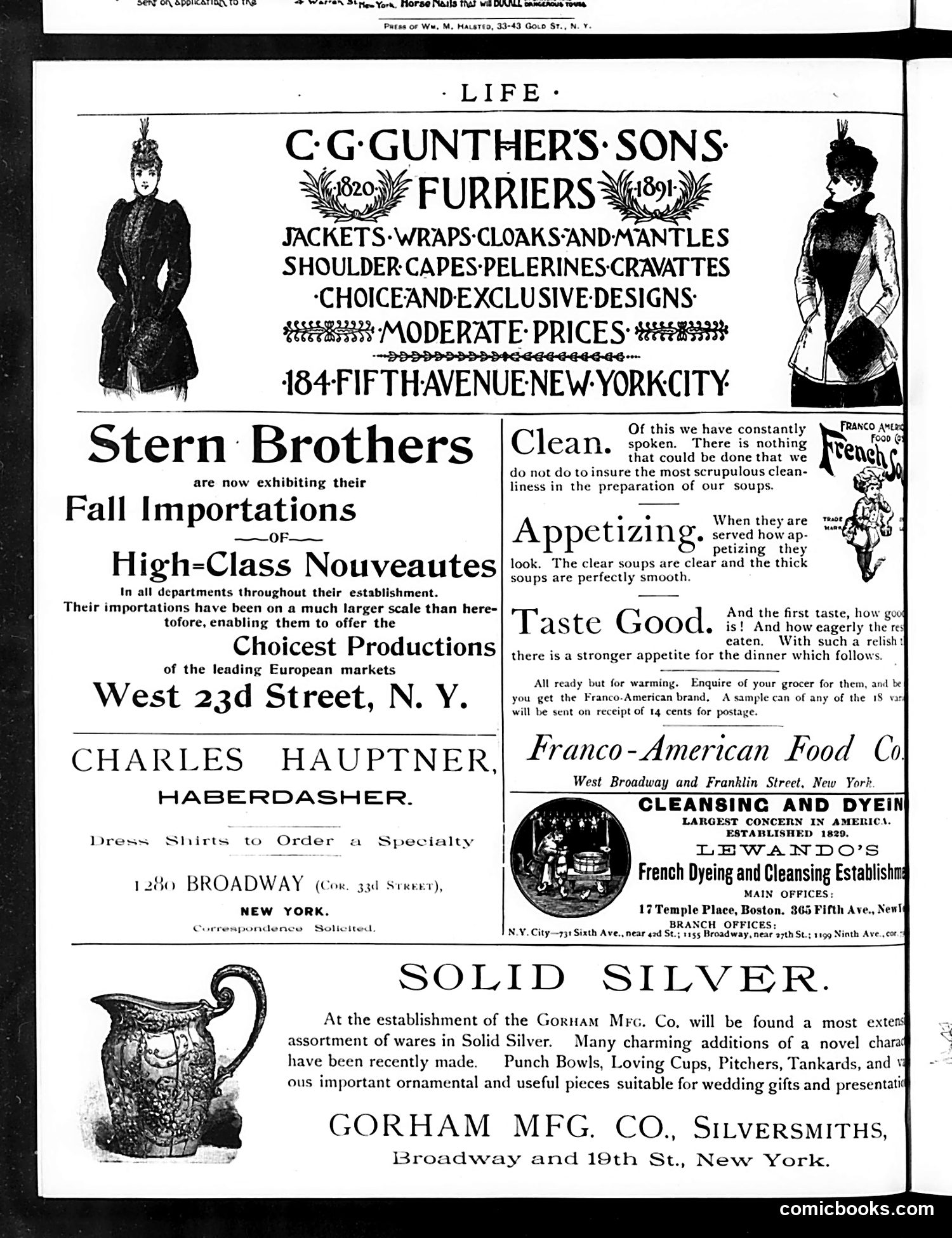
This page is **primarily advertising**, not satirical content. It contains several period advertisements: 1. **C.G. Gunther's Sons Furriers** (top) - promoting women's fur garments with fashion illustrations typical of the 1890s era. 2. **Stern Brothers** - announcing fall imported "High-Class Nouveautes" (fashionable goods) from European markets. 3. **Charles Hauptner, Haberdasher** - advertising custom dress shirts. 4. **Franco-American Food Co.** - promoting canned soups with claims about cleanliness and taste. 5. **Lewando's French Dyeing and Cleansing** - dry cleaning services. 6. **Gorham Mfg. Co.** - displaying solid silver dishware and ornamental pieces for weddings. The page reflects late 19th-century consumer culture targeting affluent New Yorkers, with no apparent political satire.
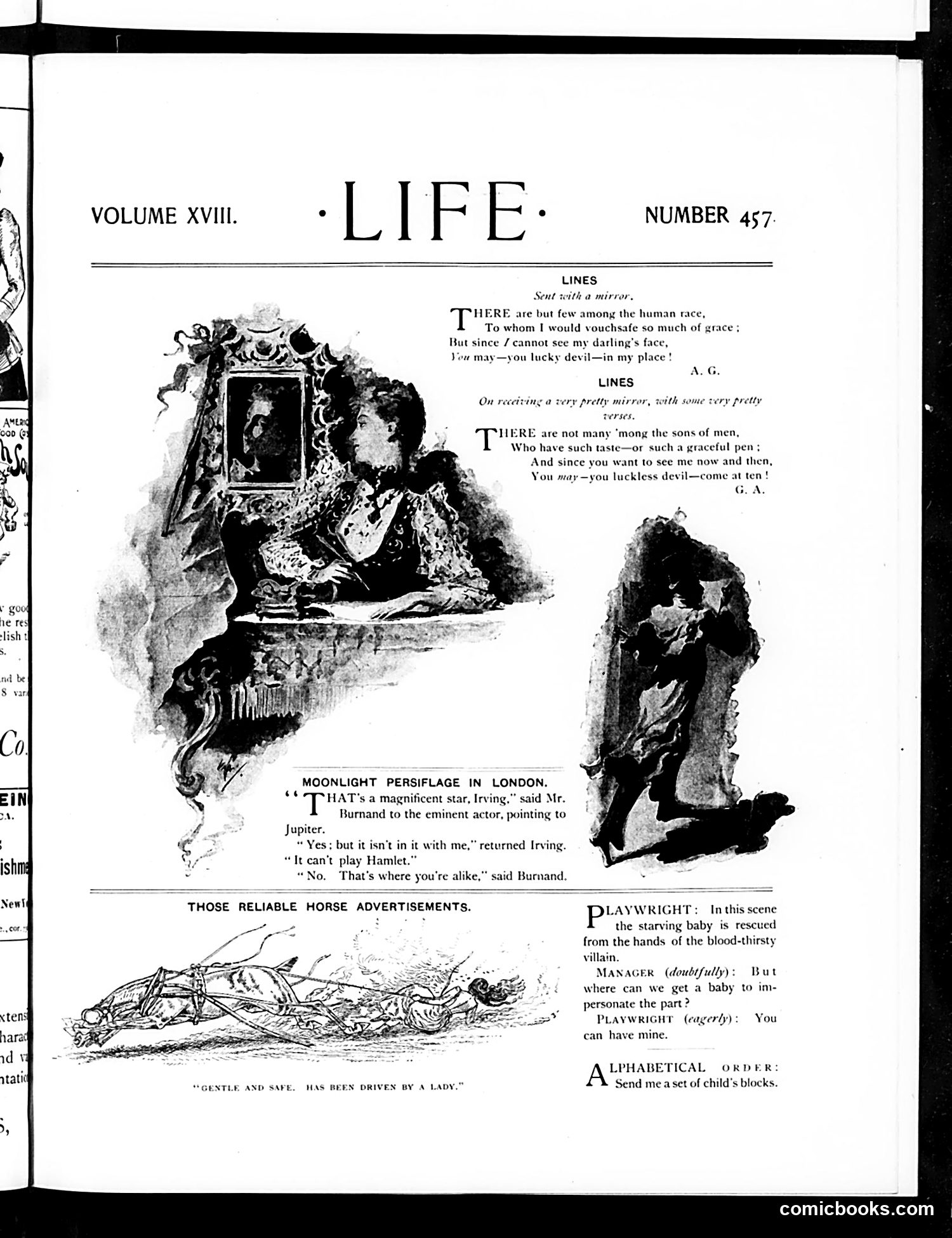
This page contains literary content and satirical sketches rather than political cartoons. The "Lines" poems reference romantic themes—one addresses a lover via mirror, another playfully chides someone for their absence. The main illustration, "Moonlight Persiflage in London," depicts two figures in Victorian dress discussing theatrical performance, with a reference to Irving (likely actor Henry Irving) and Hamlet. "Those Reliable Horse Advertisements" shows a horse-drawn carriage accident with the caption "Gentile and Safe. Has Been Driven by a Lady"—satirizing contemporary advertisements claiming horses or carriages were safe, while the image contradicts this claim. The final dialogue is a brief playwright sketch about rescuing a starving baby. The page is primarily literary/entertainment-focused rather than politically charged.
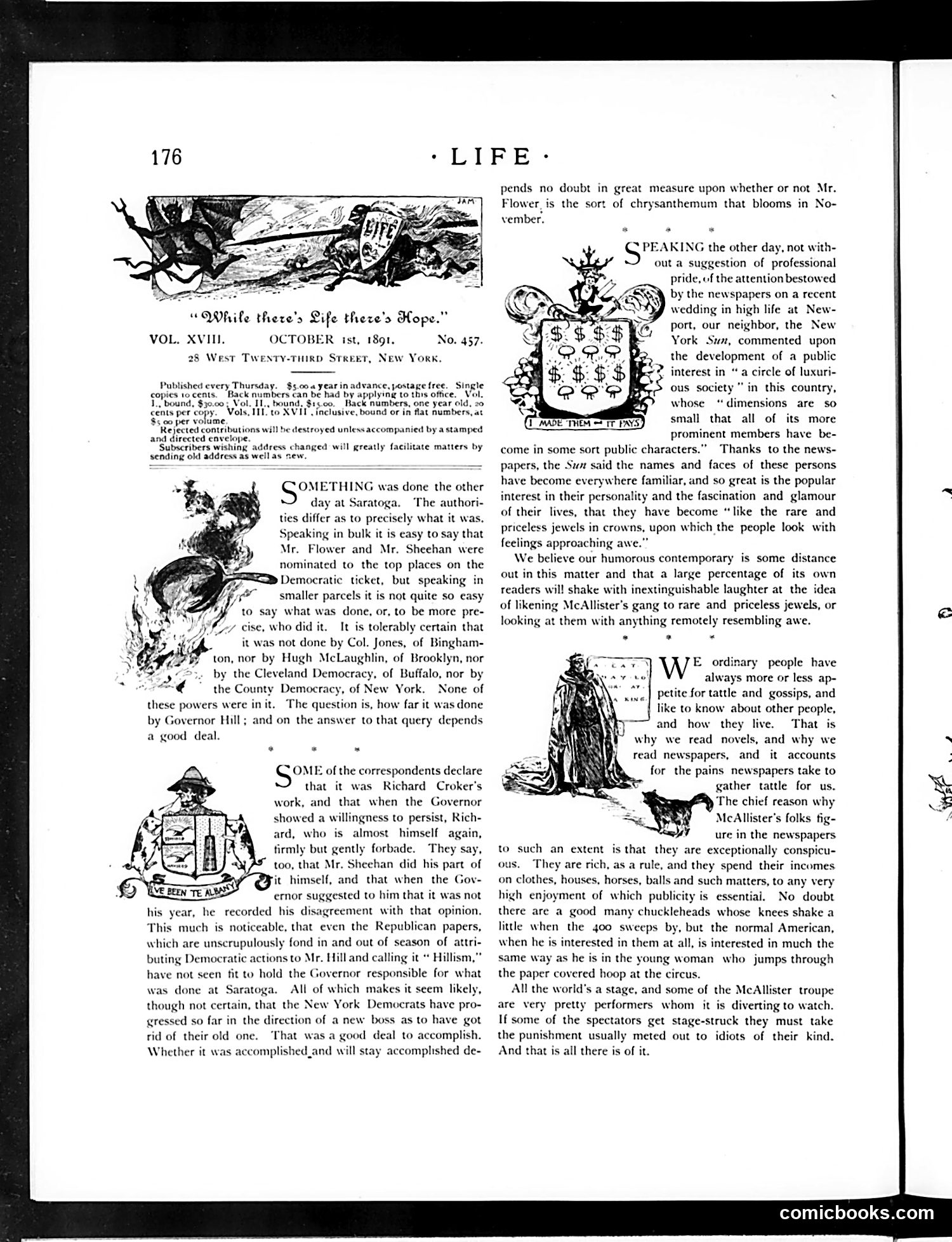
This page discusses a Democratic political event at Saratoga involving Governor Hill and Mr. Flower, though the specific incident remains unclear from the text alone. The article notes that attributing the action to various Democratic politicians—Col. Jones (Binghamton), Hugh McLaughlin (Brooklyn), Cleveland Democrats, or Tammany Hall—is difficult, suggesting internal party confusion or deliberate obfuscation. Richard Croker's involvement is mentioned, with claims he urged persistence despite the Governor's gentle objections. The satirical point appears to be mocking Democratic disorganization and finger-pointing over responsibility for whatever occurred. The accompanying cartoons (visible but details unclear) likely reinforce this criticism of party leadership infighting during this period of factional Democratic strife.
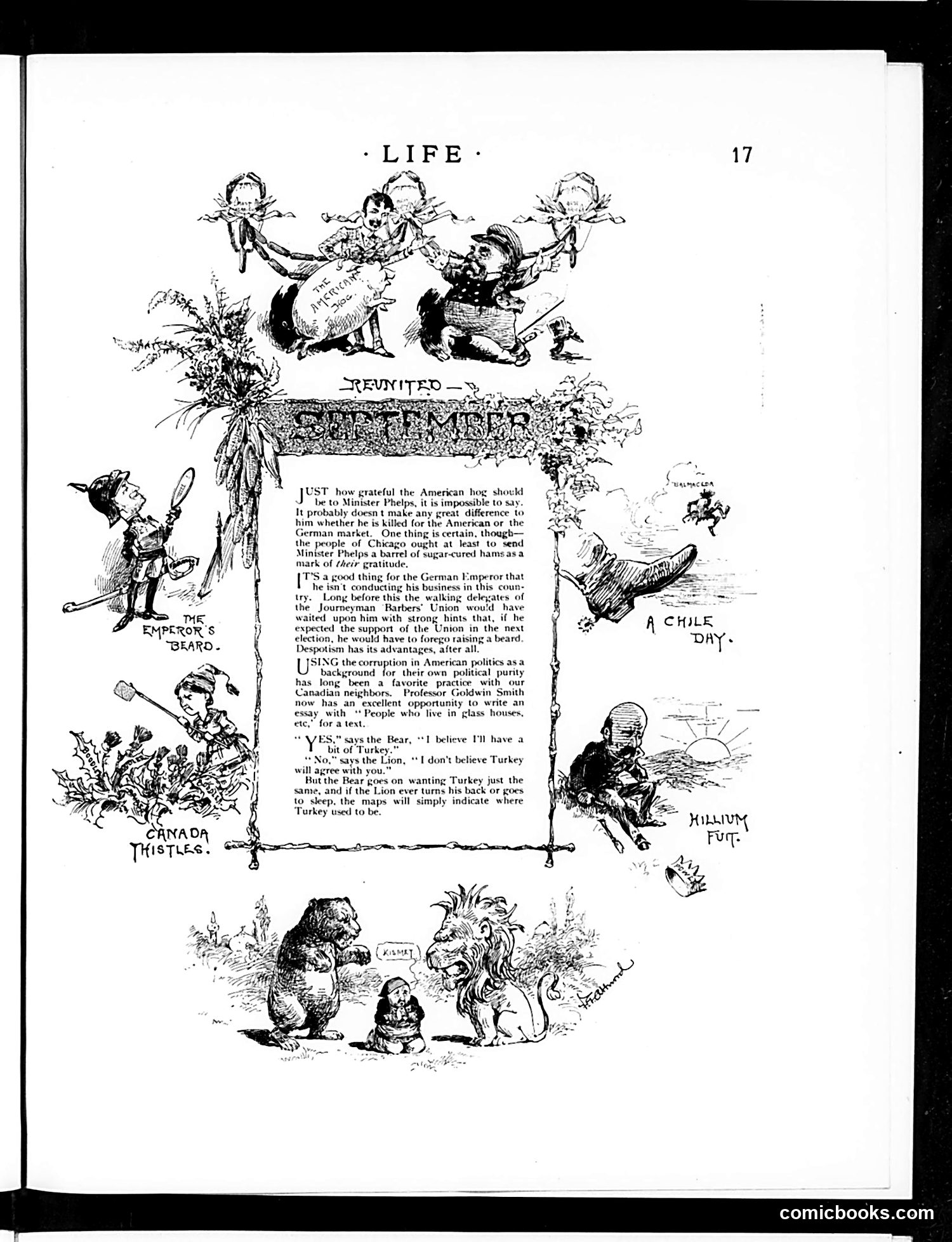
This political cartoon satirizes American foreign policy regarding various nations. The central text debates whether the U.S. should support Turkey, with a "Bear" (Russia) and "Lion" (Britain) disagreeing about Turkey's fate. The surrounding vignettes labeled "The Emperor's Beard," "Canada Thistles," "A Chile Day," and "Hilium Fut" appear to represent different international relationships or territories—likely depicting how various nations are treated as pawns or problems for American consideration. The top illustration shows cherubs juggling or manipulating what appears to be nations or political entities, suggesting America's role in international affairs. The overall message critiques American foreign policy as opportunistic and self-interested, treating smaller nations as expendable resources rather than sovereign entities deserving respect.
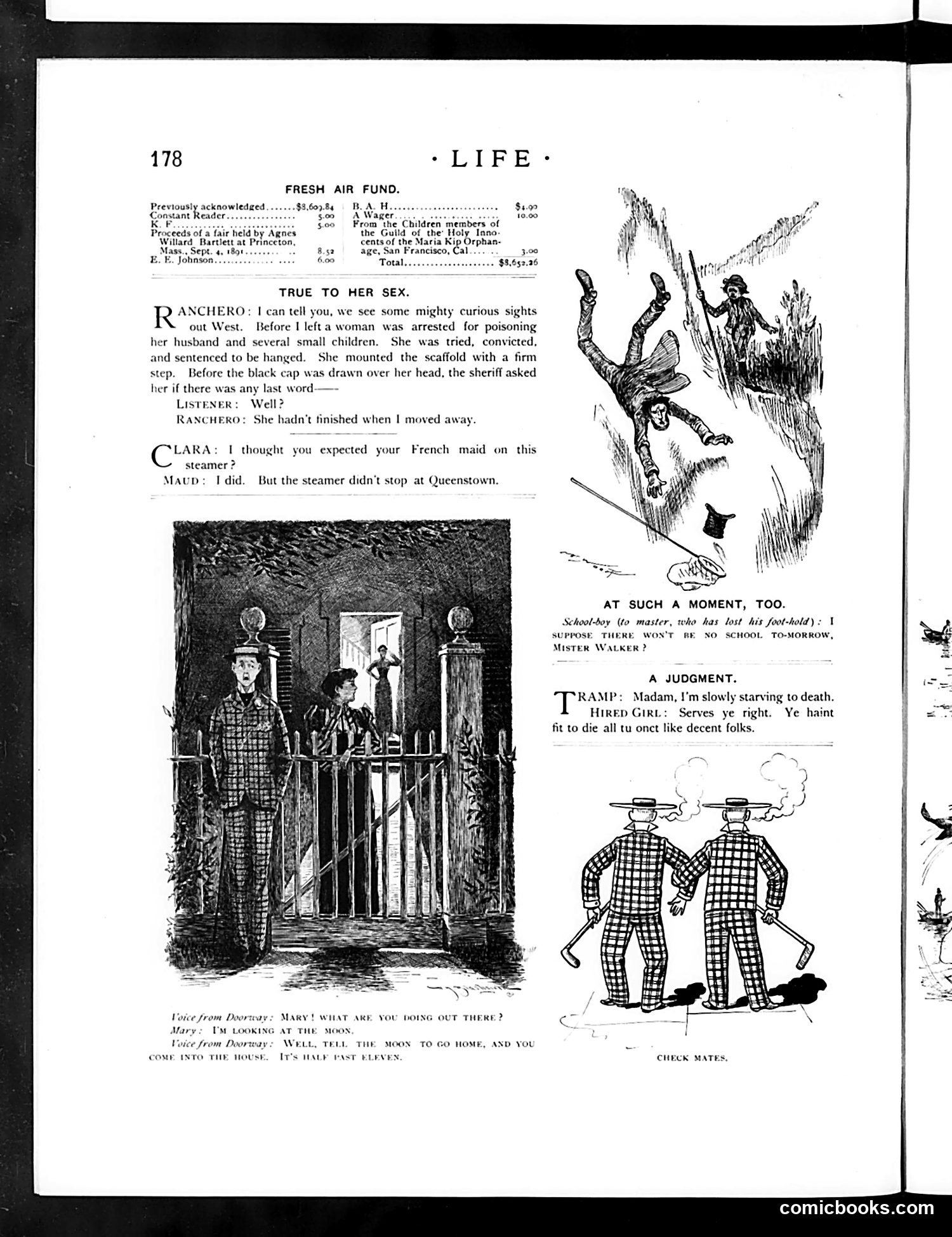
This page from *Life* magazine contains three separate satirical sketches: 1. **"True to Her Sex"** — A dialogue mocking a woman's alleged inconsistency. A man recounts witnessing a woman's execution for poisoning her husband and children, but she hadn't finished speaking before he left. The joke plays on period stereotypes of women as talkative and unable to stay silent even facing death. 2. **"At Such a Moment, Too"** — A cartoon showing a schoolboy falling, captioned as a joke about disrupting the teacher's routine. 3. **"A Judgment"** and **"Check Mates"** — Two final sketches employing crude humor about poverty and morality typical of early 20th-century satirical magazines. The specific references are now obscure without fuller context. The overall tone reflects *Life*'s genteel but often mean-spirited humor toward working classes and women.
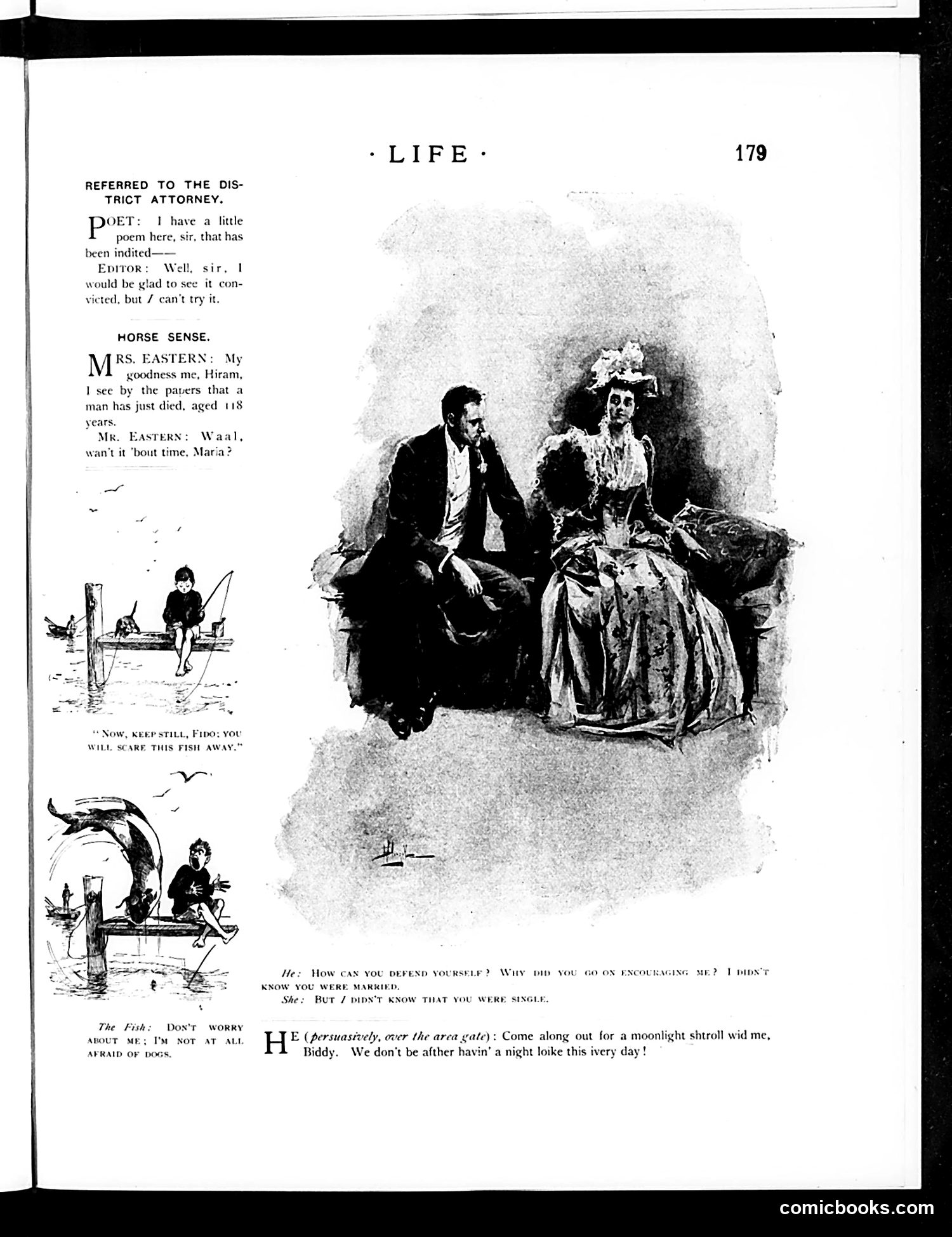
This page contains three separate satirical pieces: 1. **"Referred to the District Attorney"**: A poet submits work to an editor, who declines despite appreciating it—likely mocking amateur poetry submissions. 2. **"Horse Sense"**: Mrs. Eastern observes that a man aged 118 has died, prompting discussion about marriage duration. The humor appears to rest on remarriage or longevity. 3. **"The Fish"**: Small illustrations show a boy fishing. One features fish dialogue ("Don't worry about me; I'm not at all afraid of dogs"), establishing anthropomorphic humor typical of Life's style. 4. **Main illustration**: A well-dressed couple in an interior scene; the man asks the woman to join him for a moonlit walk, claiming ignorance of her marital status—satirizing courtship deception or flirtation. The humor is genteel, domestic, and characteristic of early 20th-century American magazine satire.
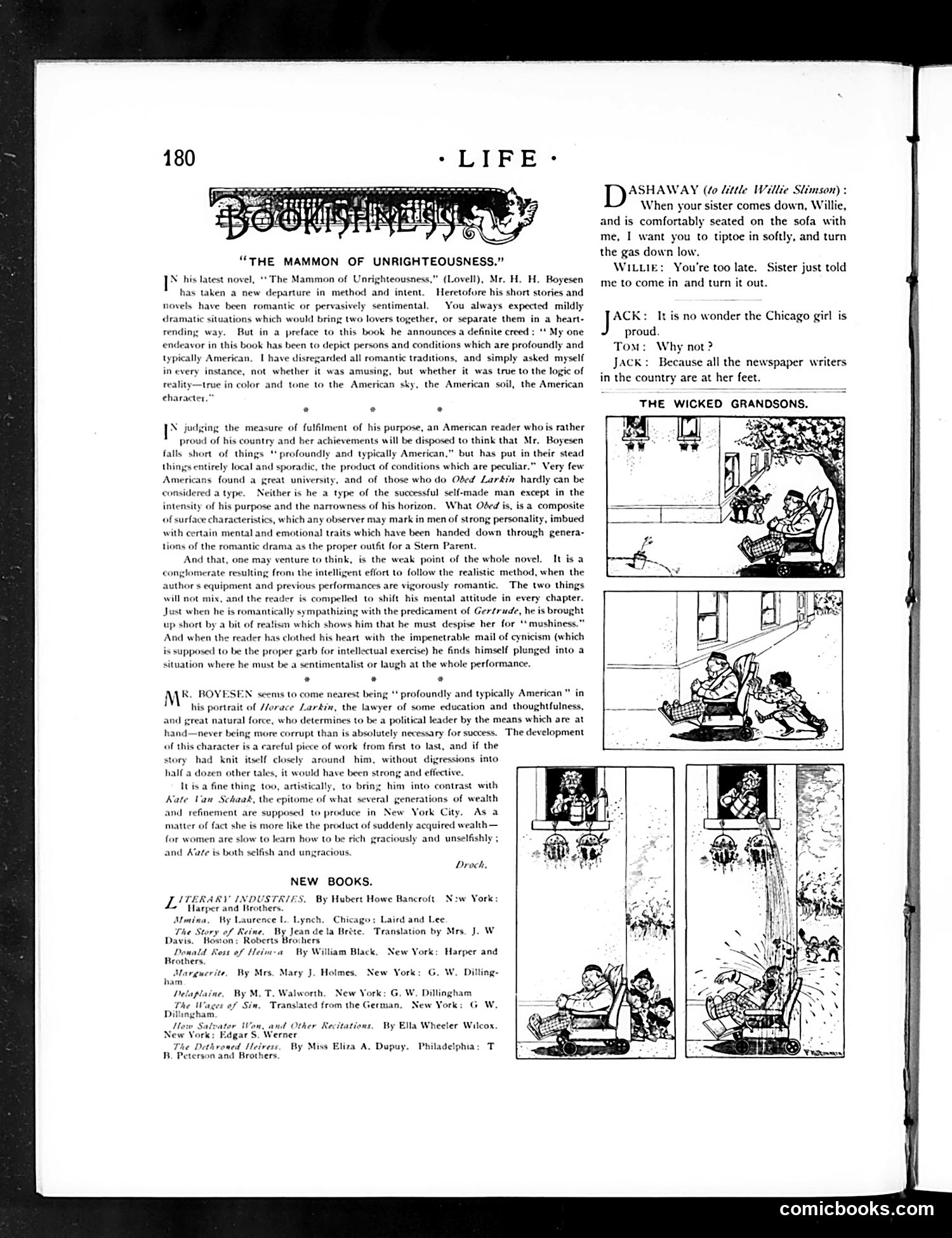
This multi-panel comic appears to satirize the contrast between generations of wealthy families. The title "The Wicked Grandsons" suggests the humor centers on how descendants of the rich have squandered or misused inherited wealth and privilege. The panels show what appear to be wealthy characters in domestic situations—lounging, playing, and generally behaving frivolously. The satire likely critiques the moral or social decay among heirs of industrial fortunes, a common theme in early 20th-century American satire. The comic suggests that while grandfathers built empires through hard work, their grandsons have become idle and dissolute, wasting family fortunes on leisure and vice rather than productive enterprise.
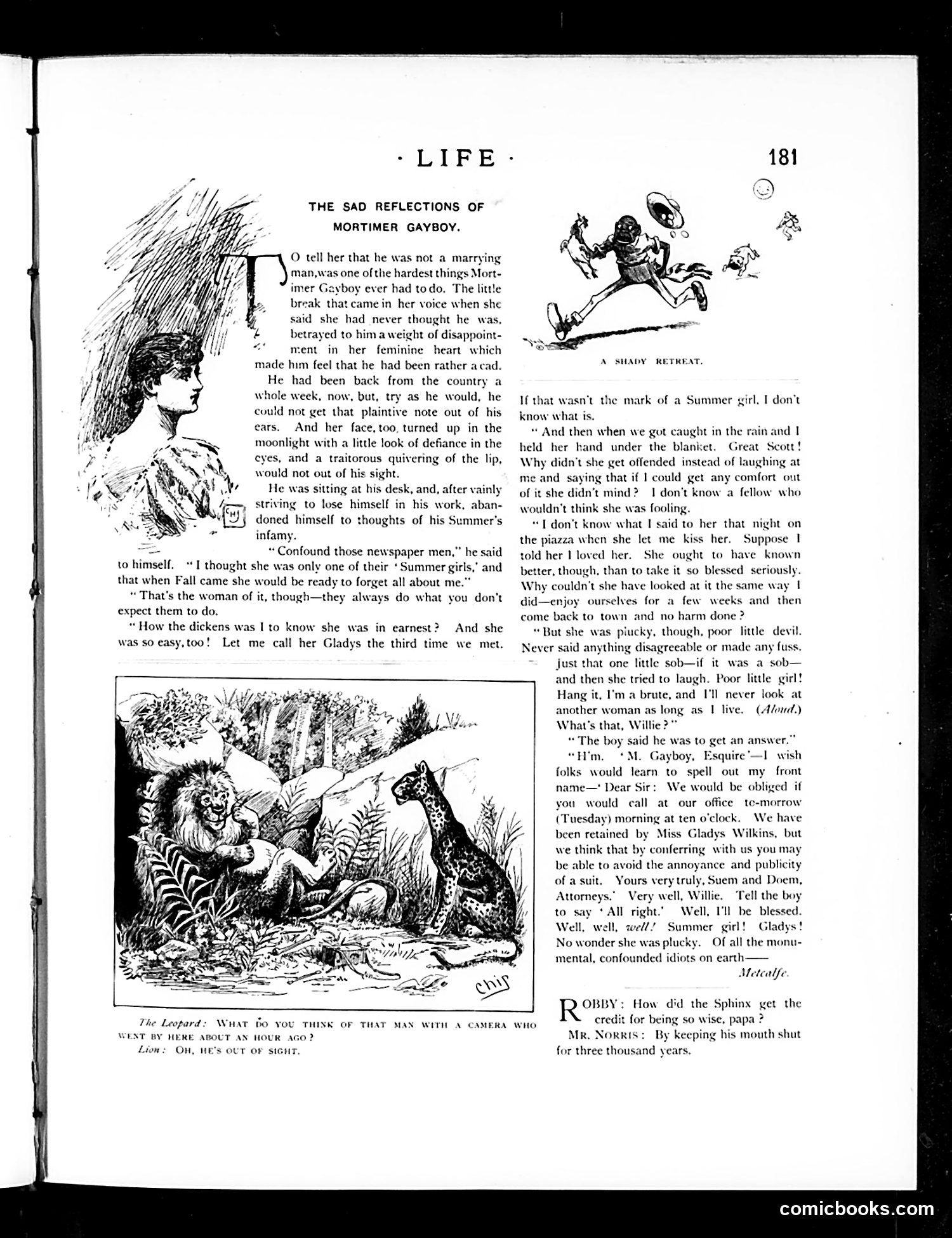
This satirical piece depicts a wealthy, socially prominent man (Mortimer Gayboy) lamenting his failed romantic pursuit of a "Summer girl"—likely a working-class or lower-status woman he encountered during vacation. The humor targets male entitlement and hypocrisy: Gayboy believed the woman was a "Summer girl" (implying casual availability), but she took him seriously, expecting commitment. When she rejected his advances, he's bitter, calling her names and dismissing her as foolish. The accompanying cartoon showing a leopard and lion mocks male vanity. The joke at the page's bottom plays on the Sphinx's legendary silence as wisdom—satirizing men's similar tendency to stay quiet rather than admit mistakes or speak truthfully about women.
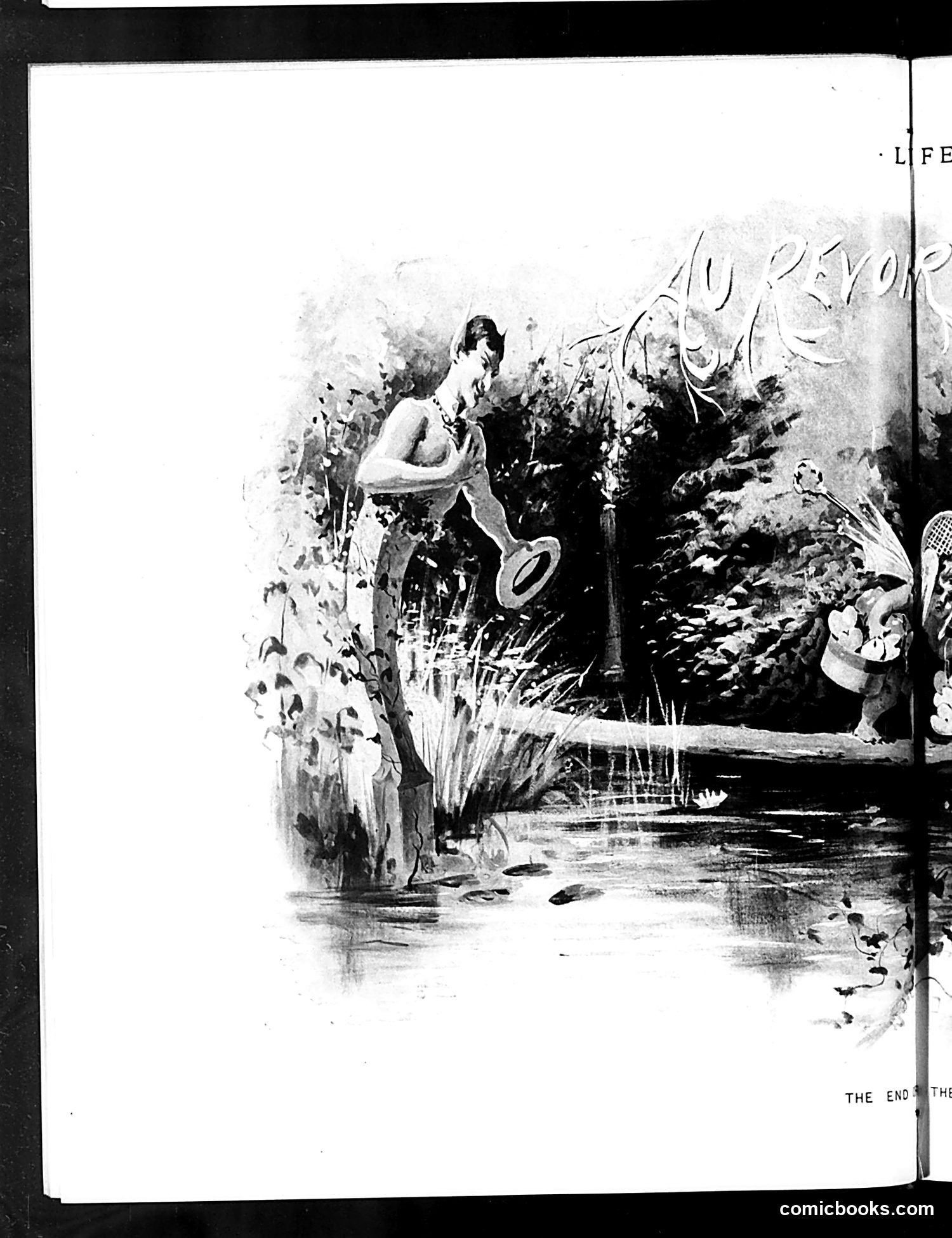
This appears to be an illustration from *Life* magazine depicting a romantic or idyllic scene rather than political satire. The image shows a shirtless man standing in shallow water among reeds and aquatic plants, holding what appears to be a hat. A woman in period dress is visible on the right side of the composition. The sketch style and composition suggest this may be illustrating a literary work or romantic narrative, possibly from a short story or serialized fiction that *Life* magazine published. Without visible text identifying the specific story or its subject matter, the exact satirical or editorial point remains unclear. The "END" notation at bottom suggests this concludes a particular piece.
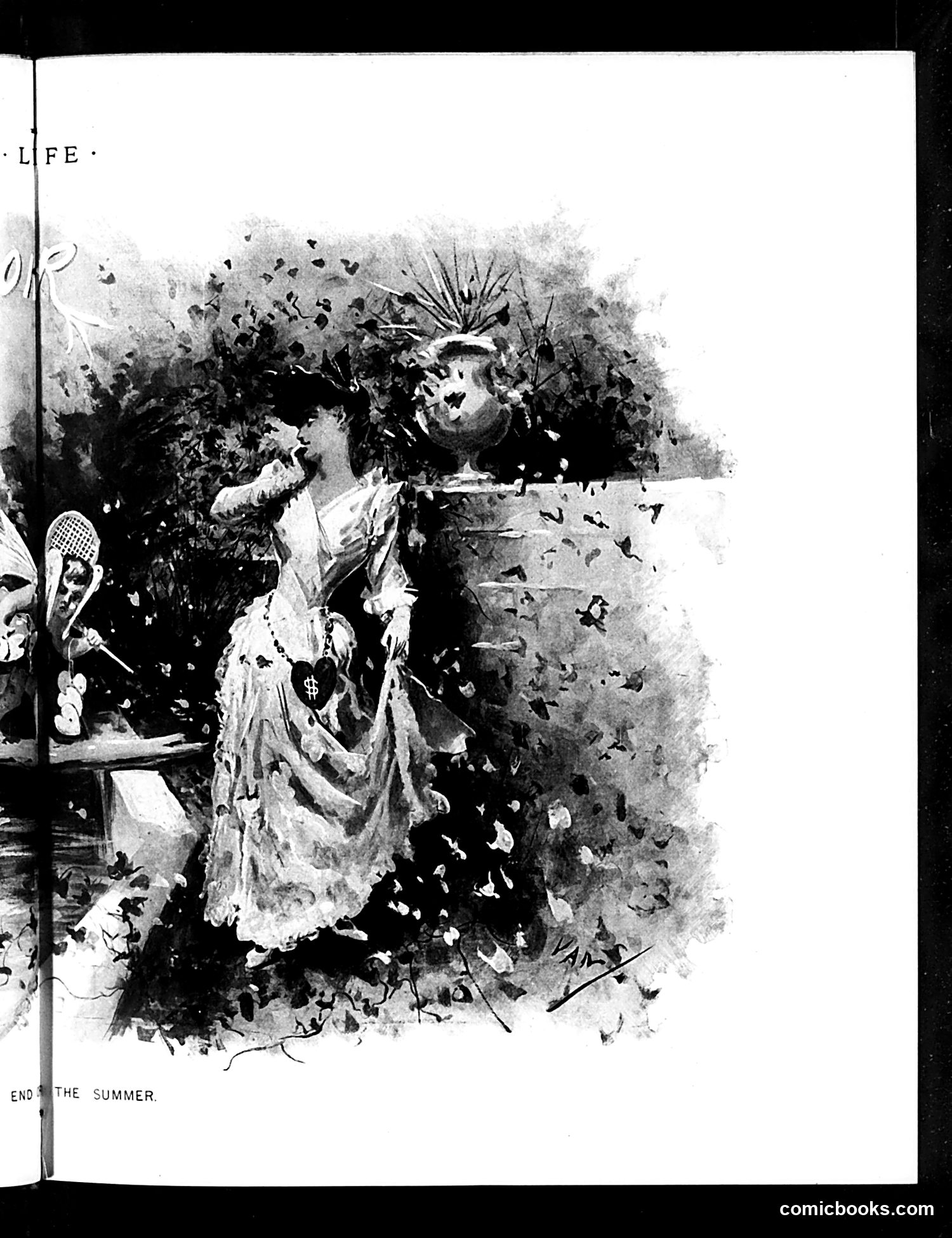
This appears to be an illustration titled "The Summer" from Life magazine's public-domain era. The image depicts a woman in a white dress amid lush garden foliage and flowering plants, with what looks like a decorative urn or planter behind her. The artistic style—rendered in watercolor or wash technique—is typical of early 20th-century Life magazine aesthetic illustrations. Without additional context or visible text identifying specific figures or satirical targets, this seems to be a seasonal or thematic illustration celebrating summer leisure and romance rather than a political cartoon. The romantic garden setting and elegant dress suggest it may have accompanied a story or poem about summer pleasures, common content in Life's literary sections.
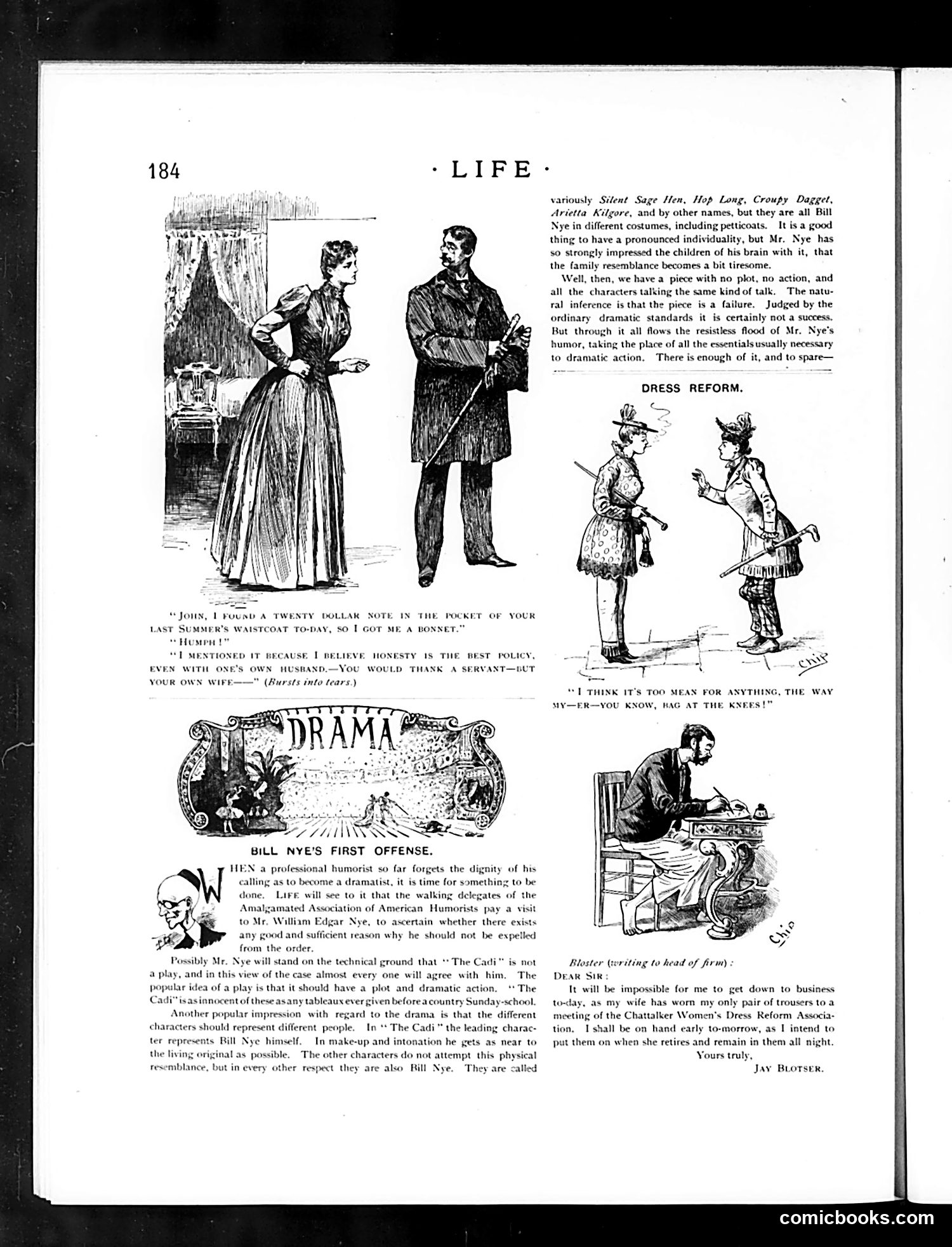
This page satirizes **Bill Nye**, a prominent American humorist of the era, for his theatrical debut in a play called "The Cadi." The magazine's drama critic argues that while Nye's work lacks conventional plot and dramatic action, his strong comedic personality carries it—though this dominance becomes tiresome. Every character, despite different names and costumes (including female roles in "petticoats"), essentially speaks and behaves as Nye himself, making the piece feel repetitive rather than dramatically diverse. The top cartoon depicts a domestic dispute: a husband found money and bought his wife a bonnet without consulting her, claiming honesty is "the best policy" while ironically sneaking purchases without her knowledge—satirizing male hypocrisy about transparency. The "Dress Reform" section mocks the emerging women's dress reform movement through a letter from an office worker whose wife has borrowed his only trousers for a Women's Dress Reform Association meeting, leaving him unable to work—the joke being the irony of reform advocates adopting masculine clothing.
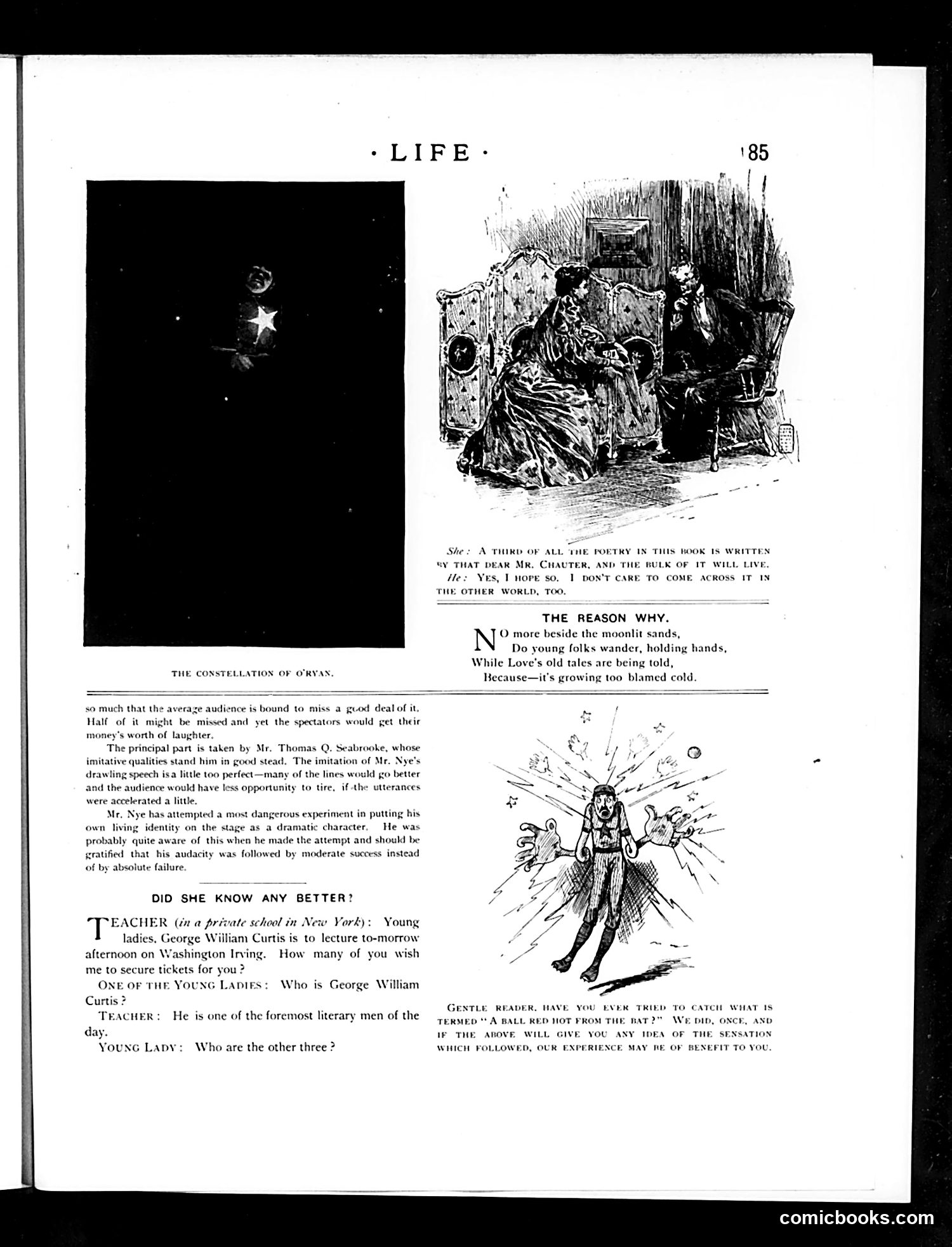
This page contains multiple satirical pieces typical of late 19th-century American humor: **"The Constellation of O'Ryan"** (left): A darkly comic sketch mocking Irish identity, likely referencing a contemporary Irish-American figure or stereotype. The title plays on astronomical terminology to suggest Irish people as a distinct "constellation." **The dialogue scenes** critique literary pretension. "Did She Know Any Better?" satirizes a schoolteacher's assumption that educated young women should recognize George William Curtis (a prominent 19th-century essayist and editor). The joke hinges on the student's ignorant response, mocking both educational gaps and the teacher's condescension. **"The Reason Why"** presents a sentimental poem about courtship cooling due to weather—likely mocking overwrought Romantic poetry popular in the era. **The baseball illustration** uses physical comedy: attempting to catch a ball "red hot from the bat" produces chaotic results, illustrating the violent sensation to "gentle readers" unfamiliar with the sport. Overall, the page blends social commentary on education, ethnicity, and American pastimes with period-specific humor about literary culture.
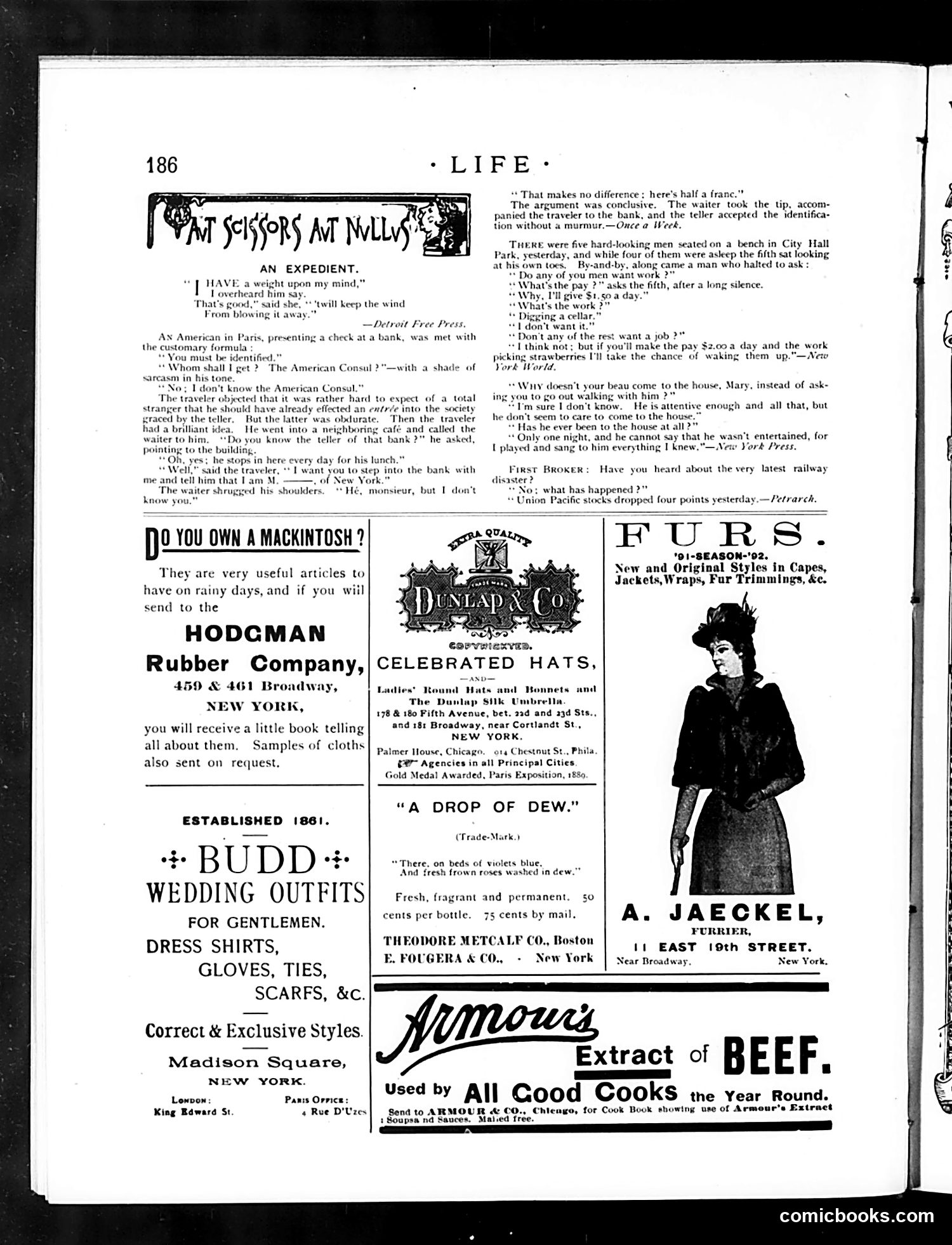
This page contains multiple short humorous anecdotes rather than a single political cartoon. The jokes satirize various social situations of the era: **"An Expedient"** mocks bureaucratic absurdity—an American in Paris cannot cash a check without "identification," but a waiter's endorsement (bought with a tip) suffices, exposing the arbitrariness of official procedures. **"City Hall Bench"** satirizes the unemployed or vagrant men who congregate in public spaces. A laborer offers $1.50/day for cellar-digging; when rejected, he raises it to $2.00 for strawberry-picking. The joke suggests these men are so lazy or indifferent they'd rather sleep than accept any work. **"The Beau"** gently mocks a woman whose suitor avoids visiting her house (likely implying he finds her entertainment—her singing and playing—unbearable). **"First Broker"** delivers a sharp financial joke: the "disaster" isn't lives lost but stock prices dropping four points—satirizing Wall Street's priorities and callousness. The page is predominantly **advertisements** for period goods (mackintoshes, hats, furs, beef extract), typical of Life's revenue model.