
Life, 1891-10-01 · page 8 of 14
Life — October 1, 1891 — page 8: what you’re looking at
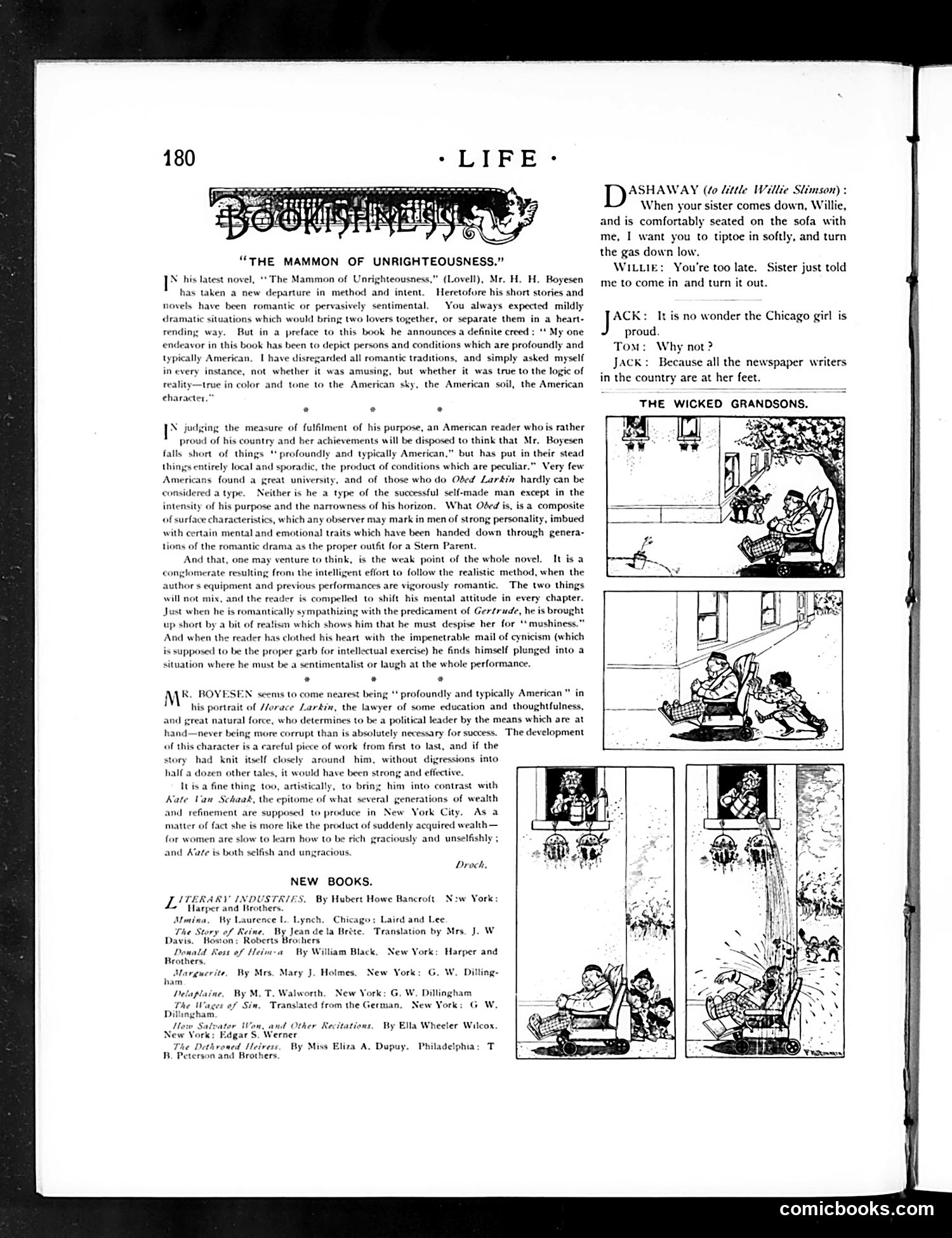
What you’re looking at
This multi-panel comic appears to satirize the contrast between generations of wealthy families. The title "The Wicked Grandsons" suggests the humor centers on how descendants of the rich have squandered or misused inherited wealth and privilege. The panels show what appear to be wealthy characters in domestic situations—lounging, playing, and generally behaving frivolously. The satire likely critiques the moral or social decay among heirs of industrial fortunes, a common theme in early 20th-century American satire. The comic suggests that while grandfathers built empires through hard work, their grandsons have become idle and dissolute, wasting family fortunes on leisure and vice rather than productive enterprise.
📄 Transcribed text from this page (OCR, searchable)
Machine-transcribed from the original scan — historical spelling and the odd misread are preserved.
ASHAWAY (0 Little Willie Slimson) : tii i > 5 When your sister comes down, Willie, é gst and is comfortably seated on the sofa with me, I want you to tiptoe in softly, and turn the gas down low. WILLIE: You're too late. Sister just told me to come in and turn it out. “THE MAMMON OF UNRIGHTEOUSNESS.” N his latest novel, ‘The Mammon of Unrighteousness,” (Lovell), Mr. H. H. Boyesen has taken a new departure in method and intent. Heretofore his short stories and novels have been romantic or pervasively sentimental. You always expected mildly dramatic situations which would bring two lovers together, or separate them in a heart- Ne It is no wonder the Chicago girl is proud. endeavor in this book has been to depict persons and conditions which are profoundly and Tom: Why not? typically American. I have disregarded all romantic traditions, and simply asked myself s in every instance, not whether it was amusing, but whether it was true to the logic of reality—true in color and tone to the American sky, the American soil, the American rending way. But in a preface to this book he announces a definite creed : ** My one Jack: Because all the newspaper writers in the country are at her feet. « ° * THE WICKED GRANDSONS. eharacter N judging the measure of fulfilment of his purpose, an American reader who is rather proud of his country and her achievements will be disposed to think that Mr. Boyesen falls short of things ‘profoundly and typically American,” but has put in their stead things entirely local and sporadic, the product of conditions which are peculiar.” Very few Americans found a great university, and of those who do Obed Larkin hardly can be considered a type. Neither is he a type of the successful self-made man except in the intensity of his purpose and the narrowness of his horizon, What Obed is, is a composite of surface characteristics, which any observer may mark in men of strong personality, imbued with certain mental and emotional traits which have been handed down through genera- tions of the romantic drama as the proper outfit for a Stern Parent. And that, one may venture to think, is the weak point of the whole novel. It is a conglomerate resulting fron: the intelligent effort to follow the realistic method, when the author s equipment and previous performances are vigorously romantic. The two things will not mix, and the reader is compelled to shift his mental attitude in every chapter. Just when he is romantically sympathizing with the predicament of Gertrude, he is brought up short by a bit of realism which shows him that he must despise her for * mushiness.”” And when the reader has clothed his heart with the impenetrable mail of cynicism (which is supposed to be the proper garb for intellectual exercise) he finds himself plunged into a situation where he must be a sentimentalist or laugh at the whole performance. ° . ° [\{&. BOVESEN seems to come nearest being * profoundly and typically American" in IVA his portrait of Horace Larkin, the lawyer of some education and thoughtfulness, and great natural force, who determines to be a political leader by the means which are at hand—never being more corrupt than is absolutely necessary for success. The development this character is a careful piece of work from first to last, and if the story had knit itself closely around him, without digressions into half a dozen other tales, it would have been strong and effective It isa fine thing too, artistically, to bring him into contrast with Kate Van Schaak, the epitome of what several generations of wealth and refinement are supposed to produce in New York City, As a matter of fact she is more like the product of suddenly acquired wealth — for women are slow to learn how to be rich graciously and unselfishly ; and Kate is both selfish and ungracious Droch. NEW BOOKS. ITERARY INDUSTRIES. By Hubert Howe Bancroft, N:w York Harper and Brothers. Mmina, By Laurence L.. Lynch. Chicago: Laird and Lee The Story of Keine. By Jean dela Brite. Translation by Mrs. J. W Davis. Boston: Roberts Bro:hers Donald Kes of Heim-a By William Black, New York: Harper and Brothers. Marguerite, By Mrs. Mary J. Holmes, New York: G, W. Dilling- ham) Delaplaine, By M, T. Walworth W. Dillingham The Wages of Sin, Translated from the . New York: GW. tor Won, and Other Recitations, By Ella Wheeler Wilcox. gar S. Werner The Dethroned Heiress. By Miss Eliza A, Dupuy. Philadelphia: T B. Peterson and Brothers. comicbooks.com