
Life, 1891-10-01 · page 4 of 14
Life — October 1, 1891 — page 4: what you’re looking at
What you’re looking at
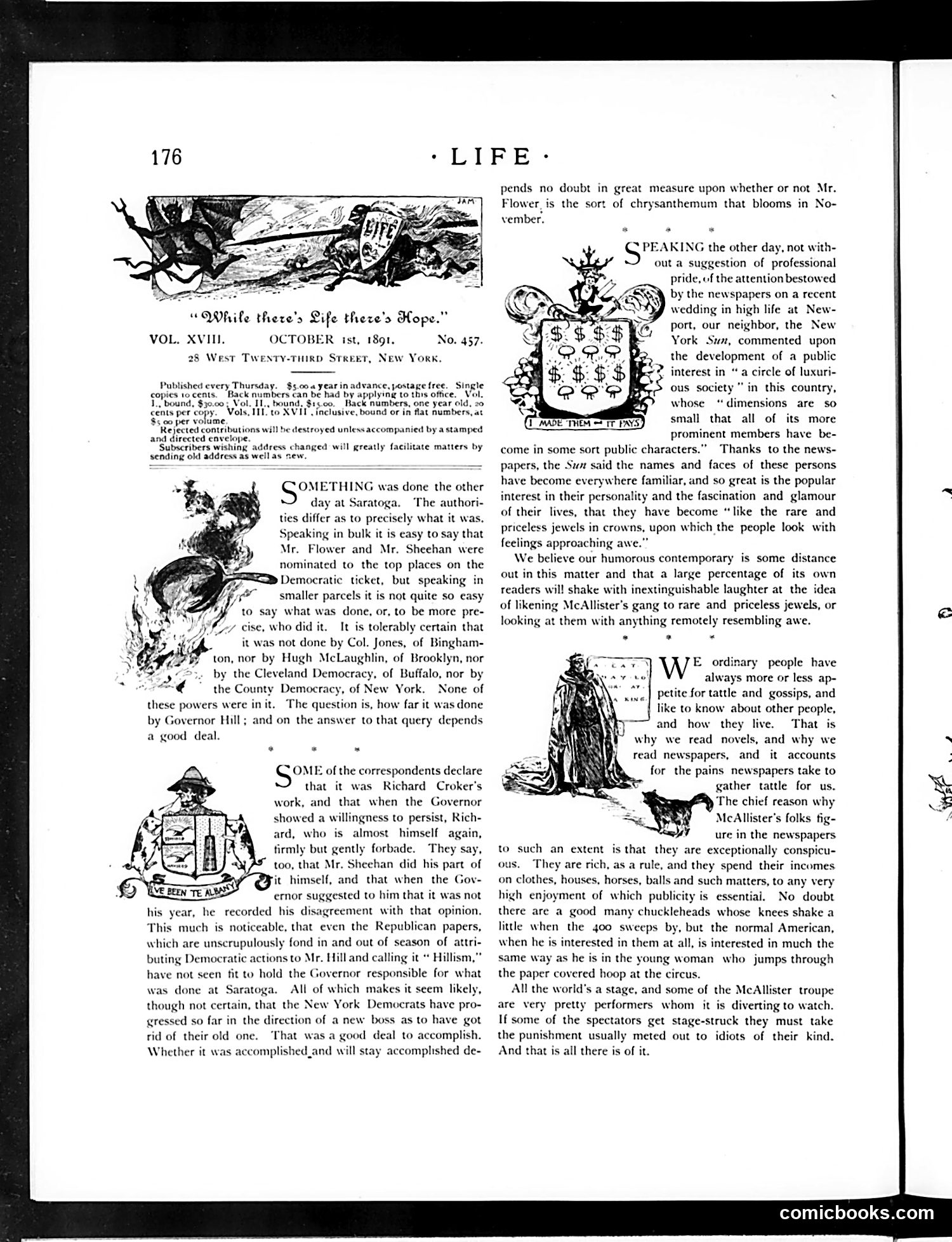
This page discusses a Democratic political event at Saratoga involving Governor Hill and Mr. Flower, though the specific incident remains unclear from the text alone. The article notes that attributing the action to various Democratic politicians—Col. Jones (Binghamton), Hugh McLaughlin (Brooklyn), Cleveland Democrats, or Tammany Hall—is difficult, suggesting internal party confusion or deliberate obfuscation. Richard Croker's involvement is mentioned, with claims he urged persistence despite the Governor's gentle objections. The satirical point appears to be mocking Democratic disorganization and finger-pointing over responsibility for whatever occurred. The accompanying cartoons (visible but details unclear) likely reinforce this criticism of party leadership infighting during this period of factional Democratic strife.
📄 Transcribed text from this page (OCR, searchable)
Machine-transcribed from the original scan — historical spelling and the odd misread are preserved.
‘LIFE: “While there's Life there's Hope.” VOL. XVIII. OCTOBER ist, 1891. No. 457. 28 West Twenty-THixp Street, New York. Published every Thursday. $5.00.4 year in advance, postage free. Single copies to cents. Back numbers can be had by applying to this office. Vol. 1., bound, $30.00; Vol. I1., bound, $15.00. Back numbers, one year old, 26 cents per copy. Vols. IIT to XVIT inclusive, bound or in flat numbers, at $5.00 per volume, Rejected contributions will he destroyed unlexsaccompanied by a stamped and directed envelope. Subscribers wishing address changed will greatly facilitate matters by sending old address as well as new OMETHING was done the other y at Saratoga. The authori- ties differ as to precisely what it was, Speaking in bulk it is easy to say that Mr. Flower and Mr. Sheehan were nominated to the top places on the Democratic ticket, but speaking in smaller parcels it is not quite so easy to say what was done, or, to be more pre- d cise, who did it. It is tolerably certain that a7 © it was not done by Col. Jones, of Bingham- hi ton, nor by Hugh McLaughlin, of Brooklyn, nor by the Cleveland Democracy, of Buffalo, nor by the County Democracy, of New York. None of these powers were init. The question is, how far it done by Governor Hill; and on the answer to that query depends a good deal. ~ OME of the correspondents declare that it was Richard Croker’s work, and that when the Governor owed a willingness to persist, Rich- ard, who is almost himself again, *Y tirmly but gently forbade. They say, too, that Mr. Sheehan did his part of PF it himself, and that when the Gov- HN TEAS ernor suggested to him that it was not his year, he recorded his disagreement with that opinion. This much is noticeable, that even the Republican paper: which are unscrupulously fond in and out of season of attri- buting Democratic actions to Mr. Hill and calling it * Hillism,” have not seen fit to hold the Governor responsible for what was done at Saratoga. All of which makes it seem likely, though not certain, that the New York Democrats have pro- gressed so far in the direction of a new boss as to have got rid of their old one. That was a good deal to accomplish. Whether it was accomplished and will stay accomplished de- pends no doubt in great measure upon whether or not Mr. Flower, is the sort of chrysanthemum that blooms in No- vember. PEAKING the other day, not with- out a suggestion of professional pride, of the attention bestowed by the newspapers on a recent wedding in high life at New- port, our neighbor, the New York Sz, commented upon the development of a public interest in “a circle of luxuri- ous society” in this country, A whose ‘dimensions are so ‘eG MADE THOM eT TT PAYS small that all of its more prominent members have be- come in some sort public characters.” Thanks to the news- papers, the Sw said the names and faces of these persons have become everywhere familiar, and so great is the popular interest in their personality and the fascination and glamour of their lives, that they have become “like the rare and priceless jewels in crowns, upon which the people look with feelings approaching awe. We believe our humorous contemporary is some distance out in this matter and that a large percentage of its own readers wil! shake with inextinguishable laughter at the idea of likening McAllister’s gang to rare and priceless jewels, or looking at them with anything remotely resembling awe. E ordinary people have always more or less ap- petite for tattle and gossips, and like to know about other people, and how they live. That is why we read novels, and why we papers, and it accounts for the pains newspapers take to gather tattle for us. The chief reason why McAllister’s folks fig- ¥ ure in the newspapers to such an extent is that they are exceptionally conspicu- ous. They are rich, as a rule, and they spend their incomes on clothes, houses, horses, balls and such matters, to any very high enjoyment of which publicity is essential. No doubt there are a good many chuckleheads whose knees shake a little when the goo sweeps by, but the normal American, when he is interested in them at all, is interested in much the same way as he is in the young woman who jumps through the paper covered hoop at the circus. All the world’s a stage, and some of the McAllister troupe are very pretty performers whom it is diverting to watch. If some of the spectators get stage-struck they must take the punishment usually meted out to idiots of their kind. And that is all there is of it. comicbooks.com