
A complete issue · 18 pages · 1891
Life — September 24, 1891
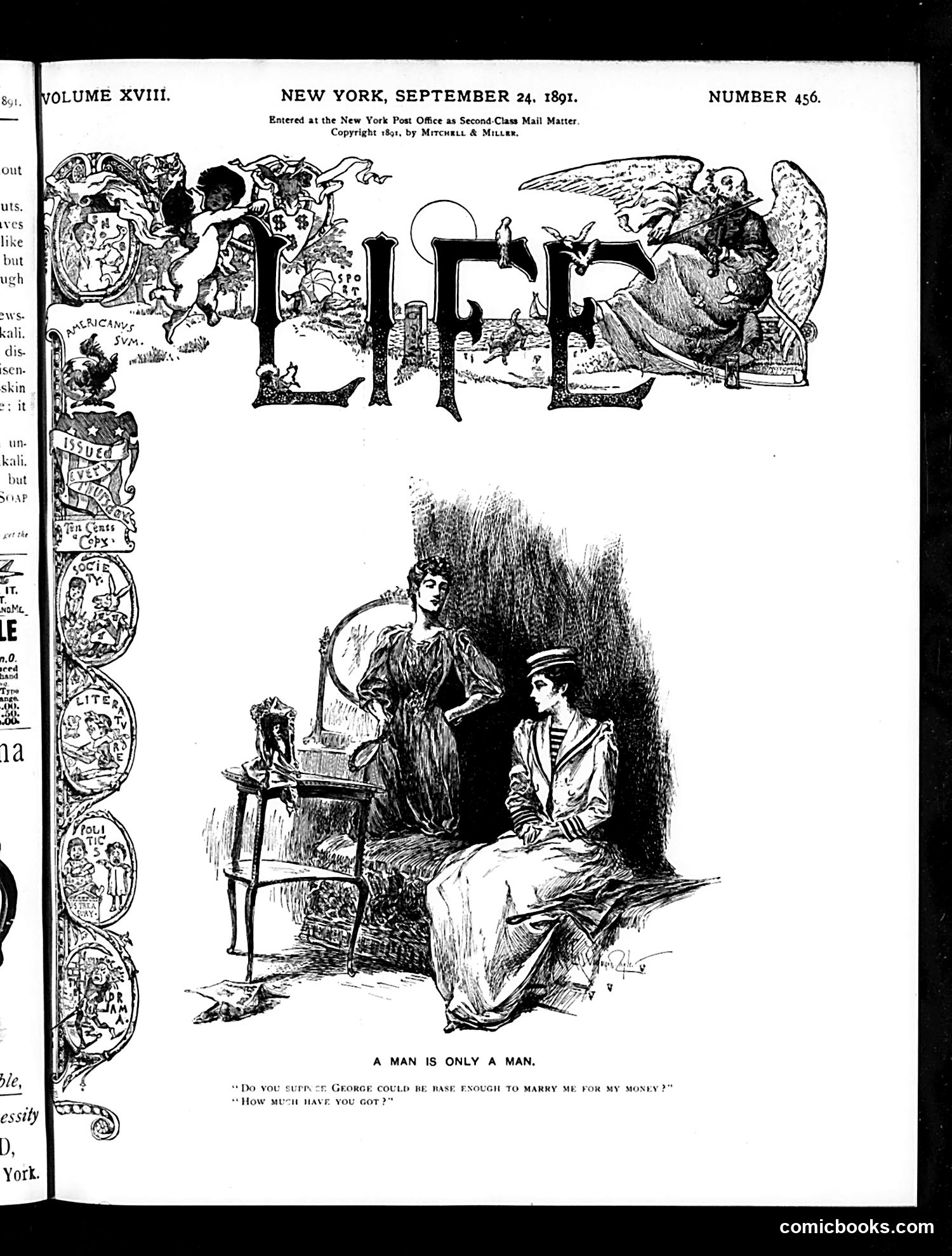
The page features a cartoon titled "A Man Is Only a Man" depicting a domestic scene where a woman sits while a man stands before her. The dialogue reads: "Do you suppose George could be base enough to marry me for my money?" and "How much have you got?" This satirizes late 19th-century marriage practices and anxieties about male fortune-hunting. The joke targets upper-class women's concerns about suitors' mercenary motives—a common Victorian social anxiety. The title's cynicism suggests men will compromise their principles for wealth, reducing them to purely self-interested actors. The woman's question reveals her own uncertainty about her suitor's genuine affection versus financial interest, reflecting Gilded Age concerns about authenticity in courtship among the wealthy.
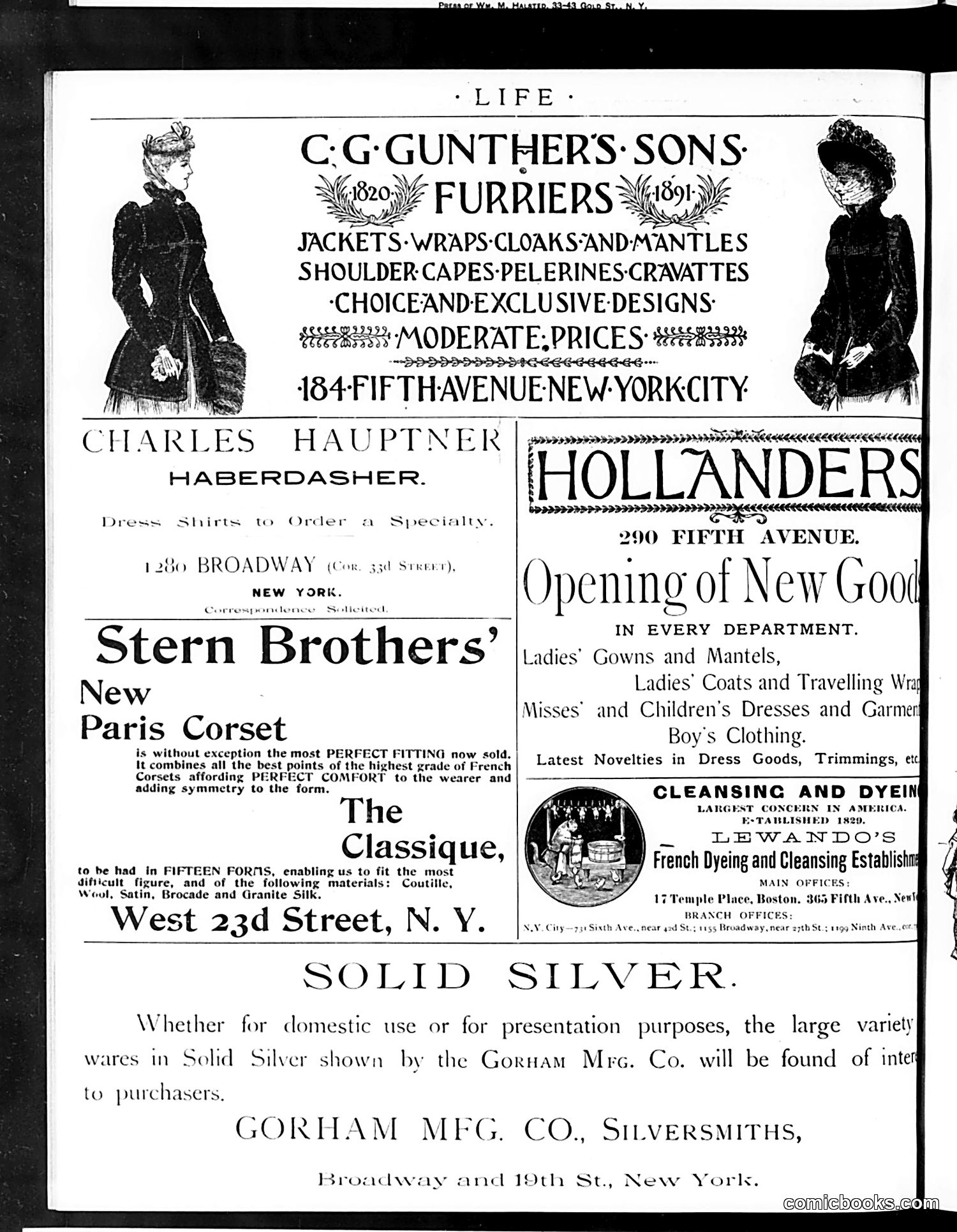
This page is primarily **advertising, not satirical content**. It contains several fashion and retail advertisements from circa 1890 (based on the dates 1820-1891 visible in the C.G. Gunthers Sons header). The advertisements feature: - **C.G. Gunthers Sons Furriers** - offering women's outerwear with illustrations of fashionably dressed women in elaborate Victorian clothing - **Charles Hauptner Haberdasher** - dress shirts to order - **Stern Brothers** - a "New Paris Corset" - **Hollanders** - department store at Fifth Avenue announcing new goods - **Gorham Mfg. Co.** - solid silver wares for domestic or presentation use There is no political cartoon or satire evident on this page. It represents typical late-19th-century fashion advertising targeting wealthy New York City consumers, emphasizing imported European styles and luxury goods.
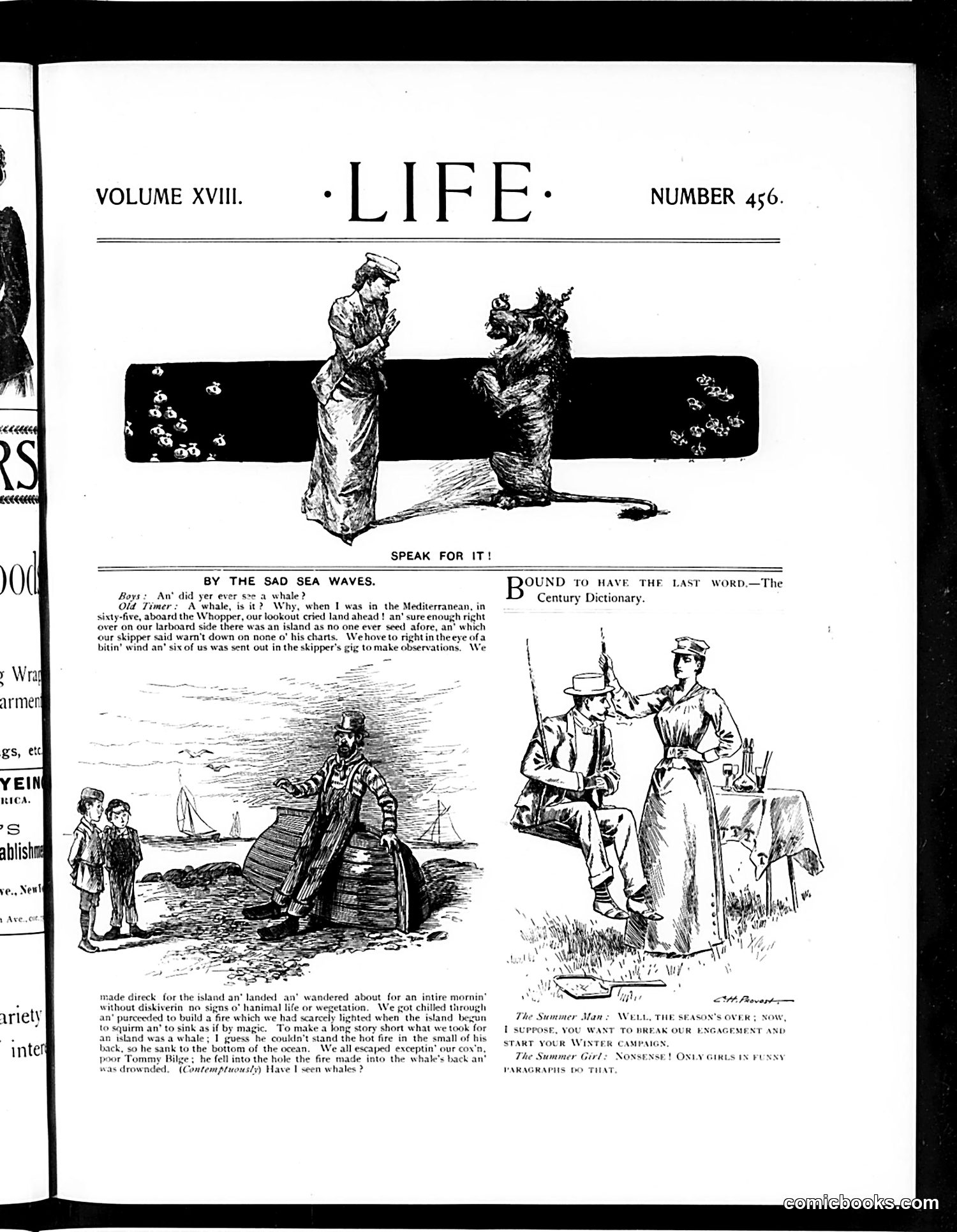
This page contains three separate cartoon vignettes satirizing social interactions and courtship customs of the era. **Top cartoon ("Speak for It!"):** A woman confronts a bear-like man, apparently demanding he "speak" or declare his intentions—likely satirizing contemporary courtship expectations where men were expected to formally propose or articulate their romantic interest. **Bottom left ("By the Sad Sea Waves"):** A sailor recounts discovering an island and whale. The narrative humor appears to rest on exaggerated maritime storytelling—a common satirical target in this period. **Bottom right ("The Summer Man" and "The Summer Girl"):** Social commentary on seasonal romance, with dialogue suggesting women's frustration with men who abandon courtship promises when summer ends and winter approaches, resuming their social lives. The humor targets gender relations and romantic conventions of the era.
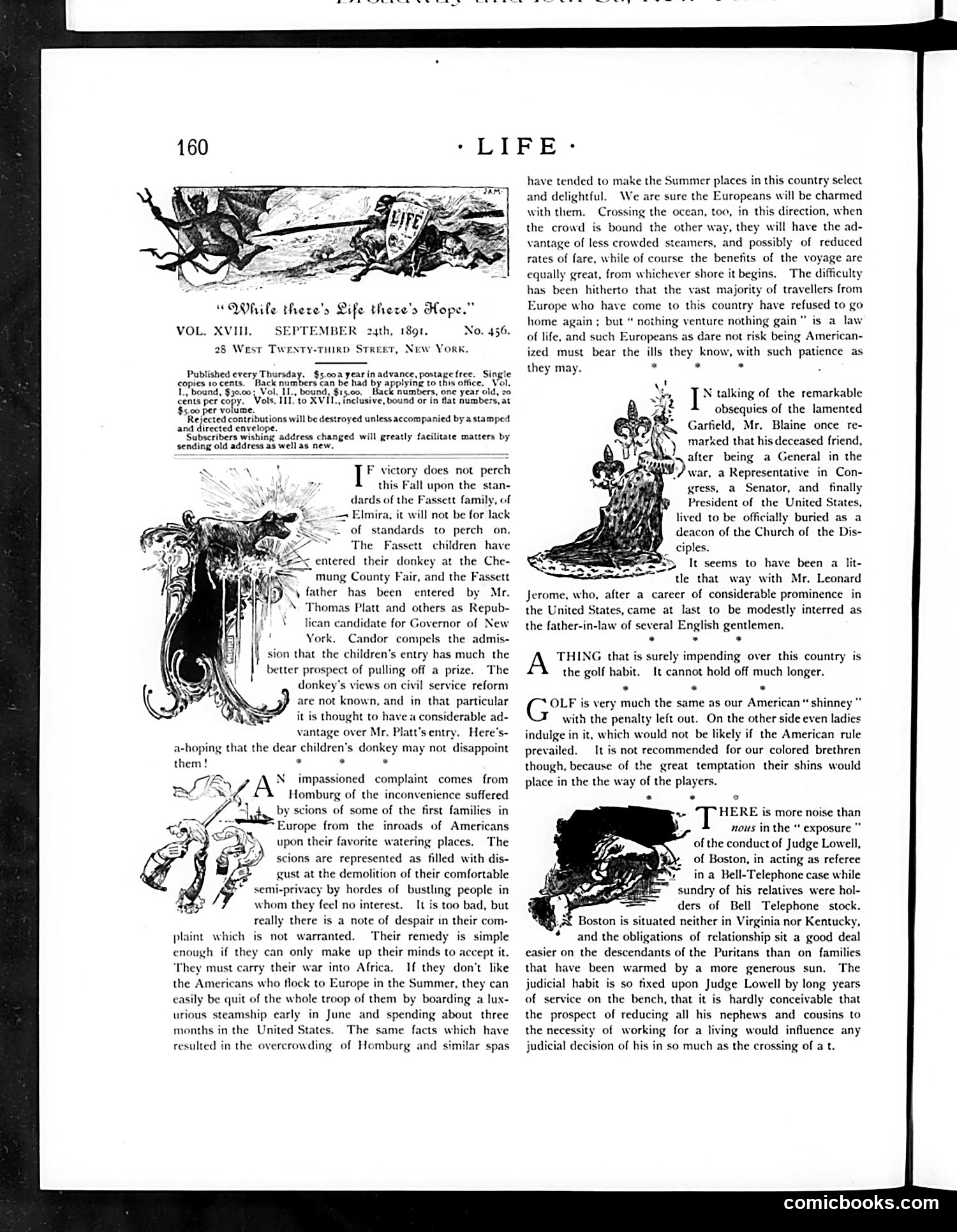
This page contains three satirical vignettes on American social issues circa early 1900s: 1. **The Fassett Family Donkey**: Mocks Thomas Platt's endorsement of a Republican gubernatorial candidate, suggesting the children's entry into a donkey race has "much better prospect" than Platt's political backing—a dismissive jab at Platt's political influence. 2. **European Tourism Complaint**: Satirizes wealthy European visitors' grievances about overcrowded American summer destinations, suggesting they simply avoid America entirely if dissatisfied. 3. **Judge Lowell and Bell Telephone**: Criticizes Judge Lowell's Bell Telephone stock holdings while serving as referee in a Bell Telephone case, highlighting apparent judicial conflict of interest—a commentary on corruption concerns in the era. The illustrations use caricature and humor to critique political corruption and social pretension.
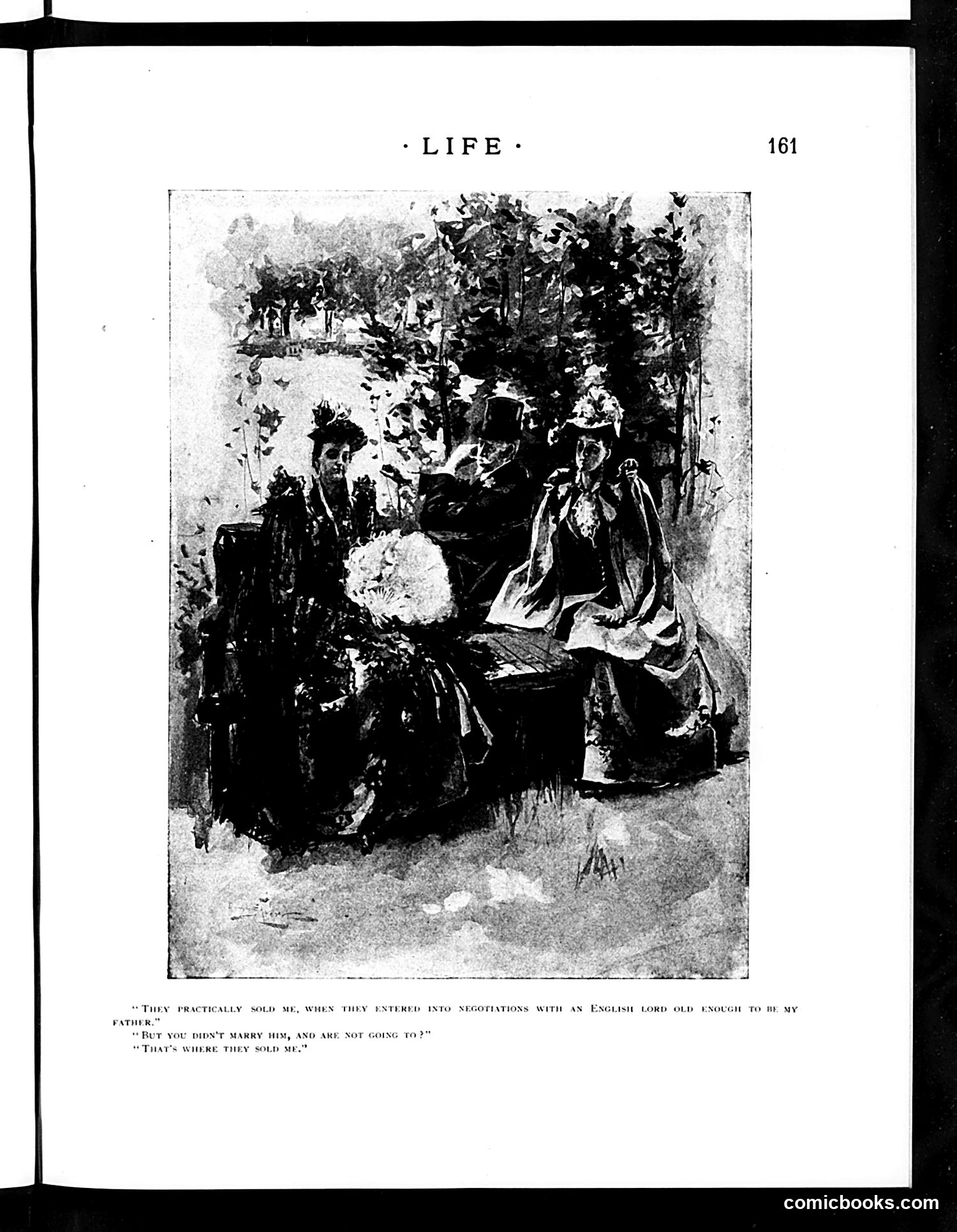
This illustration depicts a social scene of well-dressed Victorian-era figures in what appears to be a parlor or drawing room, with elaborate floral decorations overhead. The caption references a marriage negotiation involving "an English lord old enough to be my father," with dialogue: "But you didn't marry him, and are not going to?" and the response "That's where they sold me." This satirizes the common 19th-century practice where wealthy American families sought to marry their daughters to impoverished British aristocrats, trading wealth for titles. The cartoon mocks this transatlantic marriage market, suggesting the young woman was "sold" into an unwanted engagement—a critique of treating matrimony as a financial transaction rather than a matter of personal affection.
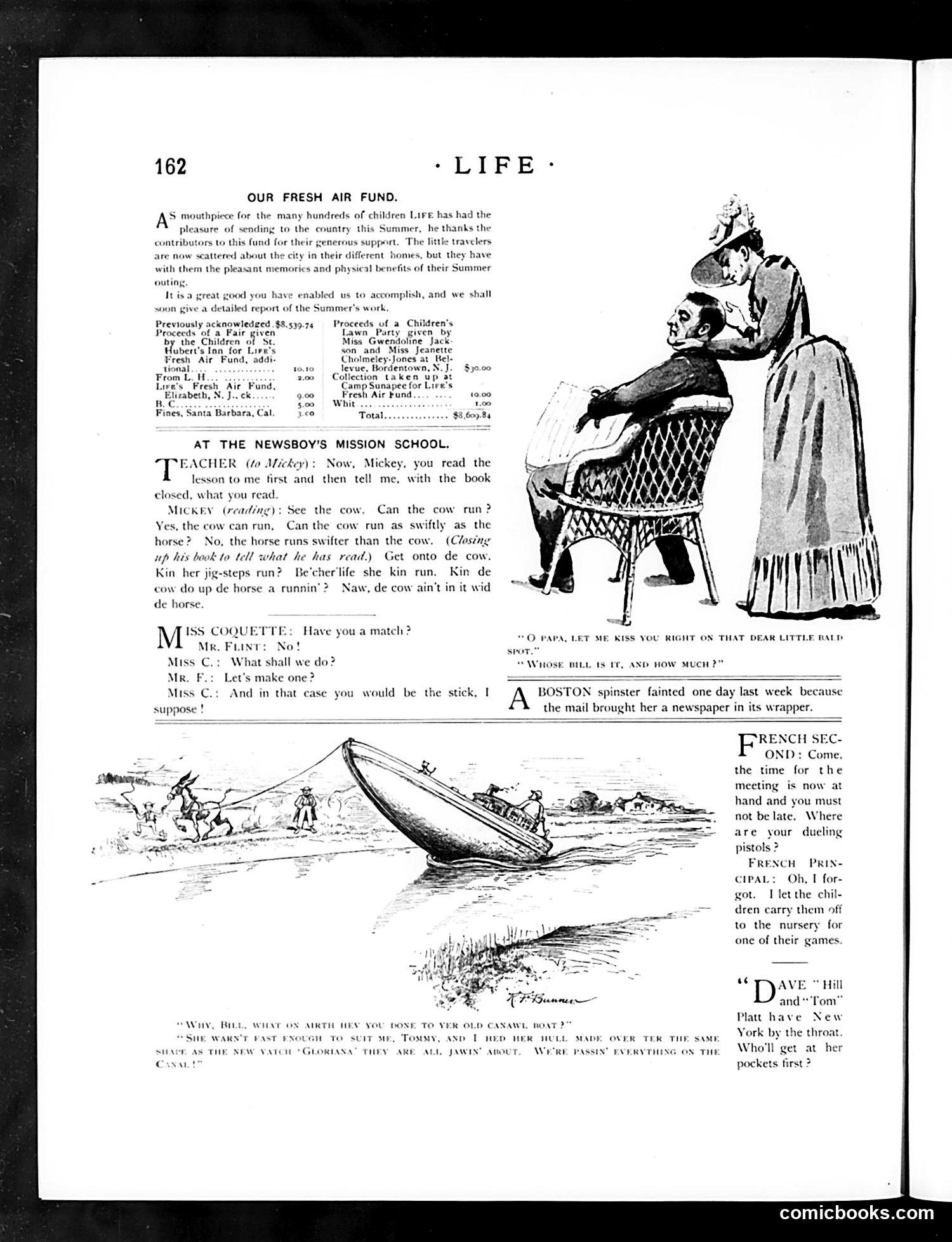
This page contains three distinct pieces: 1. **"Our Fresh Air Fund"** (top): A charitable appeal encouraging donations to send poor city children to the countryside for summer vacations. It lists previous contributors and donation amounts. 2. **"At the Newsboy's Mission School"** (middle): A humorous dialogue between a teacher and Mickey (a student newsboy) about reading comprehension, followed by Miss Coquette and Mr. Flint discussing making matches—likely a pun on matchmaking versus actual matches. 3. **Two illustrated vignettes** with captions about domestic situations—one depicting a woman with a child, another showing a beached boat. The humor appears to involve wordplay and domestic comedy typical of early 20th-century satirical magazines. The page primarily showcases Life's mix of charitable announcements, gentle social satire, and family-oriented humor.
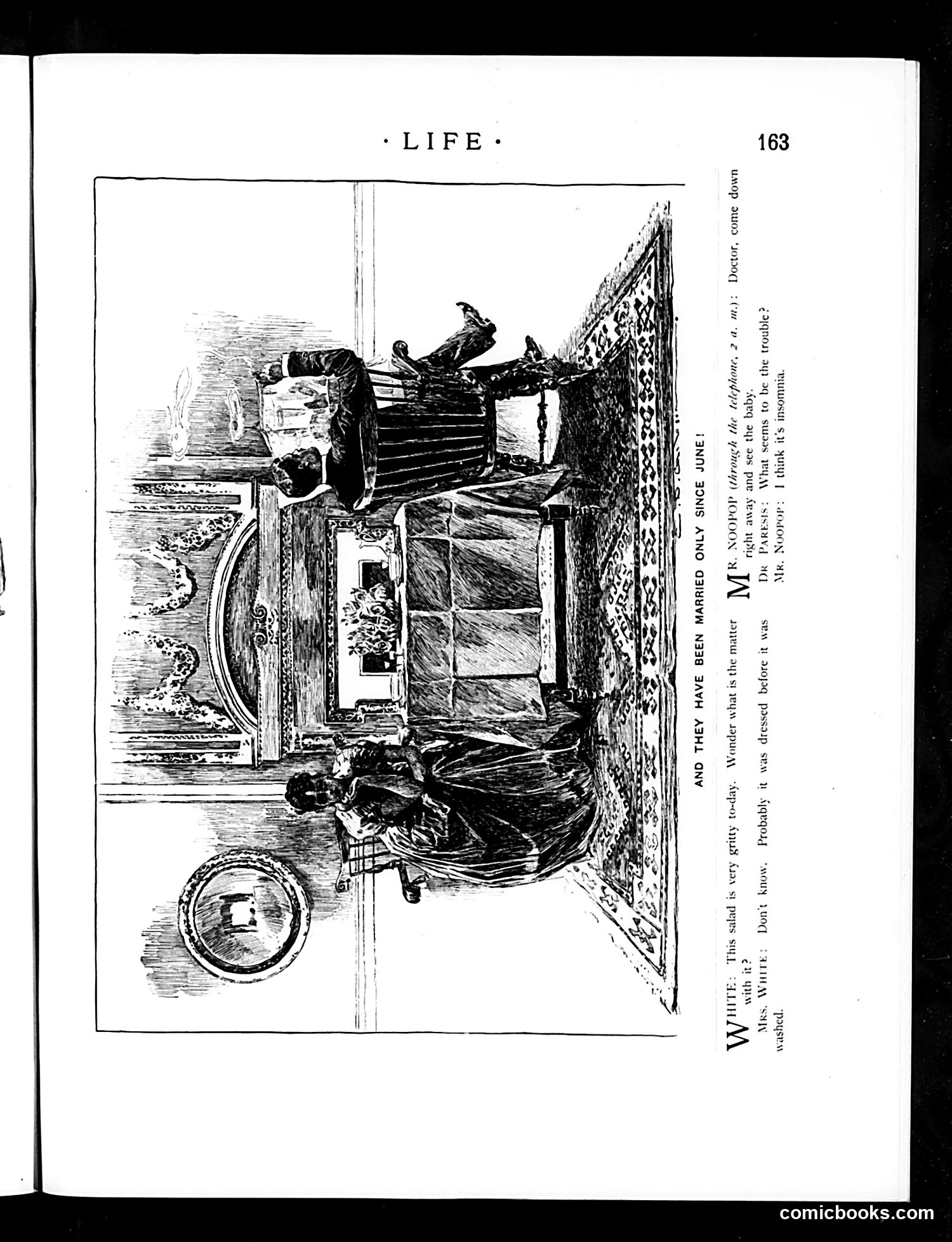
This is a satirical illustration from *Life* magazine (page 163) titled "And They Have Been Married Since Janet" with a caption about a doctor coming down. The image depicts a domestic scene rotated 90 degrees, showing a woman in a Victorian-era dress sitting in what appears to be a parlor. The satire likely concerns marriage and domestic life—specifically the caption's reference to "they have been married since Janet" suggests commentary on a long-standing marriage or a relationship milestone. The "doctor come down" reference is unclear without additional context, but appears to involve a physician visiting the household, possibly for a comedic domestic situation. The elaborate interior decoration and formal dress suggest this mocks upper-class domestic pretensions or marital expectations of the period. The exact political or social target remains ambiguous from the image alone.
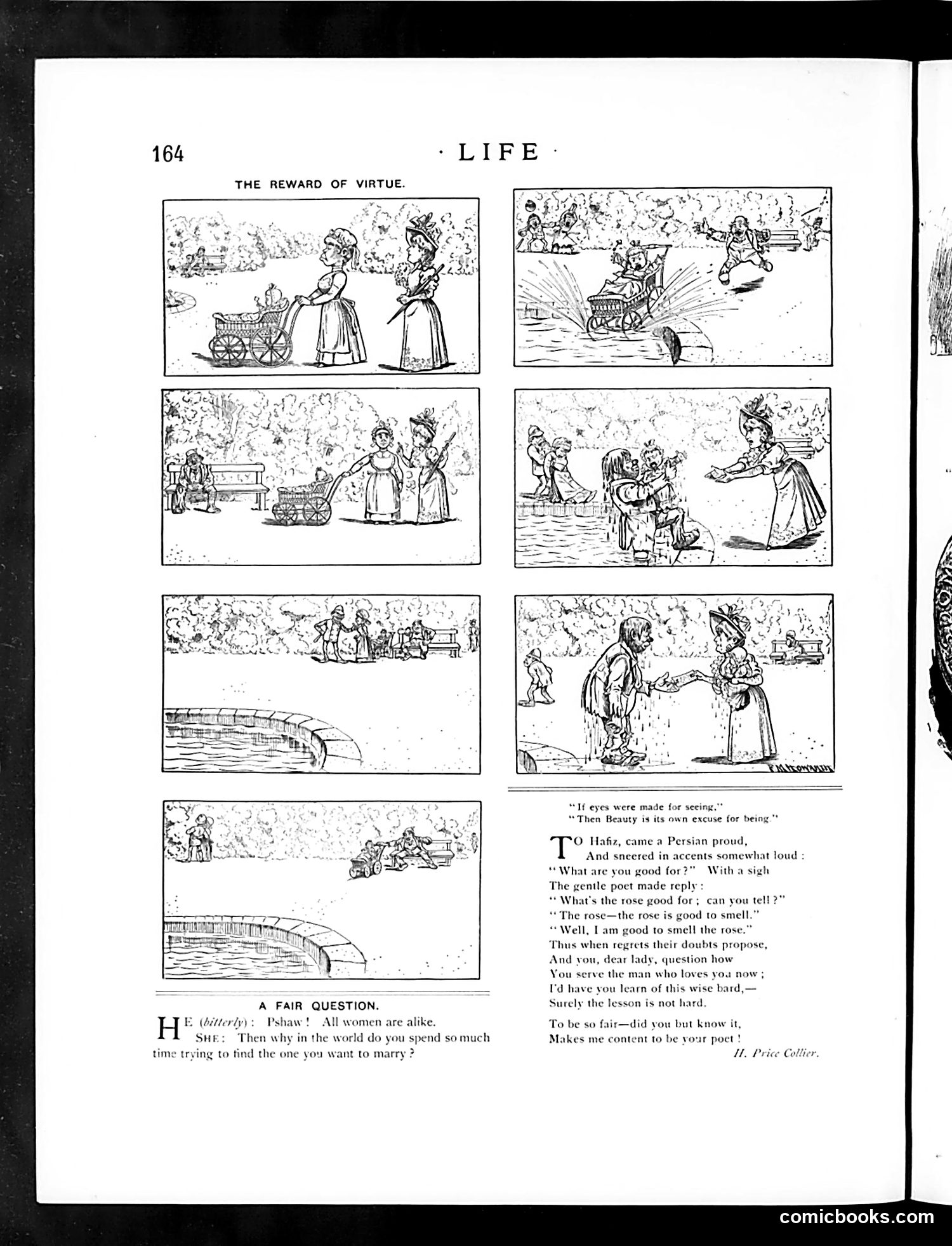
This page presents a seven-panel narrative comic strip depicting women performing acts of charity and virtue—distributing food, helping children, and caring for the poor. The sequence illustrates idealized "feminine" benevolence. Below, "A Fair Question" presents a dialogue joke: a bitter man (labeled "HE") states all women are alike, while a woman (SHE) sarcastically asks why he spends so much time trying to find "the one" to marry if they're identical. The page also includes poetry by H. Price Collier about a Persian's skepticism regarding the "usefulness" of beauty and roses, concluding that being "fair" (virtuous or beautiful) justifies women's existence. Together, these pieces satirize Victorian gender ideology—mocking both sentimental views of feminine virtue and men's contradictory expectations of women.
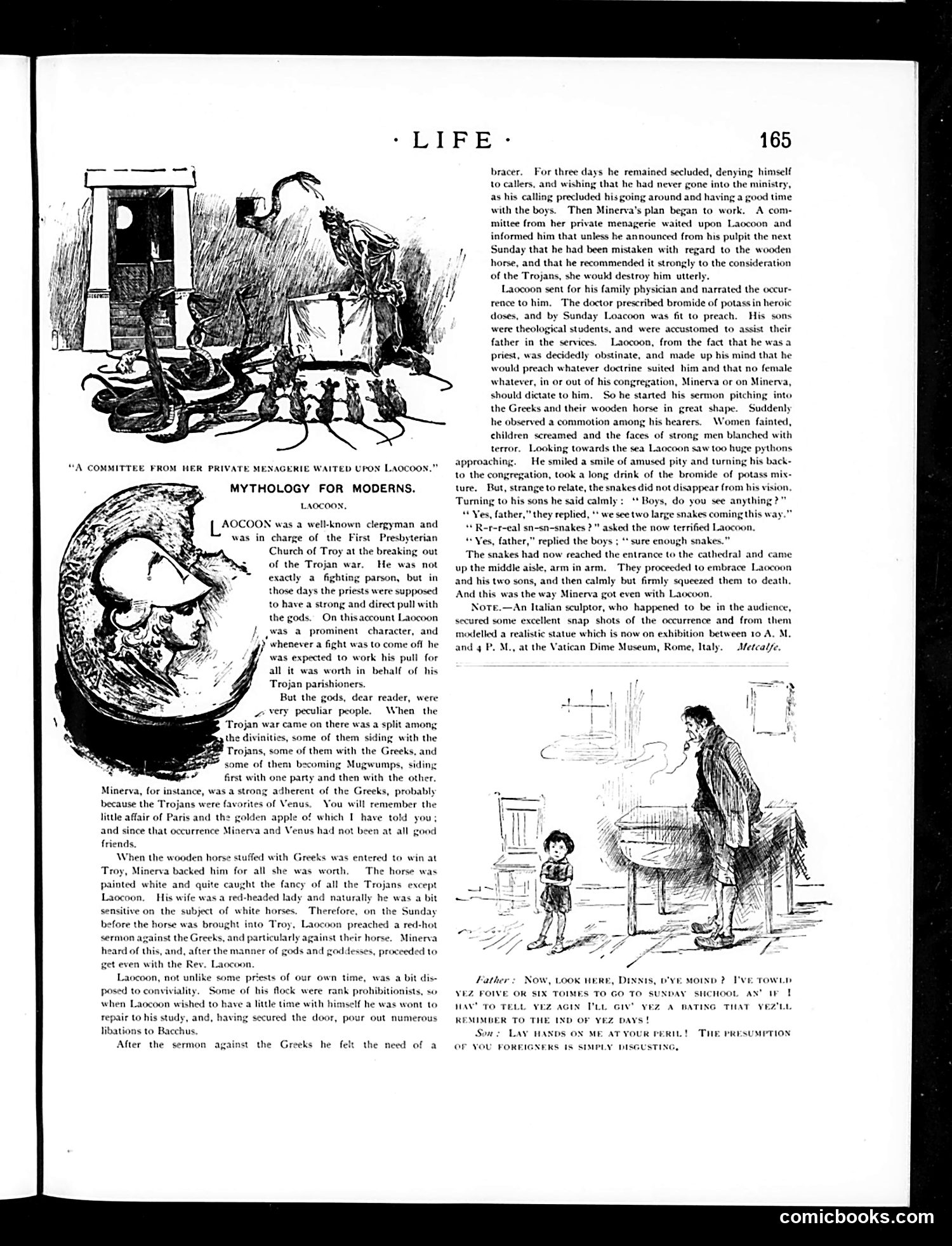
This page contains a satirical piece titled "Mythology for Moderns" featuring the classical figure **Laocoon**—the Trojan priest famous from ancient sculpture for being strangled by serpents. The satire reframes Laocoon's story as a modern moral lesson. The text humorously describes how Laocoon, a Presbyterian clergyman during the Trojan War, warned against the wooden horse but was ignored. His punishment—the serpents—becomes a cautionary tale about clerical authority and congregational disobedience. The accompanying illustrations show domestic scenes (a father and child) that appear to draw parallels between classical divine punishment and modern family discipline, satirizing how outdated religious authority figures invoke ancient mythology to maintain control over contemporary audiences. The piece mocks both classical pretension and authoritarian moral frameworks.
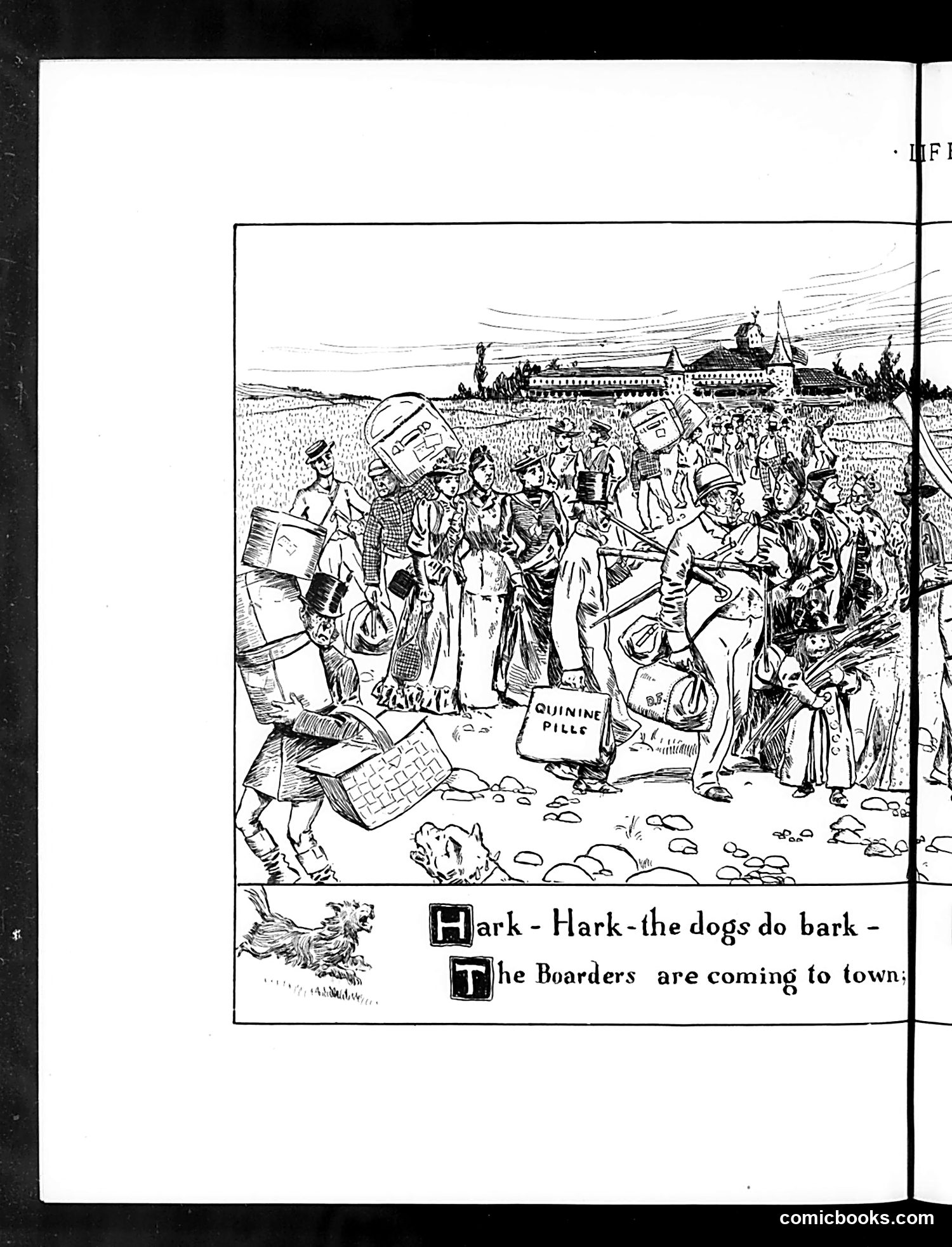
This is a satirical cartoon showing a crowd of people carrying large boxes labeled "QUININE PILLS" approaching a town. The verse reads: "Hark—Hark—the dogs do bark— / The Boarders are coming to town." This appears to be a reference to a nursery rhyme ("Beggar man, beggar woman, etc."), repurposed as social satire. The "Boarders" likely refers to boarding house residents or lodgers. The prominent display of quinine pills suggests the cartoon is satirizing either: 1. Health-conscious or hypochondriac boarders arriving en masse, or 2. Boarders associated with illness or disease concerns The industrial building in the background and the rural/country setting suggest tension between urban boarders and rural communities. Without additional context about the specific issue Life was addressing, the exact satirical target remains unclear, though it appears to mock boarders as unwelcome outsiders.
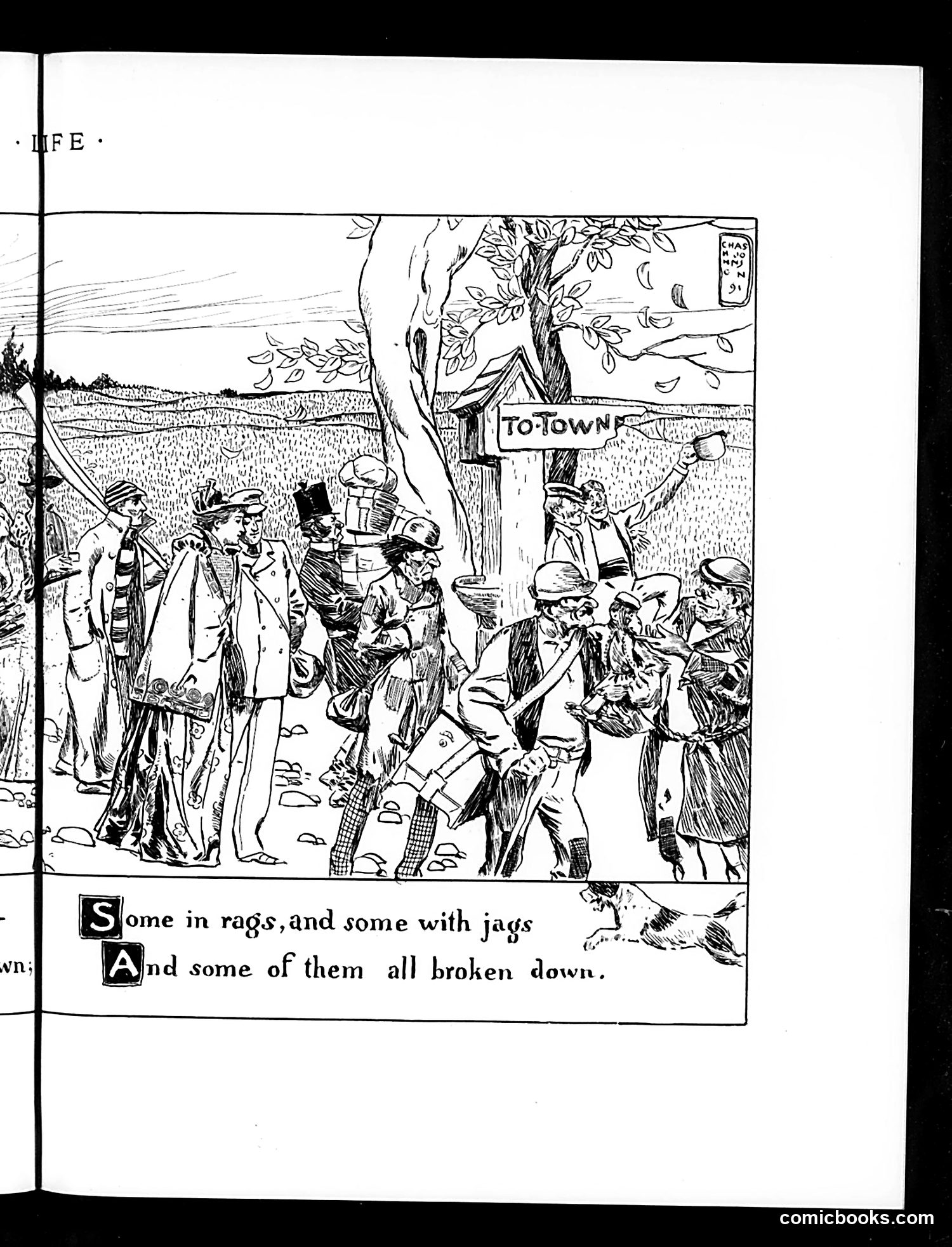
This cartoon depicts a scene at a "To Town" signpost where a group of figures in various states of dress and undress gather. The caption reads: "Some in rags, and some with jags / And some of them all broken down." The illustration appears to satirize **vagrancy or homelessness**, showing individuals of different social circumstances converging at a crossroads. The varied clothing—from rags to partial dress—emphasizes economic disparity. The phrase "broken down" suggests both physical deterioration and social decline. The specific historical context remains unclear without additional page information, but this likely comments on **urban poverty, unemployment, or possibly labor migration** in early 20th-century America. The tone is satirical rather than sympathetic, typical of *Life* magazine's social commentary on lower-class conditions during this era.
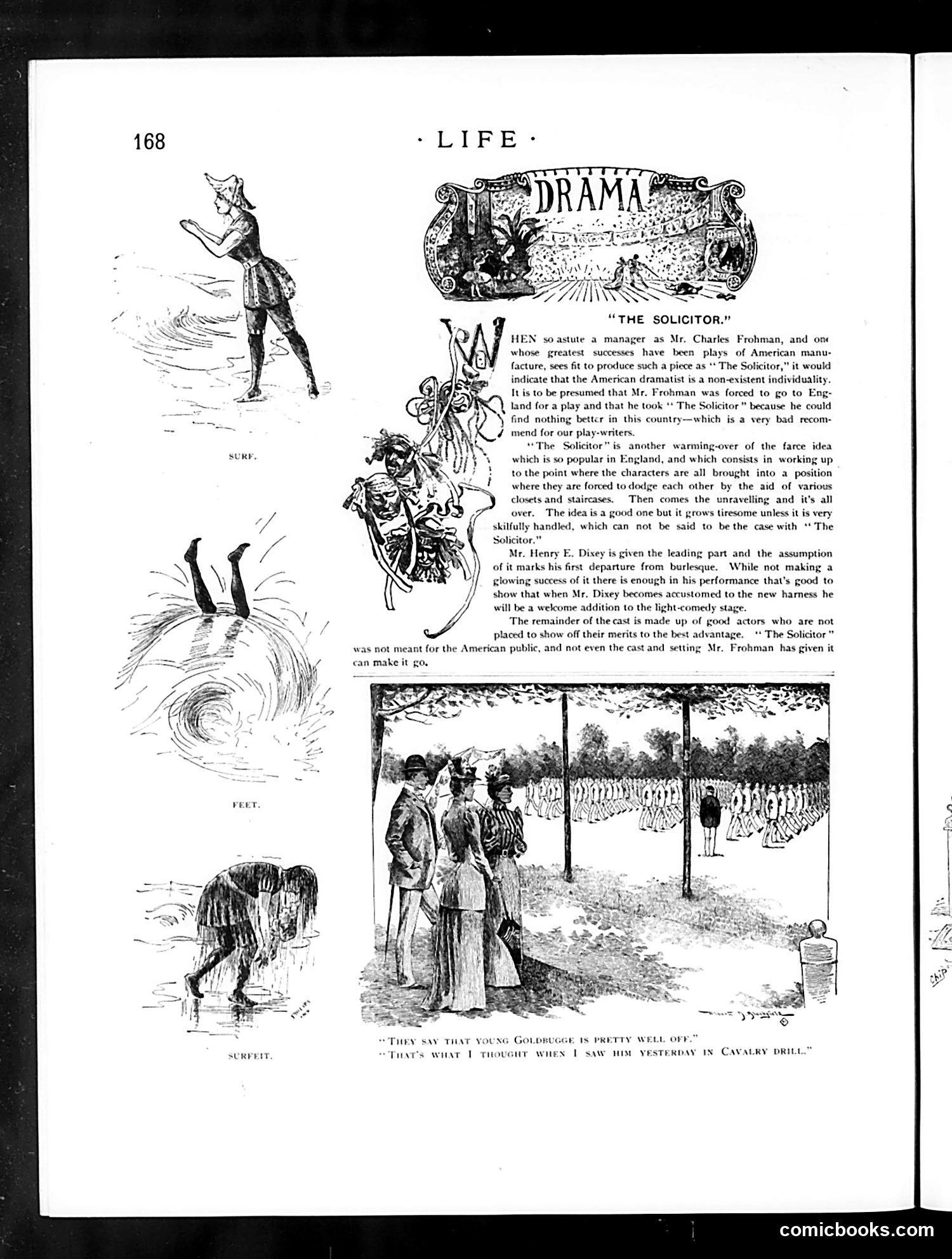
This page reviews "The Solicitor," a play produced by prominent theater manager Charles Frohman. The critic expresses disappointment that Frohman—known for championing American plays—imported this English farce rather than supporting domestic dramatists. The satire targets two groups: first, American playwrights for allegedly producing inferior work; second, Frohman himself for his apparent lack of faith in American talent. The review criticizes the play's tired formula: characters forced to hide in closets and dodge each other via staircases until resolution. While praising lead actor Henry E. Dixey's potential, the critic finds the material unsuitable for American audiences. The bottom illustration depicts cavalry drill, with a caption joking that a young "Goldrugge" appears wealthy—the satirical disconnect between appearance and reality mirrors the play's superficial comedy.
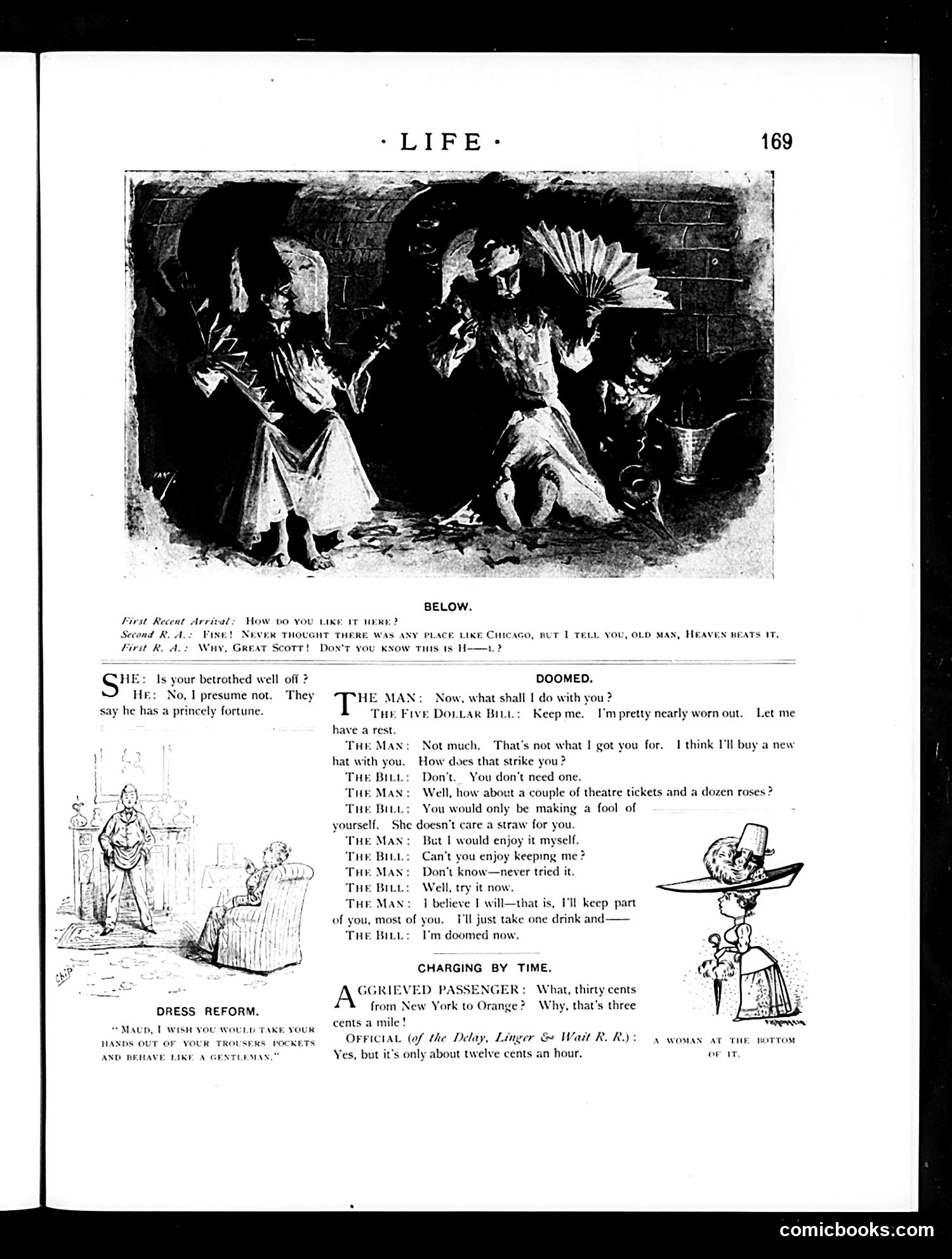
This page contains three separate satirical pieces mocking social issues of the era: **"Doomed"** depicts a personified five-dollar bill arguing with a man about how he'll spend it. The joke relies on the bill's bitter awareness that the man will squander it on frivolous pleasures (theater tickets, roses, drinks) rather than save it—a commentary on poor financial habits and consumerism. **"Dress Reform"** mocks a gentleman being told to remove his hands from his trouser pockets and behave properly—satirizing both the period's strict etiquette expectations and debates over "dress reform" movements. **"Charging by Time"** critiques railroad pricing. A passenger protests paying thirty cents per mile from New York to Orange, while a railroad official counters that it's only twelve cents per hour—highlighting the absurdity of different pricing schemes and corporate evasion of fair-rate criticism. All three pieces use humor to critique consumerism, social convention, and business practices of their era.
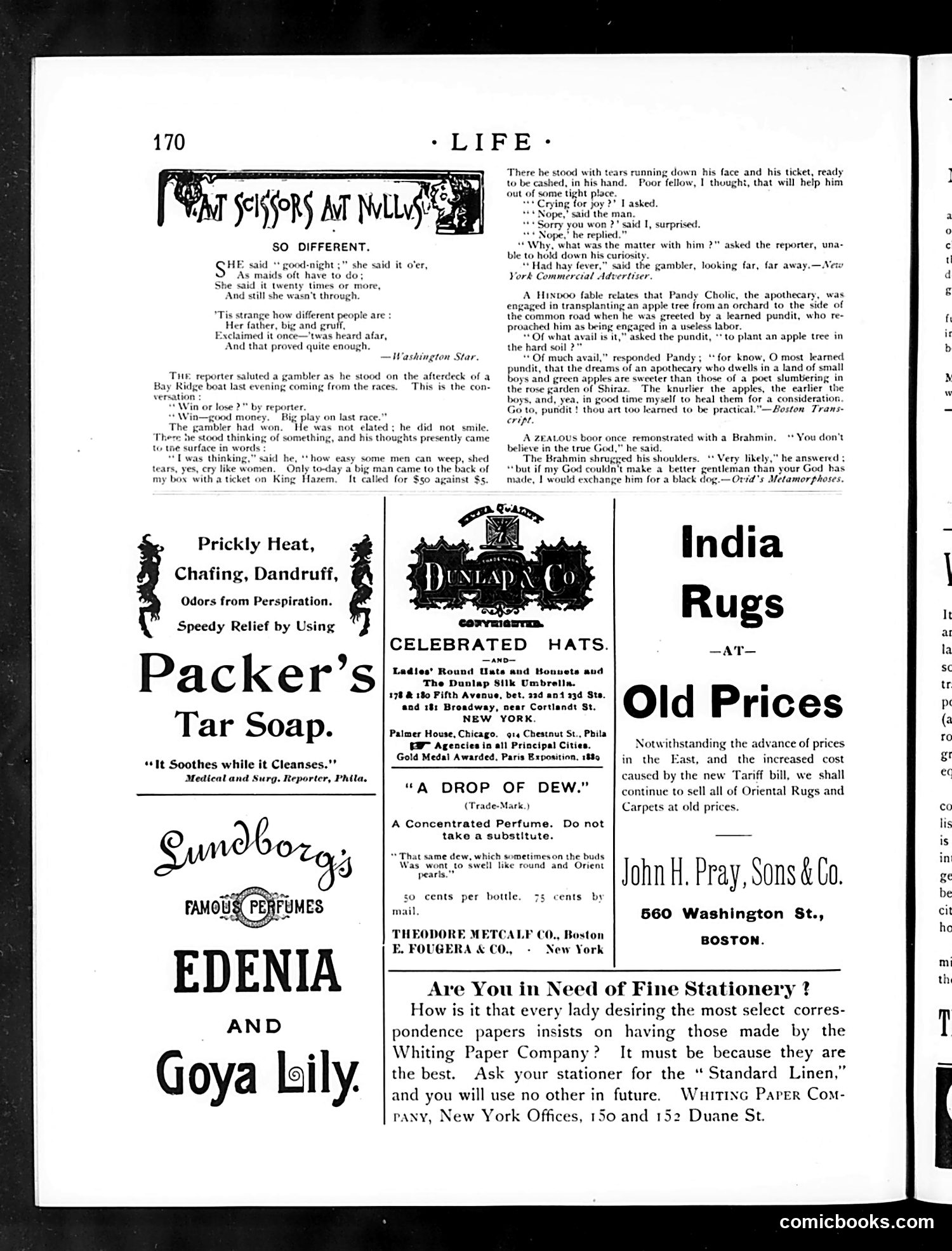
This page contains three brief humorous anecdotes and period advertisements—not political cartoons. **The Stories:** 1. **"So Different"** contrasts how a young woman says goodnight repeatedly while her gruff father says it once—satirizing gender stereotypes about verbose femininity versus masculine brevity. 2. **The Gambler anecdote** describes a man who wins $50 on a horse race but cries—not from joy but because he has hay fever. The joke plays on subverted expectations: the reporter assumes winning would make him happy. 3. **Hindu fables** present moral tales: an apothecary plants an apple tree for practical benefit (treating boys' injuries from eating unripe apples), and a Brahmin prefers his own god to one that produces inferior gentlemen. **Advertisements** dominate the lower half, promoting soap, perfume, hats, rugs, and stationery—typical of Life's revenue model. The humor relies on wordplay, unexpected punchlines, and gentle observations about human nature rather than political satire.
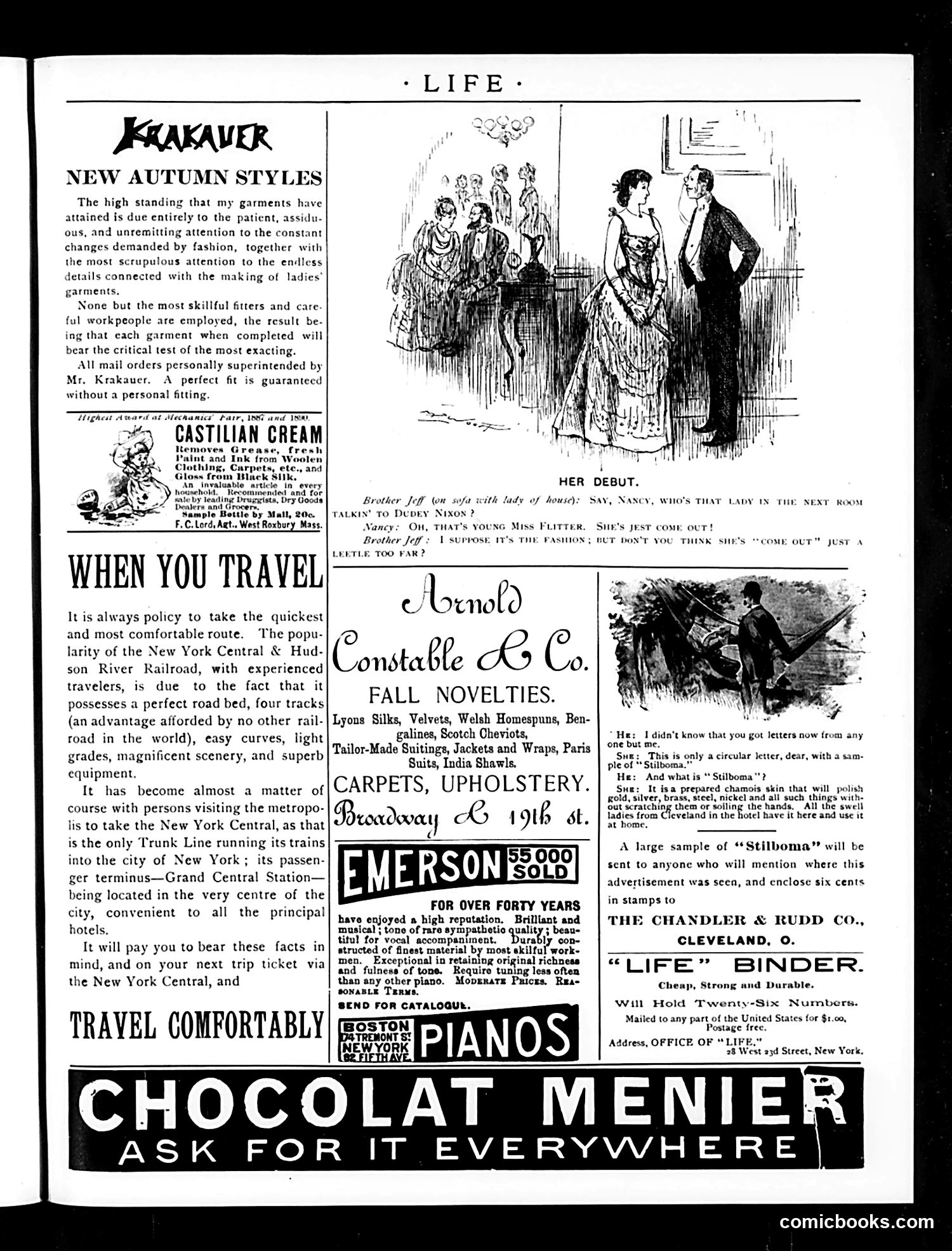
This small cartoon satirizes turn-of-the-century social conventions around young women's coming-out (debut) into society. The scene shows a brother gossiping with a houseguest about a young woman named Miss Flitter who has just made her social debut—her formal introduction to society as an eligible young woman. The humor lies in the brother's concern that Miss Flitter's fashion choices are too revealing or scandalous ("don't you think she's 'come out' just a little too far?"). The pun on "come out" (both her social debut and her physical exposure) mocks both the rigid propriety surrounding debutante presentations and the changing fashion standards that made older generations nervous. The joke reflects anxieties about modernizing women's fashions and social roles in this era.
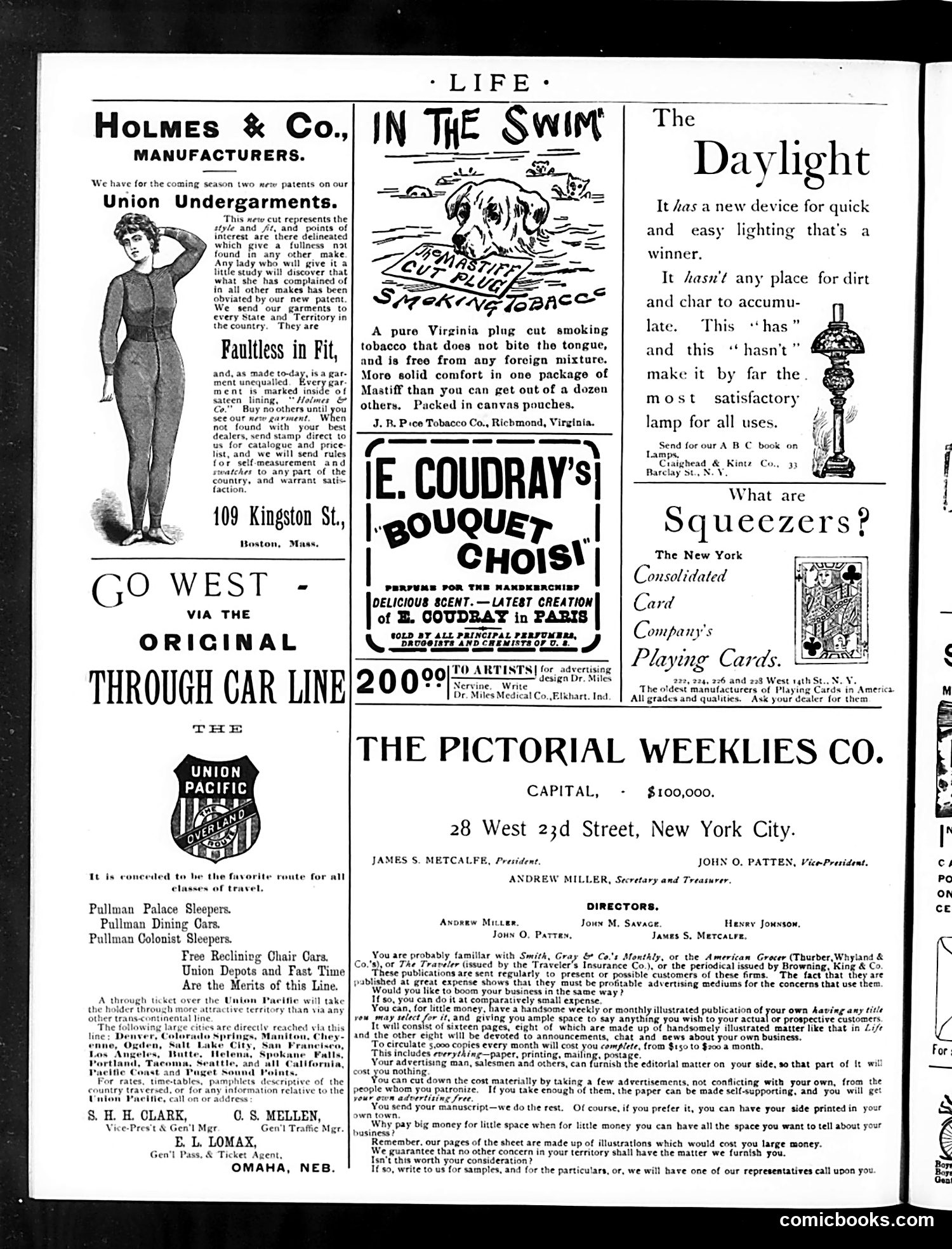
This is primarily a **commercial advertising page** from Life magazine, not a political cartoon. The page showcases various consumer products and services typical of the late 19th/early 20th century: **Main advertisements include:** - Holmes & Co. undergarments (Boston) promoting "faultless fit" - Union Pacific Railway's "through car line" to the West - Mastiff tobacco (Virginia plug cut) - E. Coudray's perfume (imported from Paris) - The Daylight lamp with a new lighting device - Consolidated Card Company playing cards - Dr. Miles' Nervine (patent medicine) **The cartoon "In the Swim"** depicts a dog swimming, likely a humorous visual pun about being "in the swim" (current slang for being fashionable/current). The page concludes with The Pictorial Weeklies Co.'s corporate information and a detailed pitch to businesses about creating their own branded publications as advertising vehicles—a novel early form of corporate marketing. This reflects Life's primary function as a commercial vehicle, not primarily satirical content.
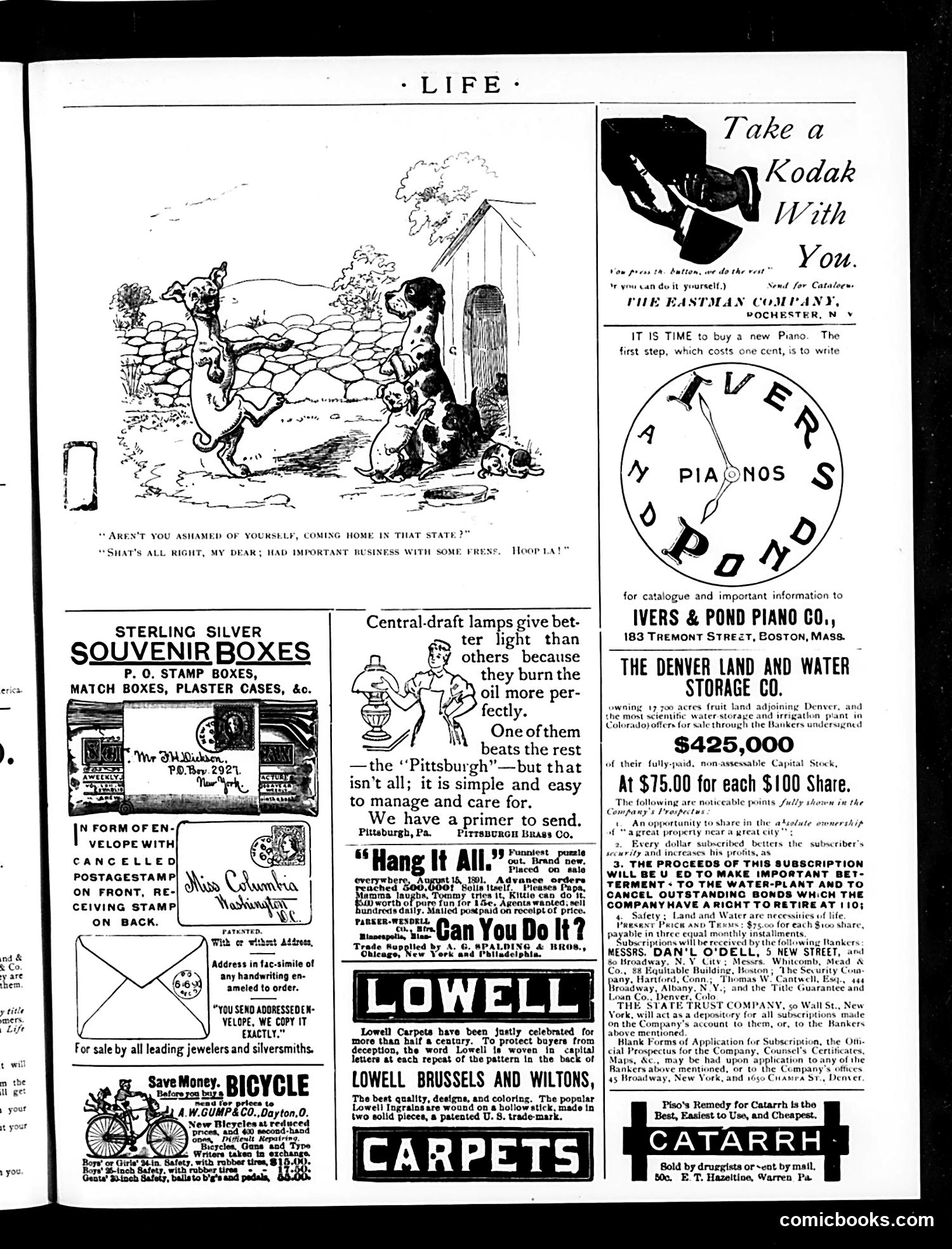
The main cartoon depicts a husband returning home disheveled, apparently intoxicated ("in that state"), while his wife scolds him. He dismisses her concern by claiming he had "important business with some frens" and offers an exaggerated "Hoor La!" — likely a crude attempt at humor or a foreign exclamation meant to be comedic. **The satire's point**: This represents domestic tension around male drinking and socializing. The husband's flimsy excuse and cheerful dismissal of his wife's legitimate concern mocks men who prioritize leisure activities (drinking with friends) over family responsibility, while downplaying their wives' justified disapproval. The cartoon's humor relies on the audience's familiarity with this common domestic conflict in early 1900s life. The rest of the page consists primarily of period advertisements (pianos, carpets, bicycles, lamps, investment opportunities).
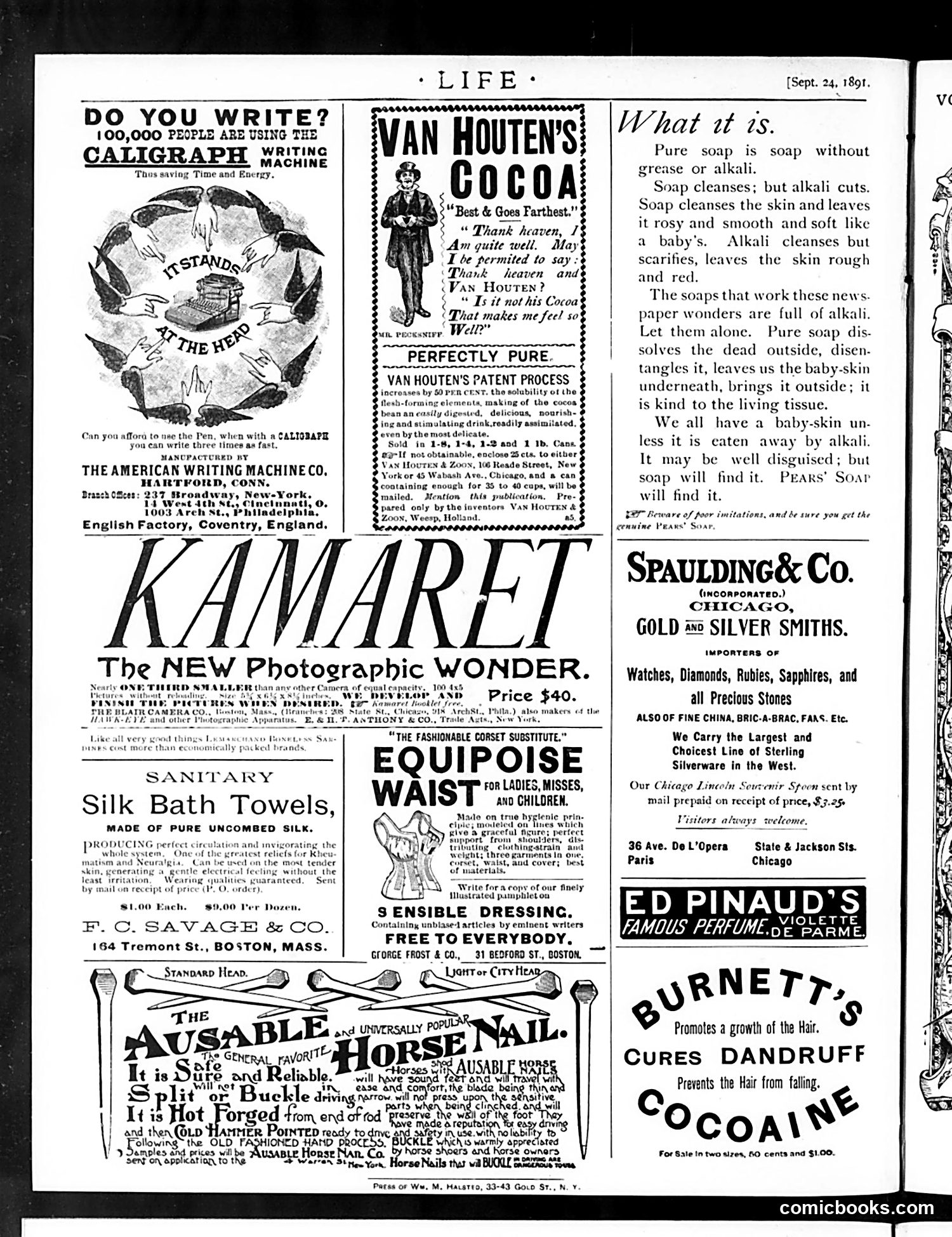
This is primarily an **advertising page** with no political cartoons or satire. The content reflects late-19th-century commercial concerns. Notable advertisements include: - **Caligraph typewriter**: Marketed as saving time/energy, competing with handwriting - **Van Houten's Cocoa**: Emphasizes its "patent process" for digestibility - **Kamaret photographic camera**: Called a "wonder," reflecting new photography technology - **Equipoise corset**: Positioned as a "hygienic" alternative to restrictive corsets - **Pears' Soap**: Makes pseudo-scientific claims about "alkali" in competitors' soaps, arguing pure soap protects "baby-skin" The **social context**: These ads target middle/upper-class consumers of new technologies and beauty products. The Equipoise and Pears' advertisements reveal period anxieties about women's health and beauty standards, while the Caligraph and Kamaret reflect the era's enthusiasm for modern mechanical and optical innovations. No satire is evident—this is straightforward advertising copy.