
A complete issue · 22 pages · 1891
Life — September 3, 1891
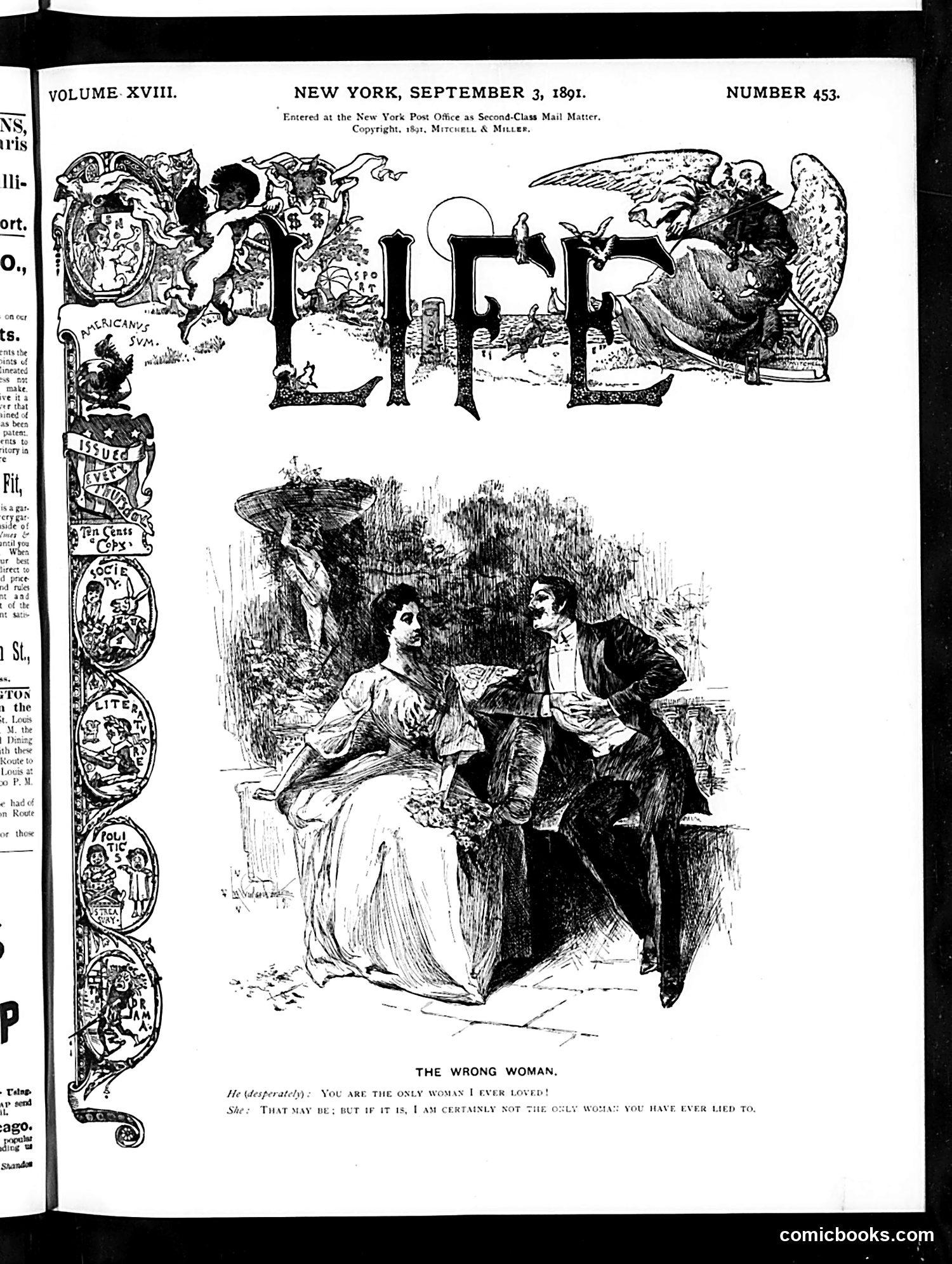
This satirical illustration depicts a domestic drama common to Victorian-era comedy: a man confessing his romantic history to a woman. The caption reads: "He (desperately): 'You are the only woman I ever loved!' / She: 'That may be; but if it is, I am certainly not the only woman you have ever lied to.'" The humor targets male infidelity and deception rather than critiquing a specific political figure or event. It's a social satire about relationship dishonesty—the woman's skeptical response suggests she knows his profession of exclusive love is false given his apparent history with other women. This reflects 1890s satirical commentary on courtship, marriage, and masculine hypocrisy, themes Life magazine frequently addressed through domestic scenarios.
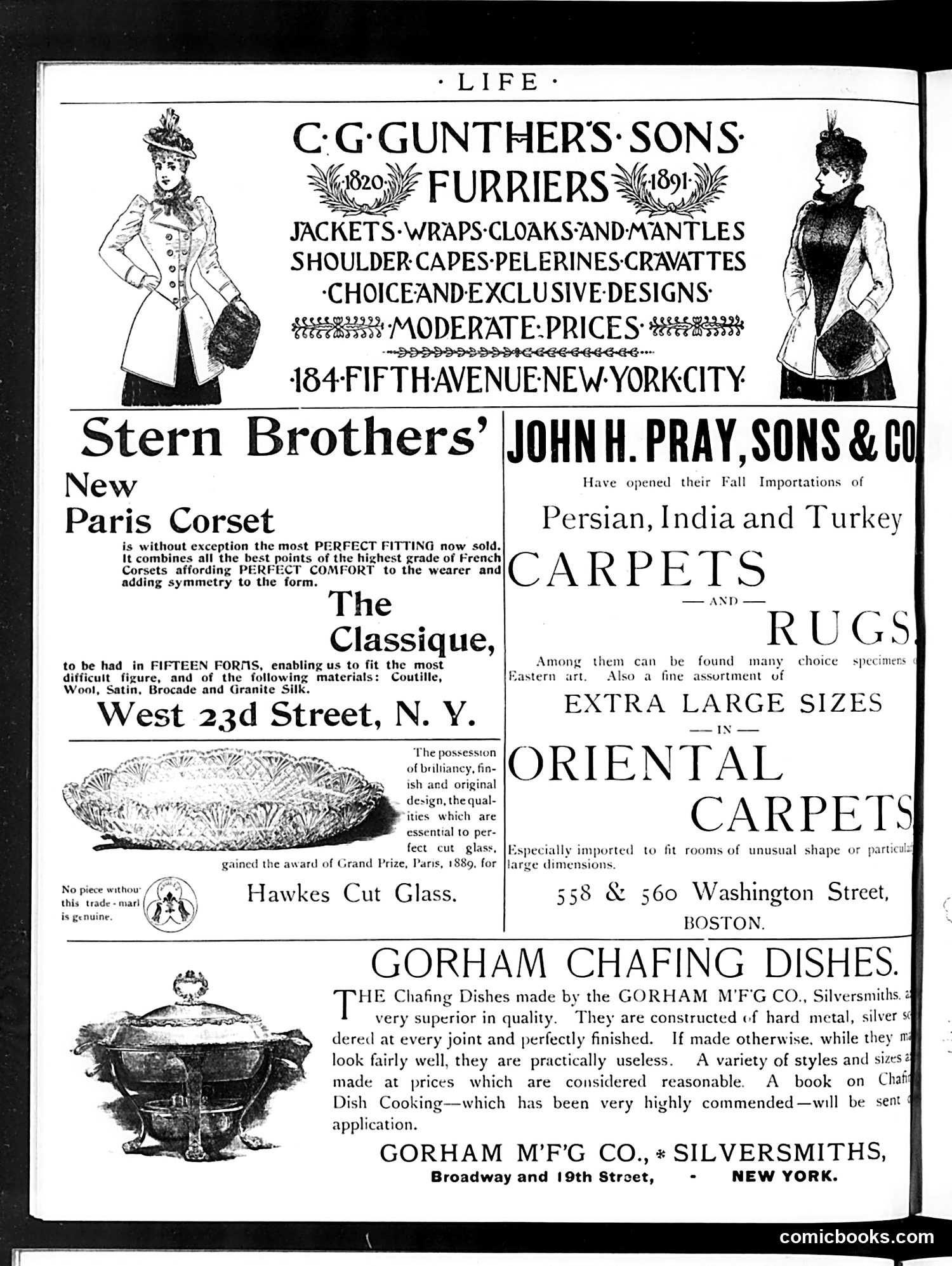
This page is **primarily advertising** with no political cartoons or satirical content visible. The advertisements showcase late 19th-century luxury goods: - **C.G. Gunther's Sons** (top): A furrier advertising fashionable women's outerwear and accessories, with illustrated models displaying the styles - **Stern Brothers**: Corsets marketed as "perfectly fitting" with French construction - **Hawkes Cut Glass**: Decorative glassware that won a Grand Prize at the Paris Exposition - **John H. Pray, Sons & Co.** (Boston): Oriental carpets and rugs in extra-large sizes - **Gorham Chafing Dishes**: High-quality silverware for dining The page reflects Gilded Age consumer culture targeting wealthy urban shoppers, featuring imported luxury goods and fashionable attire. There is no satire or political commentary—this is straightforward commercial promotion.
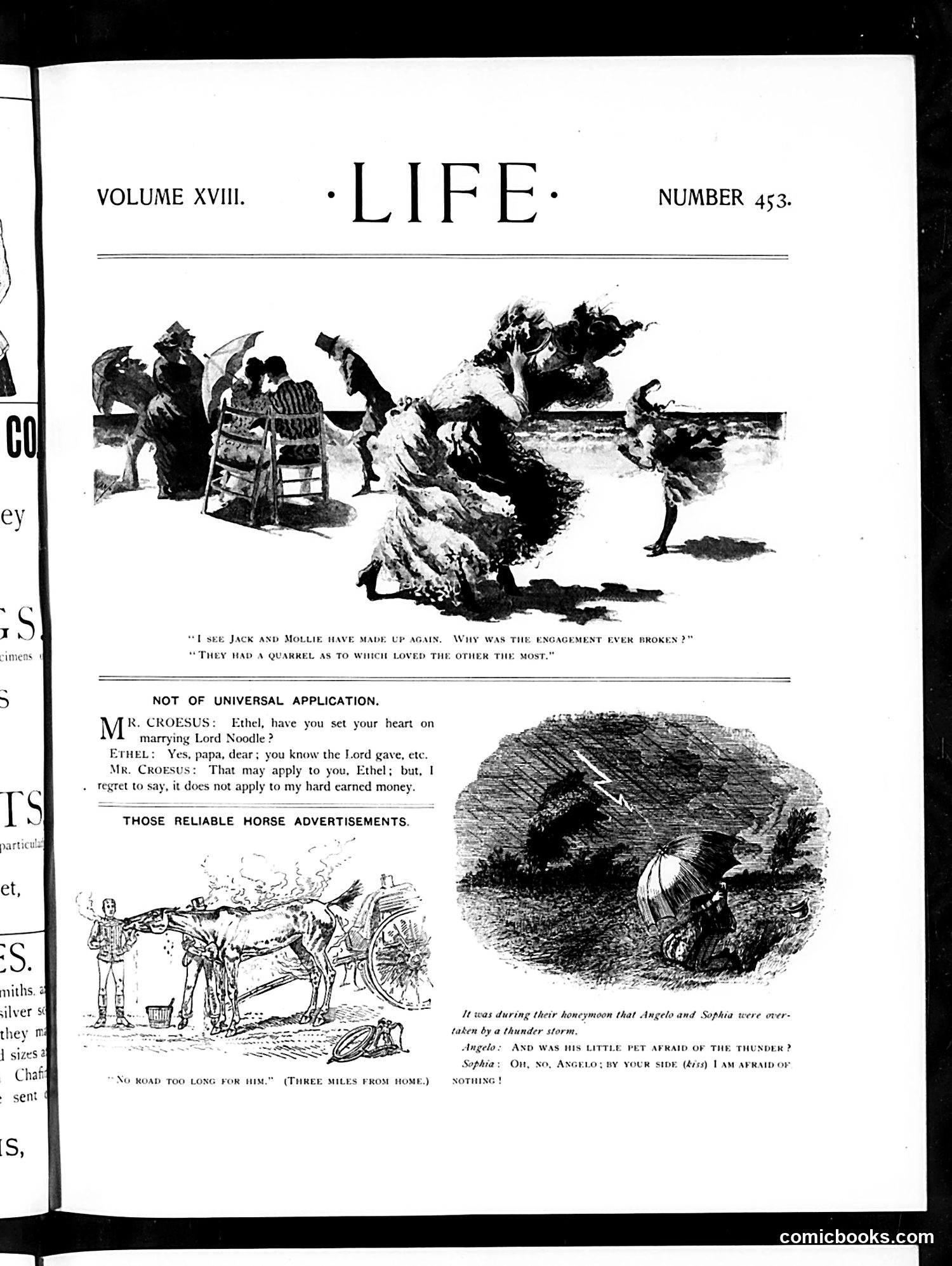
This page contains three separate satirical pieces: **Top cartoon**: Shows a seaside scene with the caption about Jack and Mollie's broken engagement, satirizing romantic drama and the question of who loved whom more—typical melodramatic relationship humor. **"Not of Universal Application"**: A brief dialogue joke where Mr. Croesus (likely referencing the wealthy ancient king) argues that while divine blessing applies to marrying Lord Noodle, it doesn't apply to his hard-earned money—mocking wealthy men's reluctance to share fortunes with spouses. **"Those Reliable Horse Advertisements"**: A horse-trading scene captioned "No road too long for him (three miles from home)"—satirizing exaggerated advertising claims about horses' capabilities that prove false in actual use. All three pieces use humor to mock pretension, romantic excess, and deceptive marketing practices common in the era.
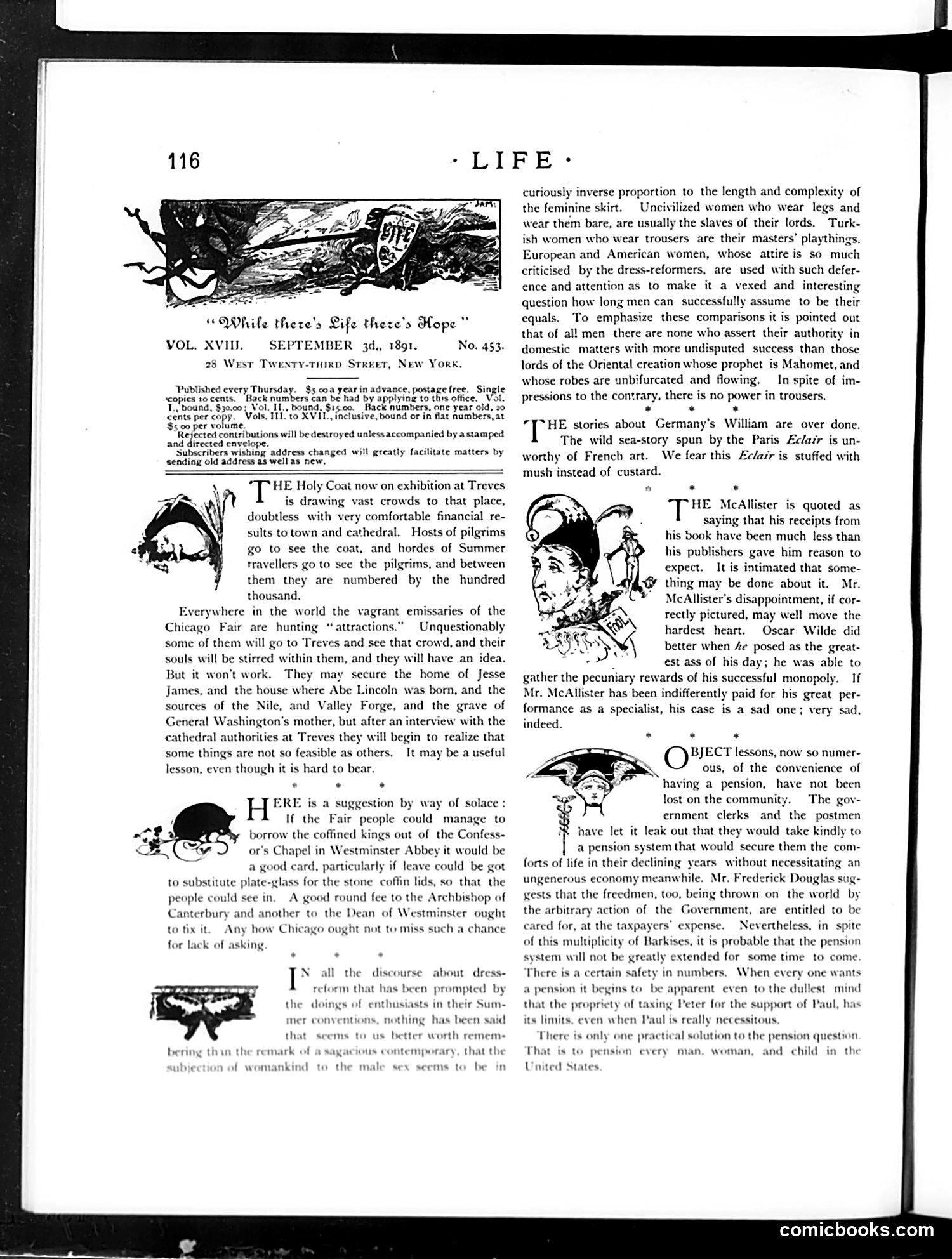
This page contains several satirical commentary pieces rather than a single unified cartoon. The top illustration shows a figure labeled "While there's Life there's Hope," referencing the magazine's title and traditional proverb. The main text discusses the Holy Coat exhibition at Treves (drawing crowds), the Chicago Fair's attractions, and dress-reform debates. There are small decorative illustrations accompanying these sections. A key point of satire concerns women's clothing and social status: the author criticizes how women's dress (particularly skirt length) reflects their subjugation, contrasting uncivilized women who wear pants as "slaves" with European/American women whose restrictive fashion emphasizes male authority. The piece advocates for practical dress reform as a measure of women's liberation. Additional commentary addresses pensions, Oscar Wilde, and the McAllister's social position—typical 1891 satirical topics for Life's urban, educated readership.
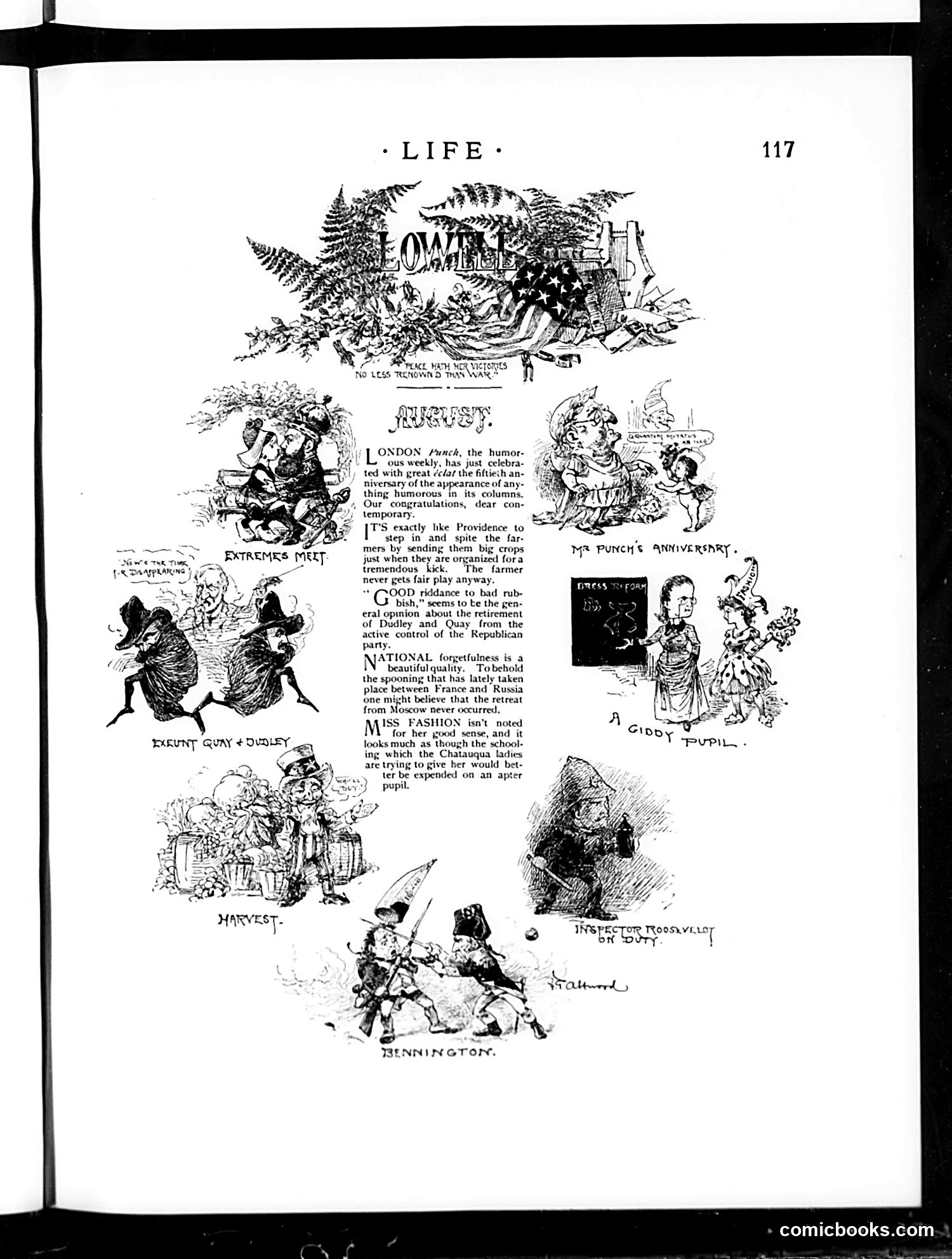
This page contains multiple political cartoons satirizing current events (likely early 1900s based on style). The visible sections include: **"Extremes Meet"** and **"Recent Guy & Dudley"**: Appear to mock Republican political figures, possibly referencing internal party conflicts or policy disagreements. **"Mr. Punch's Anniversary"** and **"A Giddy Pupil"**: Seem to satirize fashion trends and educational/social matters. **"Inspector Mosswilet on Duty"**: The text mentions commentary on national forgiveness regarding France-Russia relations, satirizing diplomatic issues. The article discusses London's humor magazine celebrating diverse satirical subjects, noting how "Providence" aids farmers through crop conditions. References to Dodley, Quay, and Republican party control suggest specific political controversies, though identifying exact figures requires additional historical context.
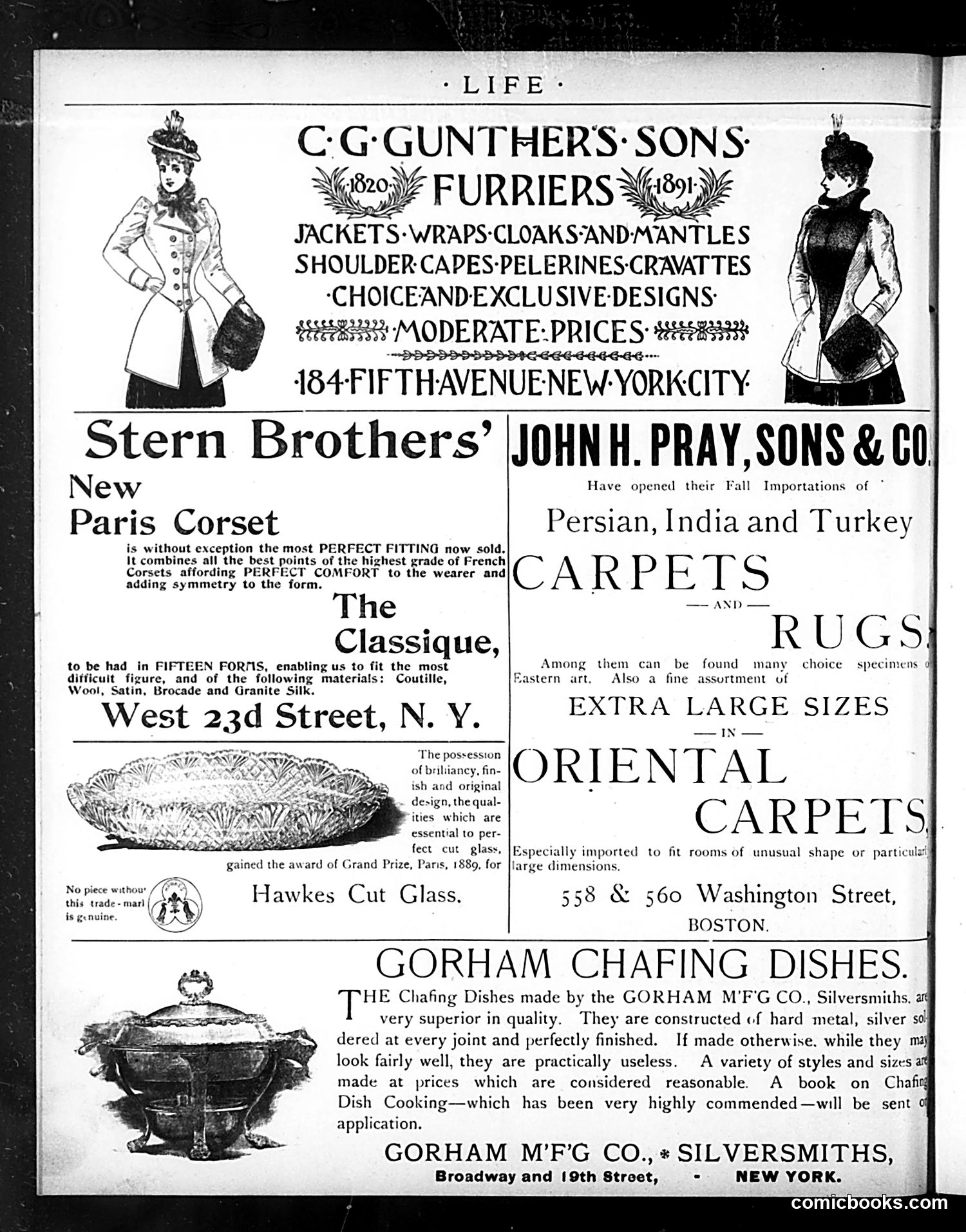
This page contains **no political cartoons or satire**—it is primarily advertising from circa 1891, as indicated by the "1820-1891" dates on the C.G. Gunthers' Furriers ad. The advertisements feature: - **C.G. Gunthers' Sons**: A furrier business advertising jackets, wraps, cloaks, and other women's garments (illustrated with fashionable women's clothing of the era) - **Stern Brothers**: Advertising corsets, specifically "The Classique" model - **John H. Pray, Sons & Co.**: Promoting imported Persian, India, and Turkish carpets and rugs from Boston - **Gorham Chafing Dishes**: Silver serving dishes for entertaining The page reflects late 19th-century consumer culture and luxury goods aimed at wealthy, urban Americans. No satire or political commentary is evident—this is straightforward period advertising.
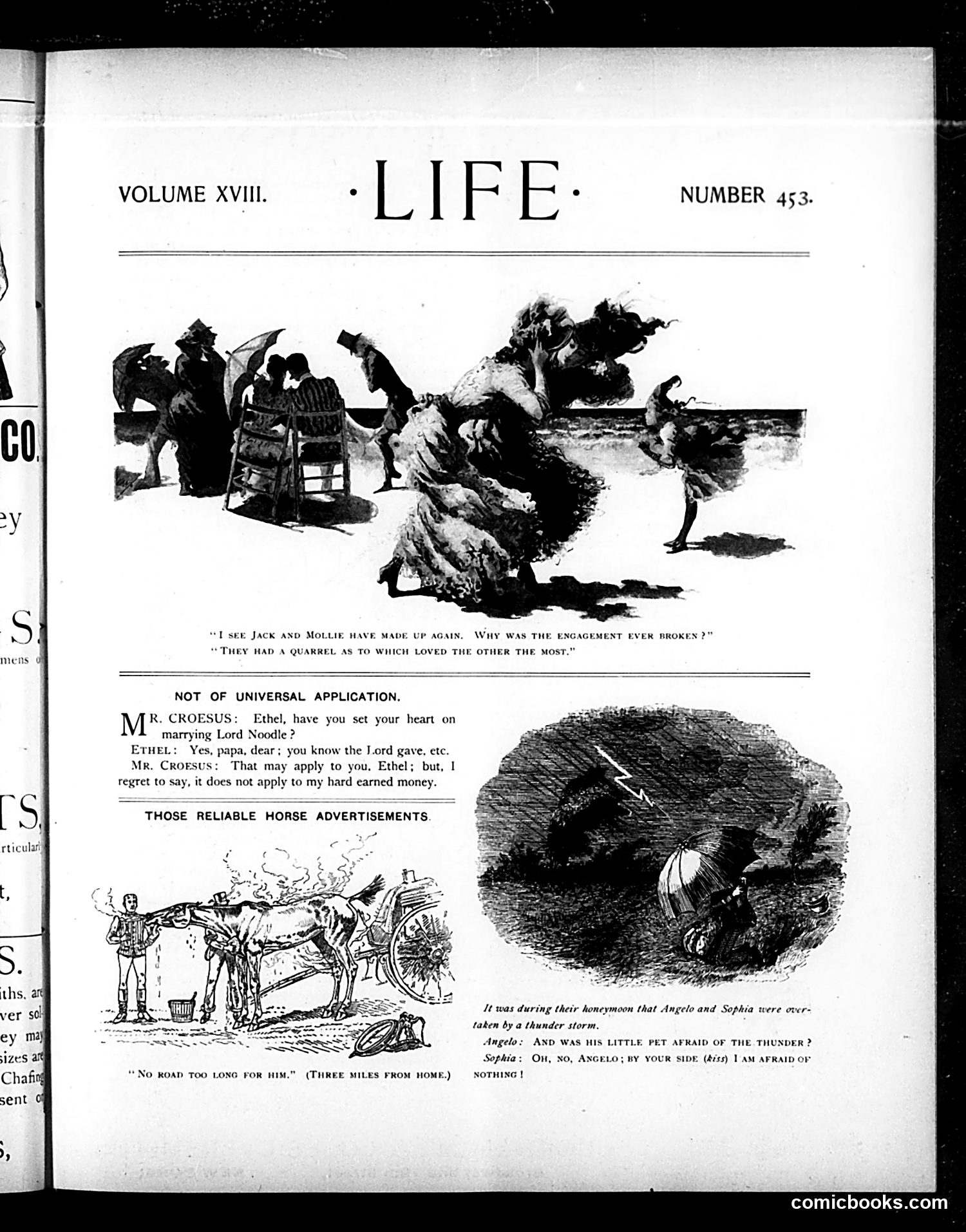
This page contains three separate satirical pieces: **Top illustration**: Shows a domestic quarrel scene with the caption about Jack and Mollie's broken engagement, illustrating a relationship dispute over conflicting loyalties. **"Not of Universal Application"**: A brief dialogue where Mr. Croesus (representing wealth) argues that moral principles about love don't apply to his "hard earned money"—satirizing wealthy individuals who exempt themselves from ethical standards. **"Those Reliable Horse Advertisements"**: Mocks false advertising claims. The illustration shows a worn-out horse with the caption "No road too long for him (Three miles from home)"—exposing how horse sellers exaggerate an animal's fitness and capabilities to deceive buyers. These pieces collectively mock hypocrisy, greed, and consumer deception in early 20th-century American society.
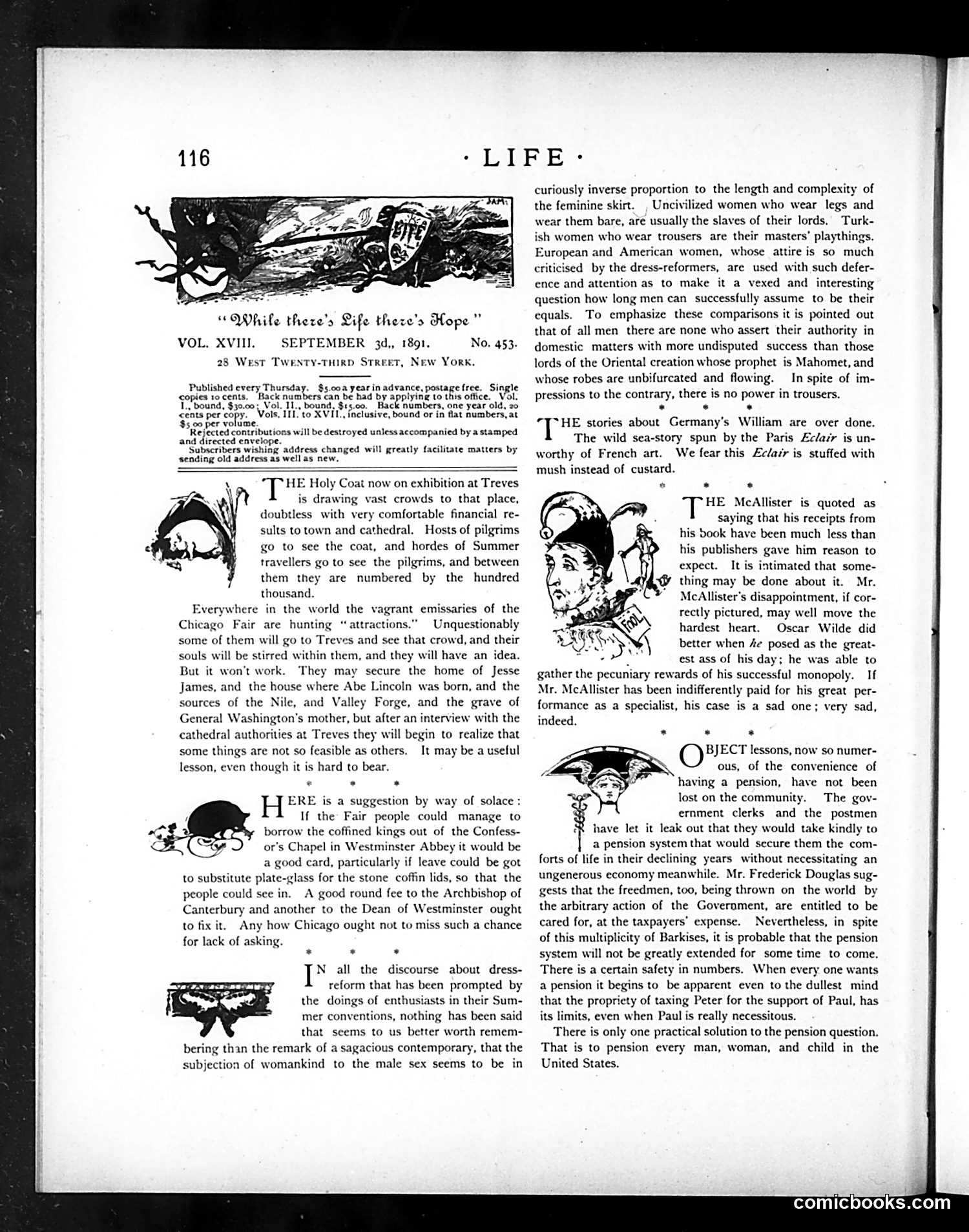
This page contains editorial commentary rather than political cartoons. The small illustrations are decorative mastheads. **Key content:** The text discusses the **World's Columbian Exposition (Chicago Fair)**, criticizing plans to display artifacts at Treves cathedral. It suggests borrowing items from Westminster Abbey instead—a satirical jab at American cultural ambitions. **On dress reform:** The lengthy passage mocks contemporary debates about women's clothing, particularly the tension between Victorian dress codes and reformers advocating simpler garments. It argues that women's subjection to male fashion standards reflects broader gender inequality. **On pensions:** The final section debates whether government should pension all citizens, referencing "Frederick Douglas" (likely **Frederick Douglass**, the abolitionist). It questions the practicality of universal pensions. The satire targets Victorian social pretensions and gender politics rather than specific individuals.
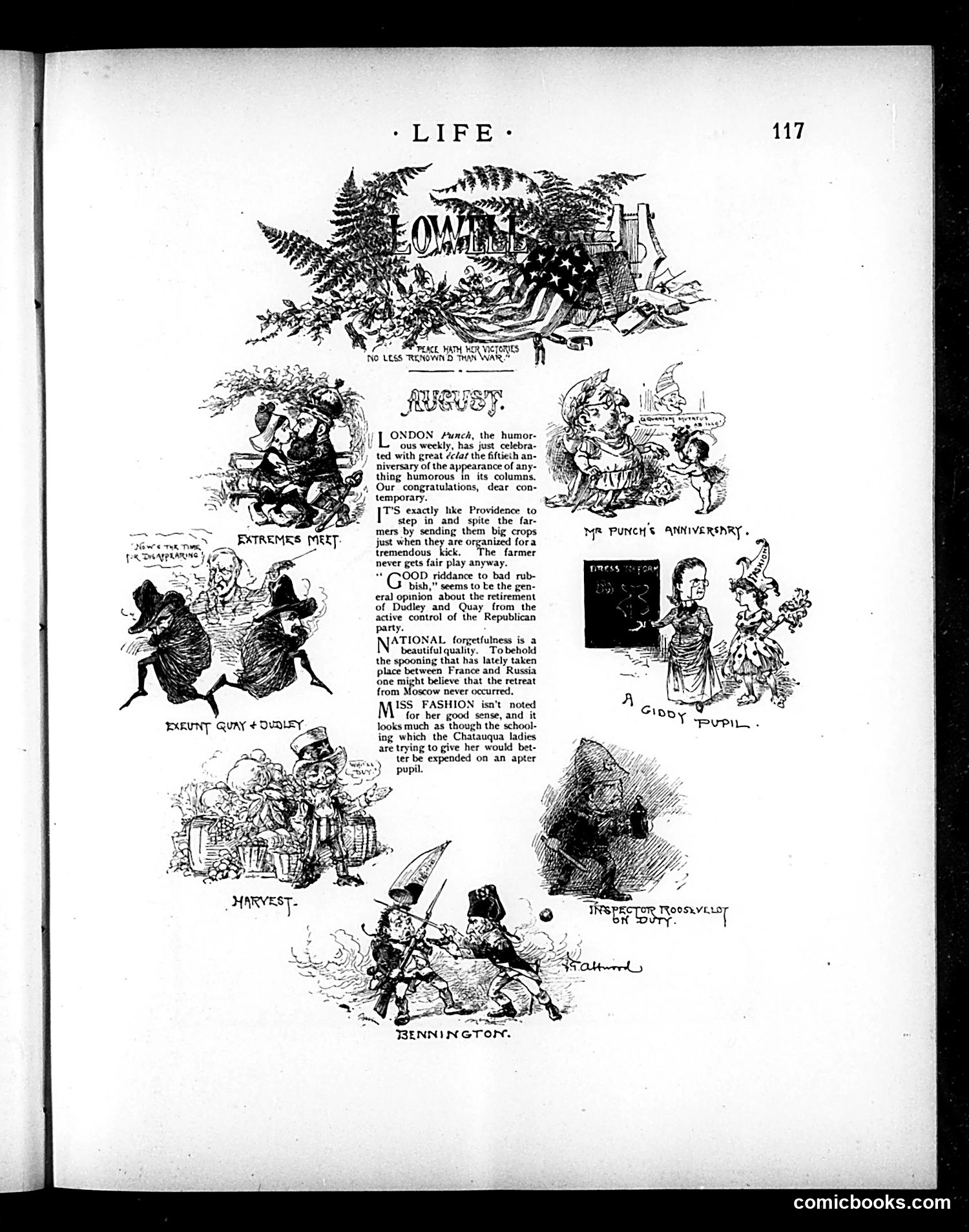
This page contains multiple satirical cartoons commenting on British politics and social issues. The central text mentions the "retirement of Dudley and Quay from the active control of the Republican party" and discusses "National forgetfulness" as a quality. The cartoons feature caricatured figures in various scenarios: "Extreme's Meet," "Exeunt Quay & Dudley," "Harvest," "A Giddy Puple" (possibly "Purple"), "Inspector Roosevelt on Duty," and "Bennington." The illustrations employ exaggerated features typical of Edwardian-era political cartooning. Without clearer visibility of all figure identifications, the specific individuals being mocked—beyond the named politicians Quay and Dudley—remains somewhat unclear, though the satire targets American Republican Party politics and possibly British fashion/society figures mentioned in the accompanying text.
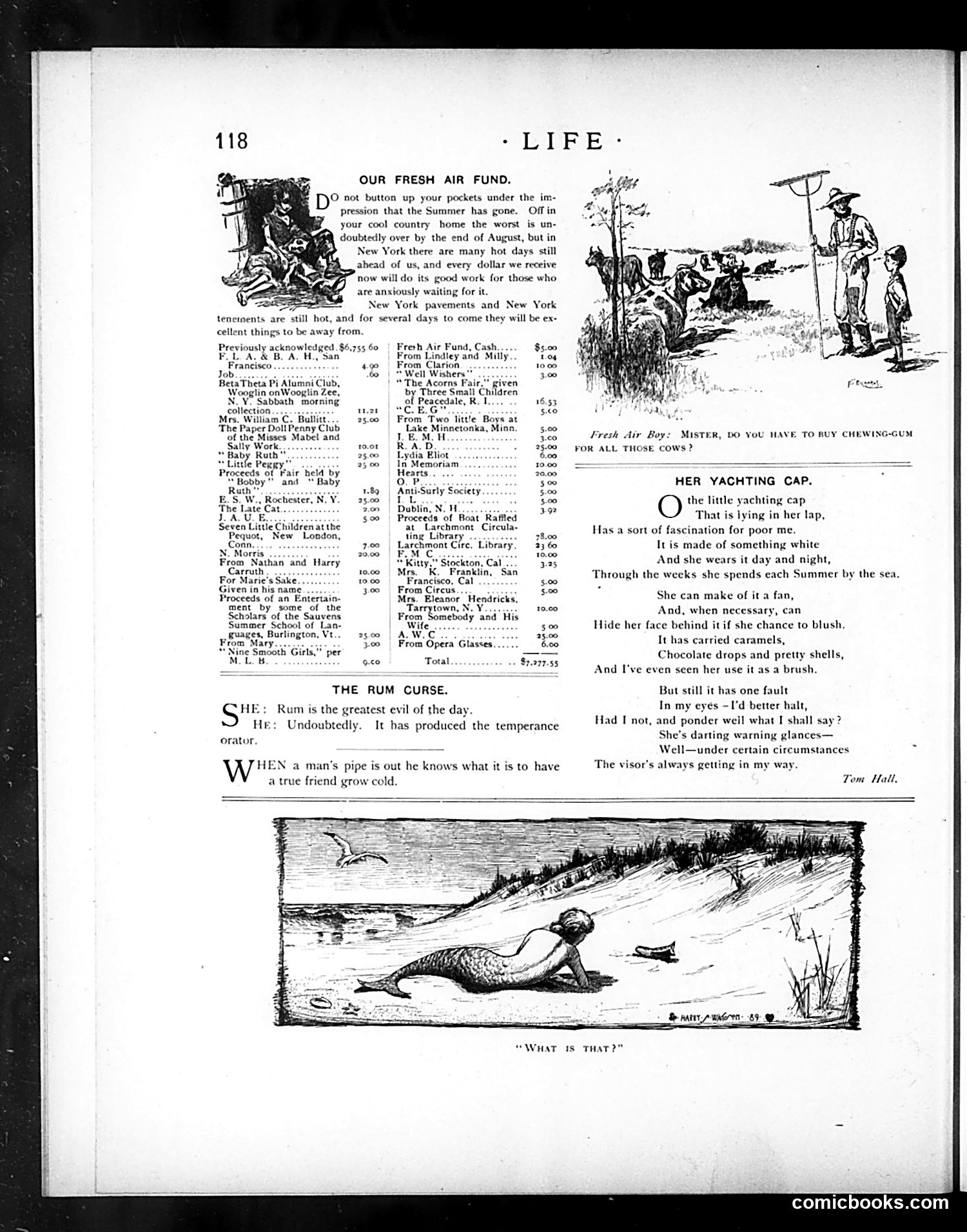
This page contains three distinct elements: 1. **"Our Fresh Air Fund"** - A fundraising appeal listing donations for sending poor urban children to the countryside during hot summers. This was a genuine charitable cause of the era. 2. **"The Rum Curse"** - A brief dialogue between "She" and "He" debating whether rum is "the greatest evil of the day," reflecting temperance movement concerns of the Prohibition era. 3. **"Her Yachting Cap"** - A humorous poem by Tom Hall about a woman's white yachting cap and its various uses (fan, brush, hiding blushes). The accompanying cartoon shows a mermaid on a beach, captioned "What is that?" - likely a visual gag unrelated to the poem's text. The page reflects early 20th-century American middle-class anxieties about poverty, alcohol, and leisure activities.
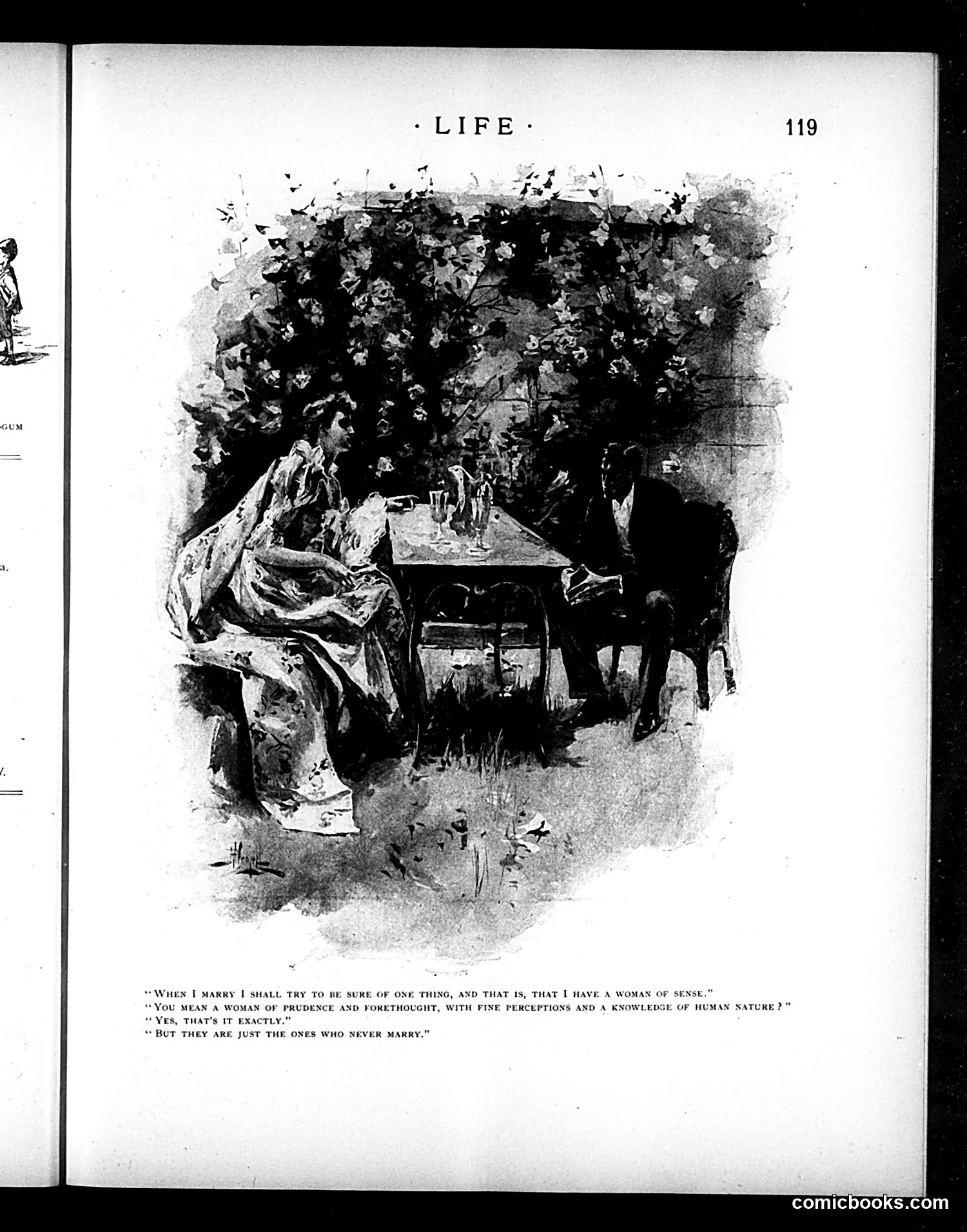
This illustration depicts an outdoor romantic scene under flowering vines or trees. Two figures sit at a table in conversation—a woman on the left in flowing dress and a man on the right in dark clothing. The quoted dialogue below addresses marriage and women's qualities: the speaker (likely male) states he'll seek "a woman of sense" with "prudence and forethought, with fine perceptions and a knowledge of human nature." When asked if such women exist, he responds affirmatively—"But they are just the ones who never marry." This is satirical commentary on marriage prospects and gender relations, suggesting that intelligent, sensible women avoid matrimony, implying either that marriage is undesirable or that men of the era failed to appreciate or seek such qualities in wives. The joke reflects period anxieties about courtship and matrimonial compatibility.
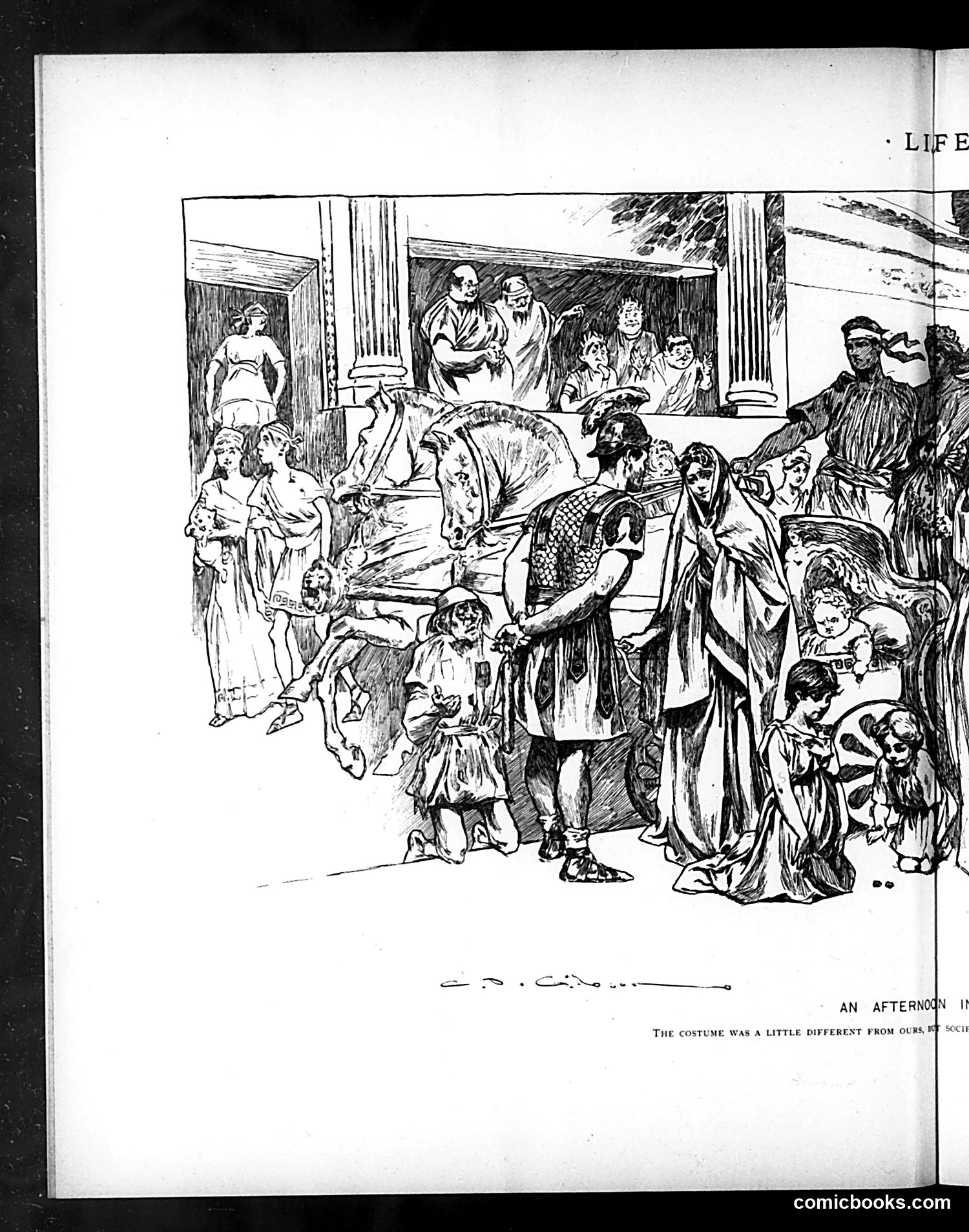
This single-panel cartoon depicts a scene labeled "An Afternoon in Rome" with the caption noting "The costume was a little different from ours." The illustration shows a crowded Roman street or forum with figures in classical dress—togas and period clothing—gathered around a horse-drawn cart or chariot. The satire appears to compare Roman society to contemporary American life, suggesting that despite surface differences in clothing and customs, human behavior and social dynamics remain fundamentally similar across time periods. The busy, crowded scene with diverse classes of people (wealthy figures, common folk, children) emphasizes this timeless aspect of human nature. The joke is visual rather than dependent on specific political figures—it's a commentary on universal human character rather than contemporary events.
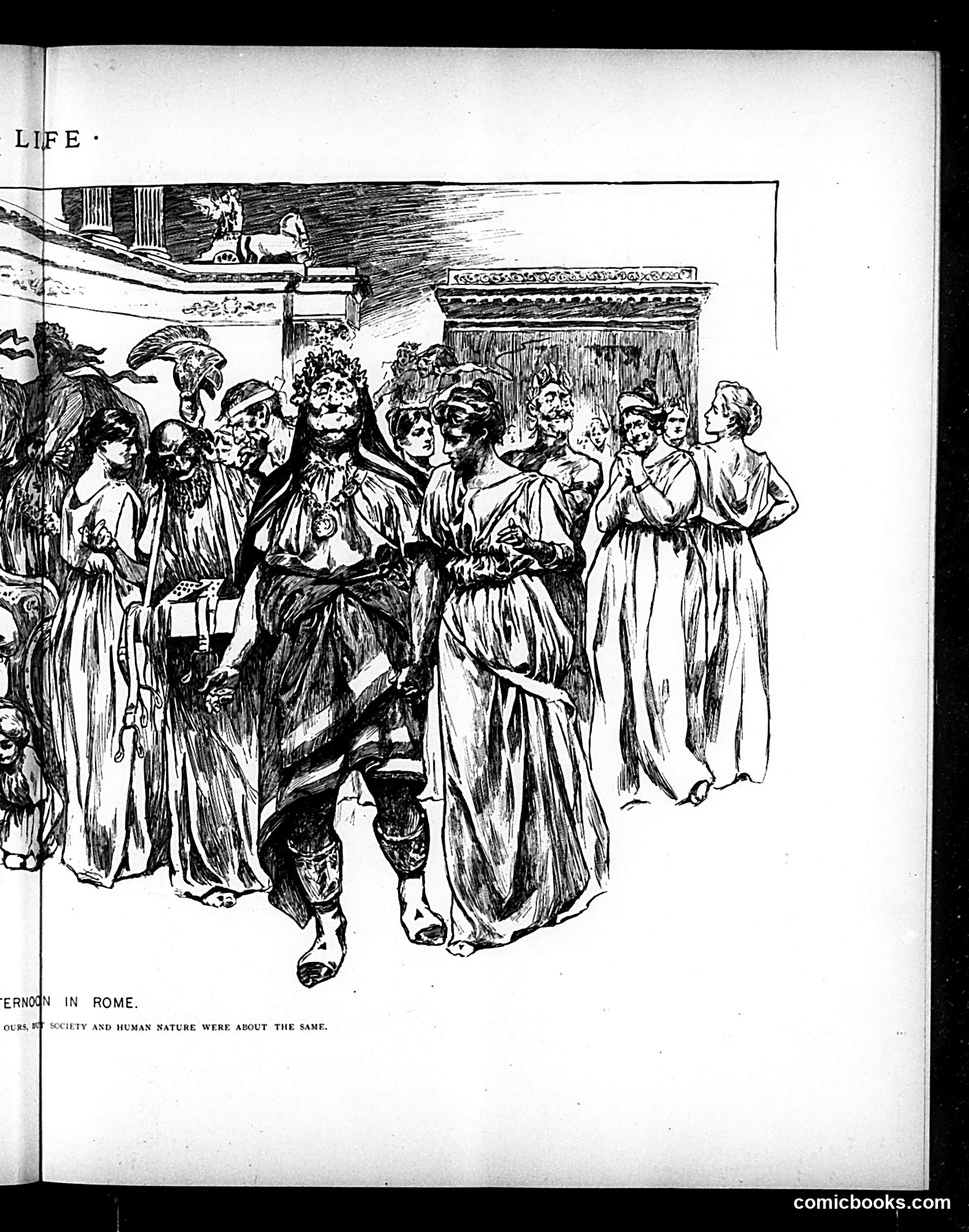
This illustration depicts a gathering of women in classical Roman dress in what appears to be a Roman setting, with architectural elements visible in the background. The caption reads: "Our Society and Human Nature Were About the Same." The satire compares contemporary American society (represented by the gathered women) to ancient Rome, suggesting that human behavior and social dynamics remain fundamentally unchanged across centuries. The implication is social commentary on the timelessness of gossip, status-consciousness, or social hierarchies—that despite historical progress, modern "society" (likely referring to high society or wealthy social circles) exhibits the same petty concerns and behaviors as ancient Romans. The cartoon uses historical analogy to mock contemporary American social conventions as cyclical rather than evolved.
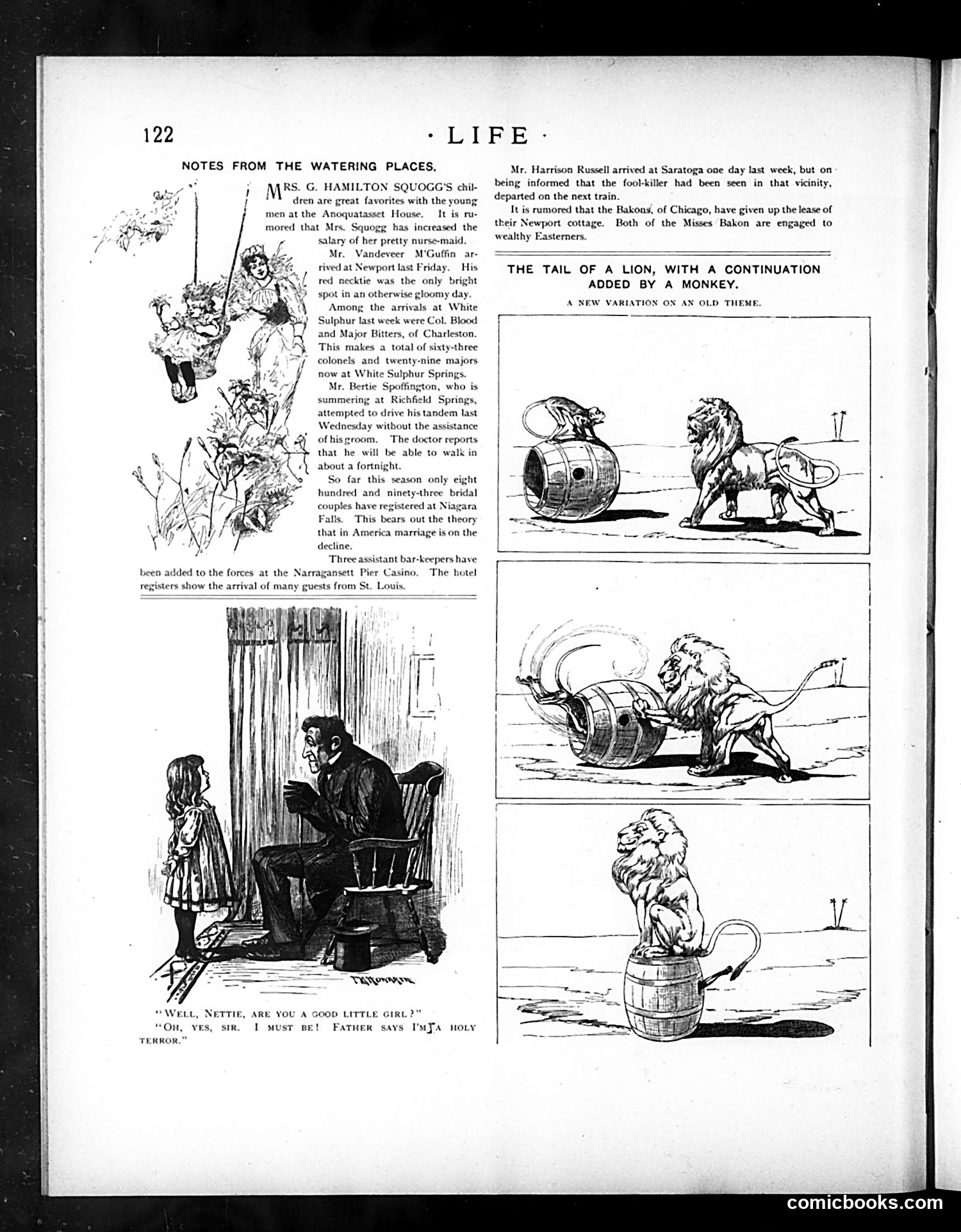
This page satirizes wealthy Americans at fashionable resort towns (Saratoga, Newport, White Sulphur Springs). The upper section contains brief gossip items mocking the elite: a man fleeing upon hearing a "footballer" is nearby, engagements to wealthy suitors, and officers inflating their military titles. The main cartoon series depicts a lion's tail emerging from a barrel, then a monkey grabbing and swinging it. This appears to be a visual pun or fable—likely satirizing how the wealthy class (the "lion") has its dignity or authority absurdly diminished by lower-class interference (the "monkey"). The lower cartoon shows a man praising a young girl's obedience, with her replying her father calls her "a holy terror"—humor derived from the child's innocent misunderstanding of parental teasing. The overall page mocks upper-class pretension and social anxiety during the Gilded Age resort season.
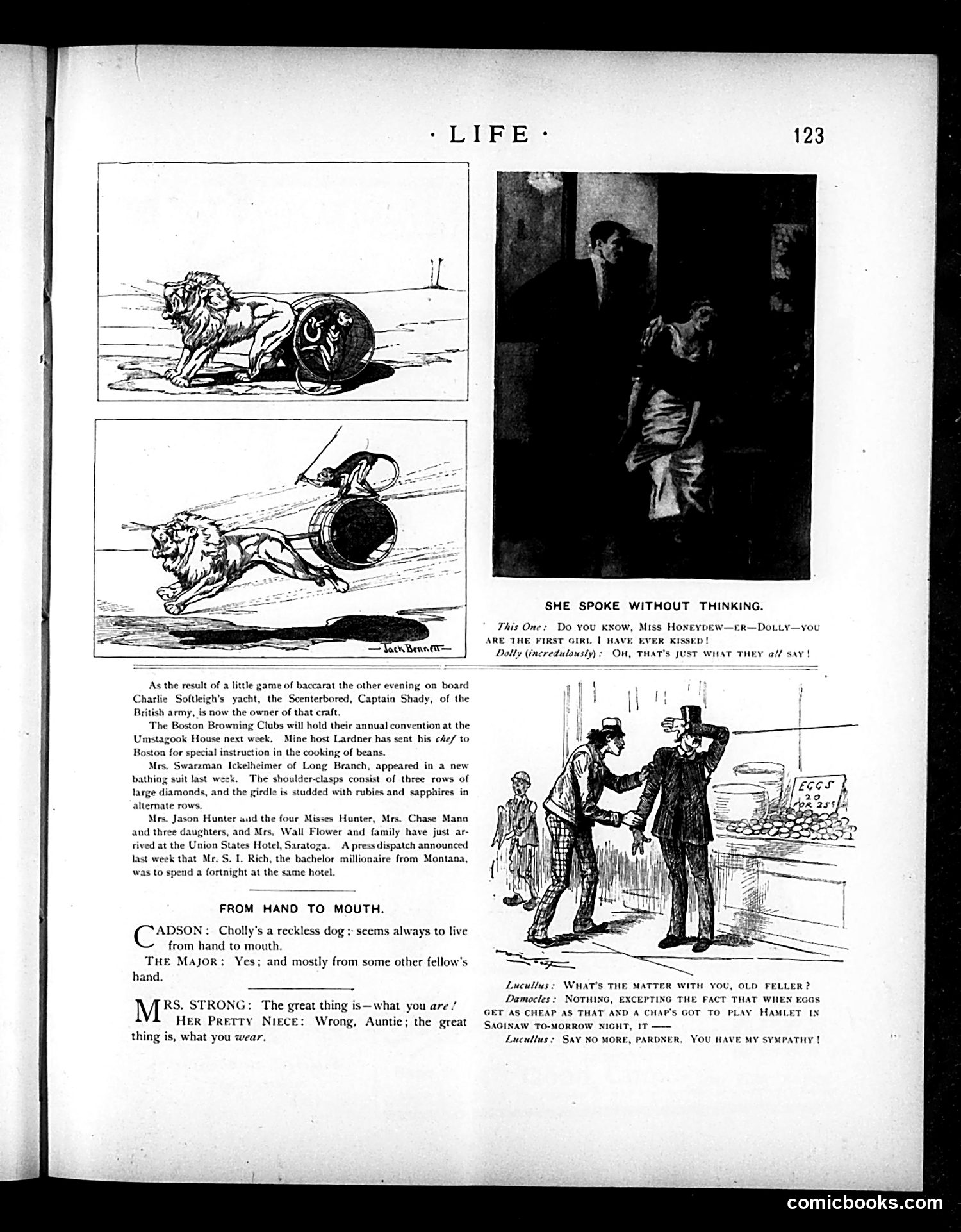
This page contains several brief satirical jokes mocking wealthy American society circa early 1900s: **Top section** mixes gossipy society notes with humor: a man loses his yacht in a baccarat game; wealthy Boston clubs obsess over bean cookery; nouveau-riche women display ostentatious diamond jewelry; marriage-minded families converge at Saratoga hotels hoping to catch a wealthy Montana bachelor. **Comic dialogue** targets social hypocrisy and materialism: - "From Hand to Mouth" jokes that a reckless man lives off others' generosity - A woman advises her niece that appearance (what you wear) matters more than character (what you are) - A young woman sarcastically responds to a man's claim she's his first kiss—implying he's lying or she's been kissed by many - Final exchange mocks a man forced to play cards for money he can't afford The overall satire critiques the era's wealthy class for their superficiality, recklessness with money, obsession with status symbols, and moral compromises—themes central to *Life* magazine's social commentary.
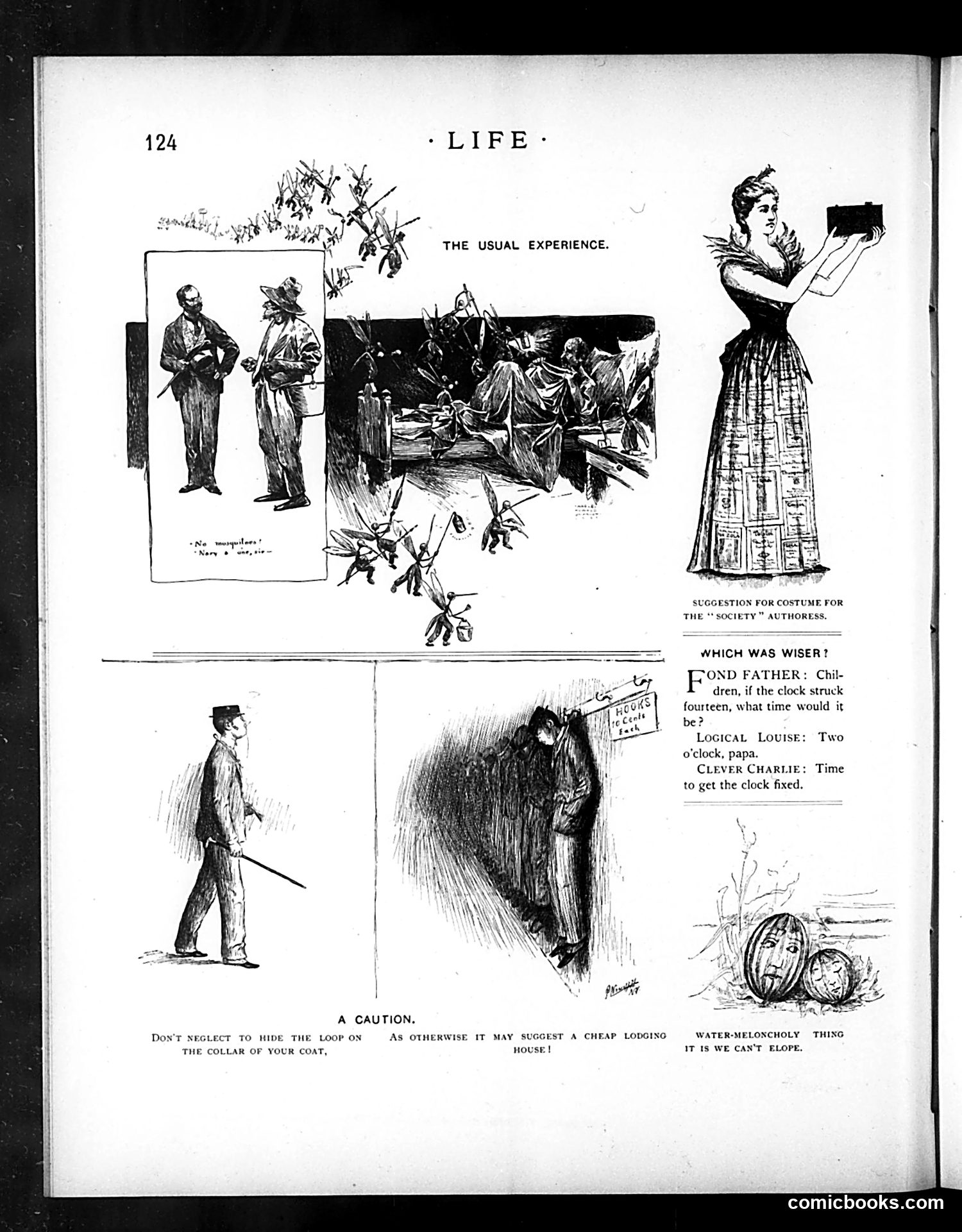
This satirical page mocks "society authoresses"—women writers claiming literary sophistication. The top section "The Usual Experience" depicts such an author presenting her work to publishers or audiences (shown in the crowded scene), then a fashion suggestion mocking her pretensions. The "Which Was Wiser?" riddle contrasts logical thinking: a fond father asks what time it would be if a clock struck fourteen. "Logical Louise" answers literally (two o'clock), while "Clever Charlie" correctly identifies that a malfunctioning clock needs repair, not mathematical parsing—satirizing overly intellectual but impractical responses. The bottom "Caution" jokes about concealing one's poverty: hiding a coat loop (suggesting cheap ready-made clothing) and avoiding elopement to spare melons (suggesting financial desperation). Overall, the page ridicules both pretentious female writers and the absurdity of class-consciousness among the aspiring genteel.
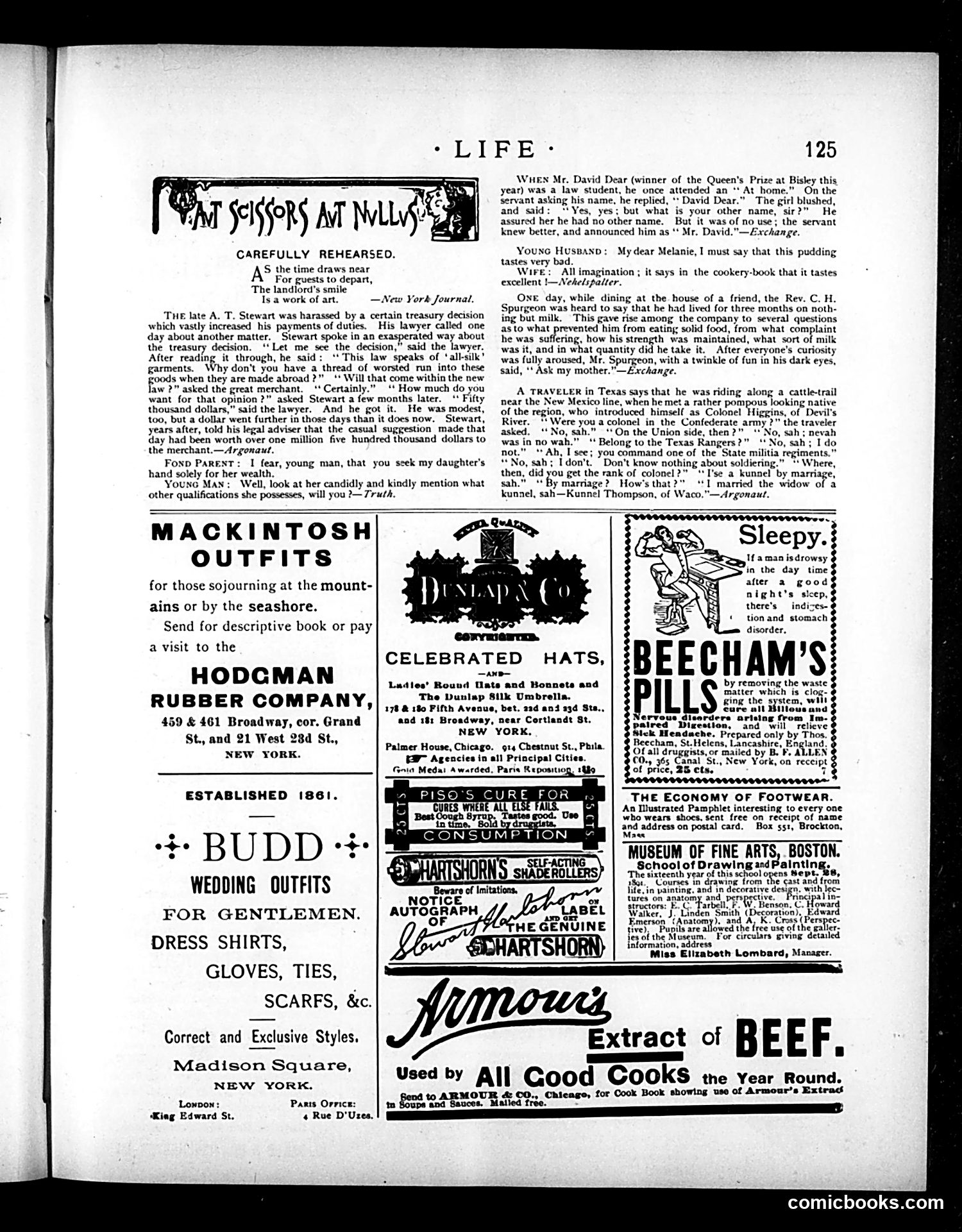
This page from *Life* magazine presents several brief satirical anecdotes typical of the publication's humor style. The title piece, "Scissors at Nulls," humorously depicts a landlord's forced smile as guests depart—a relatable social observation about hospitality theater. Below are four short jokes: one about a merchant's lawyer profiting enormously from a casual tax-avoidance suggestion; another about a young suitor's mercenary motives; a third involving Reverend C.H. Spurgeon's cryptic claim about living on milk alone (the punchline being his mother's feeding, not actual deprivation); and finally a tall tale about a Texas "Colonel" who earned his rank solely through marrying a colonel's widow. These anecdotes target recognizable types—mercenary lawyers, fortune-hunting suitors, publicity-seeking clergy, and frontier pretension—through deadpan delivery. The humor relies on understated absurdity rather than elaborate satire, reflecting *Life*'s accessible, conversational approach to American social foibles circa this period.
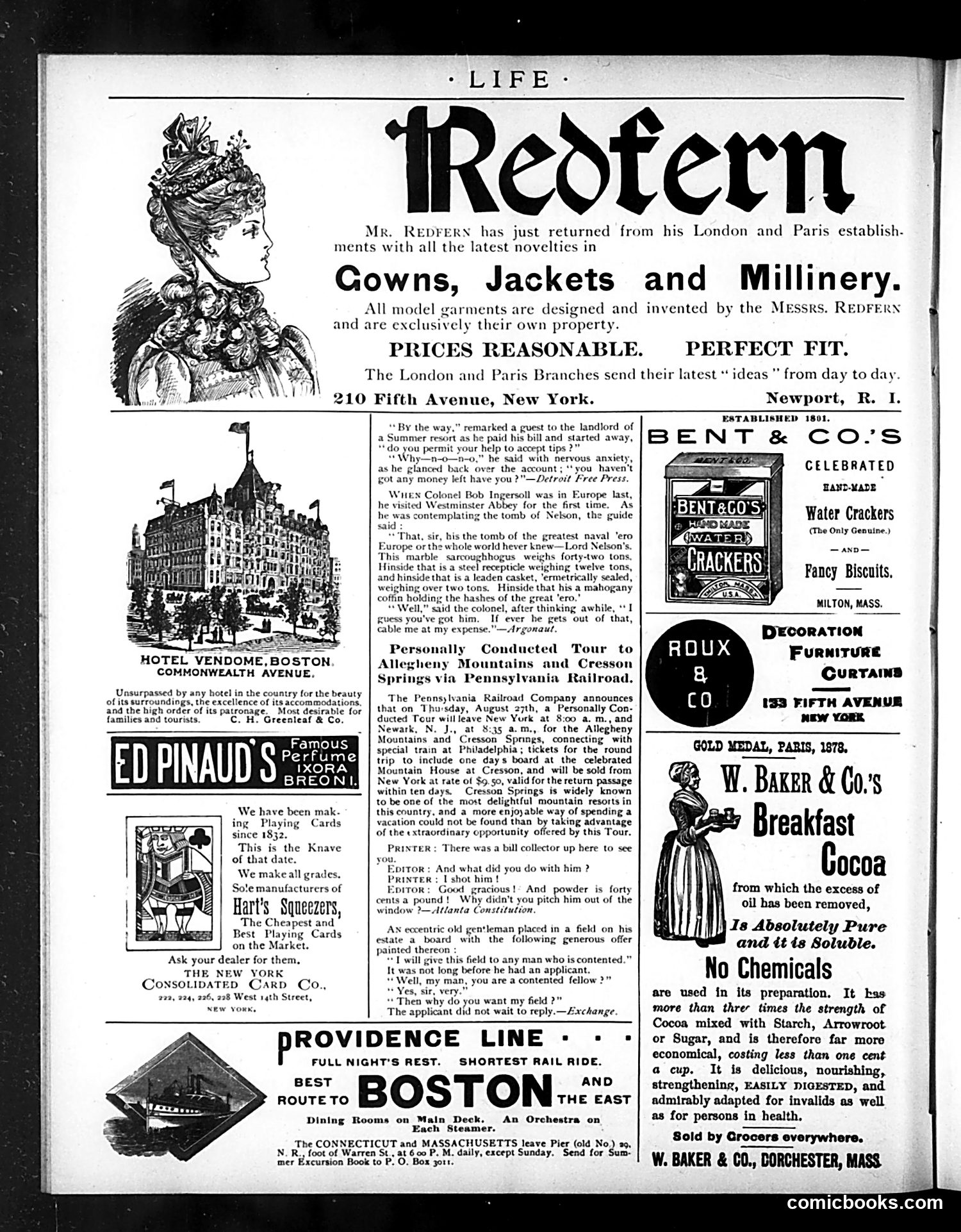
This is primarily **an advertising page** from an early Life magazine, with embedded humorous anecdotes rather than political cartoons. **Main Advertisement:** Redfern, a high-end women's fashion house advertising gowns, jackets, and millinery imported from London and Paris locations. **Humor Content:** Four short jokes appear in the text: 1. A guest jokes with a hotel landlord about tipping staff 2. Colonel Robert Ingersoll (the famous 19th-century agnostic) tours Westminster Abbey and makes a wry comment about Lord Nelson's elaborate tomb—the satire targets excessive monumentalism and funeral ostentation 3. A printer shoots a bill collector, playing on the desperation of debt 4. An old gentleman's "contented man" riddle—a beggar asks for the field not because he's content, but because he wants free land The remaining content consists of travel and product advertisements (Hotel Vendome, Pennsylvania Railroad tours, playing cards, cocoa, crackers). No political figures or cartoons are present.
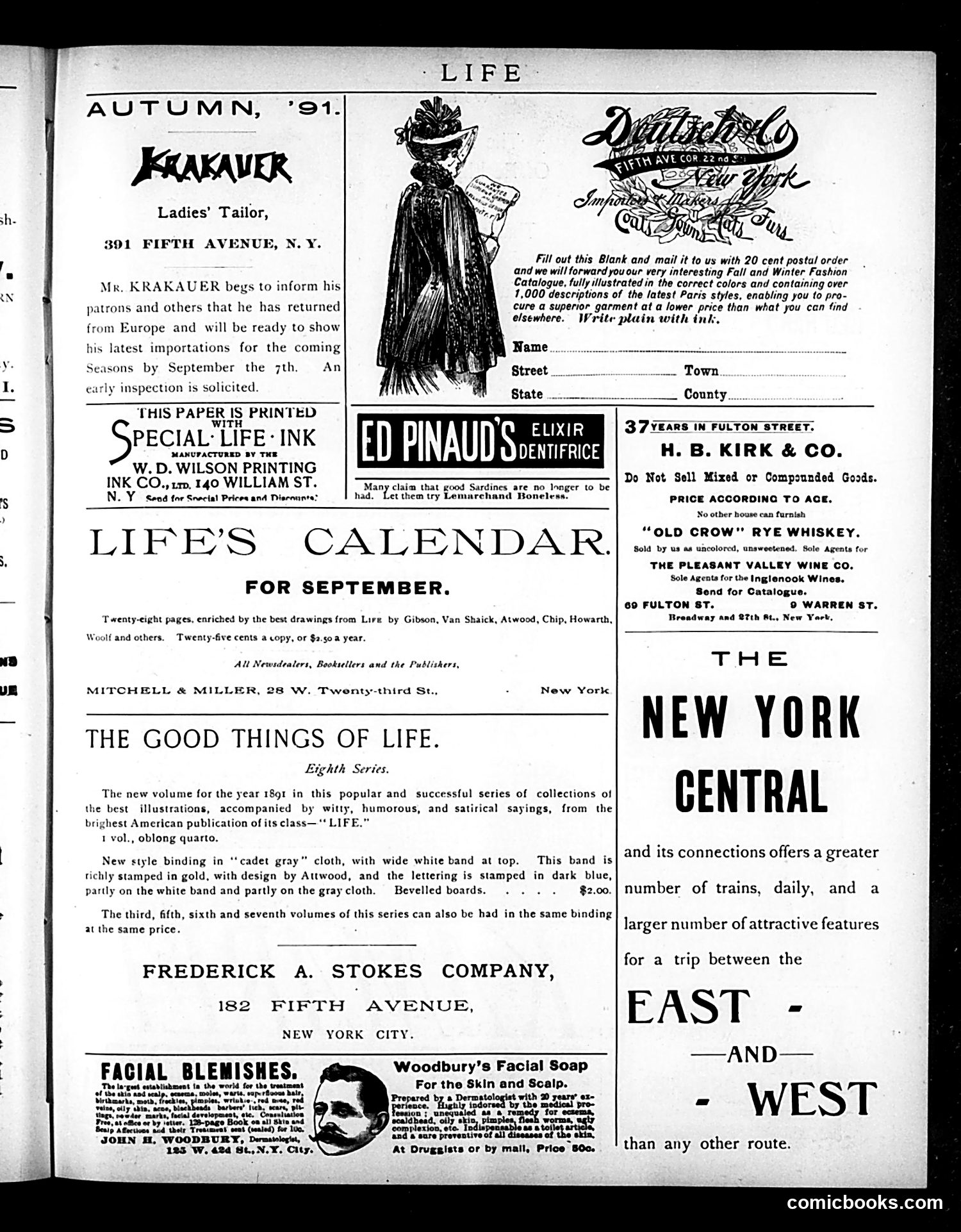
This page is predominantly **advertising and promotional content** rather than editorial cartoons or satire. It contains: **Key advertisements:** - Krakauer (ladies' tailor, Fifth Avenue) - Datterick (fashion catalogue service, New York) - Life's Calendar for September - "The Good Things of Life" book series (eighth volume, 1891) - Frederick A. Stokes Company (publisher) - Ed Pinaud's Elixir Dentifrice - H.B. Kirk & Co. (whiskey and wine merchants) - New York Central Railroad - John H. Woodbury's Facial Soap The single **illustrated figure** (upper center) appears to be a fashionable woman in 1891 dress, promoting the Datterick fashion catalogue—typical of period advertising. **No political satire is evident.** This represents Life's dual function as both satirical publication and carrier of upscale consumer advertising targeting middle and upper-class readers in 1891 New York.
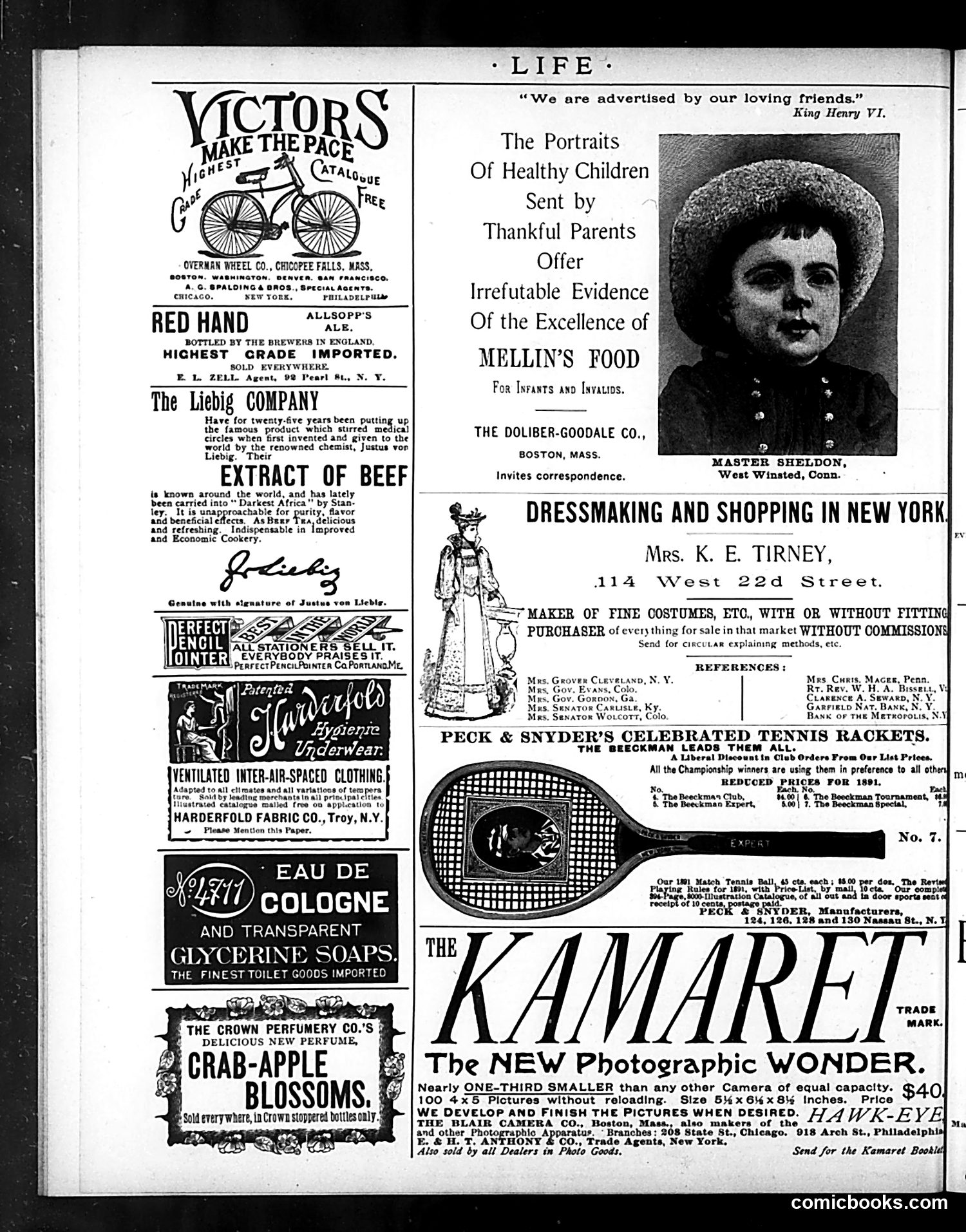
This is primarily an **advertising page** from Life magazine, not a satirical cartoon. The page contains various product advertisements typical of the 1890s era, with minimal editorial content. The one notable non-advertisement element is a epigraph at top quoting King Henry VI: "We are advertised by our loving friends"—a meta-commentary on advertising itself, suggesting that testimonials and word-of-mouth (including the portrait of "Master Sheldon" endorsing Mellin's Food) serve as effective marketing. The advertisements reflect Victorian-era consumer products: imported ales, beef extract, soaps, perfumes, dressmaking services, tennis rackets, and an early photographic camera (the Kamaret). These ads reveal what middle-to-upper-class Americans purchased and valued—imported luxury goods, infant nutrition products, and emerging photography technology. The page demonstrates Life's business model: satirical editorial content subsidized by paid advertising from manufacturers seeking respectable publication venues.
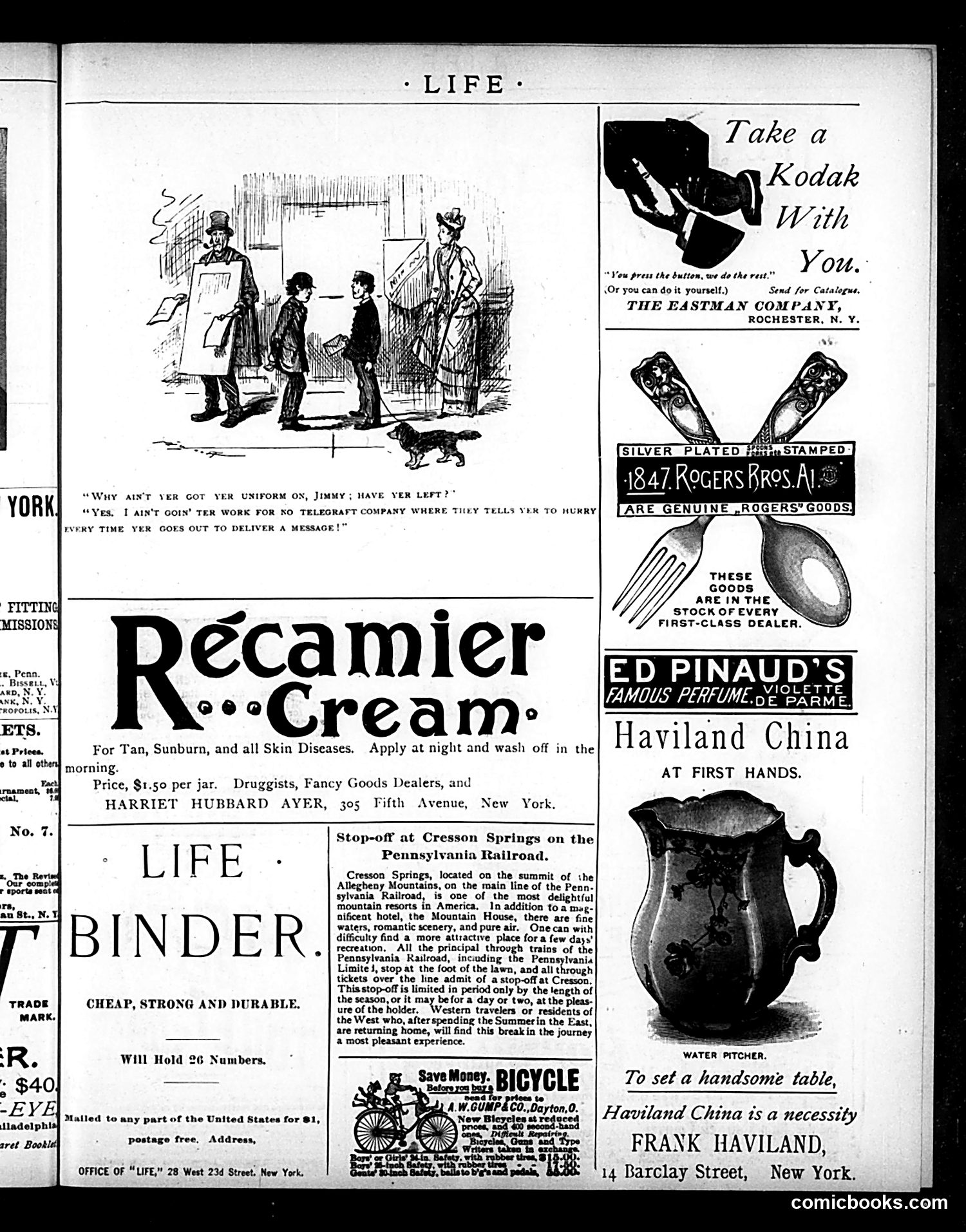
The main cartoon depicts a conversation between what appears to be a telegraph company manager and a young messenger boy named Jimmy. Jimmy explains he's quitting because the company constantly rushes him—telling him to hurry every time he delivers a message. The satire mocks the demanding, fast-paced work culture of telegraph companies, which relied on speed as a competitive advantage. Jimmy's complaint reflects a worker's perspective on the relentless pressure of early industrial employment, where efficiency demands left no room for rest. The humor lies in the boy's frank refusal to tolerate such conditions, poking fun at both the company's obsession with speed and the tension between employer expectations and worker patience during this era of rapid communication technology.
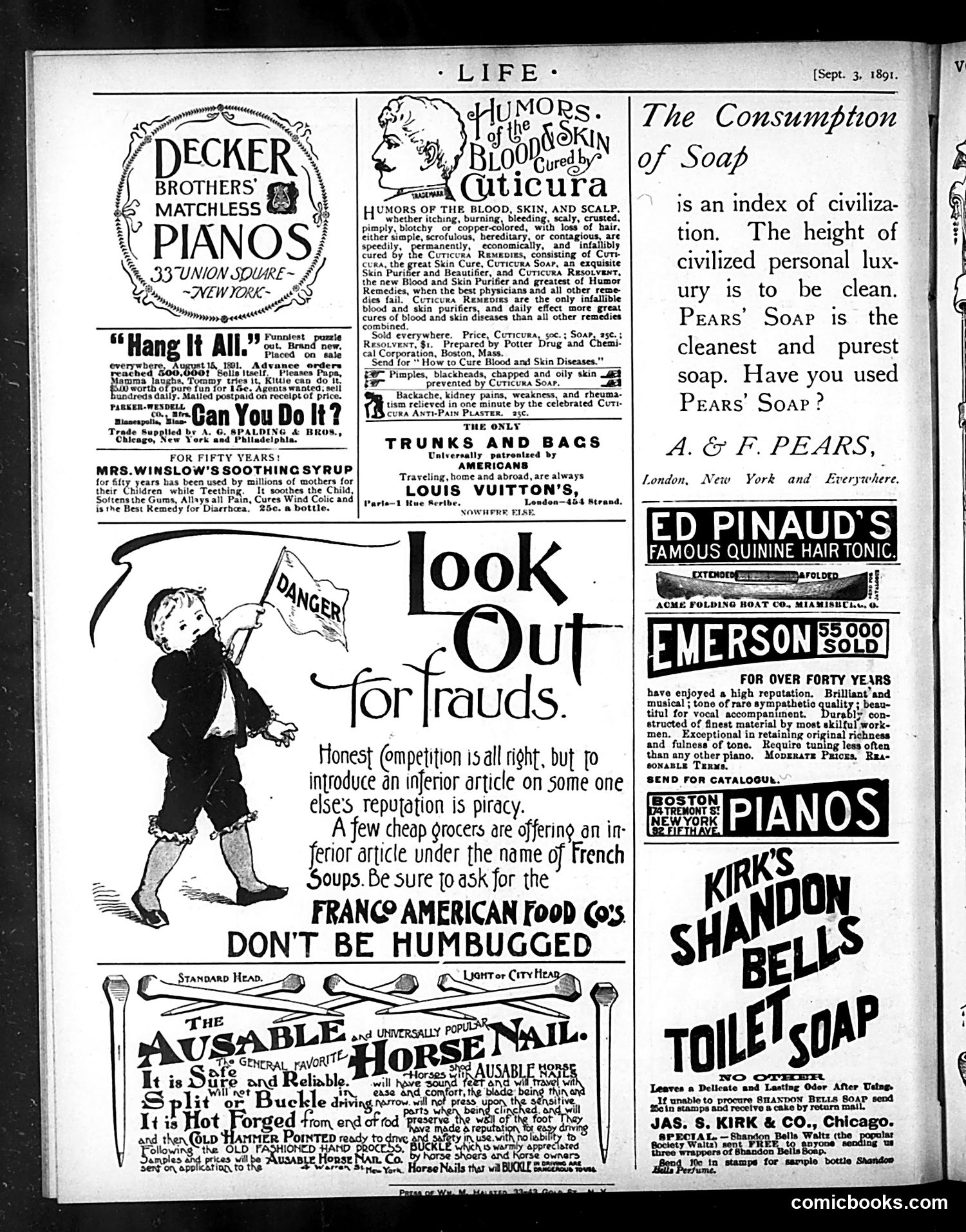
This page features a prominent satirical cartoon warning consumers against product fraud. A young boy waves a "DANGER" flag while running, illustrating the message: "Honest competition is all right, but to introduce an inferior article on some one else's reputation is piracy." The specific target: cheap grocers selling counterfeit "French Soups" under fraudulent names, marketed by the Franco-American Food Company. The cartoon urges readers to verify they're purchasing genuine products. The broader context reflects **late 19th-century consumer vulnerability**. With mass manufacturing and limited regulation, unscrupulous sellers routinely copied brand names and reputations—a practice called "passing off." The page itself (filled with competing soap, piano, and patent medicine ads) exemplifies this era's largely unregulated marketplace where similar-looking products could hide inferior or even dangerous contents. The satire targets both the counterfeiters' dishonesty and consumers' susceptibility to deception through trusted brand names.