
Life, 1891-09-03 · page 8 of 22
Life — September 3, 1891 — page 8: what you’re looking at
What you’re looking at
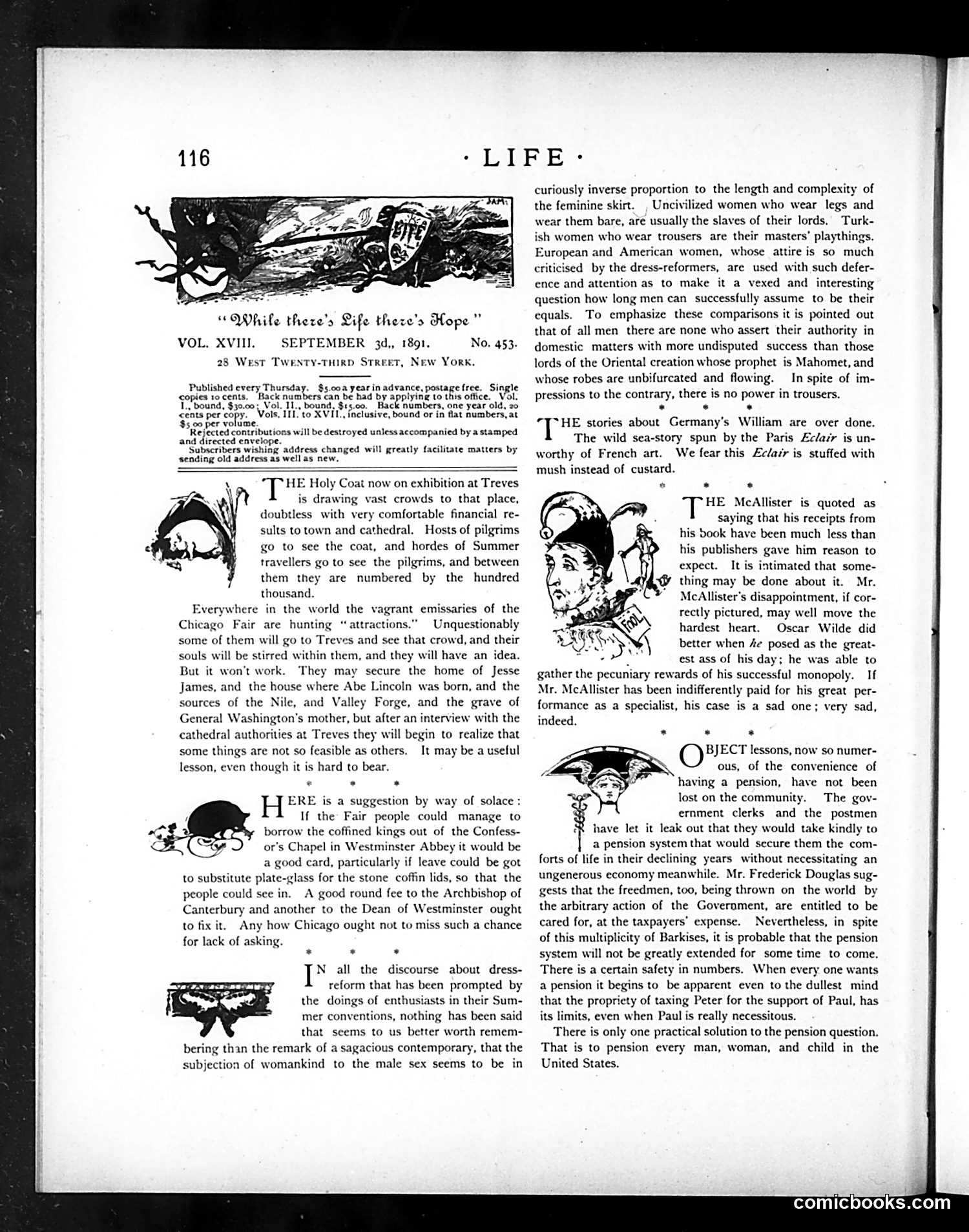
This page contains editorial commentary rather than political cartoons. The small illustrations are decorative mastheads. **Key content:** The text discusses the **World's Columbian Exposition (Chicago Fair)**, criticizing plans to display artifacts at Treves cathedral. It suggests borrowing items from Westminster Abbey instead—a satirical jab at American cultural ambitions. **On dress reform:** The lengthy passage mocks contemporary debates about women's clothing, particularly the tension between Victorian dress codes and reformers advocating simpler garments. It argues that women's subjection to male fashion standards reflects broader gender inequality. **On pensions:** The final section debates whether government should pension all citizens, referencing "Frederick Douglas" (likely **Frederick Douglass**, the abolitionist). It questions the practicality of universal pensions. The satire targets Victorian social pretensions and gender politics rather than specific individuals.
📄 Transcribed text from this page (OCR, searchable)
Machine-transcribed from the original scan — historical spelling and the odd misread are preserved.
- LIFE: ae “While there's Life theze’s Hope ” VOL. XVIII. SEPTEMBER 34,, 1891. No. 453. 28 West TWeNTY-THIRD STREET, New York. Published every Thursday. $s.00a year in advance, postage free. Single sonics ze.cents. Back numbers can be had by applying to this office, | Vol. 1, bound, $30.00; Vol. I1., bound. $15.00. Back numbers, one year old, 20 cents per copy. Vols, III. to XVIT., inclusive, bound or in flat numbers,at $5.00 per volume. Rejected contributions will be destroyed unlessaccompanied by a stamped and directed envelope. Subscribers wishing address changed will greatly facilitate matters by sending old address as well as new. HE Holy Coat now on exhibition at Treves is drawing vast crowds to that place, doubtless with very comfortable financial re- sults to town and cathedral. Hosts of pilgrims go to see the coat, and hordes of Summer travellers go to see the pilgrims, and between them they are numbered by the hundred thousand. ywhere in the world the vagrant emissaries of the Chicago Fair are hunting “attractions.” Unquestionably some of them will go to Treves and see that crowd, and their souls will be stirred within them, and they will have an idea. But it won't work. They may secure the home of Jesse James, and the house where Abe Lincoln was born, and the sources of the Nile, and Valley Forge, and the grave of General Washington's mother, but after an interview with the cathedral authorities at Treves they will begin to realize that some things are not so feasible as others, It may be a useful lesson, even though it is hard to bear. ERE is a suggestion by way of solace : If the Fair people could manage to borrow the coffined kings out of the Confess- CY or’s Chapel in Westminster Abbey it would be S i a good card, particularly if leave could be got to substitute plate-glass for the stone coffin lids, so that the people could see in, A good round fee to the Archbishop of Canterbury and another to the Dean of Westminster ought to fix it. Any how Chicago ought not to miss such a chance for lack of asking. * . * * all the discourse about dress- reform that has been prompted by the doings of enthusiasts in their mer conventions, nothing has been said that seems to us better worth remem- bering than the remark of a sagacious contemporary, that the subjection of womankind to the male sex seems to be in curiously inverse proportion to the length and complexity of the feminine skirt. , Uncivilized women who wear legs and wear them bare, are usually the slaves of their lords. Turk- ish women who wear trousers are their masters’ playthings. European and American women, whose attire is so much criticised by the dress-reformers, are used with such defer- ence and attention as to make it a vexed and _ interesting question how long men can successfully assume to be their equals. To emphasize these comparisons it is pointed out that of all men there are none who assert their authority in domestic matters with more undisputed success than those lords of the Oriental creation whose prophet is Mahomet, and whose robes are unbifurcated and flowing. In spite of im- pressions to the contrary, there is no power in trousers. . . . Te stories about Germany's William are over done. The wild sea-story spun by the Paris £c/a/r is un- worthy of French art. We fear this Ec/aér is stuffed with mush instead of custard. * . Pt McAllister is quoted as saying that his receipts from his book have been much less than his publishers gave him reason to expect. It is intimated that some- thing may be done about it. Mr. McAllister’s disappointment, if cor- rectly pictured, may well move the hardest heart. Oscar Wilde did better when 4e posed as the great- : est ass of his day; he was able to gather the pecuniary rewards of his successful monopoly. If Mr. McAllister has been indifferently paid for his great per- formance as a specialist, his case is a sad one; very sad, . . BJECT lessons, now so numer- ous, of the convenience of having a pension, have not been lost on the community, The gov- ernment clerks and the postmen &® have let it leak out that they would take kindly to a pension system that would secure them the com- forts of life in their declining years without necessitating an ungenerous economy meanwhile. Mr. Frederick Douglas sug- gests that the freedmen, too, being thrown on the world by the arbitrary action of the Government, are entitled to be cared for, at the taxpayers’ expense. Nevertheless, in spite of this multiplicity of Barkises, it is probable that the pension system will not be greatly extended for some time to come. There is a certain safety in numbers. When every one wants a pension it begins to be apparent even to the dullest mind that the propriety of taxing Peter for the support of Paul, has its limits, even when Paul is really necessitous. There is only one practical solution to the pension question. That is to pension every man, woman, and child in the United States. comicbooks.com