
A complete issue · 18 pages · 1891
Life — July 2, 1891
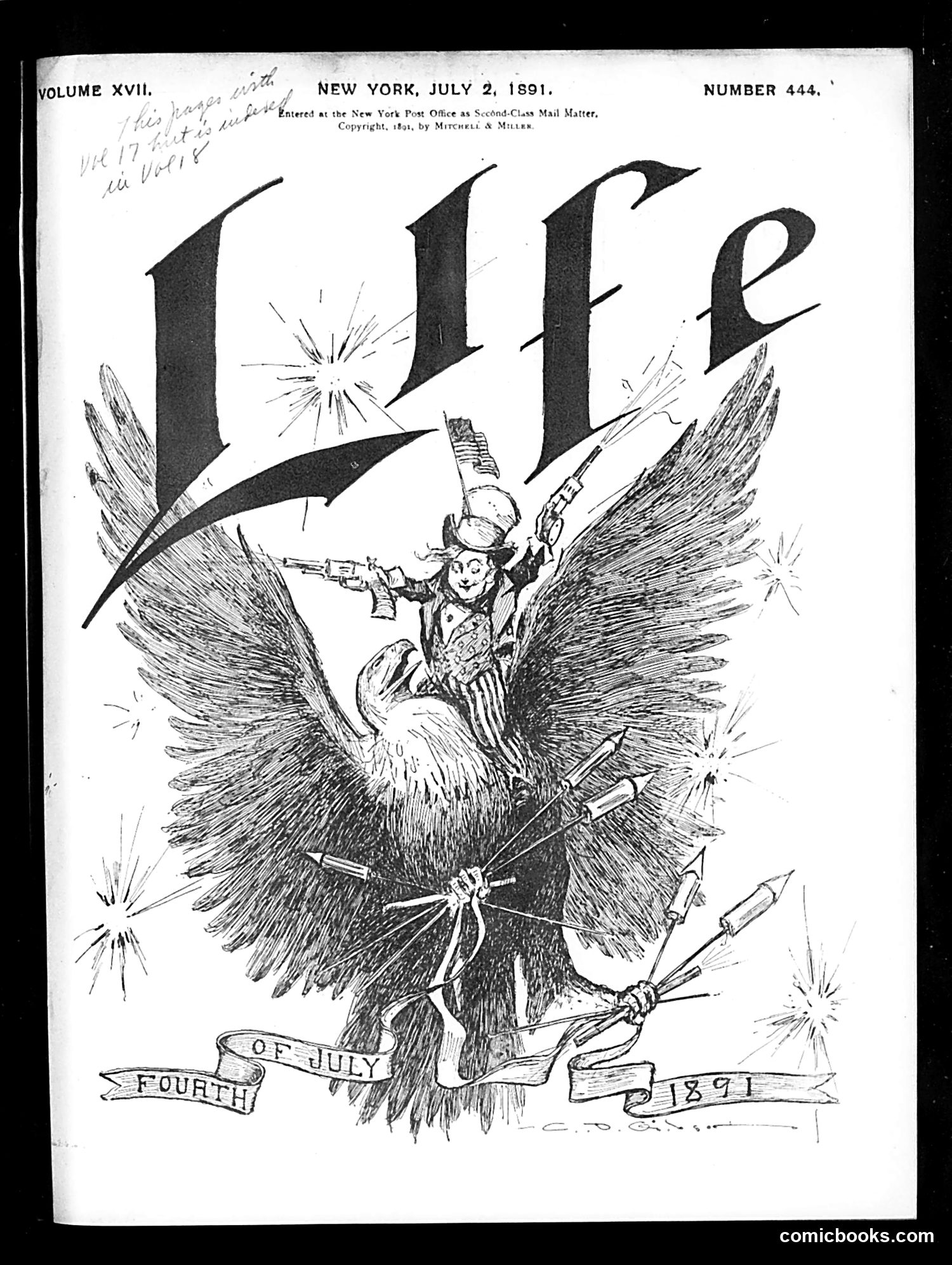
This is a Fourth of July 1891 cover celebrating American independence. The central figure is Uncle Sam (identifiable by his characteristic top hat with stars and striped clothing), riding an eagle—a symbol of American national power and sovereignty. He's wielding weapons and appears triumphant, with fireworks exploding around him. The satire likely comments on American military strength or expansionist ambitions during this period. The aggressive posture—weapons raised, commanding the eagle—suggests commentary on U.S. foreign policy or military confidence in 1891. Without additional text visible, the specific political event referenced remains unclear, but the overall message celebrates (or possibly mocks) American martial prowess and patriotic fervor during the Fourth of July.
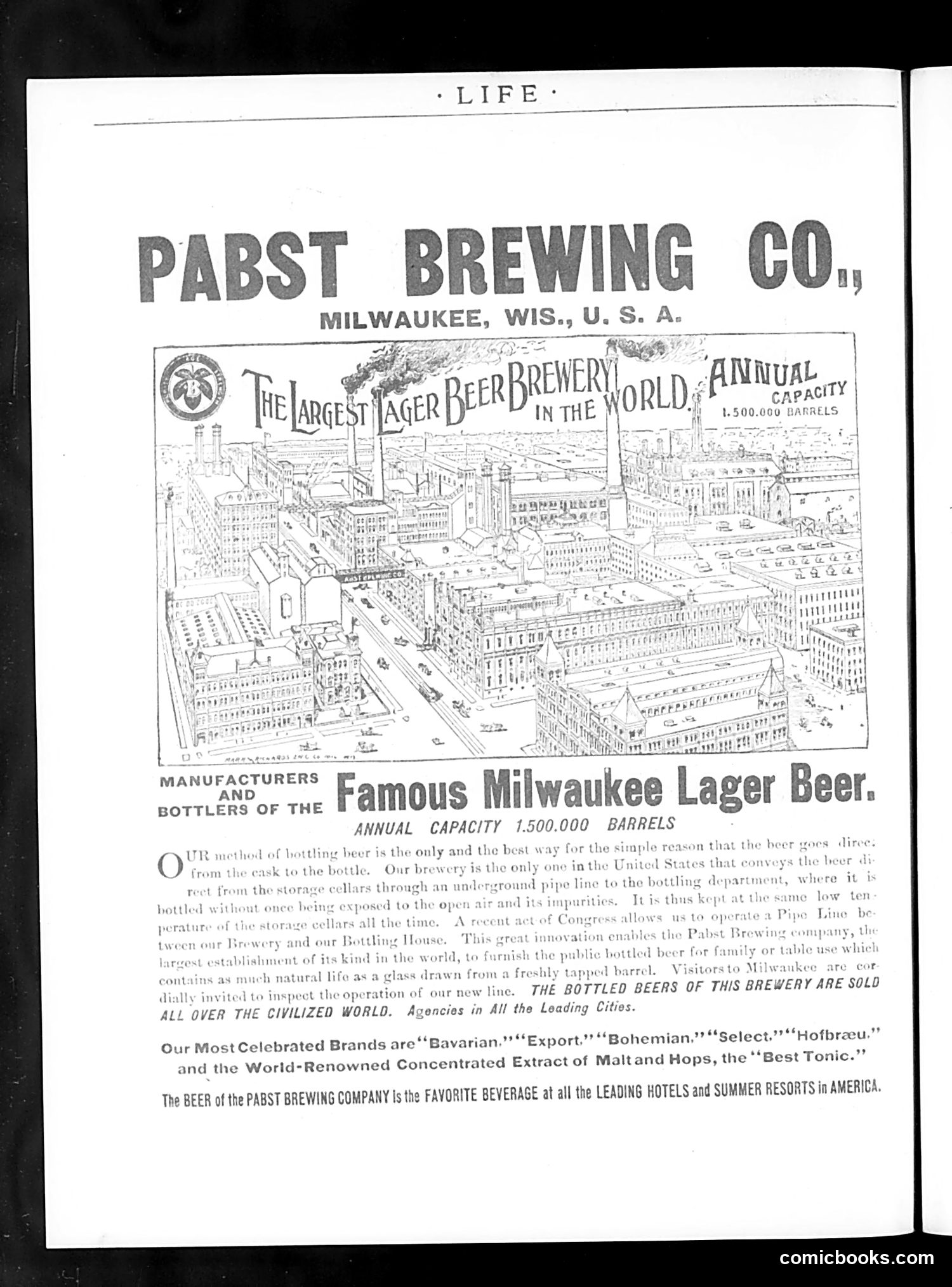
This is **not a political cartoon or satire** — it's a full-page advertisement for Pabst Brewing Company of Milwaukee, Wisconsin. The ad features an aerial illustration of the brewery complex and claims it's "the largest lager beer brewery in the world" with annual capacity of 1.5 million barrels. The text emphasizes their bottling innovation: beer flows directly from cask to bottle through underground pipes, protecting it from air exposure and impurities—a key selling point for quality assurance. The ad promotes their famous Milwaukee lager beer and several brand names ("Bavarian," "Export," "Bohemian," "Select," "Hofbrau") sold "all over the civilized world." It concludes by noting Pabst is the "favorite beverage at all the leading hotels and summer resorts in America." This is straightforward commercial advertising from the early 20th century.
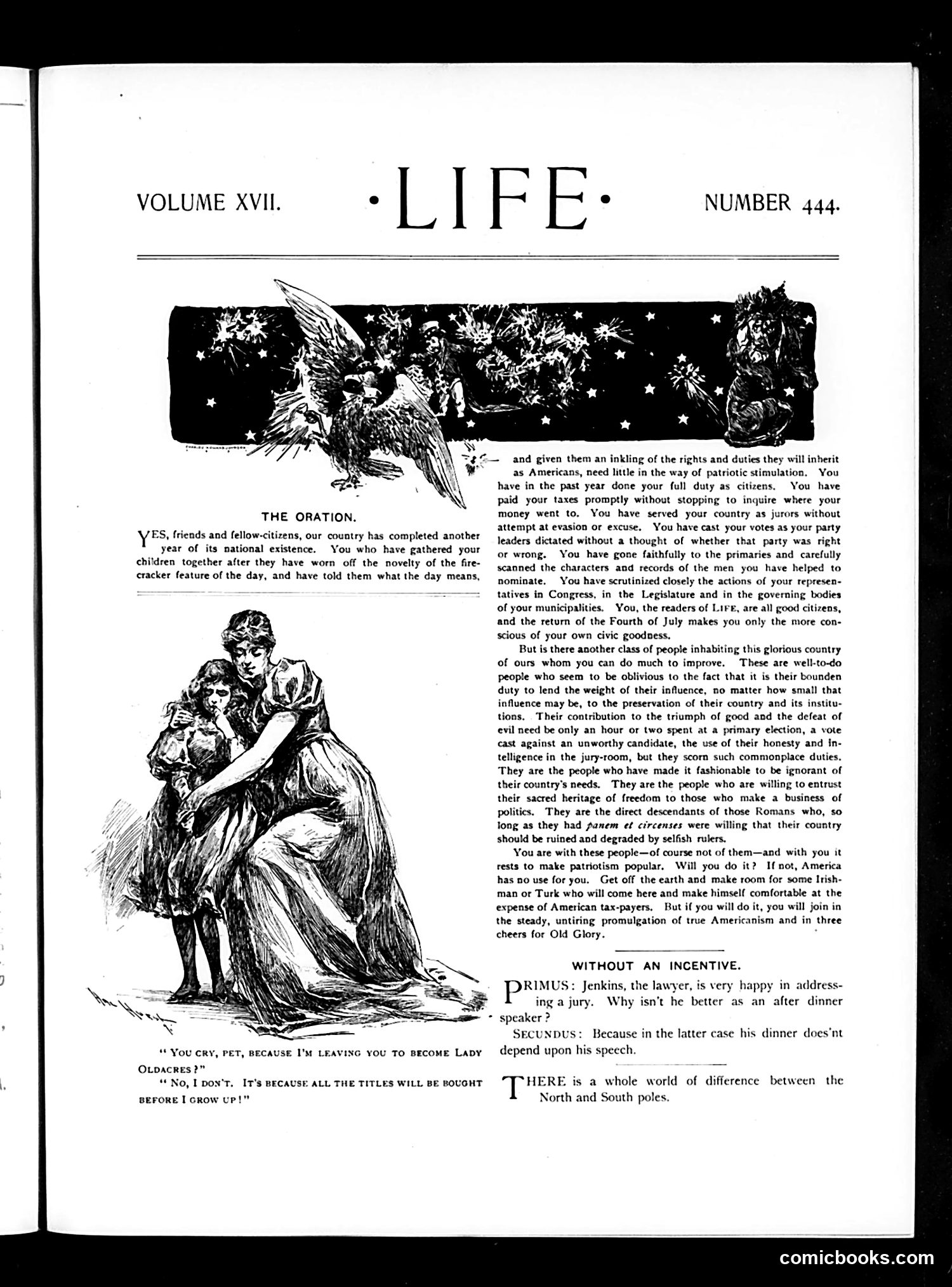
**"The Oration"** section contains a patriotic Fourth of July speech addressing citizens' civic duties. The accompanying illustration shows a woman (likely Liberty or Columbia, representing America) with children, emphasizing national responsibility and patriotism. **"Without an Incentive"** presents a brief joke: Primus asks why lawyer Jenkins is happier as an after-dinner speaker than a jury speaker. Secundus replies that jury speeches depend on dinner (implying the lawyer's performance was poor), while after-dinner speaking doesn't require good food to succeed—a play on the lawyer's presumed lack of talent. The page reflects early 20th-century American civic nationalism and contains period humor typical of Life's satirical format, mixing patriotic content with light social commentary.
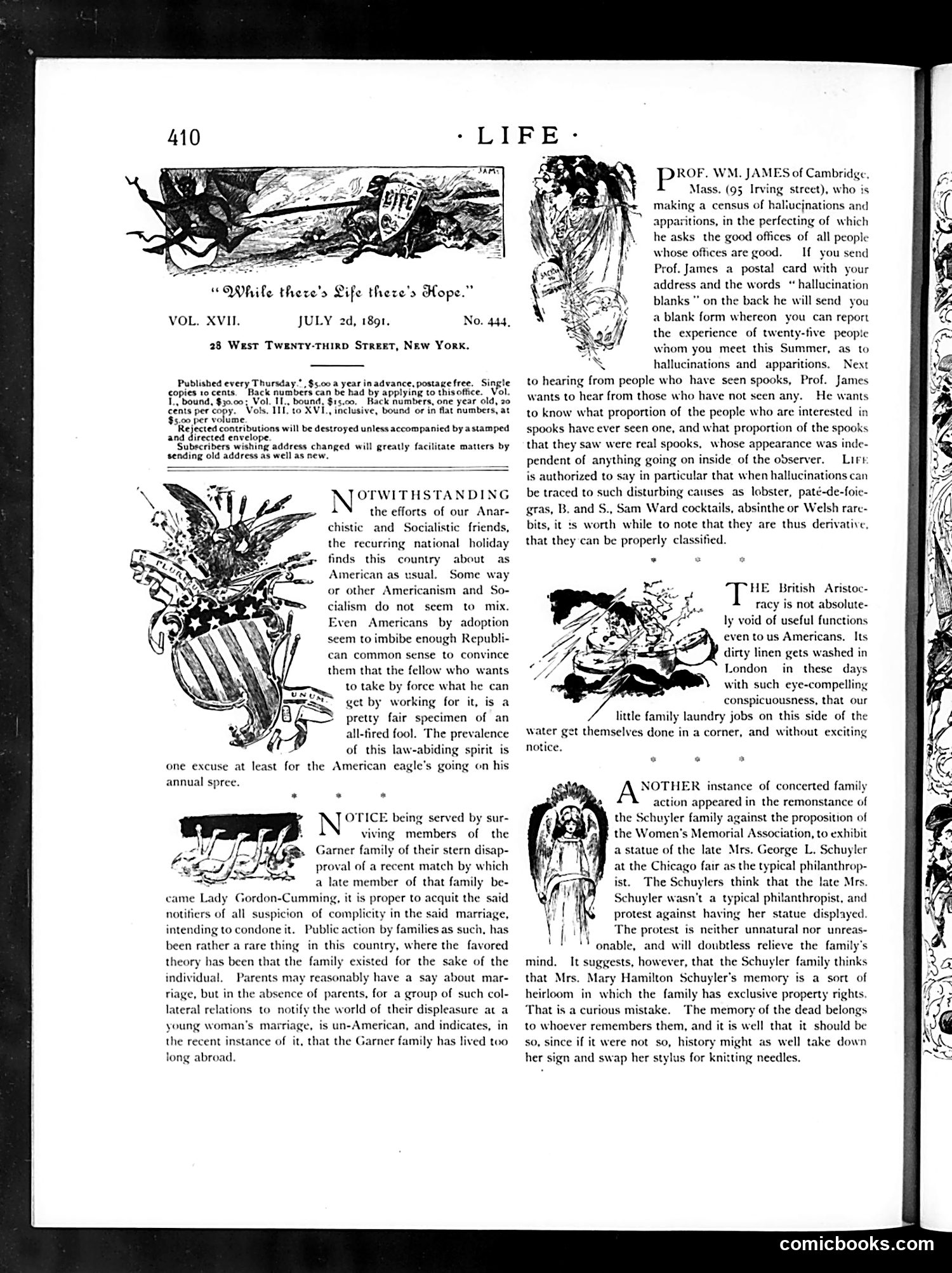
The page contains three distinct satirical pieces: 1. **Top cartoon**: An eagle labeled "LIFE" appears to mock American holiday customs, suggesting that despite Fourth of July patriotism, Americans adopt foreign socialist and anarchist ideas. The satire targets the contradiction between nationalist rhetoric and progressive political influences. 2. **Middle cartoon**: Depicts the Garner family's disapproval of a match involving "Lady Gordon-Cumming," satirizing how American families judge marriages by class and social standing. The text criticizes the "un-American" tendency of families to interfere in romantic decisions based on social hierarchy. 3. **Bottom section**: Comments on the Schuyler family's objection to displaying a statue of Mrs. George L. Schuyler at the Chicago World's Fair, mocking disputes over philanthropic legacy and family property rights. The overall theme critiques American social pretension and family dynamics.
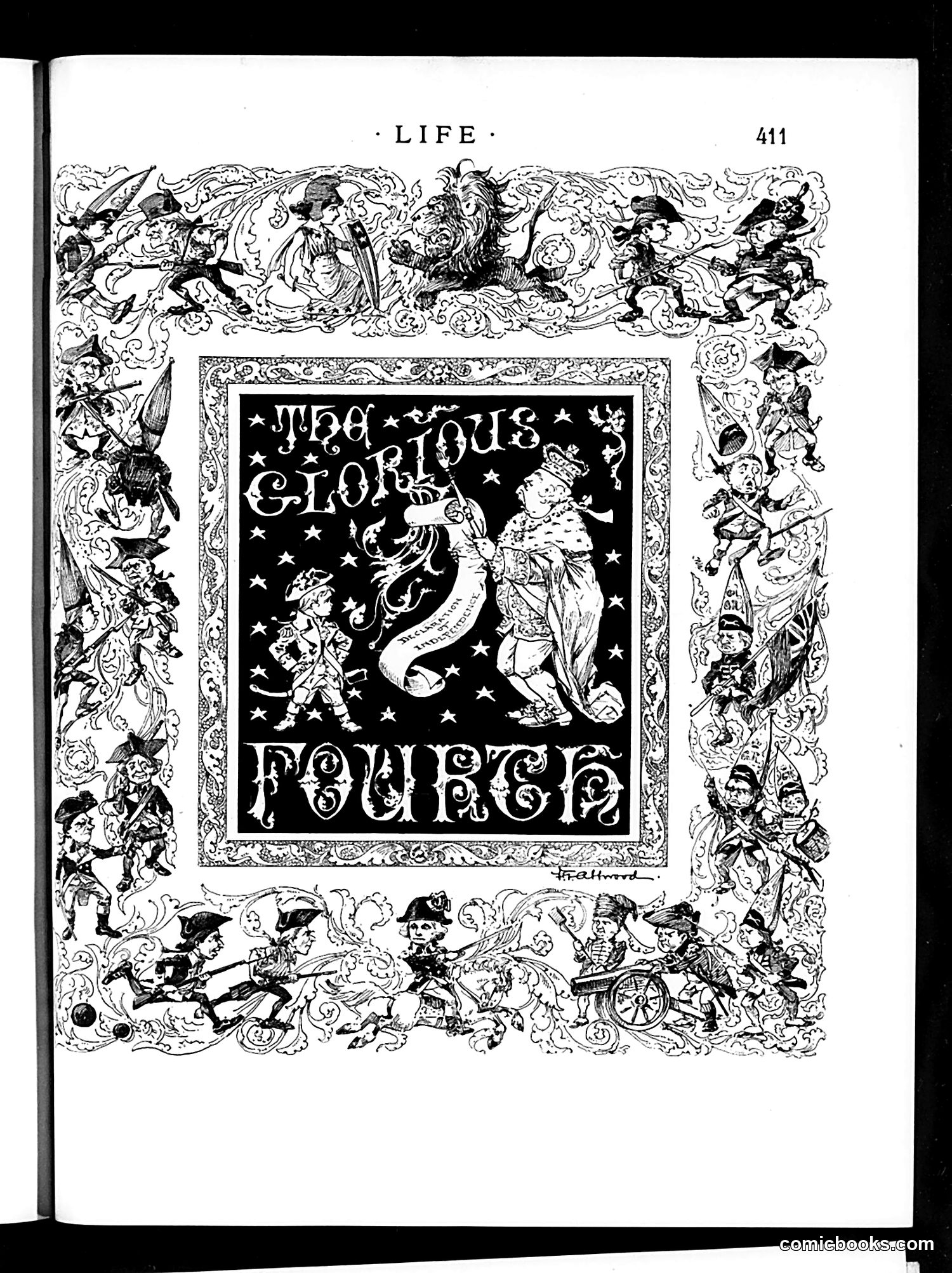
This is a decorative title page featuring "The Glorious Four" with ornate Art Nouveau borders populated by whimsical characters and jesters. The central black panel shows two figures amid stars and a crescent moon—appearing to reference classical or allegorical figures rather than specific contemporary politicians. Without clearer identification of the figures or accompanying article text, the exact satirical target remains unclear. However, Life magazine's style suggests this likely mocks a group of four political or social figures prominent at the time of publication. The elaborate, playful border decoration—typical of Life's visual approach—frames what appears to be a serious headline meant ironically. The specific "Four" being satirized cannot be definitively identified from the image alone.
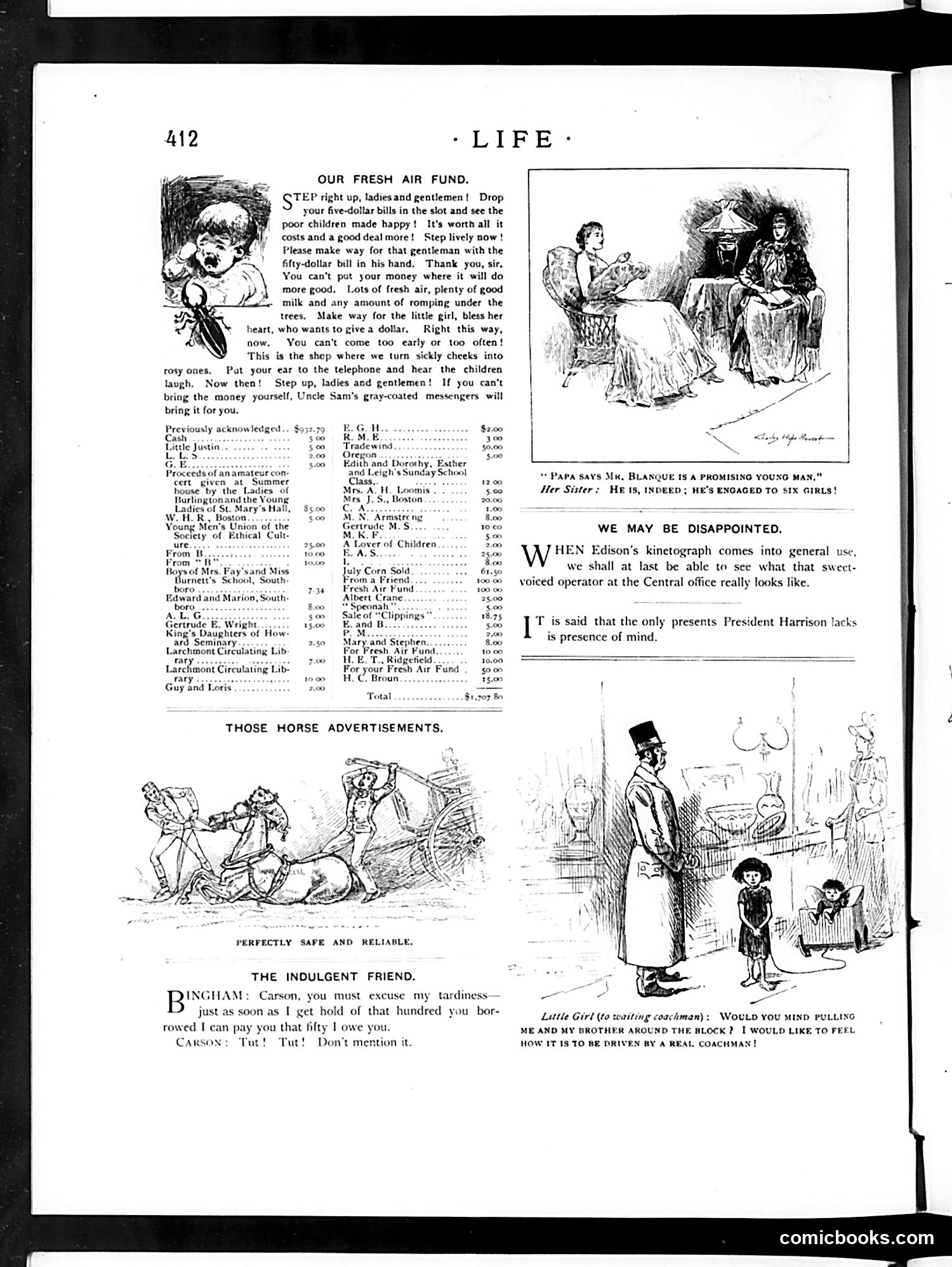
This page contains three distinct sections: **"Our Fresh Air Fund"** (top left): A fundraising appeal for poor children's summer outings, with a humorous pitch encouraging donations. **"Papa says Mr. Blanque is a Promising Young Man"** (top right): A cartoon showing a young woman speaking to her sister about a suitor, suggesting social commentary on courtship and class expectations. **"Those Horse Advertisements"** (bottom): A cartoon mocking exaggerated horse-sale advertising claims ("Perfectly Safe and Reliable"), showing a chaotic scene where horses cause mayhem—satirizing deceptive marketing practices common in the era. **"The Indulgent Friend"** (bottom): A brief comedic exchange where one character (Bingham) asks Carson to excuse tardiness while repaying a debt, with Carson dismissing the concern—poking fun at financial irresponsibility among friends.
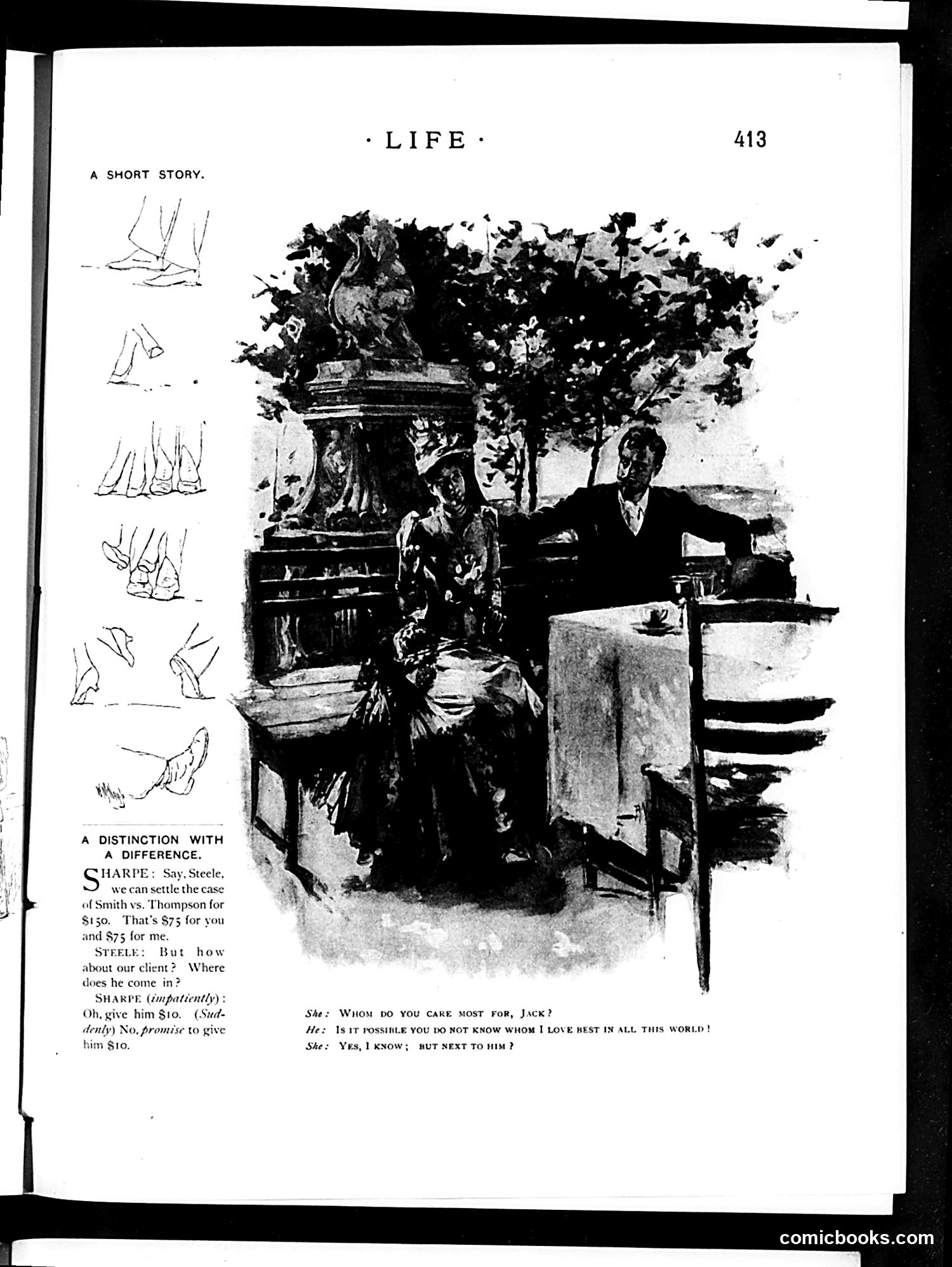
This page contains two distinct elements: **Left side:** "A Distinction With a Difference" - a short comedic dialogue between characters named Sharpe and Steele about a legal case (Smith vs. Thompson). Sharpe promises to give Steele $10 if he can settle the case, then claims he can't pay, offering only $10 later. The humor relies on wordplay about promises and payment timing—a satire of lawyer tactics or client deception. **Right side:** An illustration titled "A Short Story" showing what appears to be a domestic scene with figures in period dress near a large plant or tree. The dialogue below suggests a conversation about love and care, though the satirical point is unclear without additional context about the specific social or romantic conventions being mocked. Both segments appear to mock human behavior through brief, punchy scenarios typical of *Life* magazine's satirical style.
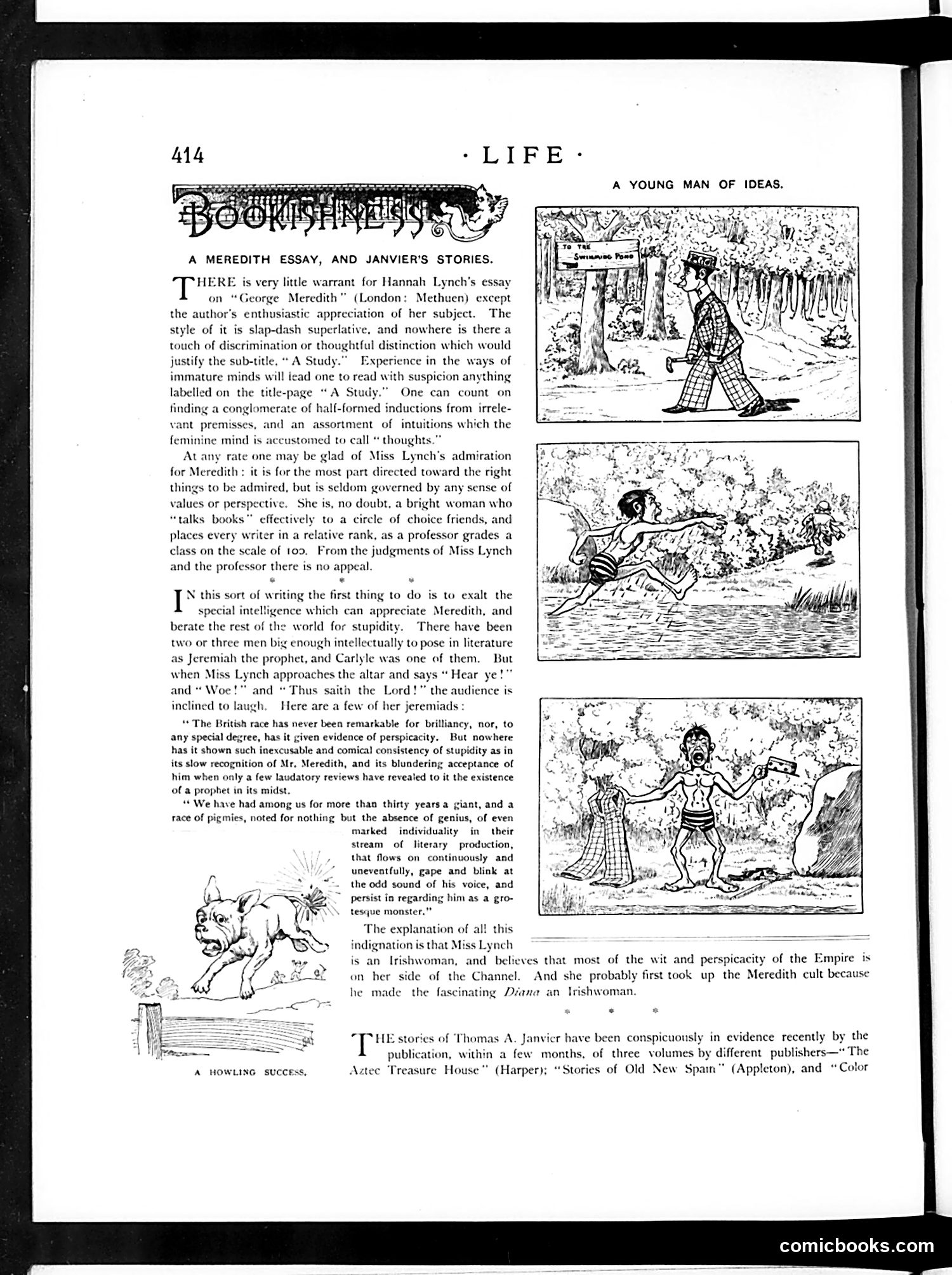
This page from *Life* magazine reviews Hannah Lynch's essay "A Meredith" and stories by Thomas A. Janvier. The text is largely literary criticism rather than political satire. The reviewer criticizes Lynch's essay on George Meredith as lacking analytical depth, dismissing it as superficial admiration. More sharply, the reviewer attacks Meredith himself as an overrated "prophet" and "genius," mocking his pretentious style and his acceptance by admirers who mistake obscurity for profundity. The three illustrations on the right appear to be drawings from Janvier's stories (depicting outdoor scenes with figures), while the dog illustration at bottom left ("A Howling Success") likely comments mockingly on one of the works discussed. This is primarily **literary criticism and book review**, not political satire.
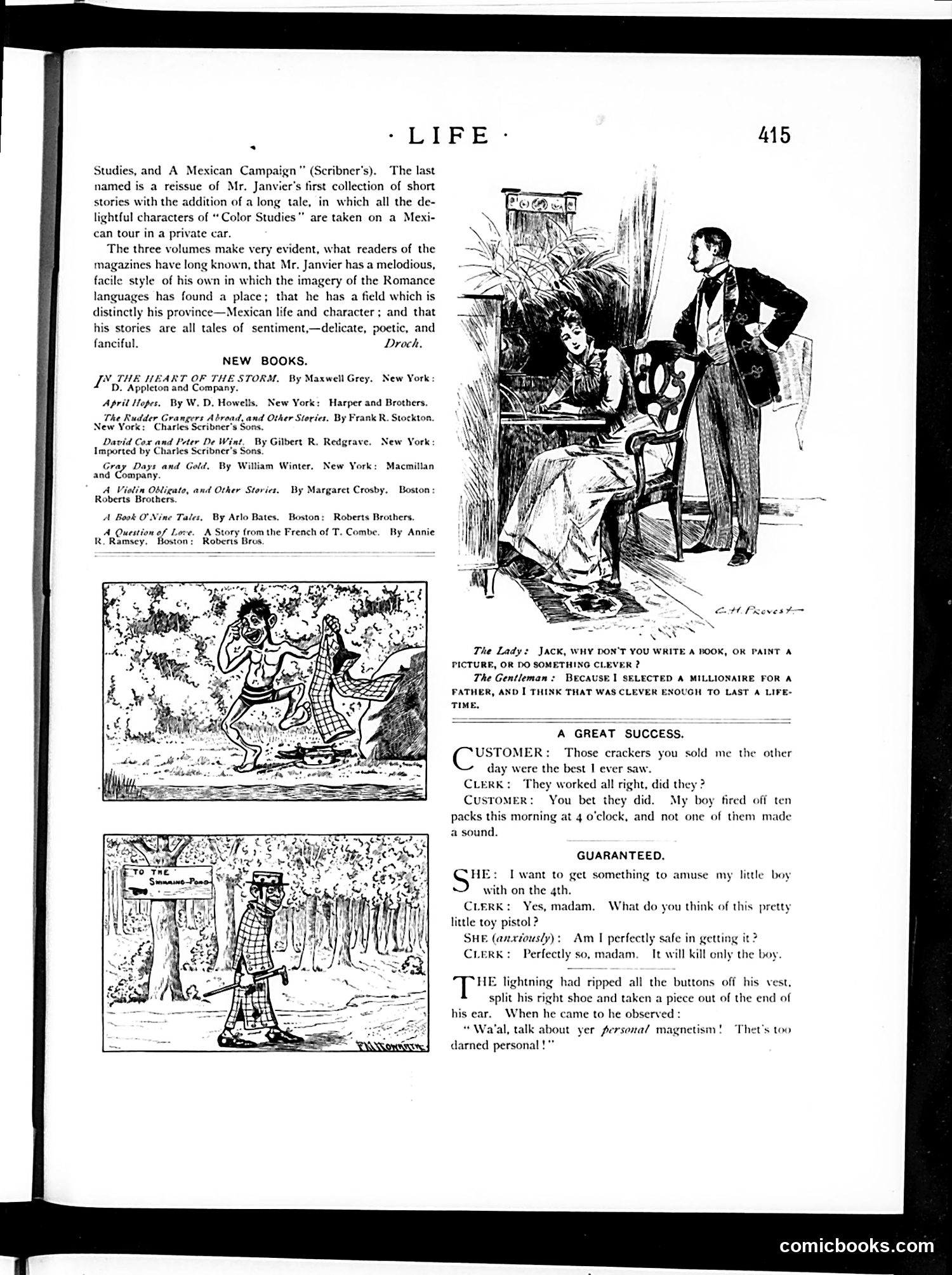
This page contains book reviews and humorous illustrations unrelated to politics. The top section reviews three volumes of short stories by Mexican-themed writer Janvier, praised for his "melodious, facile style" and depiction of Mexican life. Below are three cartoon vignettes with accompanying jokes about everyday situations: a couple discussing writing/painting, a customer praising silent firecrackers to a clerk, and a woman asking about a toy pistol's safety while a child tests it (resulting in torn clothing and injury). The humor relies on physical comedy, irony, and domestic situations—not political satire. The cartoons illustrate conventional Life magazine humor of their era, focusing on social embarrassment and mishap rather than commentary on current events or public figures.
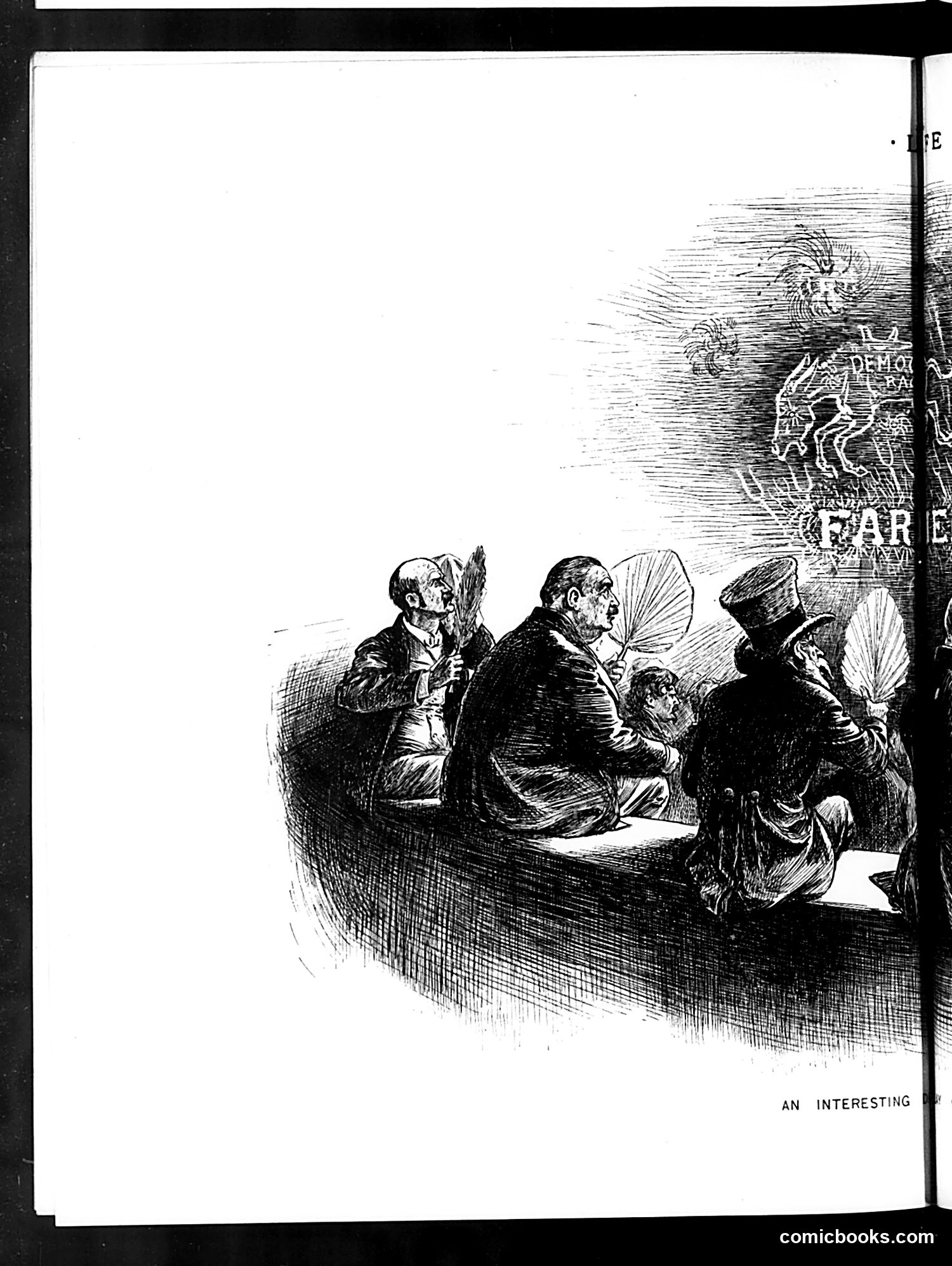
This is a satirical sketch from *Life* magazine showing what appears to be a formal gathering or courtroom scene. Five men in Victorian-era dress are depicted—some seated, some standing—with exaggerated facial features typical of period caricature. Two women with elaborate bonnets are also present. The partial caption reads "AN INTERESTING," but the full text is cut off, preventing identification of the specific subject or satire target. Without the complete caption or additional context, I cannot definitively identify which political figures, legal proceeding, or social event this depicts. The formal setting and caricatured style suggest it mocks either a legal case, political meeting, or society scandal, but I cannot specify which without risking inaccuracy.
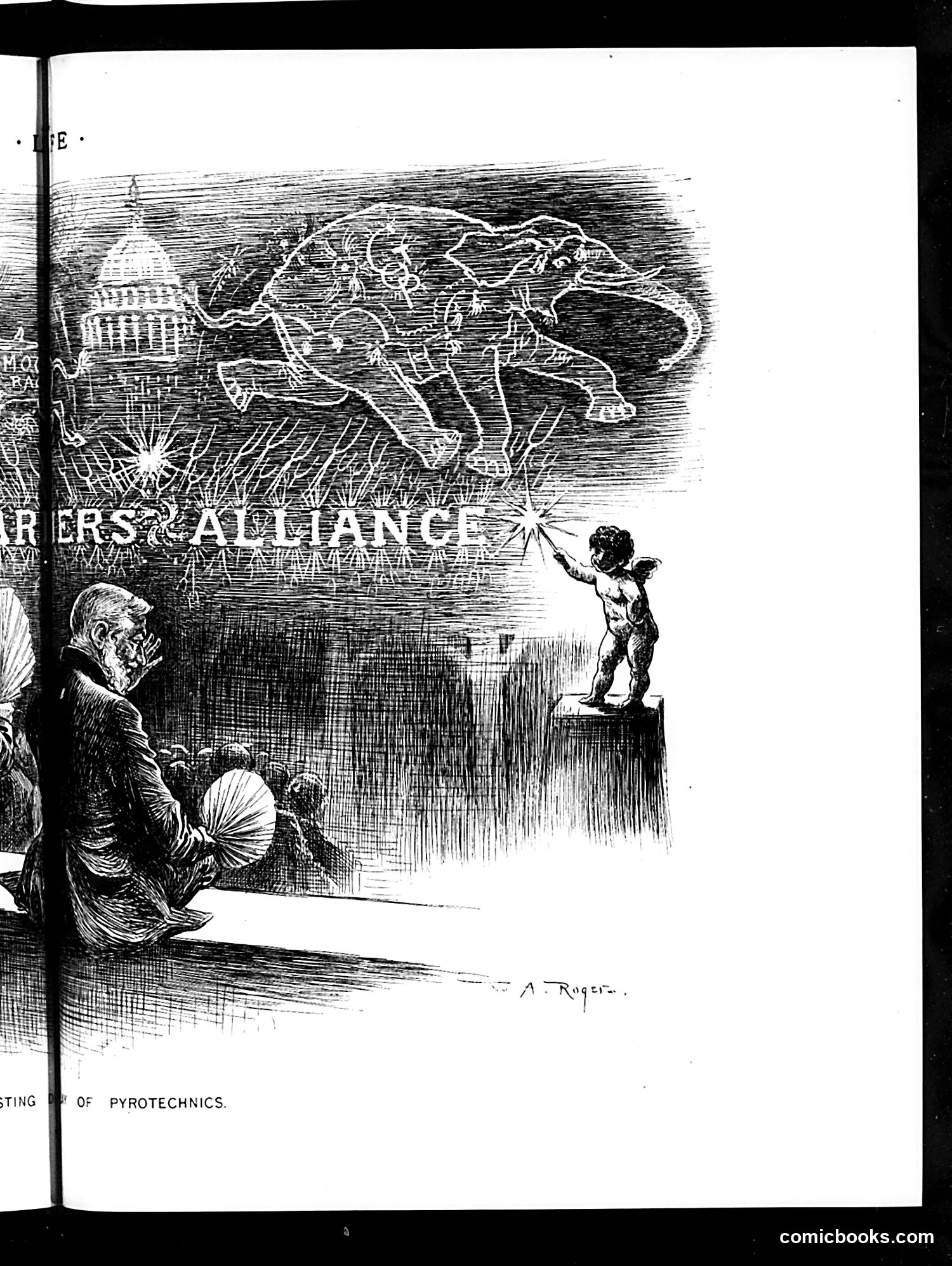
This political cartoon by A. Rogers depicts an allegorical scene titled "BEARERS ALLIANCE." A cherub or cupid figure stands on a pedestal, pointing upward toward a bear constellation or bear-shaped form in the night sky above the Capitol building. An elderly gentleman observes from the left. The "bearers alliance" likely references a political alliance or agreement—the bear typically symbolized Russia in 19th-century political cartoons. The Capitol dome suggests this concerns American foreign policy. The cherub directing attention skyward may represent idealism or guidance toward this alliance. Without the publication date or fuller context visible, the specific political moment remains unclear, but this appears to satirize American diplomatic relations or proposed alliances with Russia during a particular historical period.
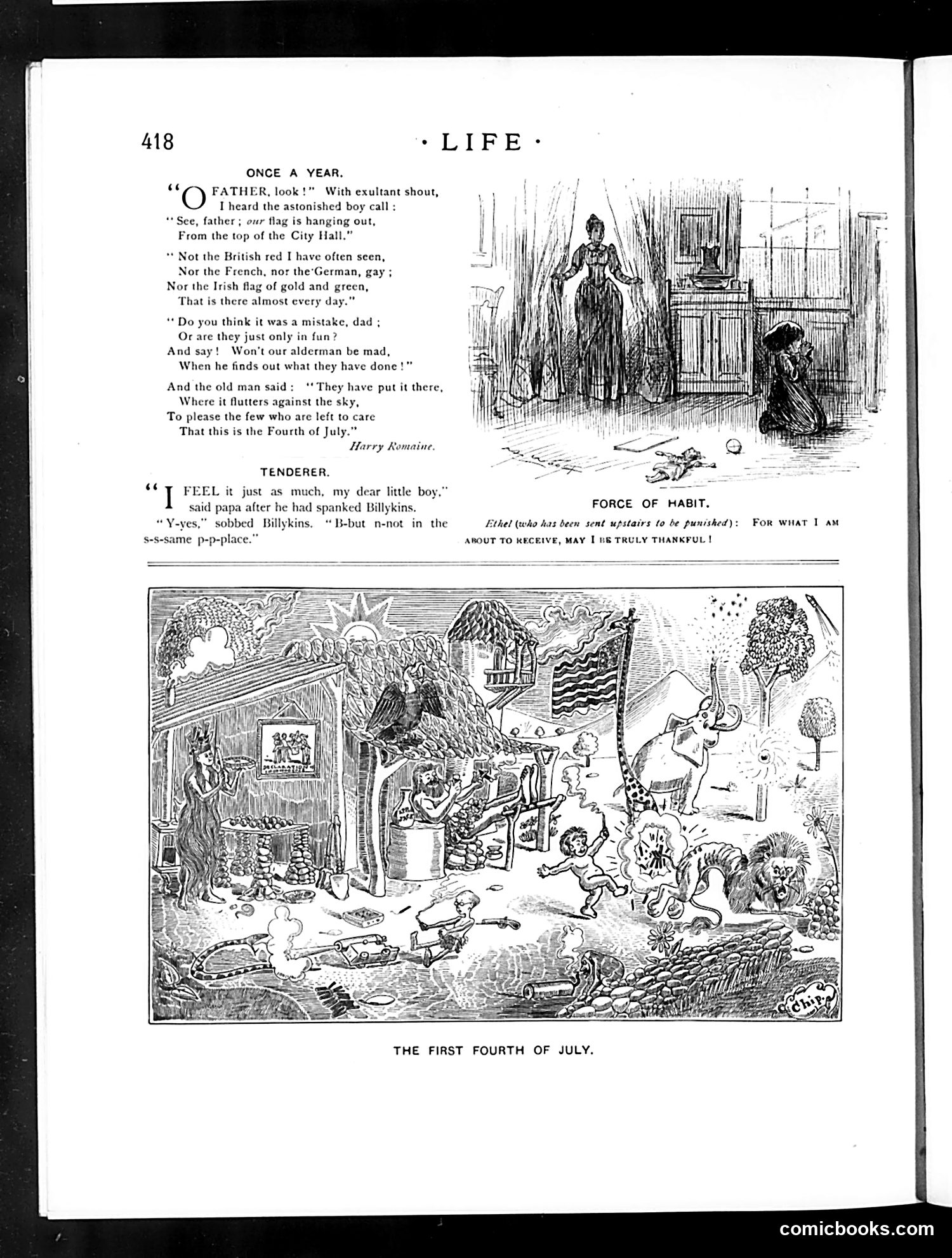
This page contains two satirical pieces about American patriotism and discipline: **"Once a Year"** (top): A poem by Harry Romaine depicts a boy noticing the American flag flying from City Hall on the Fourth of July. The satire suggests the flag appears so rarely that the boy questions whether it's an error or joke—implying American patriotism is neglected year-round. The father's response that they raised it "to please the few who are left to care" mocks declining patriotic sentiment or civic indifference. **"Force of Habit"** (middle): A brief joke where a father spanks his son "Billykins," then the boy cries that it doesn't hurt "in the s-s-same p-pop-plop" way. The caption notes a girl named Ethel being punished upstairs says she's "truly thankful" for what she's about to receive—dark humor about corporal punishment as routine. **"The First Fourth of July"** (bottom): An elaborate engraving showing chaotic Independence Day revelry with children, animals, and anarchic celebration. Together, these pieces satirize American patriotism, parental discipline, and holiday excess in early 20th-century society.
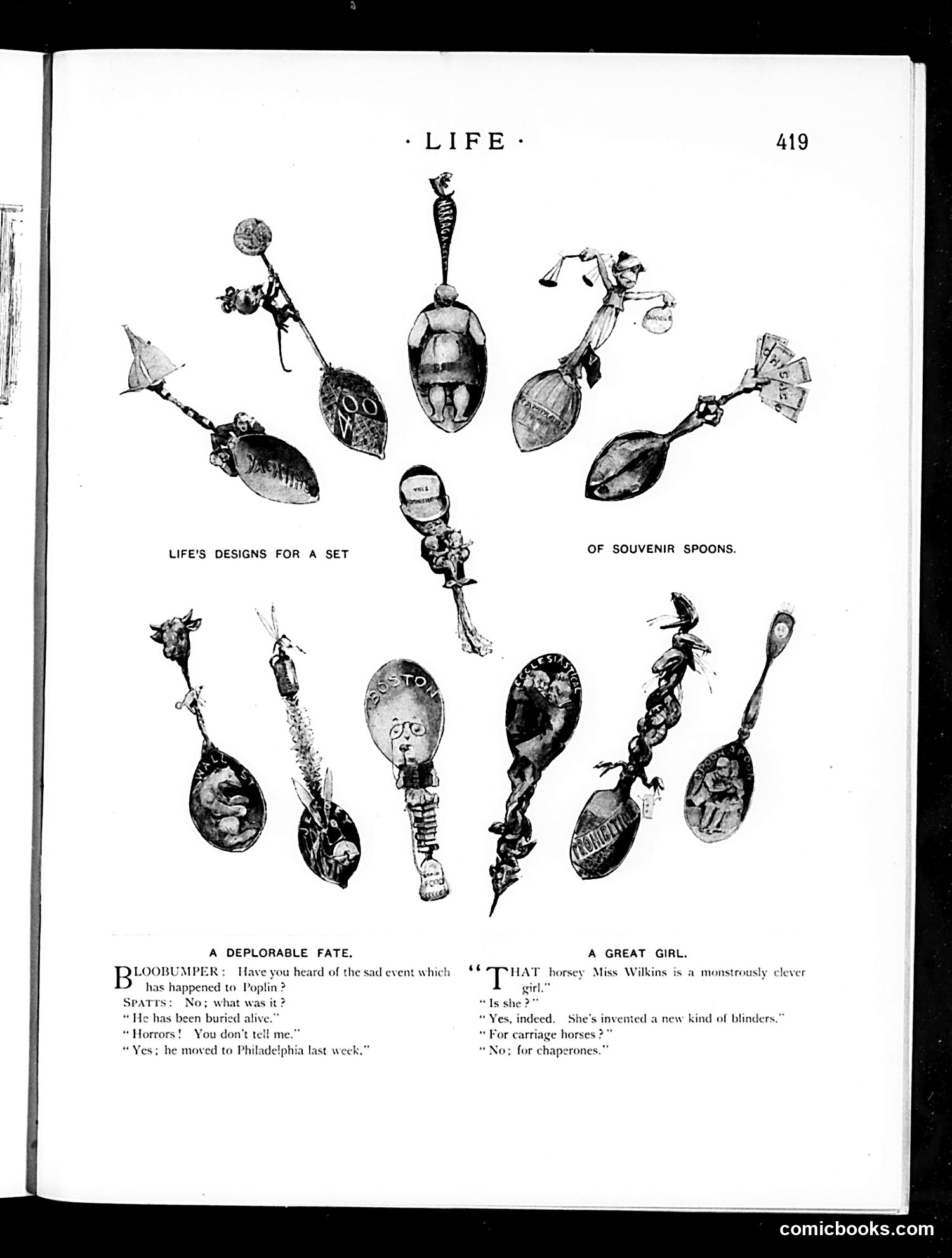
This page showcases **Life's satirical designs for decorative souvenir spoons**—ornate objects popular in the late 19th/early 20th century. The elaborate spoon handles feature whimsical characters and scenes, reflecting the era's taste for novelty collectibles. Below are two brief comedic dialogues: **"A Deplorable Fate"** jokes darkly about someone named Poplin being "buried alive" by moving to Philadelphia—a dated reference suggesting Philadelphia was considered provincial or tedious compared to New York or other urban centers. **"A Great Girl"** portrays Miss Wilkins as clever for inventing "a new kind of blinders...for chaperones." This satirizes the social convention requiring unmarried women to have chaperones during courtship. The joke: blinders would prevent chaperones from witnessing romantic indiscretions, implying the "clever" girl seeks to evade moral oversight. Both items mock social conventions of the period through exaggeration and wordplay typical of Life's humor.
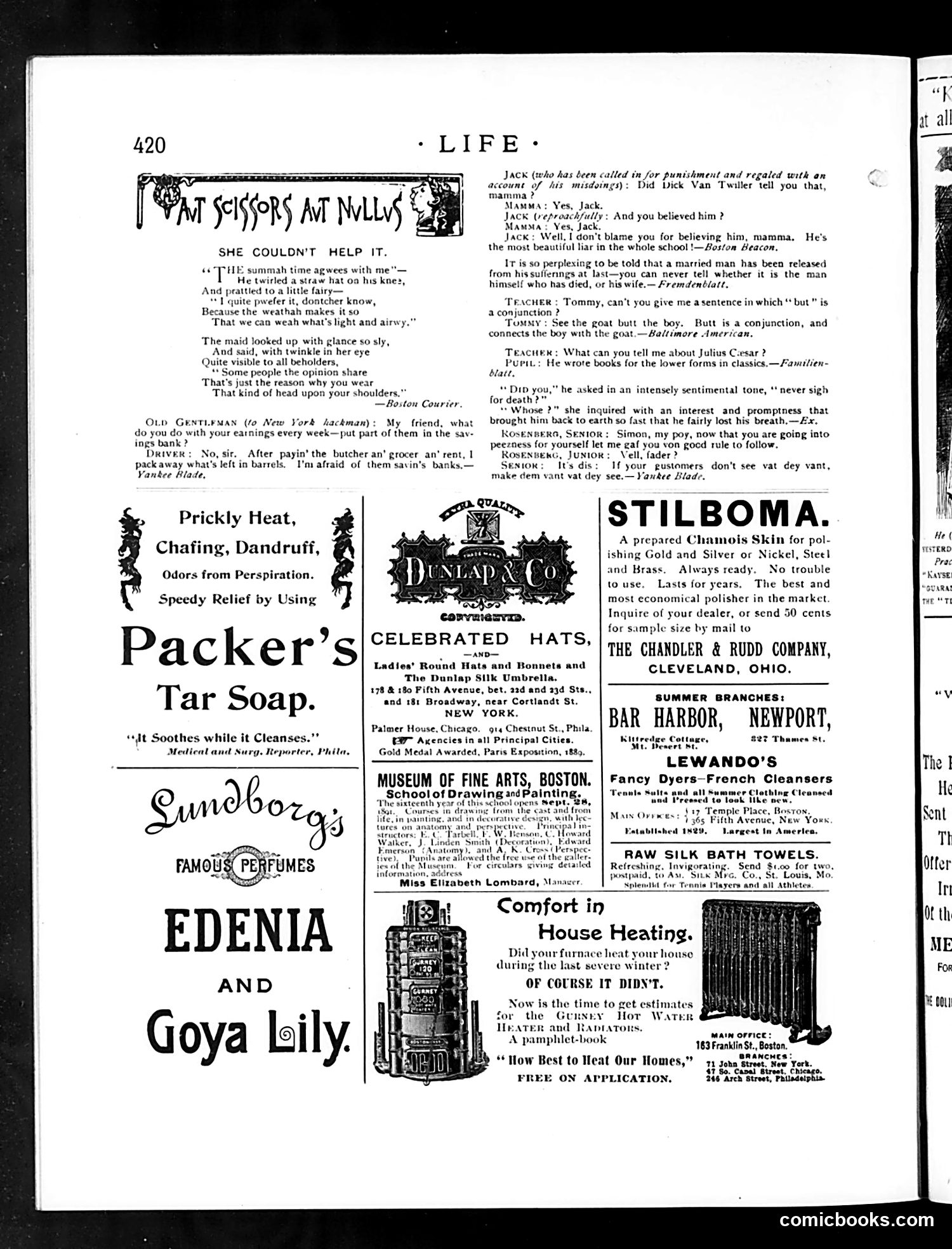
This is primarily an **advertising page** from Life magazine, with several short humorous anecdotes interspersed. The main cartoon content consists of **brief comic stories** rather than visual illustrations: 1. **"At Scissors at Nully's"** - A sentimental poem about a maid and child 2. **School humor pieces** - Including exchanges where a boy named Tommy makes grammatical jokes (a "butt" is a conjunction because it "connects the boy with the goat") 3. **"Old Gentleman" story** - A hackman explains he keeps his savings in barrels rather than banks, fearing loss These sketches satirize **Victorian sentimentality** and showcase **wordplay humor** popular in the era. The anecdotes feature innocent characters (children, immigrants) making unintentional puns. The bulk of the page consists of **period advertisements** for consumer goods: Packer's Tar Soap, perfumes (Edenia, Goya Lily), Dunlap hats, Stilboma polish, and heating equipment. There are no prominent political cartoons or caricatures on this page.
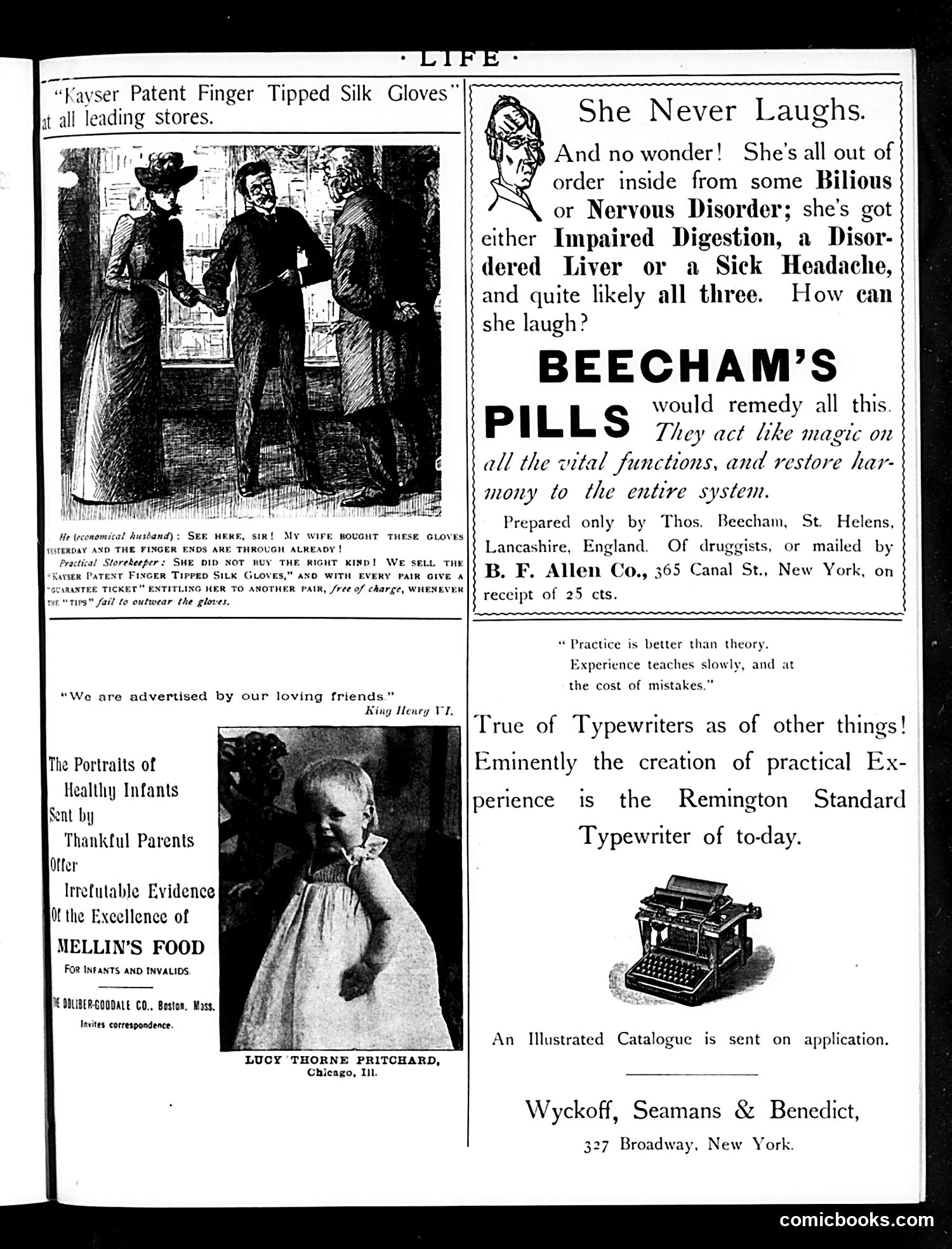
This is primarily an **advertising page** with one satirical cartoon at the top. The cartoon depicts a domestic scene where a husband complains to a shopkeeper that his wife's new Kayser Patent Finger Tipped Silk Gloves wore out too quickly. The shopkeeper responds that they didn't buy the *right kind*—implying the husband was cheap. The joke satirizes both **marital frugality** (the husband's economical nature) and **marketing claims**: the gloves come with a guarantee ticket for free replacement, yet the shopkeeper still manages to shame the customer into feeling he made a poor purchase decision. The page otherwise contains advertisements for **Beecham's Pills** (a patent medicine promising to cure digestive/nervous disorders), **Mellin's Food** (infant formula), and **Remington Typewriters**. These reflect early-1900s consumer culture and the era's heavy reliance on patent medicines and dubious health claims. The King Henry VII quote about word-of-mouth advertising frames the commercial content ironically.
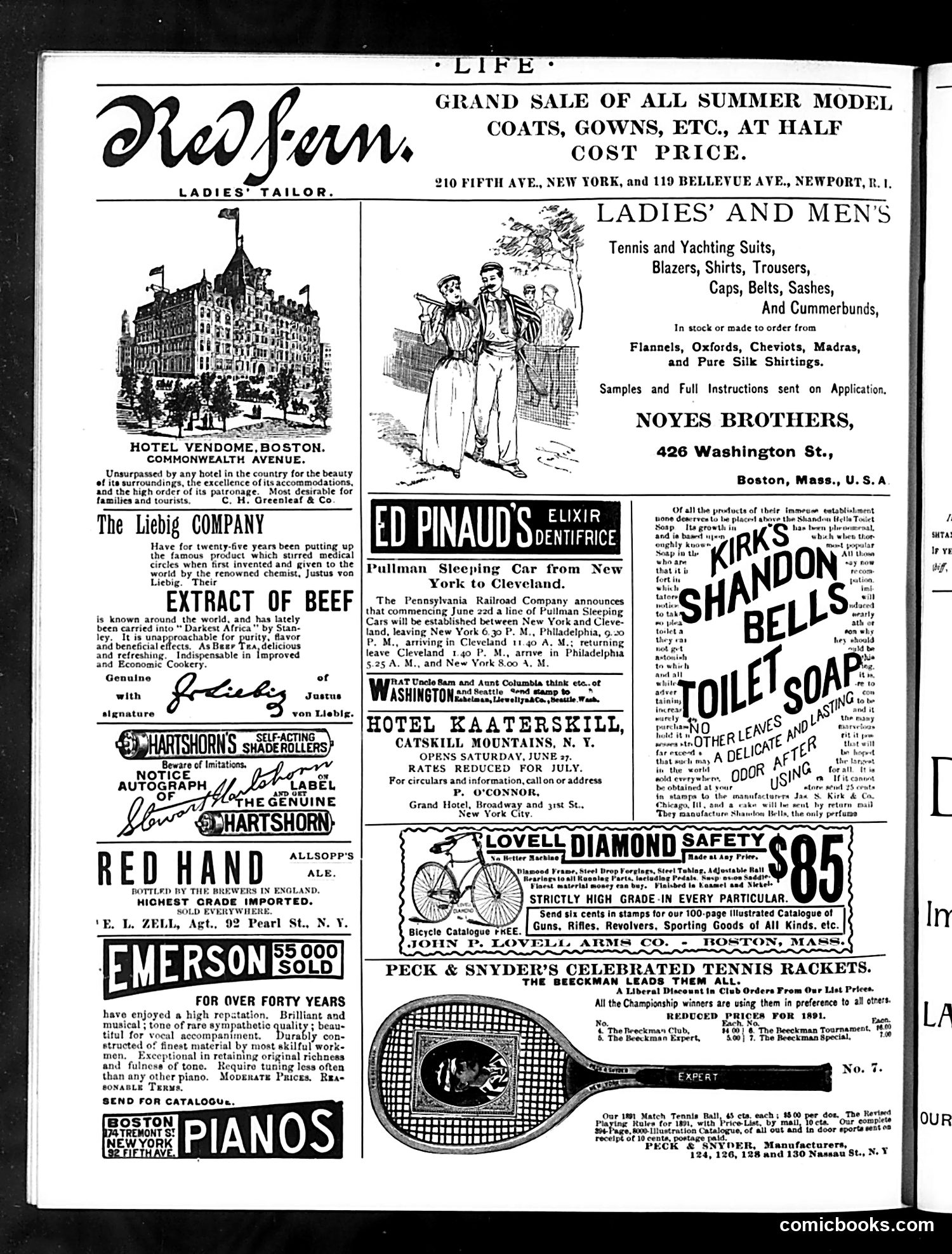
This is primarily an **advertising page** from Life magazine, not a satirical cartoon page. It contains mostly commercial advertisements from the 1890s (based on references to 1891 pricing). The ads showcase period consumer goods: Red Hand Ale, Emerson Pianos, Liebig's Extract of Beef (a famous product), Ed Pinaud's dental products, and sporting equipment like tennis rackets and bicycles. There's also advertising for hotels (Hotel Vendome in Boston, Hotel Kaaterskill in the Catskills) and tailoring services. The only illustration with potential satirical content appears to be a small sketch of two figures in period dress, but without clearer context or caption visible, I cannot identify specific figures or political commentary. The page essentially reflects **late-Victorian commercial life**: the prominence of import brands ("Highest Grade Imported"), resort tourism, sporting fashion, and the positioning of products as luxury items for educated urban consumers. It's a snapshot of 1890s American consumer culture rather than political satire.
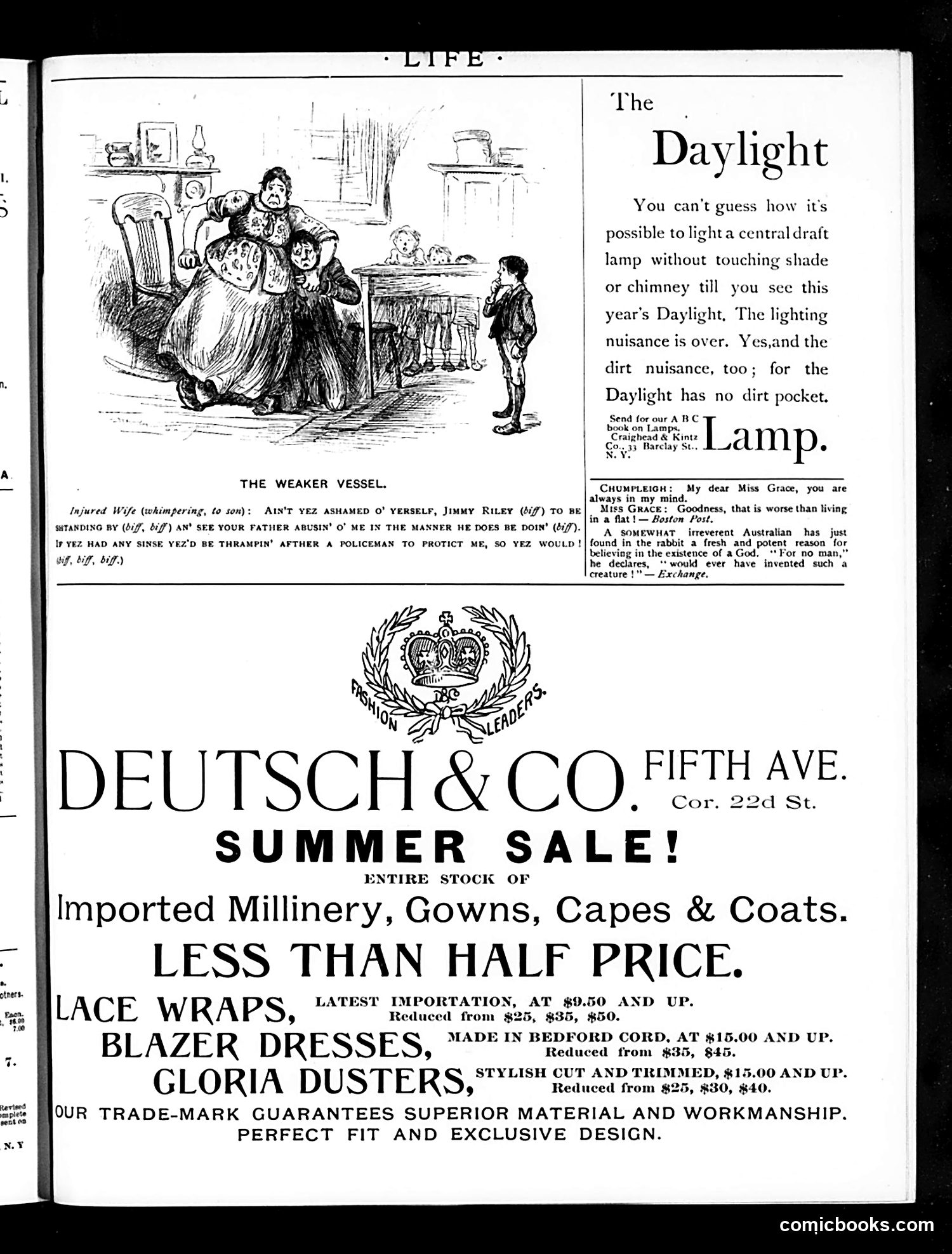
This satirical cartoon depicts a domestic dispute with Irish-immigrant characters, identifiable by the phonetic dialect spelling ("AIN'T YEZ ASHAMED," "THRAMPIN'"). An injured wife complains to her son Jimmy Riley about her husband's abuse, scolding the boy for not fetching a policeman to protect her. The satire targets two subjects: First, the stereotype of Irish immigrants as violent and domestic abusers. Second, and more pointedly, it mocks the "weaker vessel" concept—the Victorian notion that women were physically and morally fragile—by showing this woman as loud, commanding, and emotionally dominant over the men, thereby undercutting the pretense of female weakness. The cartoon appears in *Life*, a publication known for satirizing social hypocrisies and ethnic stereotypes of the era.
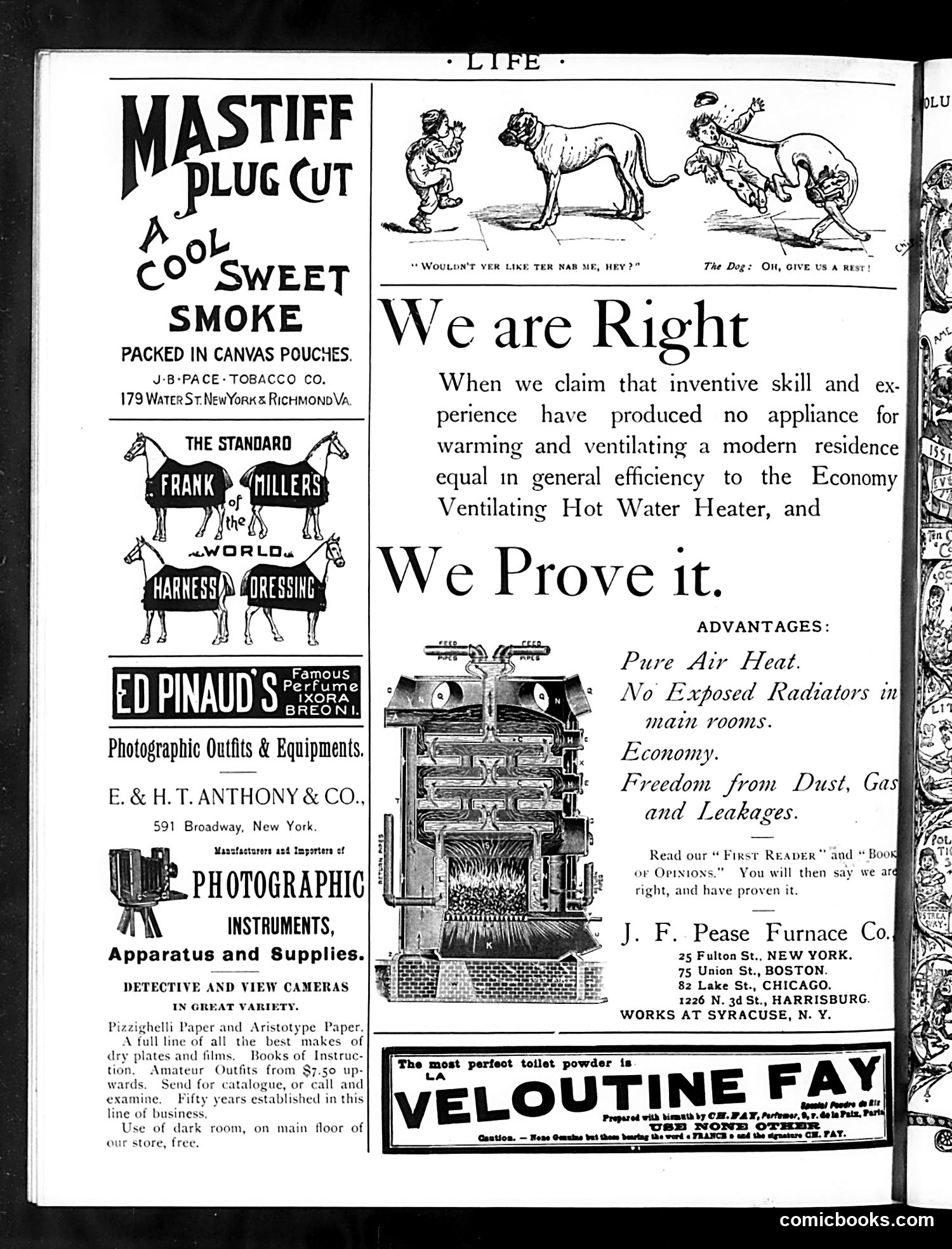
This page is primarily **advertising**, not editorial content. The cartoons are minimal—two small sketches at the top showing a man and dog with the caption "Wouldn't yer like ter nab me, hey?" and "Oh, give us a rest!" These appear to be generic humorous illustrations rather than political commentary. The main content consists of period advertisements for: - **Mastiff Plug Cut tobacco** (canvas pouches) - **Photographic equipment** (cameras, film, supplies) - **J.F. Pease heating systems** (emphasizing modern home ventilation) - **Veloutine Fay** (toilet powder) The only notable element is the heating system ad's rhetorical claim "We are Right" / "We Prove it"—a common early-20th-century marketing technique using pseudo-scientific language to build consumer confidence in new domestic technology. Overall, this reflects early 1900s advertising aimed at middle-class consumers adopting modern conveniences.