
Life, 1891-07-02 · page 8 of 18
Life — July 2, 1891 — page 8: what you’re looking at
What you’re looking at
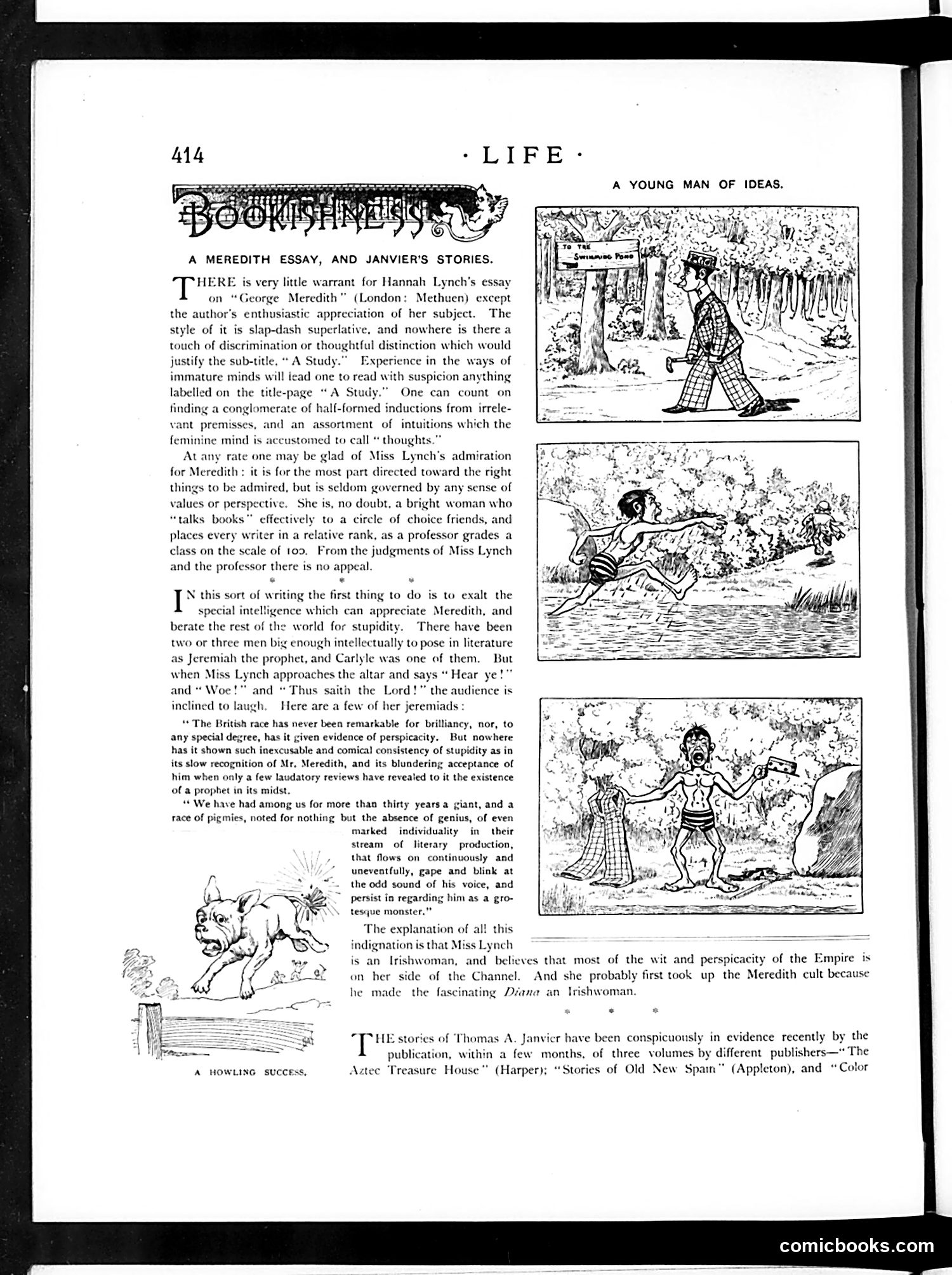
This page from *Life* magazine reviews Hannah Lynch's essay "A Meredith" and stories by Thomas A. Janvier. The text is largely literary criticism rather than political satire. The reviewer criticizes Lynch's essay on George Meredith as lacking analytical depth, dismissing it as superficial admiration. More sharply, the reviewer attacks Meredith himself as an overrated "prophet" and "genius," mocking his pretentious style and his acceptance by admirers who mistake obscurity for profundity. The three illustrations on the right appear to be drawings from Janvier's stories (depicting outdoor scenes with figures), while the dog illustration at bottom left ("A Howling Success") likely comments mockingly on one of the works discussed. This is primarily **literary criticism and book review**, not political satire.
📄 Transcribed text from this page (OCR, searchable)
Machine-transcribed from the original scan — historical spelling and the odd misread are preserved.
A YOUNG MAN OF IDEAS. A MEREDITH ESSAY, AND JANVIER'S STORIES. HERE is very little warrant for Hannah Lynch's © on “Gi * (London: Methuen) except the author’s enthusiastic appreciation of her subject. The style of it is slap-dash superlative, and nowhere is there a touch of discrimination or thoughtful distinction which would justify the sub-title, * A Study.” Experience in the ways of immature minds will icad one to read with suspicion anything labelled on the title-page “A Study.” One can count on finding a conglomerate of half-formed inductions from irrele- vant premisses, and an assortment of intuitions which the feminine mind is accustomed to call “ thoughts.” At any rate one may be glad of Miss Lynch's admiration for Meredith: it is for the most part directed toward the right things to be admired, but is seldom governed by any sense of values or perspective. She is, no doubt, a bright woman who “talks books” effectively to a circle of choice friends, and places every writer in a relative rank, as a professor grades a class on the scale of 109. From the judgments of Miss Lynch and the professor there is no appeal. N this sort of writing the first thing to do is to exalt the special inteltigence which can appreciate Meredith, and berate the rest of the world for stupidity. There have been two or three men big enough intellectually to pose in literature as Jeremiah the prophet, and Carlyle was one of them. But when Miss Lynch approaches the altar and says “ Hear ye!” and * Woe and “Thus saith the Lord!” the audience is inclined to laugh. Here are a few of her jeremiads : “The British race has never been remarkable for brilliancy, nor, to any special degree, has it given evidence of perspicacity, But nowhere has it shown such inexcusable and comical consistency of stupidity as in its stow recognition of Mr, Meredith, and its blundering acceptance of him when only a few laudatory reviews have revealed to it the existence of a prophet in its midst, “We have had among us for more than thirty years a giant, and a race of pigmies, noted for nothing but the absence of genius, of even marked individuality in their stream of literary production, that flows on continuously and uneventfully, gape and blink at the odd sound of his voice, and persist in regarding him as a gro- tesque monster.” The explanation o this indignation is that Miss Lynch is an Irishwoman, and believes that most of the wit and perspicacity of the Empire is on her side of the Channel. And she probably first took up the Meredith cult because he made the fascinating Déana an Irishwoman. “THE stories of Thomas A. Janvier have been conspicuously in evidence recently by the publication, within a few months, of three volumes by different’ publishers—* The HOWLING SUCCESS, Aztec Treasure House" (Harper); “Stories of Old New Spain” (Appleton), and “Color comicbooks.com