
A complete issue · 15 pages · 1891
Life — June 25, 1891
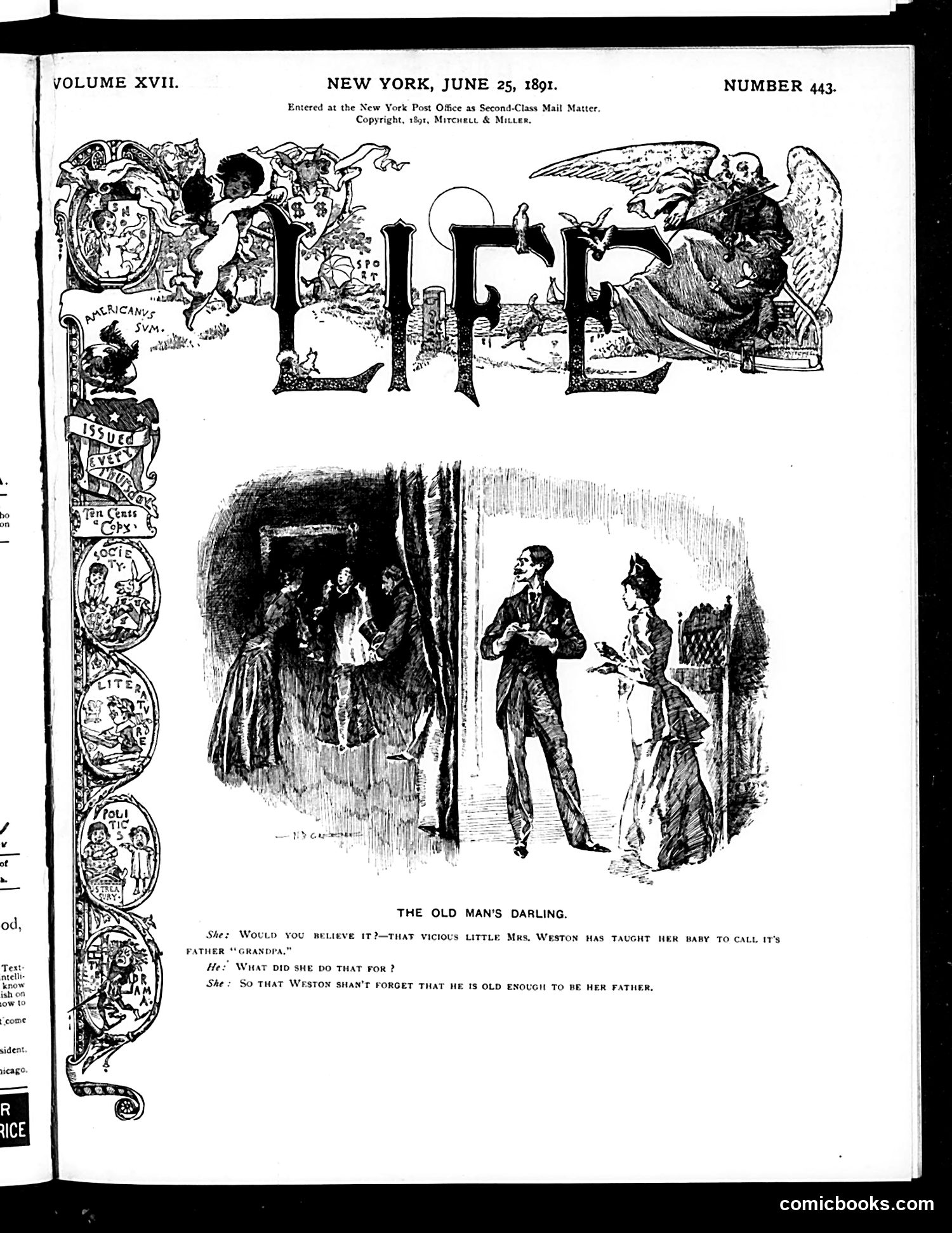
This page from Life magazine (June 25, 1891) contains a satirical cartoon about domestic relations. The illustration shows a conversation between a man and woman, with dialogue below revealing the joke's premise: A woman (Mrs. Weston) has taught her baby to call an older man "Grandpa" rather than "Father," implying the man is too elderly to be the actual father. The satire hinges on this social awkwardness—the man asks why she would do this, and she responds that she wants to ensure Weston "shan't forget that he is old enough to be her father." The humor targets age-gap relationships and questions of paternity/legitimacy that were considered risqué subjects for the era's satirical press.
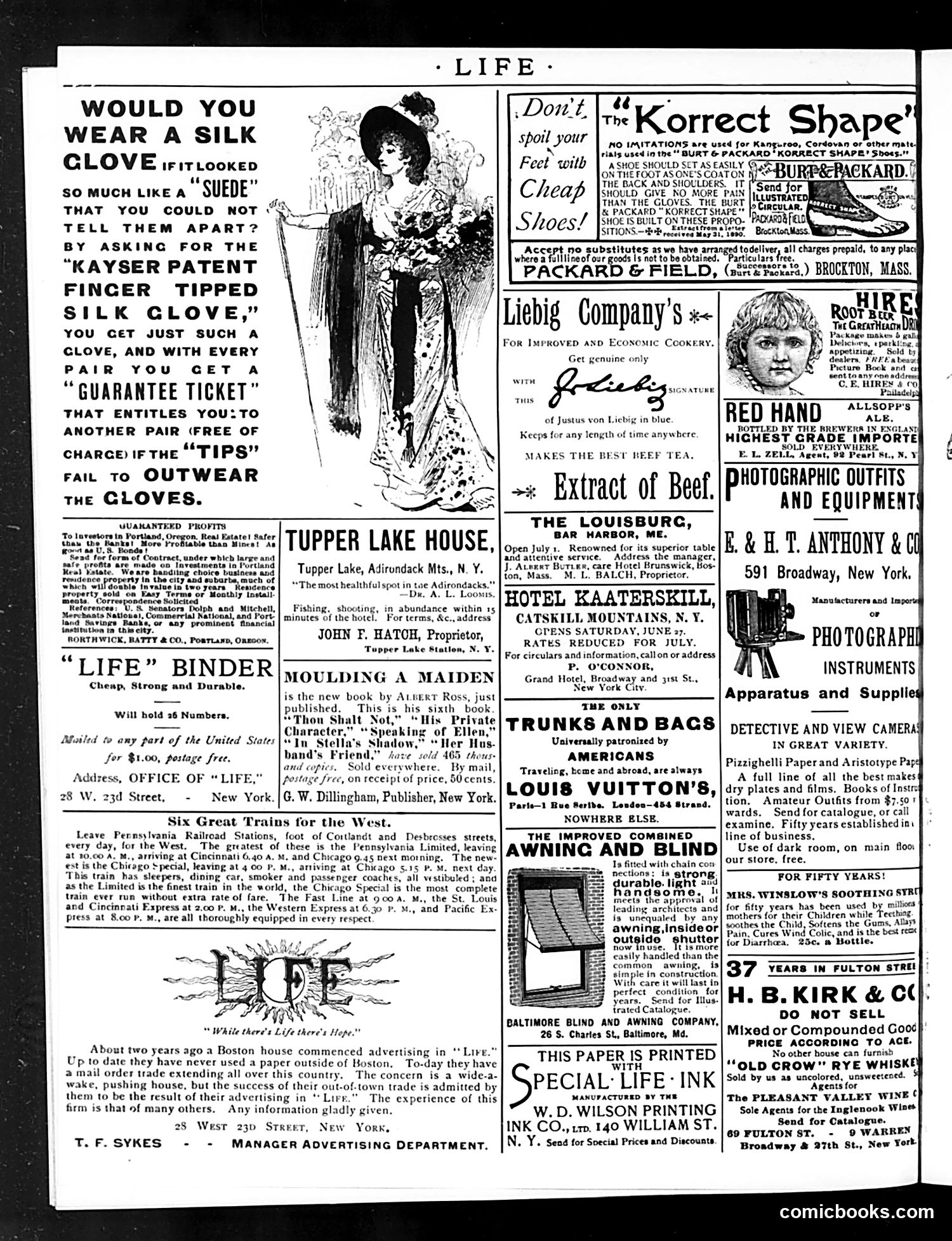
This page is primarily **advertising**, not political satire. It contains approximately fifteen different advertisements for consumer goods and services from the early 1900s, including: - Silk gloves with a "guarantee ticket" promising replacements if the finger tips wear through - Hotel and resort advertisements (Tupper Lake House, Hotel Kaaterskill) - Photographic equipment from B. & H.T. Anthony & Co. - Patent medicines and health products - Travel services and trunks - Printing services The only editorial content is a brief item by T.F. Sykes (Manager Advertising Department) explaining that Life magazine itself accepts mail-order advertising. The page reflects early 20th-century consumer culture and product marketing strategies rather than containing political or social satire.
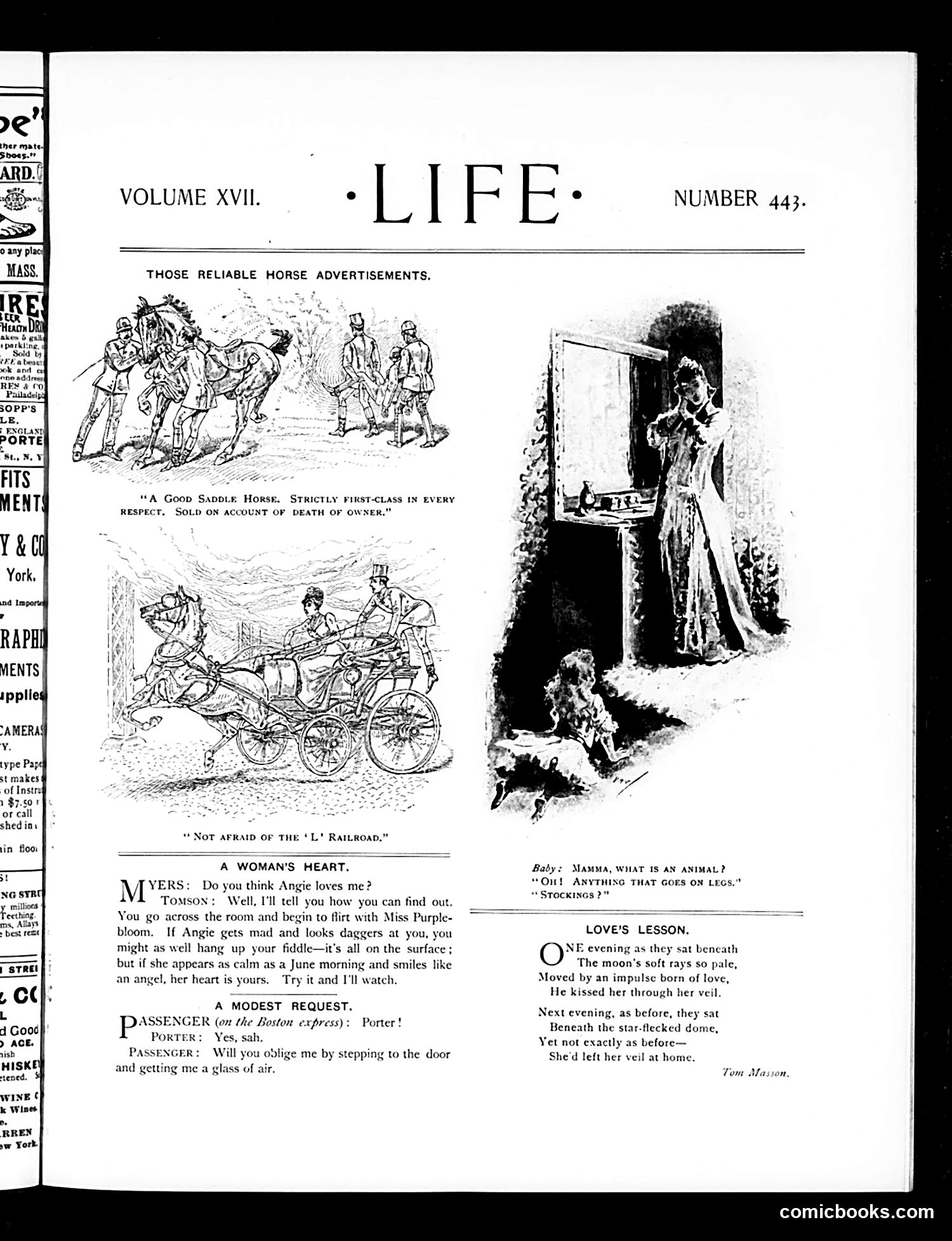
This page satirizes misleading classified ads for horses. The top cartoon shows a "good saddle horse, strictly first-class in every respect. Sold on account of death of owner"—implying the horse killed its previous owner. The second cartoon mocks the "L" Railroad, showing a chaotic multi-horse team pulling a carriage, suggesting the advertised vehicle is uncontrollable. The humor targets the gap between flowery horse-sale descriptions and reality. Buyers expecting quality animals receive dangerous or unreliable ones. This reflects genuine frustration with deceptive advertising practices of the era, when horses were essential transportation and purchasing one was a significant investment. The remaining content includes unrelated short comedic sketches and poems.
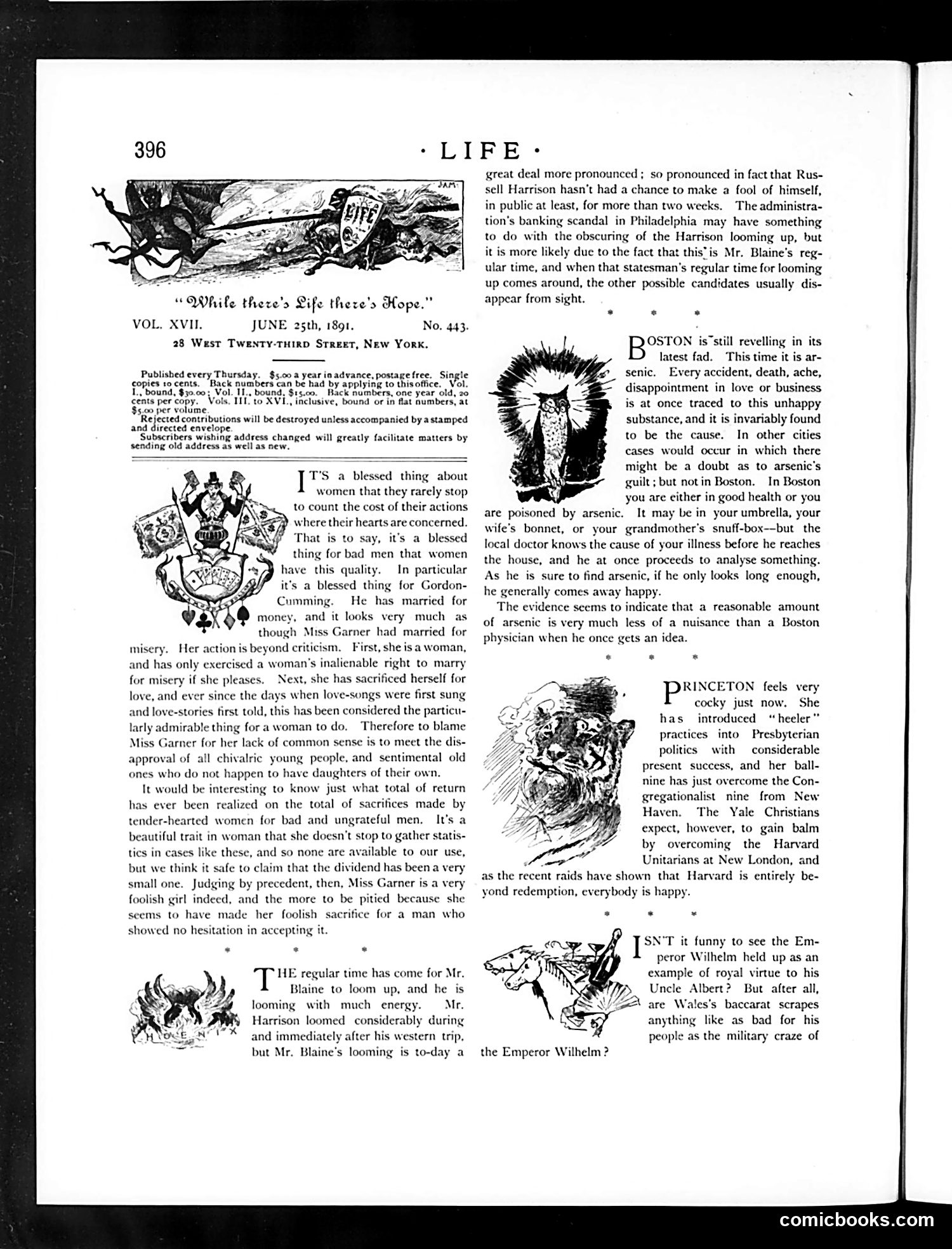
This page contains three satirical essays with accompanying illustrations, typical of Life's commentary style. **The main topics discussed:** 1. **Gordon Cumming scandal**: The text defends Miss Gordon Cumming's marriage decision despite public scandal, arguing women shouldn't be blamed for marrying for security after sacrificing for unworthy men. 2. **Boston arsenic poisonings**: A dark satire suggesting Boston's repeated arsenic poisoning cases indicate the substance is everywhere—in umbrellas, bonnets, even doctors' diagnoses—making it less notable than a Boston physician. 3. **Princeton/Yale rivalry**: Commentary on Princeton's recent religious reforms ("heckler" practices) and competitive tension with Harvard's "redemption." 4. **Emperor Wilhelm II**: A brief jab at the German emperor's military ambitions compared unfavorably to Uncle Albert's example. The page primarily showcases Life's satirical commentary on contemporary scandals and social issues.
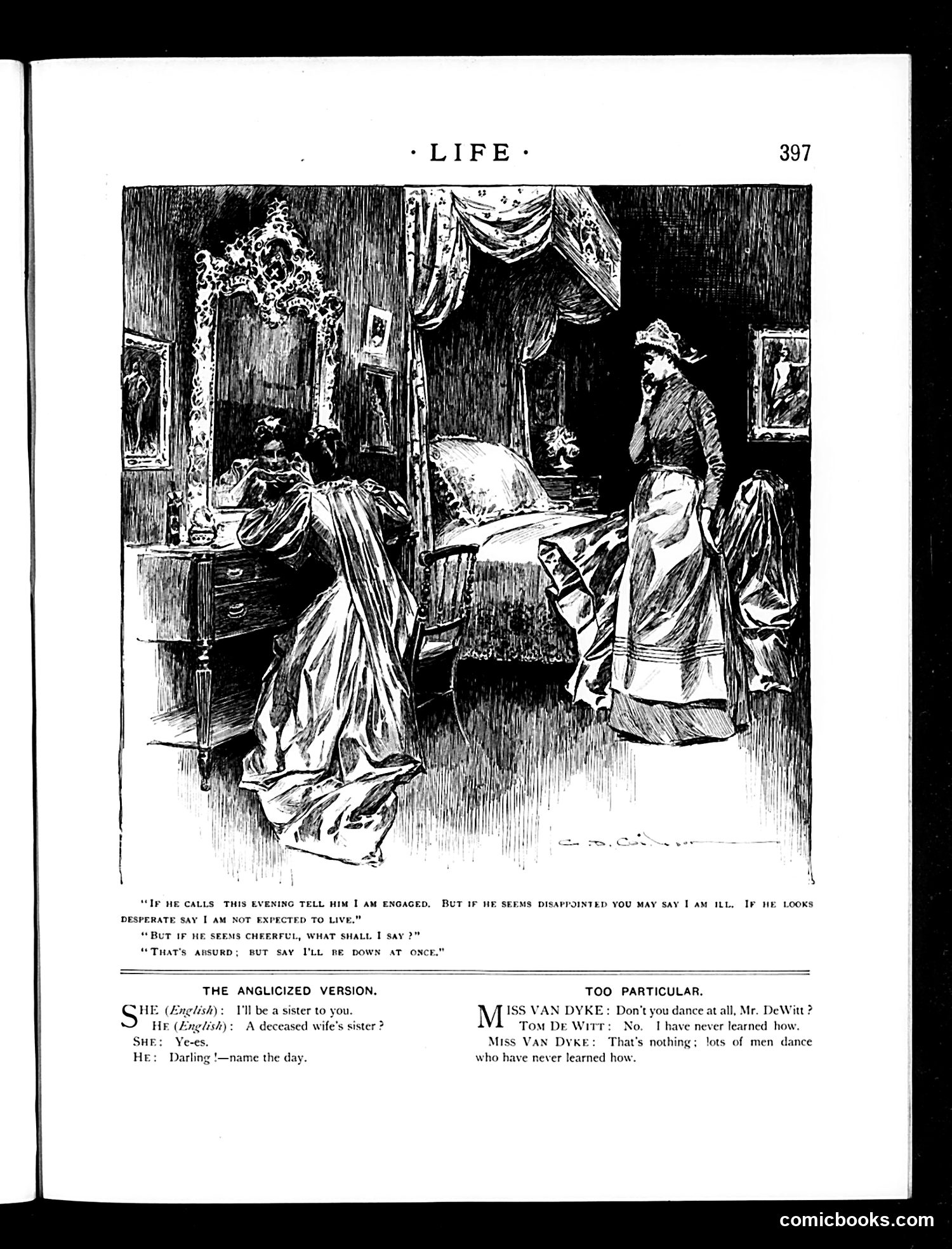
This page from *Life* magazine presents two separate pieces of social satire: **Upper illustration**: Shows a domestic scene where a woman sits at a vanity while a man stands nearby. The caption offers strategic advice about managing a suitor's expectations—telling him she's engaged if he seems uninterested, claiming illness if he appears disappointed, but assuring him she'll see him immediately if he seems cheerful. The satire mocks women's calculated manipulation of romantic attention and the performative nature of courtship. **Lower section**: Two brief comedic dialogues. "The Anglicized Version" jokes about linguistic pretension in discussing family relationships. "Too Particular" features Miss Van Dyke declining to dance with Tom DeWitt, dismissing his lack of dancing ability as unimportant since "lots of men" have never learned. The satire targets snobbish social attitudes and arbitrary standards in courtship and social interactions.
This page contains primarily book reviews and a charitable fundraising appeal for "Our Fresh Air Fund," with no political cartoons visible. The left column discusses a children's charity providing fresh air and outdoor experiences to poor urban children. It contrasts tenement living conditions with countryside benefits, arguing such programs prevent delinquency and crime. The right column reviews F. Marion Crawford's novel *Khaled*, describing it as an Oriental-themed story about a supernatural being learning human emotion through love. The reviewer notes Crawford successfully captures Eastern metaphor and rhetoric, though the plot is somewhat thin. Below is a "Bookshelf" section listing recent publications. No satirical cartoons or political commentary appear on this page—it's primarily literary and philanthropic content.
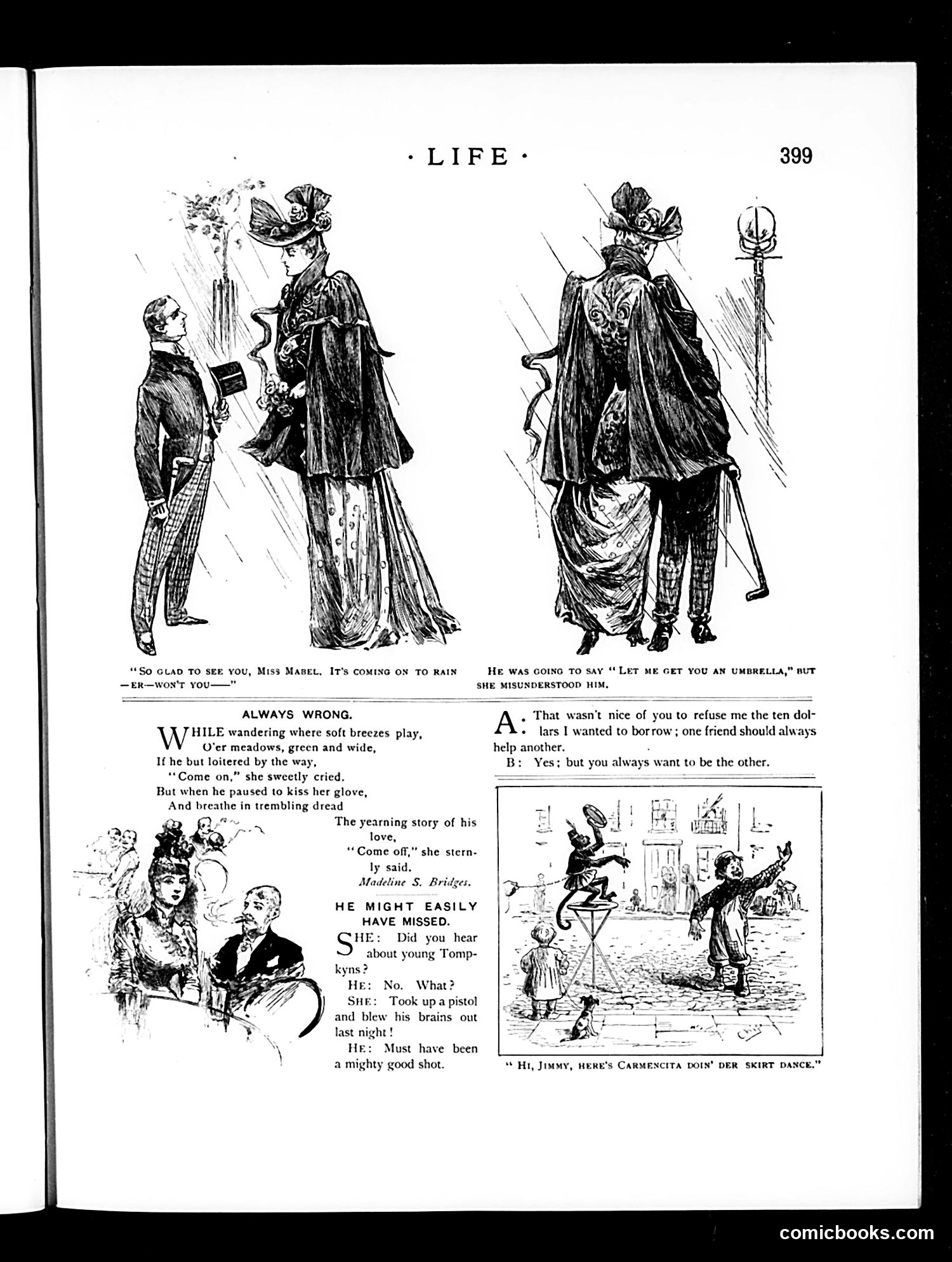
This page from *Life* magazine contains three satirical pieces about relationships and social behavior in the early 20th century. **"Always Wrong"** (top left) tells a romantic story in verse: a woman refuses a suitor's kiss, then regrets it, calling him back—but he's already gone. The accompanying illustration shows their contrasting emotions. **"He Might Easily Have Missed"** (center) presents a dialogue joke about a man named Tomp who shot himself. The humor relies on dark irony typical of the era's comedy. The **top illustrations** show fashionable figures in period dress (large hats, long coats), satirizing courtship rituals and misunderstandings between men and women. **Bottom right**: A street scene captioned about "Carmencita doing der skirt dance," likely referencing a performance or theatrical trend of the period. Overall, the page satirizes romantic miscommunication and social conventions of the era.
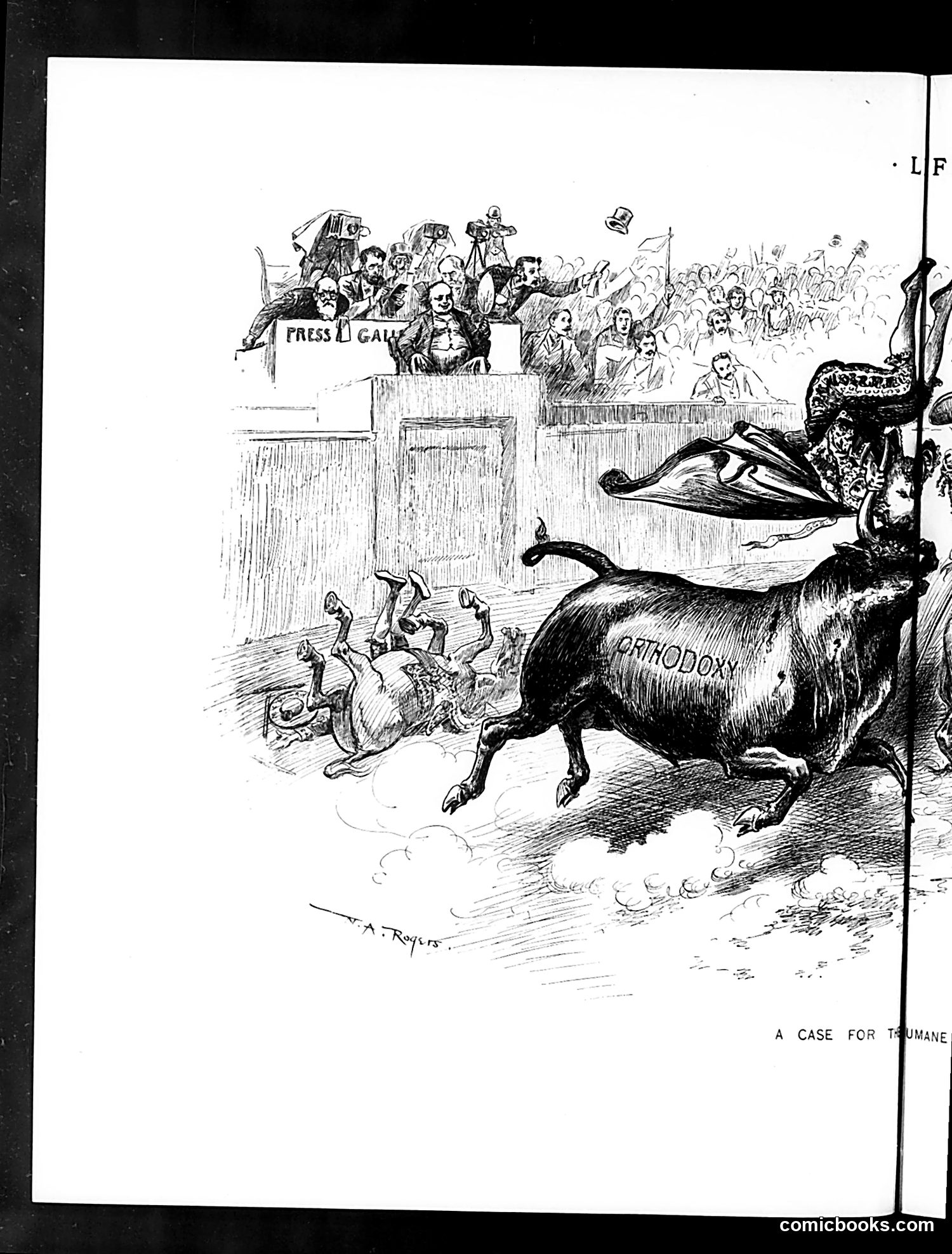
This political cartoon satirizes **Tammany Hall**, the powerful Democratic political machine that controlled New York City politics. The image depicts a massive beast labeled "ORTHODOX" (likely representing corrupt traditional politics) attacking smaller figures in an arena setting, while a "PRESS GALLERY" observes from above. The cartoon suggests that Tammany Hall's entrenched political establishment—represented as a dangerous, out-of-control force—needs to be examined and exposed by the press and public. The arena setting implies this is a public spectacle or battle. The title "A Case for Tammany" appears ironic, likely criticizing rather than supporting the organization. The satire targets political corruption and the need for reform or investigation into Tammany's practices.
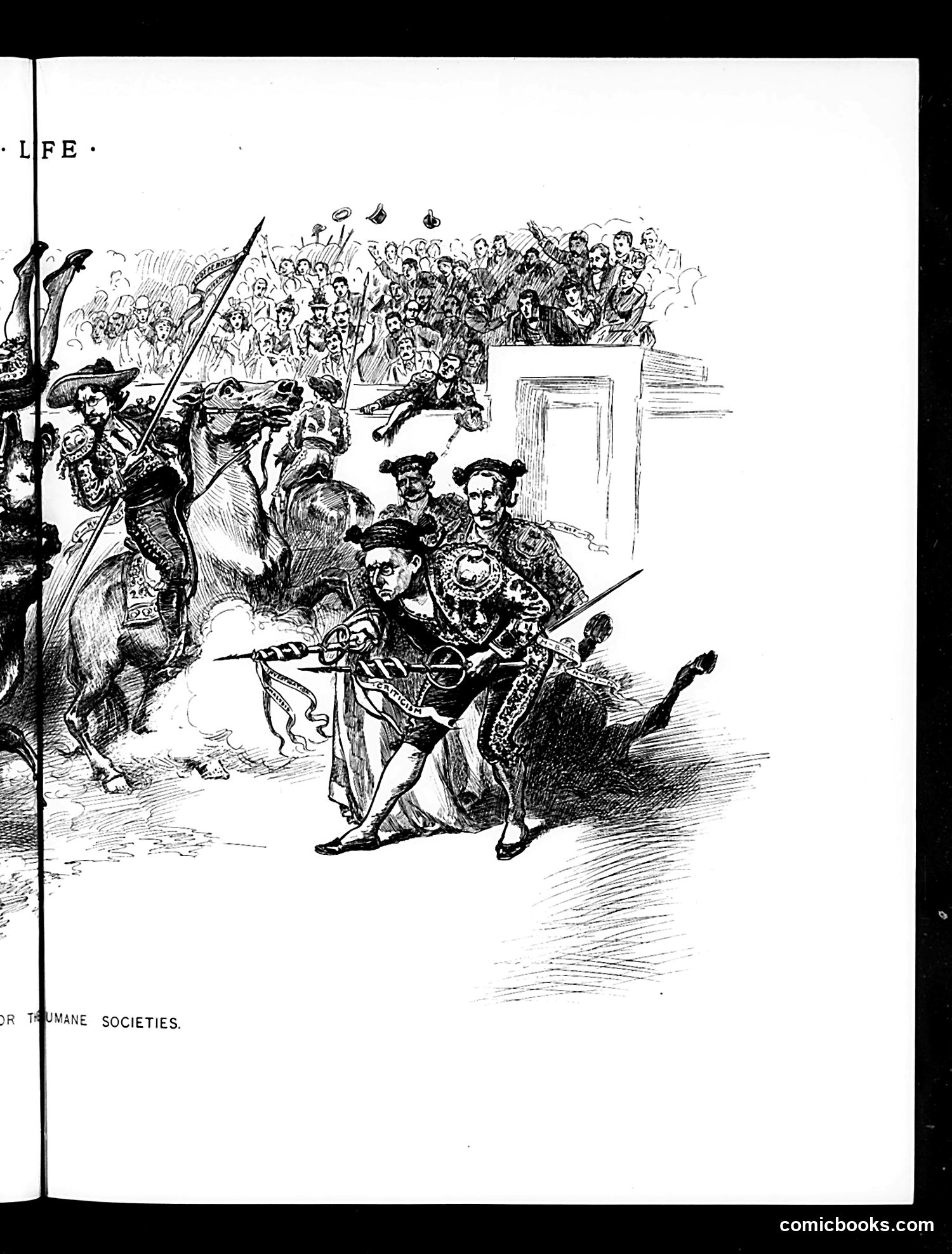
This satirical illustration from *Life* magazine depicts a military or royal procession scene. A mounted figure in ornate uniform leads elaborately dressed soldiers or officials in the foreground, while masses of common people crowd behind a barrier, watching from above. The text reference to "humane societies" (visible at bottom) suggests this cartoons satirizes the contrast between military pageantry and public welfare concerns. The crowded masses observing from their elevated perch may represent ordinary citizens relegated to spectating rather than participating in power. The elaborate dress and ceremonial nature of the foreground figures suggests mockery of governmental pomp and formality, while the cartoon critiques indifference to humanitarian issues. The specific historical reference remains unclear without additional context about *Life's* publication date.
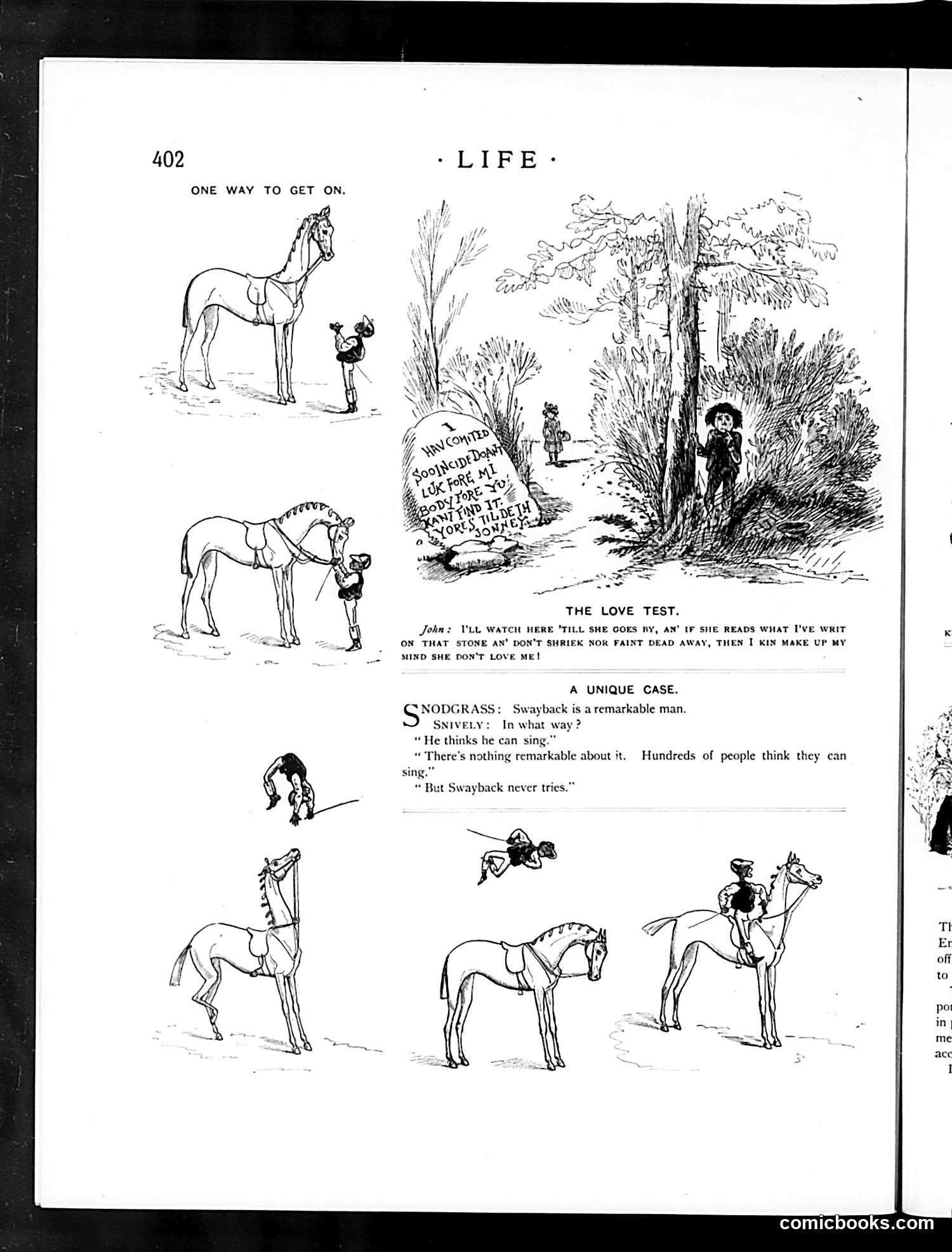
This page contains three separate humorous sketches about relationships and human nature: **"One Way to Get On"** shows a small man mounting a tall horse—a visual pun suggesting social climbing through marriage or partnership. **"The Love Test"** depicts a man leaving a love note on a stone, testing whether his beloved truly cares by observing her reaction. The joke plays on romantic insecurity and the absurdity of such "tests." **"A Unique Case"** presents a dialogue where Snodgrass claims his friend Swayback is "remarkable" because he *never* tries to sing—unlike "hundreds of people" who attempt it. The humor lies in the ironic inversion: being remarkable through *not* doing something rather than accomplishing it. All three jokes reflect early 20th-century attitudes about romance, class aspiration, and social behavior through lighthearted domestic satire.
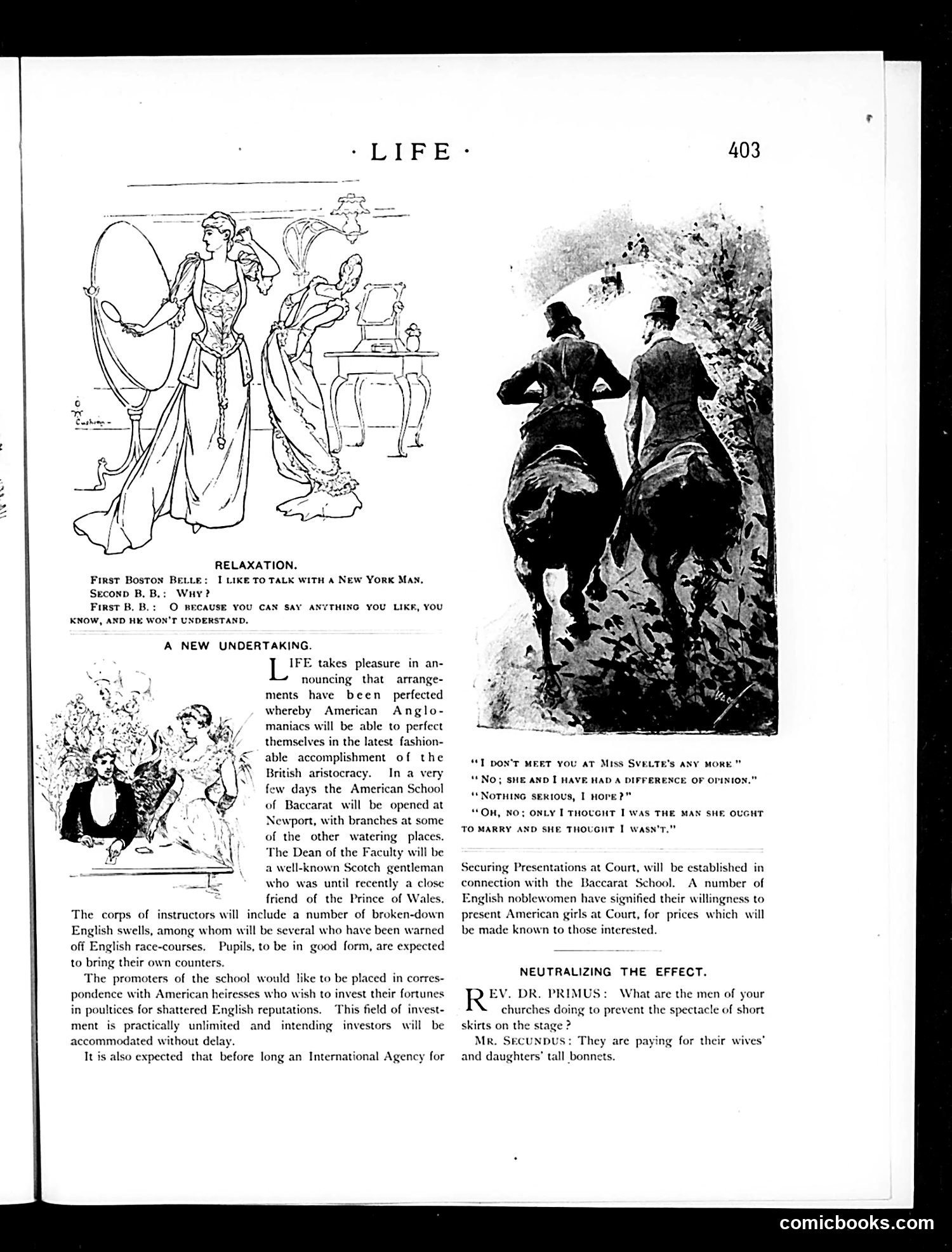
This upper-left cartoon satirizes regional stereotypes and class differences. A "First Boston Belle" claims she likes talking with a "New York Man" because "he won't understand" her—implying New Yorkers are intellectually inferior or socially oblivious compared to Boston's self-perceived cultural sophistication. The joke mocks Boston snobbery by suggesting elite Bostonians deliberately seek out company they can condescend to without being challenged. The photograph below depicts two men on horseback viewed from behind, captioned with dialogue about a woman named Miss Svelte, discussing whether she should have married one of them. The caption implies romantic rejection or uncertainty, though context is limited without additional information about the specific individuals referenced.
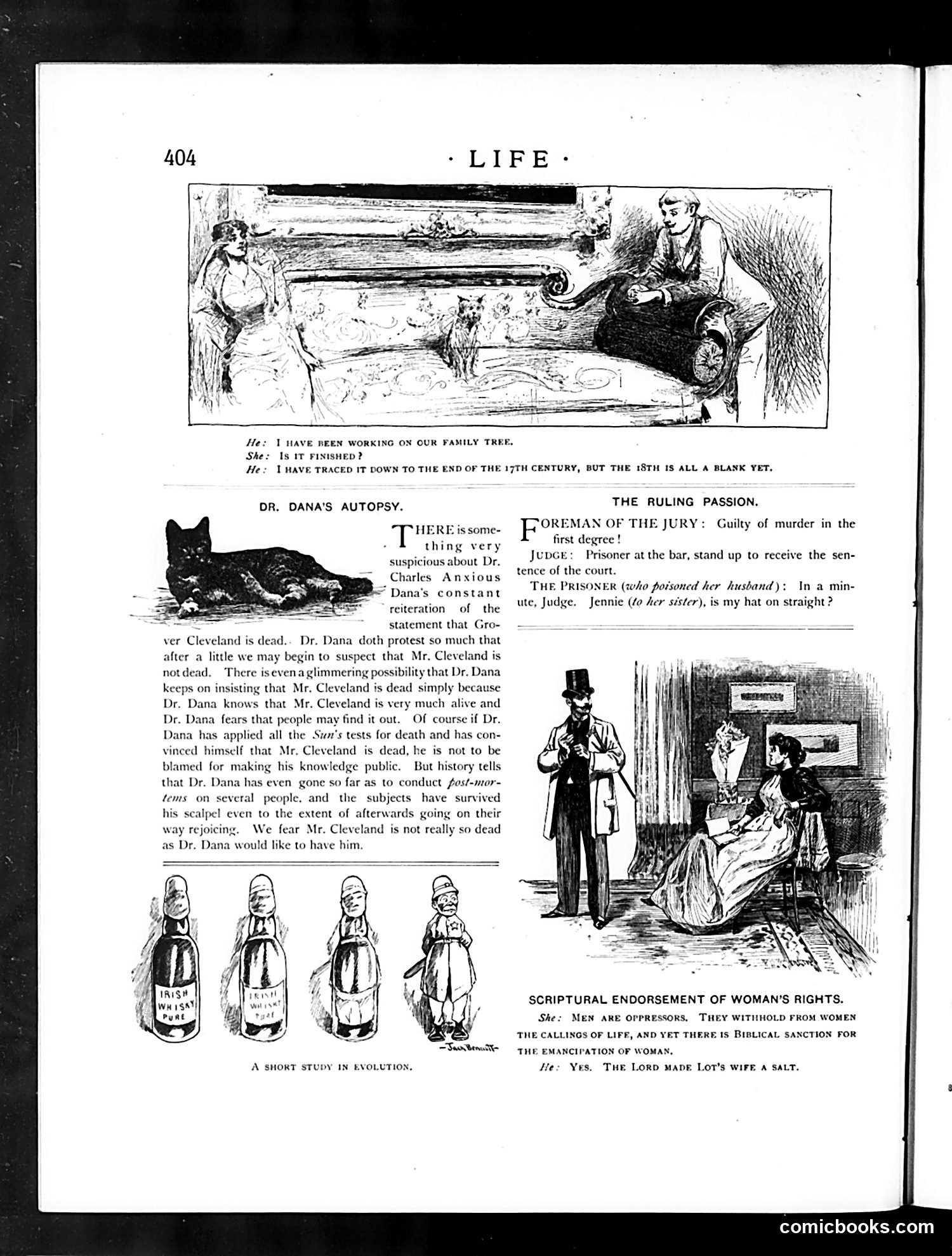
This page contains multiple Victorian-era satirical cartoons: 1. **"Family Tree"**: A couple discusses genealogy; the husband admits tracing their lineage only to the 17th century, with the 18th century "blank." This jokes about unclear or potentially shameful ancestry—a common anxiety among those claiming respectability. 2. **"The Ruling Passion"**: A woman convicted of poisoning her husband shows her priorities remain superficial, concerned with her hat's appearance rather than her dire sentence. Satire on female vanity. 3. **"Dr. Dana's Autopsy"**: References Charles Anxious Dana (likely editor of the NY Sun), mocking his repeated insistence that President Grover Cleveland is dead. The satire suggests Dana protests too much, implying Cleveland may actually be alive or the editor's credibility is suspect. 4. **"A Short Study in Evolution"**: Four bottles showing progressive stages of "evolution"—satire on Darwinian theory and human progress. 5. **"Scriptural Endorsement of Woman's Rights"**: A woman argues biblical support for women's rights; her husband counters with Lot's wife turned to salt—dark satire dismissing women's equality claims through scripture.
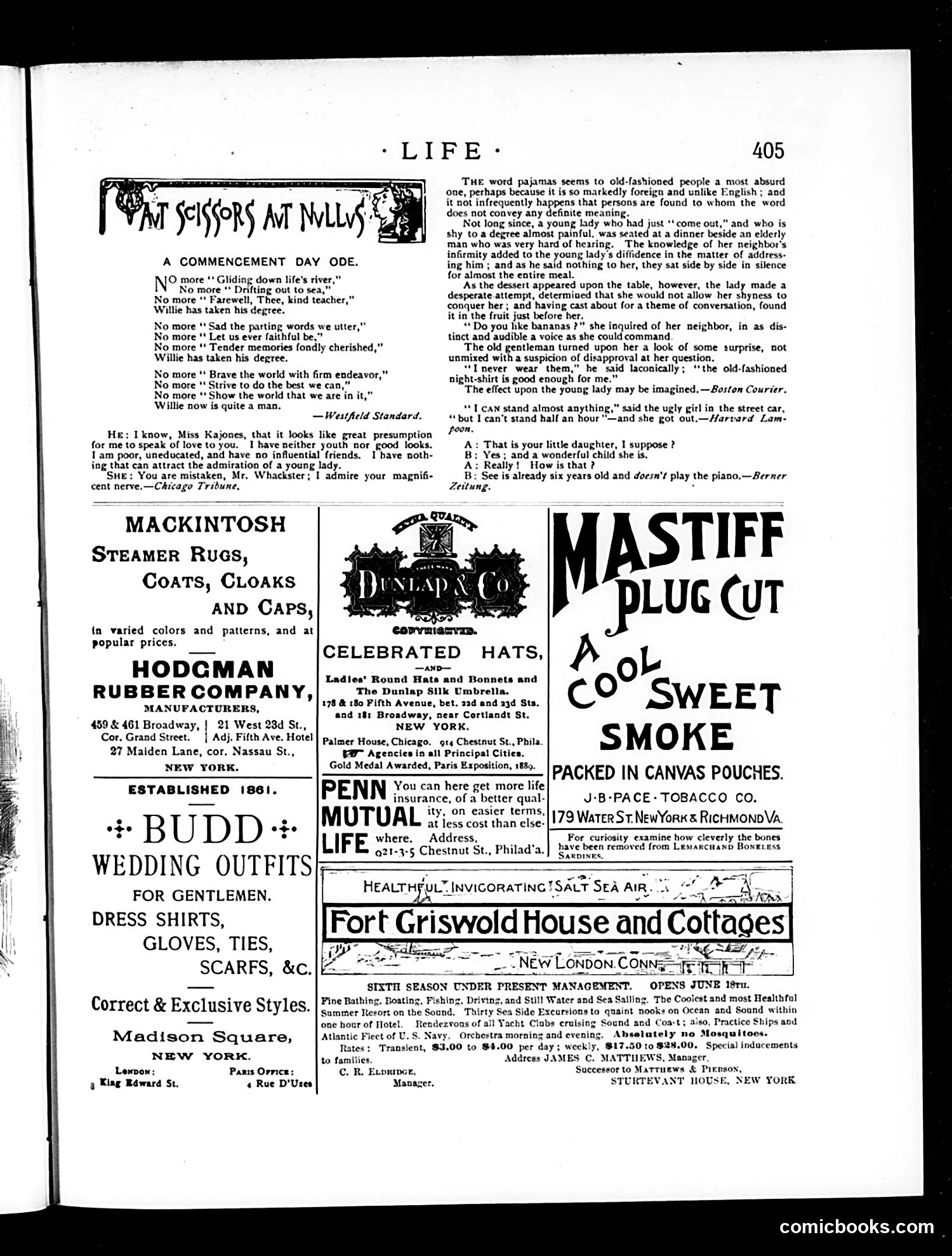
This page combines **satirical poetry and humorous anecdotes** with period advertisements. The main content consists of three jokes: 1. **"At Scissors at Nulls"** — A commencement poem mocking the sentimental clichés of graduation speeches, suggesting that once a student completes their degree, they're suddenly expected to abandon youthful idealism and become a "man." 2. **The Pajamas Anecdote** — A young debutante, attempting dinner conversation with a deaf elderly gentleman, asks if he likes bananas. He misunderstands "bananas" as "pajamas" and replies he prefers the old-fashioned nightshirt, leaving her mortified. The humor relies on the word "pajamas" being foreign and unfamiliar to older Americans. 3. **The Proposal Joke** — A poor suitor's self-deprecating confession impresses a woman not through charm but through sheer audacity. These pieces satirize **social pretension, communication failures, and generational gaps** in late Victorian America. The advertisements are period-appropriate (rubber goods, hats, insurance, tobacco).
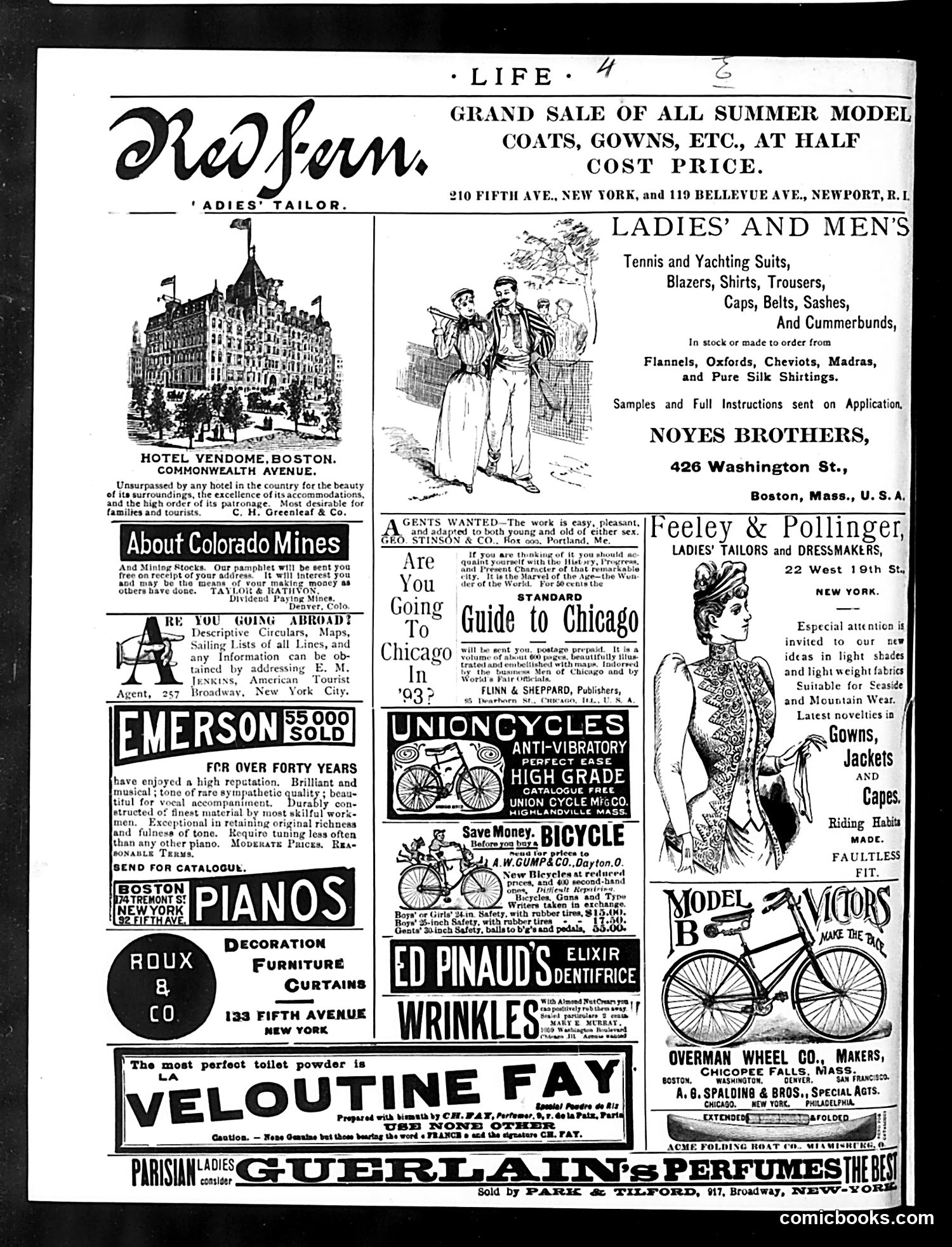
This is primarily an **advertising page** rather than editorial content or satire. It consists of numerous commercial advertisements typical of early 1900s Life magazine. Key advertisers include: - **Red Fern Ladies' Tailor** (top) — clothing sales at Fifth Avenue, New York and Newport, Rhode Island - **Hotel Vendôme, Boston** — luxury accommodations - **Emerson Pianos** — musical instruments ("55,000 sold") - **Union Cycles** and bicycle advertisements — promoting bicycles as consumer goods - **Veloutine** toilet powder and **Ed Pinaud's** dentifrice — personal care products - **Overman Wheel Company** — another bicycle manufacturer The page reflects **Gilded Age consumer culture**: luxury items (pianos, hotels, tailored clothing) marketed to wealthy readers, alongside new technologies like bicycles gaining popularity. The repeated bicycle ads suggest cycling was a fashionable leisure activity. There is **no cartoon or satirical content** visible—this is a straightforward commercial advertising section from Life's early period.
I can see this is a page from Life magazine with significant portions appearing blank or very dark, making the content difficult to discern clearly. On the left margin, there are partial text fragments visible including references to "DEL," "T. R. I," "N'S," and what appears to be partial headings or captions. The right side of the page is predominantly black/dark. At the bottom right corner, there's a small curved line drawing that might be part of a cartoon or illustration, though it's too minimal to interpret meaningfully. Without clearer visibility of the actual cartoon artwork and accompanying text, I cannot reliably identify the figures, political references, or satirical intent. The image quality and darkness prevent accurate analysis of the content's historical context or meaning.