
Life, 1891-06-25 · page 6 of 15
Life — June 25, 1891 — page 6: what you’re looking at
What you’re looking at
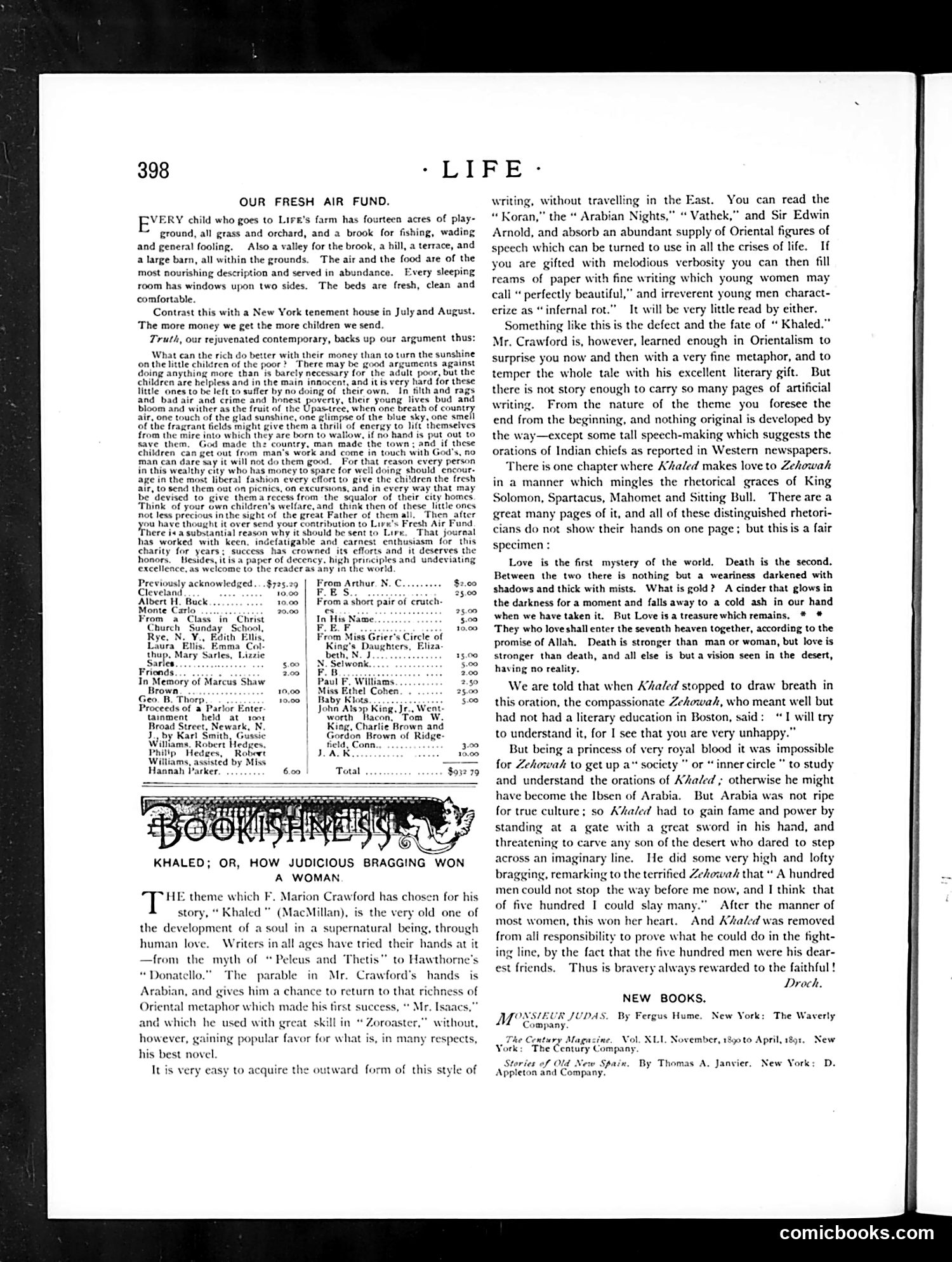
This page contains primarily book reviews and a charitable fundraising appeal for "Our Fresh Air Fund," with no political cartoons visible. The left column discusses a children's charity providing fresh air and outdoor experiences to poor urban children. It contrasts tenement living conditions with countryside benefits, arguing such programs prevent delinquency and crime. The right column reviews F. Marion Crawford's novel *Khaled*, describing it as an Oriental-themed story about a supernatural being learning human emotion through love. The reviewer notes Crawford successfully captures Eastern metaphor and rhetoric, though the plot is somewhat thin. Below is a "Bookshelf" section listing recent publications. No satirical cartoons or political commentary appear on this page—it's primarily literary and philanthropic content.
📄 Transcribed text from this page (OCR, searchable)
Machine-transcribed from the original scan — historical spelling and the odd misread are preserved.
398 OUR FRESH AIR FUND. EVERY child who goes to Lire’s farm has fourteen acres of play- ground, all grass and orchard, and a brook for fishing, wading and general fooling. Also a valley for the brook, a hill, a terrace, and a large barn, all within the grounds. The air and the food are of the most nourishing description and served in abundance. Every sleeping room has windows upon two sides. The beds are fresh, clean and comfortable. Contrast this with a New York tenement house in July and August. ‘The more money we get the more children we send. Truth, our rejuvenated contemporary, backs up our argument thus: What can the rich do better with their money than to turn the sunshine on the little children of the poor? ‘There may be good arguments against doing anything more than is barely necessary for the adult poor, but the children are helpless and in the main innocent, and it is very hard for these little ones to be left to suffer by no doing of their own. In filth and rags and bad air and crime and honest poverty, their young lives bud and bloom and wither as the fruit of the Upas-tree, when one breath of count air, one touch of the glad sunshine, one glimpse of the biue sky, one smell of the frag t give them a thrill of energy to lift themselves f to which they are born to wallow, if no hand is put out to save them. God made th: country, man made the town ; and if these children can get out from man’s work and come in touch with God's, no man can dare st not do them good. For that reason every person in this wealthy city who has money to spare for well doing should encour. age in the most liberal fashion every effort to give the children the fresh air, to send them ind in every way that may be ‘devised to give thema recess from the squalor of their city homes. Think of your own children’s welfare, and think then of these little ones not less precious inthe sight of the great Father of them all, Then af you have thought it over send your contribution to Live's Fresh Air Fu There is a substantial reason why it should be sent to Lire. That jo has worked with keen, indefatigable and earnest enthusiasm for charity for years; success has crowned its efforts and it deserves the honors. Hesides, it is a paper of decency. high principles and undeviating excellence, as welcome to the reader as any in the world. From Arthur. N. FES Be From a short pair of crutch- es In His Name’. From Miss Grier’s Circle of King's I $725.29 10.00 10,00 20.00 | Previously acknowledged. Cleveland . Albert H. Buck Monte Carlo From a Class Church jn Christ sunday School, Edith Frionds. In Memory Brown Geo. B. Thorp. Proceeds of a Parlor Enter tainment held at soo Baby . John Alsop King Jr. W worth Bacon, Tom W. Broad Street, Newark, N. King, Charlie Brown and J., by Karl Smith, Guss Gordon Brown of Ridge- ms. Robert Hedges. field, Conn. Robeet aR, Williams, assisted by Miss Hannah KHALED; OR, HOW JUDICIOUS BRAGGING WON A WOMAN HE theme which F. Marion Crawford has chosen for his story, “ Khaled ” (MacMillan), is the very old one of the development of a soul in human love. Writers in supernatural being, through 's have tried their hands at it “Peleus and Thetis” all ay —from the myth of to Hawthorne's “Donatello.” T Mr. Crawford's hands is Arabian, and gives him a chance to return to that richness of Oriental metaphor which made his tirst suc ve parable in Ir. Isaa without, however, gaining popular favor for what is, in many respects, his best novel. and which he used with great skill in“ Zoroaster, It is very easy to acquire the outward form of this style of - LIFE: writing, without travelling in the East. You can read the “Koran,” the “ Arabian Nights,” “ Vathek,” and Sir Edwin Arnold, and absorb an abundant supply of Oriental figures of speech which can be turned to use in all the crises of life. If you are gifted with melodious verbosity you can then fill reams of paper with fine writing which young women may call “ perfectly beautiful,” and irreverent young men charact- erize as “infernal rot.” It will be very little read by either. Something like this is the defect and the fate of “ Khaled. Mr, Crawford is, however, learned enough in Orientalism to surprise you now and then with a very fine metaphor, and to temper the whole tale with his excellent literary gift. But there is not story enough to carry so many pages of artificial writing. From the nature of the theme you foresee the end from the beginning, and nothing original is developed by the way—except some tall speech-making which suggests the orations of Indian chiefs as reported in Western newspapers. There is one chapter where AZaled makes love to Zehowah in a manner which mingles the rhetorical graces of King Solomon, Spartacus, Mahomet and Sitting Bull. There are a great many pages of it, and all of these distinguished rhetori- cians do not show their hands on one page; but this is a fair specimen : Love is the first mystery of the world, Death is the second. Between the two there is nothing but a weariness darkened with shadows and thick with mists. What is gold? A cinder that glows in the darkness for a moment and falls away to a cold ash in our hand when we have taken it. But Love is a treasure which remains, * * They who love shall enter the seventh heaven together, according to the promise of Allah. Death is stronger than man or woman, but love is stronger than death, and all else is but a vision seen in the desert, having no reality, We are told that when A‘a/ed stopped to draw breath in this oration, the compassionate Zehowah, who meant well but had not had a literary education in Boston, said: “I will try to understand it, for I see that you are very unhappy.” But being a princess of very royal blood it was impossible for Zehowah to get up a” society " or “ inner circle " to study and understand the orations of A’Aa/ed ; otherwise he might have become the Ibsen of Arabia. But Arabia was not ripe for true culture; so A’ha/ed had to gain fame and power by standing at a gate with a great sword in his hand, and threatening to carve any son of the desert who dared to step across an imaginary line. He did some very high and lofty bragging, remarking to the terrified Zehowah that * A hundred men could not stop the way before me now, and I think that of five hundred I could slay many.” After the manner of most women, this won her heart. And Ahaled removed from ali responsibility to prove what he could do in the fight- ing line, by the fact that the five hundred men were his dear- est friends. Thus is bravery always rewarded to the faithful ! Droch. NEW BOOKS. 'SIEUR JUDAS. By Fergus Hume, vmpany New Vork: The Waverly M _ The Century Magazine. Vol. XL1. November, 180 to April, 1891. York: The Century Company Stories of Old New Spain. Appleton and Company. New By Thomas A. Janvier. New York: D. comicbooks.com