
A complete issue · 16 pages · 1891
Life — June 18, 1891
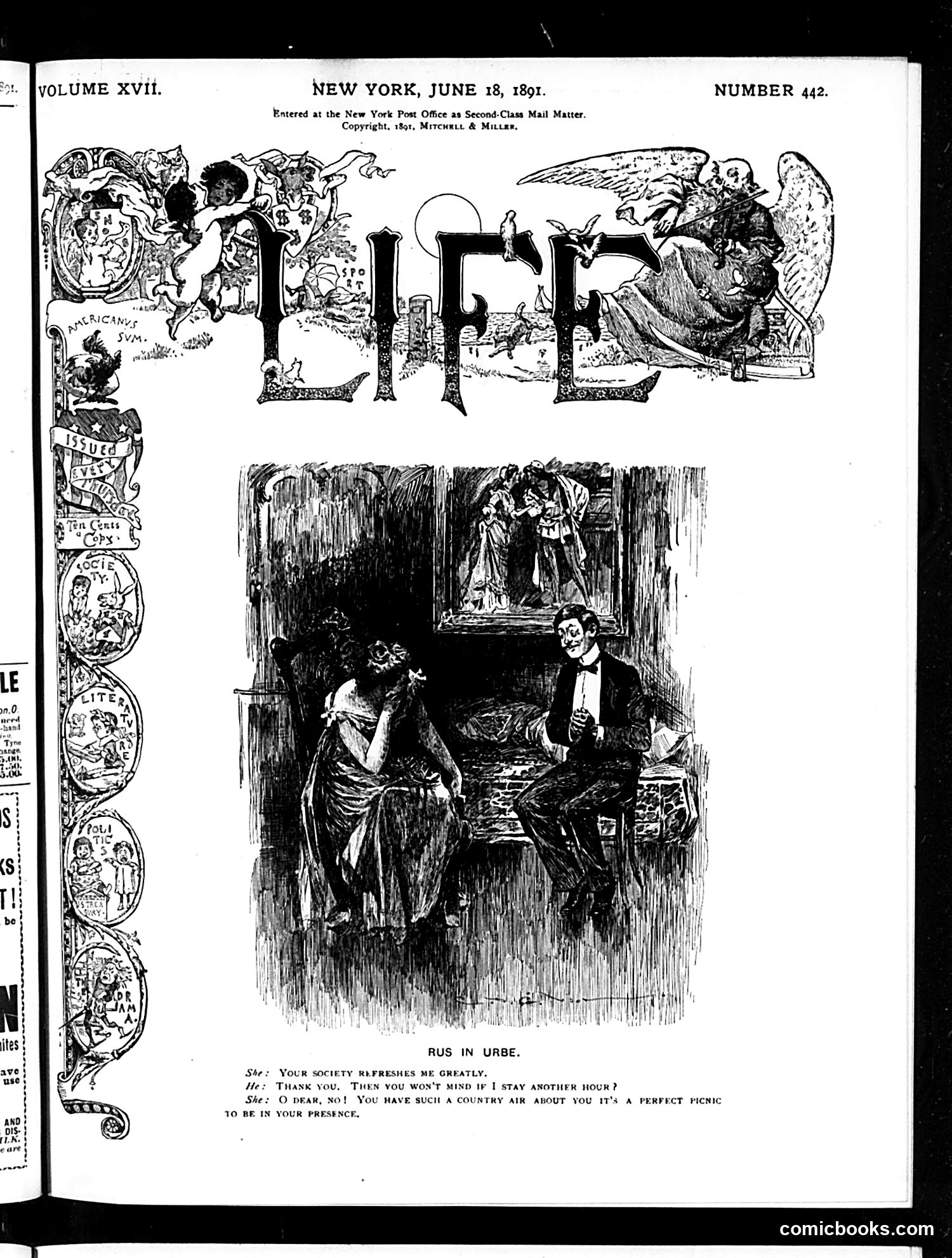
This cartoon illustrates a social comedy sketch titled "Rus in Urbe" (Latin: "country in the city"). The dialogue reveals the joke: a woman from the country thanks a city man for his company, noting his "country air," while he attributes it to her presence creating "a perfect picnic." The humor derives from a clash of manners—the rural visitor genuinely compliments what she perceives as his rustic, wholesome quality, while the urbane gentleman interprets her compliment as flirtation, responding gallantly but somewhat disingenuously. The satirical point targets both rural naïveté and city sophistication, poking fun at how each group misreads the other's social cues and intentions.
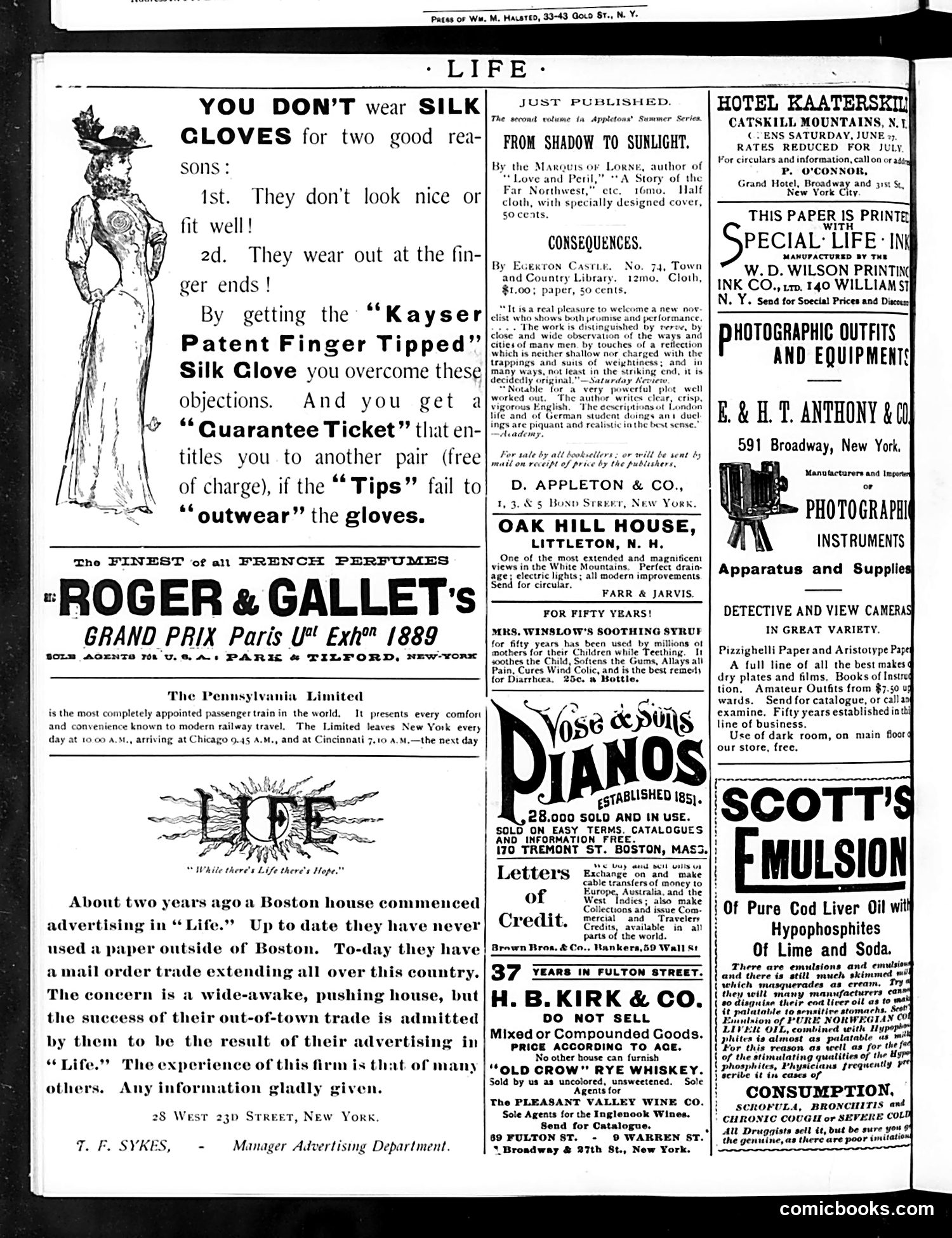
This page is **primarily advertising** with minimal editorial content. The main cartoon occupies the left side and depicts a fashionably dressed woman in an elaborate gown and hat, illustrating an advertisement for "Kayser Patent Finger Tipped" silk gloves. The satire is straightforward product marketing: the ad humorously lists two reasons NOT to wear silk gloves (poor appearance, wear at fingertips), then positions Kayser's product as the solution. The "Guarantee Ticket" promising a free replacement pair if the tips fail represents early consumer protection marketing. The rest of the page contains advertisements for perfume, trains, pianos, photographic equipment, and patent medicines—typical of Life magazine's revenue model rather than satirical commentary.
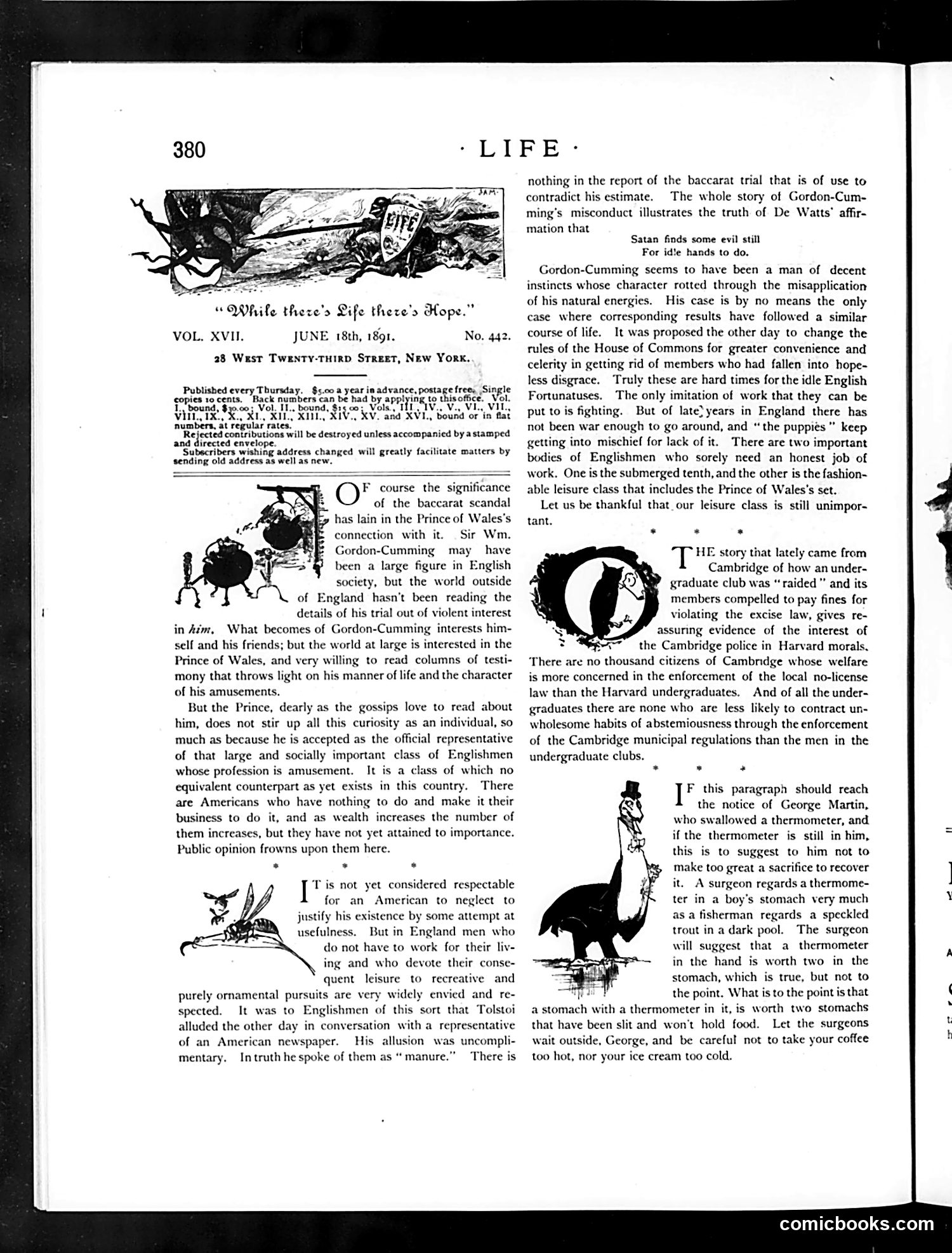
This page satirizes the Prince of Wales (later King Edward VII) and English high society's fascination with scandal. The text criticizes how the English public obsesses over the Prince's involvement in the baccarat gambling scandal, while being indifferent to more serious social issues affecting working-class English people. The cartoons mock American attitudes toward leisure and propriety. One depicts an ostrich, likely symbolizing willful ignorance or avoidance of serious matters. Another illustration shows a figure swallowing a thermometer—satirizing absurd aristocratic pursuits and the frivolous concerns of wealthy leisure classes compared to genuine social problems. The piece argues that England's upper classes remain preoccupied with entertainment and scandal rather than addressing legitimate social concerns.
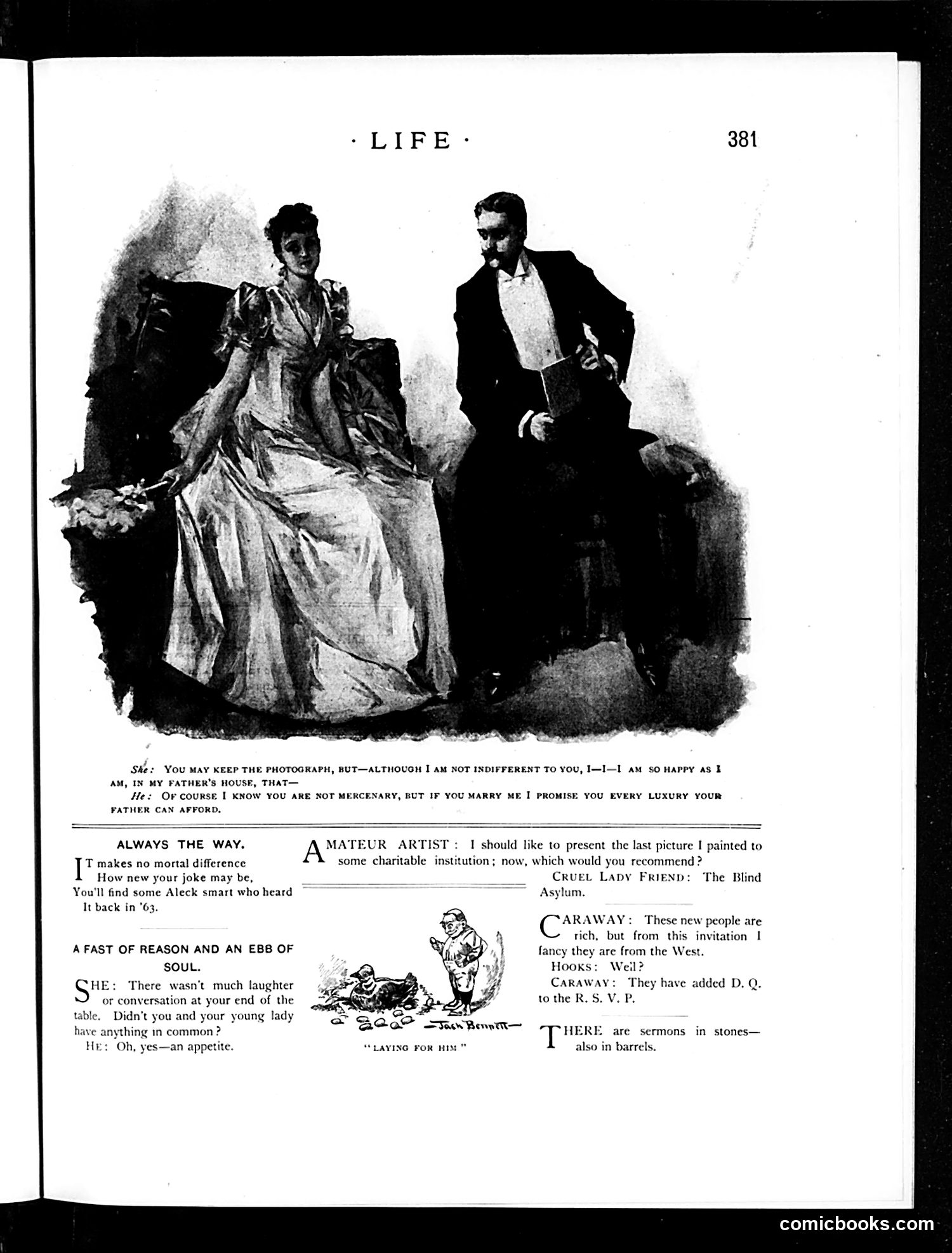
The top illustration depicts a romantic scene between a woman and man in formal attire, likely from a serialized story or satirical narrative about courtship and marriage prospects. The three shorter joke sections below appear to be typical magazine humor: - "Always the Way" mocks the predictability of romantic disappointment - "A Fast of Reason and an Ebb of Soul" humorously depicts a couple's depleted conversation after dining together - The remaining sections contain brief witticisms about art patronage, wealthy "new people" from the West, and charitable institutions Without identifying specific individuals, these represent typical early 20th-century satirical commentary on upper-class social pretension, marriage conventions, and the behavior of newly wealthy Americans—themes common to Life magazine's satirical approach during this period.
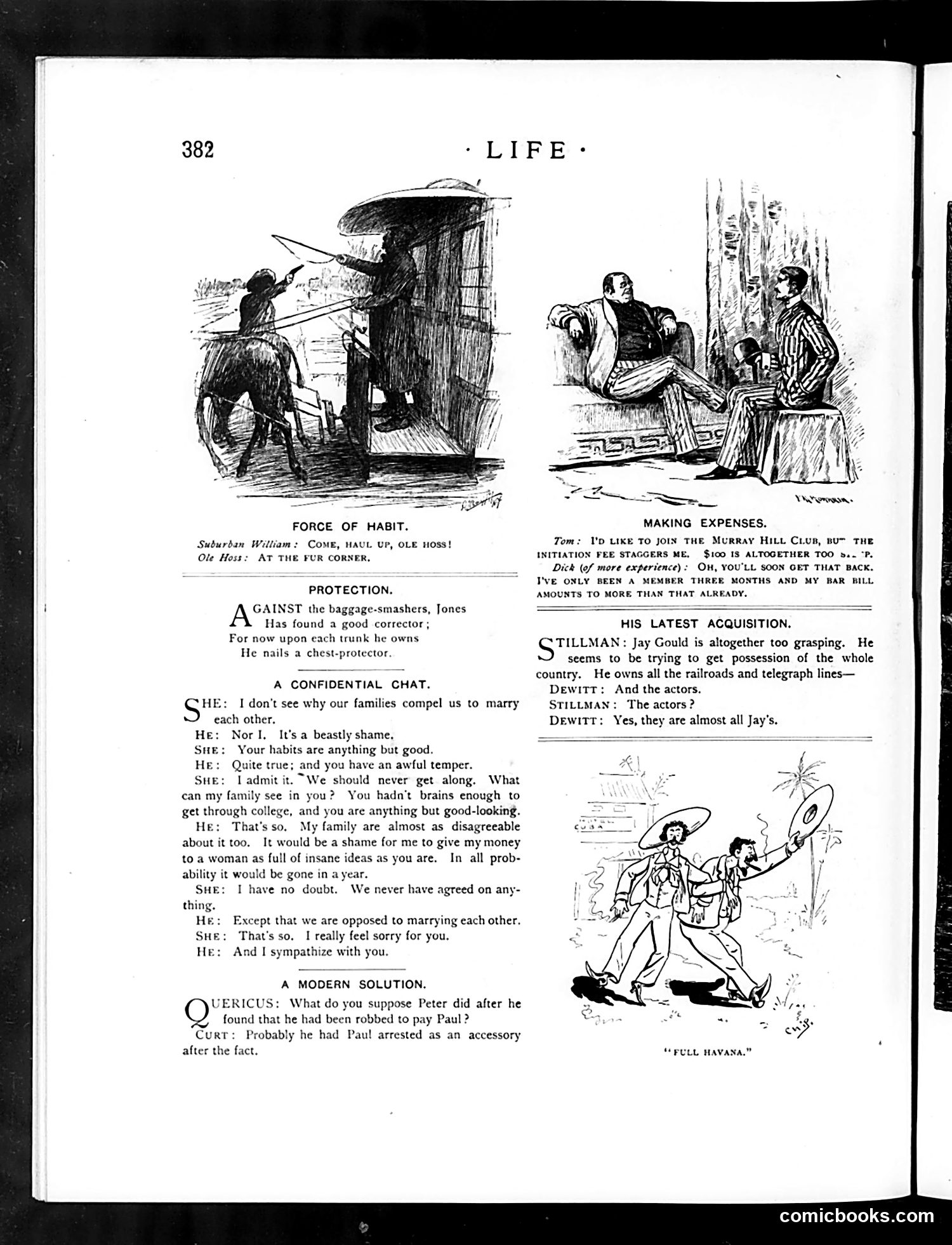
This page contains several short satirical pieces typical of early-to-mid 20th century Life magazine humor: **"Force of Habit"** and **"Making Expenses"** are captioned cartoon vignettes mocking working-class and social-climbing behavior—the first about habitual bar patronage, the second about club membership costs. **"Protection"** jokes about a man installing a "chest protector" against muggers, playing on urban crime anxieties. **"A Confidential Chat"** satirizes marital discord, with husband and wife exchanging bitter complaints about each other's worthlessness. **"His Latest Acquisition"** mocks wealthy businessman Jay Gould's greed and monopolistic control. **"A Modern Solution"** presents wordplay about legal consequences. The **"Full Havana"** cartoon depicts slapstick physical comedy. These reflect period concerns: crime, class anxiety, marital strain, and wealthy industrialists' power.
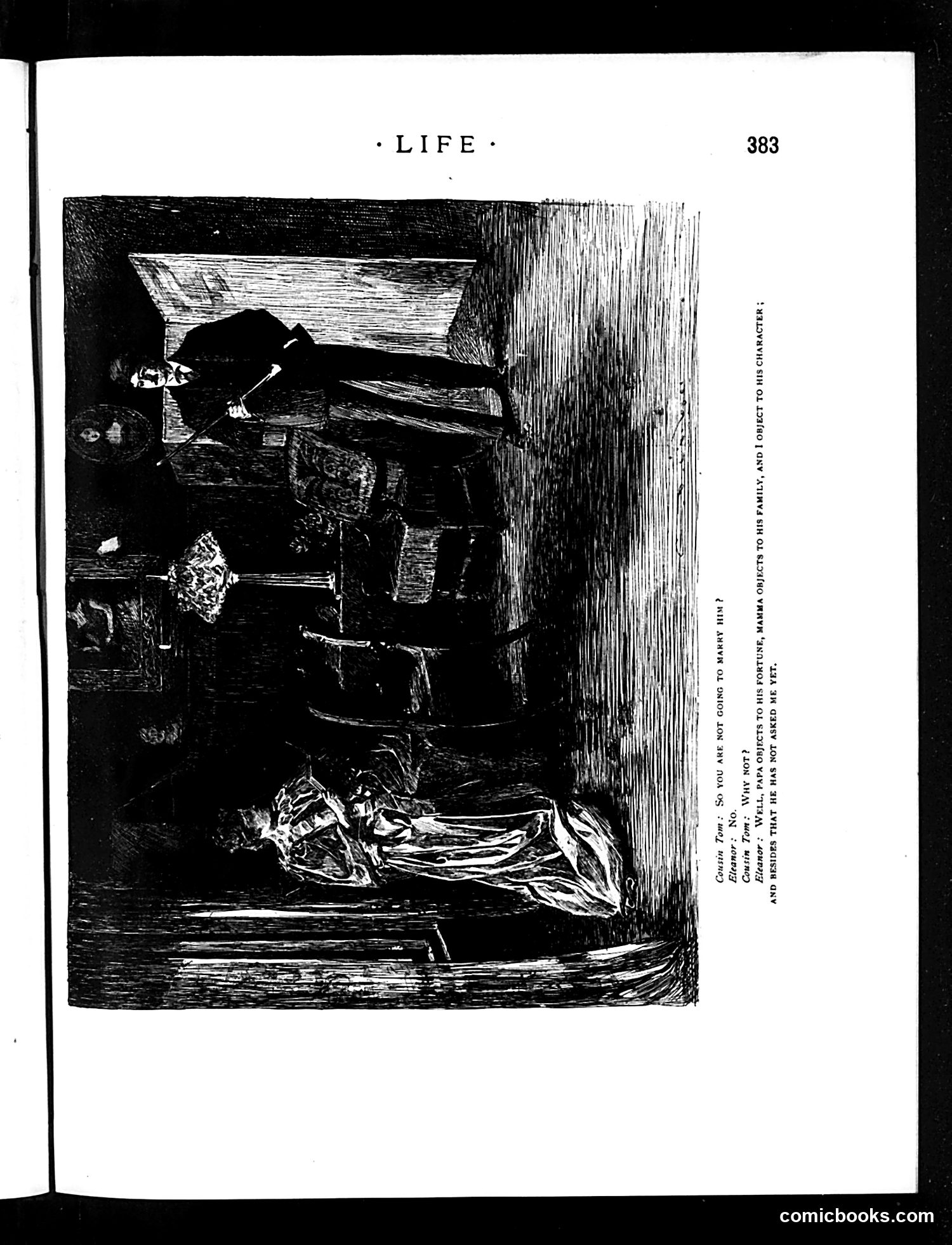
I can see this is page 383 from Life magazine featuring a dark, expressionist etching or engraving. The image depicts a reclining figure in what appears to be an interior domestic setting, rendered in stark black and white with heavy cross-hatching. However, the OCR text provided is incomplete—it only shows page number and publication title without the actual caption or article text that would explain the cartoon's subject and satirical meaning. Without the accompanying text identifying the figures, historical context, or the point of the satire, I cannot reliably explain what political or social commentary this illustration intends to convey to a modern reader. The artistic style suggests early-to-mid 20th century work, but the specific reference remains unclear from the image alone.
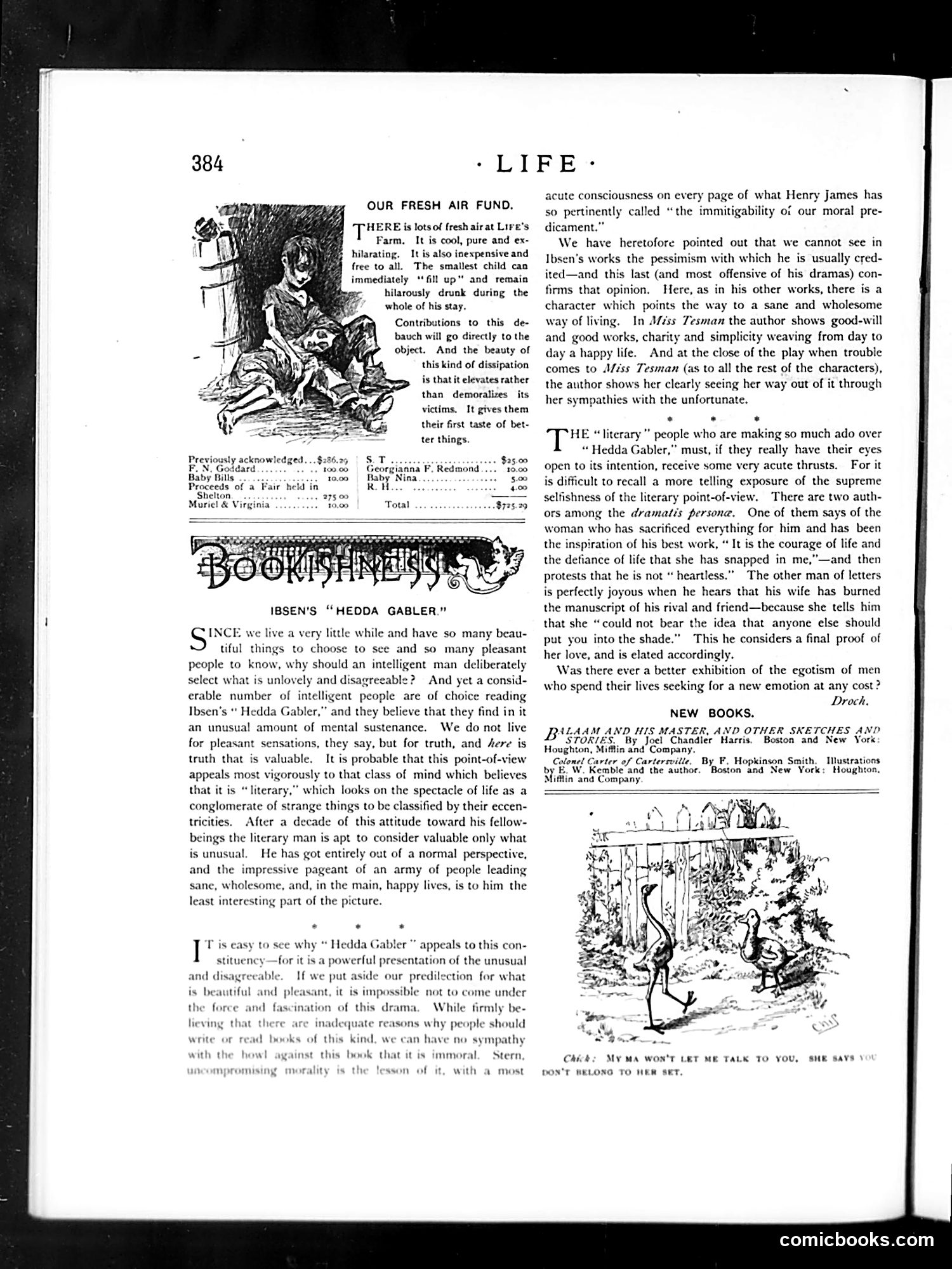
This page primarily contains **book reviews and literary criticism**, not political cartoons. The main illustrated content discusses Ibsen's play "Hedda Gabler," arguing that intellectually sophisticated readers should appreciate its dark examination of human selfishness and moral compromise. The small illustrations are **theatrical sketches** accompanying the review—showing scenes from the play rather than political satire. One depicts a woman being told "My Ma won't let me talk to you, she says I don't belong to her set," illustrating the social constraints and class divisions central to the drama. The page also advertises "Ballaam and His Master" and other new books. The "Fresh Air Fund" box at top left requests contributions for children's welfare—a genuine charitable appeal, not satire.
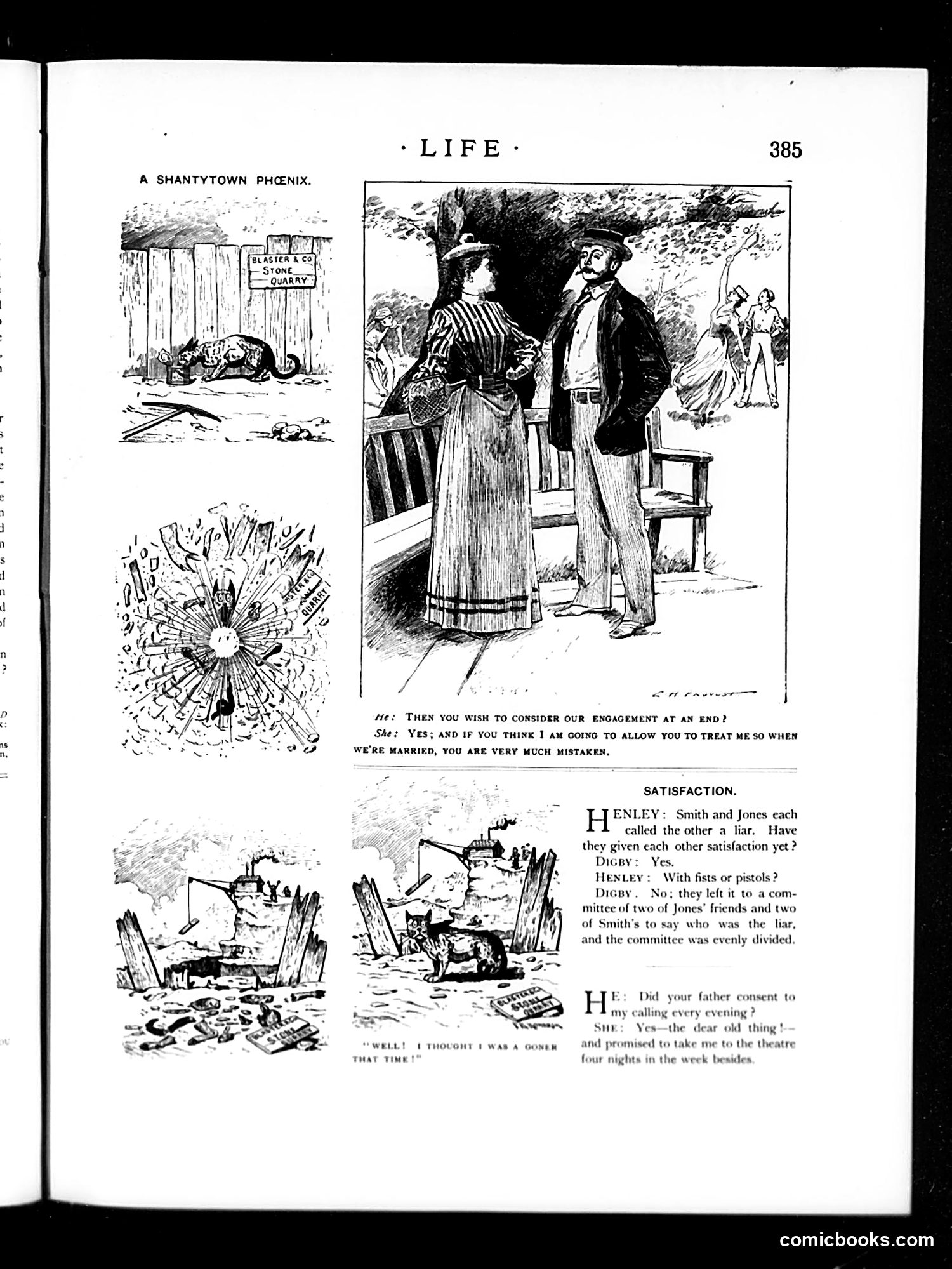
This page contains three satirical cartoons about courtship and marriage disputes: 1. **"A Shantytown Phoenix"** (top left): Shows a dilapidated shack, playing on the phoenix metaphor—likely satirizing how poor neighborhoods persistently "rise again" despite deterioration. 2. **Main cartoon** (top right): Depicts a couple in conflict over engagement. The woman declares she won't tolerate poor treatment if married, suggesting anxieties about marital power dynamics and women's agency in relationships—a social commentary on courtship expectations. 3. **"Satisfaction"** (bottom): A comic dialogue about settling disputes between Smith and Jones through a committee, which deadlocks. The humor mocks formal dispute-resolution processes as ineffective. 4. **"Well! I Thought I Was a Goose That Time!"** (bottom): Shows destruction, likely satirizing foolishness or miscalculation. These cartoons humorously critique relationship conflicts and dispute resolution.
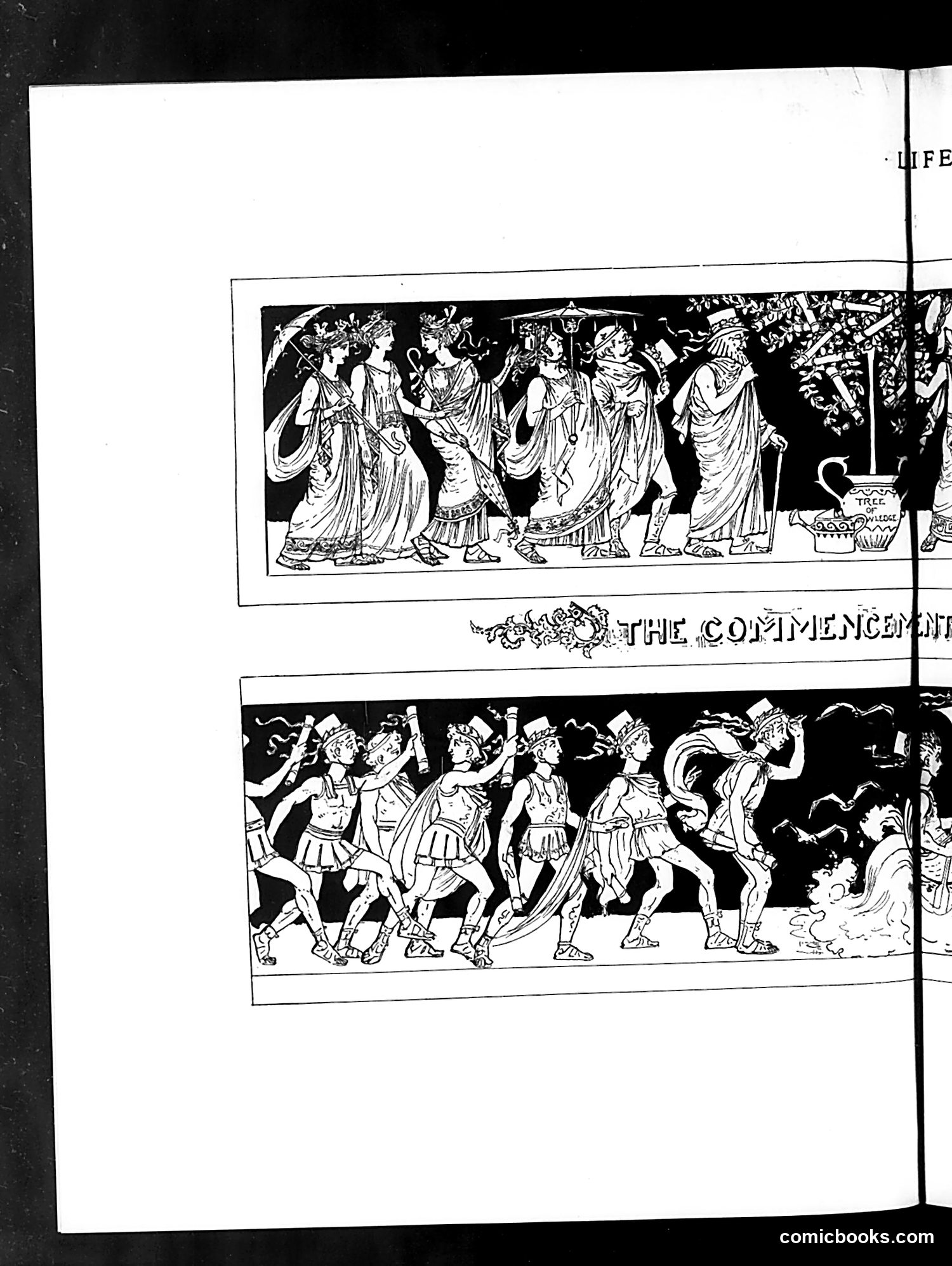
This page shows two classical-style illustrations titled "THE COMMENCEMENT" (visible text between the panels). The top panel depicts robed female figures in classical dress, appearing dignified and ceremonial. The bottom panel shows male figures in Roman or Greek military armor, in dynamic poses suggesting marching or movement. The satire likely contrasts classical ideals of wisdom and peace (represented by the draped female figures) with martial aggression (the armed male soldiers). The "commencement" title suggests a beginning or inauguration. Without the full article text, the exact political reference is unclear, but this appears to critique militarism or warn against choosing warfare over more peaceful, civilized governance—a common Life magazine theme during periods of international tension.
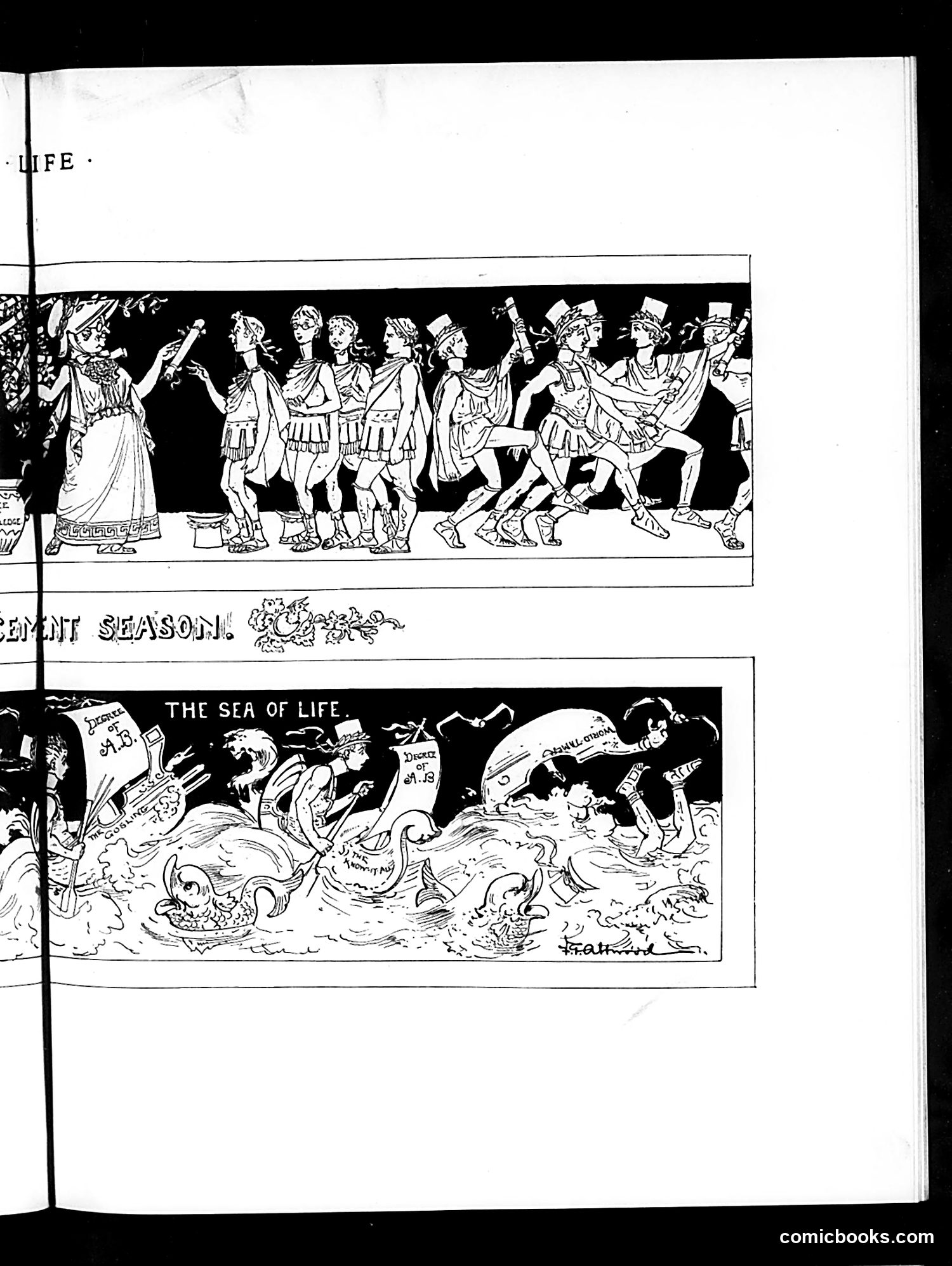
This page from *Life* magazine contains two satirical cartoons about seasons and social life. The top cartoon, titled "ANCIENT SEASON," depicts a classical Roman or Greek procession of soldiers, officials, and citizens in period dress, likely satirizing how society's seasonal social calendar repeats cyclically with predictable military or civic ceremonies. The bottom cartoon, "THE SEA OF LIFE," uses metaphorical imagery showing figures navigating turbulent waters filled with sea creatures and obstacles. This appears to be satirizing life's unpredictable challenges and dangers—the "sea" serving as a metaphor for life's difficulties that people must navigate. The figures clutching various items suggest they're struggling to survive or maintain their position amid chaos. Both cartoons employ historical and natural imagery to comment on human society and experience.
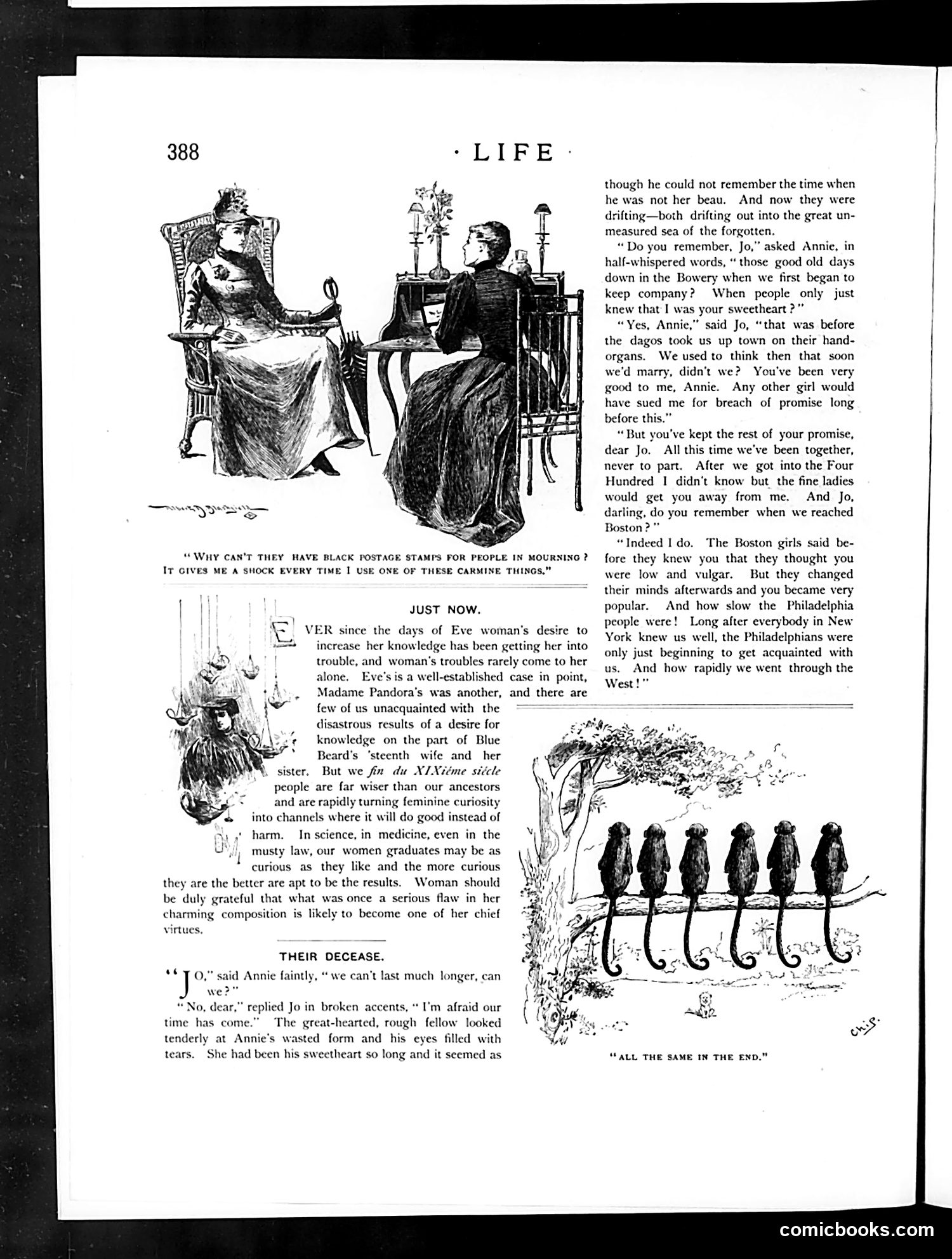
This page contains a romantic narrative with period illustrations and social commentary. The main story depicts an aging couple, Jo and Annie, reminiscing about their long courtship from New York's Bowery through social ascent to Boston and Philadelphia society. The text satirizes how their social status improved as they moved through different cities—initially dismissed as "low and vulgar" in Boston, they eventually became "very popular." The top cartoon mocks the impracticality of black postage stamps for mourning, a minor consumer complaint. The "Just Now" essay discusses how women's intellectual curiosity, historically problematic (referencing Eve and Bluebeard's wife), is now being productively channeled into science, medicine, and law. The final illustration—six monkeys on a branch titled "All the Same in the End"—darkly suggests that despite social pretensions and achievement, all creatures (humans included) ultimately face the same fate: death.
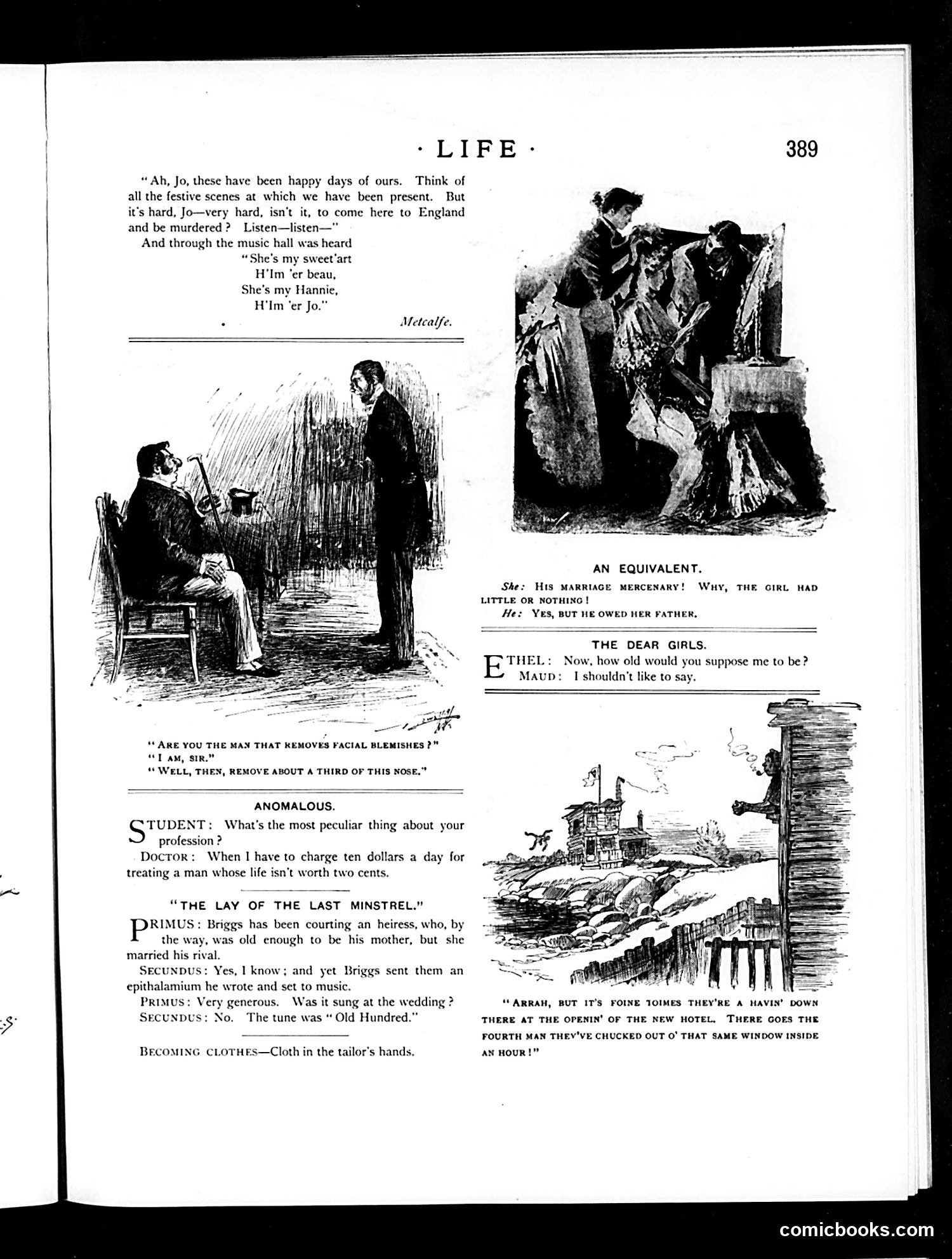
This page contains multiple short satirical jokes and sketches typical of Life magazine's humor format: **Top section**: A theatrical reference—appears to parody the musical hall song "She's My Girl," with characters lamenting having to come to England and face danger ("be murdered"). **Facial blemishes joke**: A dermatologist joke about removing a patient's nose, playing on the crude appearance of noses. **Anomalous profession**: Dark humor about a doctor charging high fees to treat patients whose lives have little value. **The Lay of the Last Minstrel**: A joke about Briggs courting an older heiress who marries his rival instead. Briggs sends them a congratulatory poem ("epithalamium") set to the tune "Old Hundred"—a somber, slow hymn—making the "gift" mockingly inappropriate. **Other brief jokes** include marriage being mercenary, age guessing, and Irish dialect humor about a hotel where men are being thrown out windows. The humor relies on wordplay, social observations, and absurdist scenarios rather than political commentary.
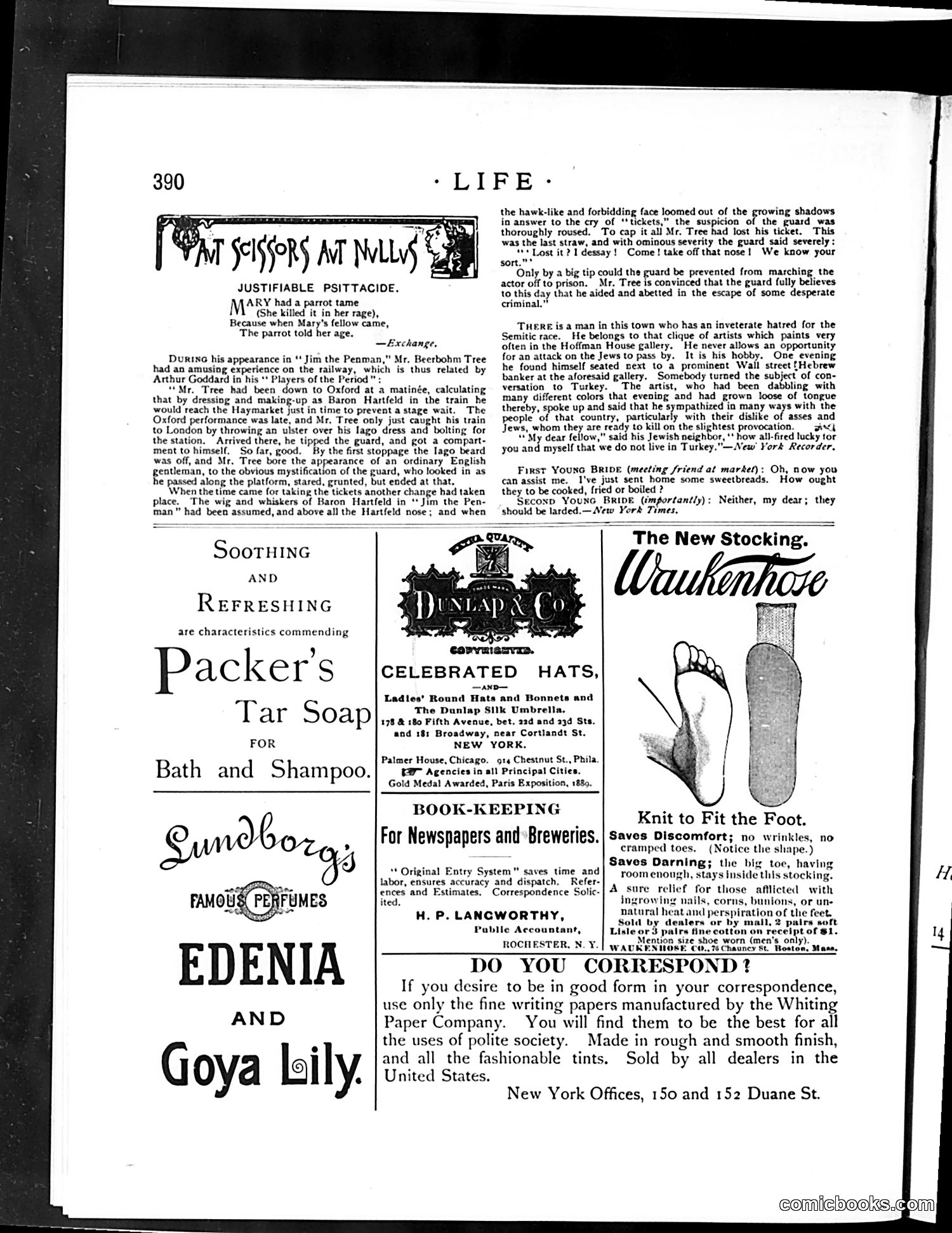
This page from *Life* magazine contains two satirical anecdotes and period advertisements. **"Justifiable Petticide"** is a joke about a woman killing her parrot because it revealed her age to her suitor—the humor lies in the vanity of hiding one's age and the parrot's inconvenient honesty. **The Beerbohm Tree anecdote** recounts actor Tree's misadventure when a railway guard becomes suspicious of a man repeatedly changing appearance (removing and donning theatrical makeup and costumes). The guard suspects criminal activity, not theatrical preparation—satirizing how ordinary people misinterpret eccentric behavior. **The antisemitic anecdote** presents a conversation where an artist expresses prejudice against Jews and Turks to a Jewish banker. The banker's witty reply—suggesting the artist should be grateful *not* to live in Turkey (implying the artist would face the same prejudice)—uses irony to mock the artist's bigotry. The page is otherwise filled with period advertisements for soaps, perfumes, hats, and business services, typical of early 20th-century magazines.
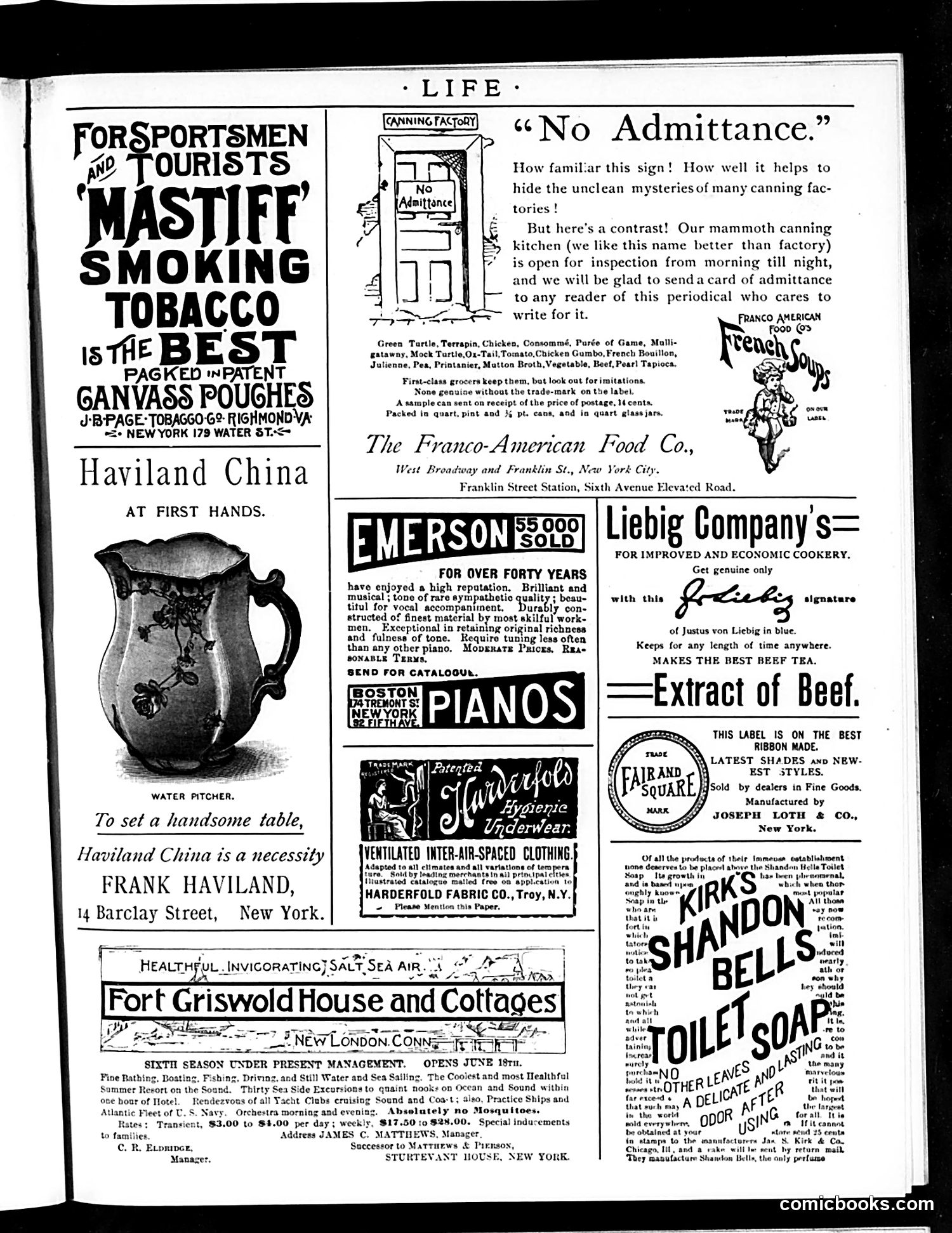
This page is primarily **advertisements** rather than editorial cartoons. The content reflects turn-of-the-century consumer goods marketing (likely 1890s-1900s based on style). The one satirical element is the Franco-American Food Company's "No Admittance" section. It mocks canning factories of the era by contrasting their secretive operations—"No Admittance" signs hiding "unclean mysteries"—with Franco-American's claim of transparent operations. This references **real public concern about food safety and hygiene in industrial canning facilities**, a legitimate anxiety before modern food regulation. The company offers factory tours and admittance cards to readers, positioning themselves as transparent and trustworthy compared to competitors shrouding their processes in secrecy. This was a genuine marketing strategy addressing consumer skepticism about processed foods. The remaining ads promote Mastiff tobacco, Haviland china, pianos, beef extract, undergarments, and resort cottages—standard period advertising with no apparent satirical intent.
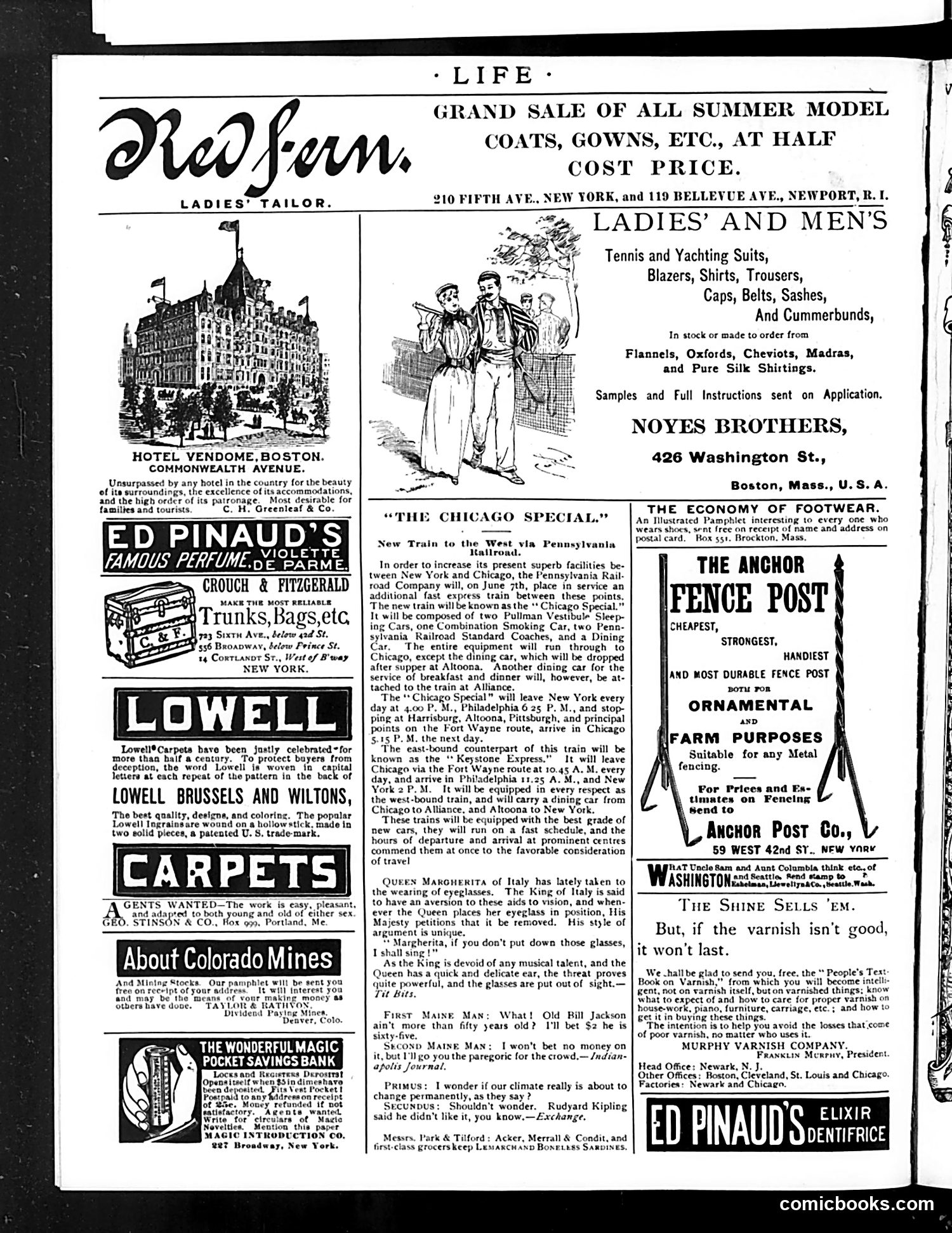
This page is primarily **advertising**, not satire or political commentary. It's a collection of commercial advertisements from what appears to be an early 20th-century issue of *Life* magazine. The content includes ads for: - Red Stern ladies' tailoring (summer coat sale) - Ed Pinaud's perfume - Crouch & Fitzgerald luggage - Lowell Carpets - Noyes Brothers (clothing) - The Pennsylvania Railroad's new "Chicago Special" train service - The Anchor Fence Post company - Various other products and services The only non-advertisement content is a small dialogue joke at bottom-right about Queen Margherita of Italy and eyeglasses, and a Rudyard Kipling quote about climate. This is essentially a magazine page designed to generate revenue through paid advertisements rather than deliver satirical content or political commentary. The various ads target upper-middle-class consumers interested in travel, fashion, and home goods.