
Life, 1891-06-18 · page 8 of 16
Life — June 18, 1891 — page 8: what you’re looking at
What you’re looking at
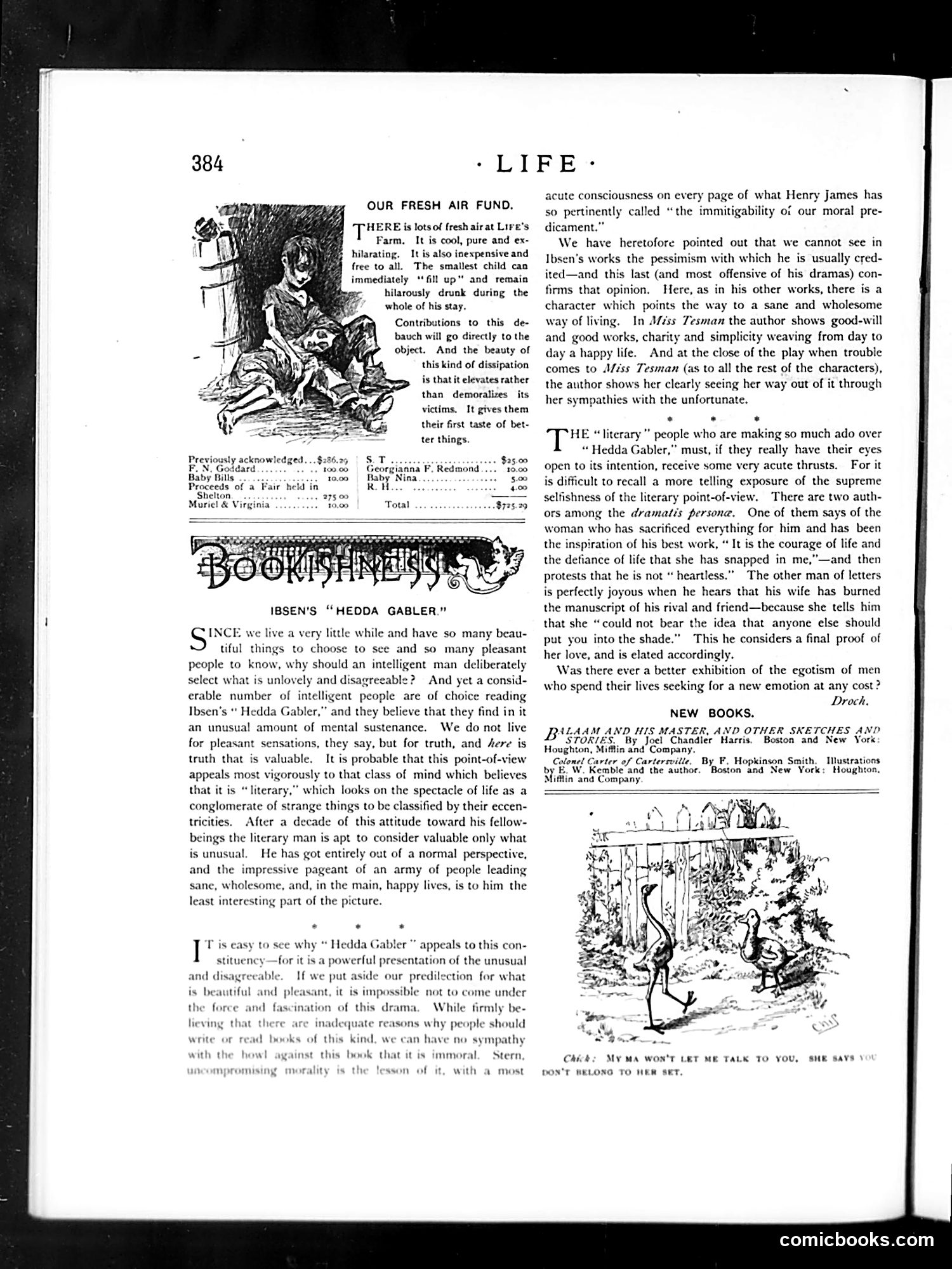
This page primarily contains **book reviews and literary criticism**, not political cartoons. The main illustrated content discusses Ibsen's play "Hedda Gabler," arguing that intellectually sophisticated readers should appreciate its dark examination of human selfishness and moral compromise. The small illustrations are **theatrical sketches** accompanying the review—showing scenes from the play rather than political satire. One depicts a woman being told "My Ma won't let me talk to you, she says I don't belong to her set," illustrating the social constraints and class divisions central to the drama. The page also advertises "Ballaam and His Master" and other new books. The "Fresh Air Fund" box at top left requests contributions for children's welfare—a genuine charitable appeal, not satire.
📄 Transcribed text from this page (OCR, searchable)
Machine-transcribed from the original scan — historical spelling and the odd misread are preserved.
- LIFE: OUR FRESH AIR FUND. HERE is lotsof fresh airat Live's Farm. It is cool, pure and ex- hilarating. It is also inexpensive and free to all. The smallest child can immediately ‘fill up" and remain hilarously drunk during the whole of his stay. Contributions to this de- object. And the beauty of this kind of dissipation is that it elevates rather than demoralizes its victims. It gives them their first taste of bet- ter things. + $25.00 10.00 3.00 Previously acknowledged. ..$2 F.N, Goddard 100 00 Baby Bills ..... 2. 10.00 Proceeds of a Fair held ‘in Shelton. 3 + 27300 Muriel & Vir Georgiana F. Redmond... Baby Nina . RH. IBSEN’S “‘HEDDA GABLER.” we live a very little while and have so many beau- tiful things to choose to and so many pleasant people to know, why should an intelligent man deliberately select what is unlovely and disagreeable? And yet a consid- erable number of intelligent people are of choice reading Ibsen's ** Hedda Gabler,” and they believe that they find in it an unusual amount of mental sustenance. We do not live for pleasant sensations, they say, but for truth, and Aere is truth that is valuable. It is probable that this point-of-view appeals most vigorously to that class of mind which believes that it is “literary,” which looks on the spectacle of life as a conglomerate of strange things to be classified by their eccen- tricities. After a decade of this attitude toward his fellow- beings the literary man is apt to consider valuable only what He has got entirely out of a normal perspective, and the impressive pageant of an army of people leading 's, is to him the is unusual. sane, wholesome, and, in the main, happy | least interesting part of the picture. I s easy to see why “ Hedda Gabler ” appeals to this con- stituency—for it is a powerful presentation of the unusual and disagreeable. If we put aside our predilection for what is beautiful and pleasant, it is impossible not to come under While firmly be- inadequate reasons why people should and fascination of this drama the force M4 this kind, we can have rk that it is sympathy mmoral, Stern vorality with a most acute consciousness on every page of what Henry James has so pertinently called “the immitigability of our moral pre- dicament.” We have heretofore pointed out that we cannot see in Ibsen's works the pessimism with which he is usually cred- ited—and this last (and most offensive of his dramas) con- firms that opinion. Here, as in his other works, there is a character which points the way to a sane and wholesome way of living. In A/’ss Tesman the author shows good-will and good works, charity and simplicity weaving from day to day a happy life. And at the close of the play when trouble comes to J/iss Tesman (as to all the rest of the characters), the author shows her clearly seeing her way out of it through ympathies with the unfortunate. . . . HE “literary” people who are making so much ado over * Hedda Gabler,” must, if they really have their eyes open to its intention, receive some very acute thrusts. For it is difficult to recall a more telling exposure of the supreme selfishness of the literary point-of-view. There are two auth- ors among the dramatis persone. One of them says of the woman who has sacrificed everything for him and has been the inspiration of his best work, “ It is the courage of life and the defiance of life that she has snapped in me,"—and then protests that he is not “ heartless.” The other man of letters is perfectly joyous when he hears that his wife has burned the manuscript of his rival and friend—because she tells him that she “could not bear the idea that anyone else should put you into the shade.” This he considers a final proof of her love, and is elated accordingly. Was there ever a better exhibition of the egotism of men who spend their lives seeking for a new emotion at any cost ? Droch. her s NEW BOOKS. BALAAM AND HIS MASTER, AND OTHER SKETCHES AND STORIES. By Joel Chandler Harris, Boston and New York Houghton, Mifflin and Company. Colonel Carter of Carterville, By F. Hopkinson Smith by E. W. Kemble and the author. Boston and New York: Mifflin and Com Mlustrations Houghton. (a MY MA WON'T Ler Me LONG TO HER SET TALK TO YOU, SHE SAYS comicbooks.com