
Life, 1891-06-18 · page 12 of 16
Life — June 18, 1891 — page 12: what you’re looking at
What you’re looking at
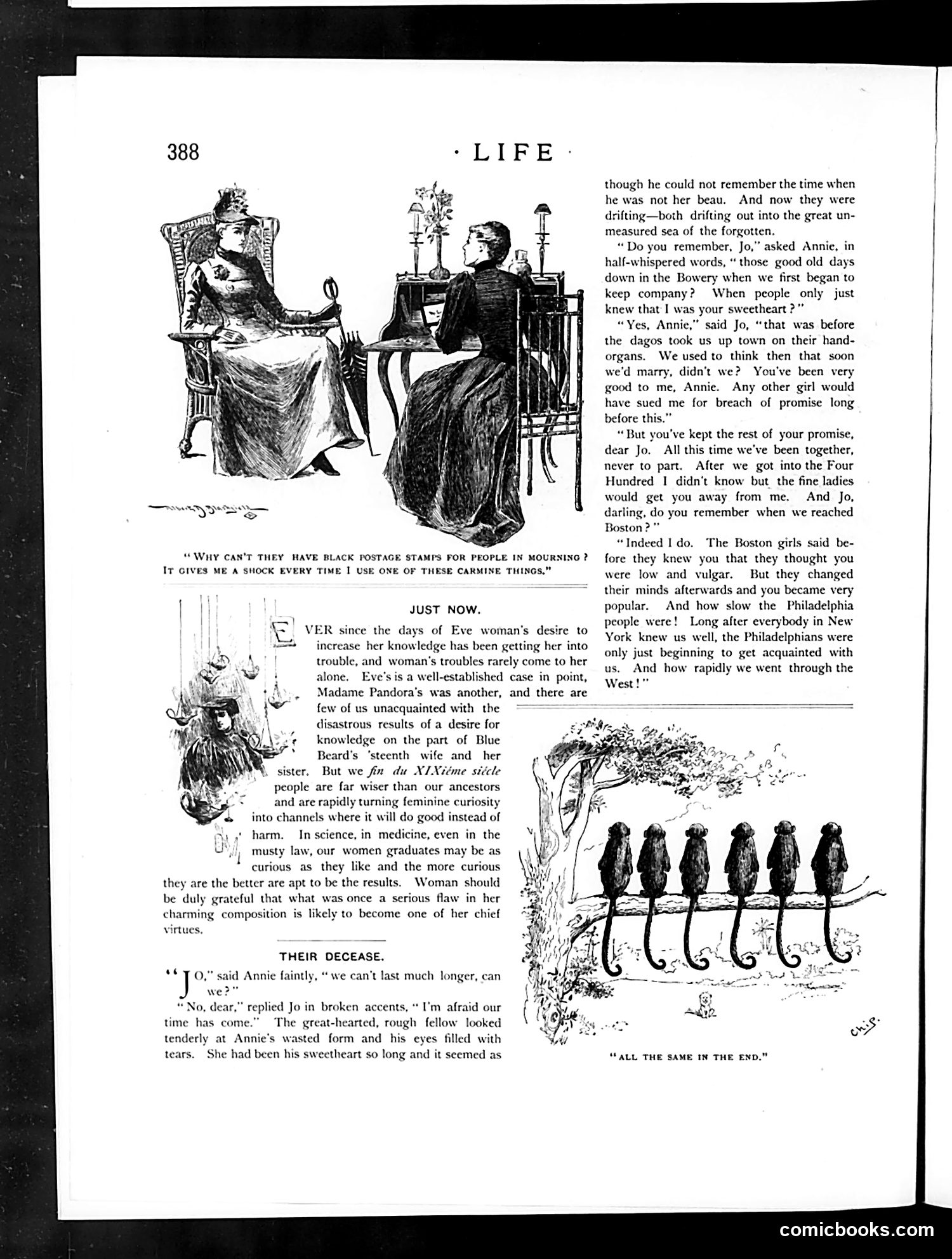
This page contains a romantic narrative with period illustrations and social commentary. The main story depicts an aging couple, Jo and Annie, reminiscing about their long courtship from New York's Bowery through social ascent to Boston and Philadelphia society. The text satirizes how their social status improved as they moved through different cities—initially dismissed as "low and vulgar" in Boston, they eventually became "very popular." The top cartoon mocks the impracticality of black postage stamps for mourning, a minor consumer complaint. The "Just Now" essay discusses how women's intellectual curiosity, historically problematic (referencing Eve and Bluebeard's wife), is now being productively channeled into science, medicine, and law. The final illustration—six monkeys on a branch titled "All the Same in the End"—darkly suggests that despite social pretensions and achievement, all creatures (humans included) ultimately face the same fate: death.
📄 Transcribed text from this page (OCR, searchable)
Machine-transcribed from the original scan — historical spelling and the odd misread are preserved.
though he could not remember the time when he was not her beau. And now they were drifting—both drifting out into the great un- measured sea of the forgotten. “Do you remember, Jo,” asked Annie, in half-whispered words, “ those good old days down in the Bowery when we first began to keep company? When people only just knew that I was your sweetheart ?” “Yes, Annie,” said Jo, “that was before the dagos took us up town on their hand- organs. We used to think then that soon we'd marry, didn't we? You've been very good to me, Annie. Any other girl would have sued me for breach of promise long before this.” “But you've kept the rest of your promise, dear Jo. All this time we've been together, never to part. After we got into the Four Hundred I didn’t know but the fine ladies would get you away from me. And Jo, darling, do you remember when we reached Boston?” “Indeed | do. The Boston girls said be- “WHY CAN'T THEY HAVE BLACK POSTAGE STAMPS POR PEOPLE IN MOURNING? fore they knew you that they thought you IT GIVES ME A SHOCK EVERY TIME I USE ONE OF THESE CARMINE THINGS,” were low and vulgar. But they changed their minds afterwards and you became very JUST NOW. popular. And how slow the Philadelphia =e > A people were! Long after everybody in New AE, VER since the days of Eve woman's desire to YOR RAS. OnF a Philadelphians aa increase her knowledge has been getting her into only just beginning to get acquainted with trouble, and woman's troubles rarely come to her . ih fr age has 3 @ ‘ : us. And how rapidly we went through the alone. Eve's is a well-established case in point, West!" Madame Pandora's was another, and there are we few of us unacquainted with the disastrous results of a desire for Gra knowledge on the part of Blue Beard’s ‘steenth wife and her sister. But we fin du X/Xréme stécle people are far wiser than our ancestors and are rapidly turning feminine curiosity into channels where it will do good instead of harm. In science, in medicine, even in the musty law, our women graduates may be as curious as they like and the more curious they are the better are apt to be the results. Woman should be duly grateful that what was once a serious flaw in her charming composition is likely to become one of her chief virtues. RAE THEIR DECEASE. . ‘J O,” said Annie faintly, “ we can’t last much longer, can we?” “No, dear,” replied Jo in broken accents, “I'm afraid our time has come.” The great-hearted, rough fellow looked tenderly at Annie's wasted form and his eyes filled with tears. She had been his sweetheart so long and it seemed as “ALL THE SAME IN THE END.” comicbooks.com