
A complete issue · 14 pages · 1891
Life — May 14, 1891
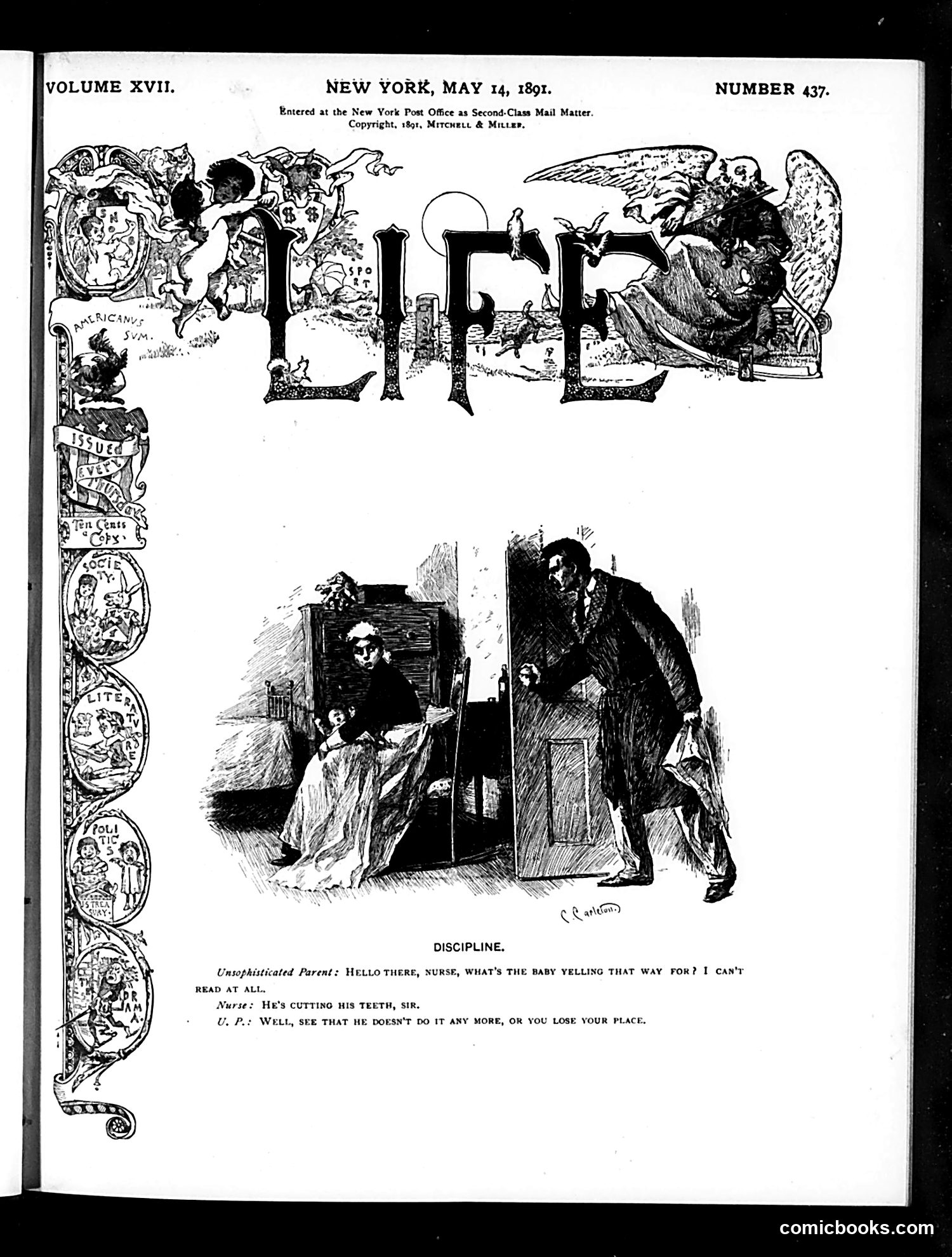
This cartoon satirizes parenting and childcare standards of the era. An unsophisticated parent complains to a nurse that he cannot understand why a baby is crying. The nurse responds that the child is "cutting his teeth," and threatens the parent with job loss if he allows the baby to continue the behavior. The satire targets two things: (1) the parent's complete ignorance of basic child development, and (2) the strict, almost punitive approach to infant care—suggesting the nurse would rather suppress the baby's natural teething discomfort than tolerate it. The joke mocks both parental incompetence and the era's harsh attitudes toward children, presenting discipline as absurdly rigid even for infants.
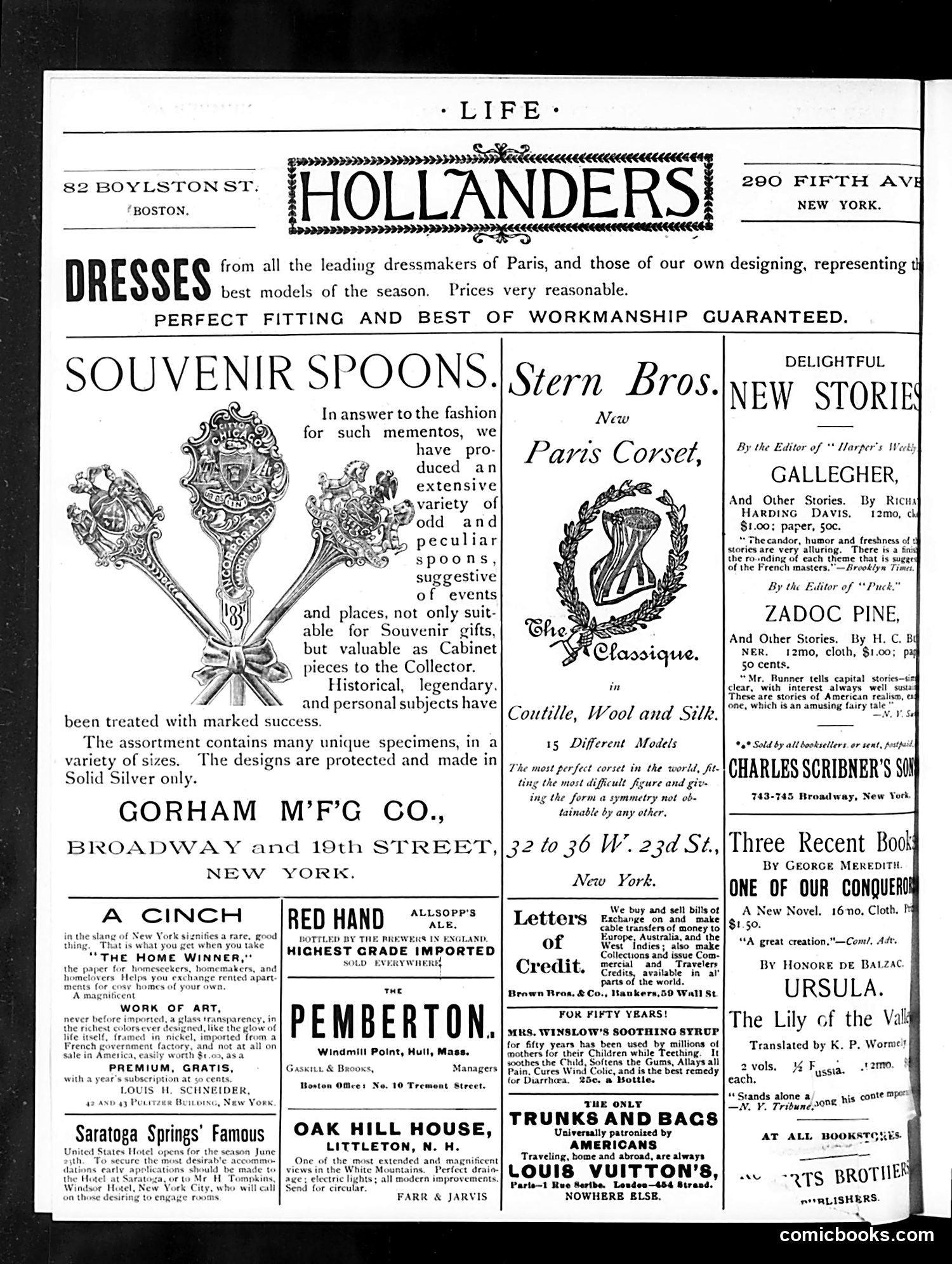
This page is **primarily advertising**, not satirical content. It contains no political cartoons or caricatures requiring historical context. The advertisements promote various products and services typical of the era: Hollanders dresses from Paris, Stern Bros. corsets, souvenir spoons, books from Charles Scribner's Sons, Red Hand ale, The Pemberton hotel, Saratoga Springs resort, Oak Hill House, trunks and bags, and other commercial goods. The only potentially humorous element is "A Cinch" advertisement, which uses wordplay—"cinch" meaning something easy—to promote home builders. The ad's humor is straightforward and requires no historical knowledge to understand. This appears to be a standard magazine page mixing editorial space with paid advertisements.
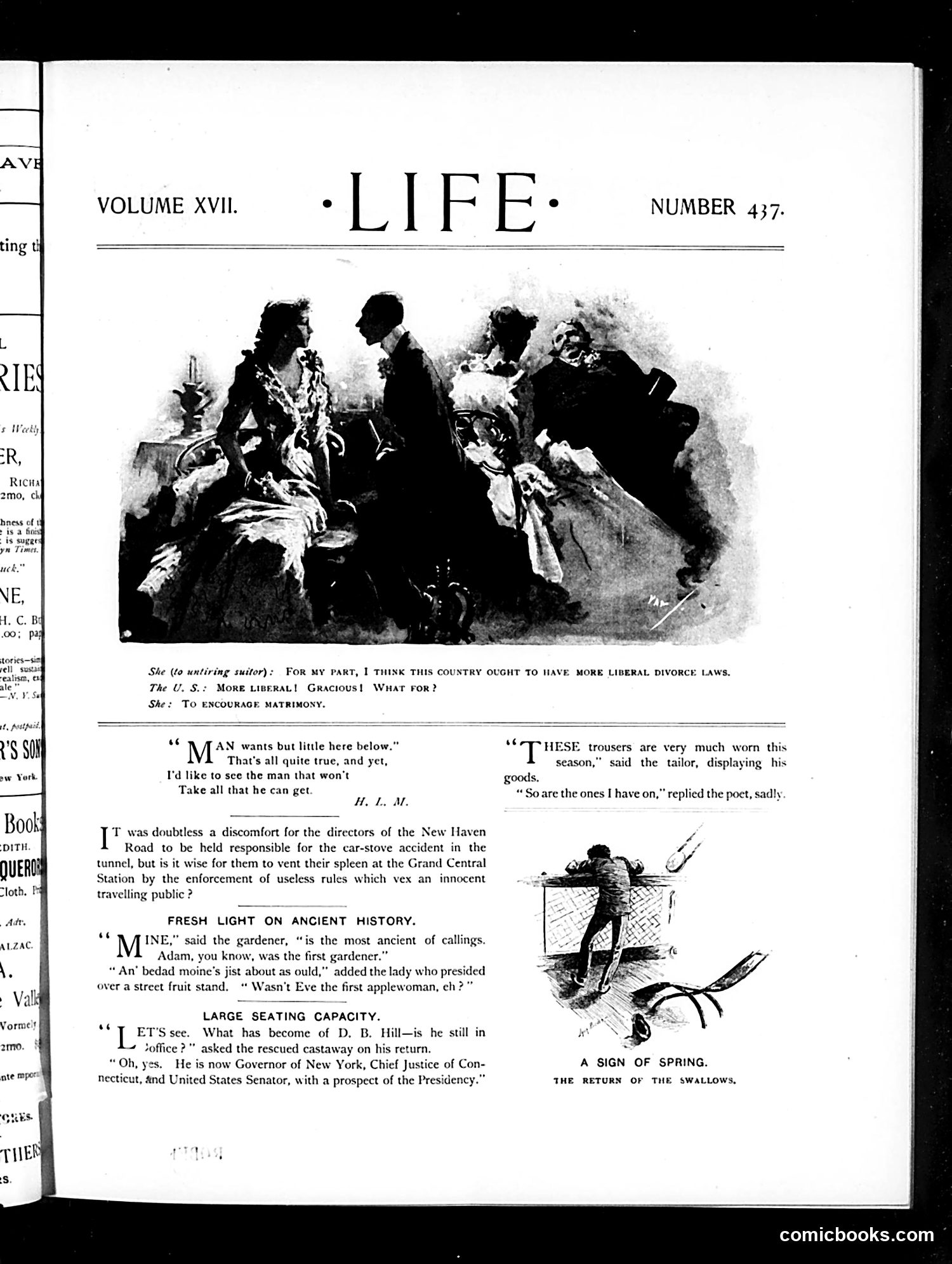
The main cartoon depicts a social scene where a woman advocates for "more liberal divorce laws" to a man, who responds by encouraging "matrimony." This satirizes turn-of-century debates about marriage and divorce reform—the woman's position represented progressive views seeking easier dissolution of marriage, while the man's rebuttal humorously defends traditional matrimony. Below are brief humorous items: a poem about men wanting little in life, a comment on New Haven Road's car-stove accident, a gardening joke playing on Eve as the "first gardener," and a note about D.B. Hill becoming Governor of New York. The illustration labeled "A Sign of Spring" shows swallows returning—a traditional spring marker. The page reflects contemporary social commentary on marriage reform and contemporary political/social developments.
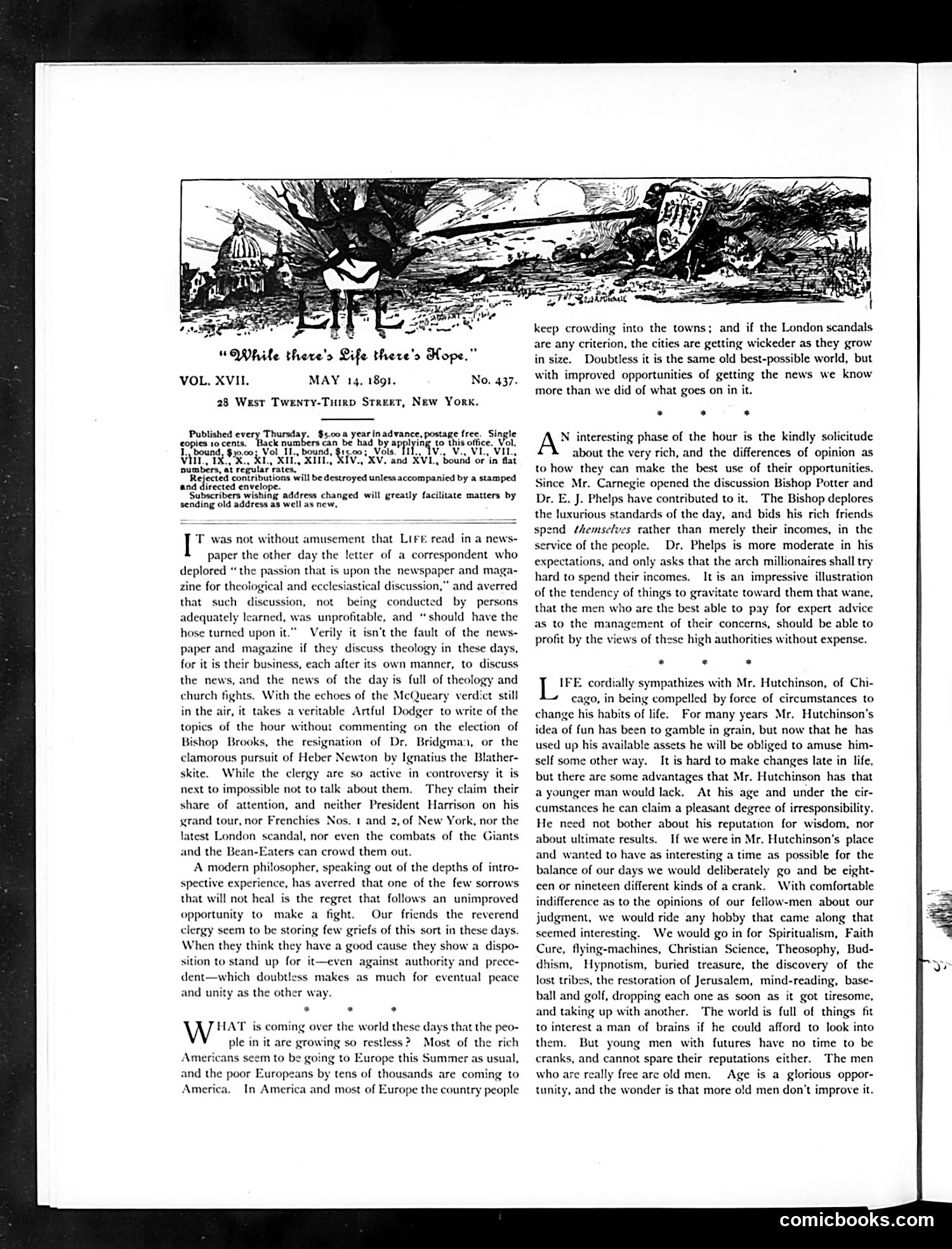
The page contains editorial commentary rather than political cartoons. The header illustration depicts a classical allegorical scene with a tree and figures, accompanying the motto "While there's Life there's Hope." The text discusses the magazine's editorial philosophy, defending its practice of discussing theological and ecclesiastical matters alongside news. It criticizes those who believe newspapers should avoid such topics. The second section comments on wealth and charitable giving, specifically referencing Andrew Carnegie and E.J. Phelps, praising wealthy individuals who use their fortunes for public service rather than merely personal consumption. It also sympathetically discusses Mr. Hutchinson of Chicago, who gambled away his fortune but maintains dignity in changed circumstances. The final section reflects on restlessness among wealthy Americans traveling to Europe, questioning the causes of social unease and generational differences.
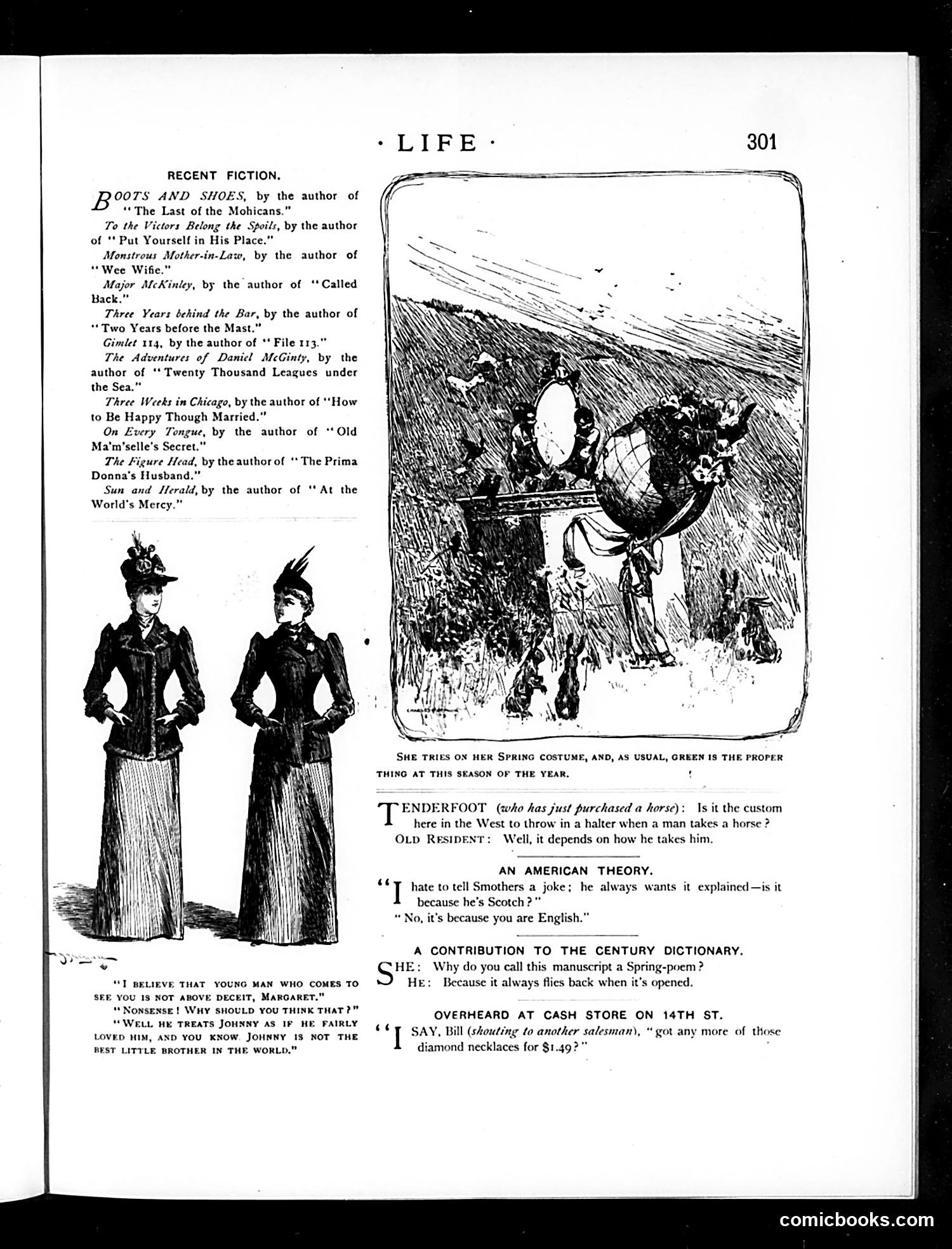
**Fashion Illustration (Left):** Two women in identical black spring costumes with high collars and long skirts, illustrating current seasonal fashion. The caption notes "green is the proper thing at this season of the year." **Main Cartoon (Right):** Depicts a woman trying on a large spring hat while looking in a mirror. The exaggerated size satirizes the trend of oversized, elaborate spring bonnets popular in this era—a recurring target of fashion satire. **Comic Exchanges (Bottom):** Brief humorous dialogues on unrelated topics: a joke about Scottish humor, a dictionary joke about manuscripts, and a punchline about diamond necklaces at a cash store. The page primarily showcases fashion commentary and light humor typical of Life's satirical approach to contemporary society and consumer culture.
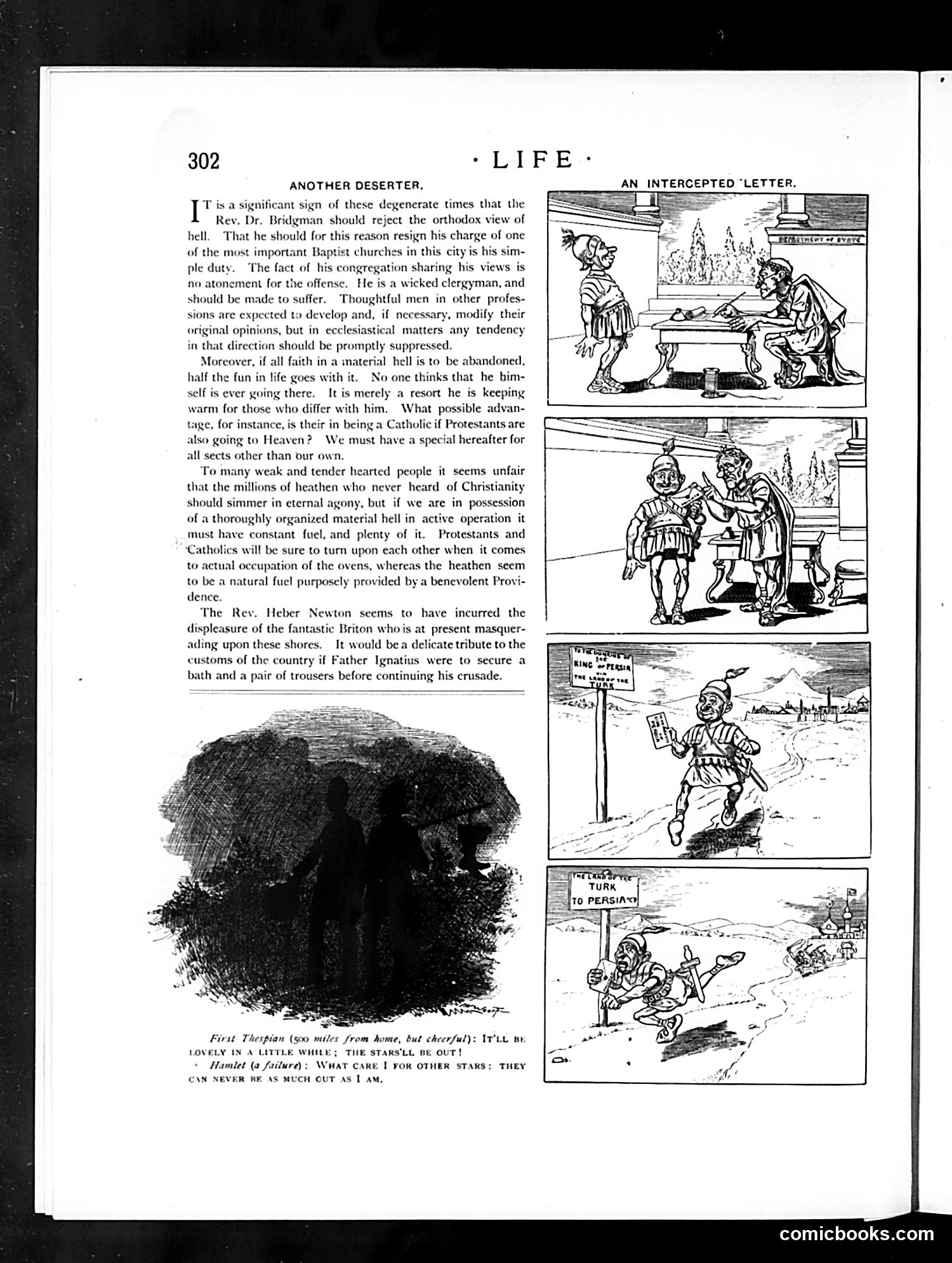
**"Another Deserter"** (left text column) criticizes Rev. Heber Newton for resigning from an important Baptist church position. The article accuses him of cowardice for abandoning his post rather than defending controversial theological views—specifically, apparently, his rejection of literal hell and acceptance of other faiths reaching heaven. The piece sarcastically suggests he should have stayed to influence his congregation, not fled like a deserter. **"An Intercepted Letter"** (right comic strip) appears to be a humorous narrative following a soldier or adventurer through various scenes with signposts. The final quote from Hamlet ("I'll be lovely in a little while") suggests mockery of someone's grandiose self-importance or delayed ambitions. The exact historical figures referenced remain unclear without additional context.
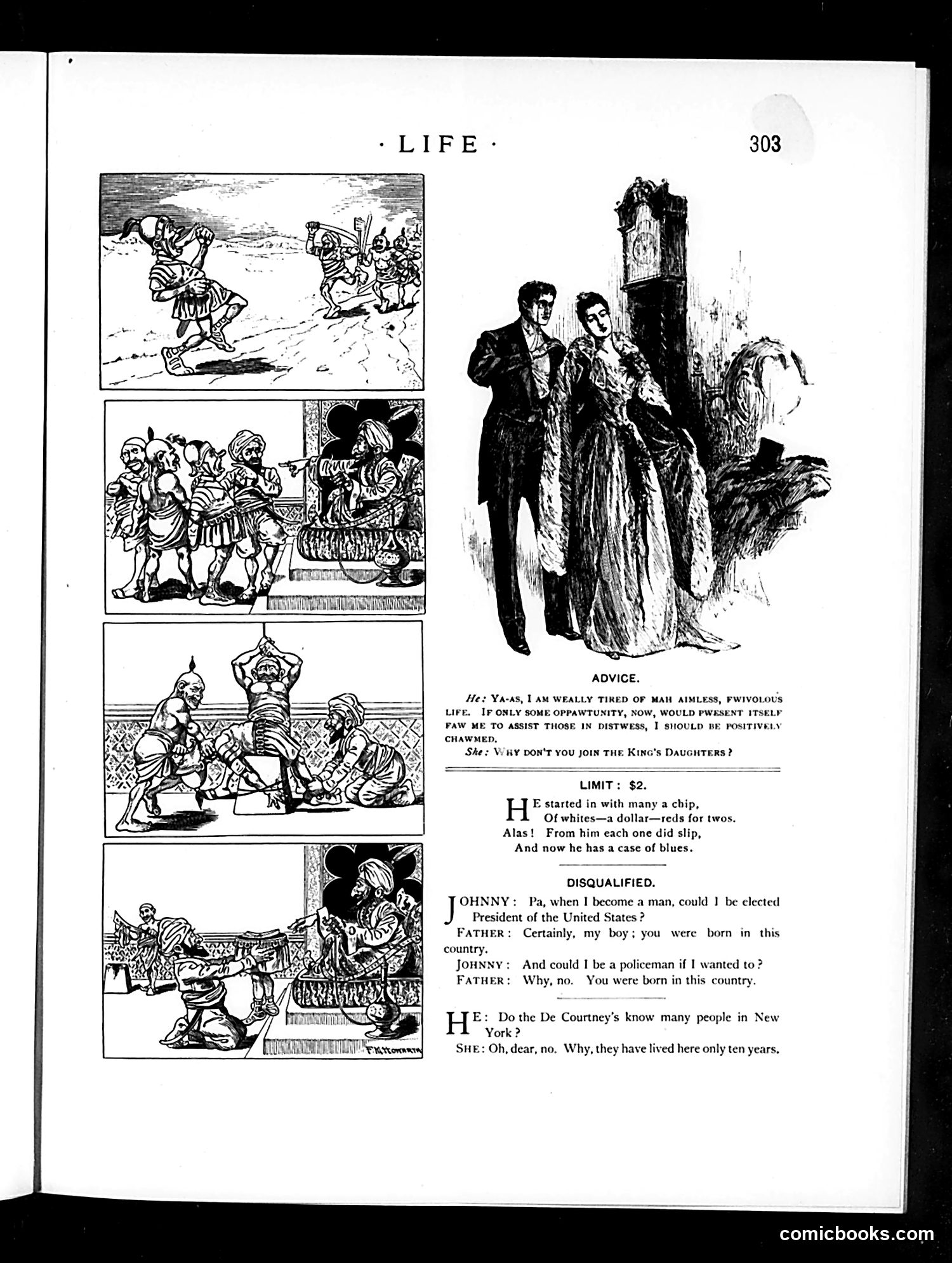
This page contains three distinct satirical pieces mocking American social pretensions and immigration attitudes: **"Advice"** depicts a wealthy woman counseling a working-class man to maintain dignity despite hardship—advice she herself wouldn't follow, suggesting class hypocrisy. **"Limit: $2"** jokes about a man losing money at gambling, a common vice satirized in period humor. **"Disqualified"** presents a father telling his immigrant son he cannot become President or policeman because he was "born in this country"—a deliberate absurdist joke inverting naturalization requirements. The final exchange mocks nouveau-riche social climbing, where a woman boasts her family has lived in New York only ten years, suggesting recent wealth and questionable social standing. The cartoons collectively lampoon class anxiety, immigrant exclusion, and social aspiration in early 20th-century America.
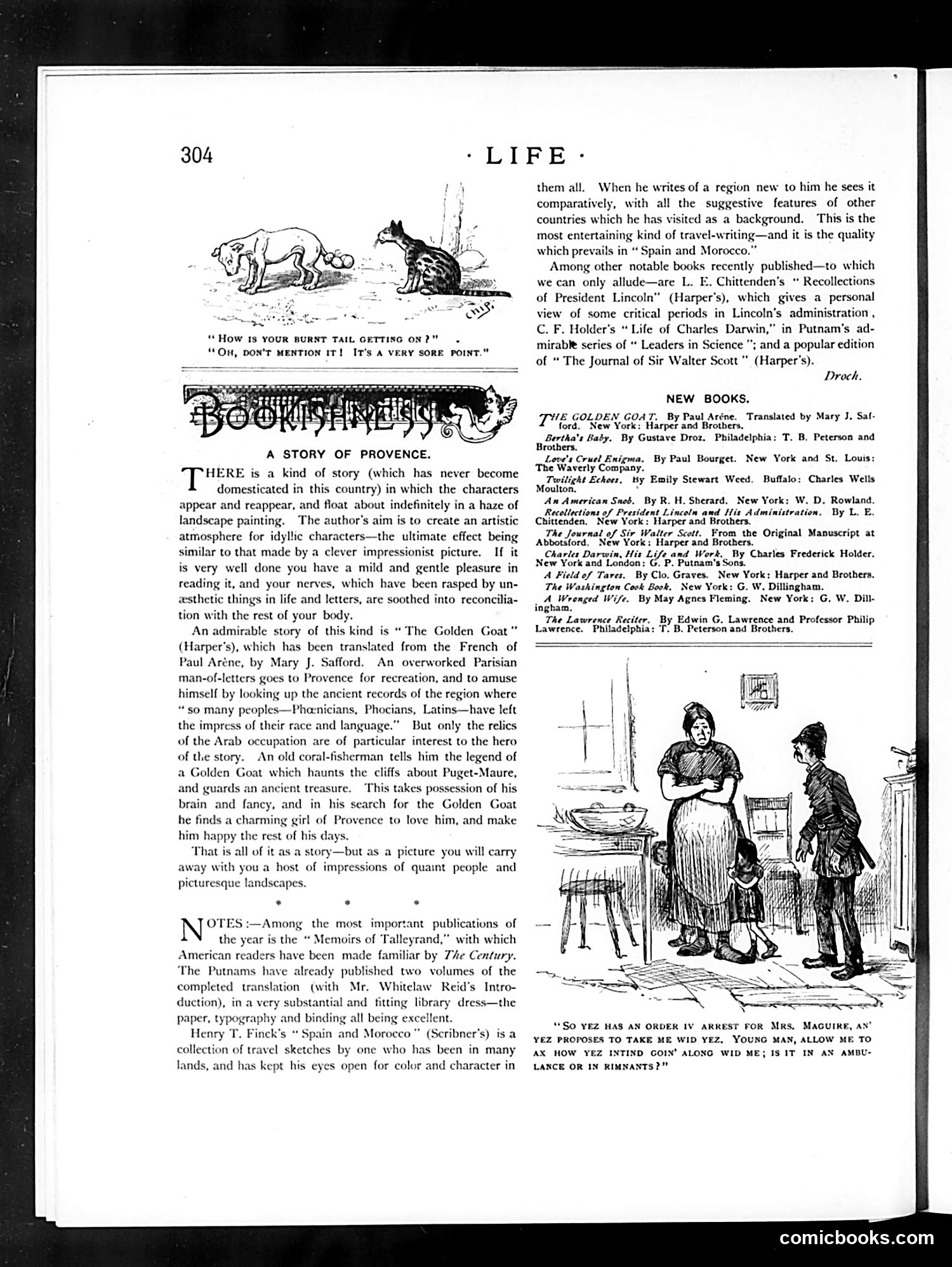
This page consists primarily of a book review section titled "A Story of Provence," discussing *The Golden Goat* by Paul Bourget (translated by Mary J. Safford). The review praises the book's ability to create artistic atmosphere through character impressionism. The two small illustrations at the top show animals (appears to be a donkey and a goat or similar creature) with the caption "How is your bursts tail getting on?" — likely a humorous reference to the book's title or provincial subject matter. The larger illustration depicts a domestic scene with working-class figures, captioned with dialogue in dialect about an "order in armest" for Mrs. Maguire. This appears to be generic genre humor rather than political satire, illustrating the book's provincial French setting or similar rustic locale. The page is primarily **literary content and advertising** rather than political commentary.
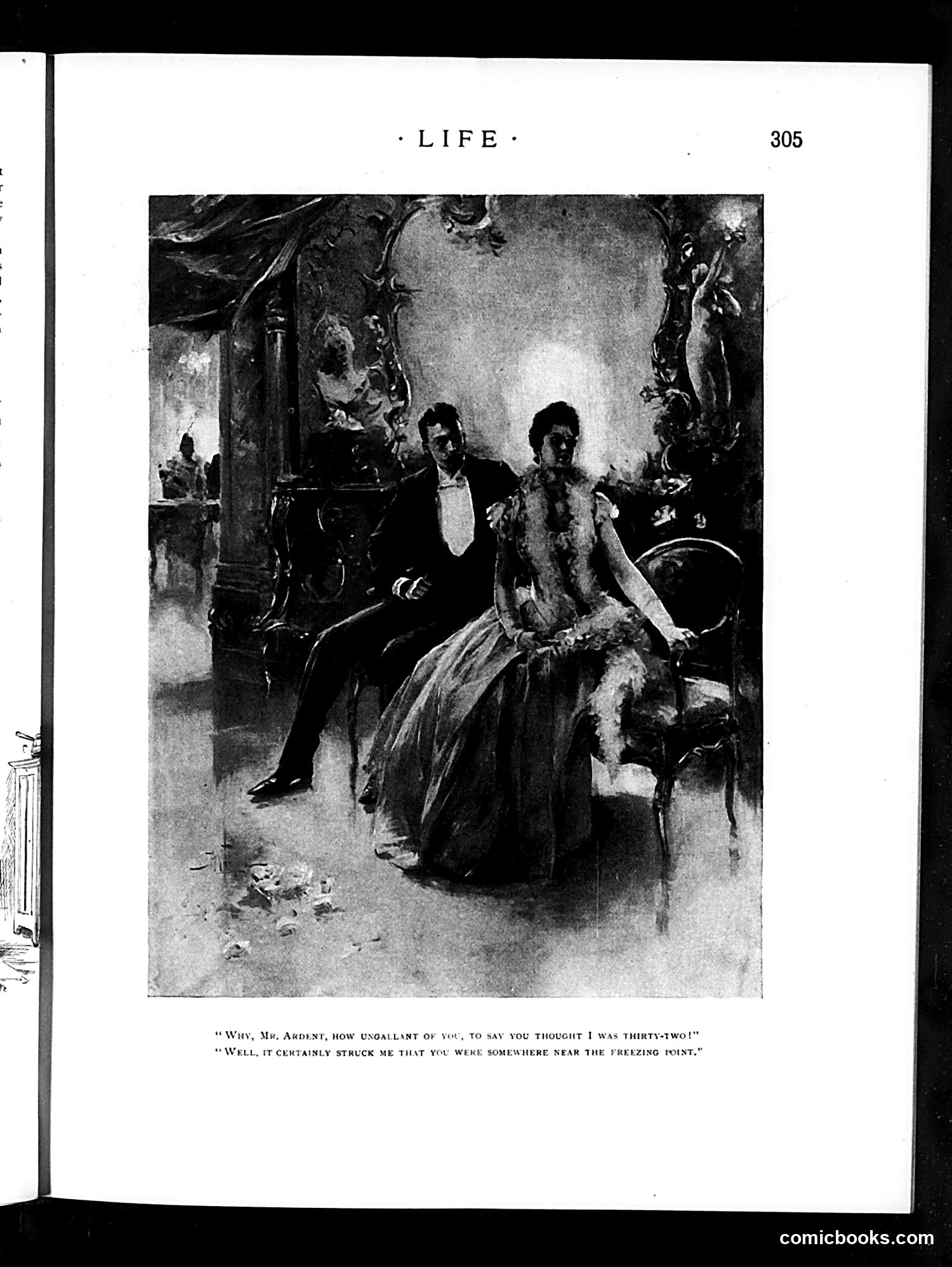
This appears to be an illustration from a satirical scene. The dialogue indicates a conversation between a man and woman in an ornate interior setting, with the man (addressed as "Ardent") being confronted about his age—he claims to be thirty-two, but the woman sarcastically suggests he's older, noting he was "somewhere near the freezing point." The satire targets male vanity and dishonesty about age in romantic contexts. The woman's barbed response—implying he's ancient ("freezing point" possibly references being cold/lifeless or simply very old)—mocks men who misrepresent their age to appear younger to potential romantic partners. The ornate classical setting and formal dress suggest this depicts upper-class social interaction, typical of Life magazine's satirical humor about society's romantic pretenses and vanities.
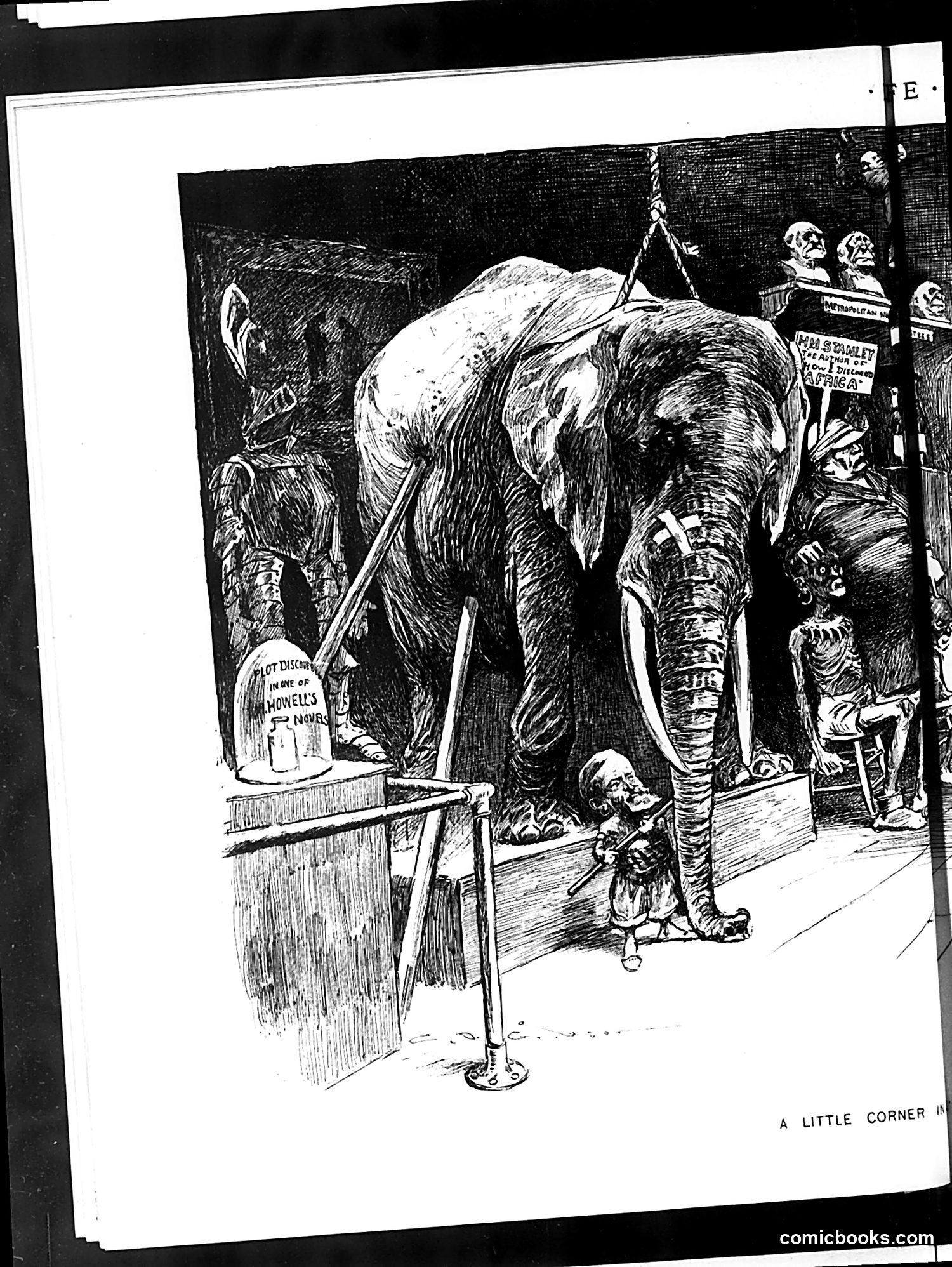
This political cartoon depicts a circus or exhibition scene featuring a large elephant as the central attraction. A small child stands before the massive animal, appearing diminished by its size—a classic visual metaphor for disparity in power or scale. The visible signage references "Howells" (likely William Dean Howells, the prominent American author and critic) and mentions what appears to be a "Stanley" expedition or display, suggesting this cartoon comments on a contemporary public spectacle or exhibition, possibly mocking how major literary or exploratory figures were being commercialized or displayed for public entertainment. The cramped "little corner" setting emphasizes the contrast between the elephant's grandeur and its constrained exhibition space.
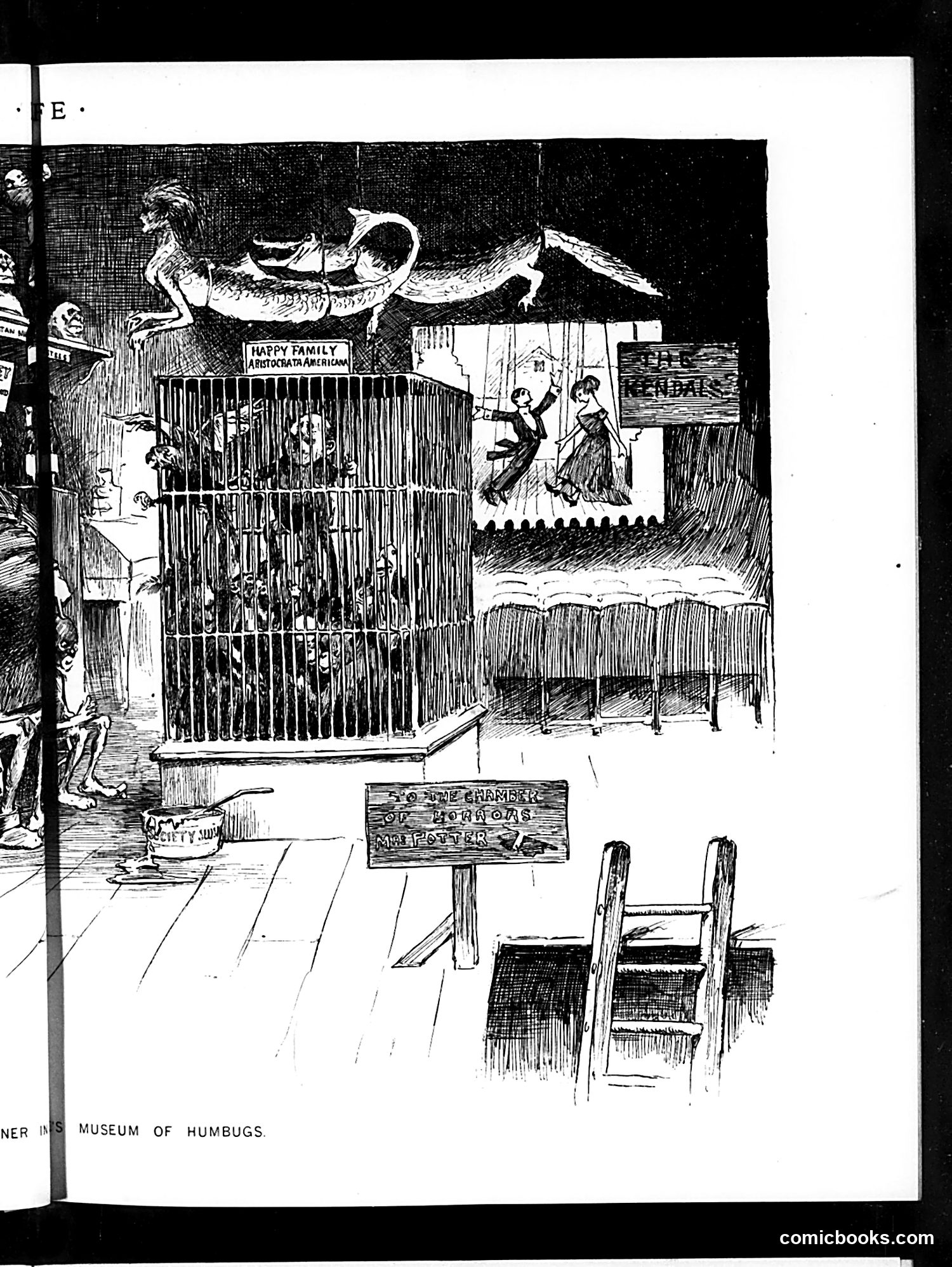
This is a satirical illustration titled "Museum of Humbugs" depicting what appears to be a traveling carnival or circus exhibit. The central image shows a caged "Happy Family" attraction—a common Victorian-era sideshow featuring animals or people in confined spaces labeled with exaggerated claims. The satire mocks fraudulent sideshows and public gullibility. A barker promotes the exhibit to passersby while figures inside perform or pose. Signs reading "Harbor of Horrors" and "Museum" suggest this critiques both dishonest carnival attractions and institutions that exploited curiosity for profit. The "humbug" reference is explicit—the magazine is ridiculing deceptive entertainment practices that deceived audiences. The caged display and promotional signage illustrate how carnival operators profited from sensationalism and false advertising, a common target of *Life* magazine's satirical commentary on American society.
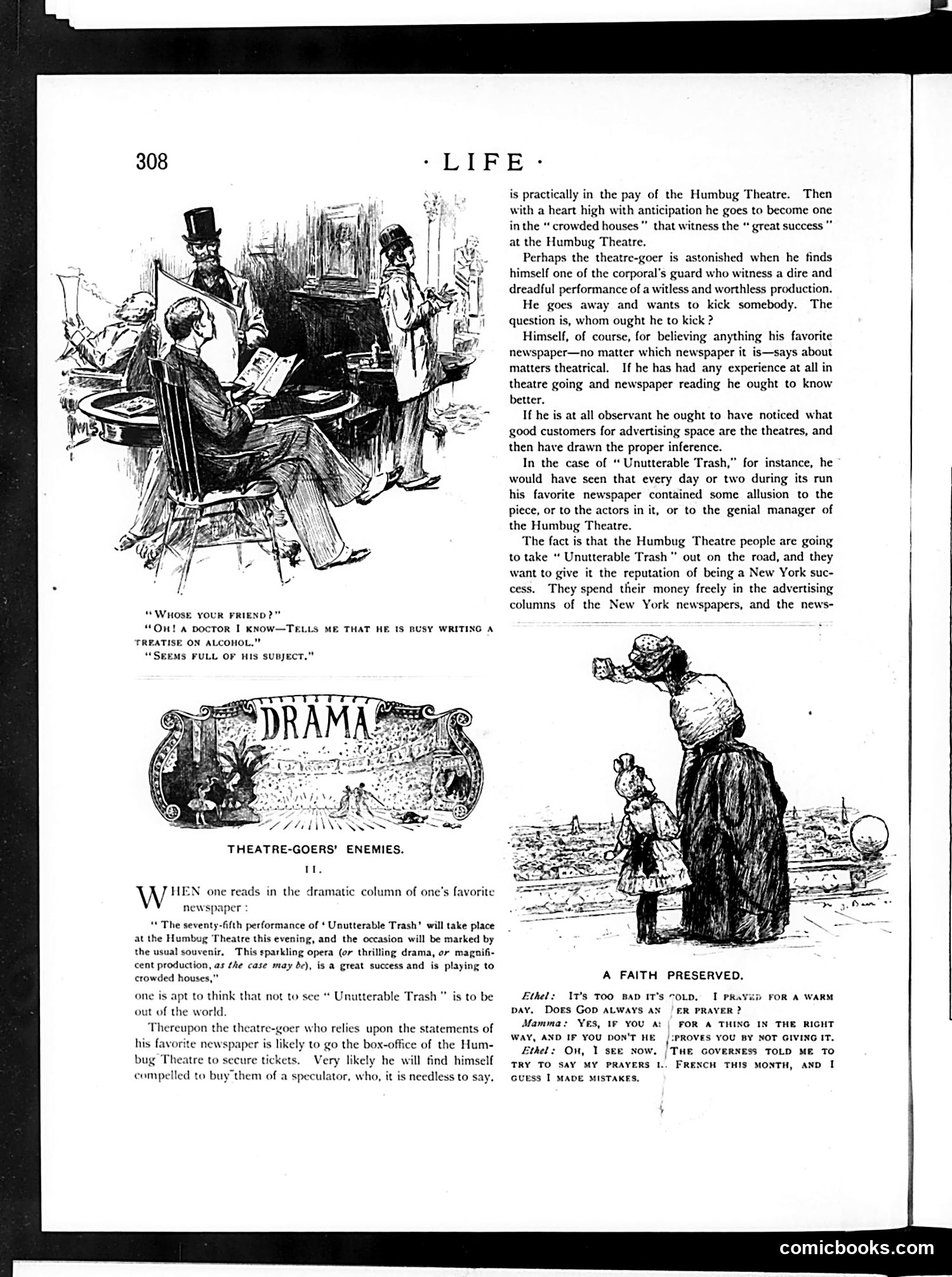
This page satirizes newspaper theater criticism as corrupt advertising rather than honest reviewing. The main article "Theatre-Goers' Enemies" argues that newspapers—particularly the *New York* papers referenced—publish glowing reviews of mediocre productions like the fictional "Unutterable Trash" because theaters pay heavily for advertising space. The satire suggests readers are duped into buying expensive tickets (often from scalpers) to see worthless shows, based on newspaper hype that's really just paid promotion disguised as editorial content. The top cartoon jokes about a doctor "busy writing a treatise on alcohol"—implying he's an alcoholic ("seems full of his subject"), a pun on being literally full of the substance he studies. The bottom cartoon, "A Faith Preserved," shows a child explaining her failed prayer: she asked God for warm weather but made mistakes saying prayers in French, so God denied her request. It's gentle humor about childhood logic and religious instruction.
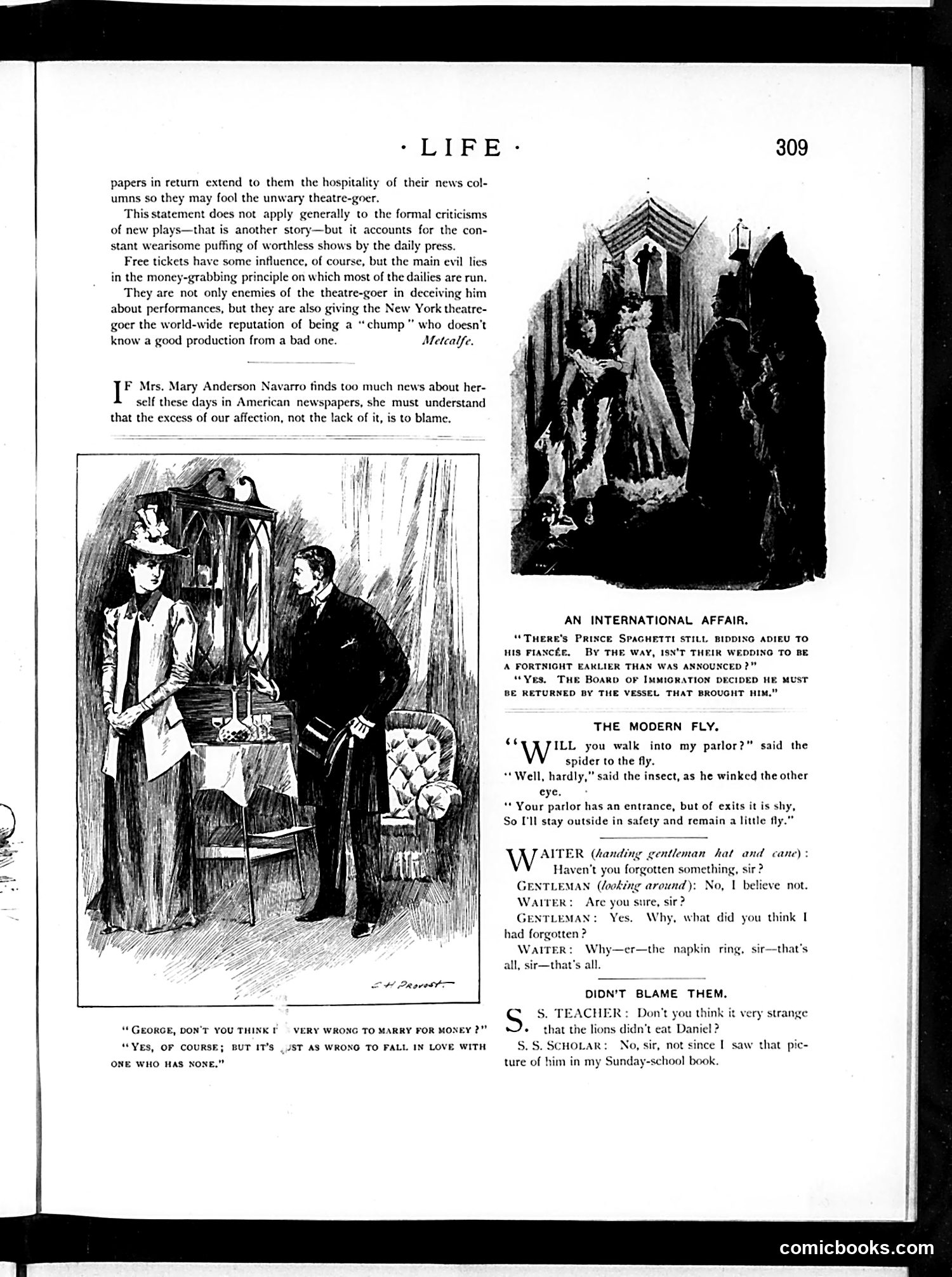
This page contains several satirical jokes targeting early 20th-century American society: **Top section** critiques theater critics accepting free tickets from producers, corrupting their reviews and giving New York theatergoers a reputation as gullible "chumps." **Main cartoon** (left) shows a man and woman at a mirror, joking about marrying for money versus falling in love with someone poor—satirizing mercenary marriage practices. **"International Affair"** mocks immigration policy: an Italian prince (likely "Prince Spaghetti," a fictional name) must be deported because immigration officials sent him back on the same ship that brought him, undercutting a romantic farewell. **"Modern Fly"** parodies the classic poem, showing the fly refusing the spider's invitation—a commentary on urban wariness or skepticism. **Waiter sketch** uses the forgotten napkin ring as comedic misdirection. **Final joke** references the Biblical Daniel in the lion's den, with a child skeptical because the Sunday-school picture showed Daniel unharmed—gentle satire on literal-minded religious education.
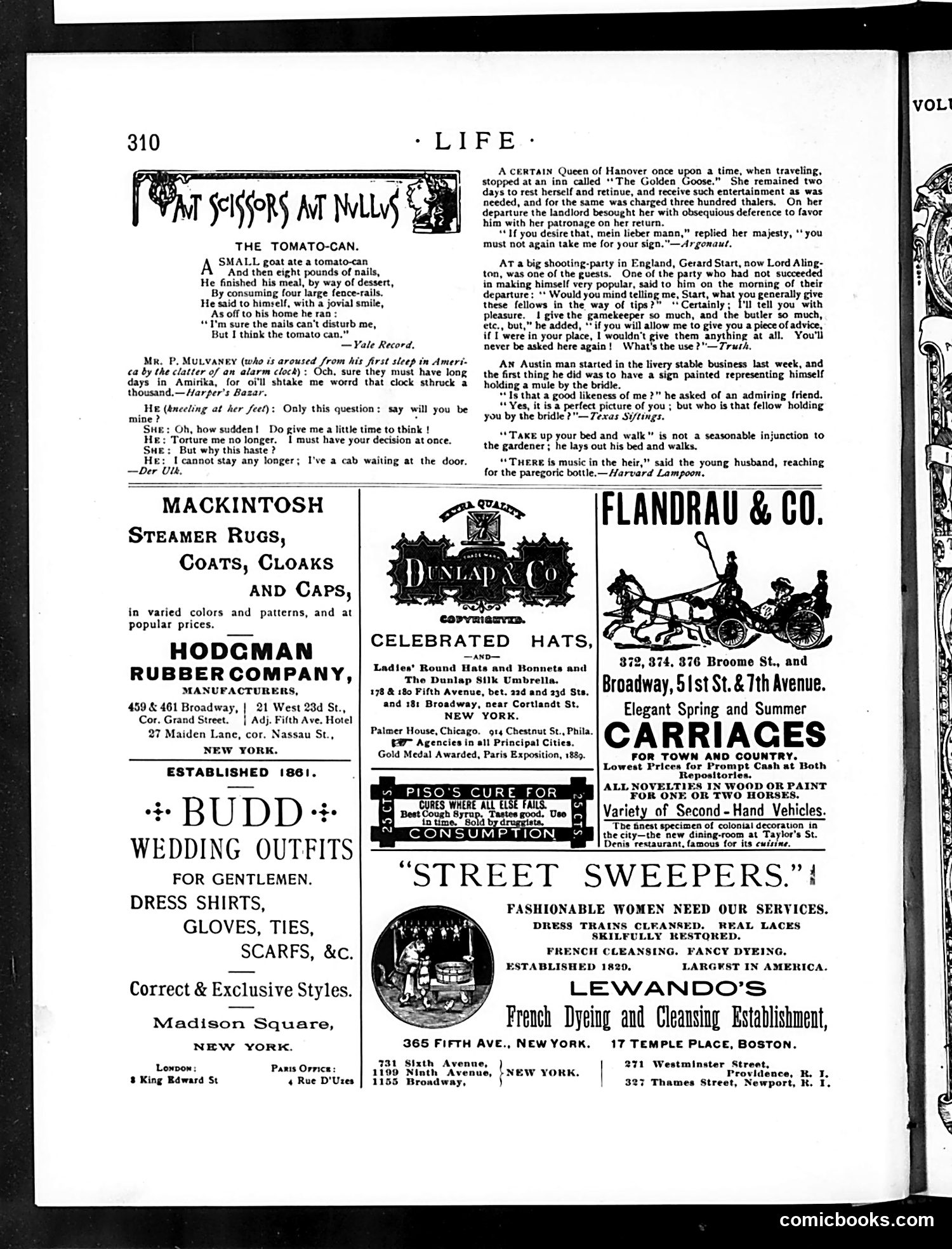
This page from *Life* magazine contains several brief humorous pieces and extensive period advertising. The main content includes: **"The Tomato-Can"** - A light verse joke about a goat eating metal objects and worrying only about the tomato-can—absurdist humor playing on unexpected concerns. **Short dialogue jokes** reprinted from other publications (Harper's Bazar, Der Ulk, Texas Siftings, etc.) addressing everyday situations: an Irish immigrant confused by loud American clocks, a rushed marriage proposal, a Queen's complaint about being portrayed as a sign at an inn, tips for house-party guests, a livery stable's unfortunate self-portrait advertisement, and wordplay about taking up one's "bed" in gardening. These are gentle, domestic satiric pieces without specific political content—typical *Life* filler humor mocking social awkwardness, Irish stereotypes, and minor absurdities of Victorian life. The page is primarily **advertisements** for clothing, carriages, hats, and cleaning services, reflecting *Life*'s commercial focus.