
Life, 1891-05-14 · page 4 of 14
Life — May 14, 1891 — page 4: what you’re looking at
What you’re looking at
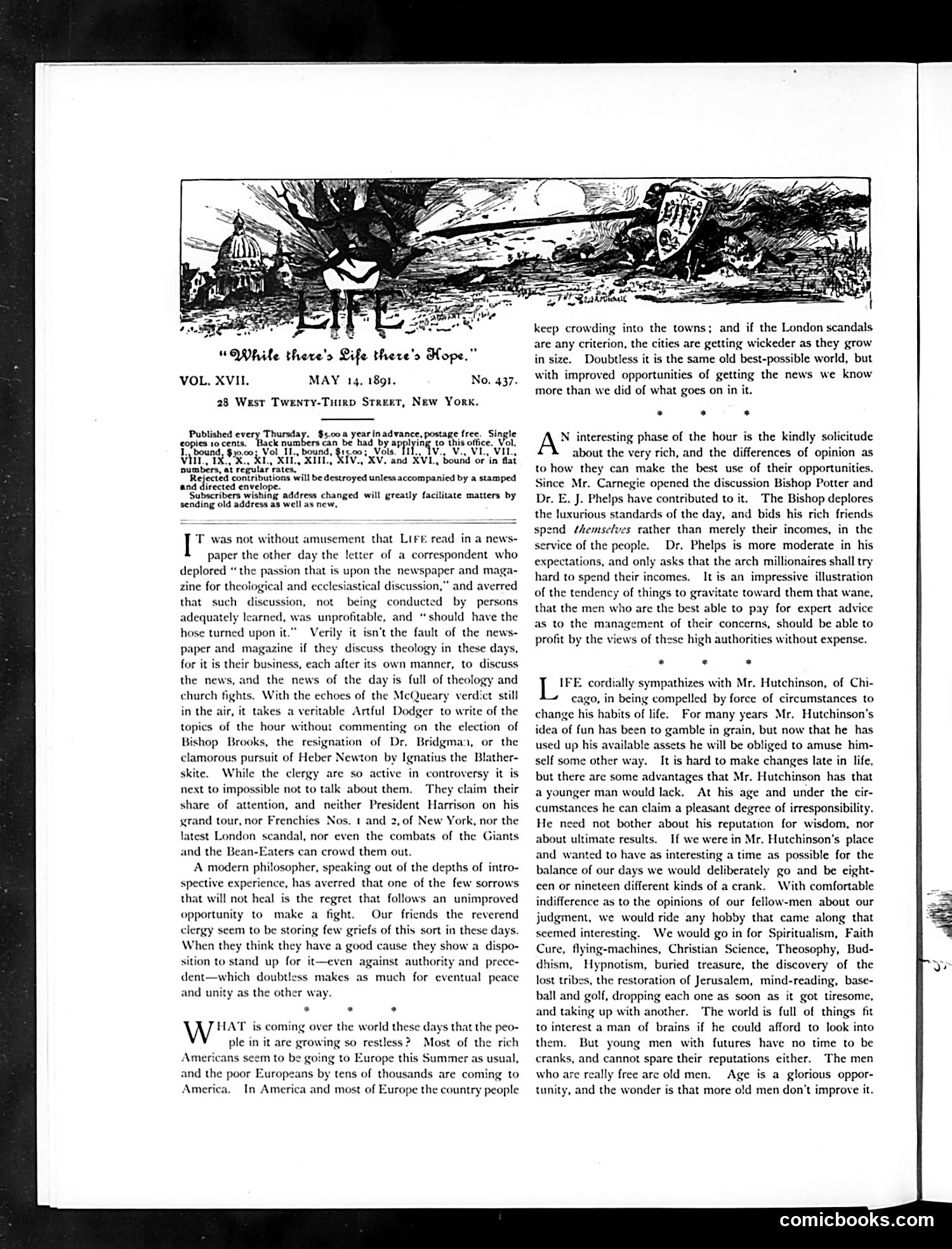
The page contains editorial commentary rather than political cartoons. The header illustration depicts a classical allegorical scene with a tree and figures, accompanying the motto "While there's Life there's Hope." The text discusses the magazine's editorial philosophy, defending its practice of discussing theological and ecclesiastical matters alongside news. It criticizes those who believe newspapers should avoid such topics. The second section comments on wealth and charitable giving, specifically referencing Andrew Carnegie and E.J. Phelps, praising wealthy individuals who use their fortunes for public service rather than merely personal consumption. It also sympathetically discusses Mr. Hutchinson of Chicago, who gambled away his fortune but maintains dignity in changed circumstances. The final section reflects on restlessness among wealthy Americans traveling to Europe, questioning the causes of social unease and generational differences.
📄 Transcribed text from this page (OCR, searchable)
Machine-transcribed from the original scan — historical spelling and the odd misread are preserved.
5 <2 wee “OMrile there's Life there's Hope.” VOL. XVII. MAY 14, 1891. 28 West Twenty-Tiirp STRE: No. 437. , New York. Published every Thursday. $5.00 a year in advance, postage free. Single copies ro cents. Back numbers can be had by applying to this office. Vol, FE ybound, $10.00; Vol IL. bound, Sr.00; Vols. HL. 1V.. V.. VI. VIL, VHT, 1X) X., KL, XID, RIL, XIV. XV, and XVI, bound of in flat numbers, at regular rates. Rejected contributions will be destroyed unless accompanied by a stamped and directed envelope. Subscribers wishing address changed will greatly facilitate matters by sending old address as well as new, T was not without amusement that Lire read in a news- paper the other day the letter of a correspondent who deplored “ the passion that is upon the newspaper and maga- zine for theological and ecclesiastical discussion,” and averred that such discussion, not being conducted by persons adequately learned, was unprofitable, and “should have the hose turned upon it.” Verily it isn’t the fault of the news- paper and magazine if they discuss theology in these days, for it is their business, each after its own manner, to discuss the news, and the news of the day is full of theology and church fights. With the echoes of the McQueary verdict still in the air, it takes a veritable Artful Dodger to write of the topics of the hour without commenting on the election of Bishop Brooks, the resignation of Dr. Bridgman, or the clamorous pursuit of Heber Newton by Ignatius the Blather- skite. While the clergy are so active in controversy it i: next to impossible not to talk about them. They claim their share of attention, and neither President Harrison on his grand tour, nor Frenchies Nos. 1 and 2, of New York, nor the latest London scandal, nor even the combats of the Giants and the Bean-Eaters can crowd them out. A modern philosopher, speaking out of the depths of intro- spective experience, has averred that one of the few sorrows that will not heal is the regret that follows an unimproved opportunity to make a fight. Our friends the reverend clergy seem to be storing few griefs of this sort in these days. When they think they have a good cause they show a dispo- sition to stand up for it—even against authority and prece- dent—which doubt!: much for eventual peace and unity as the other v makes HAT is coming over the world these days that the peo- ple in it are growing so restless? Most of the rich Americans seem to be gt and the poor Euro America. ig to Europe this Summer as usual, ins by tens of thousands are coming to In America and most of Europe the country people keep crowding into the towns; and if the London scandals are any criterion, the cities are getting wickeder as they grow in size. Doubtless it is the same old best-possible world, but with improved opportunities of getting the news we know more than we did of what goes on in it. A’ interesting phase of the hour is the kindly solicitude about the very rich, and the differences of opinion as to how they can make the best use of their opportunities. Since Mr. Carnegie opened the discussion Bishop Potter and Dr. E, J. Phelps have contributed to it. The Bishop deplores the luxurious standards of the day, and bids his rich friends spend ¢hemselves rather than merely their incomes, in the service of the people. Dr. Phelps is more moderate in his expectations, and only asks that the arch millionaires shall try hard to spend their incomes, It is an impressive illustration of the tendency of things to gravitate toward them that wane, that the men who are the best able to pay for expert advice as to the management of their concerns, should be able to profit by the views of these high authorities without expense. * * * IFE cordially sympathizes with Mr. Hutchinson, of Chi- cago, in being compelled by force of circumstances to change his habits of life. For many years Mr. Hutchinson's idea of fun has been to gamble in grain, but now that he has used up his available assets he will be obliged to amuse him- self some other way. It is hard to make changes late in life, but there are some advantages that Mr. Hutchinson has that a younger man would lack. At his age and under the cir- cumstances he can claim a pleasant degree of irresponsibility. He need not bother about his reputation for wisdom, nor about ultimate results. If we were in Mr. Hutchinson's place and wanted to have as interesting a time as possible for the balance of our days we would deliberately go and be eight- cen or nineteen different kinds of a crank. With comfortable indifference as to the opinions of our fellow-men about our judgment, we would ride any hobby that came along that seemed interesti We would go in for Spiritualism, F. Cure, flying-machines, Christian Science, Theosophy, Bud- dhism, Hypnotism, buried treasure, the discovery of the lost tribes, the restoration of Jerusalem, mind-reading, base- ball and golf, dropping each one as soon as it got tiresome, and taking up with another. The world is full of things fit to interest a man of brains if he could afford to look into them. But young men with futures have no time to be cranks, and cannot spare their reputations either. The men who are really free are old men. Age is a glorious oppor- tunity, and the wonder is that more o!d men don't improve it. comicbooks.com