
A complete issue · 16 pages · 1891
Life — March 5, 1891
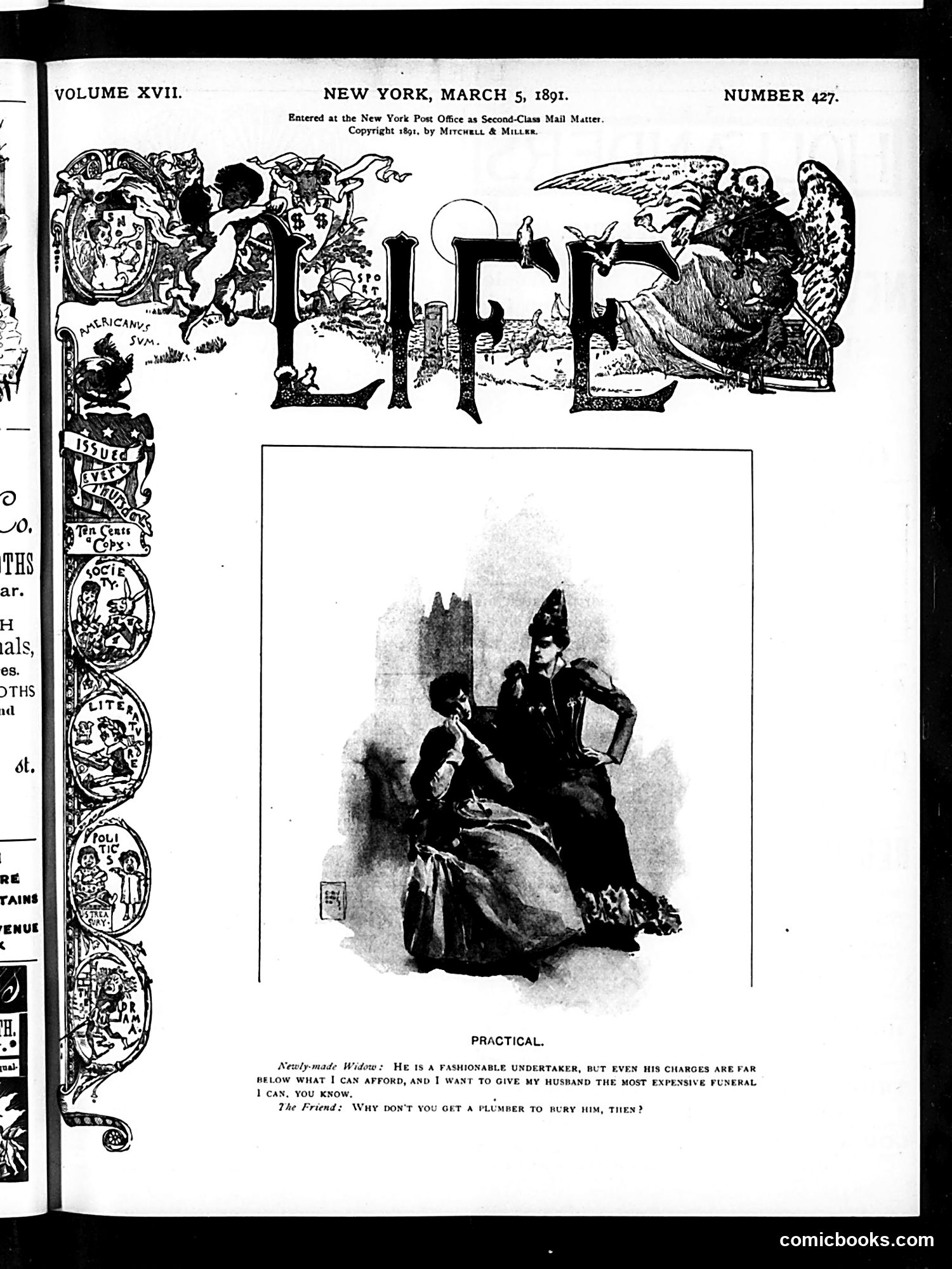
This cartoon satirizes funeral costs and social pretension. A "newly-made Widow" complains to a friend that her undertaker's charges are exorbitant—she cannot afford an expensive funeral for her husband despite wanting to give him one. The friend's practical suggestion: "Why don't you get a plumber to bury him then?" The joke mocks both the widow's status anxiety (wanting an expensive funeral to appear respectable) and the absurdity of her predicament. By suggesting a plumber instead of an undertaker, the friend highlights the ridiculousness of paying premium prices for funeral services—implying the actual work involved isn't fundamentally different from any tradesman's labor. It's social commentary on class performance and the commercialization of death rituals in the Gilded Age.
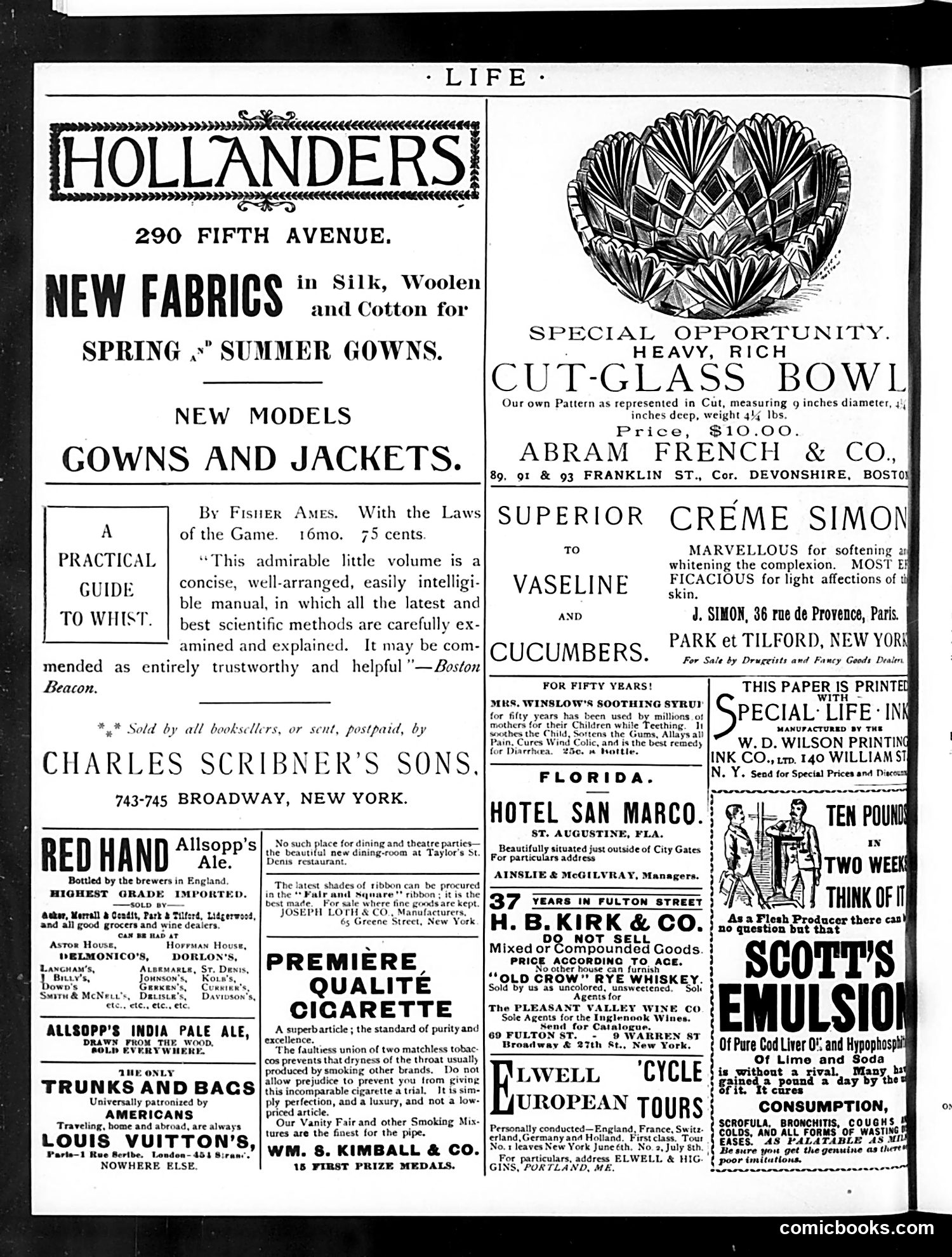
This appears to be primarily an **advertising page** from Life magazine rather than a satirical cartoon page. The content consists almost entirely of period advertisements for: - Hollanders clothing (fabrics and gowns) - Cut-glass bowls and beauty products - Books and cigars - Hotels and tourist services - Scott's Emulsion (a cod liver oil supplement) There are **no political cartoons or satirical content visible**. The page represents typical early 20th-century magazine advertising, with various companies using decorative typography and illustrations to promote consumer goods and services to Life's affluent readership. The advertisements reflect the era's consumer culture and available products rather than social or political commentary.
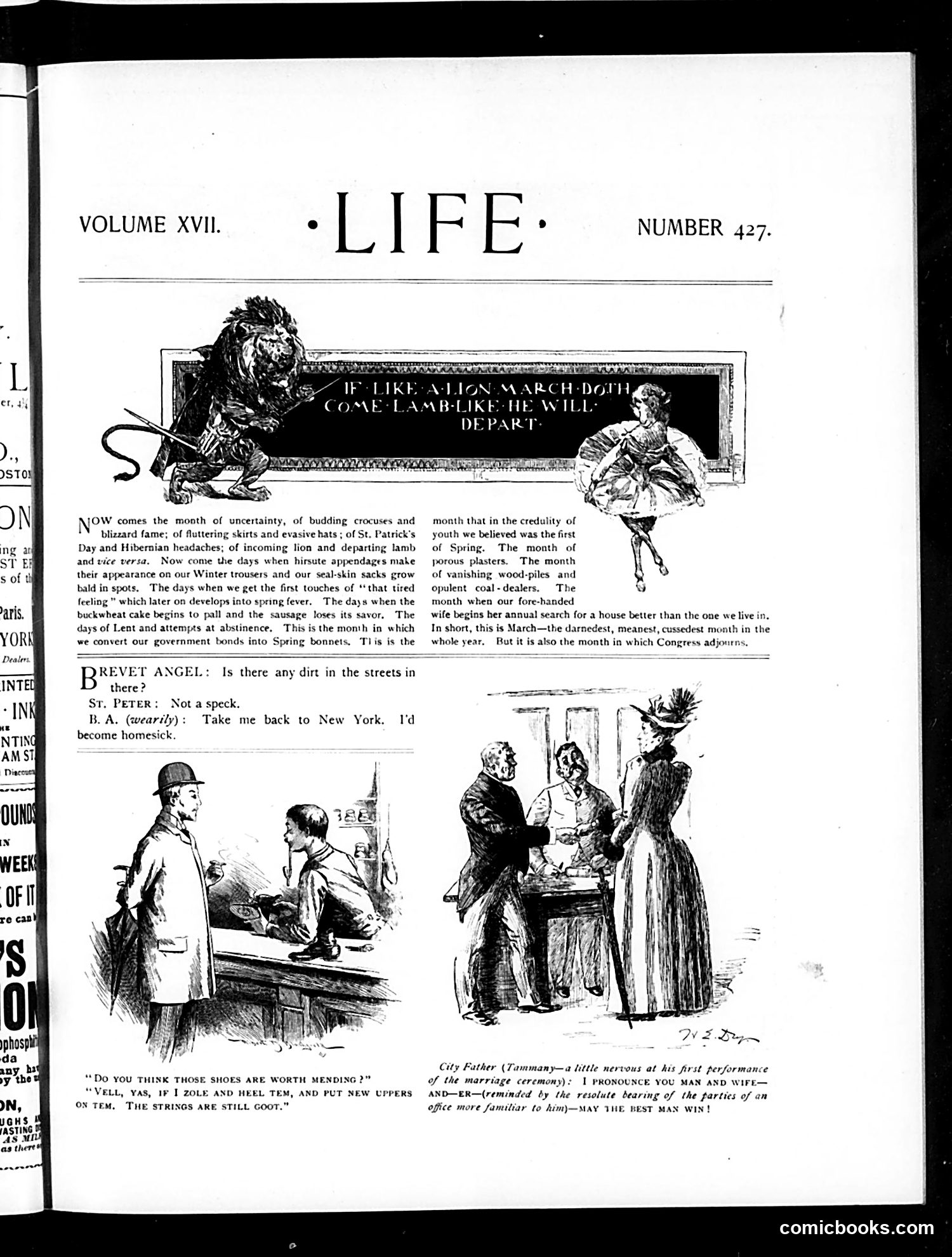
This page contains seasonal humor about March in New York City. The opening essay describes March's "uncertainty" — unpredictable weather, St. Patrick's Day celebrations, and the transition toward spring. The cartoon features a dialogue between "Brevet Angel" and "St. Peter," with St. Peter expressing homesickness for New York despite being in heaven. This is gentle satire on New Yorkers' fierce local pride. Below are two comic sketches: one showing a man asking about shoe repair costs (with dialogue about mending soles and heels), and another labeled "City Father" depicting what appears to be a wedding ceremony scene with social commentary about marriage customs. The overall tone is lighthearted urban satire typical of Life's satirical approach to American life and New York City culture.
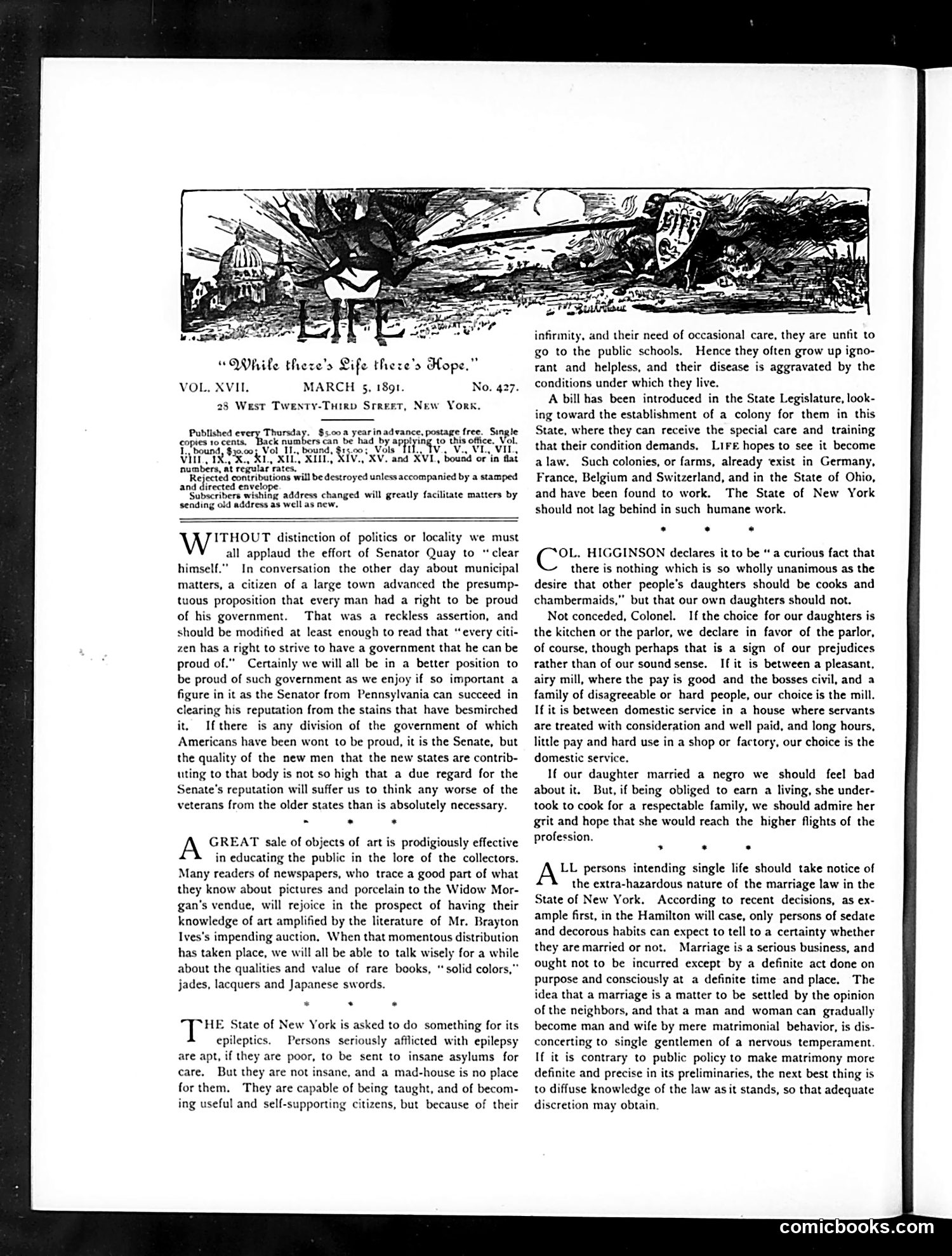
The masthead cartoon depicts a dramatic scene with classical/allegorical figures—likely representing concepts like Liberty or Hope—amid turbulent skies and architectural ruins. The imagery suggests upheaval or crisis, fitting the magazine's satirical purpose. The visible text discusses serious social issues rather than humor: epilepsy care, marriage law reform, and domestic service conditions. One section critiques Senator Quay's reputation and government accountability. Another debates whether daughters should become domestic servants, engaging class and gender questions of the era. The magazine appears to blend satirical commentary with social advocacy—using illustration and editorial essays to address contemporary policy concerns rather than relying primarily on cartoon jokes. This represents Life's role as a progressive-leaning publication addressing early 20th-century social reform issues.
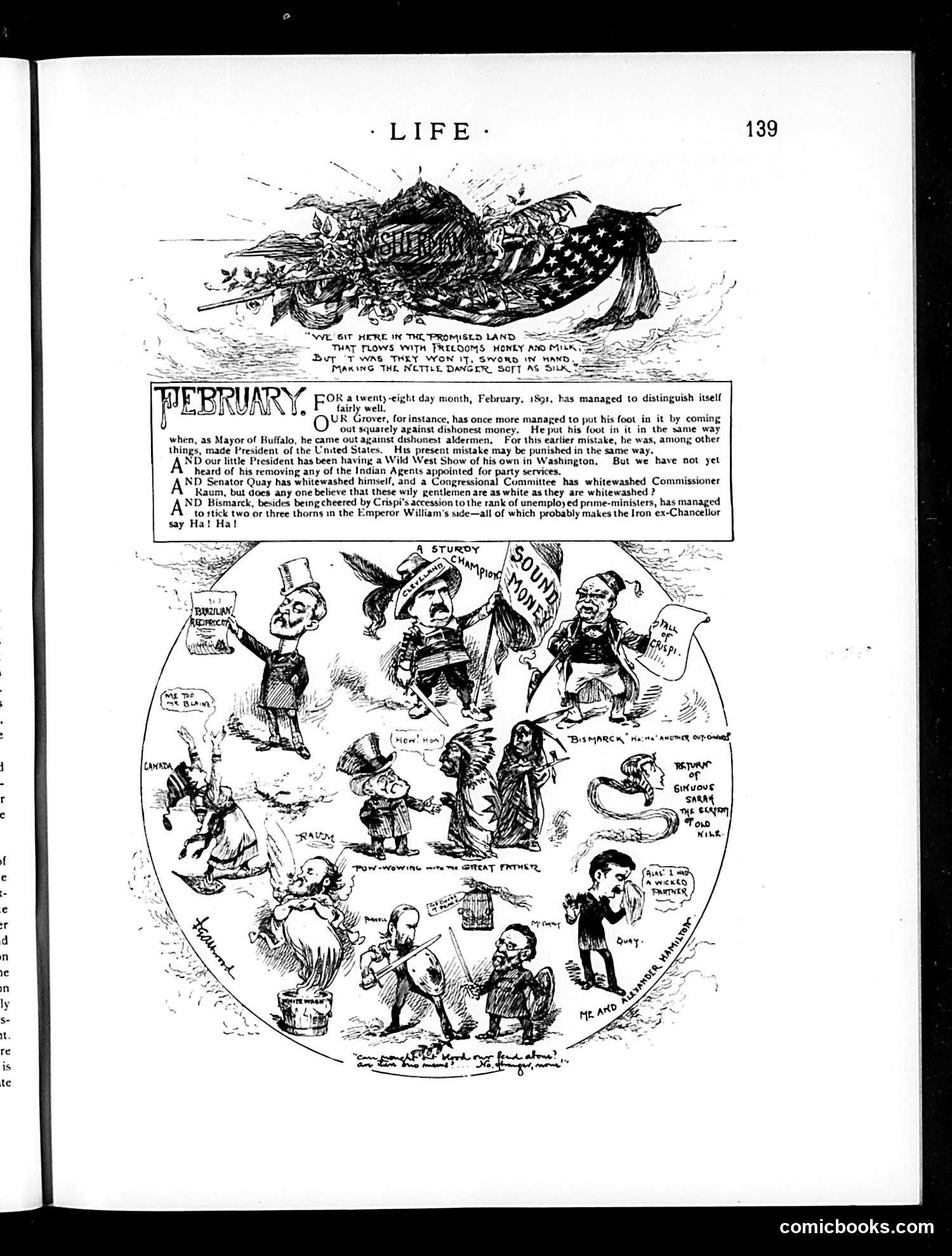
This page satirizes prominent American political figures caught in financial or ethical scandals. The text references President Harrison's administration dealing with accusations of dishonest money-handling, comparing it to earlier presidential mistakes. The circular cartoon below depicts various caricatured politicians in a chaotic scene, likely representing different scandals or controversies of early 1891. References to Senator Quay, a Congressman, and Commissioner Raum suggest specific figures involved in corruption allegations or mismanagement. The overall satire mocks the hypocrisy of politicians—particularly those in power who punish dishonesty in others while engaging in similar behavior themselves. The carnival-like composition emphasizes the absurdity and disorder created by these various scandals simultaneously plaguing the administration.
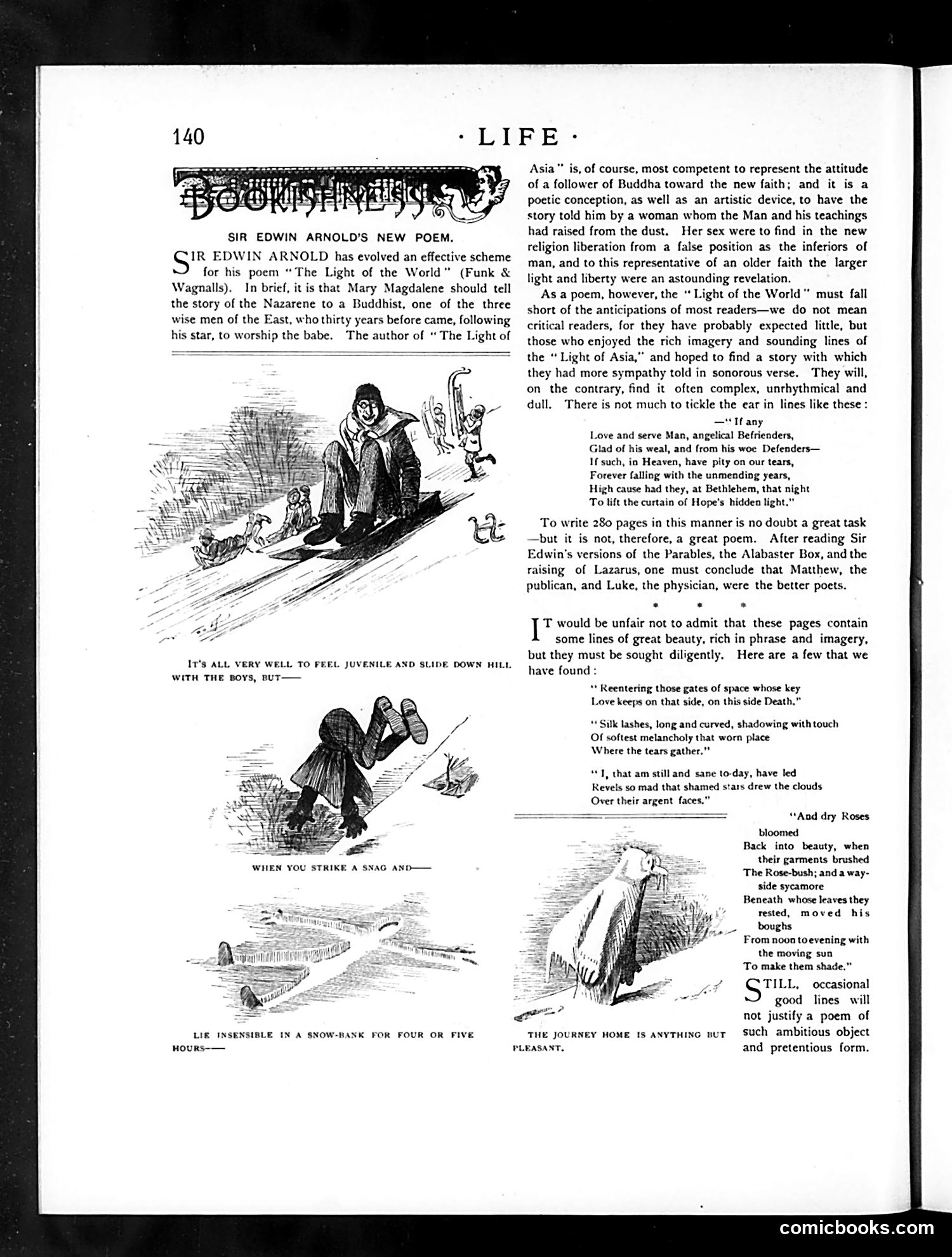
This page reviews Sir Edwin Arnold's poem "The Light of the World," which retells the nativity story with Mary Magdalene as narrator. The reviewer critiques Arnold's ambitious but flawed work, arguing that while it contains occasional beautiful lines, it ultimately fails as great poetry compared to the biblical accounts themselves (Matthew, Mark, Luke, and John). The illustrations are generic Victorian-era sketches depicting winter scenes—sledding children and snowy landscapes—unrelated to the poem's subject matter. They appear to be decorative filler rather than commentary. The satire is literary rather than political: the reviewer employs gentle mockery of Arnold's pretentious attempt to improve upon scripture through poetic embellishment, suggesting that some tasks—however worthy—don't necessarily produce great art.
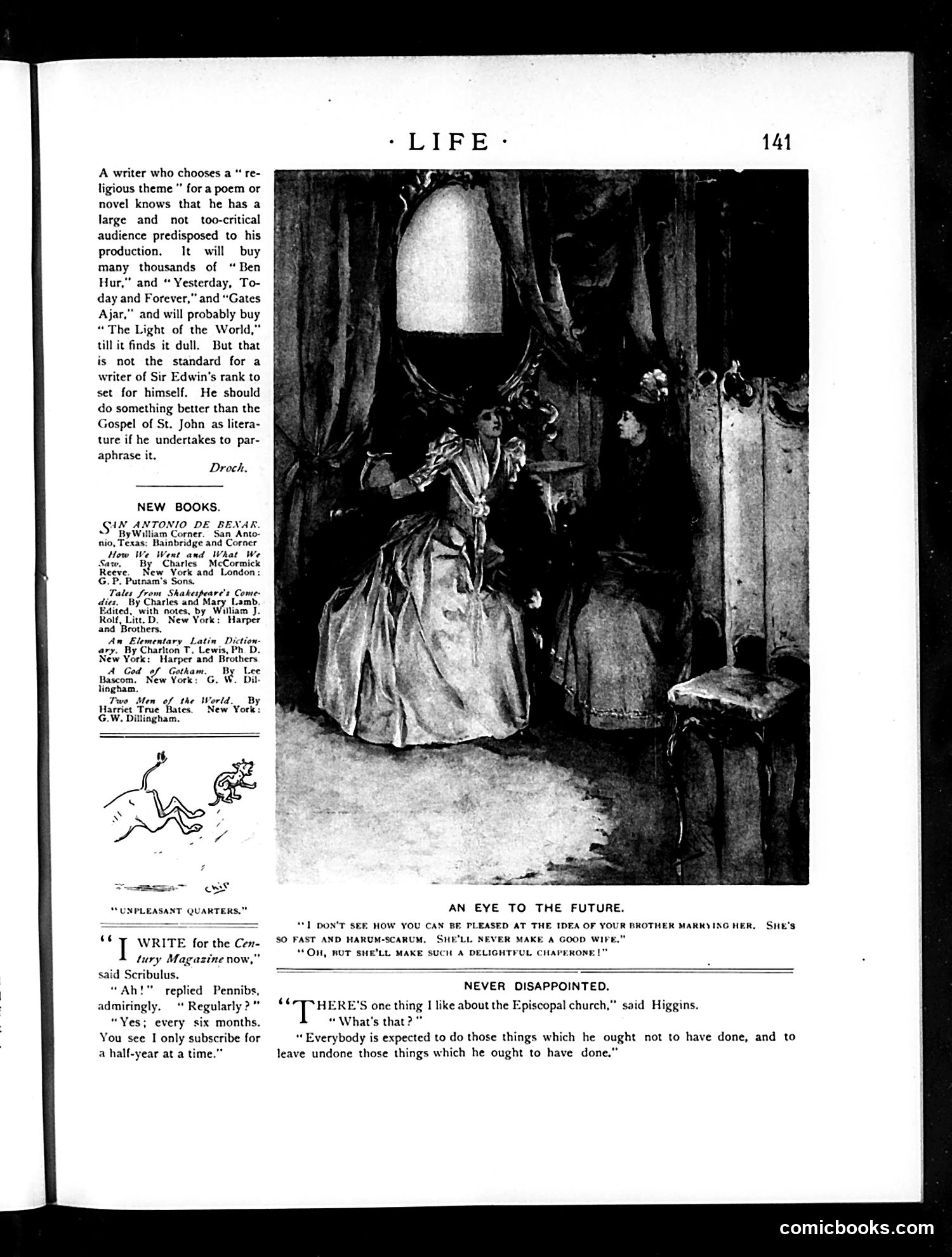
This page contains two distinct cartoons/sections: **"Unpleasant Quarters"** (bottom left): A small humorous sketch showing two figures in conflict, likely depicting domestic discord or marital tension, though the specific reference is unclear without more context. **"An Eye to the Future"** (main image): A dramatic scene showing a woman in period dress gesturing dismissively while speaking to a man. The dialogue concerns a brother's marriage, with the woman declaring the bride "will never make a good wife" and predicting the marriage will produce "such a delightful chaperone!" This appears to satirize social anxieties about matrimony and women's roles in society—specifically mocking upper-class concerns about marital suitability and the prospect of unwanted children affecting one's social standing. The page also includes book reviews and advertisements typical of the era.
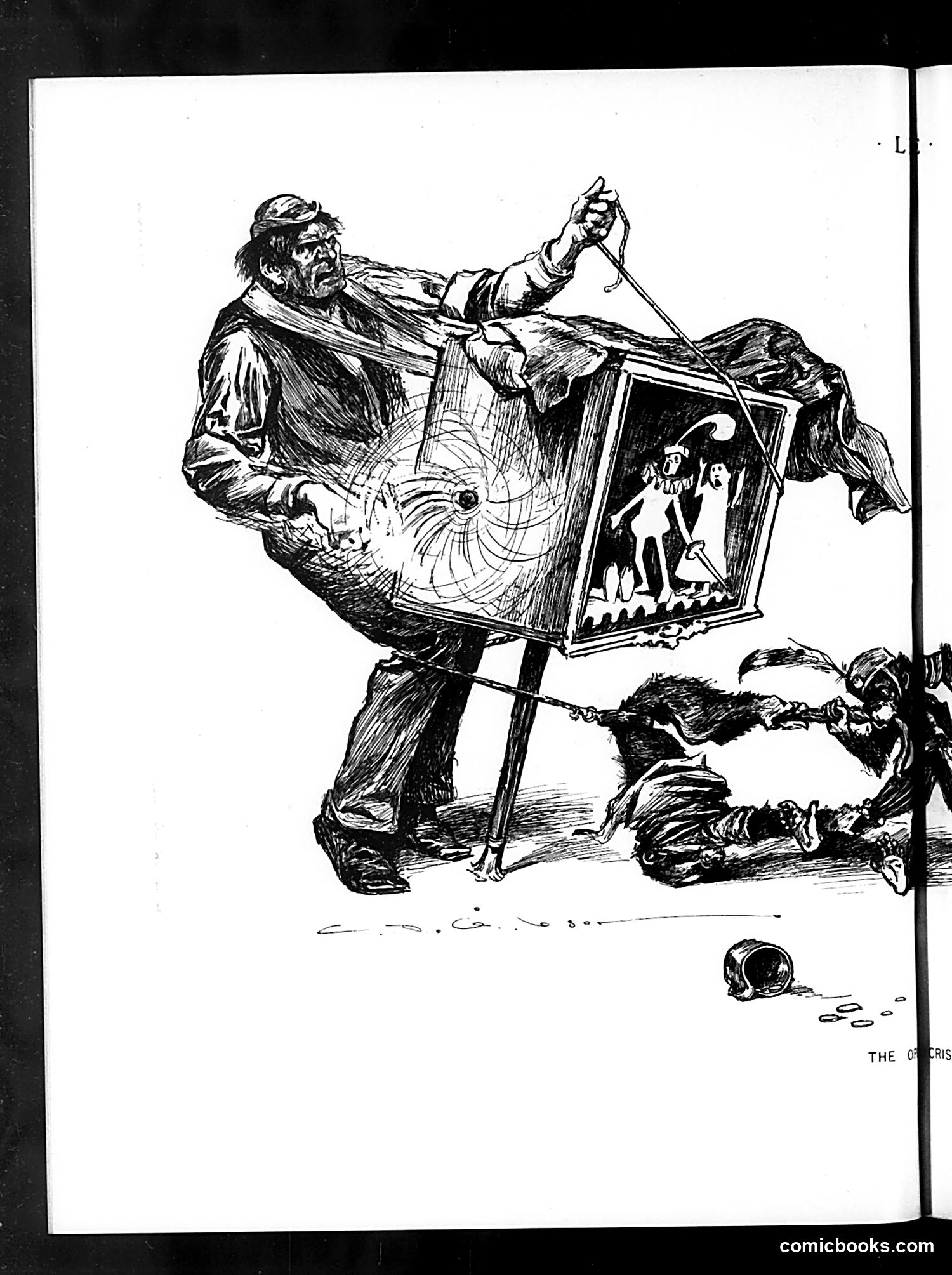
This is a satirical cartoon featuring a bearded man in period clothing holding an ornate umbrella or parasol. The umbrella's decorative panel contains figures that appear to be theatrical or artistic scenes. At his feet are what look like small puppets or marionettes on strings. The title reads "THE C[...]IS" (text cut off). The cartoon appears to be political satire about theatrical manipulation or puppet-mastery—the figure seems to be controlling performers or events like a showman. The umbrella's decorative imagery suggests he's presenting an elaborate show or illusion to the public. Without the complete title or publication date visible, the specific political figure or event referenced remains unclear, though the core message concerns deception through theatrical presentation or public manipulation.
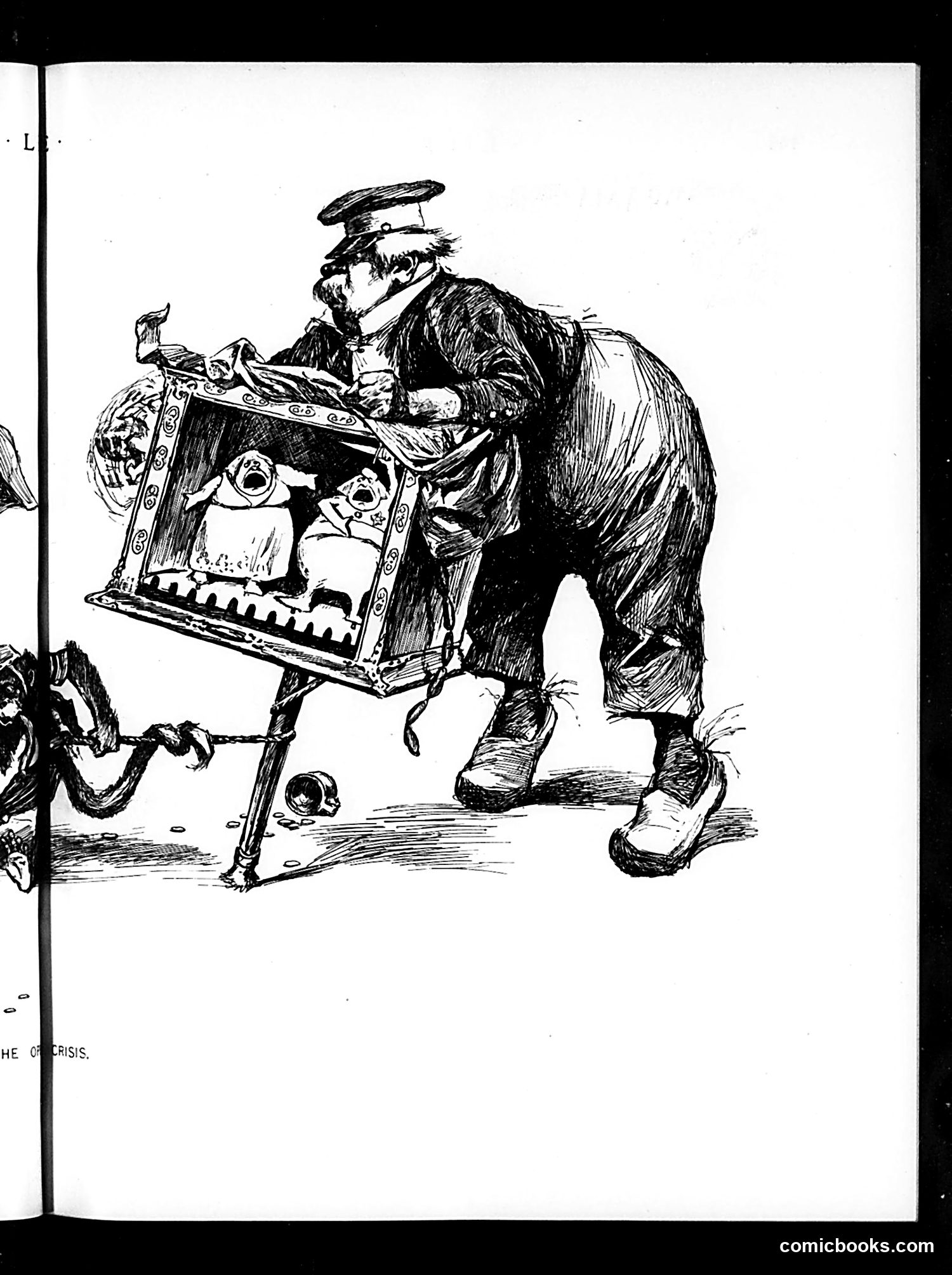
This political cartoon depicts a military or naval officer carrying an ornate organ-grinder's box (a street musician's instrument). The figure wears a captain's hat and formal military attire, suggesting high rank. The text fragment reads "HE OF CRISIS," which appears incomplete but likely refers to handling or managing a crisis. **The Satire:** The cartoon appears to criticize a military leader for "playing" or manipulating public sentiment during a national crisis—treating serious matters like entertainment for the masses. The organ-grinder imagery suggests mechanical, predetermined responses rather than genuine leadership. The figure's portly appearance and theatrical gesture reinforce the mockery of treating grave circumstances as performance. Without the complete title and publication date, the specific crisis referenced remains unclear, though the style suggests early-to-mid 20th century.
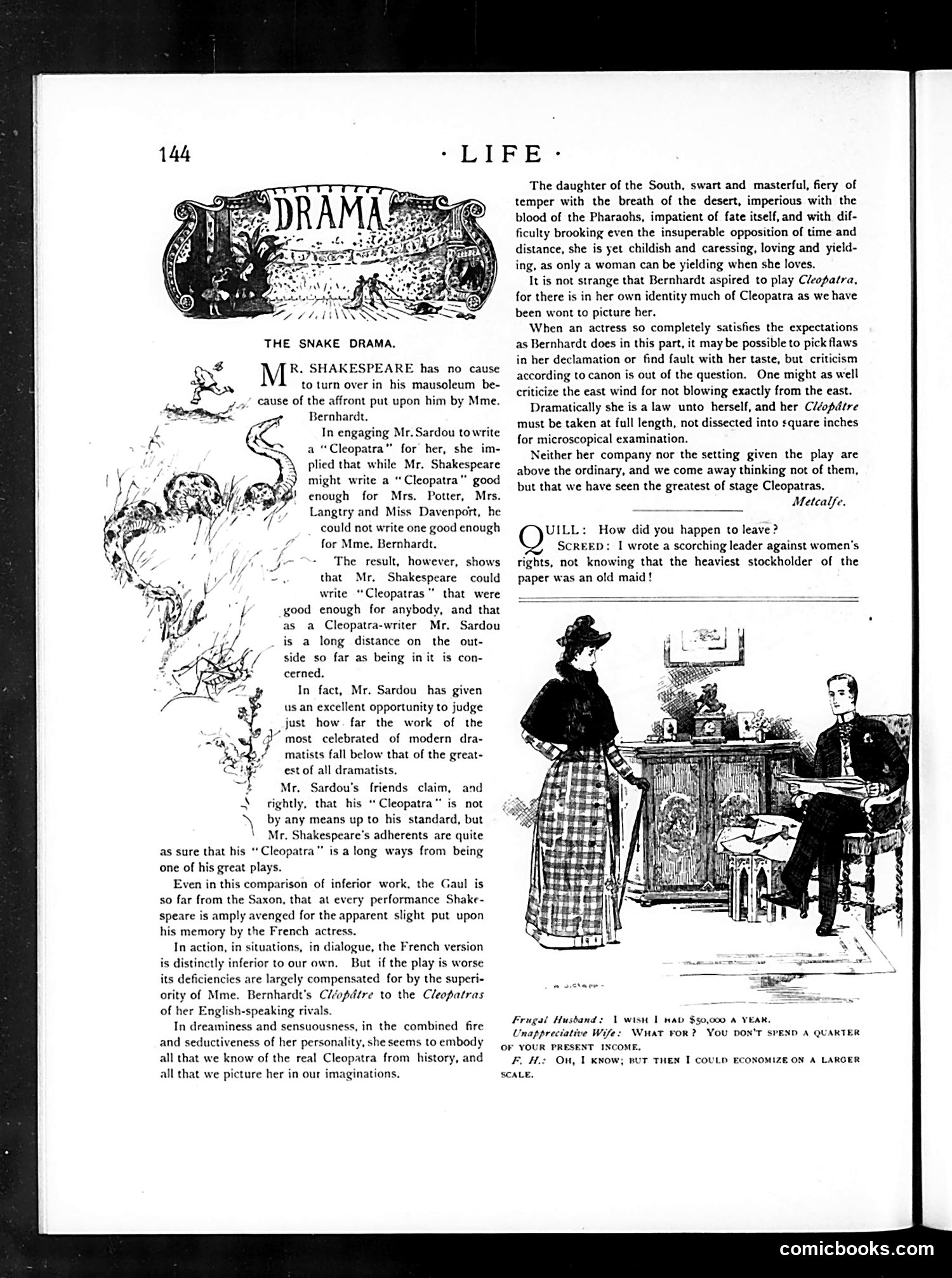
This page critiques **Mr. Sardou's play "Cleopatra,"** likely a recent French theatrical production. The text argues that while Shakespeare could not have written better Cleopatras, Sardou's version falls short of the "greatest of modern dramatists." The satirical point: Sardou's play, despite inferior quality compared to Shakespeare's work, receives acclaim largely due to the superiority of its lead actress (Mme. Bernhardt). The snake illustrations on the left side appear to mock the melodramatic or sensationalized nature of the production. The accompanying illustration shows a domestic scene, possibly referencing the dialogue about financial concerns—a sharp contrast to Cleopatra's grand historical drama, emphasizing the satire's social commentary on theatrical pretension and celebrity worship.
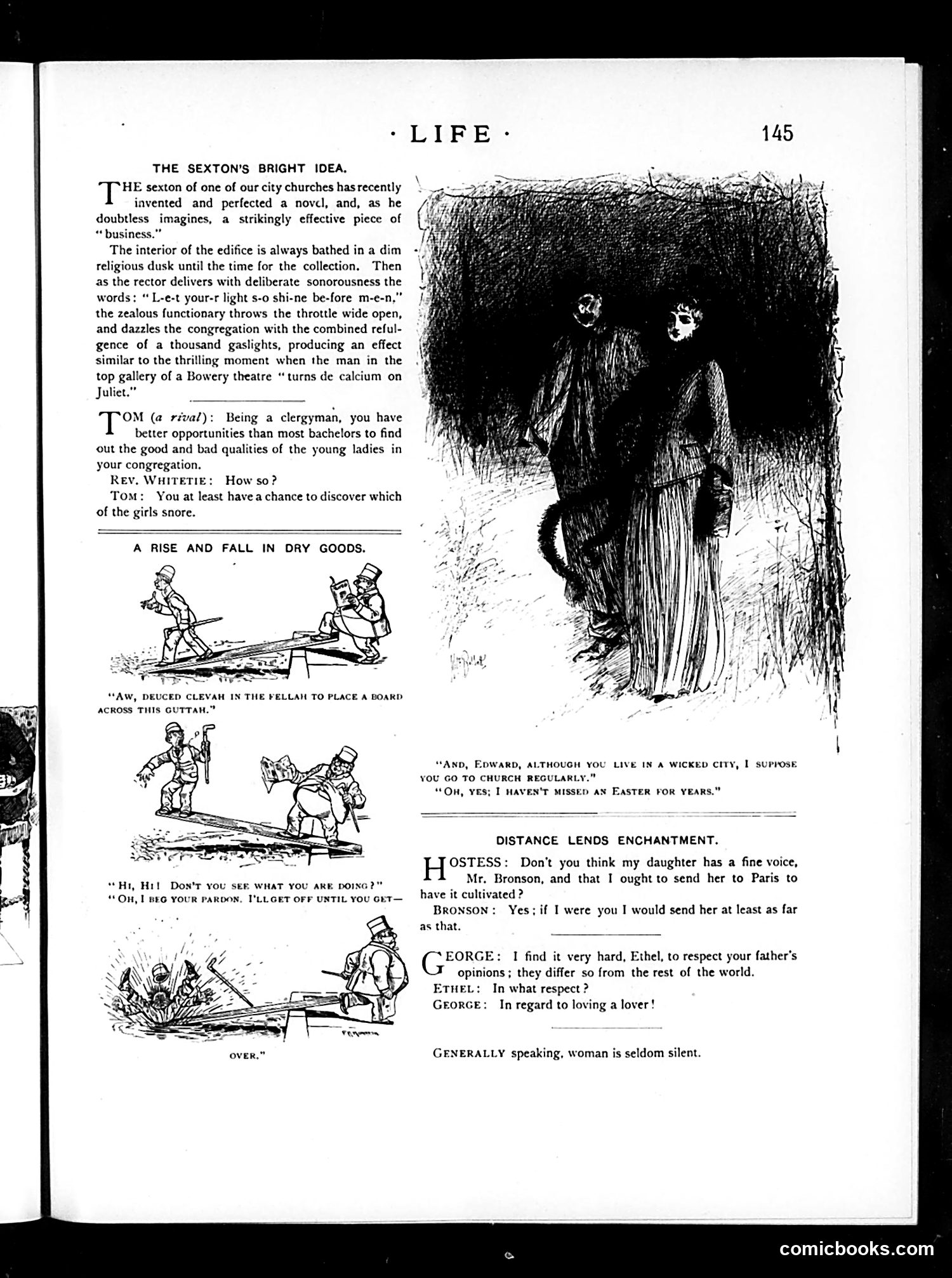
This page contains two distinct sections: **"The Sexton's Bright Idea"** (top): A humorous anecdote about a church official suggesting young women in the congregation undergo evaluation to "discover which of the girls snore" during sermons. The satire mocks both the sexton's invasive proposal and the underlying assumption that women sleep during religious services. **"A Rise and Fall in Dry Goods"** (bottom left): A comic strip showing a man falling into a gutter while carrying lumber, illustrating slapstick physical humor common to the era. **"Distance Lends Enchantment"** (right): A dialogue between characters discussing whether a daughter should be sent to Paris for vocal training. The satire appears to mock affectation and pretension regarding cultural refinement and romantic pursuits. The page reflects early 20th-century satirical humor targeting social conventions, class pretensions, and gender stereotypes.
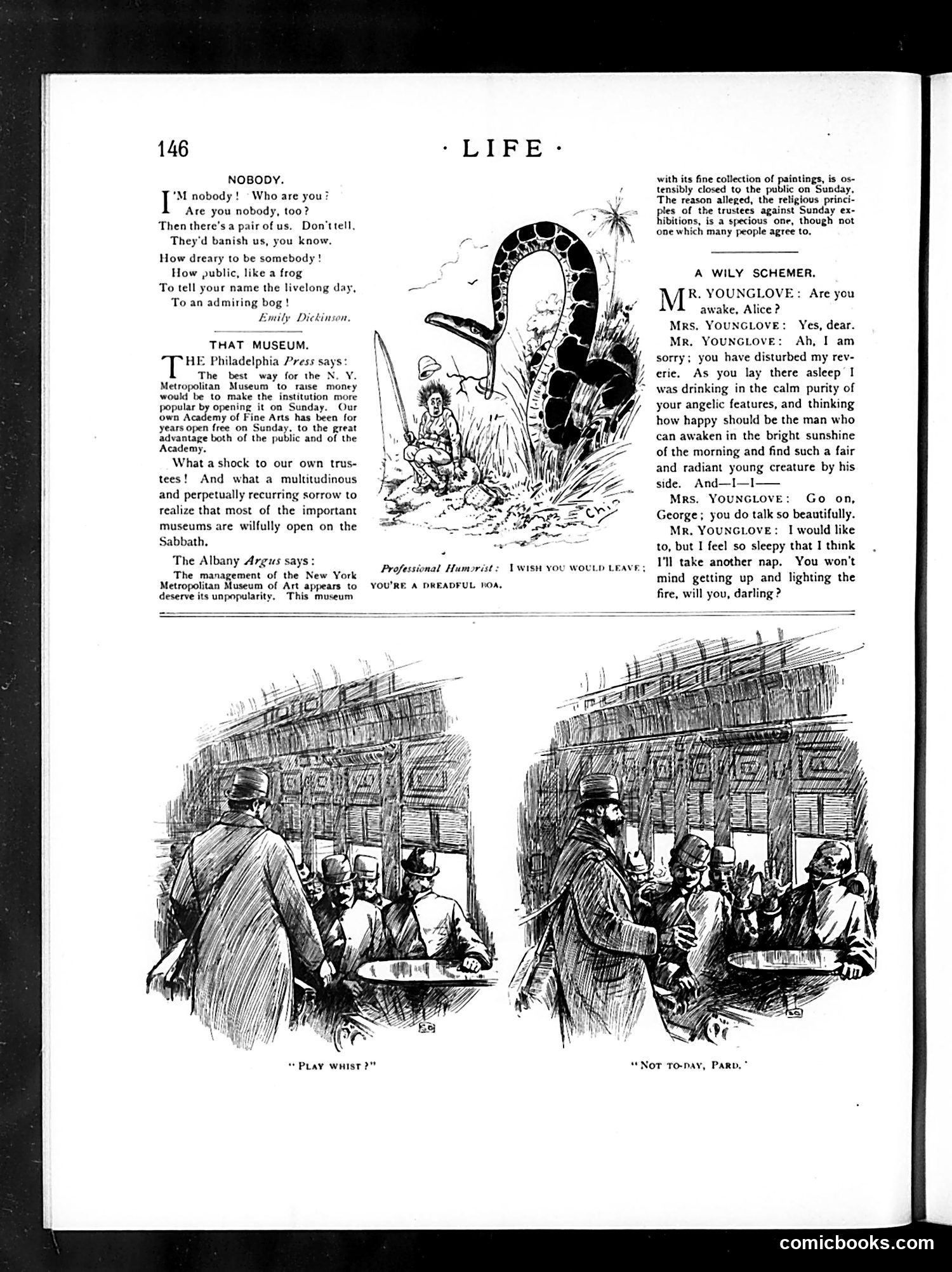
This page contains three distinct satirical pieces: **"Nobody"** reprints an Emily Dickinson poem about the appeal of anonymity versus public prominence—likely included for its thematic irony on the page. **"That Museum"** mocks religious hypocrisy. The Metropolitan Museum's trustees keep it closed Sundays for "religious principles," yet other major institutions (Philadelphia Academy, Albany museums) open freely on the Sabbath. The satire targets the trustees' selective piety—their claim to religious conviction appears false when competitors' morality doesn't prevent them from serving the public. **"A Wily Schemer"** depicts a husband (Mr. Younglove) flattering his wife with flowery romantic language about her beauty and purity, then manipulating her into getting up and lighting the fire while he returns to sleep. The "scheme" is using sentimental talk to avoid his own domestic duties—satire on male manipulation within marriage. The two cartoons below illustrate similar street scenes where men ask to play cards or avoid paying debts.
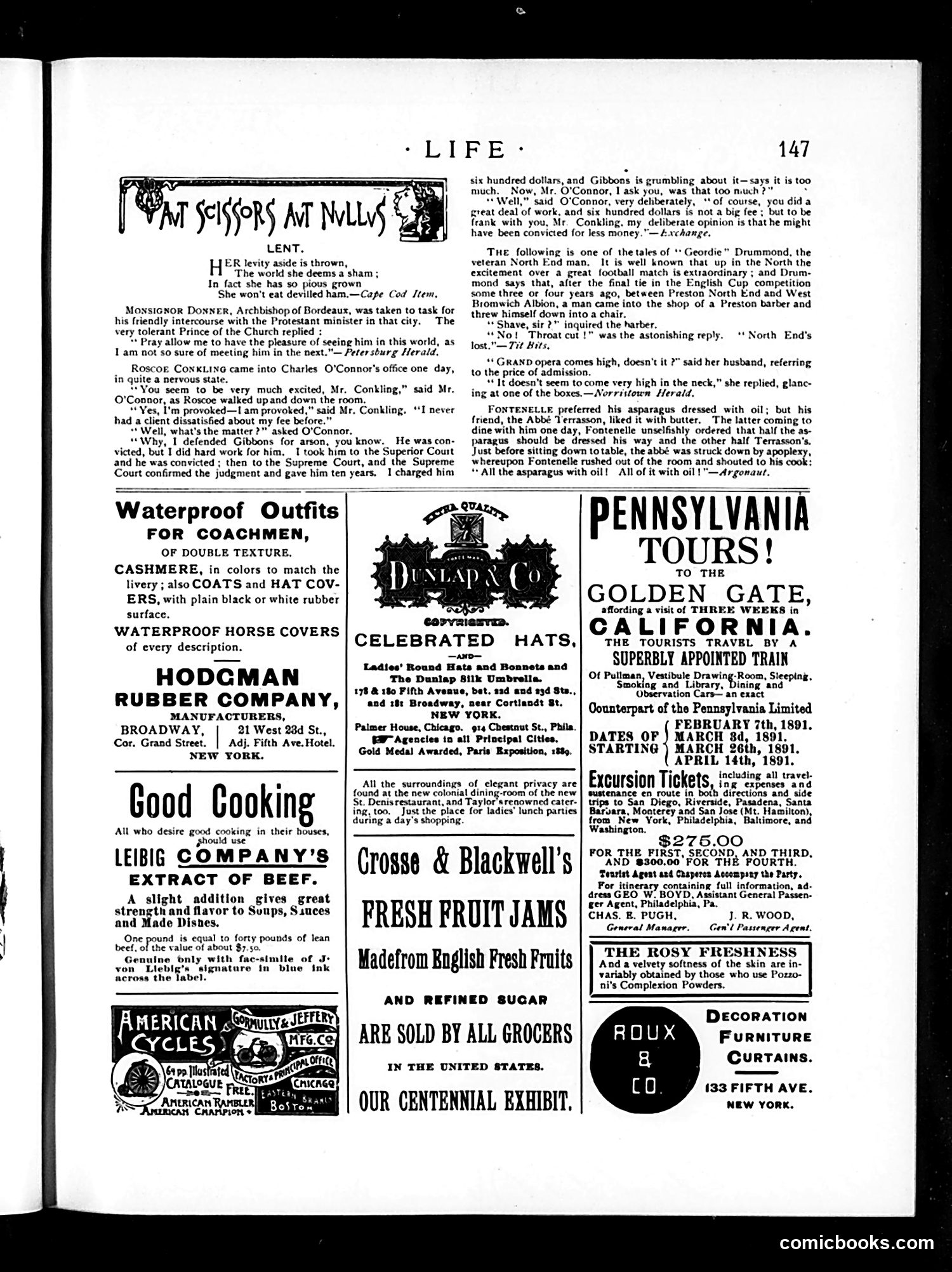
This page from *Life* magazine contains four humorous anecdotes satirizing professional incompetence and social hypocrisy among prominent figures. The central story features **Roscoe Conkling**, a famous 19th-century lawyer, complaining that his client Gibbons is ungrateful for his legal fees despite Conkling getting him convicted and sentenced to ten years in prison. The joke: Conkling's "successful" defense actually resulted in the worst possible outcome, yet he charges full price. O'Connor's response—that Gibbons "might have been convicted for less money"—mocks Conkling's audacity. Other brief jokes target clerical hypocrisy, a distraught barber customer, overpriced opera tickets, and a philosopher's petty selfishness about asparagus preparation. The page is primarily **advertisements** for rubber goods, beef extract, hats, and bicycles. The satire targets wealthy, prominent men's vanity and professional malfeasance—typical *Life* magazine fare mocking the powerful.
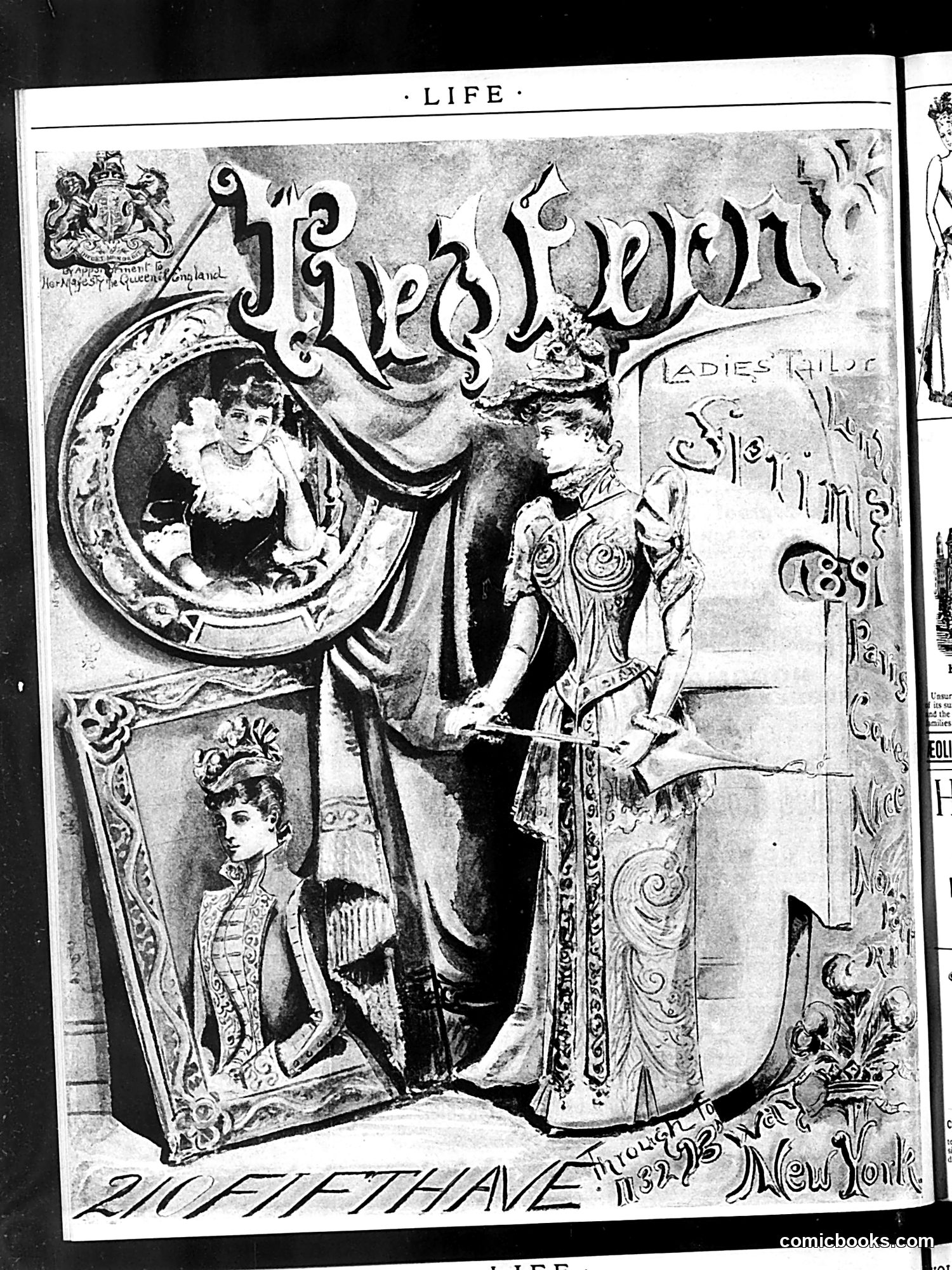
This is a Life magazine cover from November 28, 1895 (New York edition). The ornate decorative frame contains three female figures in elaborate period dress, suggesting a theatrical or society setting. The title "Les Debut" (The Debut) and text referencing "Ladies Tailor" and "Skirt Trimmings" indicate this concerns women's fashion or social presentation. The composition appears to satirize female social debuts or the fashion industry surrounding them—women dressed in ornate, corseted attire typical of 1890s upper-class society. The elaborate decorative border and theatrical framing mock the pretension and artificiality of these social rituals. The specific satirical target remains somewhat unclear without additional context, but it likely critiques either the fashion industry's excess or society women's vanity regarding their public presentation.
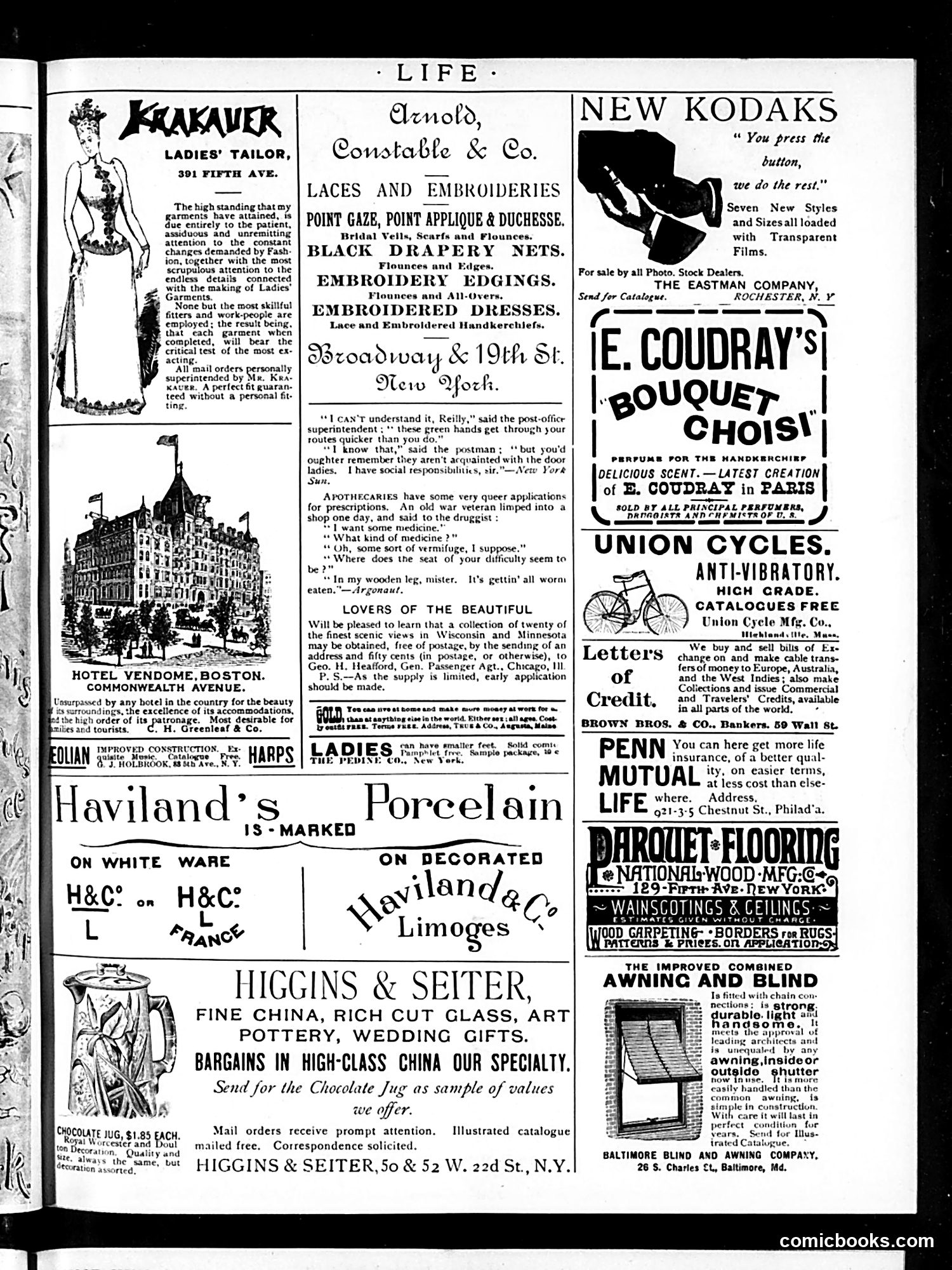
This page is primarily **advertising** for late 19th-century luxury goods (porcelain, laces, bicycles, perfume, cameras), interspersed with brief **humorous anecdotes**. The cartoon humor relies on workplace and social observations: 1. **Postman joke**: A superintendent questions why inexperienced postal carriers complete routes faster than veteran Reilly. Reilly's reply—that young men lack "social responsibilities" with the ladies on his route—satirizes male workplace distraction and flirtation as an accepted occupational hazard. 2. **Veteran's joke**: A war veteran with a wooden leg asks a druggist for vermifuge (worm medicine), claiming "it's gettin' all worn eaten." The humor depends on the double meaning: treating a wooden prosthetic as if it were biological tissue infested with actual worms—absurdist comedy based on the old soldier's deadpan confusion. Both jokes reflect period attitudes toward class, masculinity, and disability with gentle irreverence typical of Life's satirical tone.
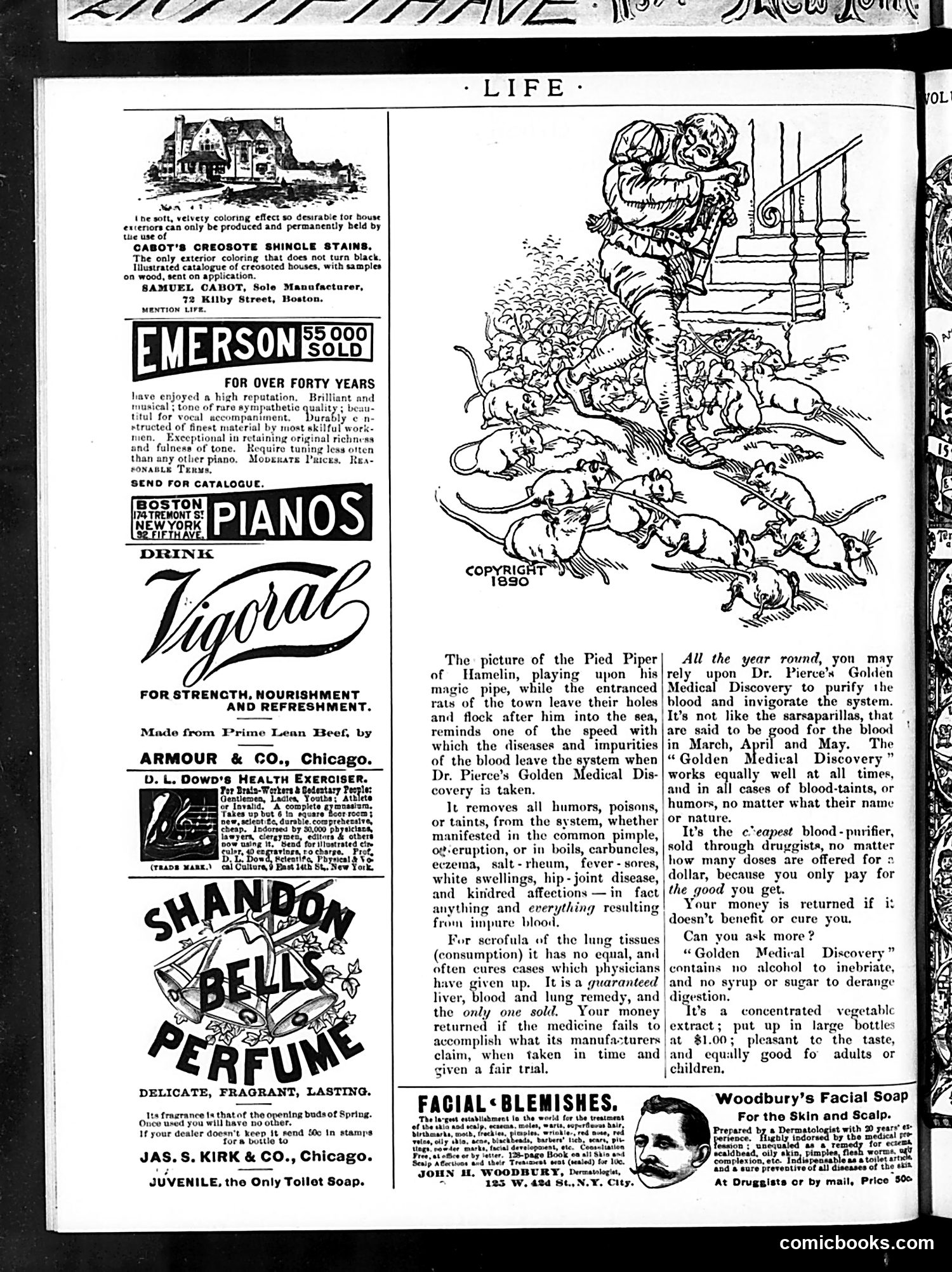
This page is primarily **advertising**, with one notable satirical illustration. The main cartoon depicts the **Pied Piper of Hamelin** leading rats into the sea. The advertisement for **Dr. Pierce's Golden Medical Discovery** (a patent medicine) uses this fairy tale as an extended metaphor: just as the Pied Piper enchanted rats to follow him to their doom, so too does this "blood purifier" supposedly draw diseases and impurities from the body. The satire is implicit: the comparison is absurd and grandiose. A patent medicine is being equated with magical enchantment. The ad makes sweeping claims—curing everything from pimples to consumption (tuberculosis)—with a money-back guarantee that sounds too good to be true (because it was; patent medicines were largely ineffective). The surrounding advertisements (for pianos, stain, beef extract, and soap) represent typical turn-of-the-century consumer goods marketed with exaggerated health and quality claims. This page captures an era when unregulated patent medicines made fantastical promises to gullible consumers.