
Life, 1891-03-05 · page 4 of 16
Life — March 5, 1891 — page 4: what you’re looking at
What you’re looking at
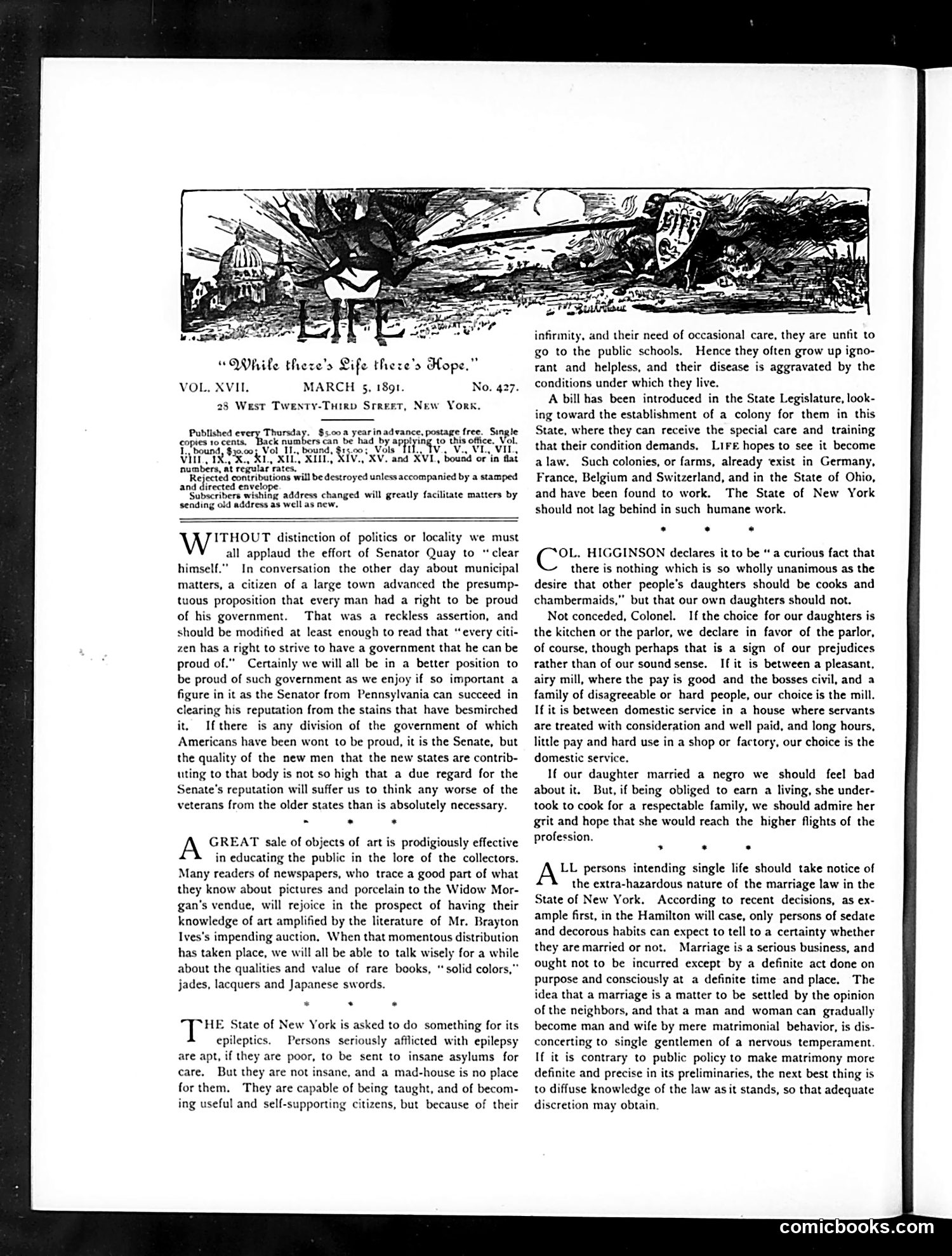
The masthead cartoon depicts a dramatic scene with classical/allegorical figures—likely representing concepts like Liberty or Hope—amid turbulent skies and architectural ruins. The imagery suggests upheaval or crisis, fitting the magazine's satirical purpose. The visible text discusses serious social issues rather than humor: epilepsy care, marriage law reform, and domestic service conditions. One section critiques Senator Quay's reputation and government accountability. Another debates whether daughters should become domestic servants, engaging class and gender questions of the era. The magazine appears to blend satirical commentary with social advocacy—using illustration and editorial essays to address contemporary policy concerns rather than relying primarily on cartoon jokes. This represents Life's role as a progressive-leaning publication addressing early 20th-century social reform issues.
📄 Transcribed text from this page (OCR, searchable)
Machine-transcribed from the original scan — historical spelling and the odd misread are preserved.
“While there's Life there's Hope.” VOL, XVII. MARCH 5, 1891. 28 West Twenty-Tuirp Srreet, New York. No. 427. yThorsday. 83.008 year in advance, postage free. Single 1 Published ev gonies to cents, Back numbers canbe had by appiying 0 his fice. Vel. 1,, bound, 00; Vol_II., bound, $15.00; Vols. Vi TR ERTL, Riis RIVE, XV and XVI, bousd rin fad numbers, at regular rates.” Rejected contributions will be destroyed unless accompanied by a stamped and directed envelope ; Subscribers wishing address changed will greatly facilitate matters by sending old address as well as new, ITHOUT distinction of politics or locality we must all applaud the effort of Senator Quay to “clear himself.” In conversation the other day about municipal matters, a citizen of a large town advanced the presump- tuous proposition that every man had a right to be proud of his government. That was a reckless assertion, and should be modified at least enough to read that “every citi- zen has a right to strive to have a government that he can be proud of.” Certainly we will all be in a better position to be proud of such government as we enjoy if so important a figure in it as the Senator from Pennsylvania can succeed in clearing his reputation from the stains that have besmirched it, Ifthere is any division of the government of which Americans have been wont to be proud, it is the Senate, but the quality of the new men that the new states are contrib- uting to that body is not so high that a due regard for the Senate's reputation will suffer us to think any worse of the veterans from the older states than is absolutely necessary. GREAT sale of objects of art is prodigiously effective in educating the public in the lore of the collectors. Many readers of newspapers, who trace a good part of what they know about pictures and porcelain to the Widow Mor- gan’s vendue, will rejoice in the prospect of having their knowledge of art amplified by the literature of Mr. Brayton Ives's impending auction, When that momentous distribution has taken place, we will all be able to talk wisely for a whil about the qualities and value of rare books, “solid colors,” jades, lacquers and Japanese swords. TR State of New York is asked to do something for its epileptics. Persons seriously afflicted with epilepsy are apt, if they are poor, to be sent to insane asylums for care, But they are not insane, and a mad-house is no place for them. They are capable of being taught, and of becom- ing useful and self-supporting citizens, but because of their infirmity, and their need of occasional care, they are unfit to go to the public schools. Hence they often grow up igno- rant and helpless, and their disease is aggravated by the conditions under which they live. A bill has been introduced in the State Legislature, look- ing toward the establishment of a colony for them in this State, where they can receive the special care and training that their condition demands. Lire hopes to see it become alaw. Such colonies, or farms, already ‘exist in Germany, France, Belgium and Switzerland, and in the State of Ohio, and have been found to work. The State of New York should not lag behind in such humane work. OL. HIGGINSON declares it to be “a curious fact that there is nothing which is so wholly unanimous as the desire that other people’s daughters should be cooks and chambermaids,” but that our own daughters should not. Not conceded, Colonel. If the choice for our daughters is the kitchen or the parlor, we declare in favor of the parlor, of course, though perhaps that is a sign of our prejudices rather than of our sound sense. If it is between a pleasant, airy mill, where the pay is good and the bosses civil, and a family of disagreeable or hard people, our choice is the mill. If it is between domestic service in a house where servants are treated with consideration and well paid, and long hours, little pay and hard use in a shop or factory, our choice is the domestic service, If our daughter married a negro we should feel bad about it. But, if being obliged to earn a living, she under- took to cook for a respectable family, we should admire her grit and hope that she would reach the higher flights of the profession. > . . LL persons intending single life should take notice of the extra-hazardous nature of the marriage law in the State of New York. According to recent decisions, as ex- ample first, in the Hamilton will case, only persons of sedate and decorous habits can expect to tell to a certainty whether they are married or not. Marriage is a serious business, and ought not to be incurred except by a definite act done on purpose and consciously at a definite time and place. The idea that a marriage is a matter to be settled by the opinion of the neighbors, and that a man and woman can gradually become man and wife by mere matrimonial behavior, is dis- concerting to single gentlemen of a nervous temperament. If it is contrary to public policy to make matrimony more definite and precise in its preliminaries, the next best thing is to diffuse knowledge of the law as it stands, so that adequate discretion may obtain. comicbooks.com