
Life, 1891-03-05 · page 6 of 16
Life — March 5, 1891 — page 6: what you’re looking at
What you’re looking at
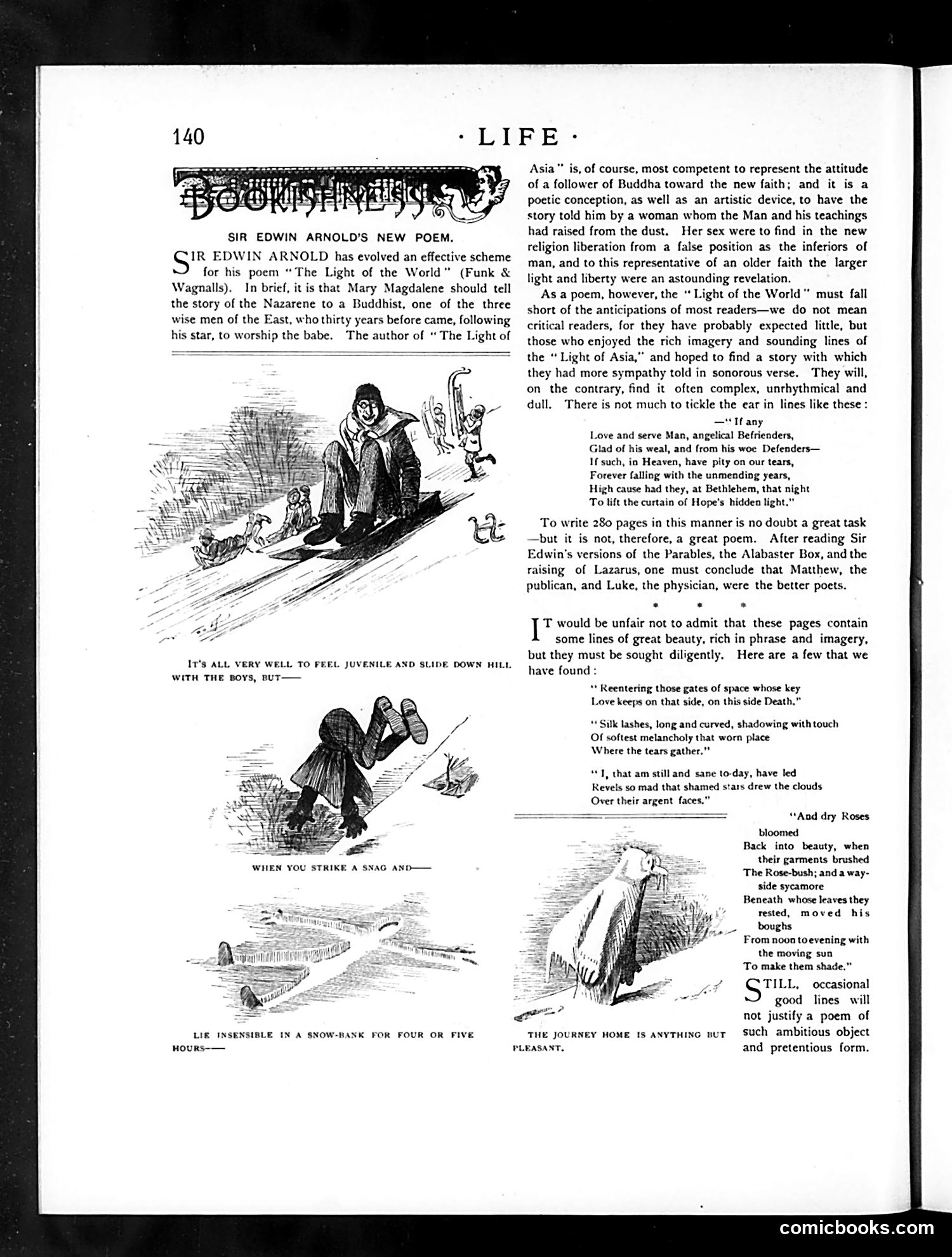
This page reviews Sir Edwin Arnold's poem "The Light of the World," which retells the nativity story with Mary Magdalene as narrator. The reviewer critiques Arnold's ambitious but flawed work, arguing that while it contains occasional beautiful lines, it ultimately fails as great poetry compared to the biblical accounts themselves (Matthew, Mark, Luke, and John). The illustrations are generic Victorian-era sketches depicting winter scenes—sledding children and snowy landscapes—unrelated to the poem's subject matter. They appear to be decorative filler rather than commentary. The satire is literary rather than political: the reviewer employs gentle mockery of Arnold's pretentious attempt to improve upon scripture through poetic embellishment, suggesting that some tasks—however worthy—don't necessarily produce great art.
📄 Transcribed text from this page (OCR, searchable)
Machine-transcribed from the original scan — historical spelling and the odd misread are preserved.
“LEE - Asia” is, of course, most competent to represent the attitude of a follower of Buddha toward the new faith; and it is a poetic conception, as well as an artistic device, to have the story told him by a woman whom the Man and his teachings had raised from the dust. Her sex were to find in the new ™ . € s religion liberation from a false position as the inferiors of IR EDWIN A RNOLD has evolved 20, effective scheme ae and to this representative ue older faith the larger for his poem “T he Light of the World” (Funk & light and liberty were an astounding revelation. Wagnalls). In brief, it is that Mary Magdalene should tell As a poem, however, the “ Light of the World" must fall the story of the Nazarene toa Buddhist, one of the three short of the anticipations of most readers—we do not mean wise men of the East, who thirty years before came, following critical readers, for they have probably expected little, but his star, to worship the babe. The author of “The Light of those who enjoyed the rich imagery and sounding lines of = the * Light of Asia,” and hoped to find a story with which they had more sympathy told in sonorous verse. They will, on the contrary, find it often complex, unrhythmical and dull. There is not much to tickle the ear in lines like these : —“Ifany Love and serve Man, angelical Befrienders, Glad of his weal, and from his woe Defenders— If such, in Heaven, have pity on our tears, Forever falling with the unmending years, High cause had they, at Bethlehem, that night To lift the curtain of Hope's hidden light.” SIR EDWIN ARNOLD'S NEW POEM. To write 280 pages in this manner is no doubt a great task —but it is not, therefore, a great poem. After reading Sir Edwin's versions of the Parables, the Alabaster Box, and the raising of Lazarus, one must conclude that Matthew, the publican, and Luke, the physician, were the better poets. . . * T would be unfair not to admit that these pages contain a some lines of great beauty, rich in phrase and imagery, but they must be sought diligently. Here are a few that we have found : ** Reentering those gates of space whose key Love keeps on that side, on this side Death.” It's ALL VERY WELL TO FEEL JUVENILE AND SLIDE DOWN HILL WITH THE Boys, BUT— “Silk lashes, long and curved, shadowing with touch Of softest melancholy that worn place Where the tears gather.” “+1, that am still and sane to-day, have led Revels so mad that shamed stats drew the clouds Over their argent faces.” = — “And dry Roses bloomed Back into beauty, when their garments brushed The Rose-bush; and a way- side sycamore Beneath whose leaves they rested, moved his boughs From noon toevening with the moving sun To make them shade.” TILL, occasional good lines will not justify a poem of LIK INSENSIBLE IN A SNOW-BANK FOR FOUR OR FIVE Tie JOURNEY HOME 1s aNyTHING nut Such ambitious object HoURS-— PLEASANT, and pretentious form. comicbooks.com