
A complete issue · 14 pages · 1891
Life — February 19, 1891
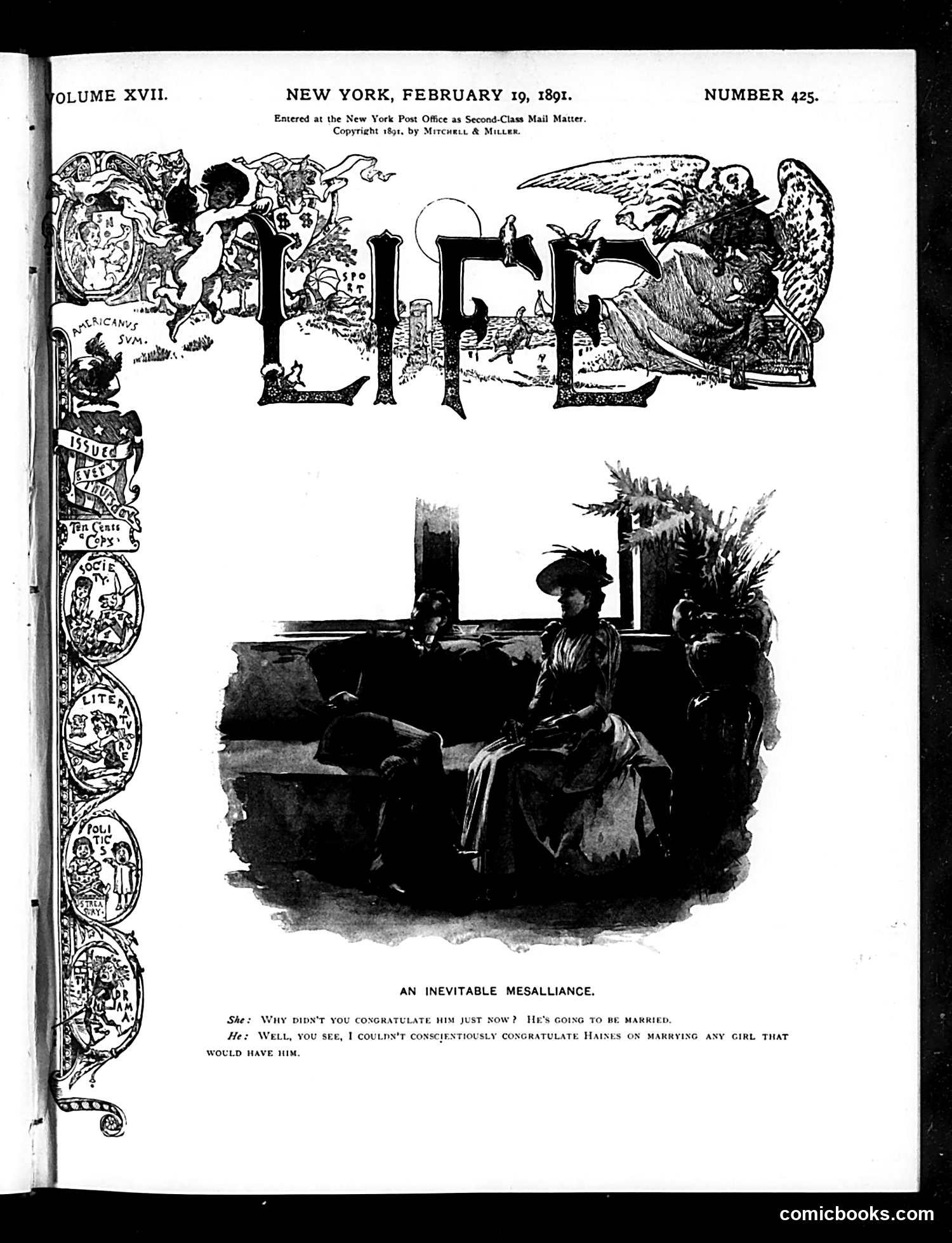
This satirical cartoon depicts a conversation between a man and woman about an impending marriage. The woman asks why he hasn't congratulated the groom, who is "going to be married." The man responds that he cannot conscientiously congratulate someone marrying "any girl that would have him." The joke relies on self-deprecating humor: the man implies the prospective groom must be so undesirable that only a woman of questionable judgment would accept him. The title "An Inevitable Mesalliance" (an unsuitable marriage) suggests the union is a mismatch—though the satire's target remains ambiguous. It could reference a specific contemporary marriage or serve as general social commentary on matrimonial mismatches among the era's upper classes.
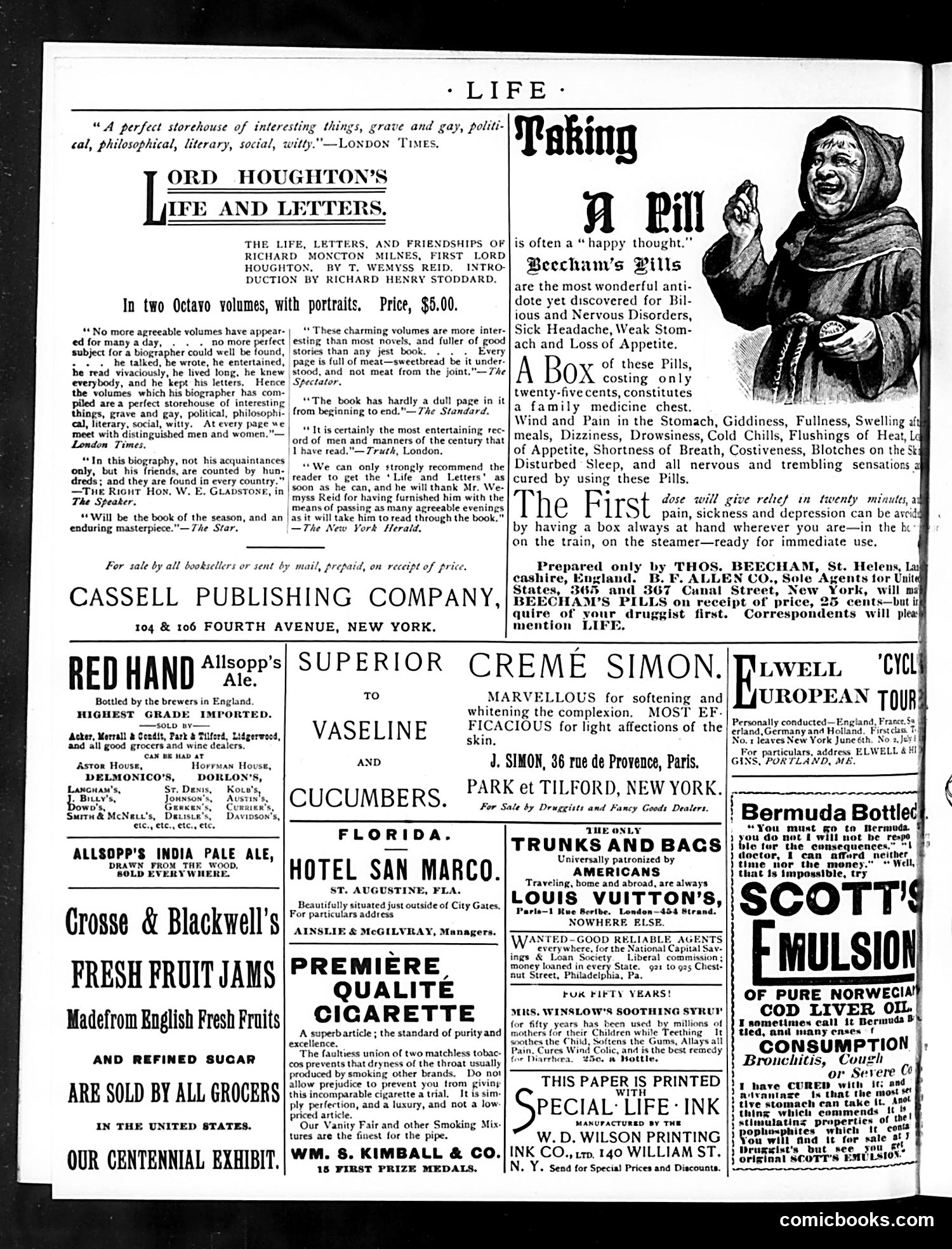
This page is **primarily advertisements** with one small cartoon illustration. The main visual element is a caricatured figure taking a pill—labeled "Taking a Pill"—promoting Beecham's Pills, a patent medicine for digestive complaints. The cartoon likely plays on the phrase "happy thought," suggesting that taking this pill constitutes a pleasant idea. The exaggerated facial expression and hood convey the relief the product supposedly provides. The rest of the page contains period advertisements: Lord Houghton's biography, Red Hand Ale, Allsopp's beer, furniture polish, hotel accommodations, Louis Vuitton luggage, Mrs. Winslow's Soothing Syrup for infants, and printing ink. This represents typical **late 19th/early 20th-century Life magazine content**, mixing satirical humor with lucrative patent-medicine advertising.
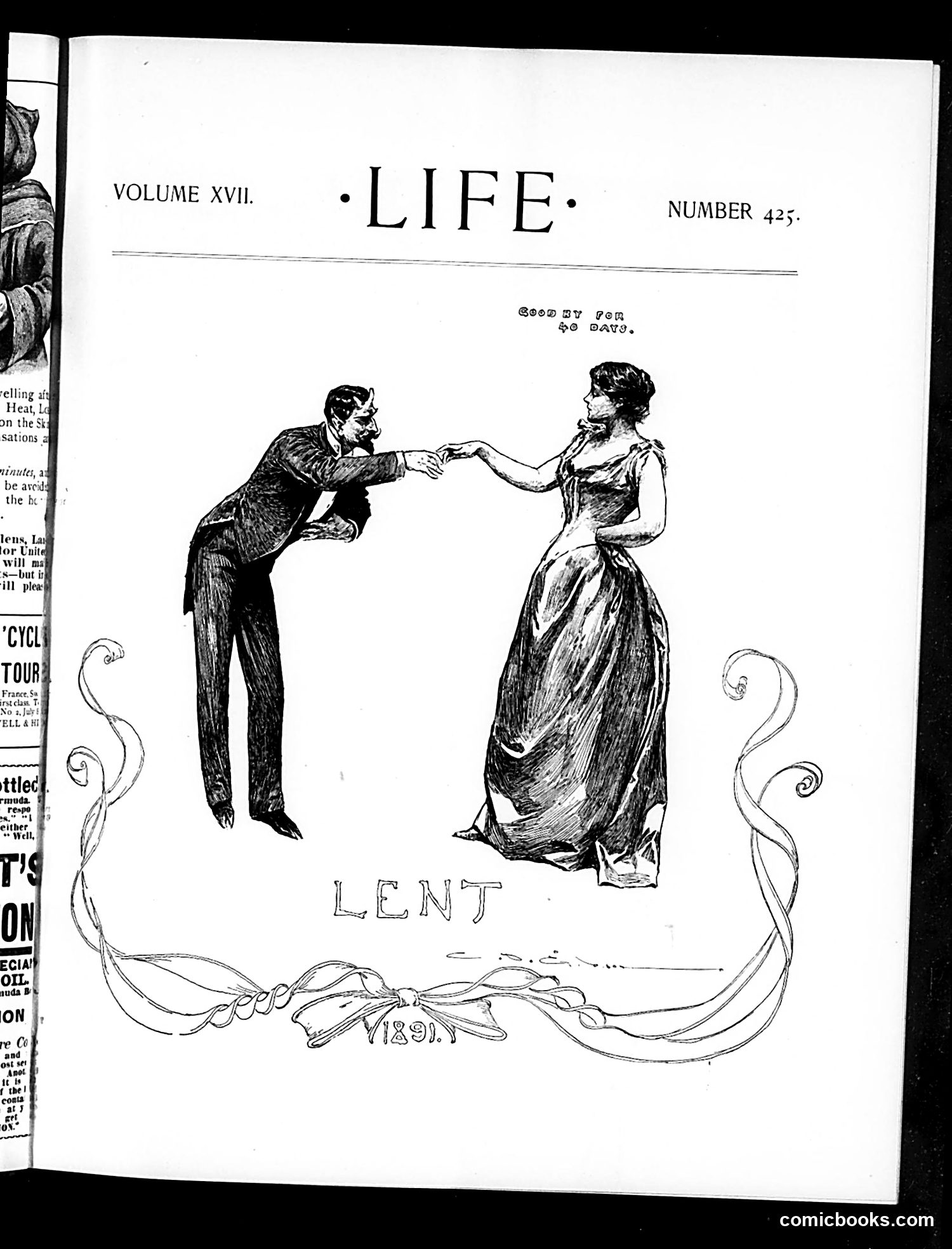
This 1891 Life magazine cover depicts a couple exchanging what appears to be a farewell handshake or kiss, captioned "LENT." The illustration satirizes the social practice of Lenten sacrifice during the Catholic season preceding Easter. The cartoon likely mocks the superficial nature of Lenten observance—particularly among the wealthy or fashionable classes—suggesting that giving up pleasures (represented by the couple's separation) was merely a temporary, performative gesture. The man's exaggerated bow and formal dress contrast with the woman's elegant gown, emphasizing the social theatricality of the ritual. The title implies casual indifference to the separation, suggesting the satirist viewed Lenten piety as insincere social convention rather than genuine spiritual commitment.
The page contains editorial commentary rather than a political cartoon. The header illustration is decorative/generic rather than satirical. The text discusses marriage cynically, noting that while "Marriage is doing pretty well," most happy marriages "make no talk" while divorces are visible. The editor claims one in twenty marriages fails—a relatively optimistic statistic for the era. A separate section sarcastically attacks American Senators regarding international copyright legislation, accusing them of neglecting "a matter of simple justice" while obsessing over political questions. This appears to reference contemporary copyright disputes between the U.S. and Britain. The page lacks sharp caricature or visual satire; it relies on written argument and irony to make its social and political points about marriage statistics and legislative priorities.
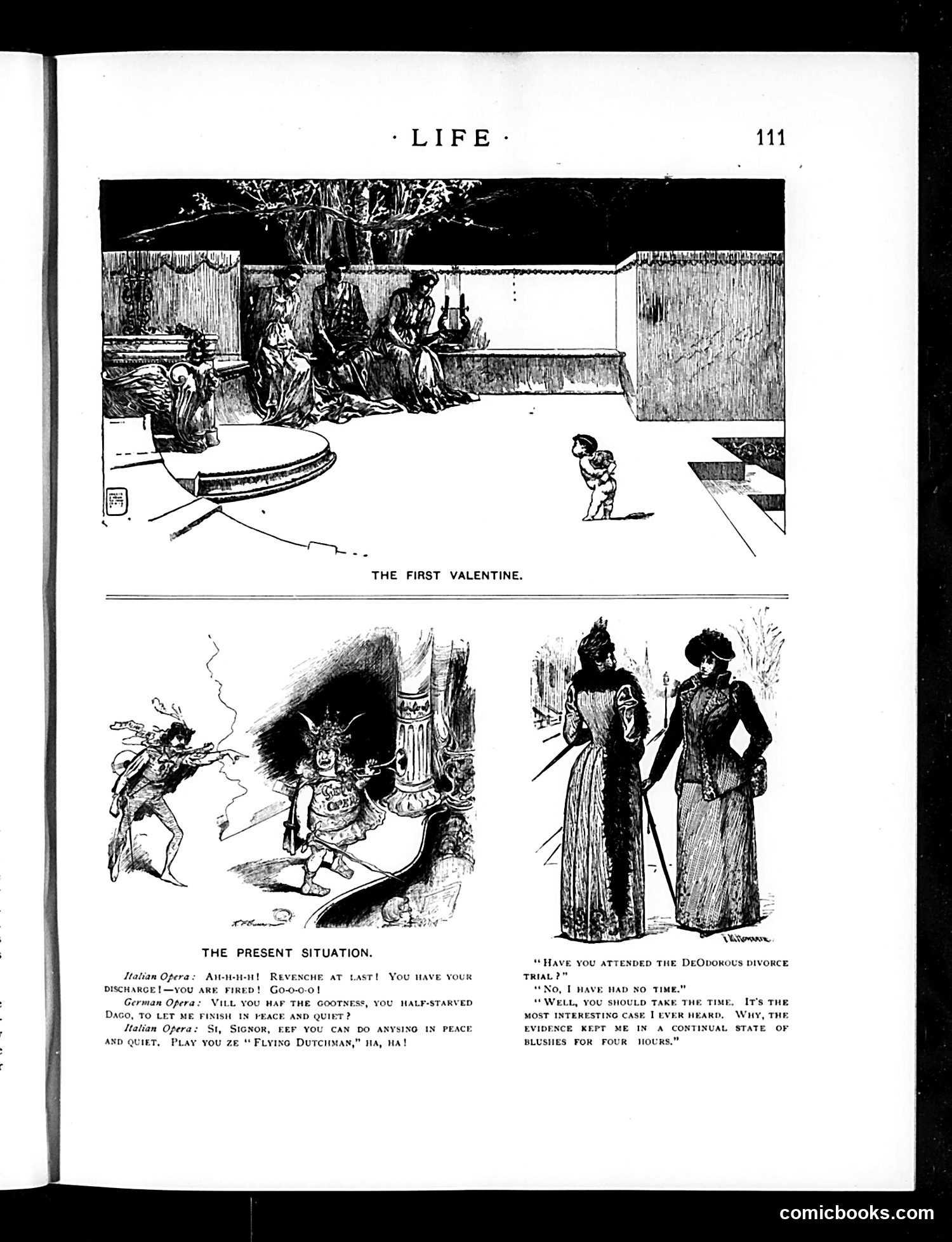
This page contains three satirical illustrations about Valentine's Day and romantic/legal matters: **"The First Valentine"** depicts a child offering a heart-shaped valentine to adults in a garden setting. **"The Present Situation"** shows operatic characters in dramatic conflict, with Italian and German opera stage directions. The satire appears to reference international tensions, possibly WWI-era, using opera as metaphor for diplomatic conflict. **"Have You Attended the DeHorous Divorce Trial?"** features two women discussing a sensational court case. One mentions the evidence "kept me in a continual state of blushes for four hours," suggesting the trial involved scandalous testimony. The satire mocks contemporary society's fascination with divorce proceedings as entertainment. The page satirizes American culture's romantic pretenses, international conflict, and tabloid-style legal sensationalism.
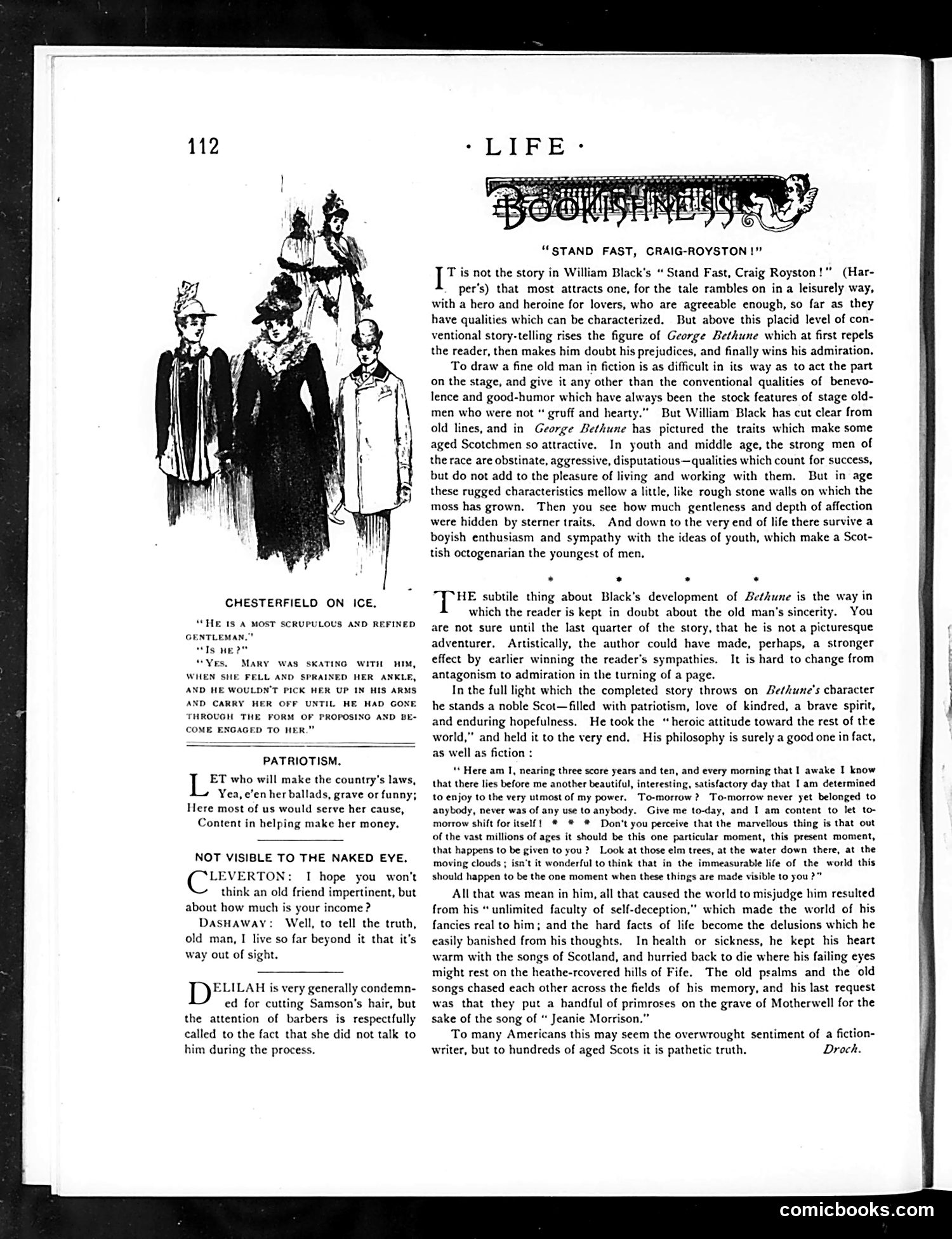
This page is primarily **literary criticism rather than political satire**. It reviews William Black's novel *"Stand Fast, Craig-Royston!"* and discusses another work titled *George Bethune*. The small illustration labeled "CHESTERFIELD ON ICE" shows figures ice-skating and appears to be a separate, unrelated sketch—likely a social comment on upper-class winter recreation rather than political commentary. The remaining content consists of three brief dialogue snippets ("Patriotism," "Not Visible to the Naked Eye," and "Delilah") that are humorous observations about daily life—taxation, income inequality, and social hypocrisy—rather than satirizing specific political figures or events. **This is primarily a literary and humor page**, not a political cartoon page.
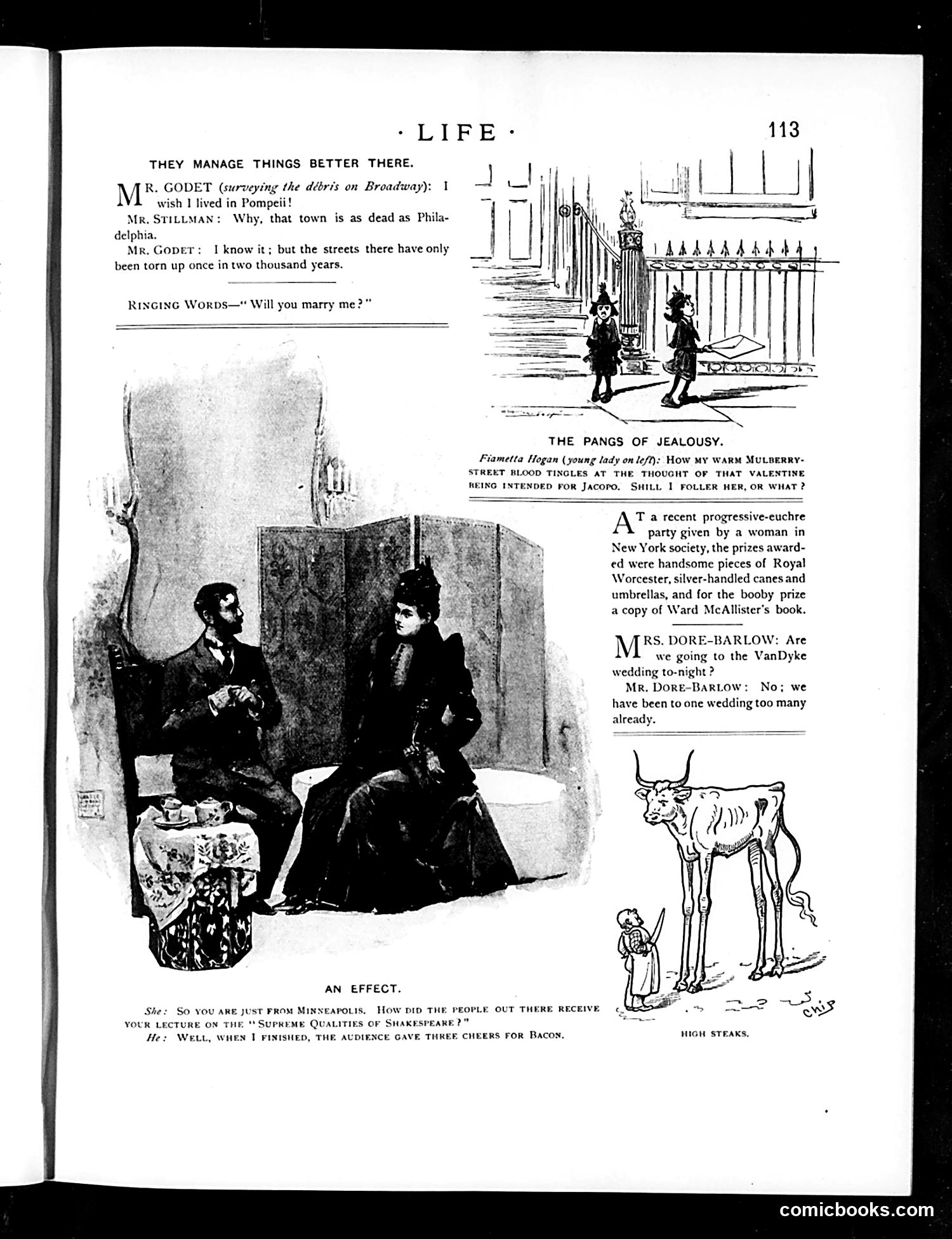
This page contains three unrelated humor pieces typical of early-20th-century satirical magazines: 1. **"They Manage Things Better There"**: A brief dialogue where Mr. Godet wishes he lived in Pompeii because the streets there have only been torn up once in two thousand years—a joke about chronic street construction in American cities. 2. **"The Pangs of Jealousy"**: A sketch depicting society figure Fiametta Hogan questioning a suitor about his attentions to another woman, mocking aristocratic social anxieties. 3. **"An Effect"** and other vignettes: Brief conversational jokes about weddings, lectures, and cattle ("High Steaks"). The page reflects turn-of-the-century urban life, social pretension, and wordplay humor common to the era. No specific political figures or events appear identifiable.
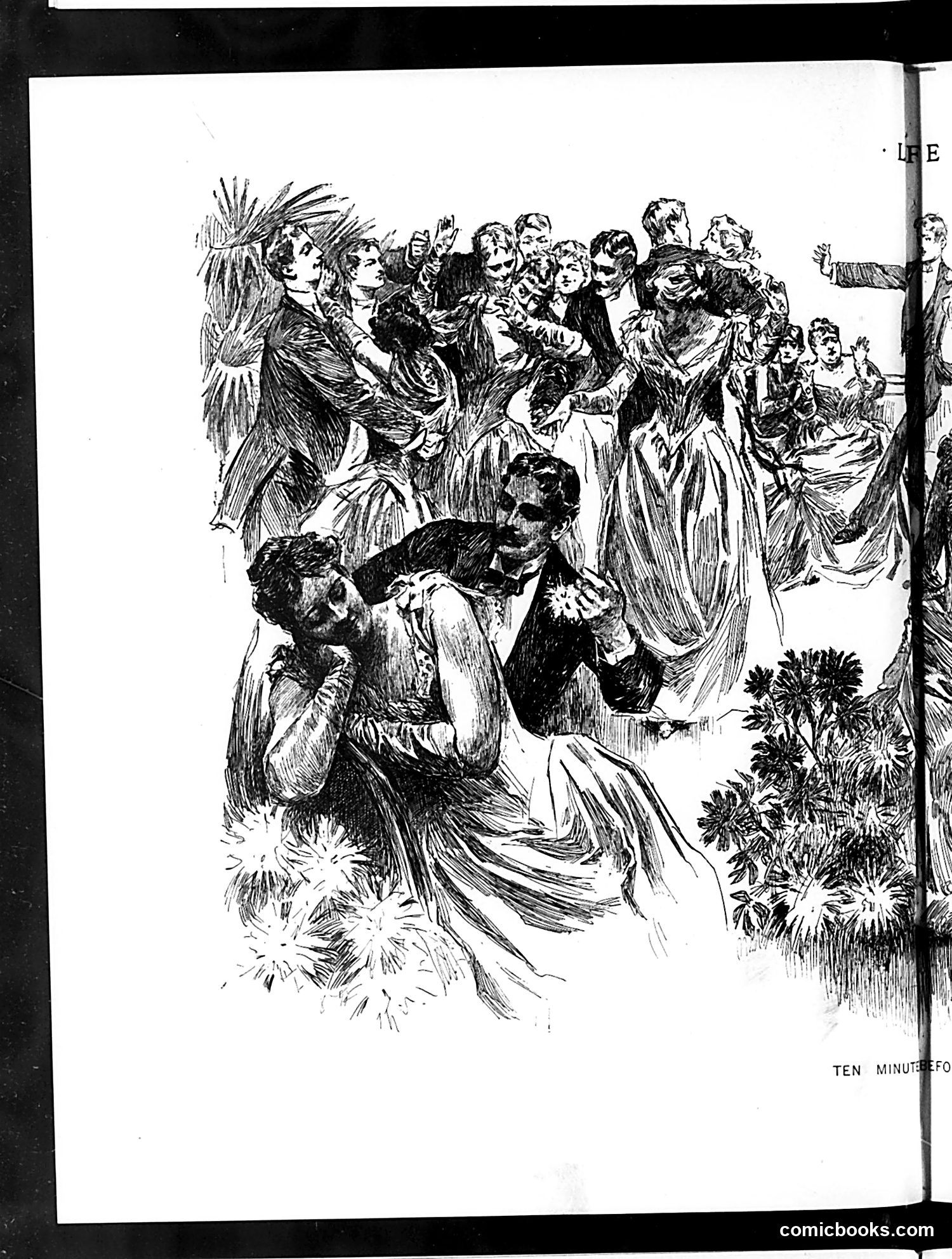
This appears to be a social satire illustration from Life magazine, though the OCR text provided contains only "TEN MINUTES" (possibly "TEN MINUTES BEFORE" or similar), which is insufficient for full context. The image depicts a formal Victorian-era social gathering, likely a ball or reception. The composition shows contrasting figures: well-dressed gentlemen in the foreground appear distressed or agitated, while an elaborate crowd of fashionably-dressed women and society figures stands behind them. The flowering plants and decorative elements suggest an upper-class venue. The satire likely mocks Victorian social conventions, possibly commenting on courtship rituals, social anxiety, or the pretensions of high society. Without complete text, the specific target remains unclear—whether the joke concerns romantic desperation, social climbing, or the absurdities of formal etiquette itself.
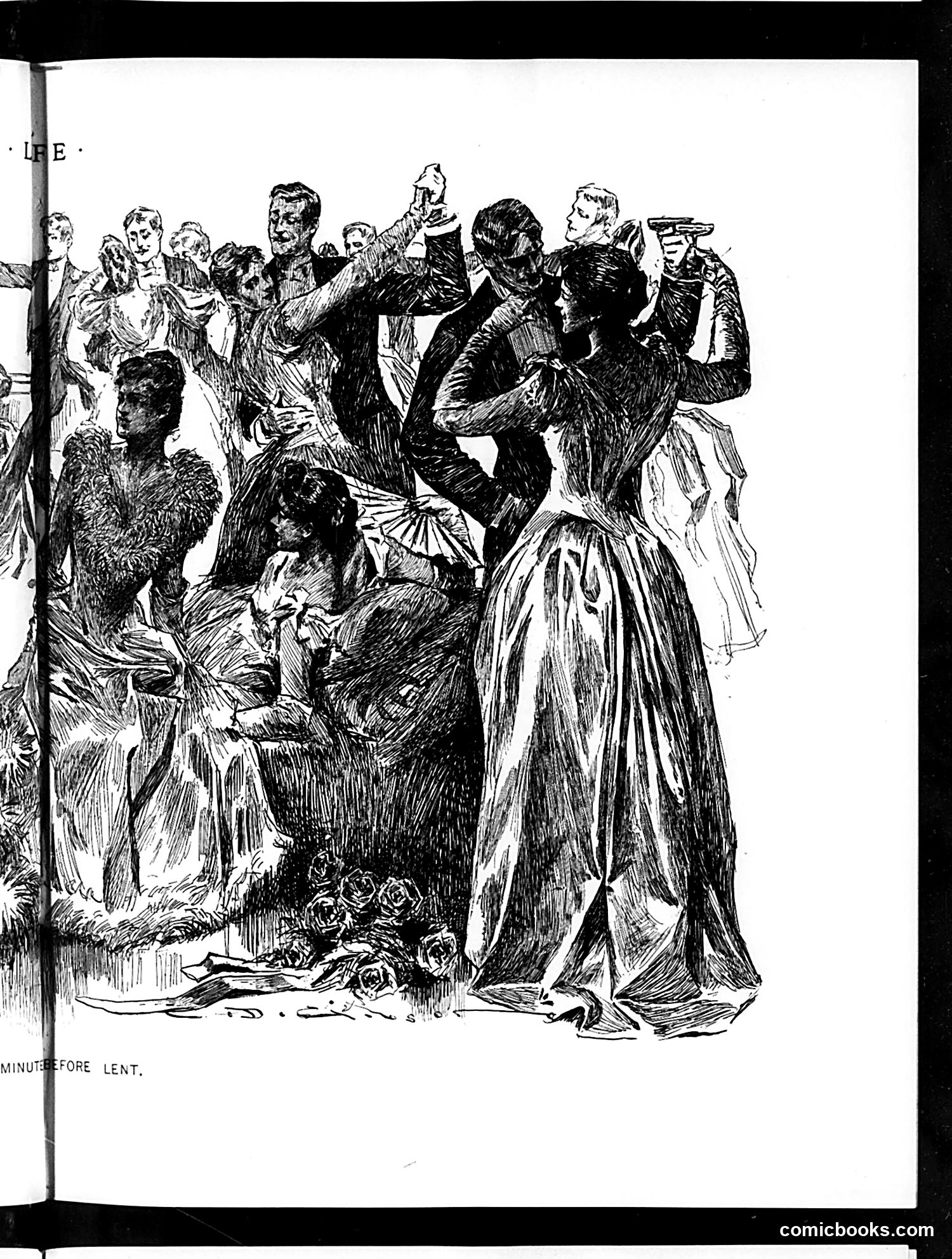
This appears to be a Victorian-era satirical illustration titled "Minute Before Lent," depicting a formal social gathering or ball scene. The engraving shows elegantly dressed figures in period costume, with women in elaborate gowns (including one with a large cape in the foreground) and men in formal wear. The satire likely critiques the hypocrisy of pre-Lenten revelry—the tradition of indulgence immediately before the Christian season of fasting and penance. The crowded, somewhat chaotic gathering suggests excess and frivolity that will abruptly end with Lenten observance. The title emphasizes this temporal irony: these figures are enjoying themselves at the "last minute" before religious restraint begins. The specific identities of the caricatured figures are unclear from the image alone.
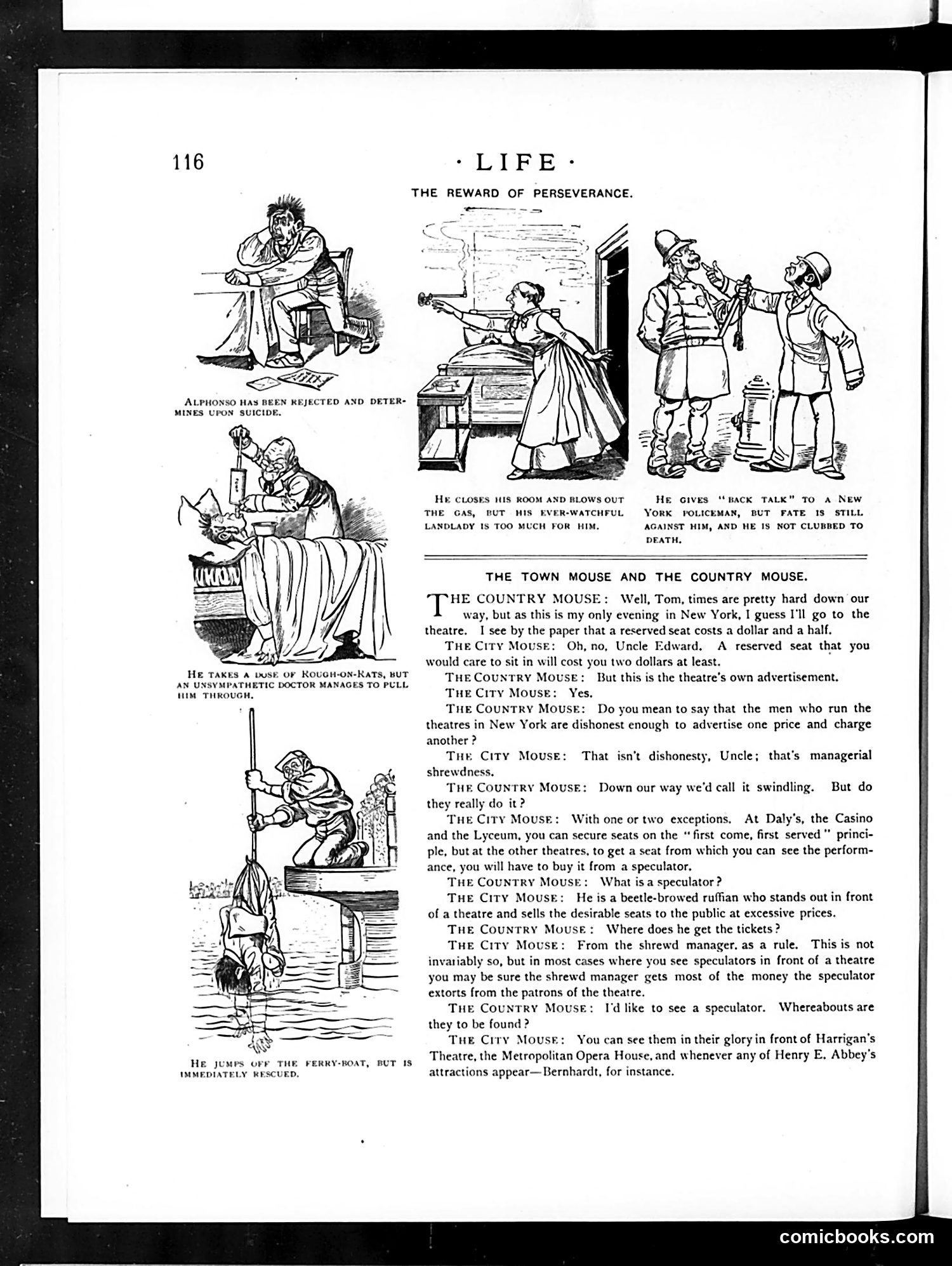
**Top Section:** A four-panel narrative about "Alphonso" depicts a man rejected in love who attempts suicide (gas), closes his door, and eventually encounters New York City policemen. The final panel shows he survives, suggesting perseverance through hardship yields redemption. **Bottom Section:** "The Town Mouse and the Country Mouse" is a satirical dialogue mocking New York City theater practices. The Country Mouse questions why reserved theater seats cost extra when already advertised. The City Mouse explains that speculators—"beetle-browed ruffians" standing outside theaters—buy desirable seats and resell them at markups to patrons, a widespread ticket-scalping practice the magazine ridicules as dishonest and exploitative. The satire targets both theater management complicity and urban scalping culture.
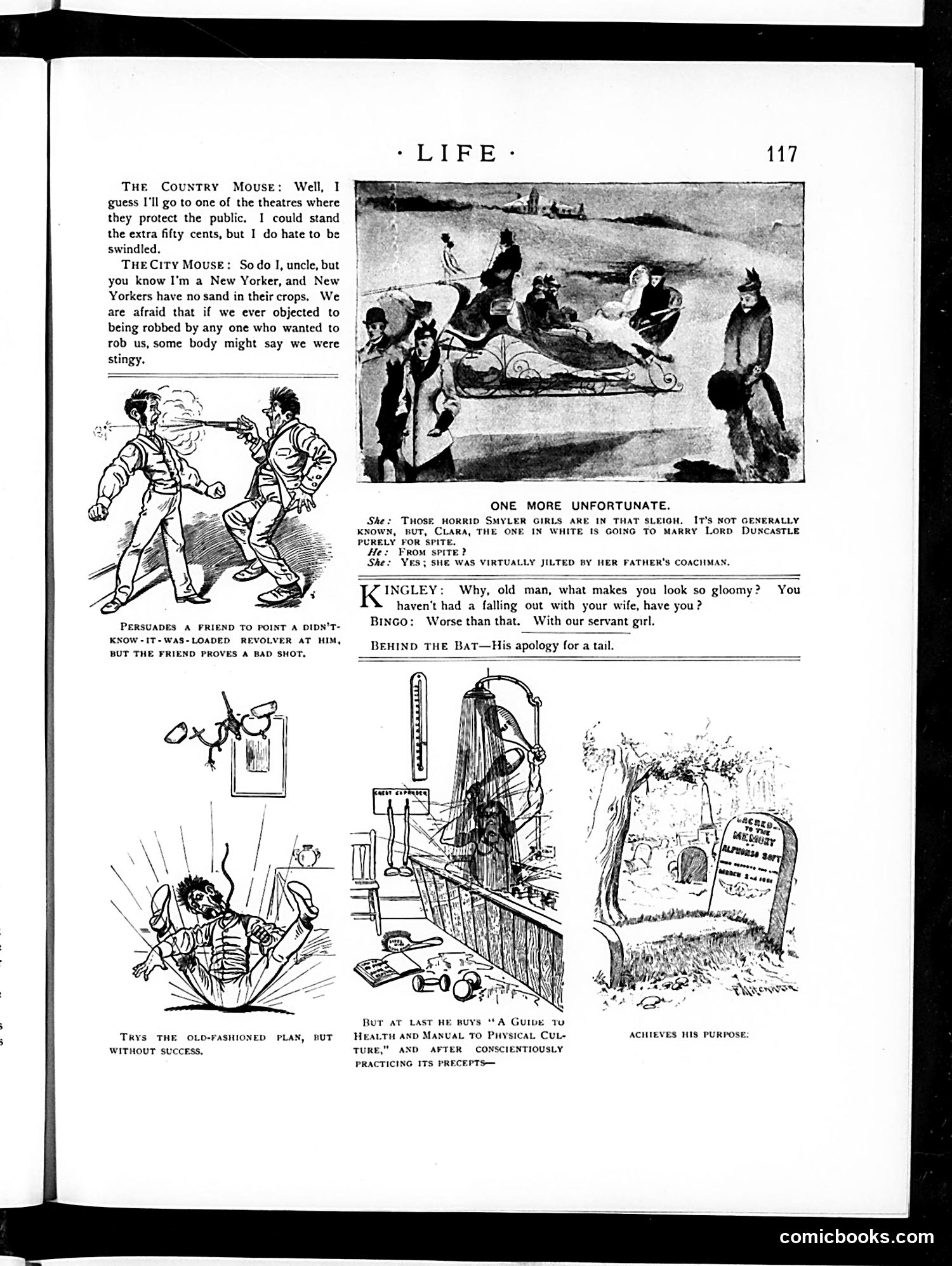
This LIFE magazine page satirizes urban versus rural life through a dialogue between a "Country Mouse" and "City Mouse." The Country Mouse fears theater ticket-gouging and robbery by city criminals. The City Mouse counters that New Yorkers face their own dangers—being robbed by those wanting to avoid the stigma of appearing "stingy." The lower cartoons mock Victorian-era health fads: one shows a man unsuccessfully attempting an old-fashioned exercise regimen; another depicts him buying a "Guide to Health and Manual to Physical Culture" and practicing its prescriptions, ultimately achieving his goal—death (suggested by the gravestone). The satire targets contemporary obsessions with fitness advice and self-improvement literature as ultimately futile.
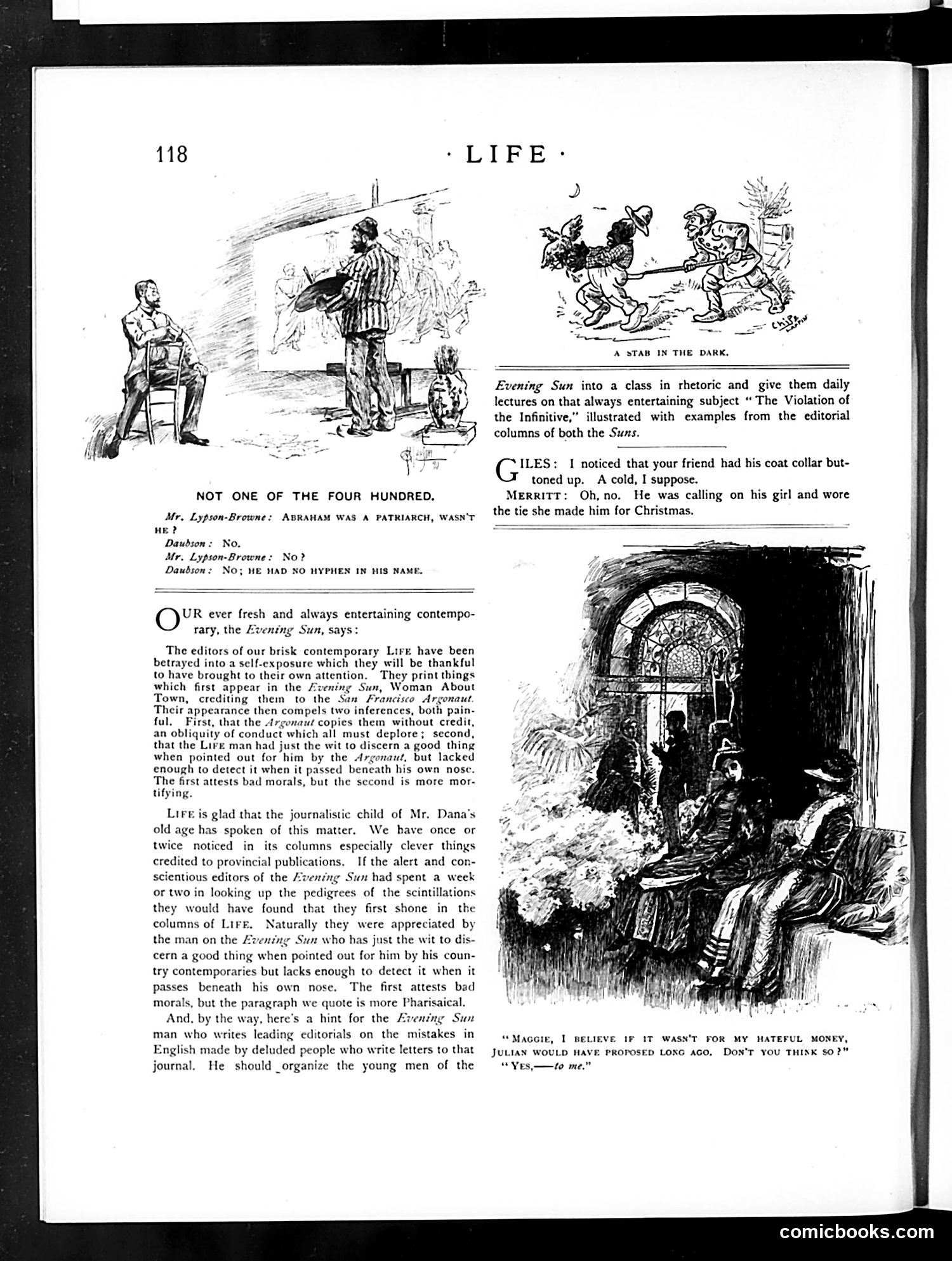
This page contains editorial satire about journalistic plagiarism. Life magazine is mocking the *Evening Sun* newspaper for claiming credit for witty content that actually originated elsewhere—specifically, Life itself and the San Francisco *Argonaut*. The joke is pointed: Life accuses the *Evening Sun* of lacking the intelligence to recognize good writing when it appears in their own pages, yet praising it once another publication points it out. Life then offers a biting suggestion: the *Evening Sun* should stop lecturing readers about English grammar mistakes when their own editorials violate basic rules (like "splitting infinitives"). The top cartoon—"Not One of the Four Hundred"—satirizes social pretension through a dialogue where a man corrects another that Abraham (the biblical patriarch) had no hyphen in his name, implying the corrector cares more about genealogical status ("four hundred" referred to New York's social elite) than accuracy. The other illustrations and brief comic exchanges appear unrelated to the main editorial dispute.
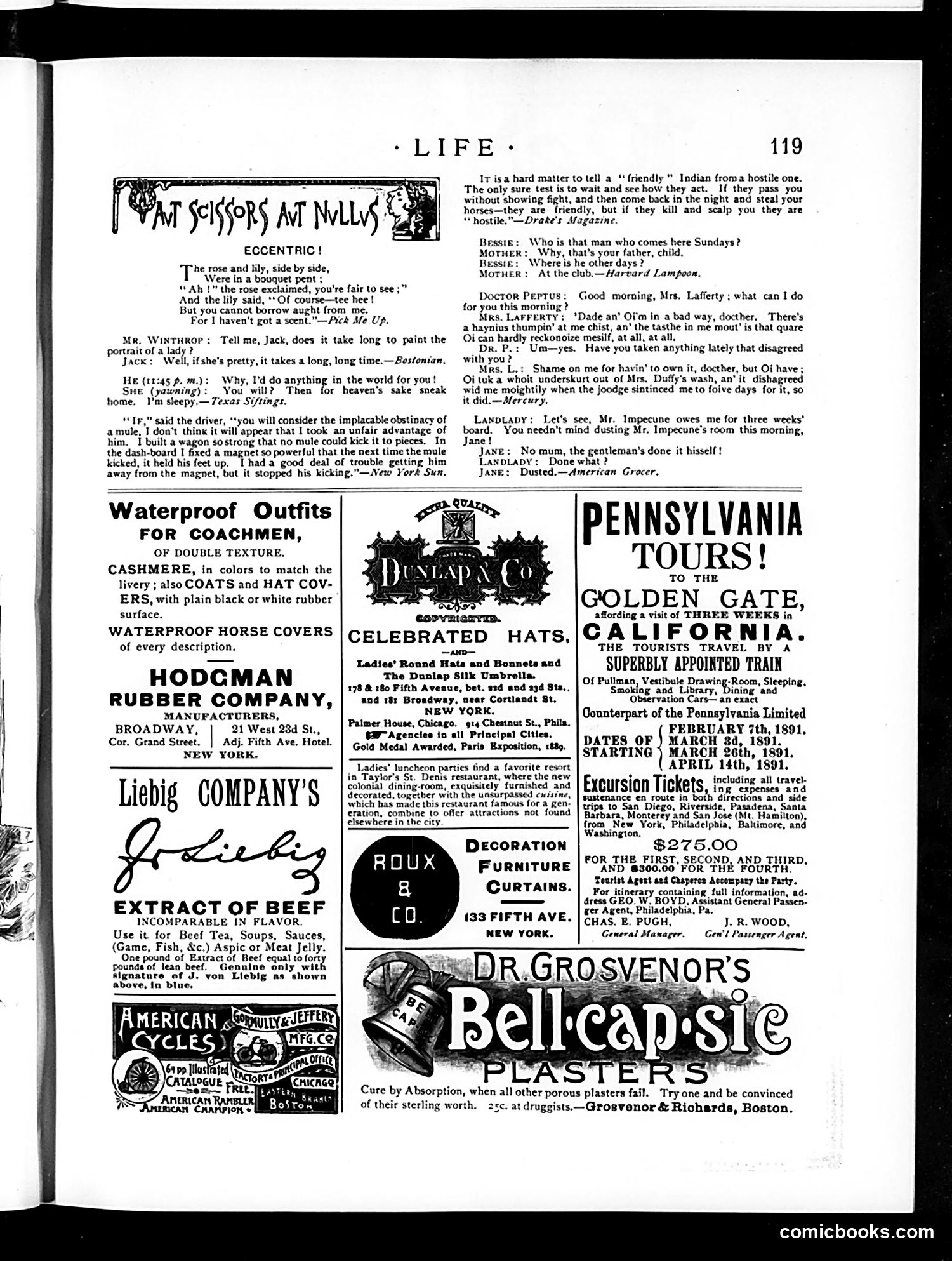
This page is **primarily advertisements** with brief humorous vignettes scattered throughout—typical of Life's satirical format from this era. The **cartoons/jokes** are short, punchy items poking fun at everyday situations: a rose and lily's vanity, a painter's delays, a lazy husband, an Irish immigrant woman's misadventure with stolen laundry, a cheap landlord avoiding a deadbeat tenant, and a mule-driver's solution to a kicking mule. One item references **"friendly" vs. "hostile" Indians**—a dated colonial-era stereotype distinguishing Indians by whether they steal horses quietly (deemed "friendly") or kill and scalp settlers (deemed "hostile"). This reflects period attitudes treating Native Americans as either threats or curiosities. The **advertisements** promote rubber goods, beef extract, bicycles, hats, furniture, and travel tours—reflecting late 19th-century consumer culture. Most humor relies on wordplay, ethnic dialect humor (the Irish woman's brogue), and mundane domestic situations rather than complex satire.
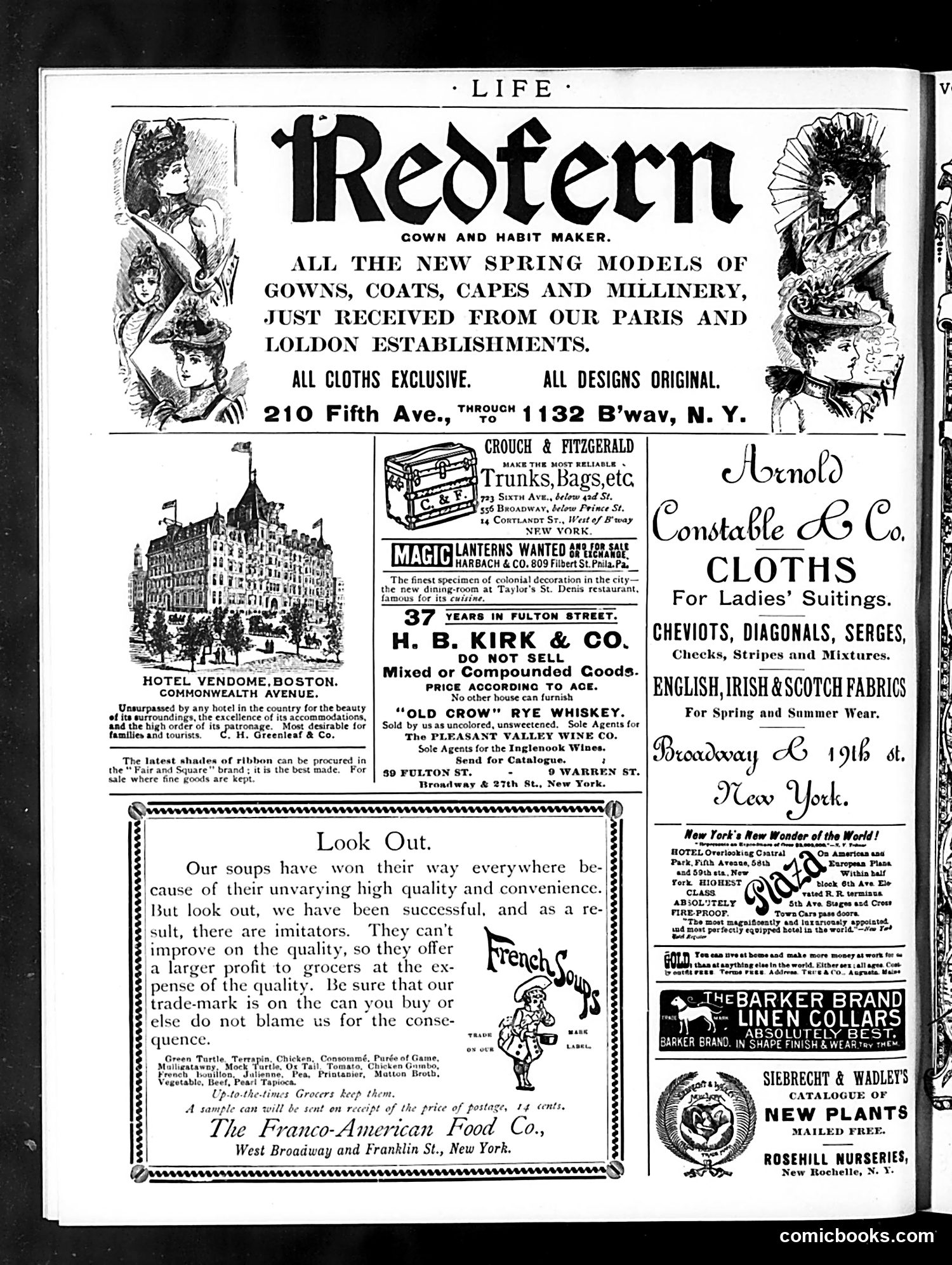
This is primarily a **commercial advertisement page** rather than editorial content or political cartoons. It features high-end fashion and luxury goods advertisements typical of early 20th-century Life magazine. The page's main content includes: - **Redfern** (top): A prestigious gown and millinery maker advertising spring fashions imported from Paris and London - **Hotel Vendome, Boston**: Luxury hotel advertising - **Franco-American Food Company** (center): A substantial advertisement emphasizing their soups' quality and warning against inferior imitators—a common concern when mass-produced goods flooded markets - **H.B. Kirk & Co.**: Whiskey and wine merchant emphasizing pure, unmixed products - **Various cloth merchants**: Advertisements for high-quality English, Irish, and Scottish fabrics The recurring theme is **quality assurance and brand trust**—advertisers repeatedly emphasize authenticity, purity, and originality to distinguish their products from cheaper imitations flooding the market during this era of industrial expansion.