
Life, 1891-02-19 · page 6 of 14
Life — February 19, 1891 — page 6: what you’re looking at
What you’re looking at
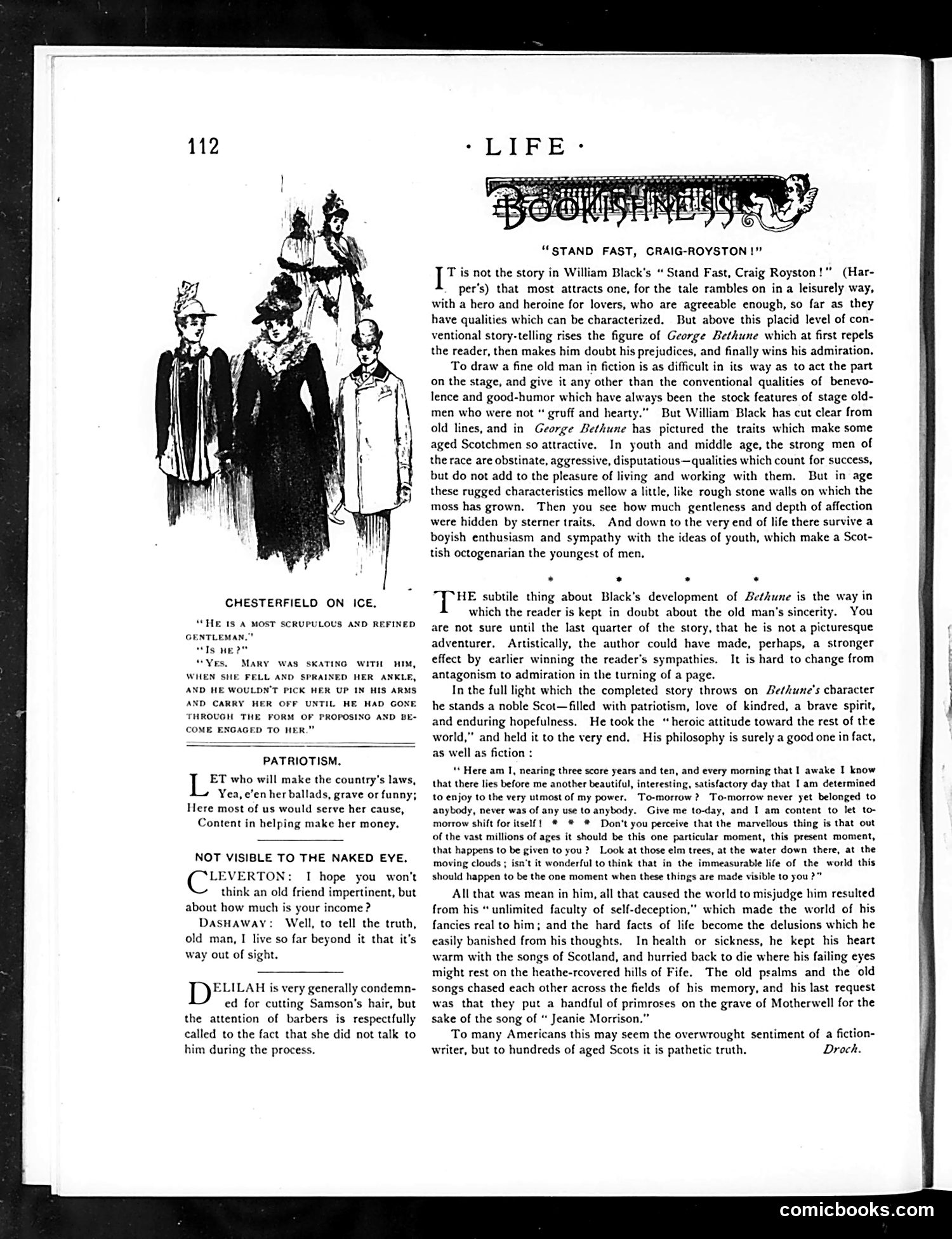
This page is primarily **literary criticism rather than political satire**. It reviews William Black's novel *"Stand Fast, Craig-Royston!"* and discusses another work titled *George Bethune*. The small illustration labeled "CHESTERFIELD ON ICE" shows figures ice-skating and appears to be a separate, unrelated sketch—likely a social comment on upper-class winter recreation rather than political commentary. The remaining content consists of three brief dialogue snippets ("Patriotism," "Not Visible to the Naked Eye," and "Delilah") that are humorous observations about daily life—taxation, income inequality, and social hypocrisy—rather than satirizing specific political figures or events. **This is primarily a literary and humor page**, not a political cartoon page.
📄 Transcribed text from this page (OCR, searchable)
Machine-transcribed from the original scan — historical spelling and the odd misread are preserved.
CHESTERFIELD ON ICE, “HE 18 A MOST SCRUPULOUS AND REFINED GENTLEMAN,” “Is ME? “Yes, MARY WAS SKATING WITH HIM, WHEN SHE FELL AND SPRAINED HER ANKLE, AND HE WOULDN'T PICK HER UP IN HIS ARMS AND CARRY HER OFF UNTIL HE HAD GON THROUGH THE FORM OF PROPOSING AND BE- COME ENGAGED TO HER.” PATRIOTISM. ET who will make the country’s laws, Yea, e’en her ballads, grave or funny; Here most of us would serve her cause, Content in helping make her money, NOT VISIBLE TO THE NAKED EYE. LEVERTON: I hope you won't think an old friend impertinent, but about how much is your income ? DasHaWay: Well, to tell the truth, old man, I live so far beyond it that it’s way out of sight. D LILAH is very generally condemn- ed for cutting Samson's hair, but the attention of barbers is respectfully called to the fact that she did not talk to him during the process. “STAND FAST, CRAIG-ROYSTON !” T is not the story in William Black's “ Stand Fast, Craig Royston per’s) that most attracts one, for the tale rambles on in a leisurely way, with a hero and heroine for lovers, who are agreeable enough, so far as they have qualities which can be characterized. But above this placid level of con- ventional story-telling rises the figure of George Bethune which at first repels the reader, then makes him doubt his prejudices, and finally wins his admiration, To draw a fine old man in fiction is as difficult in its way as to act the part on the stage, and give it any other than the conventional qualities of benevo- lence and good-humor which have always been the stock features of stage old- men who were not “ gruff and hearty.” But William Black has cut clear from old lines, and in George Bethune has pictured the traits which make some aged Scotchmen so attractive. In youth and middle age, the strong men of the race are obstinate, aggressive, disputatious—qualities which count for success, but do not add to the pleasure of living and working with them, But in age these rugged characteristics mellow a little, like rough stone walls on which the moss has grown. Then you see how much gentleness and depth of affection were hidden by sterner traits. And down to the very end of life there survive a boyish enthusiasm and sympathy with the ideas of youth, which make a Scot- tish octogenarian the youngest of men. . ° . . HE subtile thing about Black’s development of Bethune is the way in which the reader is kept in doubt about the old man’s sincerity. You are not sure until the last quarter of the story, that he is not a picturesque adventurer, Artistically, the author could have made, perhaps, a stronger effect by earlier winning the reader’s sympathies. It is hard to change from antagonism to admiration in the turning of a page. In the full light which the completed story throws on Bethune's character he stands a noble Scot—filled with patriotism, love of kindred, a brave spirit, and enduring hopefulness. He took the “heroic attitude toward the rest of tke world,” and held it to the very end. His philosophy is surely a good one in fact, as well as fiction : “ Here am I, nearing three score years and ten, and every morning that I awake I know that there lies before me another beautiful, interesting, satisfactory day that I am determined to enjoy to the very utmost of my power. To-morrow ? To-morrow never yet belonged to anybody, never was of any use to anybody. Give me to-day, and I am content to let to- morrow shift for itself! ® ® ® Don't you perceive that the marvellous thing is that out of the vast millions of ages it should be this one particular moment, this present moment, that happens to be given to you? Look at those elm trees, at the water down there, at the moving clouds ; isn’t it wonderful to think that in the immeasurable life of the world this should happen to be the one moment when these things are made visible to you ?” All that was mean in him, all that caused the world to misjudge him resulted from his “ unlimited faculty of self-deception,” which made the world of his fancies real to him; and the hard facts of life become the delusions which he easily banished from his thoughts, In health or sickness, he kept his heart warm with the songs of Scotland, and burried back to die where his failing eyes might rest on the heathe-rcovered hills of Fife. The old psalms and the old songs chased each other across the fields of his memory, and his last request was that they put a handful of primroses on the grave of Motherwell for the sake of the song of “ Jeanie Morrison.” To many Americans this may seem the overwrought sentiment of a fiction- writer, but to hundreds of aged Scots it is pathetic truth. Droch. comicbooks.com