
Life, 1891-02-19 · page 4 of 14
Life — February 19, 1891 — page 4: what you’re looking at
What you’re looking at
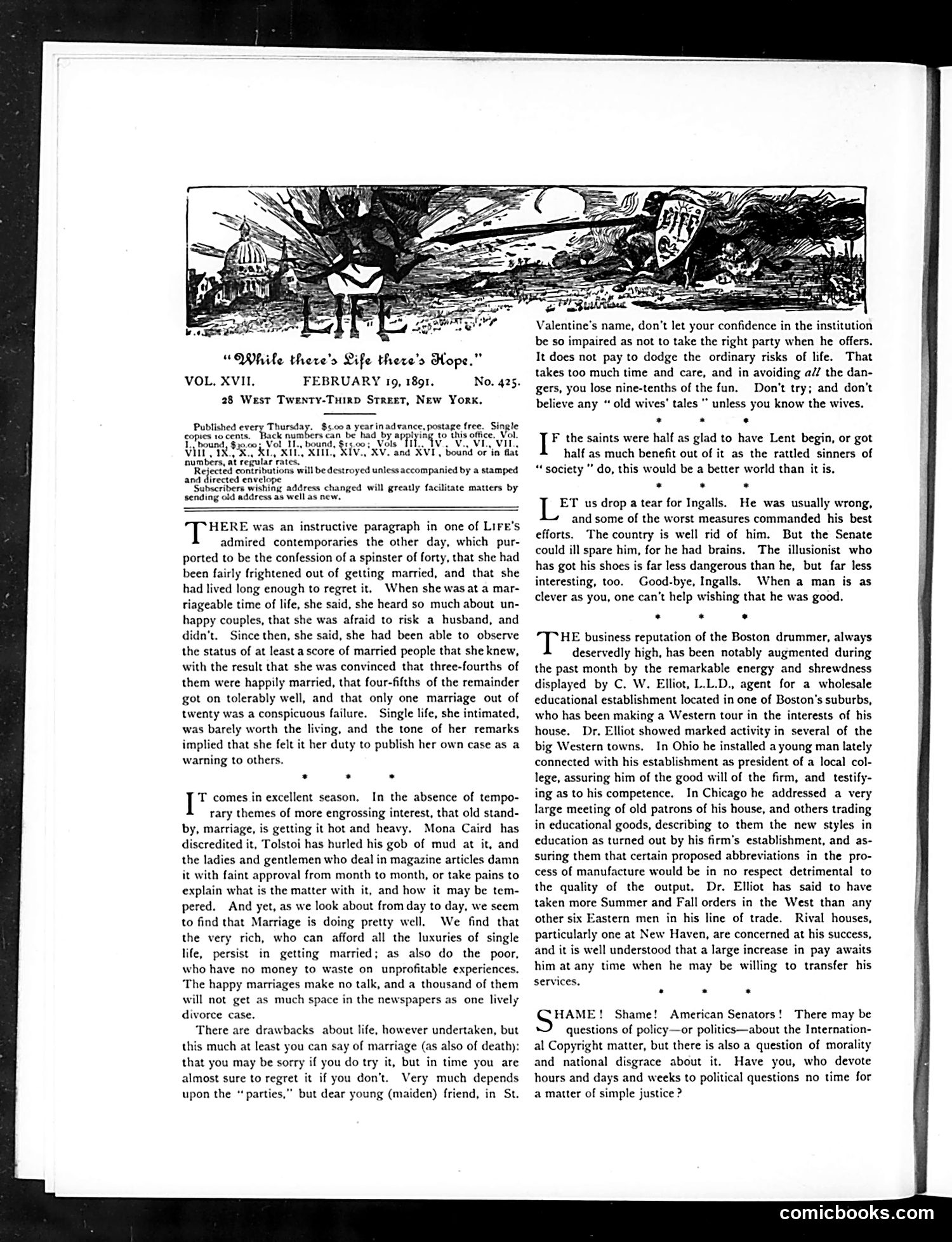
The page contains editorial commentary rather than a political cartoon. The header illustration is decorative/generic rather than satirical. The text discusses marriage cynically, noting that while "Marriage is doing pretty well," most happy marriages "make no talk" while divorces are visible. The editor claims one in twenty marriages fails—a relatively optimistic statistic for the era. A separate section sarcastically attacks American Senators regarding international copyright legislation, accusing them of neglecting "a matter of simple justice" while obsessing over political questions. This appears to reference contemporary copyright disputes between the U.S. and Britain. The page lacks sharp caricature or visual satire; it relies on written argument and irony to make its social and political points about marriage statistics and legislative priorities.
📄 Transcribed text from this page (OCR, searchable)
Machine-transcribed from the original scan — historical spelling and the odd misread are preserved.
“While there's Life there's Hope.” VOL, XVII. FEBRUARY 19, 1891. No. 425. 28 West Twenty-THIRD Street, New York, $5.00 a yearinadvance, postage free. Single by applying to this office. Vol. AY Il. ‘iv’. V.. VE, VI Published every Thursday. copies ro.cents. Back numbe 1, bound, $30.00; Vol II., bound, $15.00 ; VHT, IX, Xx. KL, X vs XV, and XVI, bound or ‘in flat numbers, at regular rat Rejected contributions will be destroyed unlessaccompanied by a stamped and directed ‘envelope Subscribers wishing address changed will greatly facilitate matters by sending old address as well as new, rscan be had HERE was an instructive paragraph in one of Lire’s admired contemporaries the other day, which pur- ported to be the confession of a spinster of forty, that she had been fairly frightened out of getting married, and that she had lived long enough to regret it, When she was at a mar- tiageable time of life, she said, she heard so much about un- happy couples, that she was afraid to risk a husband, and didn’t. Since then, she said, she had been able to observe the status of at least a score of married people that she knew, with the result that she was convinced that three-fourths of them were happily married, that four-fifths of the remainder got on tolerably well, and that only one marriage out of twenty was a conspicuous failure. Single life, she intimated, was barely worth the living, and the tone of her remarks implied that she felt it her duty to publish her own case as a warning to others. . . . T comes in excellent season, In the absence of tempo- rary themes of more engrossing interest, that old stand- by, marriage, is getting it hot and heavy. Mona Caird has discredited it, Tolstoi has hurled his gob of mud at it, and the ladies and gentlemen who deal in magazine articles damn it with faint approval from month to month, or take pains to explain what is the matter with it, and how it may be tem- pered. And yet, as we look about from day to day, we seem to find that Marriage is doing pretty well. We find that the very rich, who can afford all the luxuries of single life, persist in getting married; as also do the poor, who have no money to waste on unprofitable experiences. ‘The happy marriages make no talk, and a thousand of them will not get as much space in the newspapers as one lively divorce case. There are drawbacks about life, however undertaken, but this much at least you can say of marriage (as also of death): that you may be sorry if you do try it, but in time you are almost sure to regret it if you don’t. Very much depends upon the “parties,” but dear young (maiden) friend, in St. Valentine's name, don’t let your confidence in the institution be so impaired as not to take the right party when he offers. It does not pay to dodge the ordinary risks of life. That takes too much time and care, and in avoiding a// the dan- gers, you lose nine-tenths of the fun. Don't try; and don't believe any “old wives’ tales " unless you know the wives. . . . F the saints were half as glad to have Lent begin, or got half as much benefit out of it as the rattled sinners of “society " do, this would be a better world than it is. * . . ET us drop a tear for Ingalls. He was usually wrong, and some of the worst measures commanded his best efforts. The country is well rid of him. But the Senate could ill spare him, for he had brains. The illusionist who has got his shoes is far less dangerous than he, but far less interesting, too. Good-bye, Ingalls. When a man is as clever as you, one can’t help wishing that he was good. . * . HE business reputation of the Boston drummer, always deservedly high, has been notably augmented during the past month by the remarkable energy and shrewdness displayed by C. W. Elliot, L.L.D., agent for a wholesale educational establishment located in one of Boston's suburbs, who has been making a Western tour in the interests of his house. Dr. Elliot showed marked activity in several of the big Western towns. In Ohio he installed a young man lately connected with his establishment as president of a local col- lege, assuring him of the good will of the firm, and testify- ing as to his competence. In Chicago he addressed a very large meeting of old patrons of his house, and others trading in educational goods, describing to them the new styles in education as turned out by his firm's establishment, and as- suring them that certain proposed abbreviations in the pro- cess of manufacture would be in no respect detrimental to the quality of the output. Dr. Elliot has said to have taken more Summer and Fall orders in the West than any other six Eastern men in his line of trade. Rival houses, particularly one at New Haven, are concerned at his success, and it is well understood that a large increase in pay awaits him at any time when he may be willing to transfer his services. . . . —HAME! Shame! American Senators! There may be questions of policy—or politics—about the Internation- al Copyright matter, but there is also a question of morality and national disgrace about it. Have you, who devote hours and days and weeks to political questions no time for a matter of simple justice ? comicbooks.com