
A complete issue · 18 pages · 1891
Life — January 1, 1891
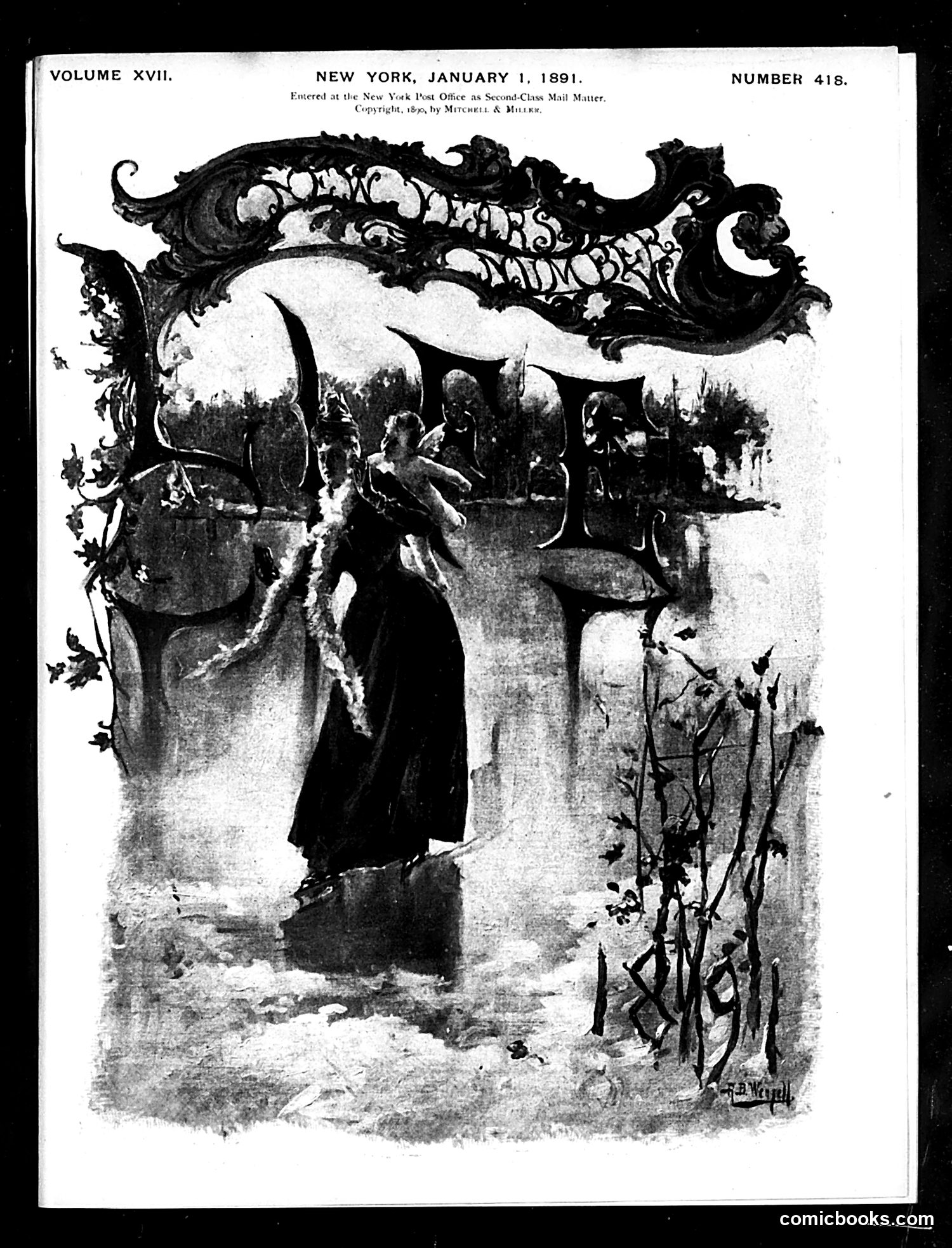
This appears to be a satirical illustration depicting a figure in dark clothing standing within or emerging from a large skull. The ornate decorative frame at the top suggests a heraldic or coat-of-arms design. The skull imagery traditionally symbolizes death, danger, or mortality in political satire. Without clearer text or identifying labels visible in the image, I cannot definitively identify which specific political figure or event this references. The composition—with the skull as a container and the solitary figure—suggests commentary on either a dangerous ideology, a failed political movement, or a threat to society. The artistic style is consistent with 1891 American satirical work, but the specific target requires additional contextual information I cannot reliably extract from the image alone.
This page is oriented sideways and appears rotated in the scan. The image shows what appears to be a winter or snowy scene with figures, bare branches, and a sign visible in the upper portion, though the text on the sign is difficult to read clearly in this reproduction. Without legible OCR text or clearer visibility of specific identifying details, I cannot confidently name the political figures or reference the specific historical event being satirized. The composition suggests social or political commentary typical of Life magazine's satirical style, but **I cannot accurately explain the specific satire or joke intended without being able to read key text elements or identify the figures with certainty.** To properly analyze this cartoon's meaning for a modern reader would require either higher image resolution or additional context about the publication date.
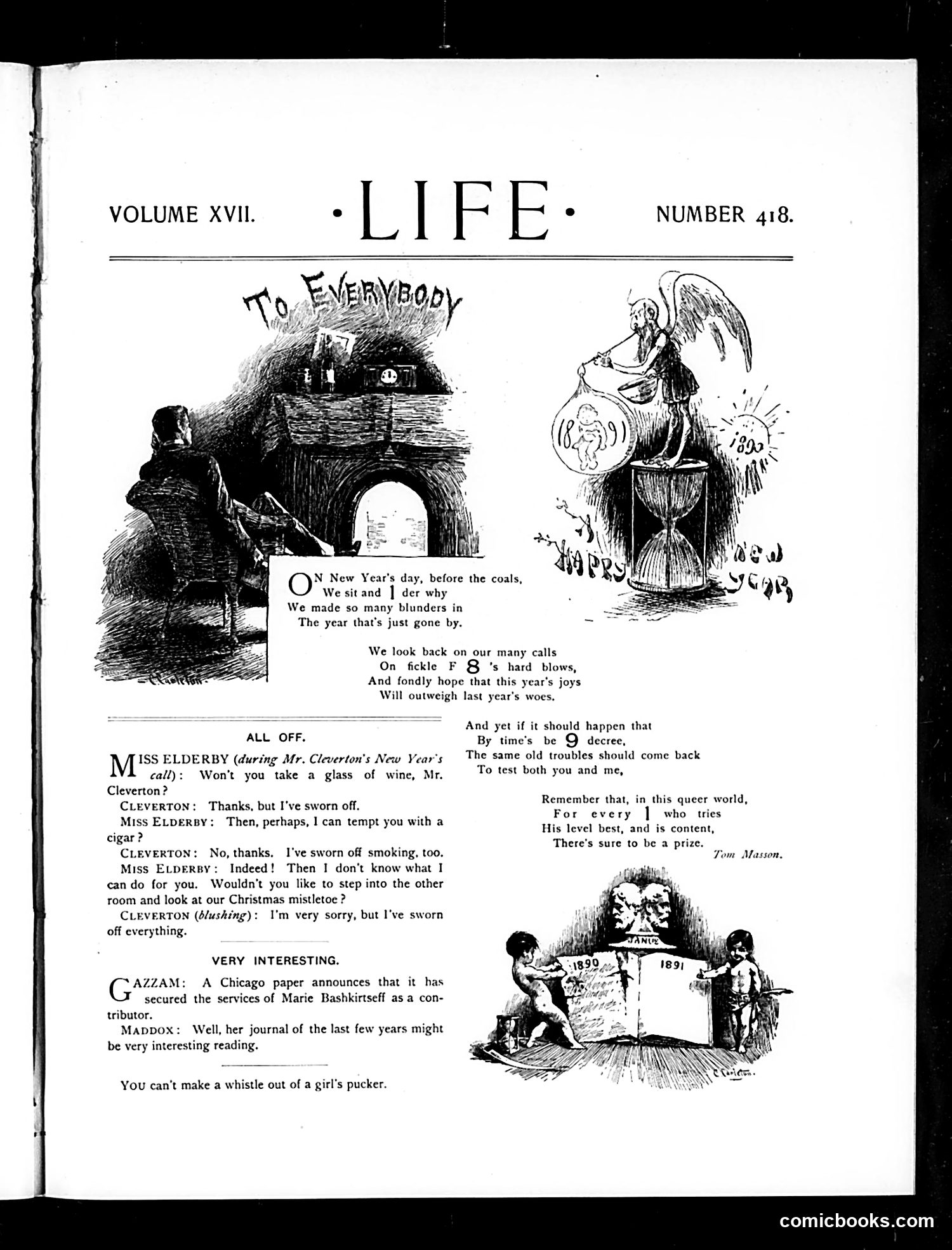
This *Life* magazine page contains New Year's reflections circa 1891-1899. The top illustration shows "To Everybody" — a figure looking back at troubles from the past year. The right illustration depicts Time as a winged figure dispensing fates from an hourglass marked with years. The dialogue "All Off" features Mr. Cleverton swearing off vices (smoking, drinking) on New Year's, a common satirical trope mocking New Year's resolutions that people rarely keep. The "Very Interesting" section jokes about Marie Bashkirtseff, an obscure historical figure whose journal apparently became noteworthy. The final quip about whistles and girls' anatomy is crude period humor. Overall, this page satirizes New Year's renewal hopes and human weakness in maintaining reform.
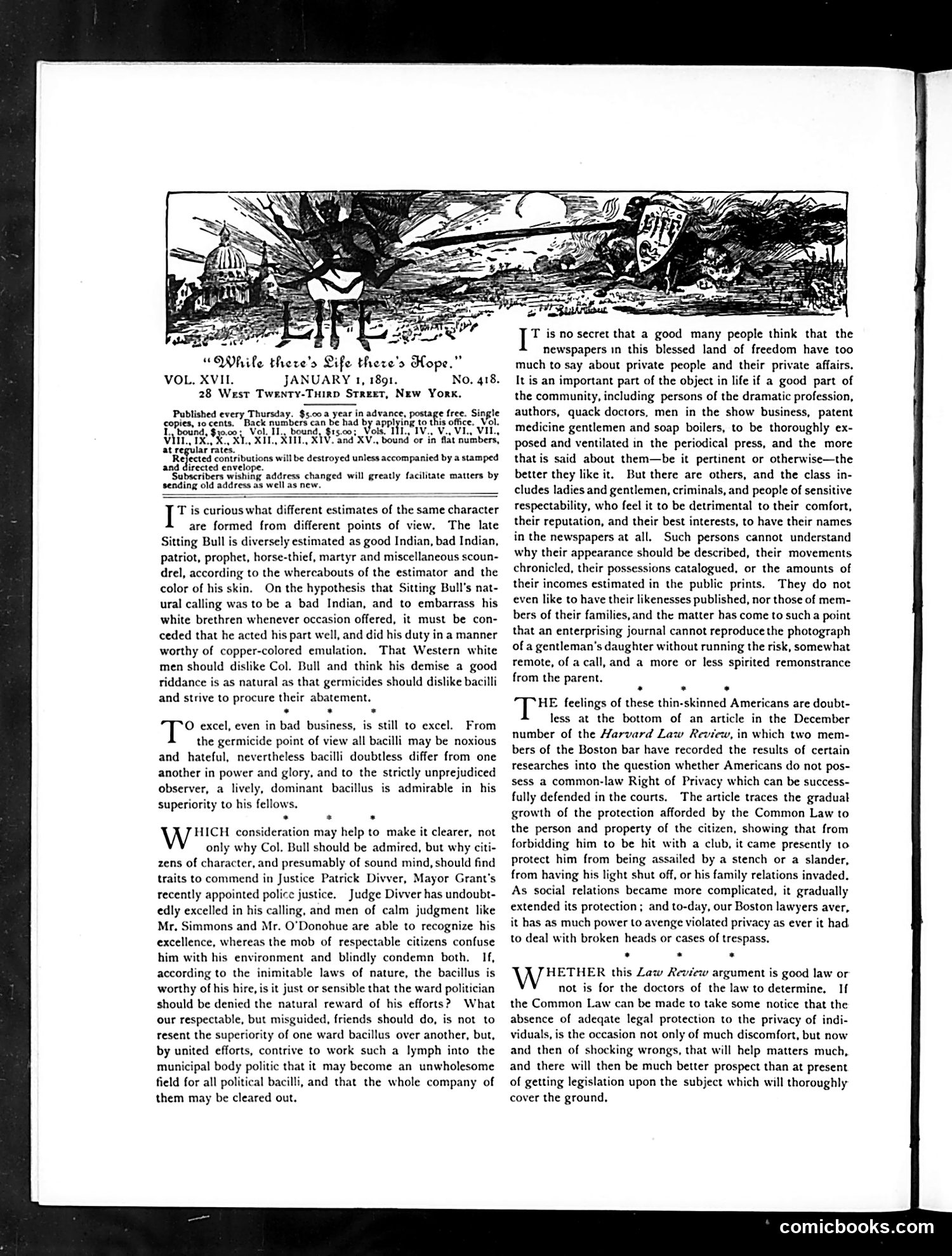
**The Image:** The masthead features an Art Nouveau-style illustration showing a classical figure amid a dramatic landscape with buildings and celestial elements—typical decorative design for this era. **The Text:** This is editorial commentary (not a political cartoon) discussing debates over privacy rights and newspaper coverage. The piece critiques newspapers for publishing details about private citizens—particularly members of "respectable" society—arguing this violates a "common-law Right of Privacy." The editors reference a *Harvard Law Review* article and invoke Judge Patrick Divver and Mayor Grant's recent police appointments, suggesting this reflects broader concerns about legal protections for individuals against unwanted public exposure. **The Point:** This advocates for legal privacy protections against invasive journalism, a progressive-era concern about emerging mass media's power.
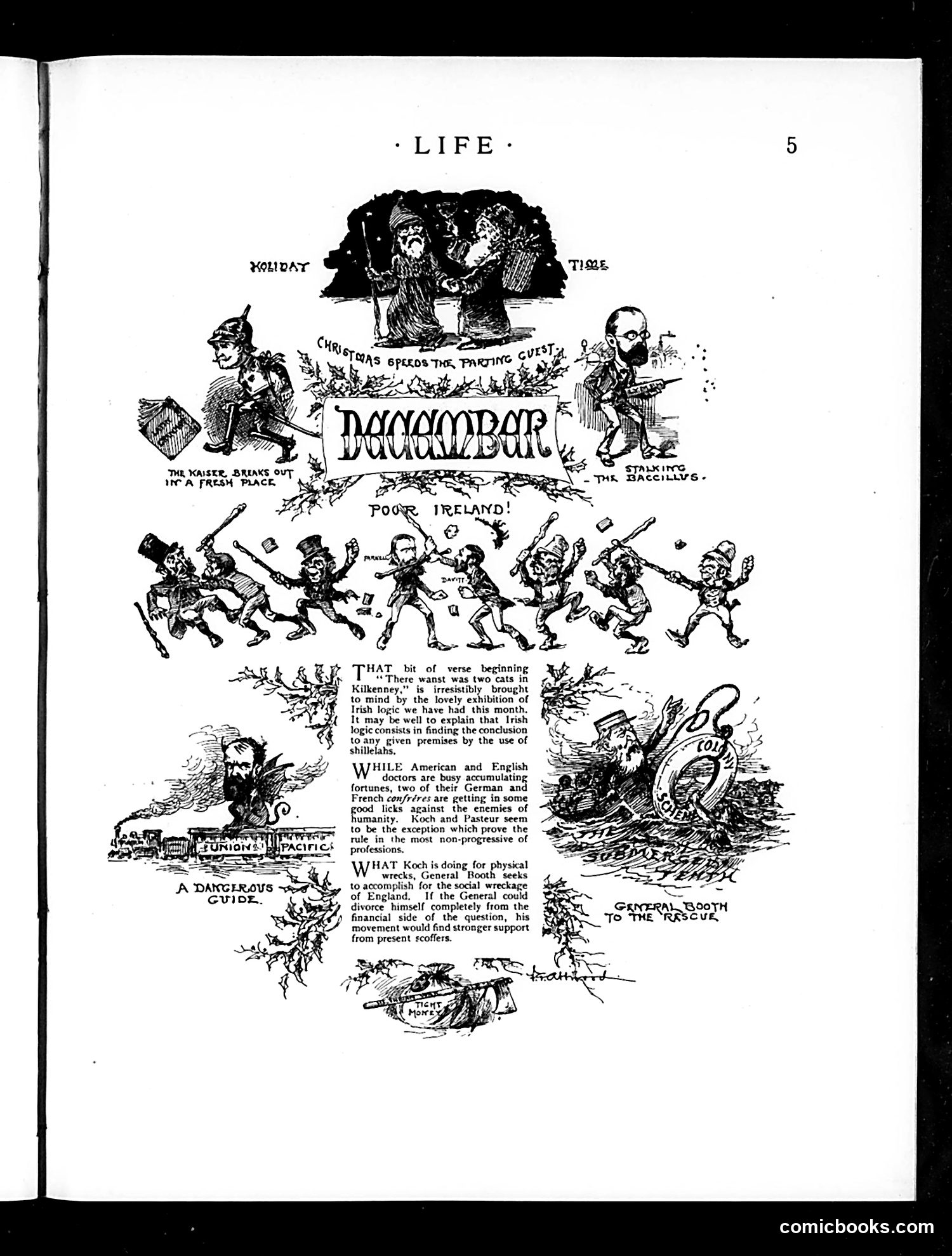
This satirical page mocks Irish logic through the central figure "Demonobar" (likely a pun on Irish names or places). The top illustration shows holiday/Christmas time chaos. Below, text discusses how Irish logic reaches absurd conclusions from premises—specifically referencing "There wanst was two cats in Kilkenny," a famous Irish riddle about logical paradox. The surrounding vignettes lampoon various contemporary figures: "A Dangerous Guide" (left), "General Booth to the Rescue" (right, likely Salvation Army founder William Booth), and references to Koch and Pasteur (scientists). The dancing figures at top suggest Irish stereotypes about celebration or disorder. The satire targets stereotypical Irish reasoning while also critiquing contemporary social figures and movements, typical of Life magazine's satirical approach.
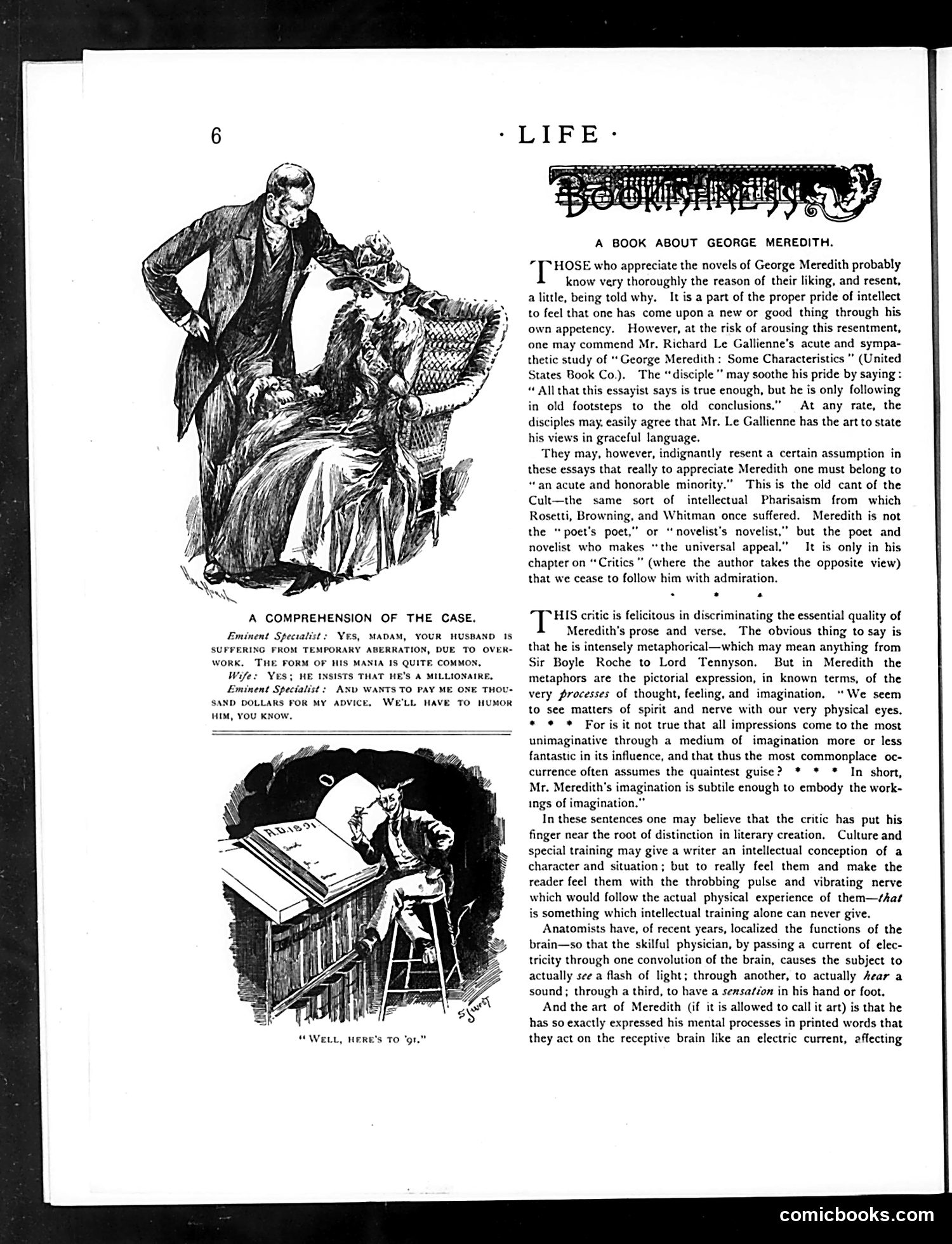
This page is a literary critique of novelist George Meredith, not political satire. The two illustrations are humorous sketches accompanying an essay about Meredith's writing style. The top cartoon shows a man "suffering from temporary aberration, due to over-work" seeking advice while insisting he's a millionaire—apparently illustrating Meredith's complex, intellectually demanding prose that confuses readers. The lower cartoon captioned "Well, here's to 't" depicts someone reading, likely referencing the difficulty of Meredith's work requiring intense concentration. The essay praises Meredith's "metaphorical" and imaginative writing style while acknowledging critics find him obscure. It argues his genius lies in expressing mental processes through language that affects readers like "an electric current."
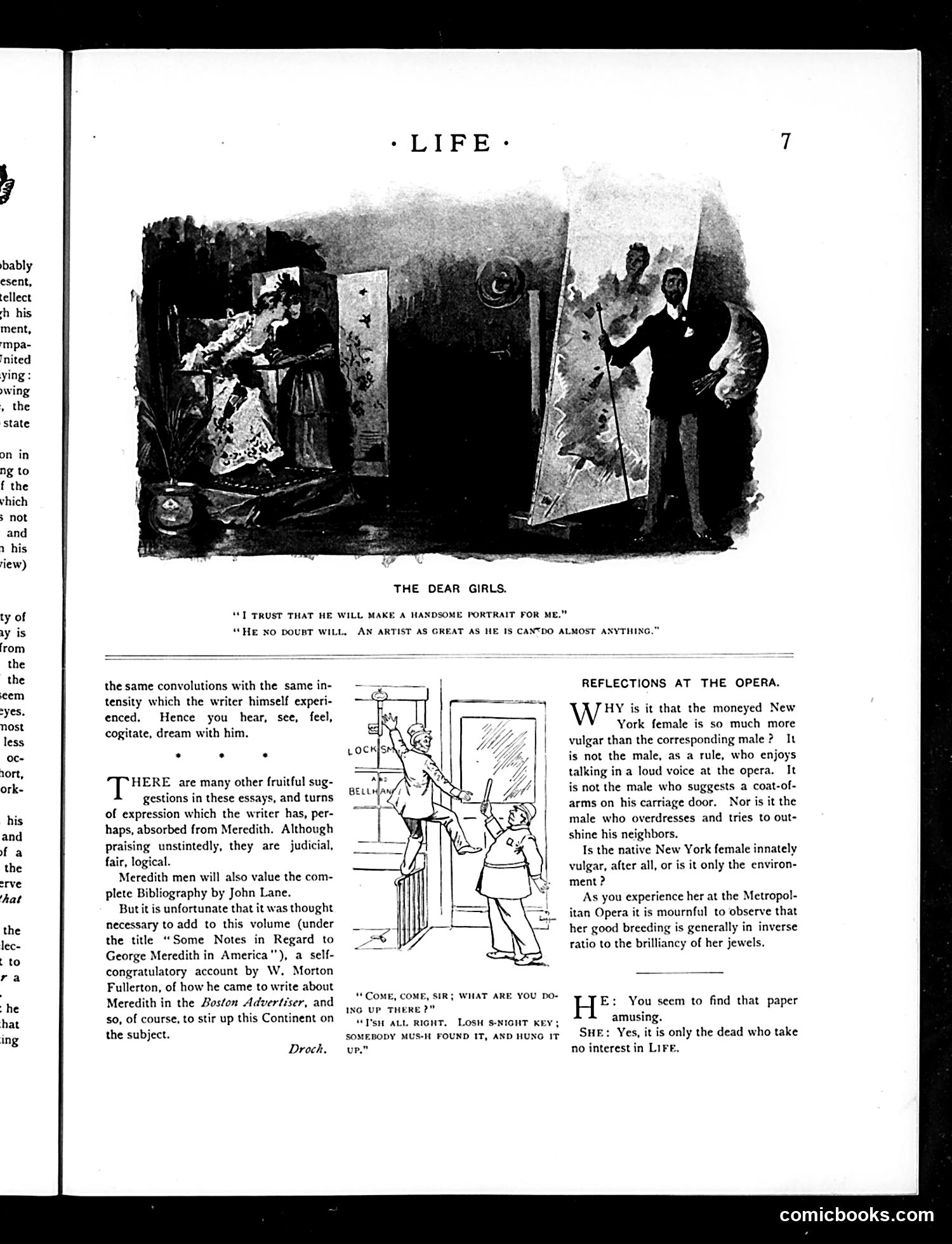
This page contains two satirical pieces: **"The Dear Girls"** (top cartoon) depicts an artist showing a woman a portrait, with dialogue about his artistic abilities. The satire appears to mock vanity and flattery in portraiture. **"Reflections at the Opera"** (right side) is a dialogue piece criticizing the behavior of New York women at the Metropolitan Opera House. The text suggests upper-class New York females are "vulgar" compared to European counterparts, attributing this to environment rather than innate character. It questions whether their poor behavior reflects breeding or circumstance. The accompanying small cartoon (left) shows opera-goers, likely illustrating the social dynamics being critiqued. The overall satire targets wealthy New York society's conduct and pretensions at cultural venues.
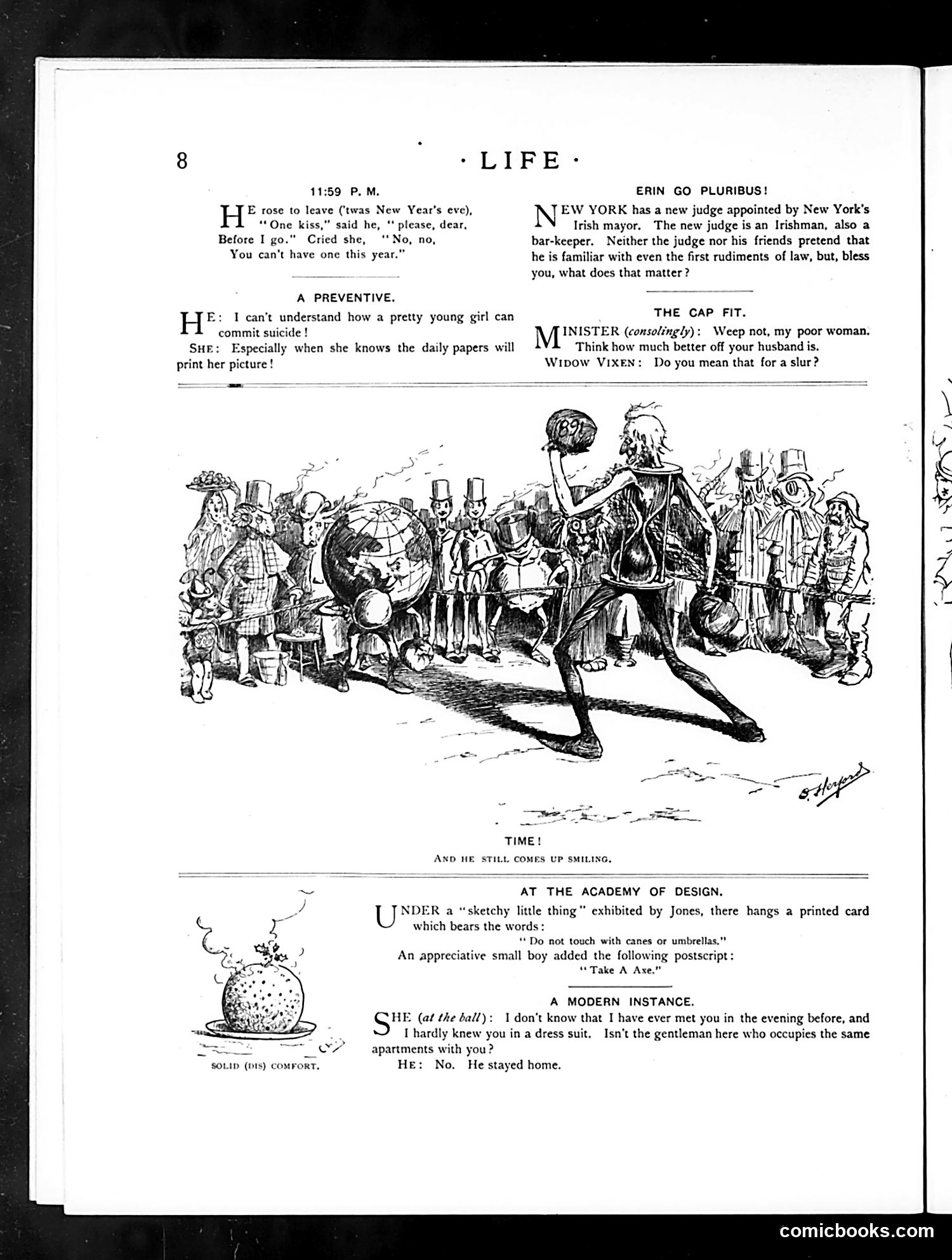
This page contains several satirical short jokes and one substantial political cartoon titled "Time! And He Still Comes Up Smiling." The main cartoon depicts a skeletal figure representing Death or hardship, dancing or emerging energetically before a crowd of various figures (appearing to represent different classes and types of people). The caption suggests resilience or optimism despite adversity—"still comes up smiling" despite repeated troubles. The smaller items are society humor pieces mocking contemporary behavior: a preventative about suicide and newspaper notoriety, a joke about a minister's cap, and an "Academy of Design" anecdote about social etiquette. The overall tone reflects early 20th-century Life magazine's blend of political commentary and genteel social satire aimed at educated urban readers.
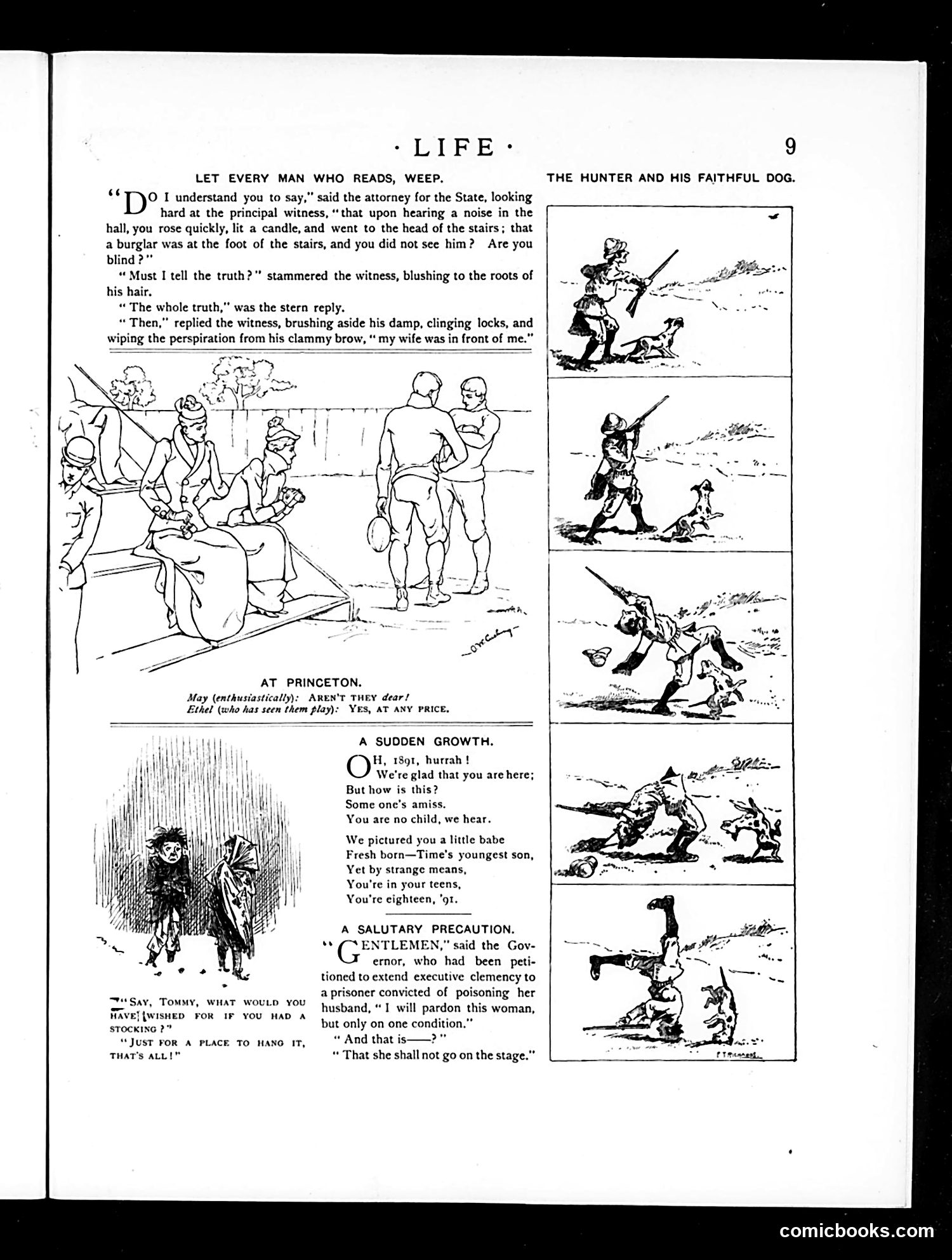
This page contains three separate humorous pieces typical of Life's satirical content: 1. **"At Princeton"**: A courtroom scene where a witness is questioned about whether he saw a burglar. The joke plays on courtroom absurdity—the witness admits his wife was in front of him, implying he couldn't see past her. 2. **"The Hunter and His Faithful Dog"**: A sequential comic strip showing a hunter and dog in increasingly chaotic hunting mishaps, culminating in physical comedy. 3. **"A Sudden Growth"** and **"A Salutary Precaution"**: Satirical poems about childhood development and a governor's conditional pardon offer to a woman convicted of poisoning, contingent on her not performing on stage. The overall tone reflects Life's signature blend of social commentary, legal satire, and physical humor aimed at educated American readers.
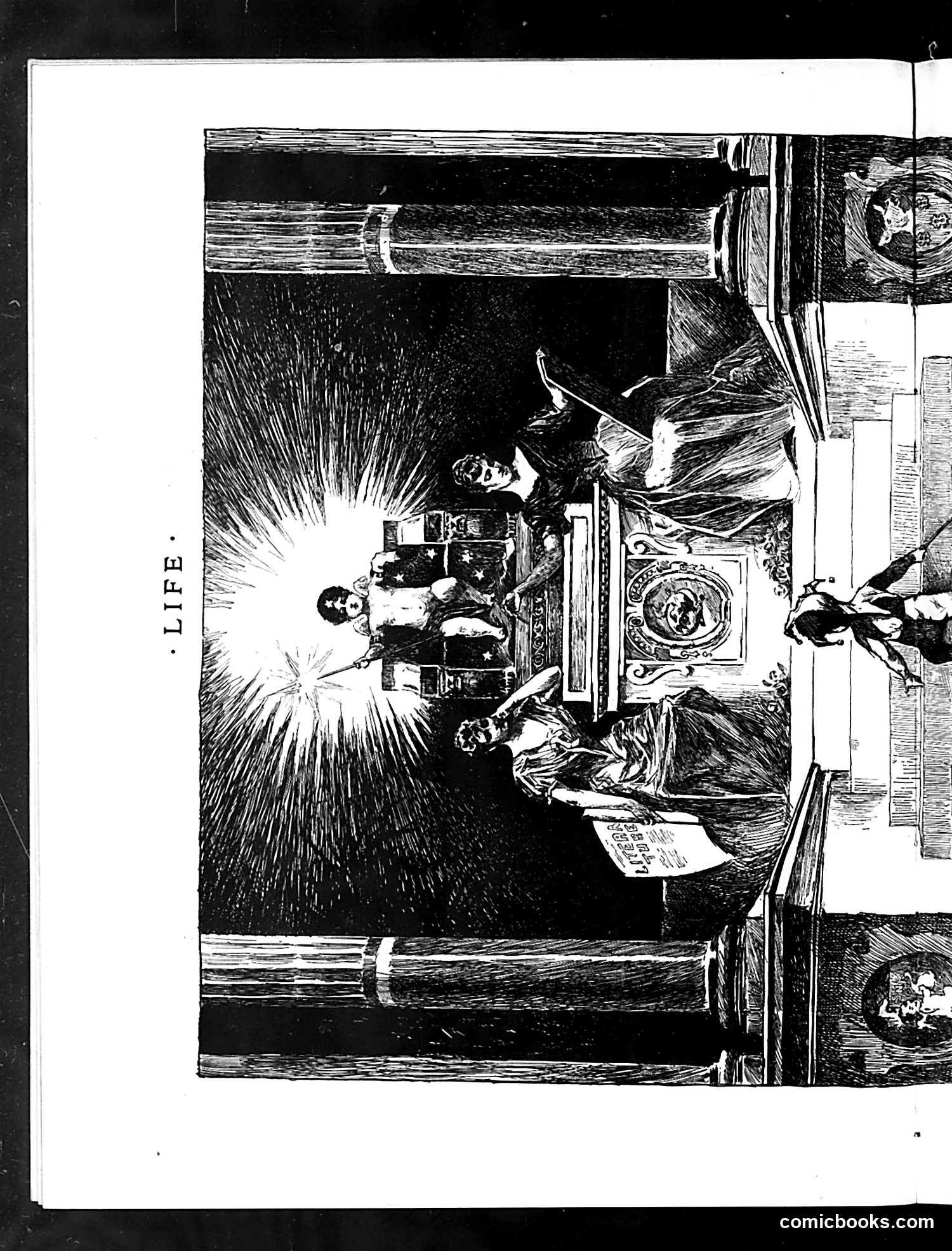
This page appears to be titled "LIFE" and shows a black and white engraving or woodcut-style illustration. The image depicts an interior scene with multiple figures in what appears to be a formal or domestic setting. There's dramatic lighting with radiating lines suggesting illumination or emphasis on a central figure or object. However, **I cannot reliably identify the specific figures, historical context, or satirical point** from this reproduction. The image quality, rotation, and lack of visible captions or accompanying text make it difficult to determine which public figures or events are being referenced. Without clearer OCR text or visible labels identifying the subjects, asserting specific meanings would require speculation beyond what the image clearly supports. To properly explain this cartoon's satire, I would need additional context—legible captions, the publication date, or clearer image resolution.
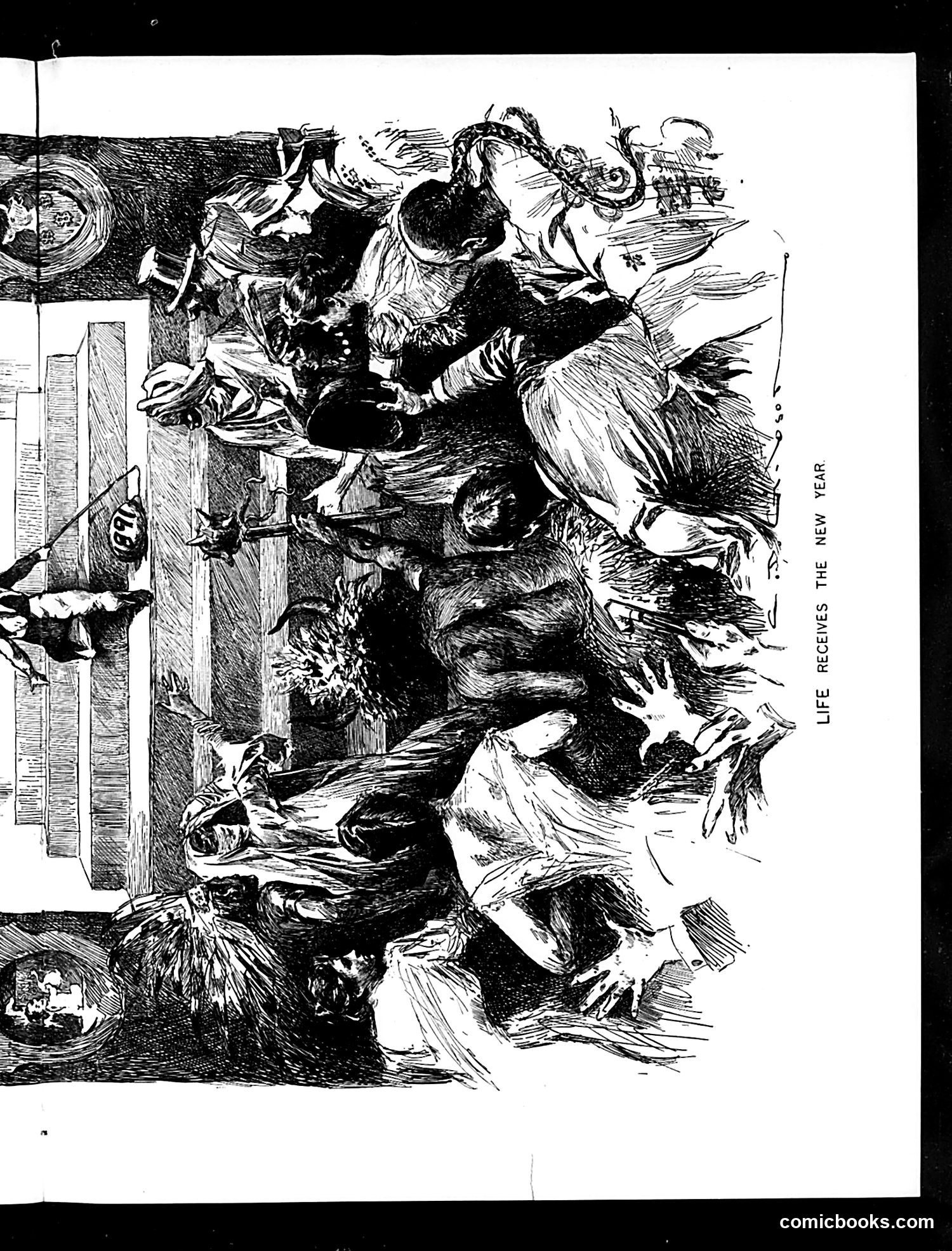
This satirical illustration depicts a chaotic New Year's celebration, with the personified figure of "Life" being mobbed by boisterous revelers in formal attire. The image shows what appears to be a raucous party scene with figures wearing top hats and fancy dress, some appearing intoxicated or overly enthusiastic. The caption "Life Receives the New Year" suggests social commentary on how people greet the new year—likely satirizing the excess, drunkenness, and wild behavior associated with New Year's Eve celebrations among the upper classes. The sketch style and densely packed composition emphasize the chaos and disorder of the occasion, mocking both the tradition itself and those who participate in such elaborate revelry.
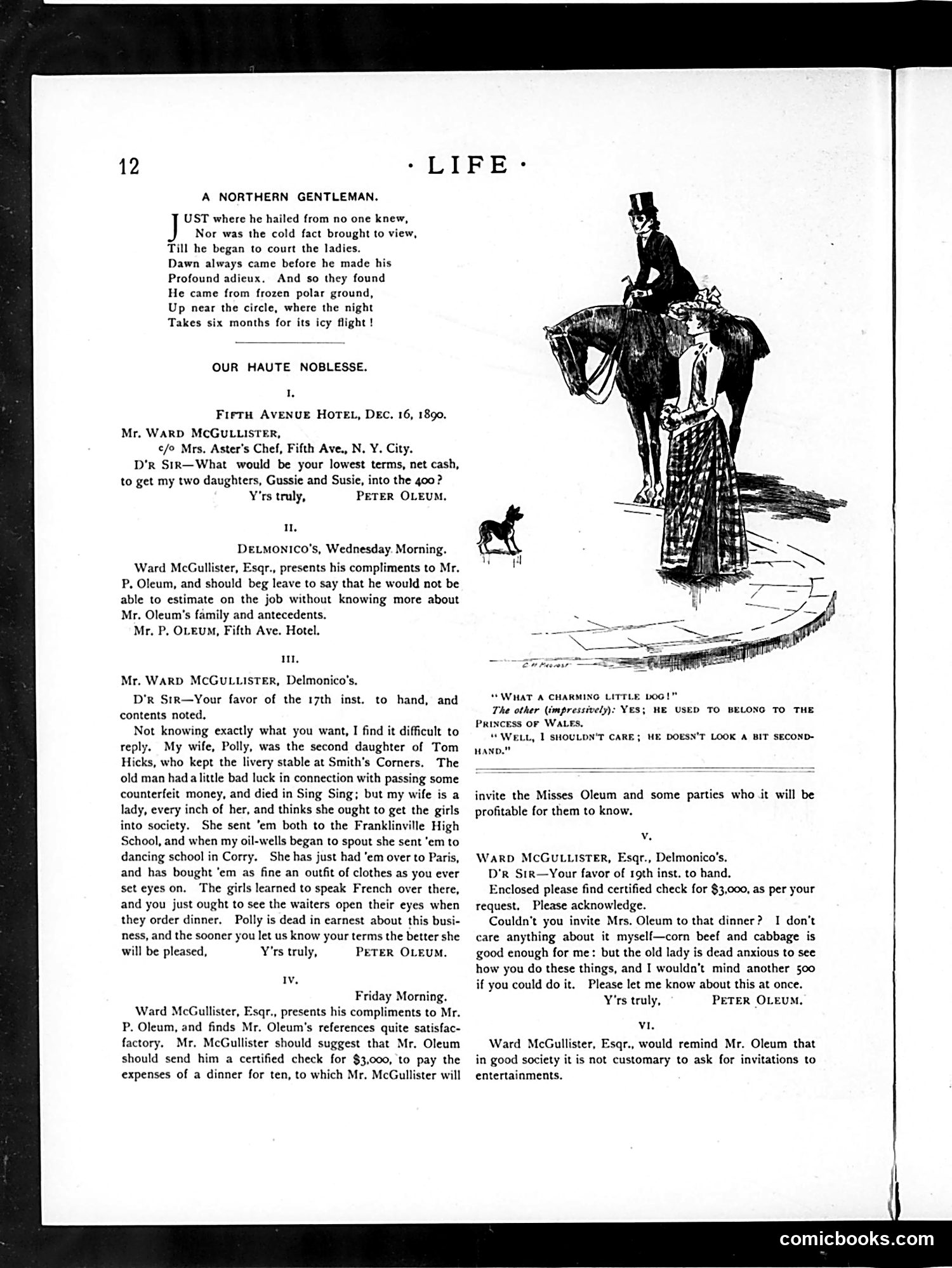
This page satirizes the newly wealthy industrialists of 1890s New York attempting to buy their way into "high society." **The Main Joke:** Peter Oleum (a transparent name suggesting oil wealth) contacts Ward McGuillister—a real social arbiter famous for compiling New York's "400" elite families—literally trying to *purchase* admission to high society for his daughters. McGuillister treats it like a transaction, eventually charging $3,000 for a dinner where the Oleum girls might meet "profitable" connections. **The Satire's Point:** The exchange exposes that aristocratic exclusivity is a sham. McGuillister's initial snobbery vanishes once he learns Oleum is wealthy. The nouveau riche (oil-rich Oleum, whose wife's father passed counterfeit money and died in Sing Sing prison) can literally buy their daughters' social acceptance through McGuillister's services—proving that Gilded Age "nobility" runs on cash, not genuine breeding. **The Poem Above** ridicules another social outsider: a mysterious "northern gentleman" whose romantic courtesies (always departing at dawn) reveal he's from the Arctic—another outsider trying to infiltrate polite society.
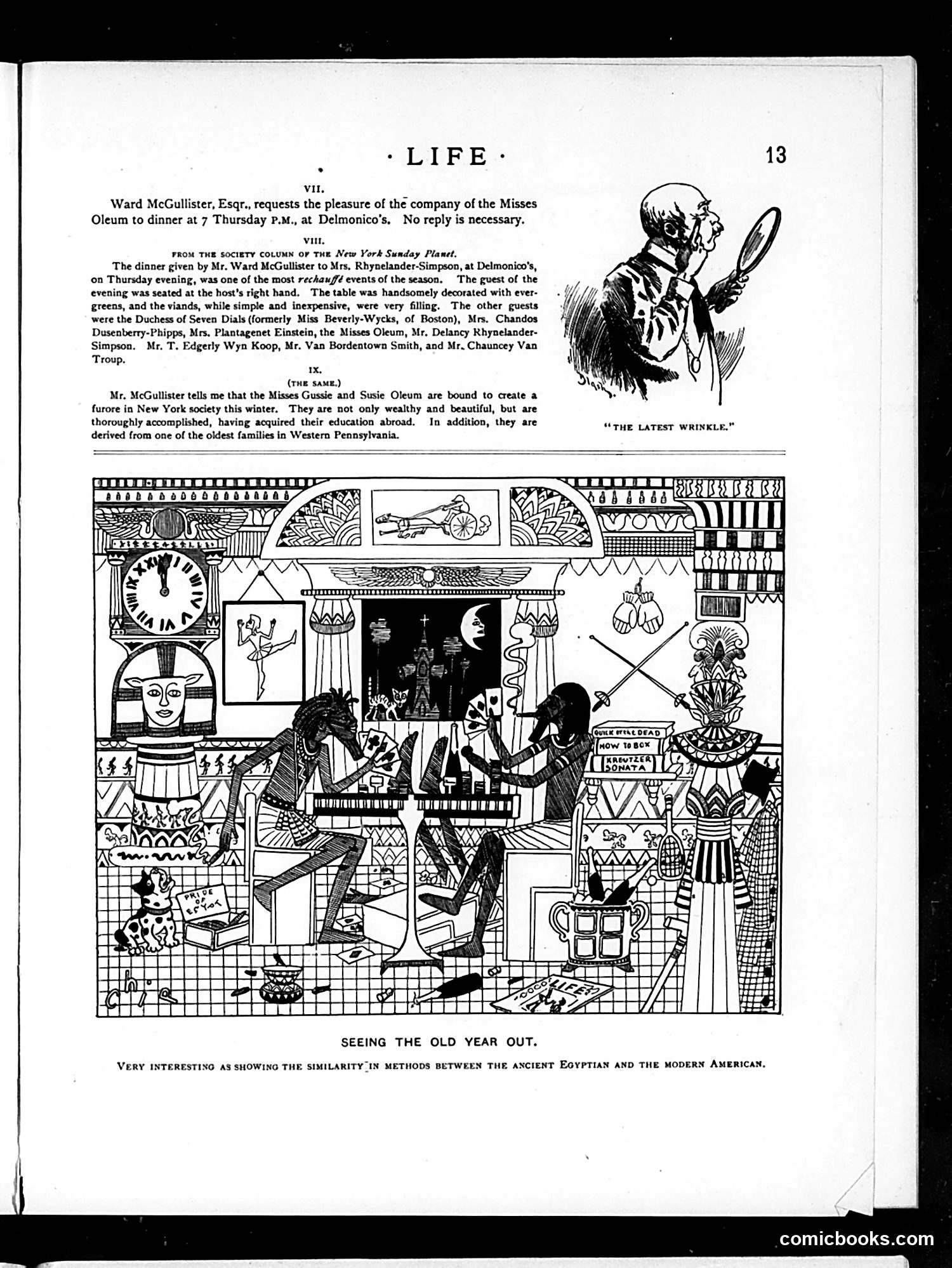
This page satirizes New York high society's pretensions and nouveau riche social climbing. The upper sections mock Ward McGuillister's dinner invitation and society column coverage, featuring absurdly grandiose guest names ("Duchess of Seven Dials," "Plantagenet Einstein") that parody aristocratic pretense. The joke intensifies when revealing the Misses Oleum—wealthy but socially new—come from "one of the oldest families in Western Pennsylvania," mocking how Americans manufacture gentility. The large illustration titled "Seeing the Old Year Out" depicts an elaborate Egyptian-themed New Year's Eve party, equating modern American revelry with ancient Egyptian practices. The caption's claim about "similarity in methods" is tongue-in-cheek: both cultures apparently engage in excessive, ostentatious celebration. The cartoon mocks how wealthy Americans adopt exotic themes and excess to appear sophisticated while fundamentally engaging in the same base festivities as any other culture.
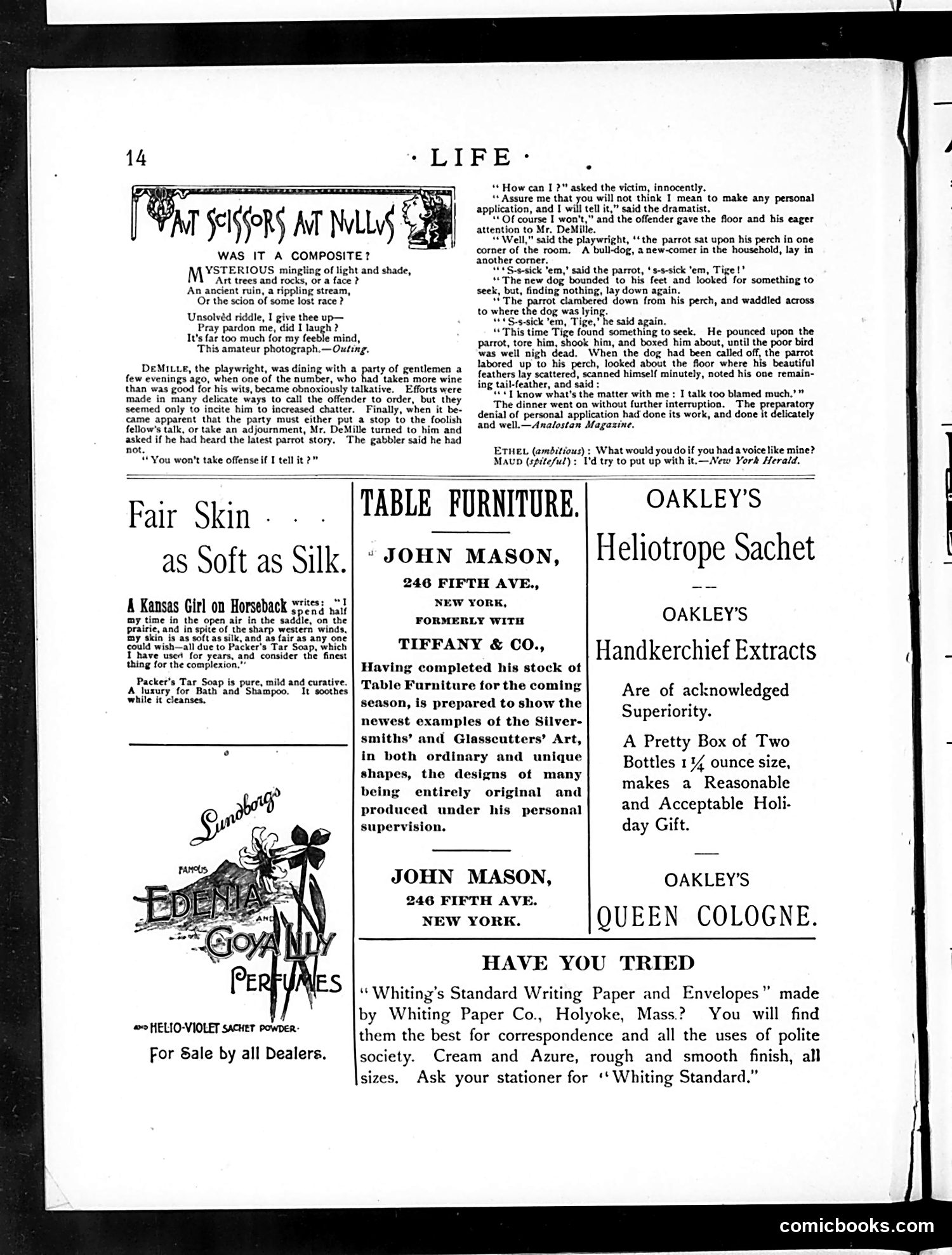
This page from *Life* magazine contains a satirical anecdote by playwright Henry C. DeMille about silencing a drunk, talkative dinner guest. DeMille tells a story about a parrot repeatedly commanding a bulldog to "sick 'em" at nothing—until the dog finally attacks the parrot itself. The parrot then realizes: "I talk too blamed much." The joke operates as a witty insult disguised as a harmless anecdote. By obtaining the guest's promise not to take "personal application," DeMille makes his point delicately—the drunk is like the parrot, and his own excessive talking has brought consequences upon himself. It's a period-appropriate example of upper-class social correction through clever indirection. The page is primarily filled with advertisements for luxury goods (table furniture, perfumes, soaps) targeting affluent readers. The cartoons and brief jokes scattered throughout reflect typical *Life* magazine humor: domestic comedy and mild social satire.
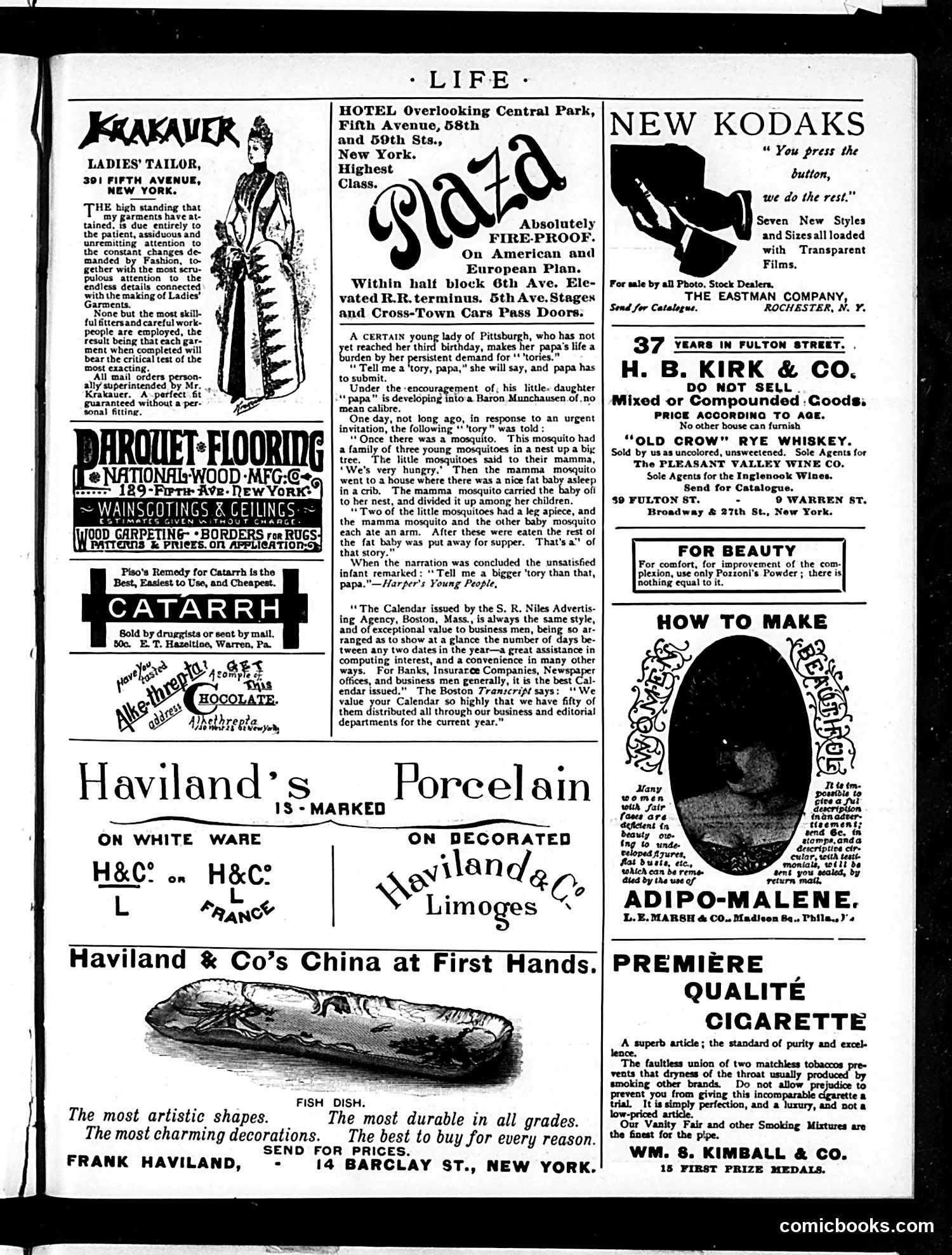
This page is primarily **advertising**, typical of Life magazine's revenue model. The ads showcase period consumer goods: ladies' tailoring, hotel accommodations, porcelain dinnerware, Kodak cameras (famous for their "You press the button, we do the rest" slogan), and cigarettes. The sole editorial content is a brief humorous story about a Pittsburgh toddler demanding increasingly implausible "stories" from her father. The child asks her father to tell bigger tales, culminating in an absurd mosquito narrative involving a stolen baby. The joke plays on children's insatiable appetite for exaggeration and the father's escalating tall tales—a gentle satire of parental storytelling rather than political commentary. The page reflects late-19th/early-20th-century consumer culture and advertising practices, with no apparent cartoons or political satire present.
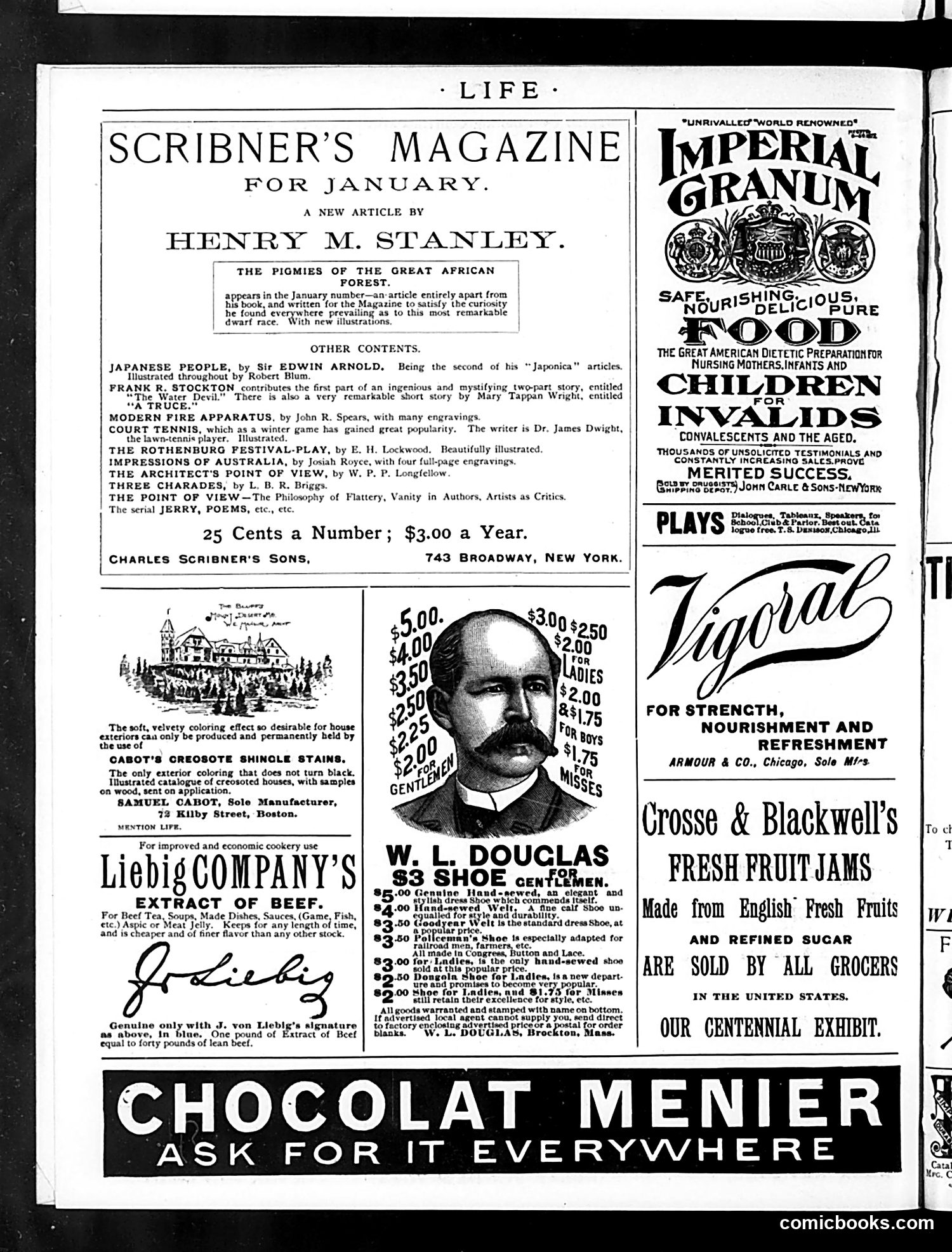
This page is primarily a **table of contents and advertisements** from *Life* magazine, not a political cartoon. The main content advertises *Scribner's Magazine* for January, featuring Henry M. Stanley's article on African pygmies—reflecting the era's fascination with exploration and "exotic" peoples. Other articles listed include pieces on Japan, Australia, and tennis. The advertisements showcase period consumer goods: W.L. Douglas shoes (emphasizing affordability at $3), Liebig's beef extract (a popular nutritional product), Imperial Granum (infant formula), Vigorol (a tonic), and various foods. These ads reveal what middle-class Americans valued: shoes, nutrition supplements, and children's health products. The page reflects late 19th-century concerns: colonial exploration, emerging consumer culture, and the medicalization of everyday life through patent tonics and extracts—many of dubious actual benefit to consumers today.
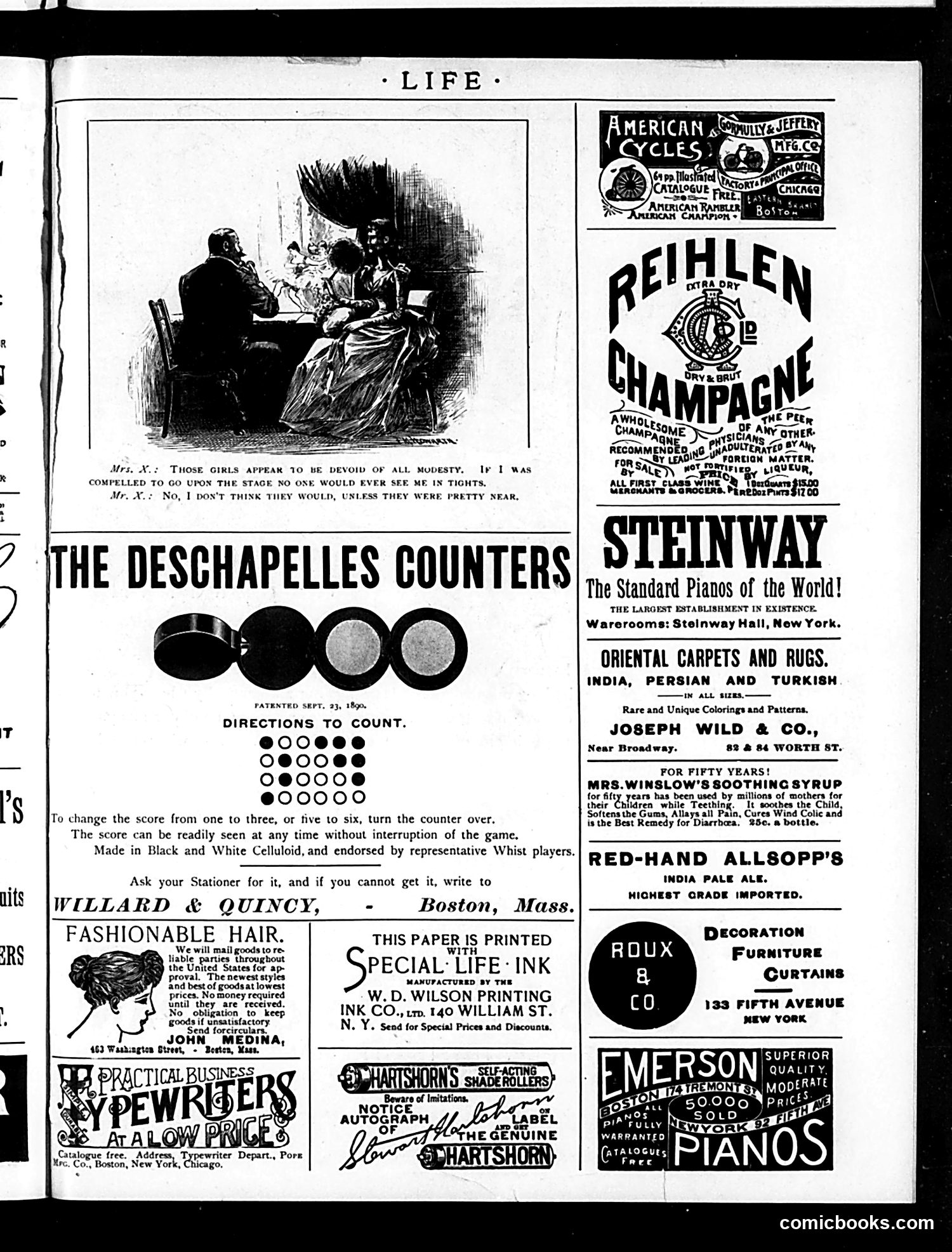
This page is primarily **advertising** with one small satirical cartoon at the top. The cartoon depicts a conversation between two women (labeled Mrs. X and Mr. X, though one appears male) about stage actresses wearing tights. Mrs. X expresses moral disapproval, claiming she'd never appear on stage in such revealing clothing. Mr. X's response—"No, I don't think they would, unless they were pretty near"—is the joke: he's sarcastically suggesting Mrs. X is too unattractive to draw an audience even if she performed. **The satire targets**: Victorian-era sexual hypocrisy and sanctimony. Mrs. X performatively clutches her pearls about actresses' immodesty while Mr. X cynically deflates her moral posturing with a cutting personal insult about her appearance. The bulk of the page consists of late-19th-century product advertisements (pianos, champagne, carpets, hair goods, etc.) and a patent notice for "The Deschapelles Counters," a card-game scoring device from 1890.
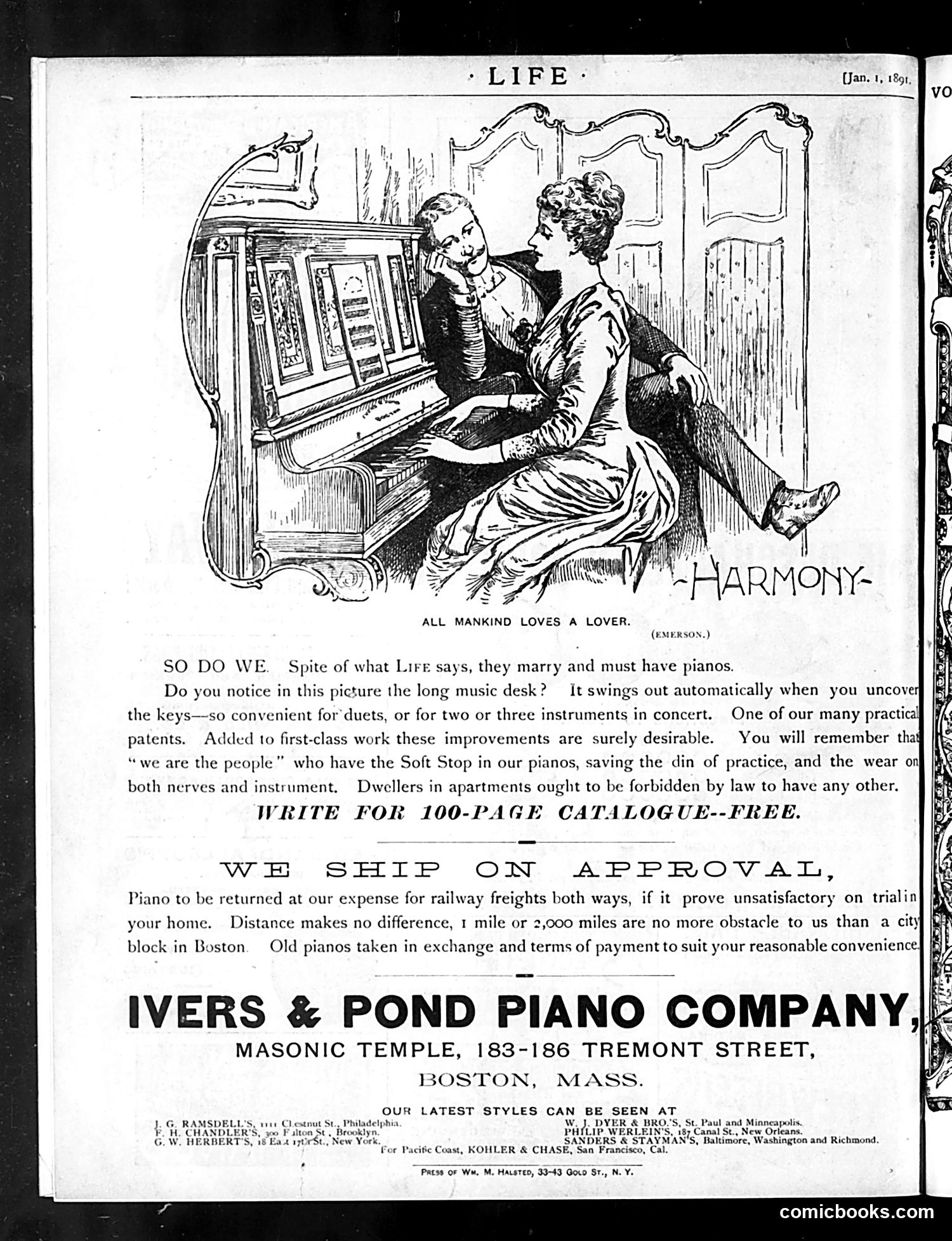
This is primarily a **piano company advertisement**, not political satire. The illustration shows a well-dressed couple at an ornate piano, the woman seated at the keys while the man leans in attentively—visualizing the Emerson quote "All Mankind Loves a Lover." The "joke" is commercial satire: the ad acknowledges that despite Life magazine's cynicism about romance, newly married couples still purchase pianos as status symbols and furnishings. The ad then pivots to promoting Ivers & Pond's "practical patents"—specifically a retractable music desk and a "Soft Stop" feature to muffle practice noise, addressing real apartment-dwellers' complaints. The humor lies in the self-aware tone: the company acknowledges the absurdity (marriage = mandatory piano purchase) while selling solutions to genuine domestic inconveniences. The "Ship on Approval" policy reflects late-19th-century mail-order commerce innovation. This reflects the Gilded Age assumption that cultural refinement (piano ownership) equaled social respectability.