
Life, 1891-01-01 · page 6 of 18
Life — January 1, 1891 — page 6: what you’re looking at
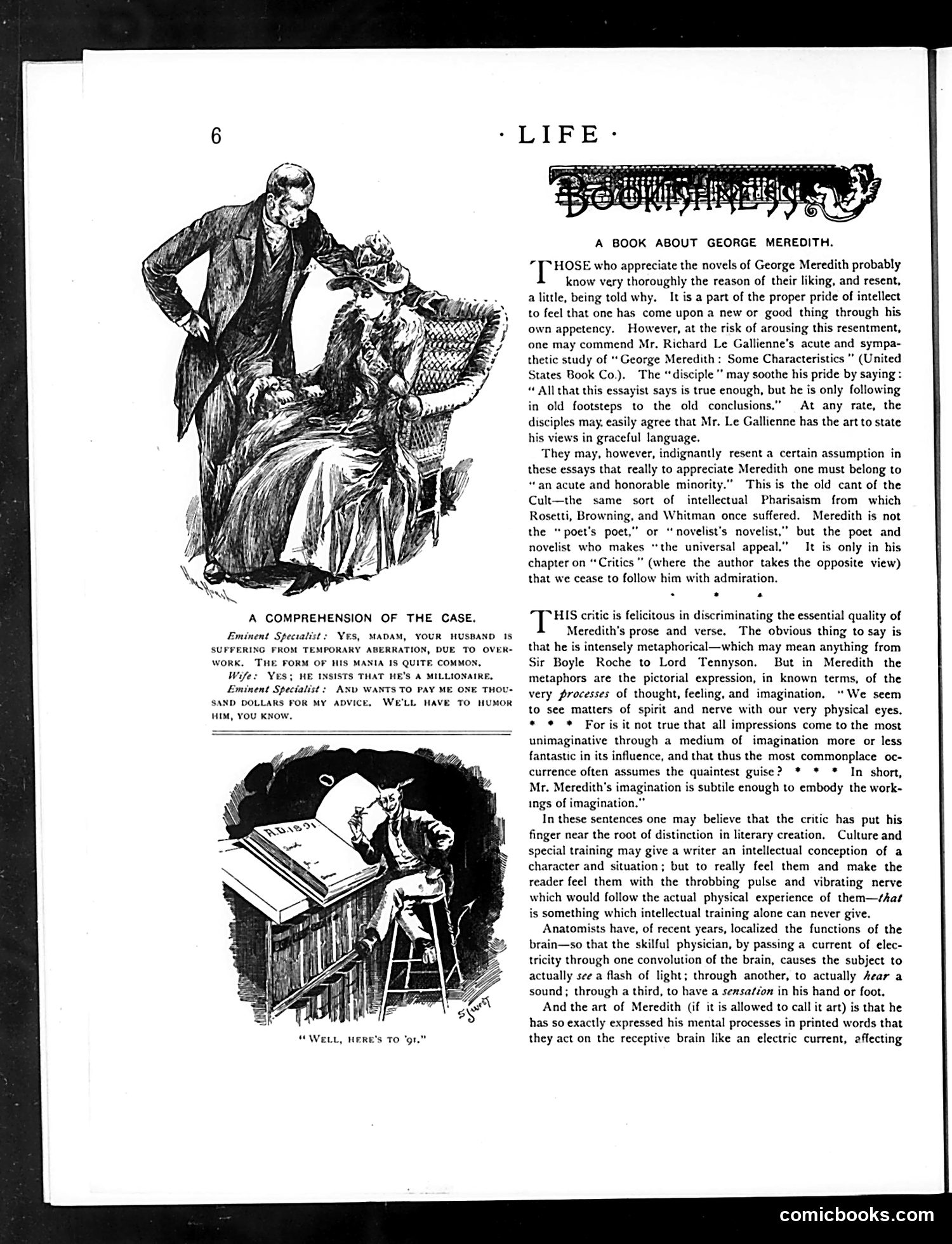
What you’re looking at
This page is a literary critique of novelist George Meredith, not political satire. The two illustrations are humorous sketches accompanying an essay about Meredith's writing style. The top cartoon shows a man "suffering from temporary aberration, due to over-work" seeking advice while insisting he's a millionaire—apparently illustrating Meredith's complex, intellectually demanding prose that confuses readers. The lower cartoon captioned "Well, here's to 't" depicts someone reading, likely referencing the difficulty of Meredith's work requiring intense concentration. The essay praises Meredith's "metaphorical" and imaginative writing style while acknowledging critics find him obscure. It argues his genius lies in expressing mental processes through language that affects readers like "an electric current."
📄 Transcribed text from this page (OCR, searchable)
Machine-transcribed from the original scan — historical spelling and the odd misread are preserved.
A COMPREHENSION OF THE CASE. Eminent Spectalist : Yes, MADAM, YOUR HUSBAND 15 SUFFERING FROM TEMPORARY ABERRATION, DUE TO OVER- WORK. THE FORM OF HIS MANIA 15 QUITE COMMON. Wife: Yes; WE INSISTS THAT HE'S A MILLIONAIRE. Eminent Specialist ; AND WANTS TO PAY ME ONE THOU- SAND DOLLARS FOR MY ADVICE. WE'LL HAVE TO HUMOR HIM, You KNOW. “WELL, HERE'S TO ‘91.” A BOOK ABOUT GEORGE MEREDITH. T HOSE who appreciate the novels of George Meredith probably know very thoroughly the reason of their liking, and resent, a little, being told why, It is a part of the proper pride of intellect to feel that one has come upon a new or good thing through his own appetency. However, at the risk of arousing this resentment, one may commend Mr. Richard Le Gallienne’s acute and sympa- thetic study of George Meredith : Some Characteristics " (United States Book Co.). The “disciple” may soothe his pride by saying: “ Allthat this essayist says is true enough, but he is only following in old footsteps to the old conclusions.” At any rate, the disciples may, easily agree that Mr. Le Gallienne has the art to state his views in graceful language. They may, however, indignantly resent a certain assumption in these essays that really to appreciate Meredith one must belong to “an acute and honorable minority.” This is the old cant of the Cult—the same sort of intellectual Pharisaism from which Rosetti, Browning, and Whitman once suffered. Meredith is not the “poet's poet,” or “novelist’s novelist,” but the poet and novelist who makes “the universal appeal.” It is only in his chapter on “Critics " (where the author takes the opposite view) that we cease to follow him with admiration. . . s THs critic is felicitous in discriminating the essential quality of Meredith's prose and verse. The obvious thing to say is that he is intensely metaphorical—which may mean anything from Sir Boyle Roche to Lord Tennyson, But in Meredith the metaphors are the pictorial expression, in known terms, of the very processes of thought, feeling, and imagination. “We seem to see matters of spirit and nerve with our very physical eyes. * © * For is it not true that all impressions come to the most unimaginative through a medium of imagination more or less fantastic in its influence, and that thus the most commonplace oc- currence often assumes the quaintest guise? * * * In short, Mr. Meredith's imagination is subtile enough to embody the work- ings of imagination.” In these sentences one may believe that the critic has put his finger near the root of distinction in literary creation, Culture and special training may give a writer an intellectual conception of a character and situation; but to really feel them and make the reader feel them with the throbbing pulse and vibrating nerve which would follow the actual physical experience of them—¢hat is something which intellectual training alone can never give. Anatomists have, of recent years, localized the functions of the brain—so that the skilful physician, by passing a current of elec- tricity through one convolution of the brain, causes the subject to actually see a flash of light; through another, to actually 4ear a sound; through a third, to have a sensaf‘on in his hand or foot. And the art of Meredith (if it is allowed to call it art) is that he has so exactly expressed his mental processes in printed words that they act on the receptive brain like an electric current, affecting comicbooks.com