
Life, 1891-01-01 · page 4 of 18
Life — January 1, 1891 — page 4: what you’re looking at
What you’re looking at
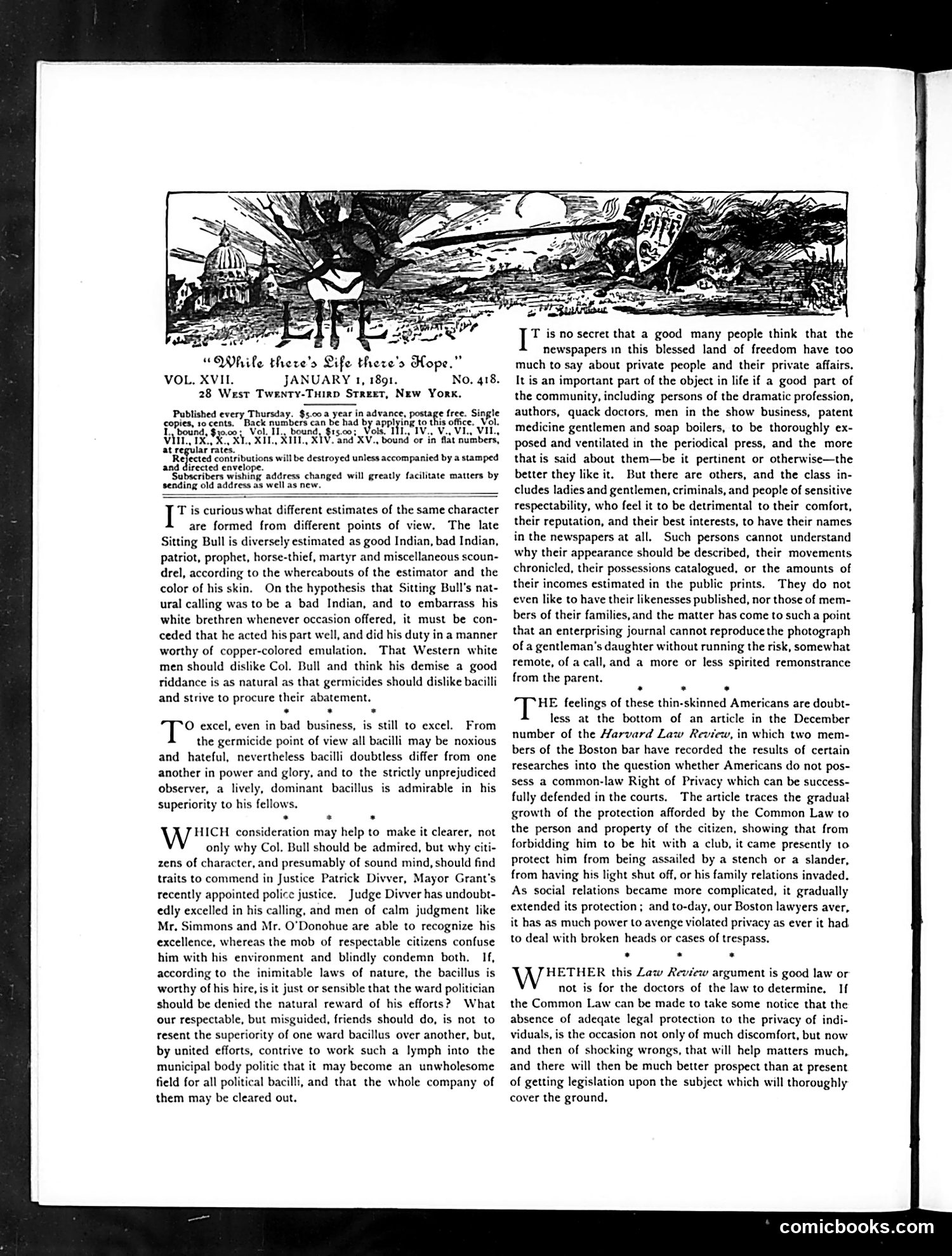
**The Image:** The masthead features an Art Nouveau-style illustration showing a classical figure amid a dramatic landscape with buildings and celestial elements—typical decorative design for this era. **The Text:** This is editorial commentary (not a political cartoon) discussing debates over privacy rights and newspaper coverage. The piece critiques newspapers for publishing details about private citizens—particularly members of "respectable" society—arguing this violates a "common-law Right of Privacy." The editors reference a *Harvard Law Review* article and invoke Judge Patrick Divver and Mayor Grant's recent police appointments, suggesting this reflects broader concerns about legal protections for individuals against unwanted public exposure. **The Point:** This advocates for legal privacy protections against invasive journalism, a progressive-era concern about emerging mass media's power.
📄 Transcribed text from this page (OCR, searchable)
Machine-transcribed from the original scan — historical spelling and the odd misread are preserved.
“Mile there's Life there's Hope.” VOL, XVII. JANUARY 1, 1891. No, 418. 28 West Twenty-Tuirp Street, New York. Published every Thursday. $5.00 a year in advance, postage free. Single x. "Back numbers can be had b applying to ‘fi ot ols, HI., 1V. copies, 10 cents. is office. Vol. , Vol. 1 1, bound, , bound, $15.00; VP IX eo RIT RT RHO Sed xVE Bound of at regular rates. Rejected contributions will be destroyed unless accompanied by a stamped and directed envelope. bscribers wishing address changed will greatly facilitate matters by sending old address as well as new. flat numbers, T is curious what different estimates of the same character are formed from different points of view. The late Sitting Bull is diversely estimated as good Indian, bad Indian, patriot, prophet, horse-thief, martyr and miscellaneous scoun- drel, according to the whereabouts of the estimator and the color of his skin. On the hypothesis that Sitting Bull's nat- ural calling was to be a bad Indian, and to embarrass his white brethren whenever occasion offered, it must be con- ceded that he acted his part well, and did his duty in a manner worthy of copper-colored emulation. That Western white men should dislike Col. Bull and think his demise a good riddance is as natural as that germicides should dislike bacilli and strive to procure their abatement. . . . O excel, even in bad business, is still to excel. From the germicide point of view all bacilli may be noxious and hateful, nevertheless bacilli doubtless differ from one another in power and glory, and to the strictly unprejudiced observer, a lively, dominant bacillus is admirable in his superiority to his fellows. HICH consideration may help to make it clearer, not only why Col. Bull should be admired, but why citi- zens of character, and presumably of sound mind, should find traits to commend in Justice Patrick Divver, Mayor Grant's recently appointed police justice. Judge Divver has undoubt- edly excelled in his calling, and men of calm judgment like Mr. Simmons and Mr. O’Donohue are able to recognize his excellence, whereas the mob of respectable citizens confuse him with his environment and blindly condemn both, If, according to the inimitable laws of nature, the bacillus is worthy of his hire, is it just or sensible that the ward politician should be denied the natural reward of his efforts? What our respectable, but misguided, friends should do, is not to resent the superiority of one ward bacillus over another, but, by united efforts, contrive to work such a lymph into the municipal body politic that it may become an unwholesome field for all political bacilli, and that the whole company of them may be cleared out. T is no secret that a good many people think that the newspapers in this blessed land of freedom have too much to say about private people and their private affairs. It is an important part of the object in life if a good part of the community, including persons of the dramatic profession, authors, quack doctors, men in the show business, patent medicine gentlemen and soap boilers, to be thoroughly ex- posed and ventilated in the periodical press, and the more that is said about them—be it pertinent or otherwise—the better they like it, But there are others, and the class in- cludes ladies and gentlemen, criminals, and people of sensitive respectability, who feel it to be detrimental to their comfort, their reputation, and their best interests, to have their names. in the newspapers at all. Such persons cannot understand why their appearance should be described, their movements chronicled, their possessions catalogued, or the amounts of their incomes estimated in the public prints. They do not even like to have their likenesses published, nor those of mem- bers of their families,and the matter has come to such a point that an enterprising journal cannot reproduce the photograph of a gentleman's daughter without running the risk, somewhat remote, of a call, and a more or less spirited remonstrance from the parent. 2 . . A ia feelings of these thin-skinned Americans are doubt- less at the bottom of an article in the December number of the Harvard Law Review, in which two mem- bers of the Boston bar have recorded the results of certain researches into the question whether Americans do not pos- sess a common-law Right of Privacy which can be success- fully defended in the courts. The article traces the gradual growth of the protection afforded by the Common Law to the person and property of the citizen, showing that from forbidding him to be hit with a club, it came presently to protect him from being assailed by a stench or a slander, from having his light shut off, or his family relations invaded. As social relations became more complicated, it gradually extended its protection ; and to-day, our Boston lawyers aver, it has as much power to avenge violated privacy as ever it had to deal with broken heads or cases of trespass. . . . AV BETHER this Law Review argument is good law or not is for the doctors of the law to determine. If the Common Law can be made to take some notice that the absence of adeqate legal protection to the privacy of indi- viduals, is the occasion not only of much discomfort, but now and then of shocking wrongs, that will help matters much, and there will then be much better prospect than at present of getting legislation upon the subject which will thoroughly cover the ground, comicbooks.com