
A complete issue · 20 pages · 1890
Life — November 13, 1890
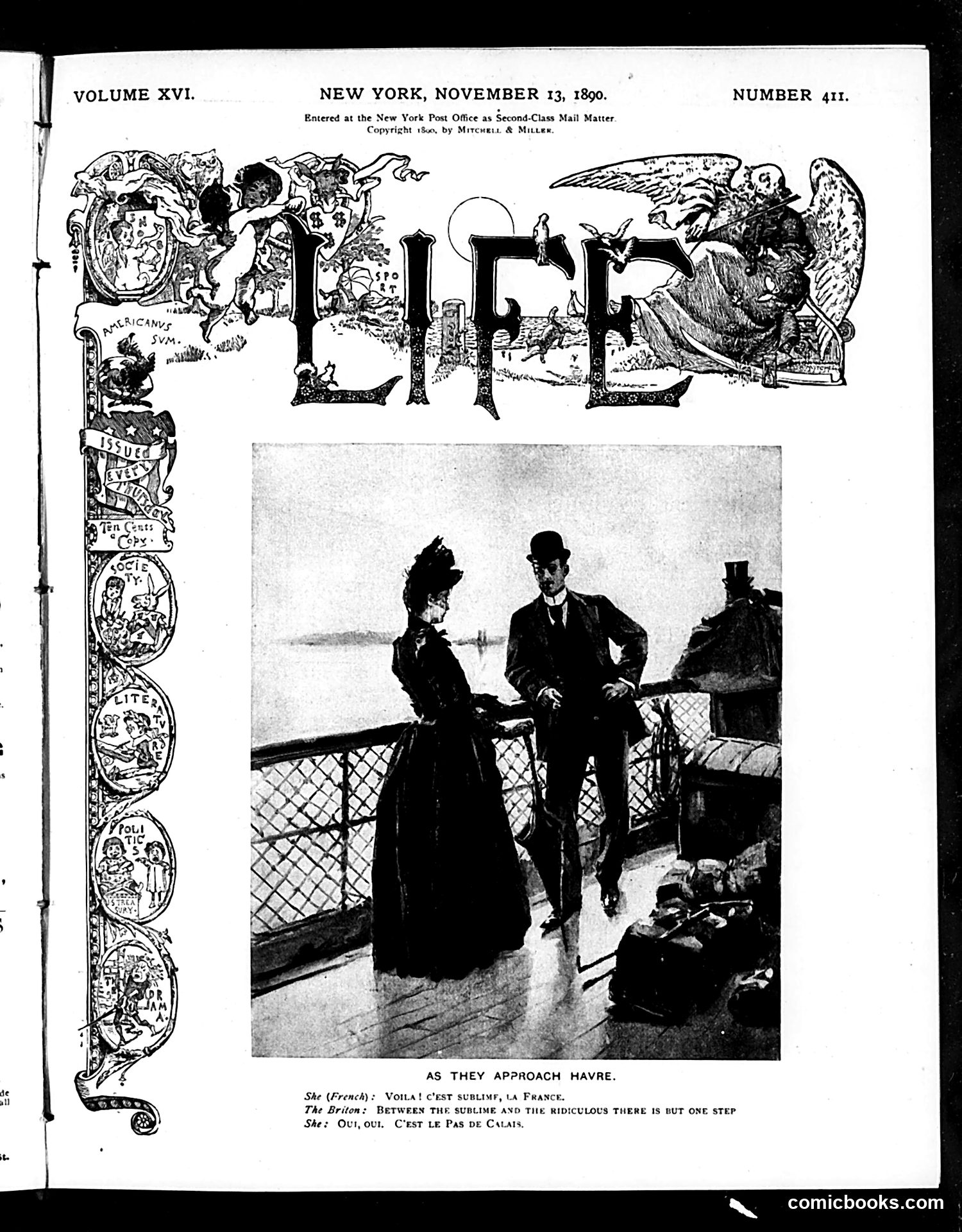
This page features an illustration titled "As They Approach Havre" depicting two figures on a ship's deck overlooking water. The French dialogue translates roughly to: "She (French): 'There! It's sublime, France.' The Briton: 'Between the sublime and the ridiculous there is but one step.' She: 'Yes, yes. It's the Pas de Calais.'" The cartoon satirizes the cultural divide between French and British perspectives. The French woman expresses romantic appreciation for approaching the French coast, while the British man makes a sardonic comment about the narrow channel (Pas de Calais) separating the two nations—suggesting the British view the French as overly sentimental while maintaining superiority through wit. It's a commentary on Anglo-French national character and mutual stereotyping.
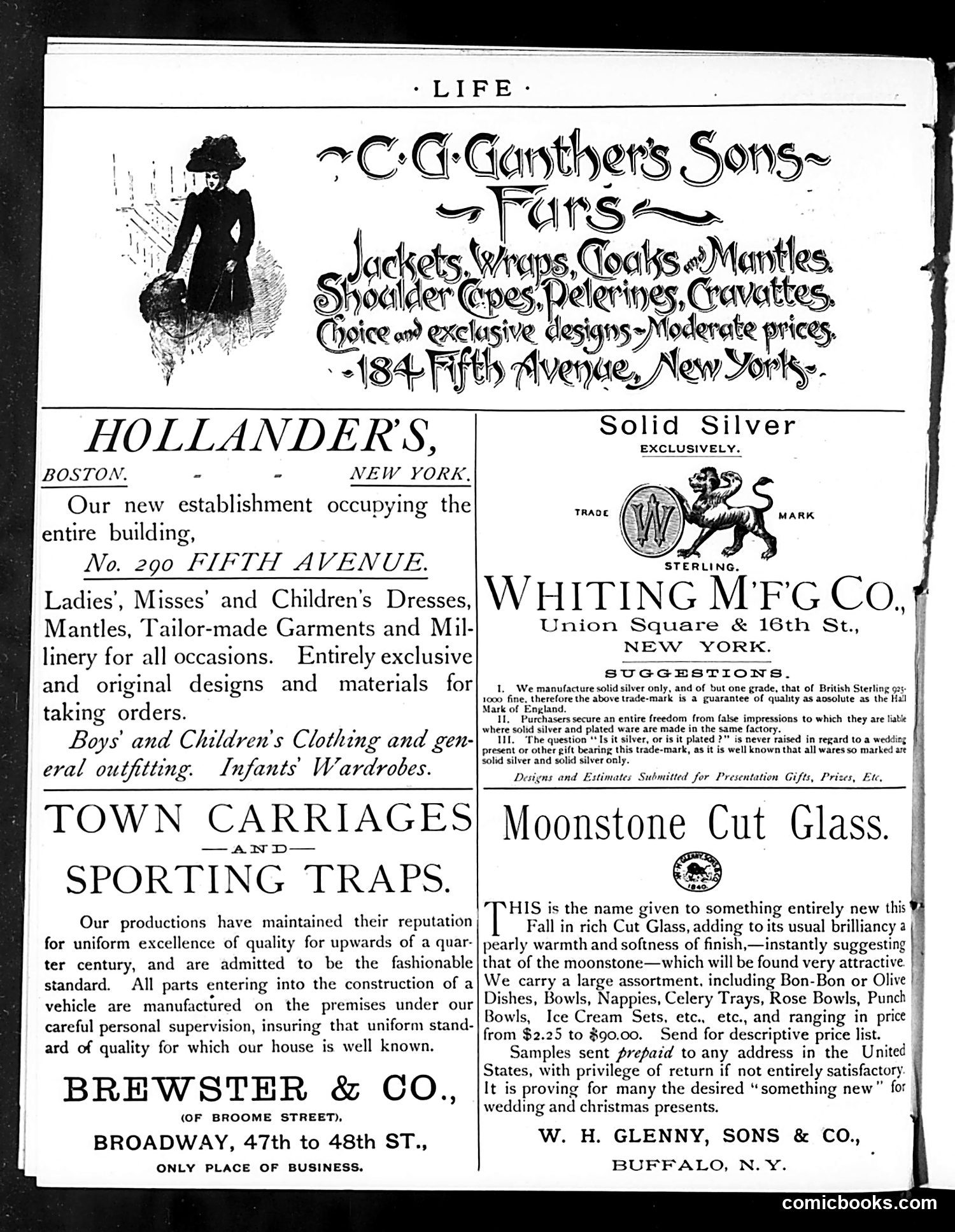
This page is **primarily advertising**, not satirical content. It contains four separate commercial advertisements from the late 19th or early 20th century: 1. **C.C. Ganthers Sons** - Furs and cloaks at 184 Fifth Avenue, New York 2. **Hollanders** - Women's and children's clothing in Boston and New York 3. **Whiting Mfg Co.** - Sterling silver goods 4. **Brewster & Co.** - Town carriages and sporting traps 5. **W.H. Glenny, Sons & Co.** - Moonstone cut glass from Buffalo The illustration shows a fashionably-dressed woman in period attire, likely promoting the clothing advertisements. There is **no political satire or cartoon commentary** visible on this page—it represents typical commercial content from *Life* magazine's advertising section.
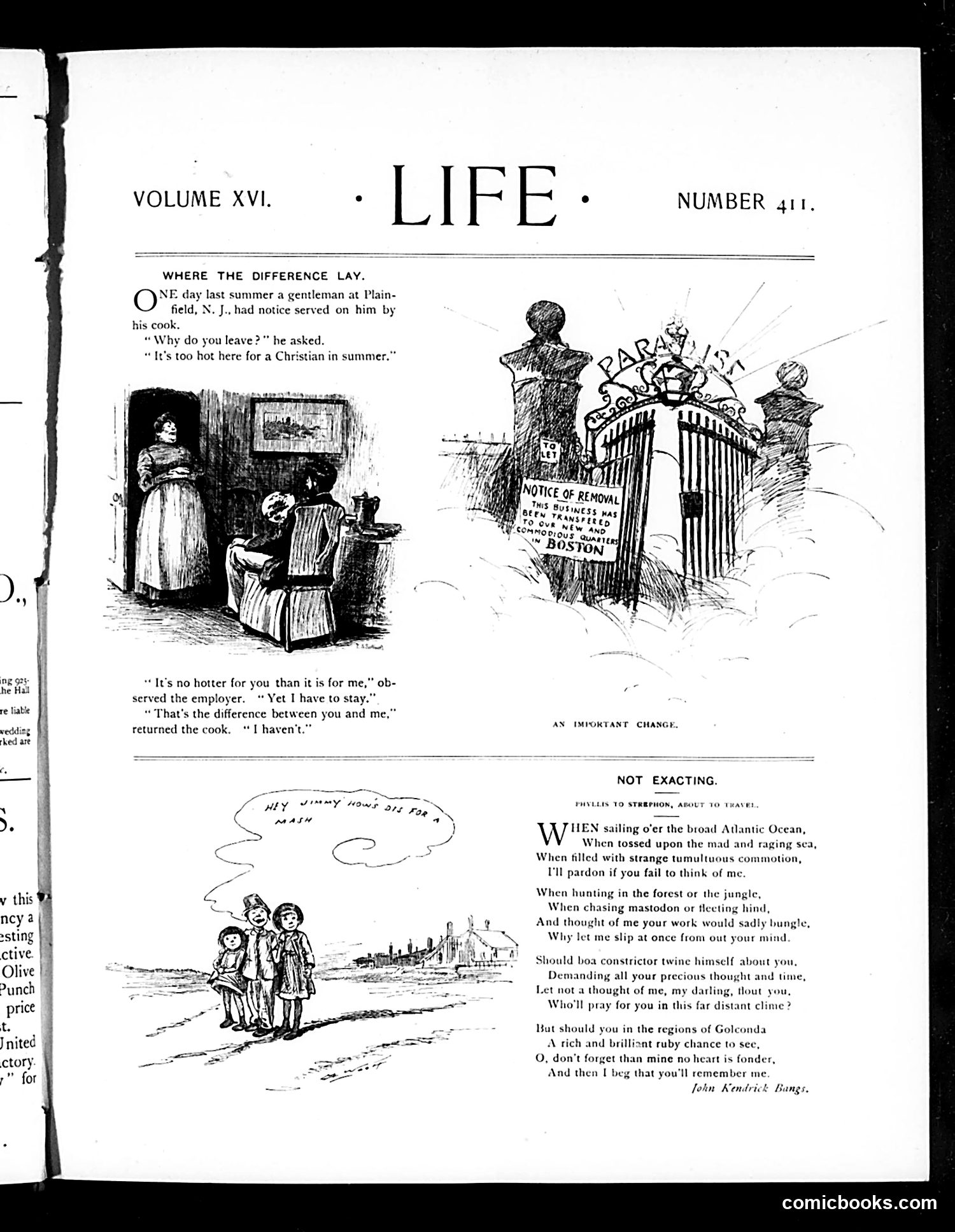
**"Where the Difference Lay"** (top): A domestic servant leaves her employer, claiming "it's too hot here for a Christian in summer." The employer counters that it's no hotter for the servant than for himself, but notes the difference: "Yet I have to stay." The joke satirizes class hypocrisy—the wealthy man frames his obligation to remain as moral duty while dismissing the servant's legitimate discomfort, implying servants lack equivalent choice or consideration. **"An Important Change"** (middle): A gate labeled "Paradise" with a notice appears to reference entry restrictions or changing conditions, though the specific satirical target is unclear from the image alone. **"Not Exacting"** (bottom): A sentimental poem by John Kendrick Bangs addressed to "Phyllis" emphasizes remembrance across distances, likely mocking overly romantic Victorian sentimentality.
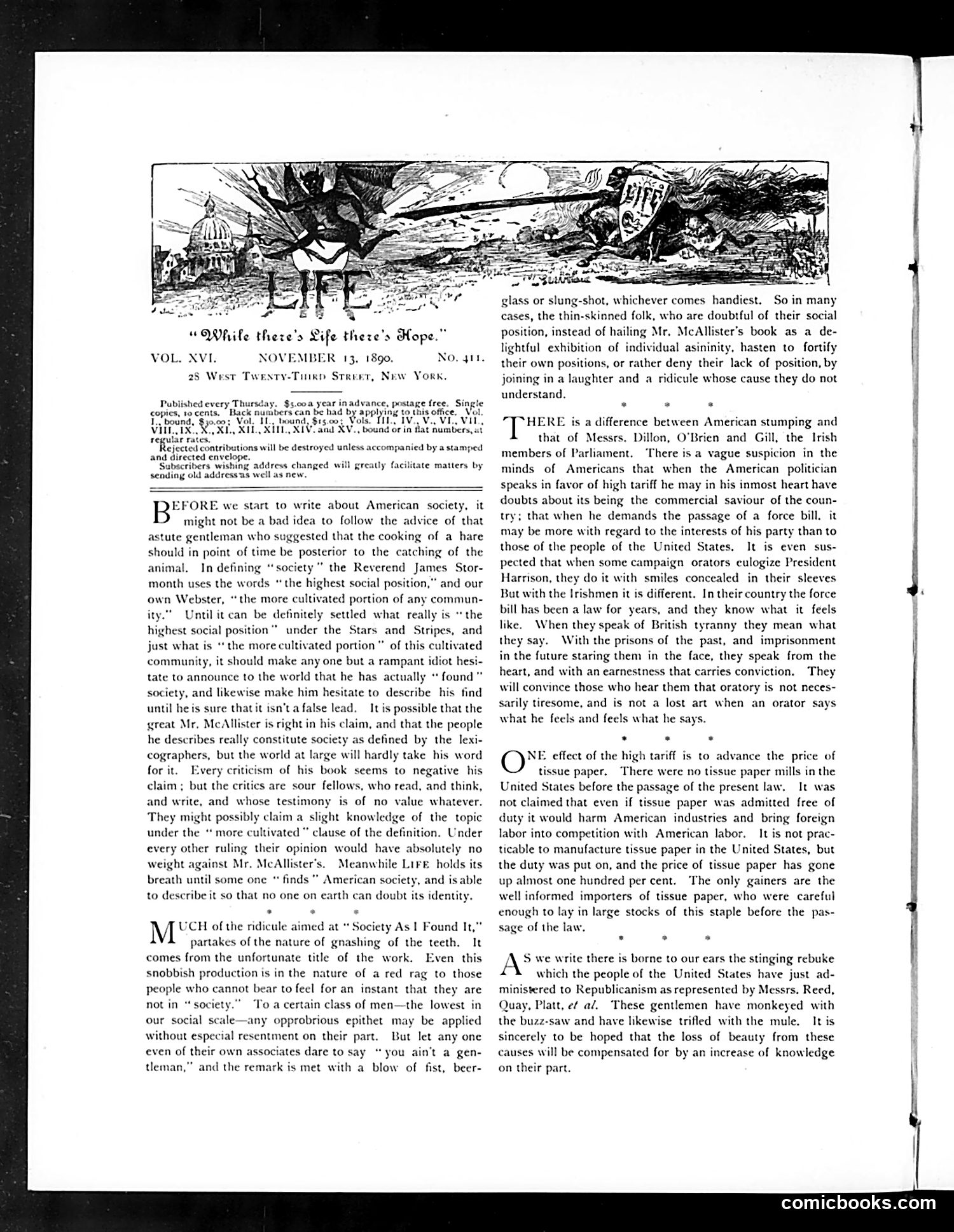
The masthead and text indicate this is from **Life Magazine, Vol. XVI, No. 411** (November 13, likely 1890). The cartoon at top depicts a chaotic apocalyptic scene titled **"While there's Life there's Hope."** The imagery suggests social upheaval or disaster—possibly referencing contemporary American anxieties about industrialization, class conflict, or political instability. The accompanying article discusses **American "society"** and critiques claims about what constitutes high social status. It mocks pretentious attempts to define refined society, comparing American social climbing unfavorably to Irish parliamentary members who speak with genuine conviction about substantive issues like tariffs and British policy. The satire targets American snobbery and superficiality in social positioning, contrasting it with what the author views as more authentic Irish political engagement.
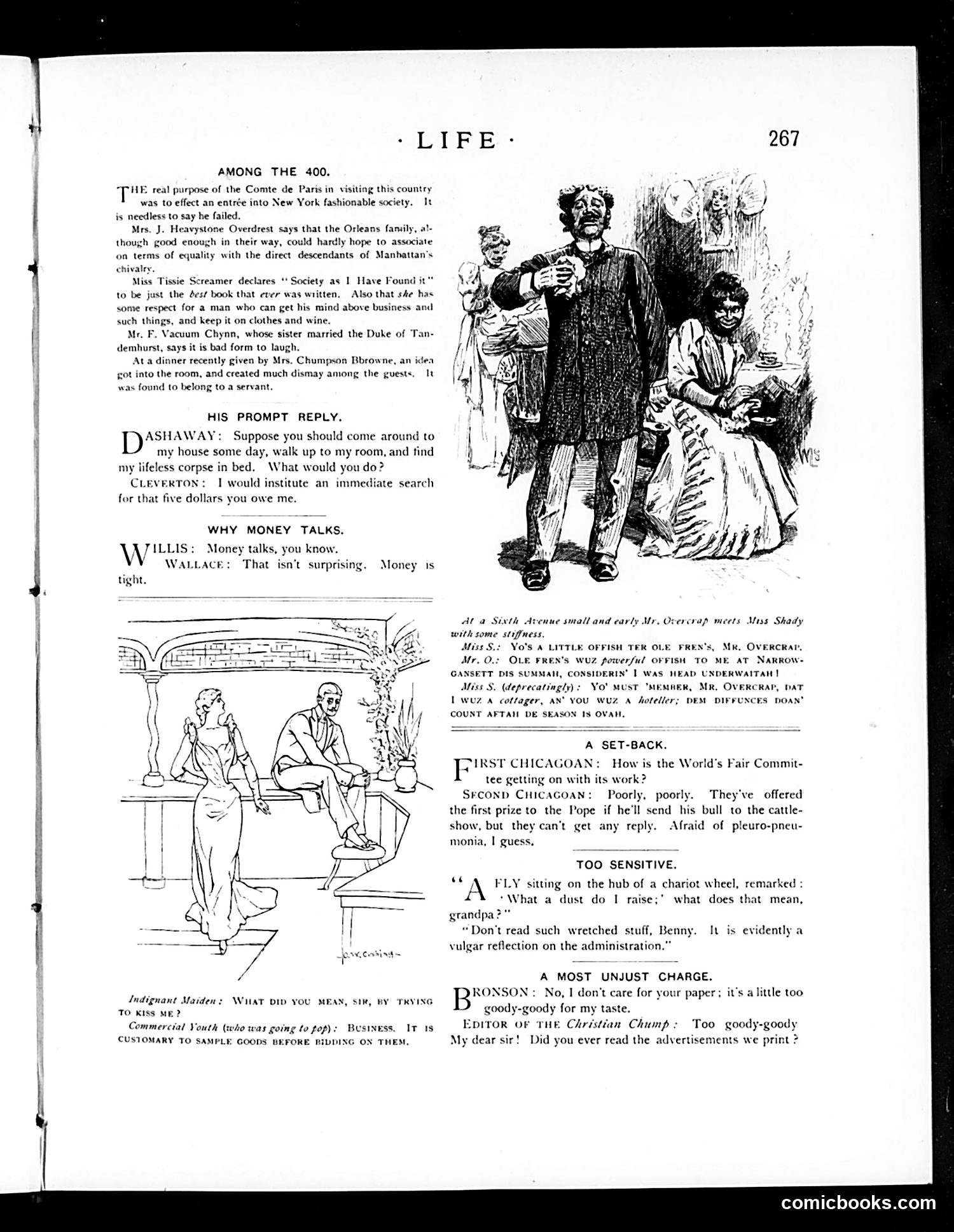
This page contains several short satirical pieces about New York high society and social pretension. **Top section** mocks the wealthy's attempts to legitimize themselves through genealogy and fashionable behavior—references to the Comte de Fam trying to infiltrate New York society, with characters claiming connection to Manhattan's "old money." **"His Prompt Reply"** and **"Why Money Talks"** are brief comedic exchanges about wealth and social climbing. **Lower sections** include a humorous dialogue between Chicagoans about the World's Fair, and a joke about a fly on a chariot wheel—likely a reference to Aesop's fables about vanity. **"A Most Unjust Charge"** criticizes newspaper advertisements as "too goody-goody." The overall theme: satire of social pretension, wealth obsession, and American materialism among the upper classes.
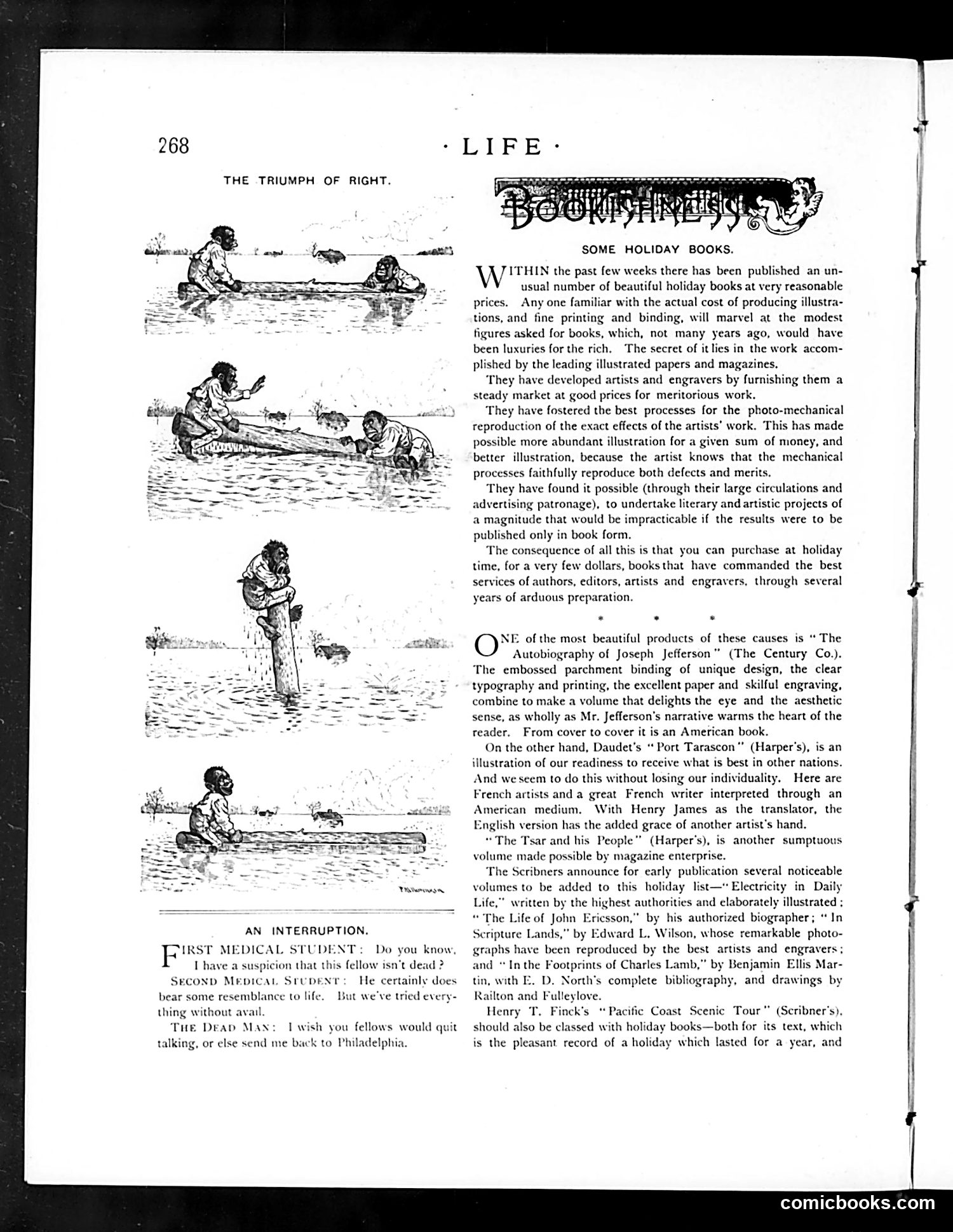
This page features a visual narrative (left side) showing figures in water, appearing to depict a drowning or rescue scenario. The sequence progresses from struggle to apparent resolution. The heading "THE TRIUMPH OF RIGHT" suggests the images illustrate a moral lesson or victory of justice, though the specific historical event referenced is unclear from the image alone. The right side contains advertising for holiday books, discussing beautiful illustrated volumes at reasonable prices—featuring works like Jefferson's autobiography and Daudet's "Port Tarascon." The bottom section includes "AN INTERRUPTION," a joke about medical students discussing a corpse's resemblance to life. Without additional context, the cartoon's specific satirical target remains ambiguous, though "triumph of right" suggests vindication or justice prevailing.
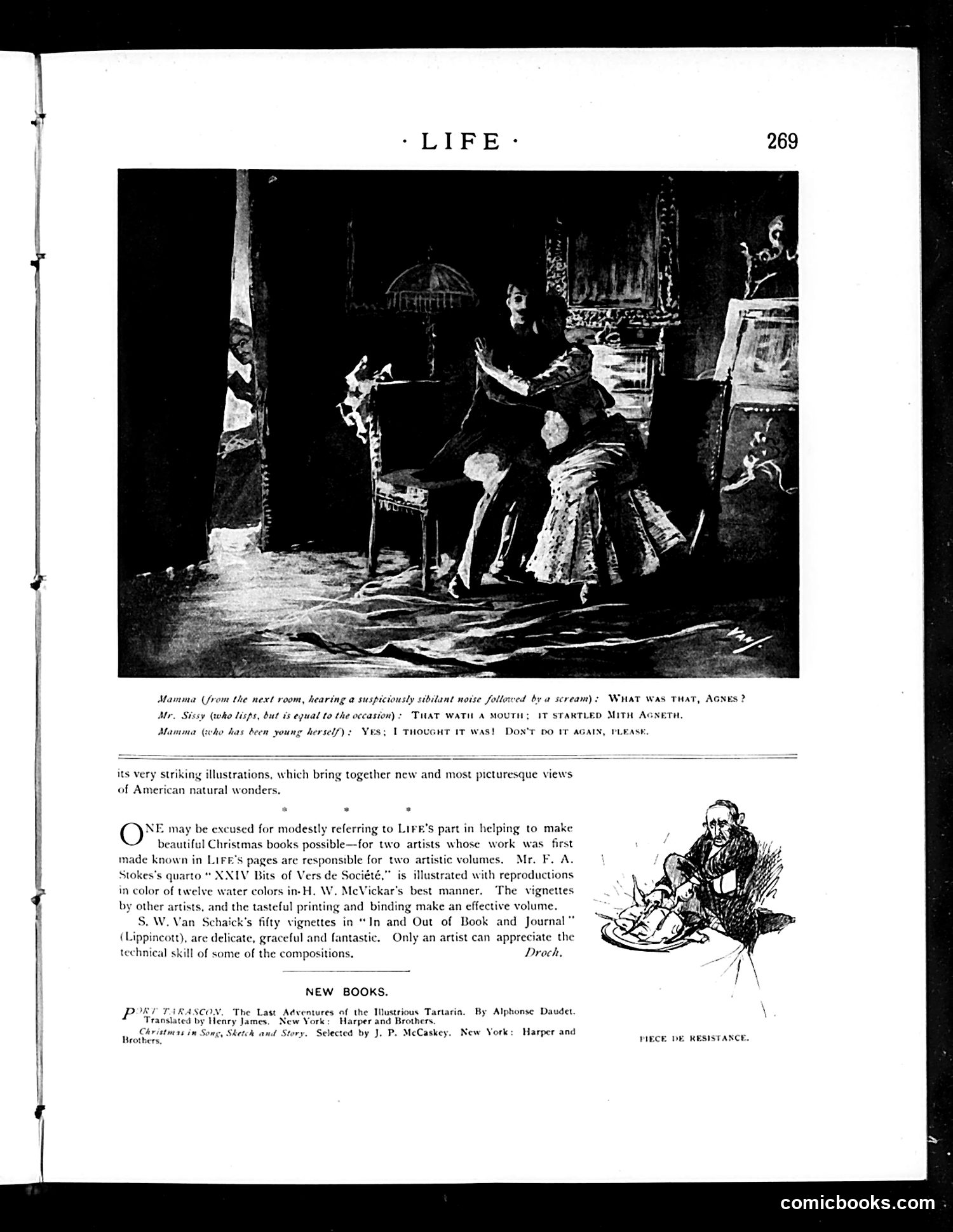
The main image appears to be a theatrical scene, likely from a play or film, showing characters in period costume in an ornate interior. The caption suggests a comedic domestic situation where "Mamma" is disturbed by a suspicious noise, with dialogue about something that "startled Mith Agneth" (possibly Agnes). Below is a brief note praising Life's contribution to Christmas book publishing, mentioning collaborations with artists on illustrated volumes, including works by F.A. Stokes and S.W. Van Schaick. The "New Books" section lists recent publications, including "The Last Adventures of the Illustrious Tartarin" by Alphonse Daudet. The page appears primarily focused on book reviews and theatrical entertainment rather than political satire or commentary.
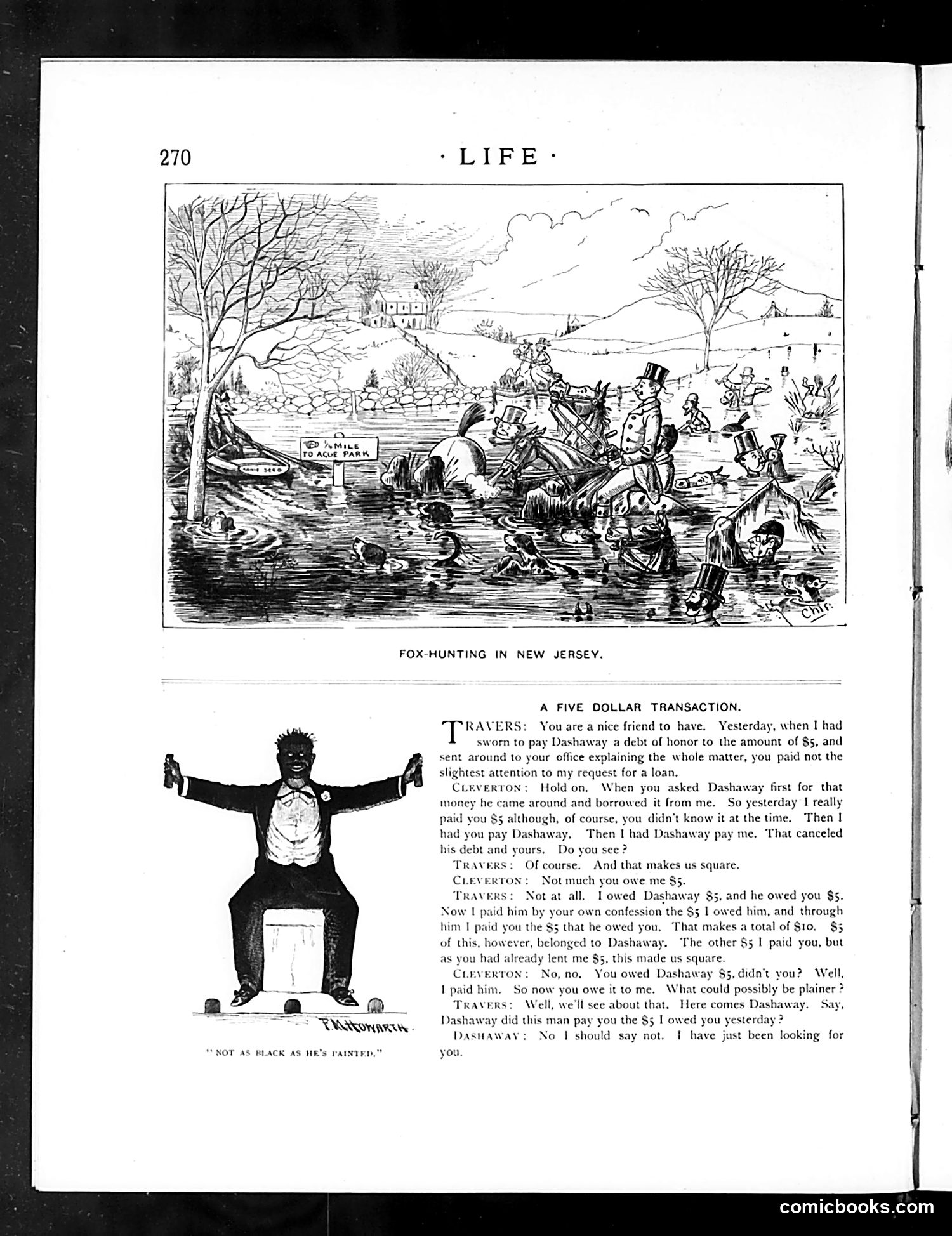
**Top Cartoon:** "Fox-Hunting in New Jersey" depicts wealthy gentlemen in top hats engaging in fox-hunting near water, satirizing the pretensions of the leisure class adopting European aristocratic pastimes. **Bottom Cartoon & Dialogue:** Titled "Not as Black as He's Painted," this piece satirizes circular debt and financial confusion. Two men (Travers and Cleverton) argue about who owes whom money through a convoluted chain involving a third party named Dashaway. The joke illustrates how financial entanglements can become so twisted that settling debts becomes logically impossible. The caricatured figure between them appears to represent the complications themselves—a visual representation of financial absurdity common in Gilded Age satire.
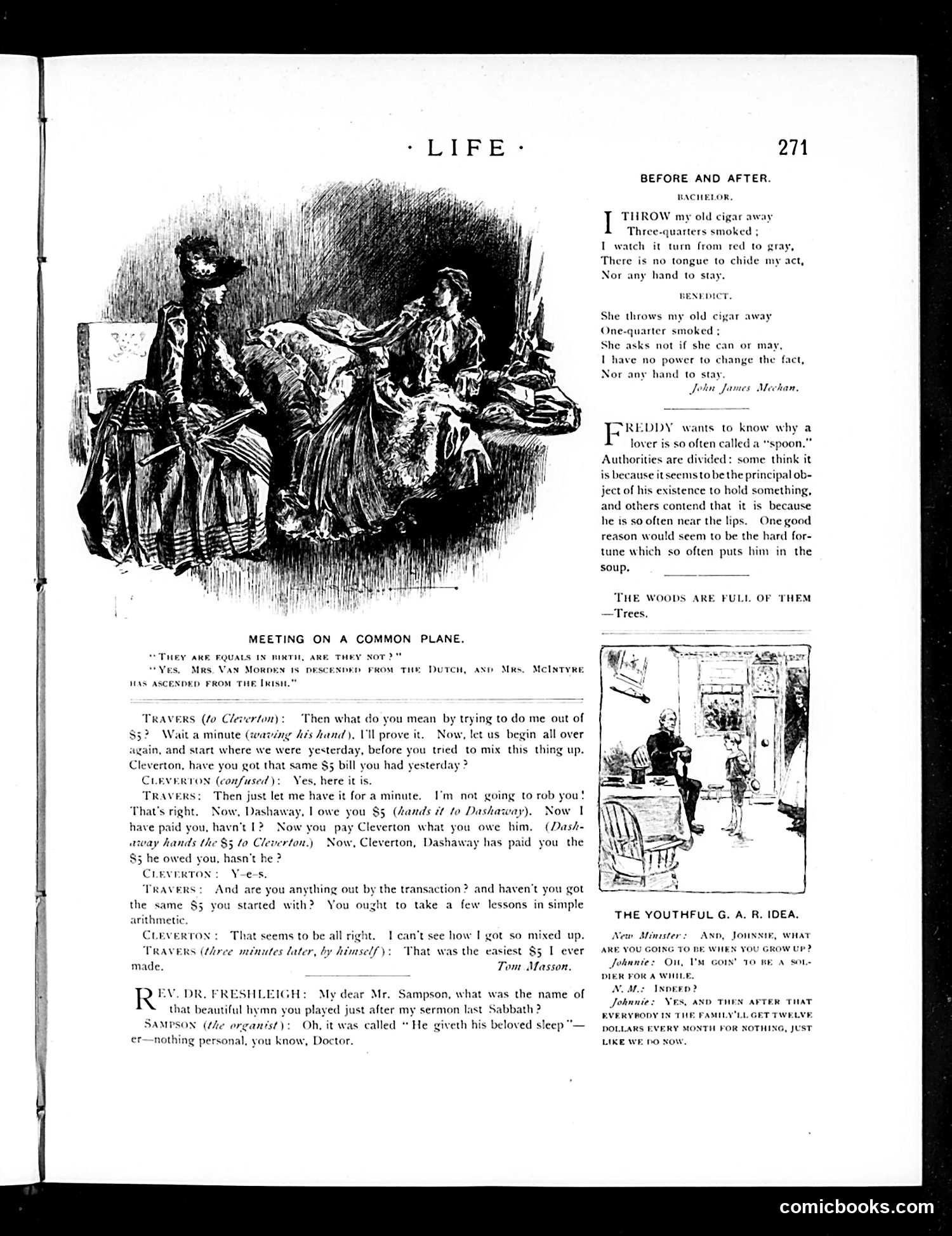
This page contains humorous social commentary about marriage and courtship. The main illustration shows a couple meeting, captioned "Meeting on a Common Plane," with a note about class differences being "equals in birth." The dialogue below depicts a comic misunderstanding between characters named Travers and Cleverton involving money and debt repayment—apparently Cleverton owes Travers £5, creating confusion about who owes whom what. A second cartoon titled "The Youthful G.A.R. Idea" shows a young boy telling his mother he plans to become a soldier, with her concerned response about supporting his family without income. The poems at top contrast a bachelor's freedom (throwing away cigars) with a married man's loss of autonomy. These pieces satirize courtship conventions, financial confusion, and changing life prospects after marriage.
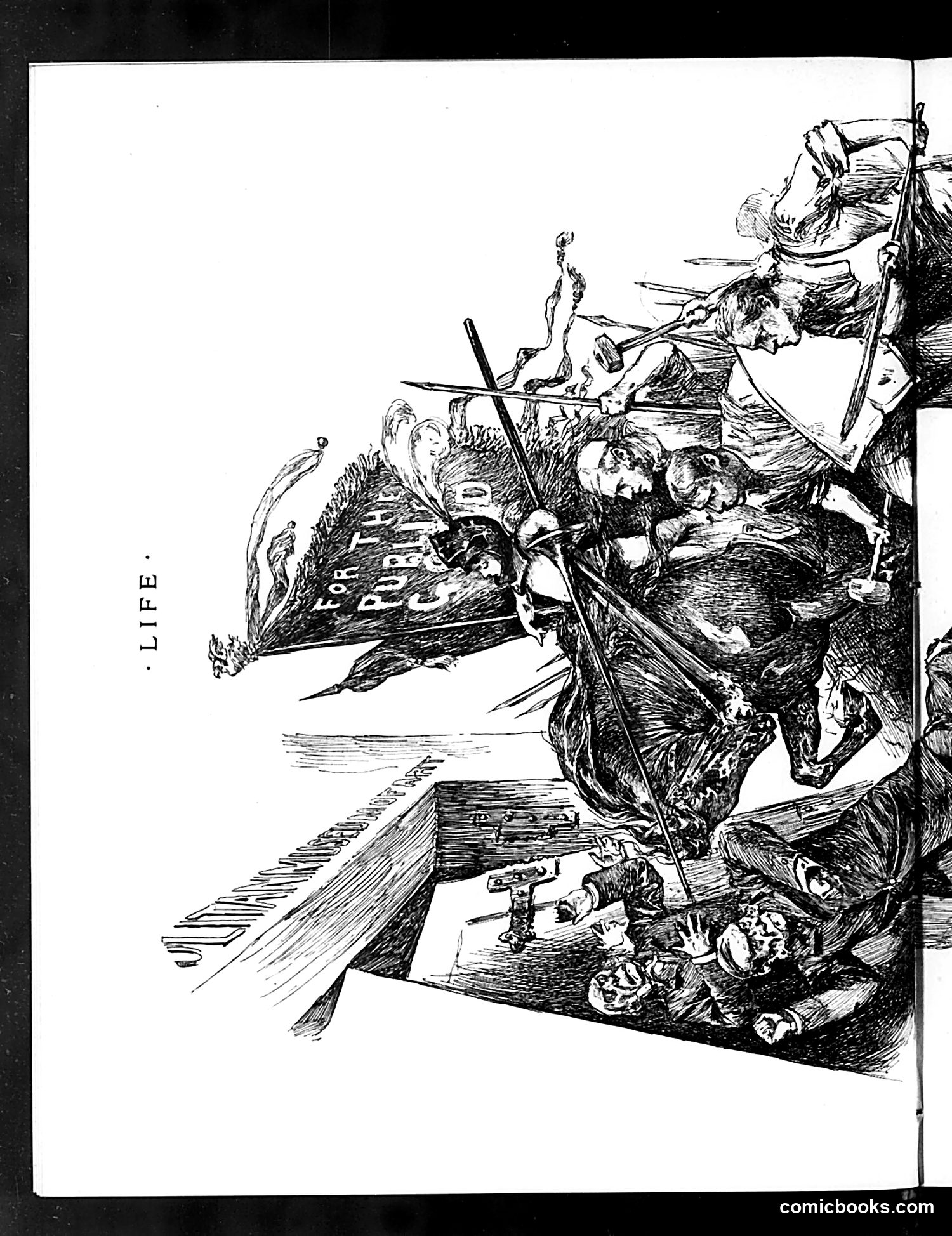
This page shows an illustration titled "LIFE" depicting a chaotic scene of multiple figures engaged in what appears to be a violent altercation or brawl. The sketch style is characteristic of late 19th or early 20th-century satirical illustration. The composition shows several men in period clothing (appearing to be Victorian or Edwardian era) entangled in combat, with weapons or implements visible. Without clearer details or accompanying article text visible on the page, I cannot definitively identify the specific political figures, event, or satirical point being referenced. The style suggests social or political commentary typical of *Life* magazine's satirical tradition, but **the specific targets and meaning remain unclear from this image alone** without additional context or readable text identifying the subjects or the referenced situation.
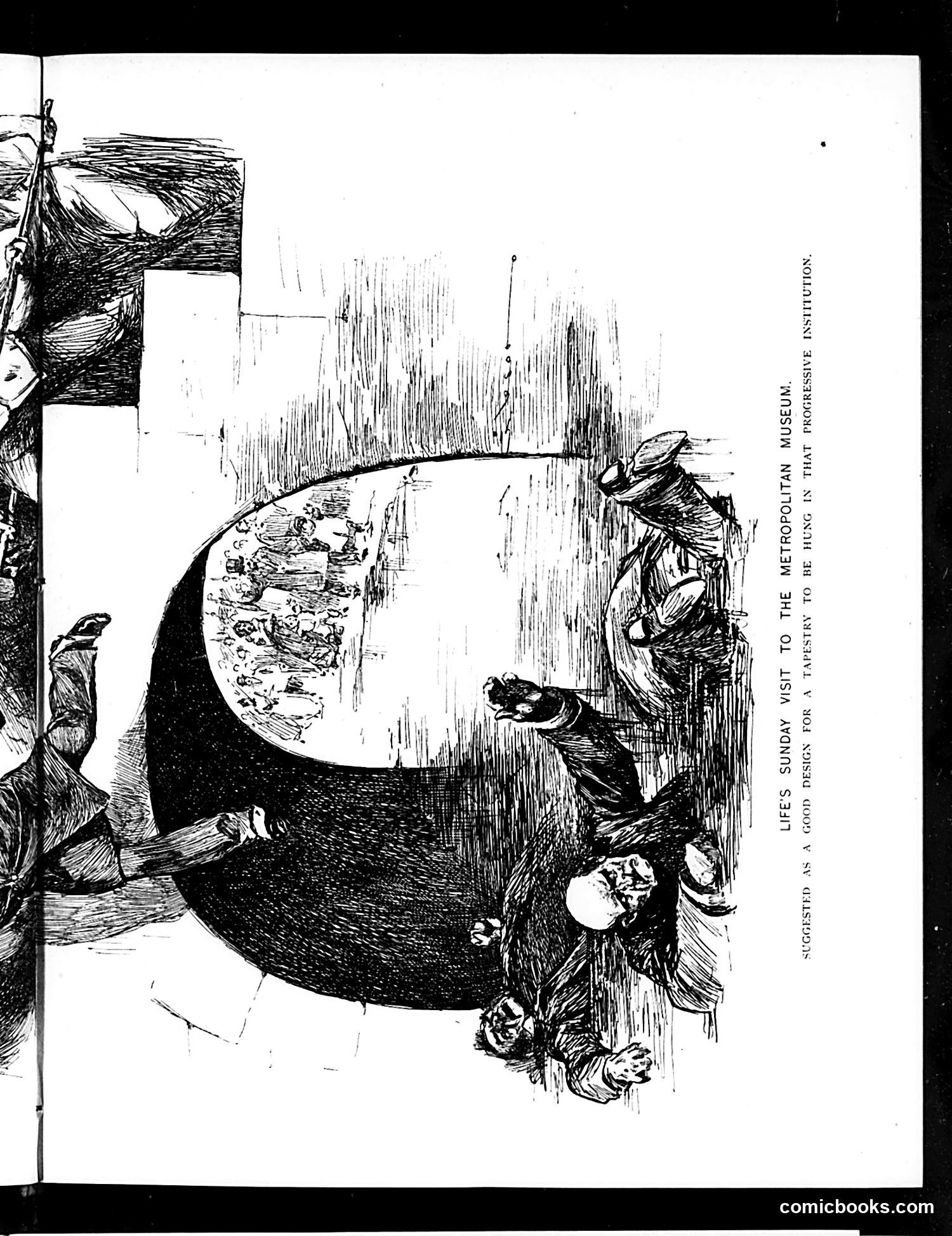
This is a single satirical illustration titled "Life's Sunday Visit to the Metropolitan Museum" with a subtitle indicating it's "sponsored as a good design for a variety to be hung in Professor Instruction." The cartoon depicts a large figure (appears to be a well-dressed woman in a long dark dress) viewing what looks like a classical bust or sculpture in a museum. The figure is drawn in an exaggerated style typical of Life magazine's humor. The satire appears to mock either museum-goers' pretensions or the juxtaposition between classical refinement and contemporary vulgarity—a common theme in early-20th-century satirical magazines. The specific political or social critique remains unclear without additional context about the publication date or the "Professor Instruction" reference.
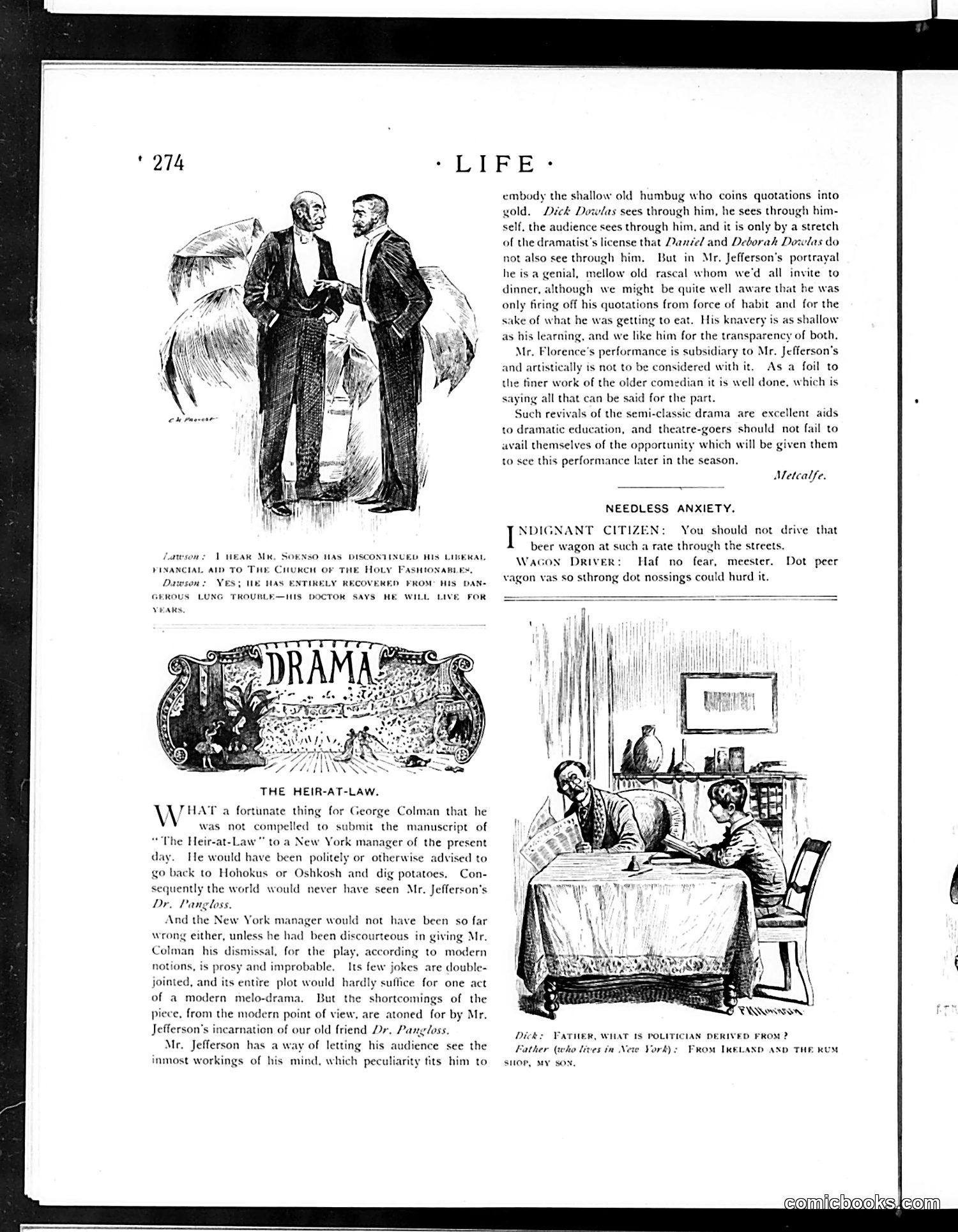
This page from *Life* magazine contains theatrical criticism and social satire from the late 19th century. **Upper cartoon**: Two well-dressed gentlemen discuss a clergyman's financial troubles. The joke satirizes wealthy donors who withdraw support from religious institutions—here, Mr. Sorenson has stopped funding "The Church of the Holy Fashionables," yet the clergyman has mysteriously recovered from serious illness anyway, suggesting his recovery was motivated by losing his financial patron's support rather than divine intervention. **"The Heir-at-Law" section**: Theater critic Metcalfe reviews a revival of George Colman's play, praising actor Joseph Jefferson's performance as Dr. Pangloss—a shallow, quotation-spouting charlatan. The review suggests the old play has weak modern standards but shines through Jefferson's skillful portrayal of transparent roguery. **Lower cartoon**: An Irish immigrant beer wagon driver dismisses safety concerns, boasting his wagon is too sturdy to be damaged. The humor relies on ethnic dialect humor and the absurdity of prioritizing cargo over passenger safety—typical of *Life*'s period comedy approach.
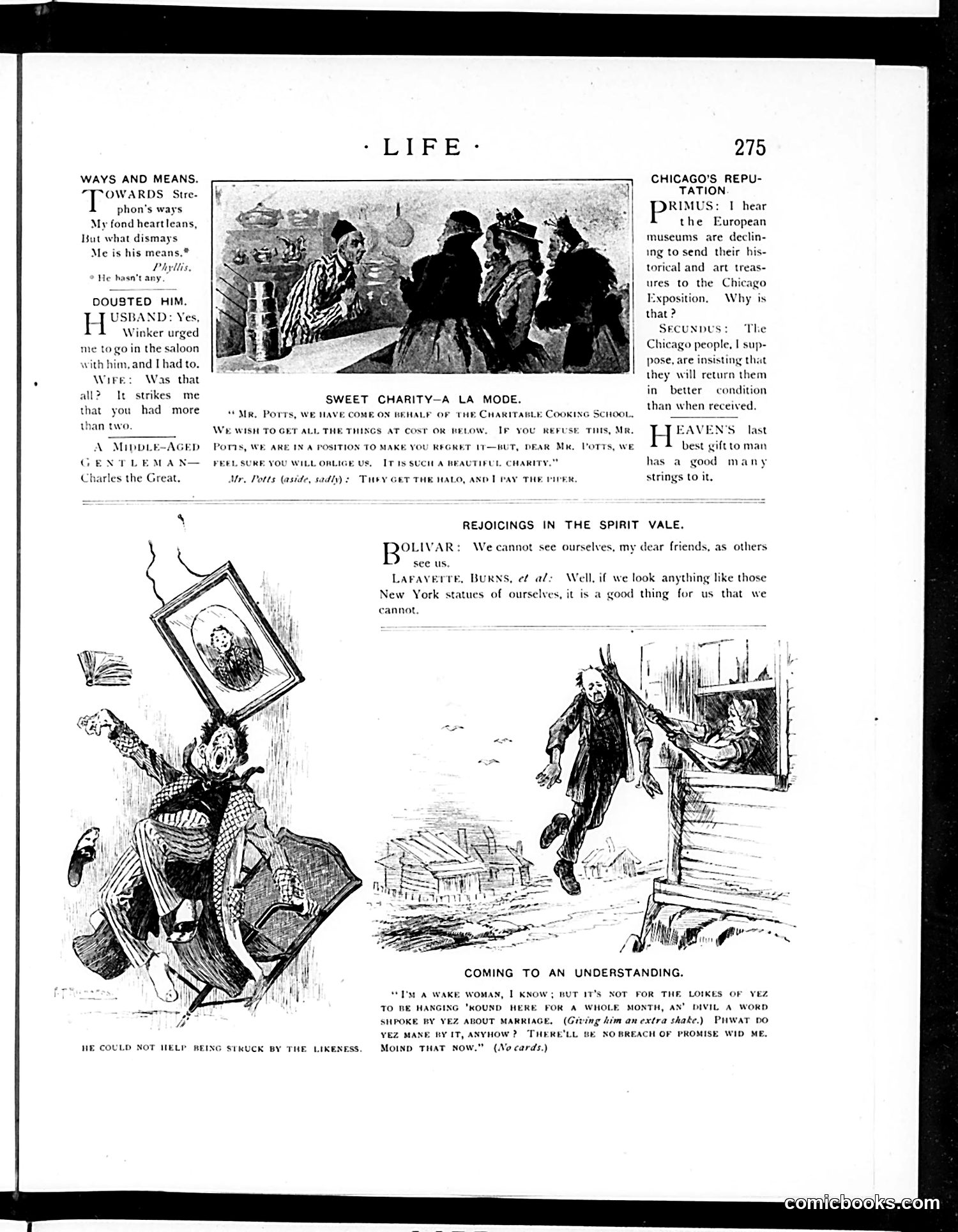
This page from *Life* magazine contains several satirical pieces mocking social pretense and hypocrisy: **"Sweet Charity—à la Mode"** depicts charity solicitors pressuring a businessman (Mr. Potts) into donations while wrapping coercion in flattery. The satire targets manipulative fundraising: they claim it's "beautiful charity" while essentially extorting him—he gets public credit (the "halo") while paying the actual cost. **"Chicago's Reputation"** jokes that European museums won't loan artifacts to the Chicago Exposition because Chicagoans have a reputation for returning borrowed items in worse condition than received—implying Chicagoans are rough or careless. **"Coming to an Understanding"** features working-class Irish dialect humor about a woman confronting a man about his intentions, threatening legal action for breach of promise if he doesn't commit to marriage. These pieces collectively mock class anxiety, charitable pretense, regional stereotypes, and gender dynamics—typical *Life* magazine satire of this era.
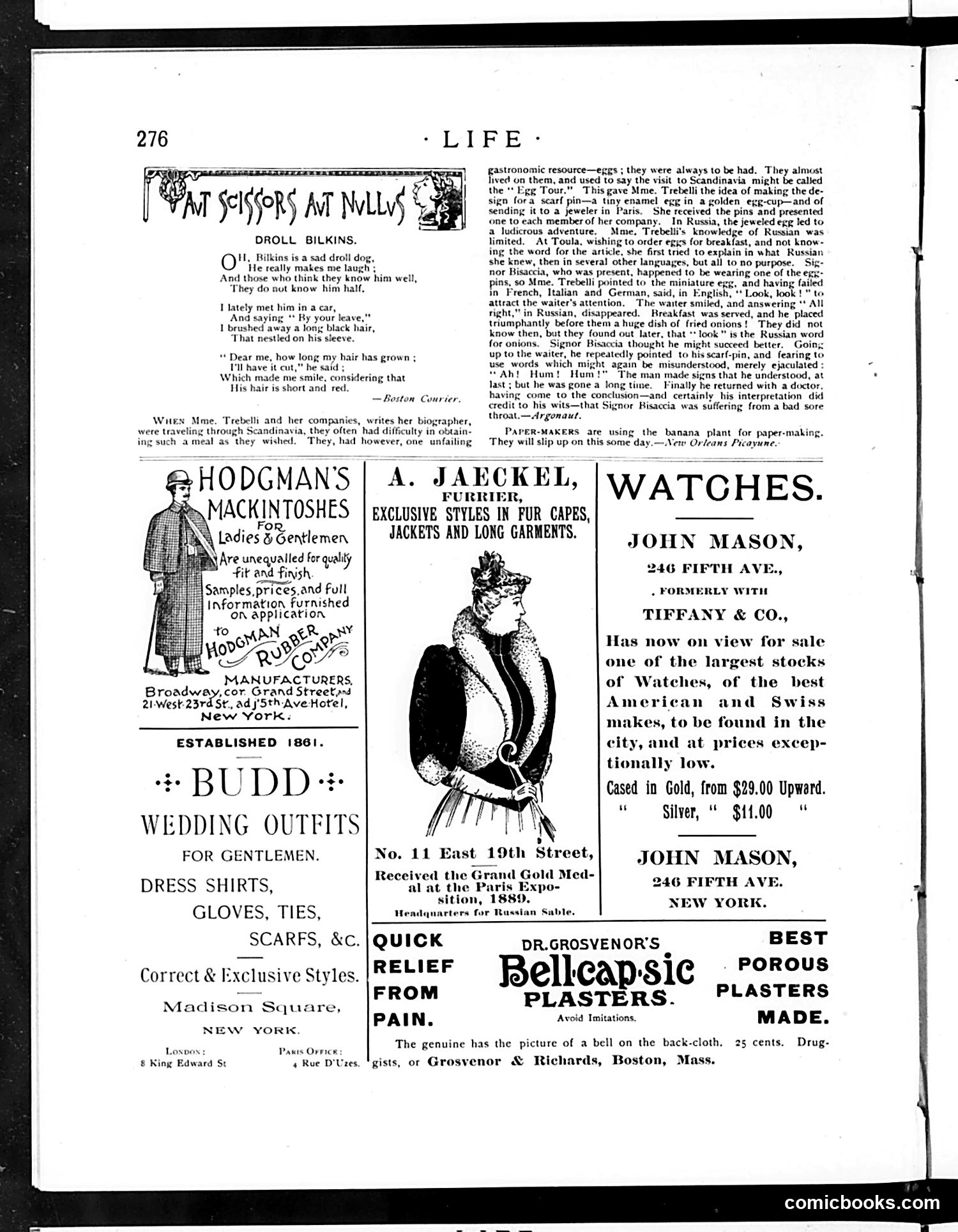
This page is primarily **advertising with a brief humorous poem** at the top. The poem by Droll Bilkins (credited to Boston Courier) is a gentle joke: the narrator encounters a red-haired man named Bilkins who complains his *black* hair has grown too long and needs cutting. The humor lies in the obvious contradiction—Bilkins is either forgetful, drunk, or deliberately obtuse about his own hair color. The larger portion of the page contains **period advertisements** for luxury goods: fur coats (Hodgman's), wedding attire (Budd), fur garments (A. Jaeckel), and watches (John Mason/Tiffany & Co.). Below the poem runs a longer anecdote about **opera singer Mme. Trebelli** traveling in Scandinavia, where language barriers cause comic misunderstandings when she tries ordering eggs for breakfast using an egg-shaped brooch as reference—the waiter interprets "look" (English) as the Russian word for onions, leading to absurd results. The page reflects late-19th-century *Life* magazine content: light social satire mixed with luxury advertising targeting wealthy readers.
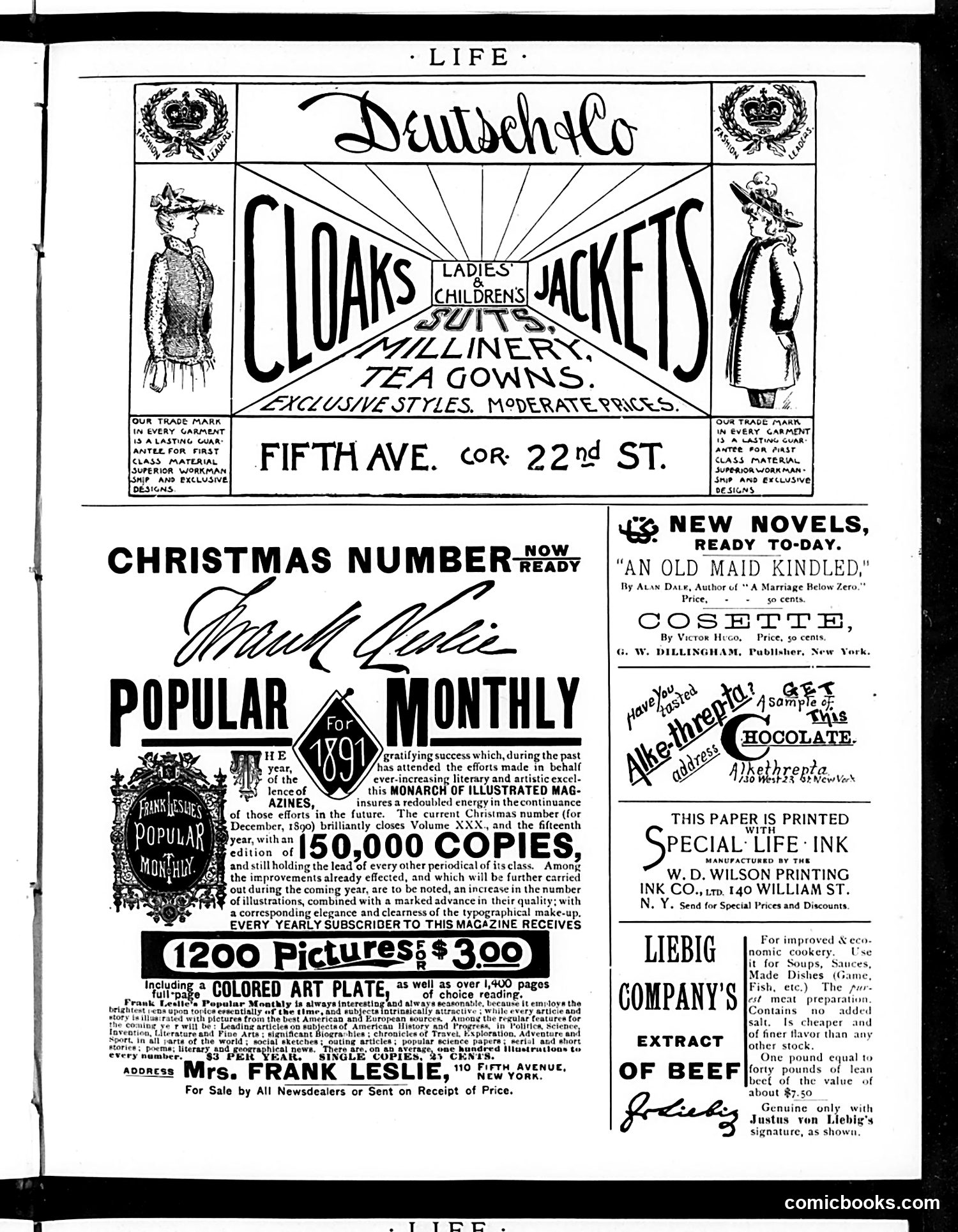
This is primarily a **commercial advertising page** from Life's Christmas 1890 issue, not a political cartoon. The page features: 1. **Deutschel advertisement** (top): A clothing retailer promoting cloaks, jackets, and millinery at Fifth Avenue and 22nd Street, using illustrated fashion figures as marketing. 2. **Popular Monthly Magazine promotion** (center): Announces the Christmas issue with 150,000 copies sold, 1,200 pictures, and a colored art plate for $3.00. Emphasizes literary and artistic quality. 3. **Book advertisements** (right): "An Old Maid Kindled" and "Cosette" (likely meaning Hugo's *Cosette*). 4. **Product advertisements**: Alkatherapy chocolate sample offer and Liebig Company's Extract of Beef (a meat concentrate). 5. **Printing ink credit**: Notes the page uses "Special Life Ink" by W.D. Wilson Printing. The page demonstrates late-19th-century magazine monetization through advertising while promoting Life's editorial prestige.
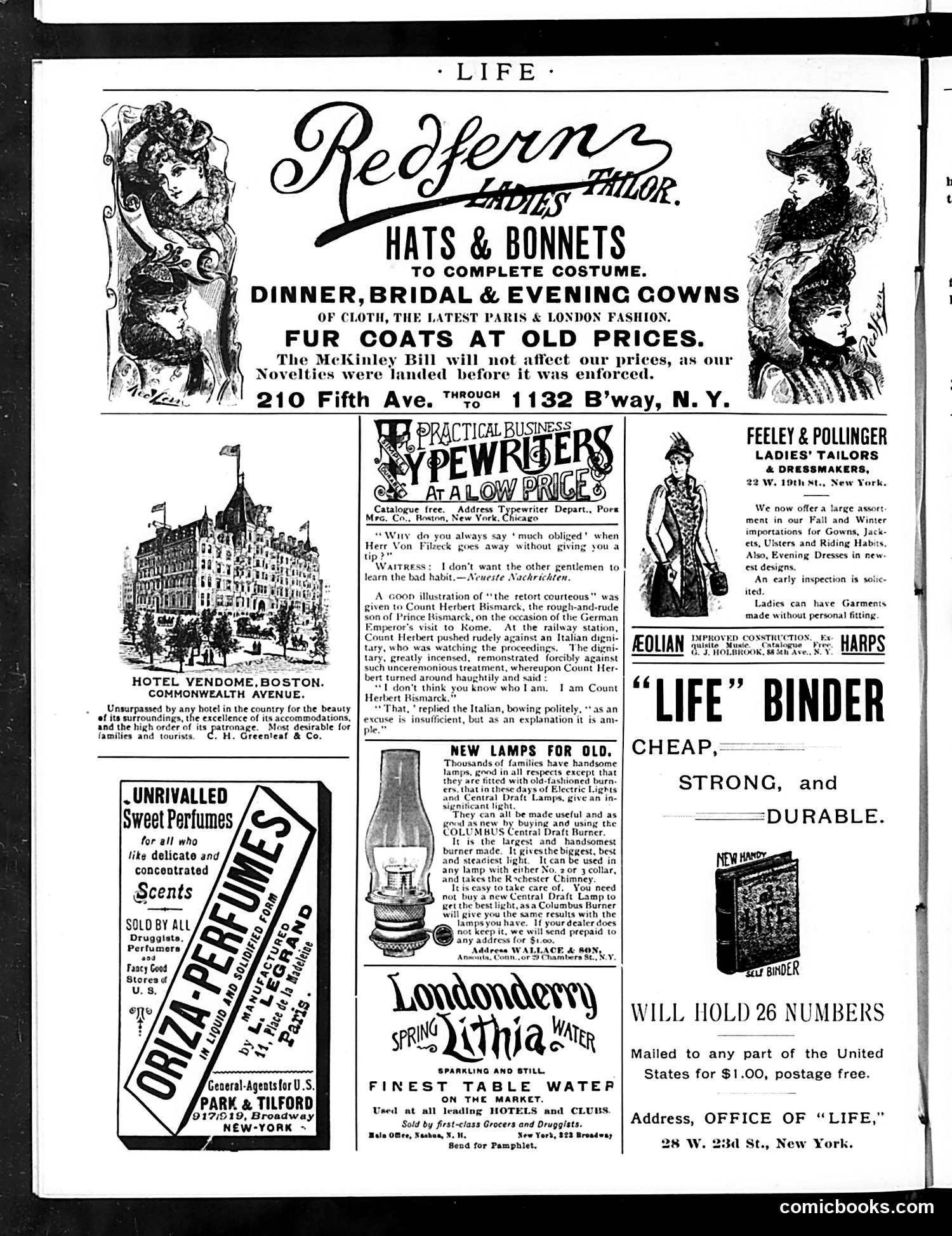
This is primarily an **advertising page** from Life magazine, not a satirical cartoon page. However, it contains one notable anecdote: The "Practical Business" section includes a joke about **Count Herbert Bismarck**, son of the German Chancellor Otto von Bismarck. The story describes an incident in Rome where Count Herbert rudely shoved an Italian dignitary at a railway station. When confronted, Herbert arrogantly demanded, "Don't you know who I am? I am Count Bismarck!" The Italian replied politely: "as an excuse it is insufficient." **The satire:** This mocks German aristocratic arrogance and Bismarck family hubris—the implication being that even famous name and status cannot excuse boorish behavior. The Italian's calm, cutting response exposes the absurdity of using one's identity as justification for rudeness. The remainder consists of period advertisements for women's clothing, perfumes, lamps, and other products—typical of Life's revenue model.
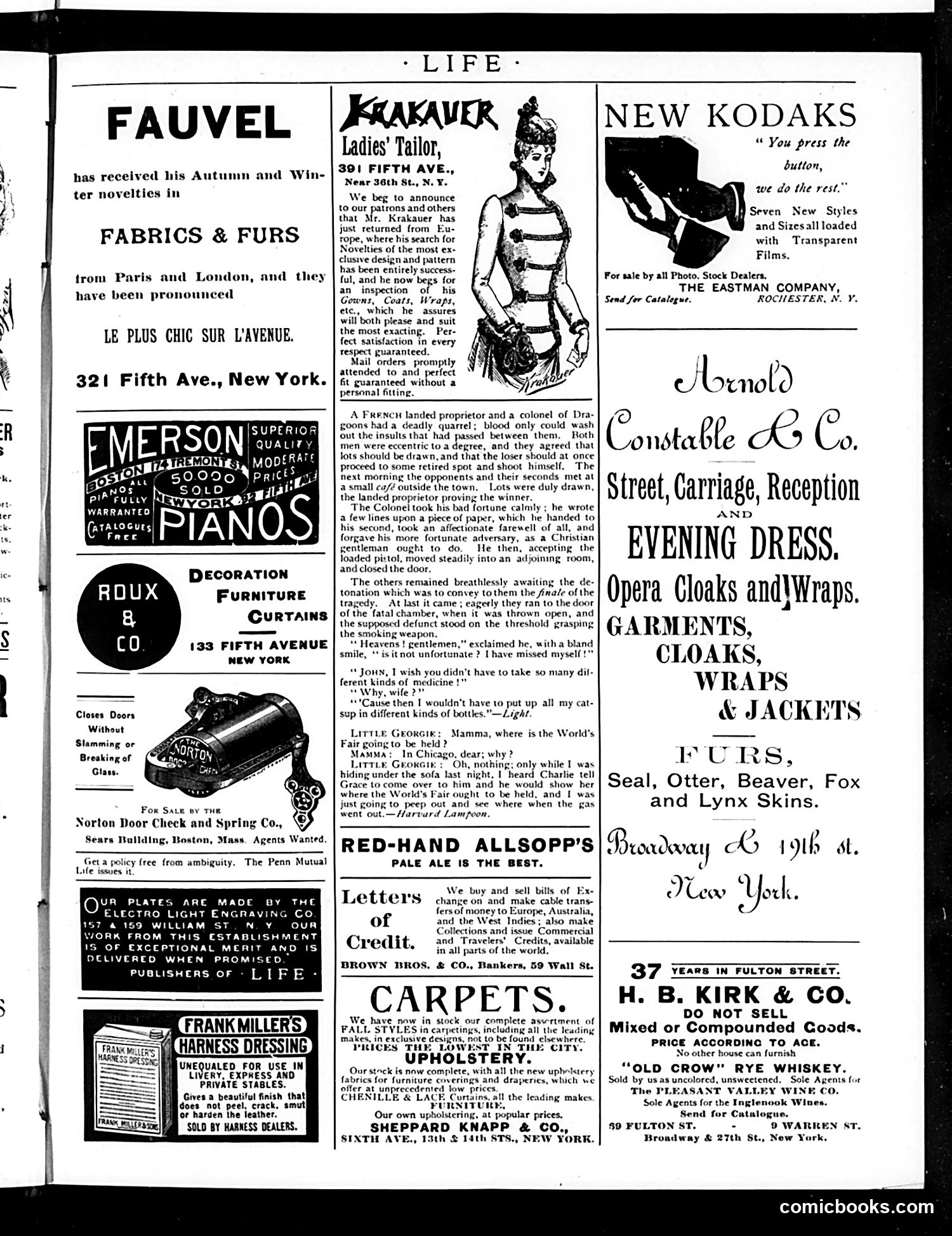
This is primarily **an advertising page** from an early-20th-century LIFE magazine, with minimal editorial humor content. The page features **two brief comedic pieces** (typical of LIFE's satirical format): 1. **A French duel anecdote**: A darkly humorous story about two aristocrats settling a quarrel by drawing lots to determine who must shoot themselves. The punchline: the "loser" who must die dramatically misses the fatal shot—a joke about both incompetence and the absurdity of aristocratic honor codes. 2. **Brief domestic humor pieces**: Including a woman complaining about storing different medicinal bottles, and a child's innocent misunderstanding about the World's Fair location—crude humor typical of the era. The bulk of the page consists of **luxury advertisements** (Fauvel furs, Emerson pianos, Arnold Constable evening wear) targeting wealthy New York consumers, reflecting the magazine's affluent readership and the prevailing consumer culture of the era. No political content appears visible on this page.
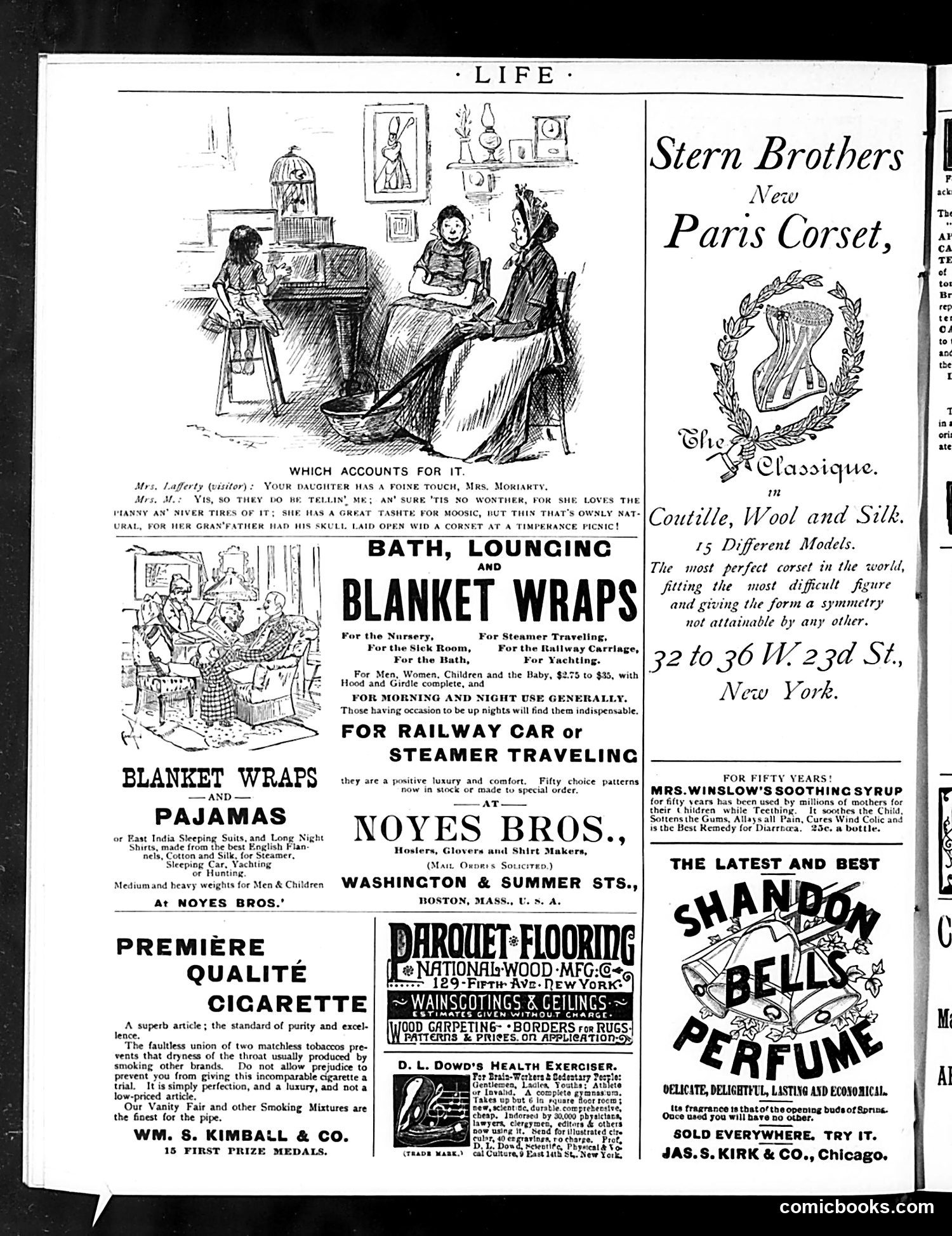
This single-panel cartoon satirizes Irish-American stereotypes common in early Life magazine. Two Irish immigrants—Mrs. Moriarty and her visitor, Mr. Lafferty (identified by their names and dialect)—discuss the daughter's musical talent. The joke hinges on a caustic explanation: the girl's "foine touch" exists because her grandfather had his skull cracked open with a cornet at a temperance picnic. The satire operates on multiple levels: it mocks both Irish immigrants' supposed propensity for drunken violence and the period's pseudo-scientific belief that physical trauma could somehow enhance abilities. The temperance reference adds irony—the incident occurred at a *temperance* event (anti-alcohol gathering), yet involves drunken brawling anyway. The exaggerated dialect reinforces period caricature conventions. This represents typical early-20th-century American humor that relied heavily on ethnic mockery, specifically targeting Irish communities.
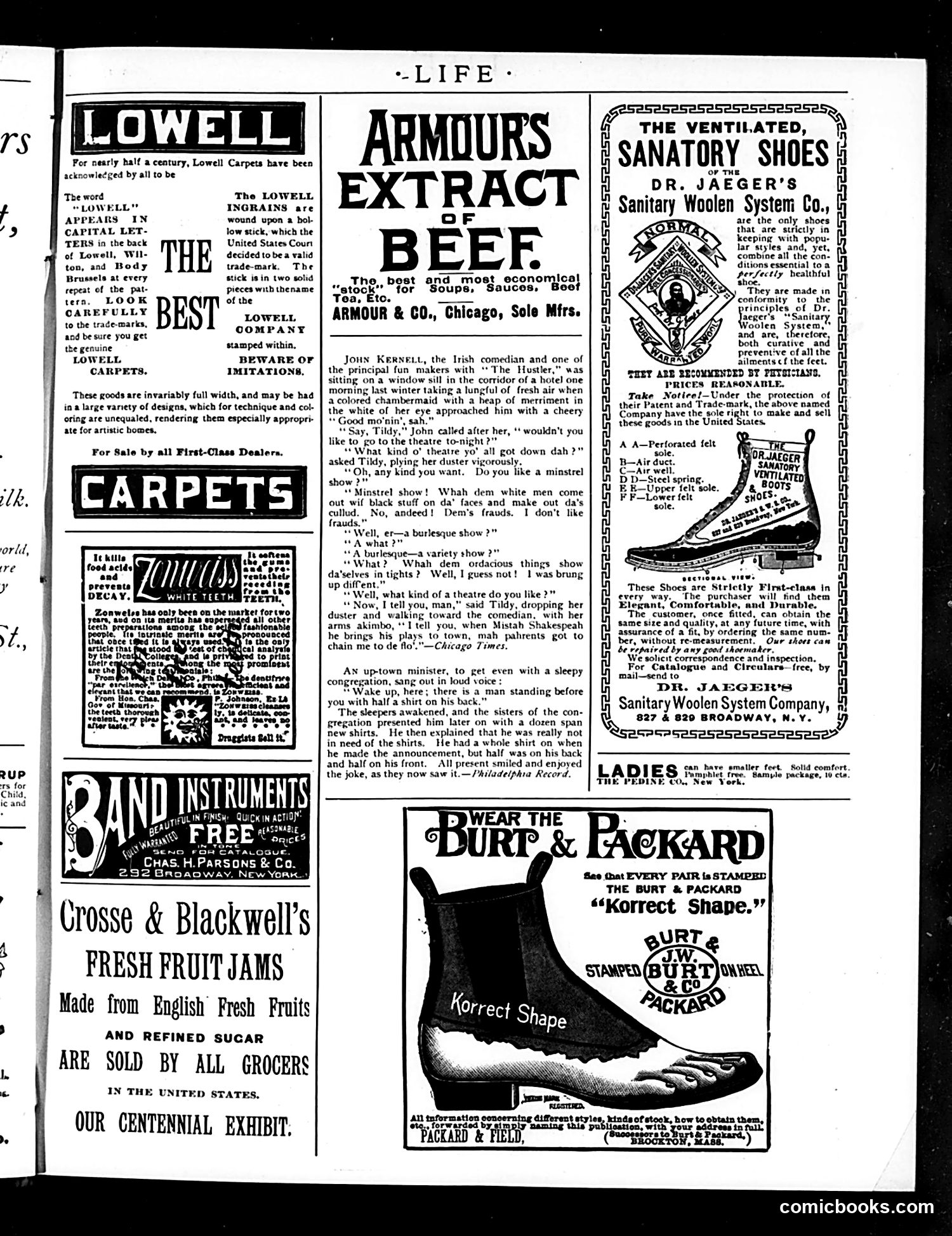
This page is primarily **advertising**, with no political cartoons. It contains two humorous anecdotes amid product advertisements typical of late-19th-century American magazines. The **humor pieces** are: 1. A dialogue between Irish comedian John Kernell and a Black chambermaid ("Tildy") about theater types. The joke relies on period racial stereotypes—the maid rejects minstrel shows (where white performers blackened their faces), burlesque, and variety shows, preferring Shakespeare. This reflects the era's casual racist humor while inadvertently suggesting the chambermaid's cultural sophistication. 2. A minister's trick to wake his congregation by claiming a man present has "half a shirt on his back"—a visual pun exploiting the double meaning of "back" (rear vs. front). The advertisements promote Lowell Carpets, Armour's Beef Extract, Jaeger's Sanitary Shoes, and other consumer goods. The shoe ad emphasizes "ventilation" and health—concerns reflecting Victorian-era anxieties about hygiene and propriety.
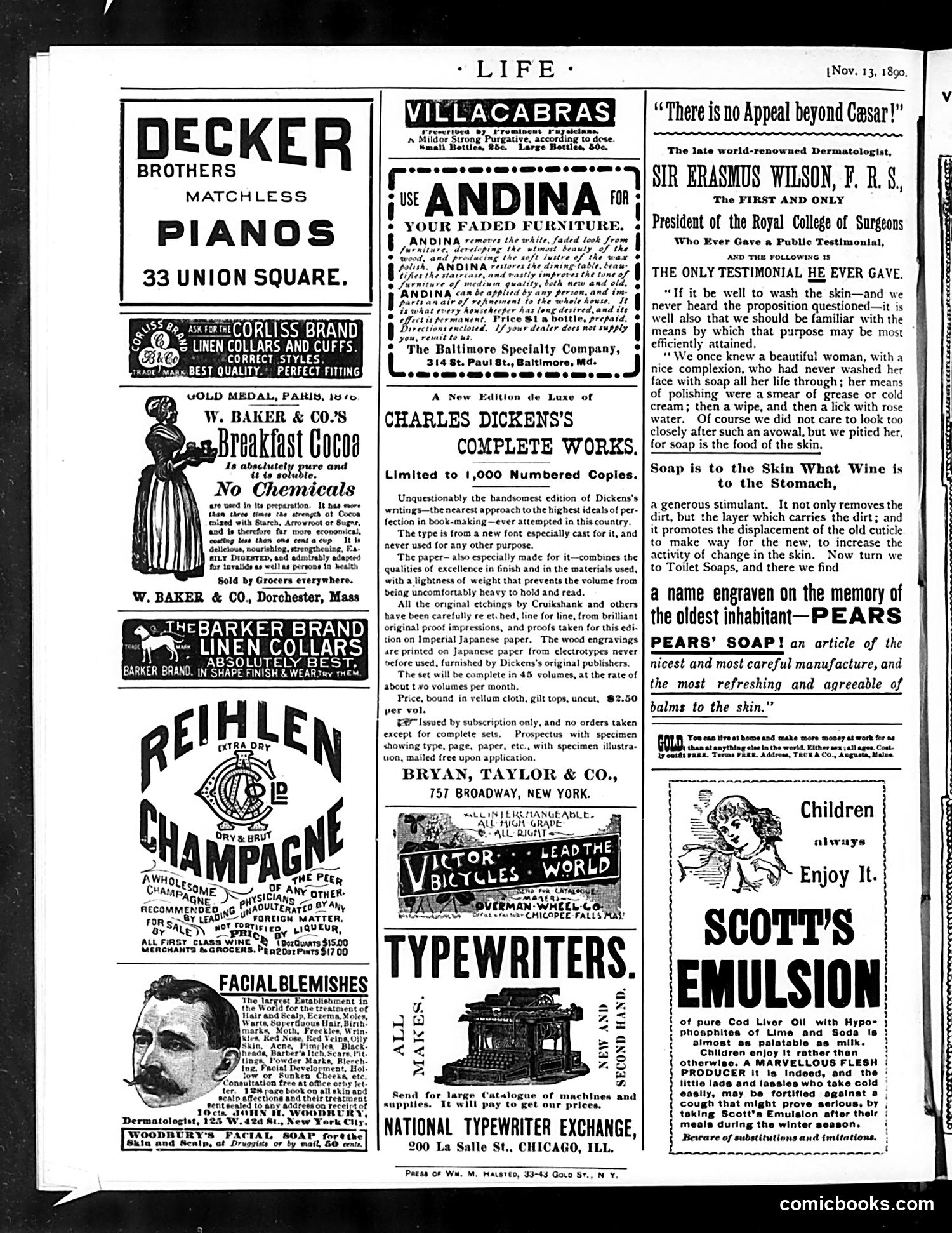
This page is almost entirely **advertisements** with no political cartoons or satirical content. It's a November 1890 issue of *Life* magazine's advertising section. The layout consists of commercial ads for consumer products: pianos, cocoa, champagne, typewriters, soap, furniture polish, and a luxury edition of Dickens's works. The only notable textual element is a quote attributed to Sir Erasmus Wilson, a real 19th-century dermatologist, endorsing the use of soap for skincare—specifically Pears' soap, which claims "Soap is to the Skin What Wine is to the Stomach." The advertisements use period marketing tactics (testimonials from authority figures, emphasis on quality materials, mail-order availability), but there is no identifiable satire, cartoon imagery, or political messaging on this page. It appears to be a straightforward commercial section rather than editorial content.