
Life, 1890-11-13 · page 4 of 20
Life — November 13, 1890 — page 4: what you’re looking at
What you’re looking at
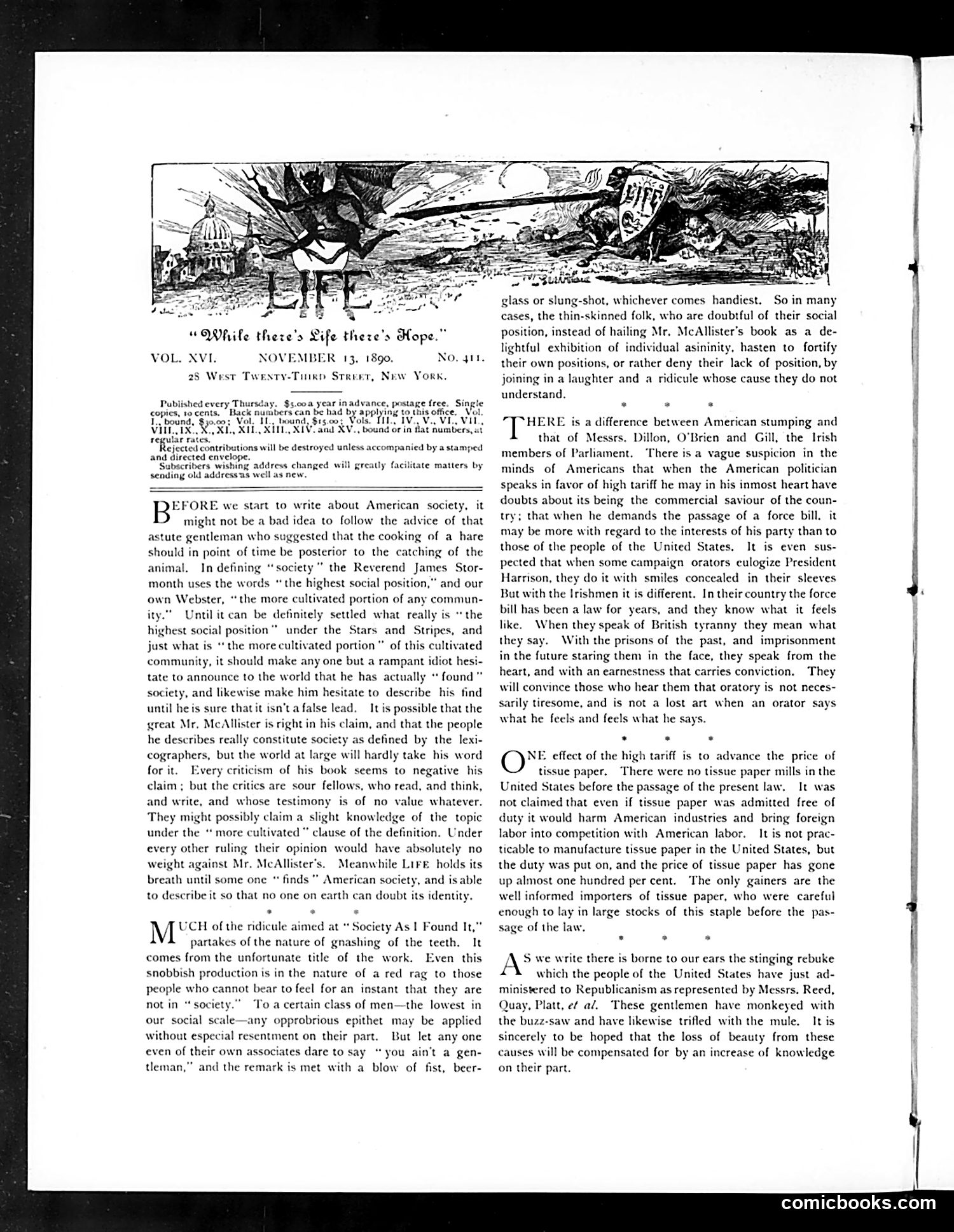
The masthead and text indicate this is from **Life Magazine, Vol. XVI, No. 411** (November 13, likely 1890). The cartoon at top depicts a chaotic apocalyptic scene titled **"While there's Life there's Hope."** The imagery suggests social upheaval or disaster—possibly referencing contemporary American anxieties about industrialization, class conflict, or political instability. The accompanying article discusses **American "society"** and critiques claims about what constitutes high social status. It mocks pretentious attempts to define refined society, comparing American social climbing unfavorably to Irish parliamentary members who speak with genuine conviction about substantive issues like tariffs and British policy. The satire targets American snobbery and superficiality in social positioning, contrasting it with what the author views as more authentic Irish political engagement.
📄 Transcribed text from this page (OCR, searchable)
Machine-transcribed from the original scan — historical spelling and the odd misread are preserved.
“Wile there's Life there's Hope.” VOL. XVI. NOVEMBER 13, 1890. 28 West Twesty-Tinen Street, New York. No, tt. y. $s.00a year inadvance, postage free. Single an be had by applying to this office. V. 4, $15.00; Vols. f11.. 1V..V.. VE. VI V., bound or in fat numbers, at Published every Thursd copies, ro cents. Back numbers 1., bound, $30.00: Vol. IL, hou VU. IX'.X..X0, XU, XU) regular rates ejected contributions will be destroyed unless accompanied by a stamped and directed envelope. . Subscribers wishing address changed will greatly facilitate matters by sending old address as well as new. B “ORE we start to write about American society, it might not be a bad idea to follow the advice of that astute gentleman who suggested that the cooking of a hare should in point of time be posterior to the catching of the animal, In defining “society” the Reverend James Stor- month uses the words “the highest social position,” and our own Webster, “the more cultivated portion of any commun- ity." Until it can be definitely settled what really is “the highest social position’ under the Stars and Stripes, and just what is ‘the more cultivated portion” of this cultivated community, it should make any one but a rampant idiot hes tate to announce to the world that he has actually “found” society, and likewise make him hesitate to describe his find until heis sure thatit isn'ta false lead. It is possible that the yreat Mr, McAllister is right in his claim, and that the people he describes really constitute society as defined by the lexi- cographers, but the world at large will hardly take his word for it. Every criticism of his book seems to negative his claim; but the critics are sour fellows, who read, and think, and write, and whose testimony is of no value whatever. They might possibly claim a slight knowledge of the topic under the * more cultivated ” clause of the definition, Under every other ruling their opinion would have absolutely no weight against Mr. McAllister Meanwhile LiFe holds its breath until some one “ finds” American society, and is able arth can doubt its identity. M UCH of the ridicule aimed at “ Society As 1 Found It,” AVL partakes of the nature of gnashing of the teeth, It comes from the unfortunate title of the work. Even this snobbish production is in the nature of a red rag to those people who cannot bear to feel for an instant that they are not in “ society To a certain class of men—the lowest in our social scale—any opprobrious epithet. may be applied without especial resentment on their part. But let any one even of their own associates dare to say “you ain't a gen- tleman,” and the remark is met with a blow of fist, beer- to describe it so that no one on glass or slung-shot, whichever comes handiest. So in many cases, the thin-skinned folk, who are doubtful of their social position, instead of hailing Mr. McAllister’s book as a de- lightful exhibition of individual asininity, hasten to fortify their own positions, or rather deny their lack of position, by joining in a laughter and a ridicule whose cause they do not understand. HERE is a difference between American stumping and that of Messrs. Dillon, O'Brien and Gill, the Irish members of Parliament. ‘There is a vague suspicion in the minds of Americans that when the American politician speaks in favor of high tariff he may in his inmost heart have doubts about its being the commercial saviour of the coun- try; that when he demands the passage of a force bill. it may be more with regard to the interests of his party than to those of the people of the United States, It is even sus- pected that when some campaign orators culogize President Harrison, they do it with smiles concealed in their sleeves But with the Irishmen it is different. In their country the force bill has been a law for years, and they know what it feels like. When they speak of British tyranny they mean what they say. With the prisons of the past, and imprisonment in the future staring them in the face, they speak from the heart, and with an earnestness that carries conviction, They will convince those who hear them that oratory is not neces- sarily tiresome, and is not a lost art when an orator say what he feel: nd feels what he says. . . . O effect of the high tariff is to advance the price of tissue paper. There were no tissue paper mills in the United States before the passage of the present law, It was not claimed that even if tissue paper was admitted free of duty it would harm American industries and bring foreign labor into competition with American labor. It is not prac- ticable to manufacture tissue paper in the United States, but the duty was put on, and the price of tissue paper has gone up almost one hundred per cent. The only gainers are the well informed importers of tissue paper, who were careful enough to lay in large stocks of this staple before the pas- sage of the law. . ° . y S we write there is borne to our ears the stinging rebuke which the people of the United States have just ad- ministered to Republicanism as represented by Messrs. Reed, Quay, Platt, ef a’. These gentlemen have monkeyed with the buzz-saw and have likewise trifled with the mule. It is sincerely to be hoped that the loss of beauty from these causes will be compensated for by an increase of knowledge on their part. \ comicbooks.com