
A complete issue · 14 pages · 1890
Life — October 30, 1890
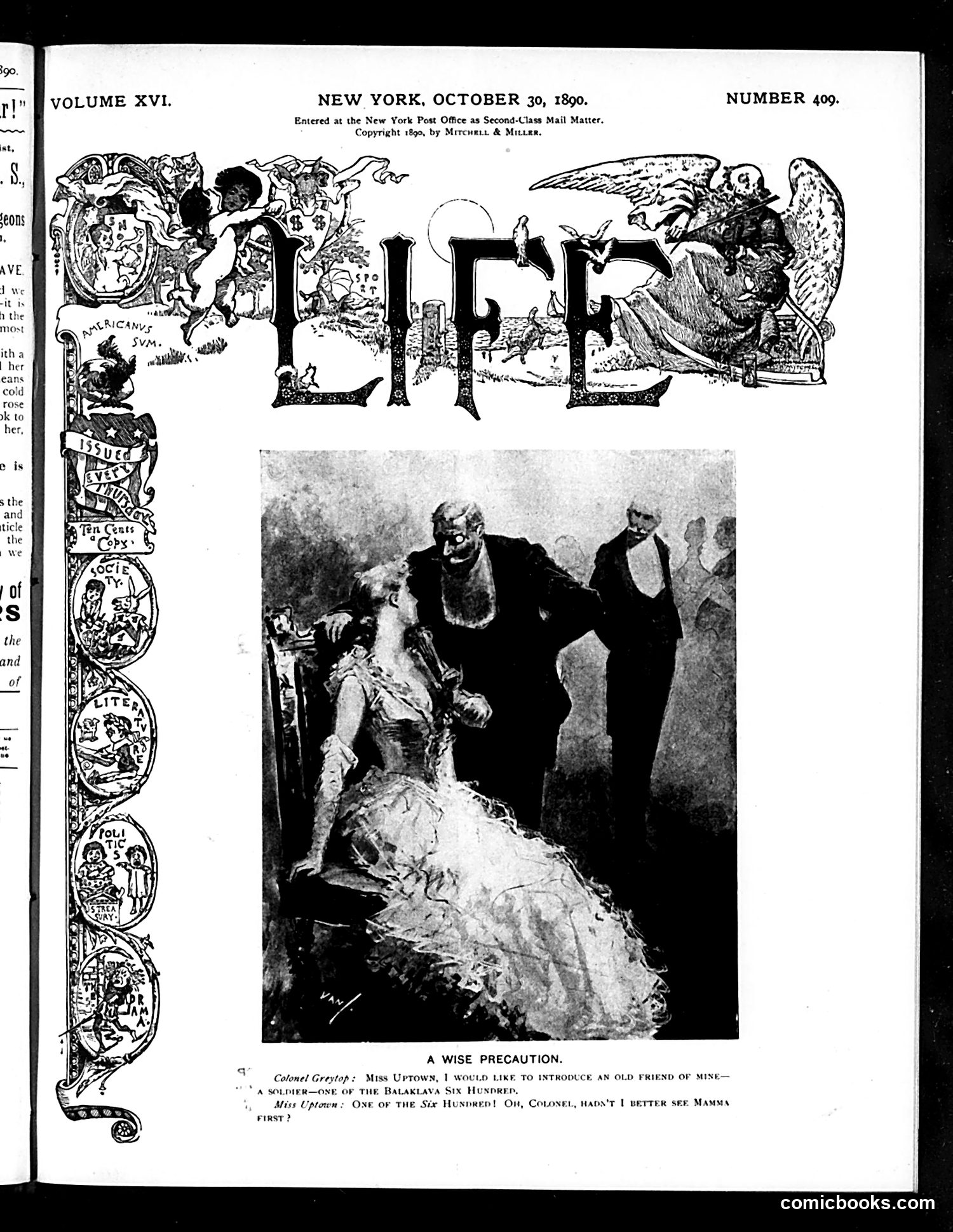
This cartoon satirizes social anxiety about introducing an unmarried woman to a soldier. The caption presents Colonel Gregory wanting to introduce Miss Uptown to "an old friend"—a soldier from the Himalayan Six Hundred regiment. Miss Uptown's worried response—"One of the Six Hundred! Oh, Colonel, hadn't I better see Mamma first?"—jokes about the woman's concern for propriety and protection of her reputation. The humor lies in the implication that meeting a soldier requires parental supervision, reflecting Victorian anxieties about unmarried women's interactions with men, particularly military men who might have questionable reputations or be considered unsuitable matches. The cartoon mocks both excessive propriety and the era's strict social conventions governing courtship.
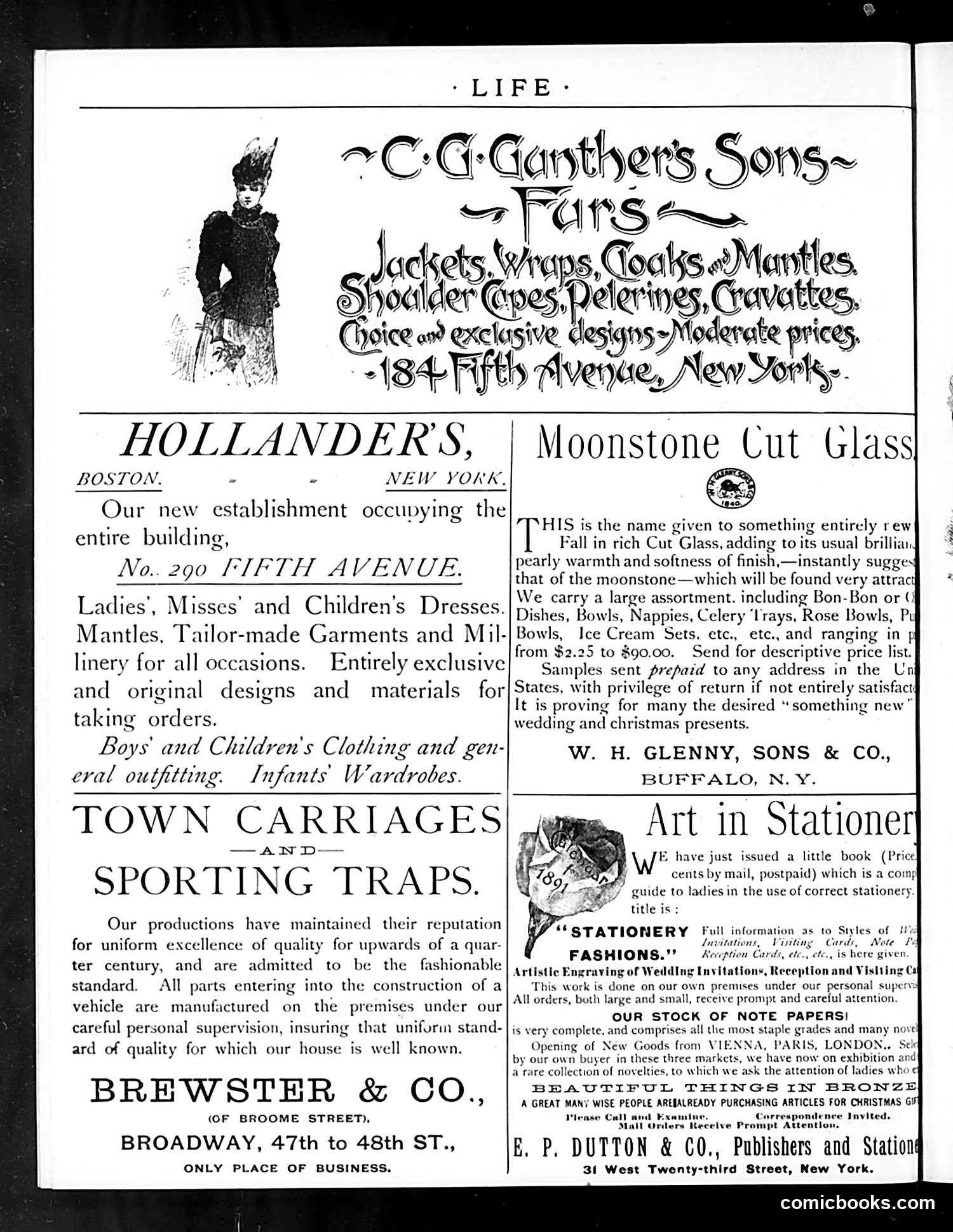
This page is **primarily advertising**, not satirical content. It contains multiple commercial advertisements from late 19th or early 20th century New York and Boston businesses: - **C.G. Ganthers Sons** advertises women's outerwear (184 Fifth Avenue) - **Hollander** (Boston/New York) sells dresses and tailored garments - **Brewster & Co.** manufactures carriages and sporting traps - **Moonstone Cut Glass** by W.H. Glenny, Sons & Co. (Buffalo) sells glassware - **Art in Stationery** promotes a ladies' guide to correct stationery usage - **E.P. Dutton & Co.** publishes books and stationery The single illustration shows a fashionably dressed woman in period attire. There is no identifiable political satire or social commentary—this is a standard advertising section from *Life* magazine's commercial pages.
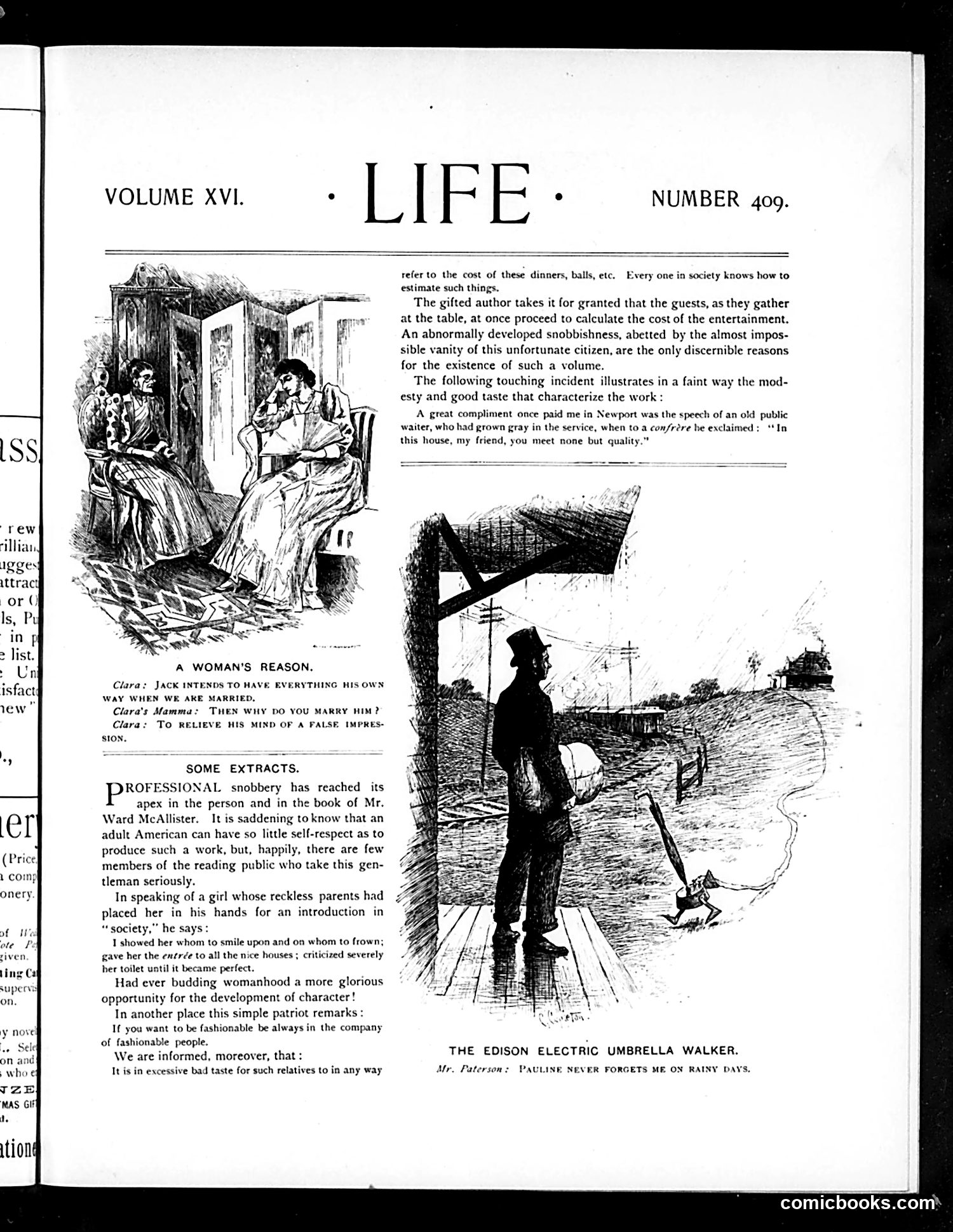
This page contains two distinct satirical items: **"Woman's Reason"** (upper left): A comic dialogue mocking women's logic. Clara wants to marry Jack despite his character flaws because he's wealthy and fashionable. Her mother questions this reasoning, which Clara dismisses as "a false impression"—satirizing the idea that women prioritize material wealth and social status over genuine moral considerations in marriage decisions. **"The Edison Electric Umbrella Walker"** (lower right): A humorous illustration depicting a man using an electric umbrella as a walking device or power source. The caption suggests this absurd invention helps him navigate rainy days, likely satirizing contemporary enthusiasm for applying new electrical technology to everyday objects—a common subject of early 20th-century humor about over-mechanization.
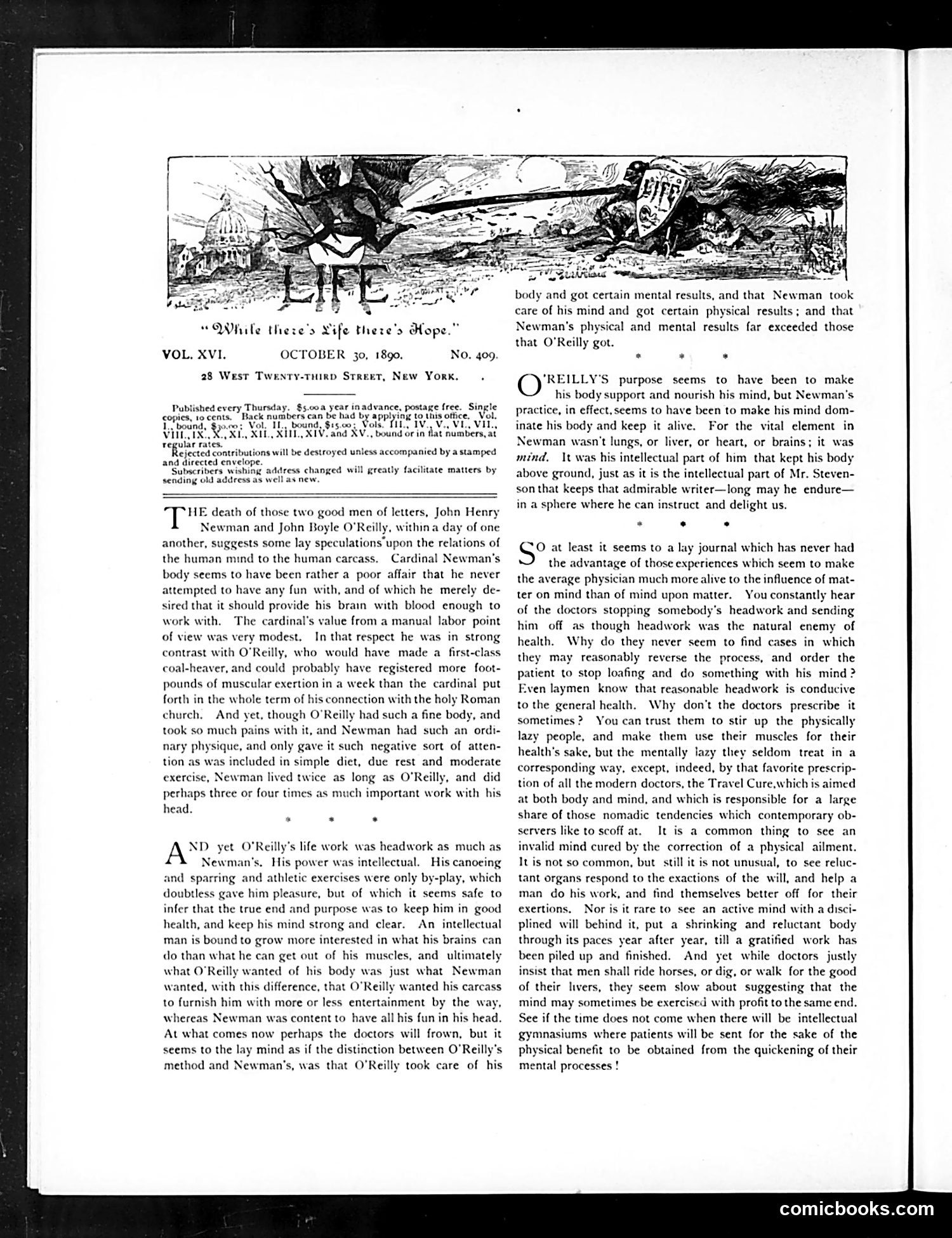
This page contains an article mourning two prominent figures: **John Henry Newman** and **John Boyle O'Reilly**, both recently deceased. The text compares their life philosophies—Newman's intellectual focus versus O'Reilly's balanced approach to physical and mental health. The *Life* masthead illustration shows a figure contemplating a landscape with a classical dome (likely St. Peter's Basilica), referencing Newman's prominence as a Catholic Cardinal and theologian. The article's central satire critiques contemporary medical practice: doctors prescribe exercise for physical ailments but ignore mental health's role in overall wellness. *Life* suggests this represents a false dichotomy—that intellectual and physical well-being should be treated as interconnected rather than separate concerns. The piece advocates for a more holistic approach to human health than Victorian medicine typically offered.
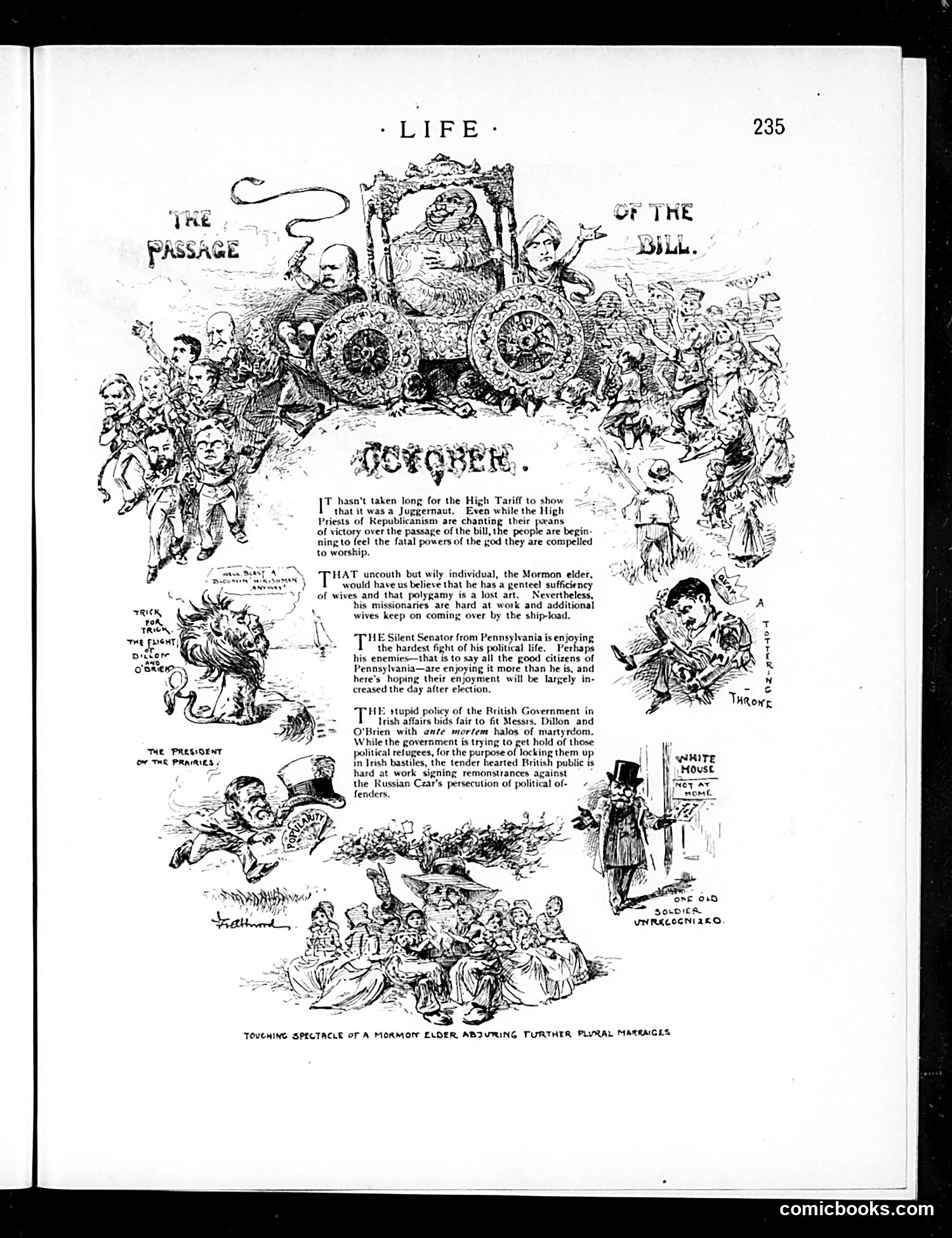
This page satirizes the passage of a significant legislative bill, likely the tariff legislation referenced in the text. The central image depicts a ornate carriage carrying political figures over a crowd of common citizens—a metaphor for how legislation affects ordinary people while benefiting elites. The surrounding vignettes mock various political figures and their responses: "The President on the Prairies," references to a "Silent Senator from Pennsylvania," and commentary on Mormon polygamy and British-Irish policy disputes. The cartoon critiques how political leaders remain disconnected from consequences their policies impose on ordinary Americans, while pursuing their own interests and agendas. The "High Priests of Republicanism" steering the carriage suggests party leadership driving policy regardless of public welfare.
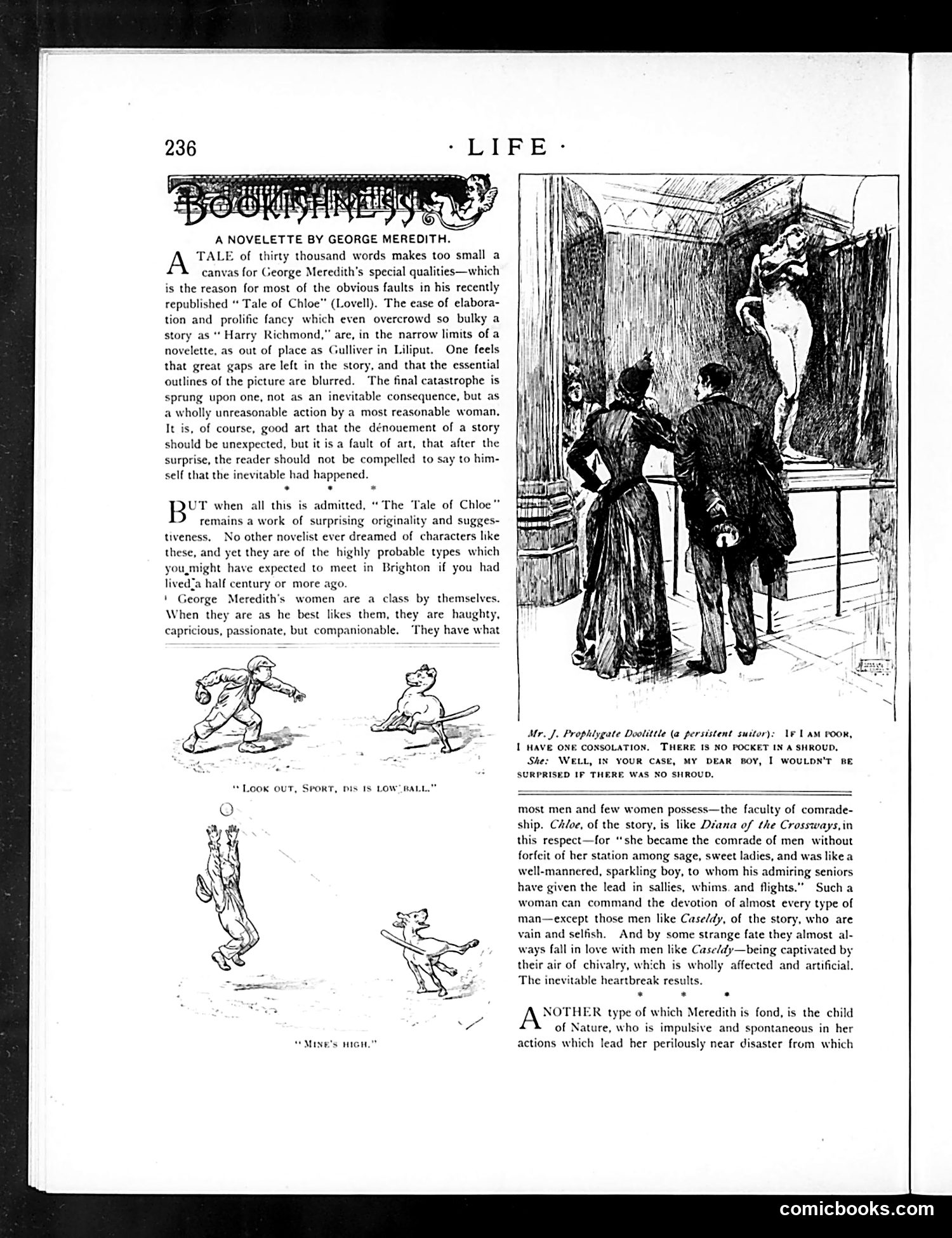
This page reviews George Meredith's novelette "The Tale of Chloe." The critic praises Meredith's ability to create memorable female characters, noting that his women are "haughty, capricious, passionate, but companionable." The small illustrations (captioned "Look out, Sport, his is low ball" and "Miss's high") appear to be unrelated sporting or humorous vignettes—possibly from a different feature—showing figures in physical action or exaggerated poses, a common filler element in Life magazine. The review focuses on literary merit rather than satire. It discusses Meredith's characterization of women like Chloe, who command devotion from men, and warns that women of "impulse and spontaneous" nature risk romantic disaster. The content is literary criticism rather than political commentary.
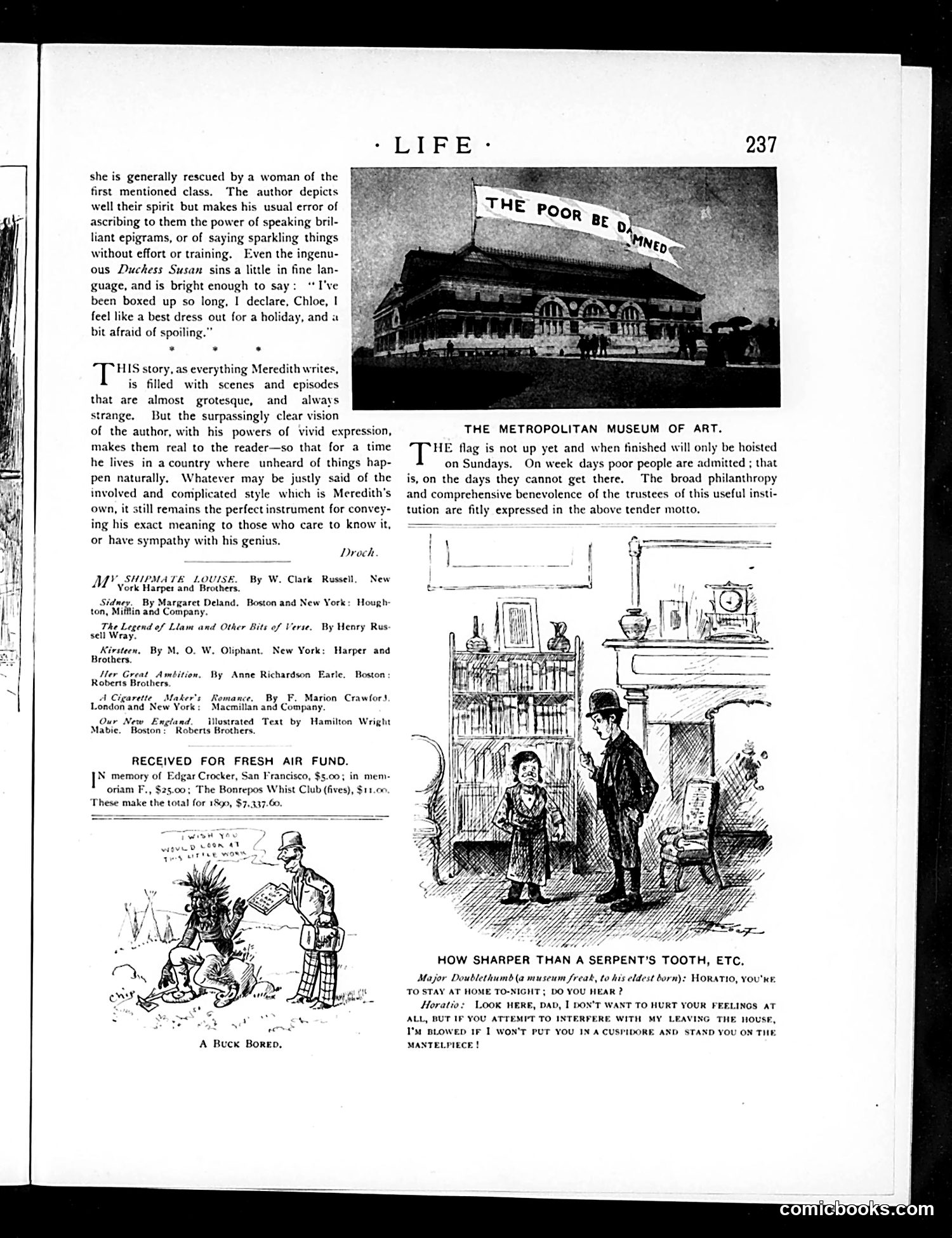
This page contains two satirical cartoons: **"A Buck Bored"** (lower left): Shows a Native American figure with an elaborate headdress appearing bored or disengaged while a man in Western dress stands nearby holding papers. The satire likely mocks stereotypical depictions of Native Americans or commentary on their treatment/displacement. **"How Sharper Than a Serpent's Tooth, Etc."** (right): Depicts a domestic scene where a father threatens his departing son with harsh language about interfering with the household. The title references Shakespeare's *King Lear*, suggesting the cartoon satirizes ungrateful children or generational conflict in American families. The page also includes book reviews and a section on donations to a "Fresh Air Fund," indicating this is a typical Life magazine issue mixing social commentary, humor, and charitable notices.
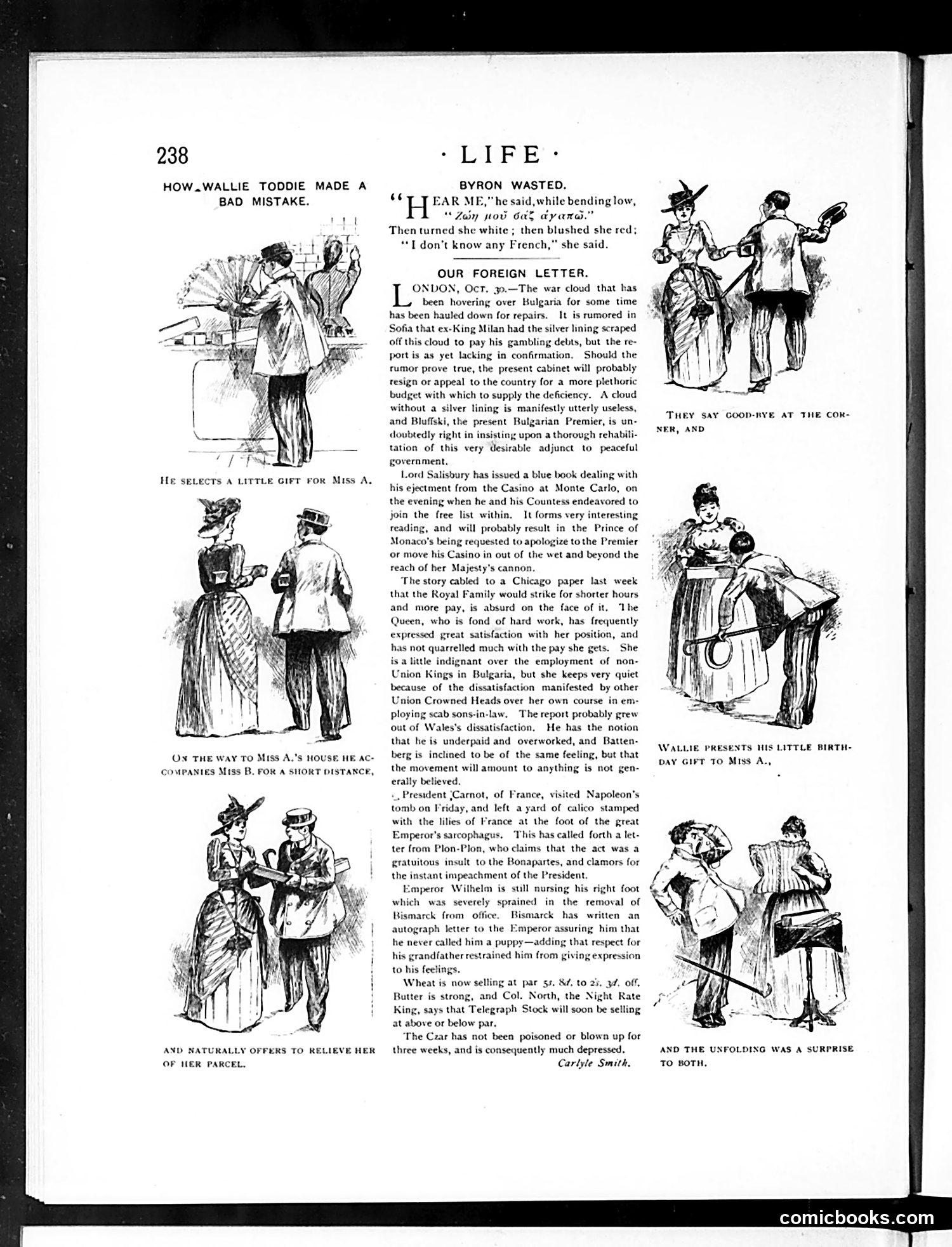
This page combines humor with international news commentary. The left side shows a comic sequence titled "How Wallie Toddie Made a Bad Mistake"—depicting a young man selecting and presenting a gift to a woman, with the final caption suggesting he awkwardly offers to relieve her of "her parcel." The right side, "Our Foreign Letter" by Carlyle Smith, reports on European affairs: Bulgarian financial crisis, French-British relations regarding Monaco's casino, labor disputes in Britain, and Kaiser Wilhelm's health. The accompanying illustrations ("Byron Wasted," "They Say Good-bye at the Corner," "Wallie Presents His Little Birthday Gift to Miss A.," and "The Unfolding Was a Surprise to Both") appear to be unrelated satirical vignettes about romantic mishaps and social awkwardness, typical of Life's humor style.
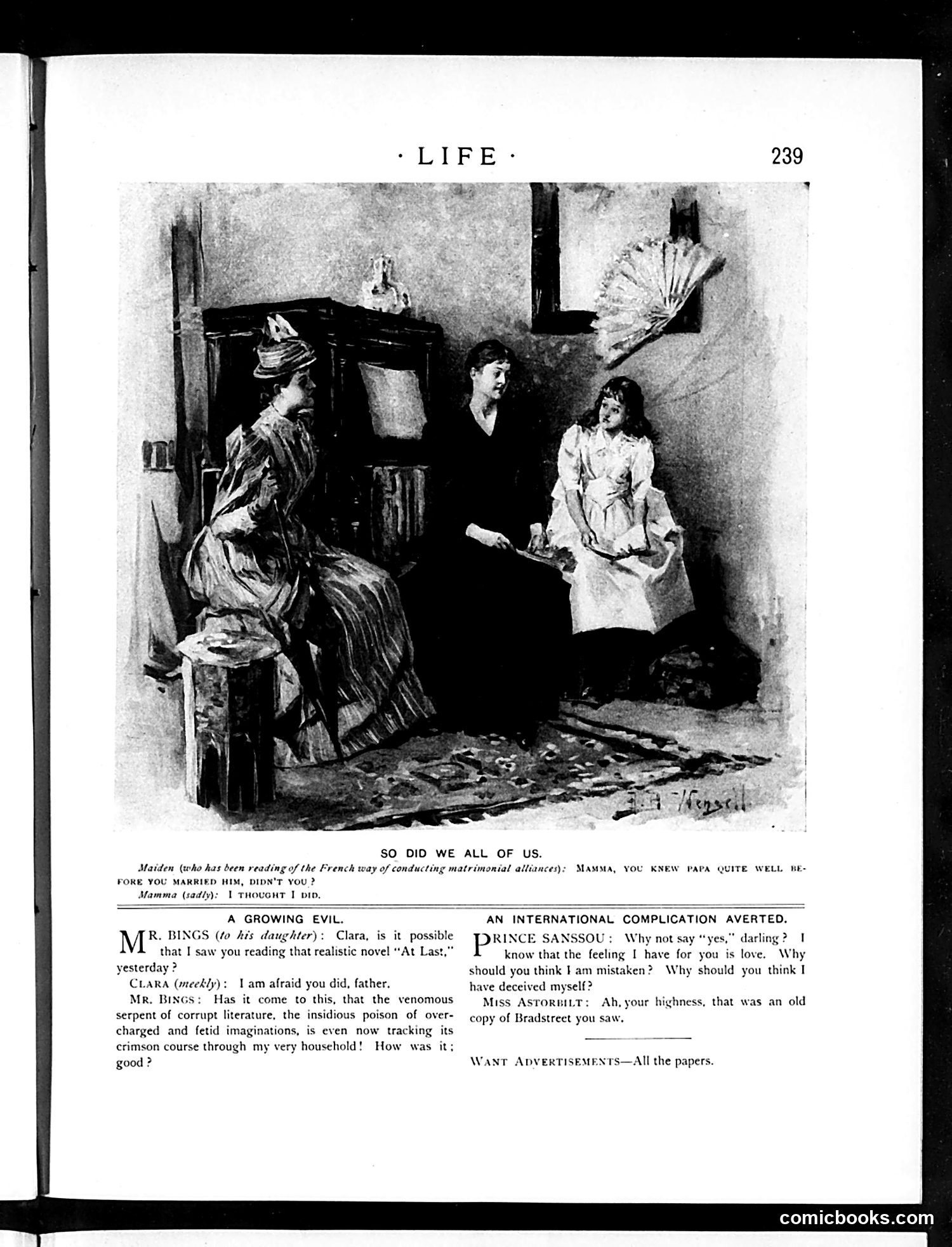
This page contains a satirical sketch titled "SO DID WE ALL OF US" depicting a domestic scene where a maiden has been caught reading a French novel about matrimonial alliances. The humor centers on a morality concern: the father (Mr. Bings) worries that "realistic" French literature is corrupting his household with "venomous serpent of corrupt literature" and "fetid imaginings." The accompanying dialogue snippet "A GROWING EVIL" and "AN INTERNATIONAL COMPLICATION AVERTED" suggests anxiety about European (specifically French) cultural influence on American morality and family values—a common satirical theme in early 20th-century American magazines. The joke targets Victorian-era concerns about dangerous foreign literature threatening domestic propriety.
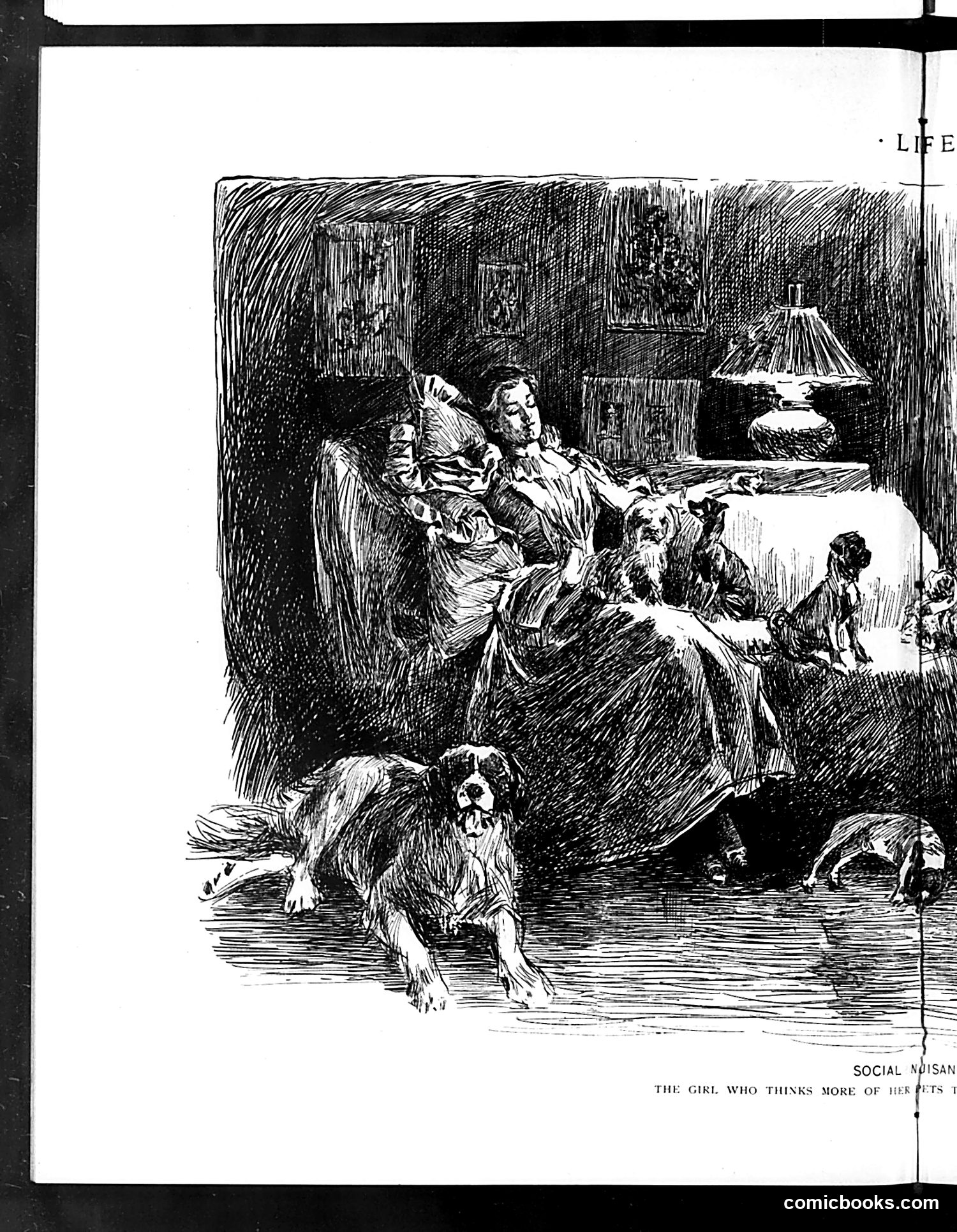
This is a satirical cartoon from *Life* magazine critiquing a woman's excessive attachment to her dogs. The scene shows a parlor where a well-dressed woman sits with several small dogs while socializing with guests. The caption's title suggests she prioritizes her pets over human companionship or social obligations. The satire targets upper-class women who lavished attention and resources on lap dogs—a common luxury among wealthy households of the era. The crowded composition, with multiple dogs occupying prominent space, emphasizes how her pet-keeping has become absurd and socially inappropriate. This reflects period anxieties about women's priorities and the perceived frivolousness of certain upper-class pursuits.
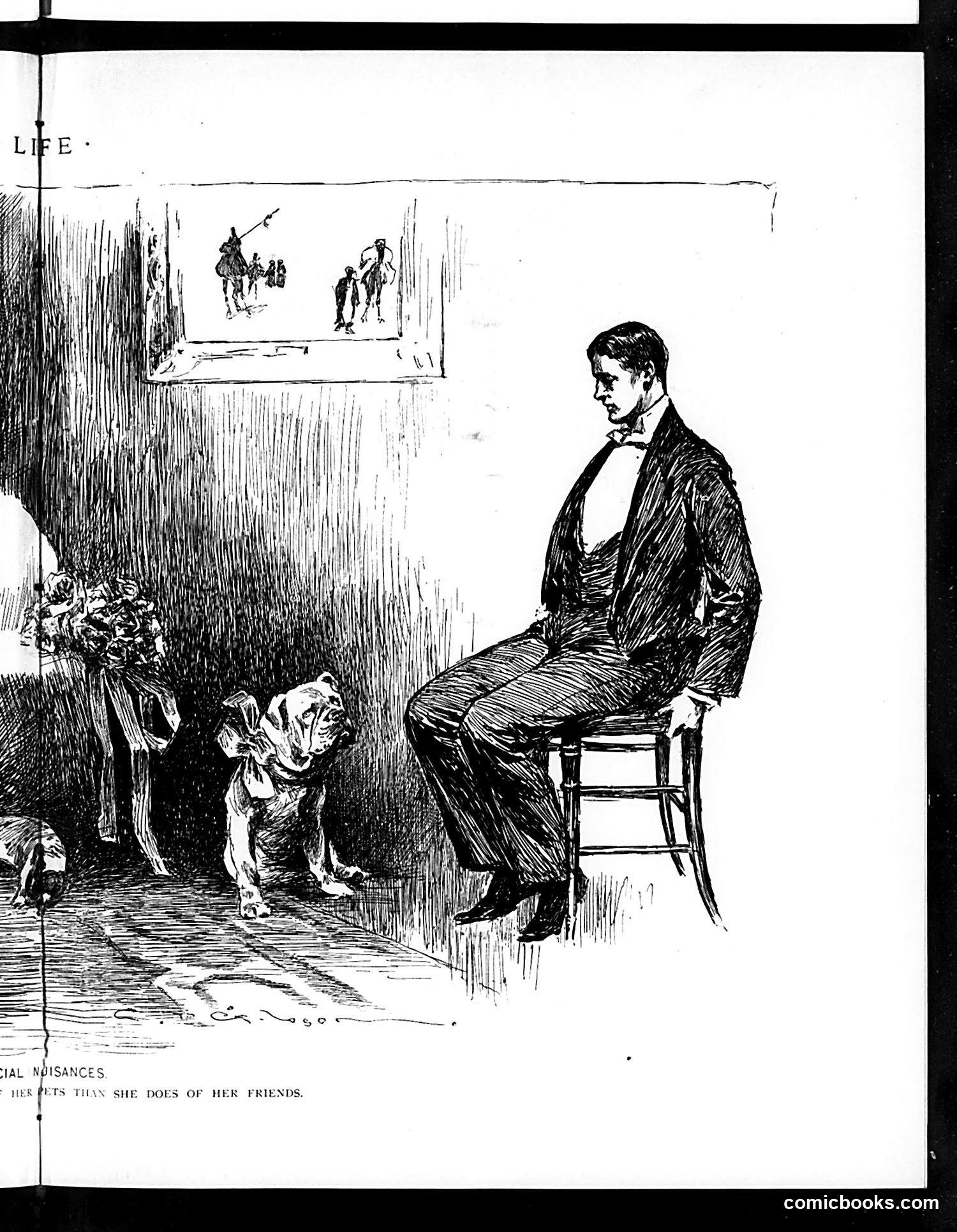
This illustration satirizes social hypocrisy regarding pet dogs. The caption reads "SOCIAL NUISANCES: HER PETS THAN SHE DOES OF HER FRIENDS" (though the OCR appears incomplete). The cartoon shows a well-dressed man sitting uncomfortably while a bulldog approaches him aggressively. On the wall hangs a framed picture suggesting pastoral or hunting scenes. The satire targets wealthy individuals—particularly women—who pamper their pet dogs excessively while neglecting courtesy toward human guests and acquaintances. The man's formal attire and stiff posture emphasize his discomfort, contrasting with the dog's bold behavior. The joke critiques the Victorian/Edwardian upper class for prioritizing lap dogs (fashionable status symbols) over genuine hospitality and consideration for visitors. This was a common complaint in period satire about wealthy society's misplaced affections.
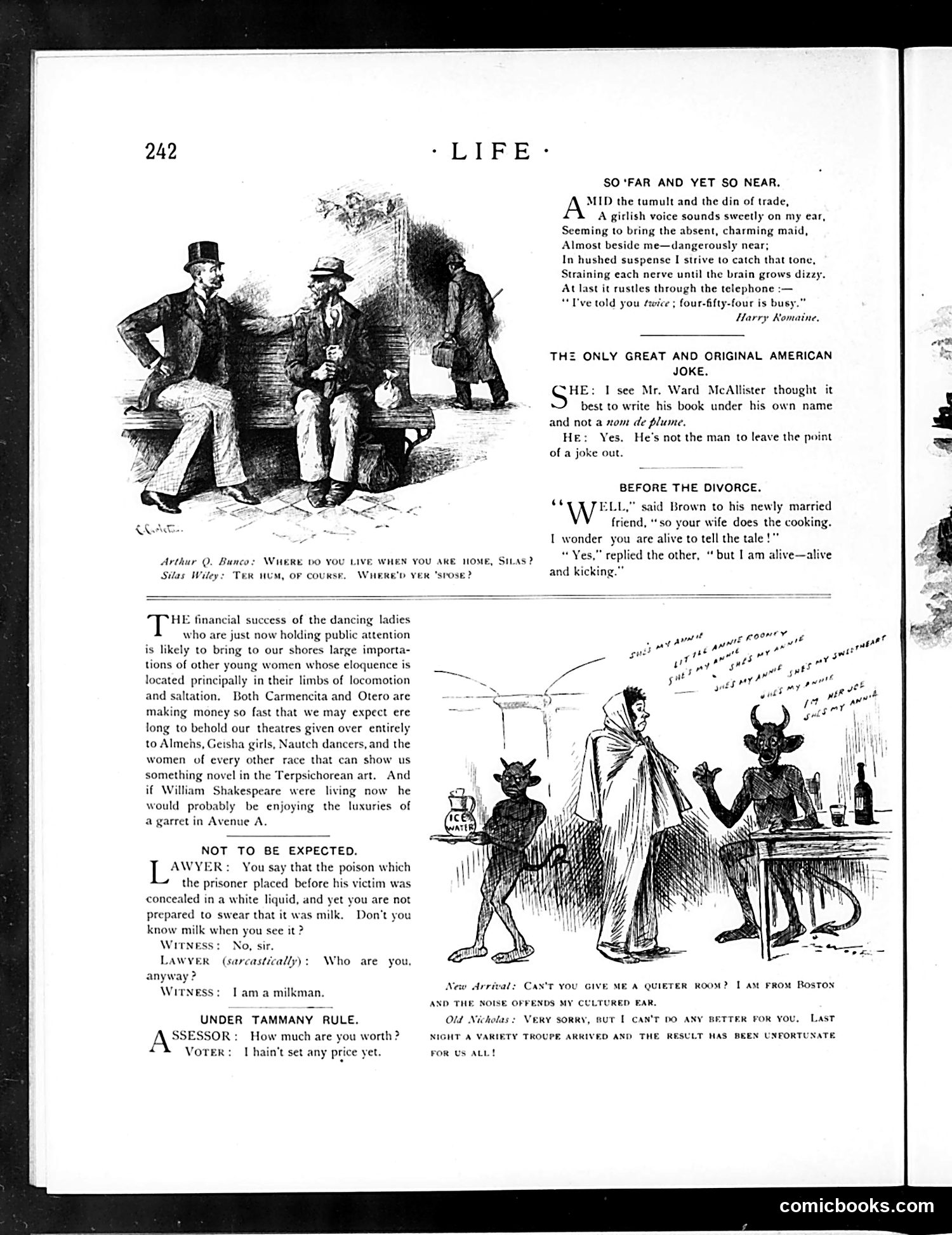
This page contains several satirical jokes and one cartoon typical of late 19th-century American humor: **Top cartoon**: Shows three men (labeled Arthur Q. Bunco and Silas Wiley), likely representing working-class types, in casual conversation—simple street humor. **Key jokes include:** - **"So Far and Yet So Near"**: Satirizes the telephone as a romantic device; a man's poetic reverie about a distant woman is interrupted by her mundane request (a phone number). - **"The Only Great and Original American Joke"**: Mocks Ward McAllister, a prominent New York society figure, for publishing under his own name rather than a pseudonym—suggesting his wit isn't sharp enough to warrant anonymity. - **"Before the Divorce"**: Jokes that a new bride's cooking is so bad her husband shouldn't survive it. - **"Not to Be Expected"**: A lawyer sarcastically questions a milkman witness who claims not to recognize milk—implying milk quality is so poor/adulterated it's unrecognizable. - **Bottom cartoon**: Complains about a noisy variety troupe, playing on New York's chaotic immigrant populations and entertainment scene. The humor relies on contemporary references to New York society, food quality concerns, and vaudeville culture.
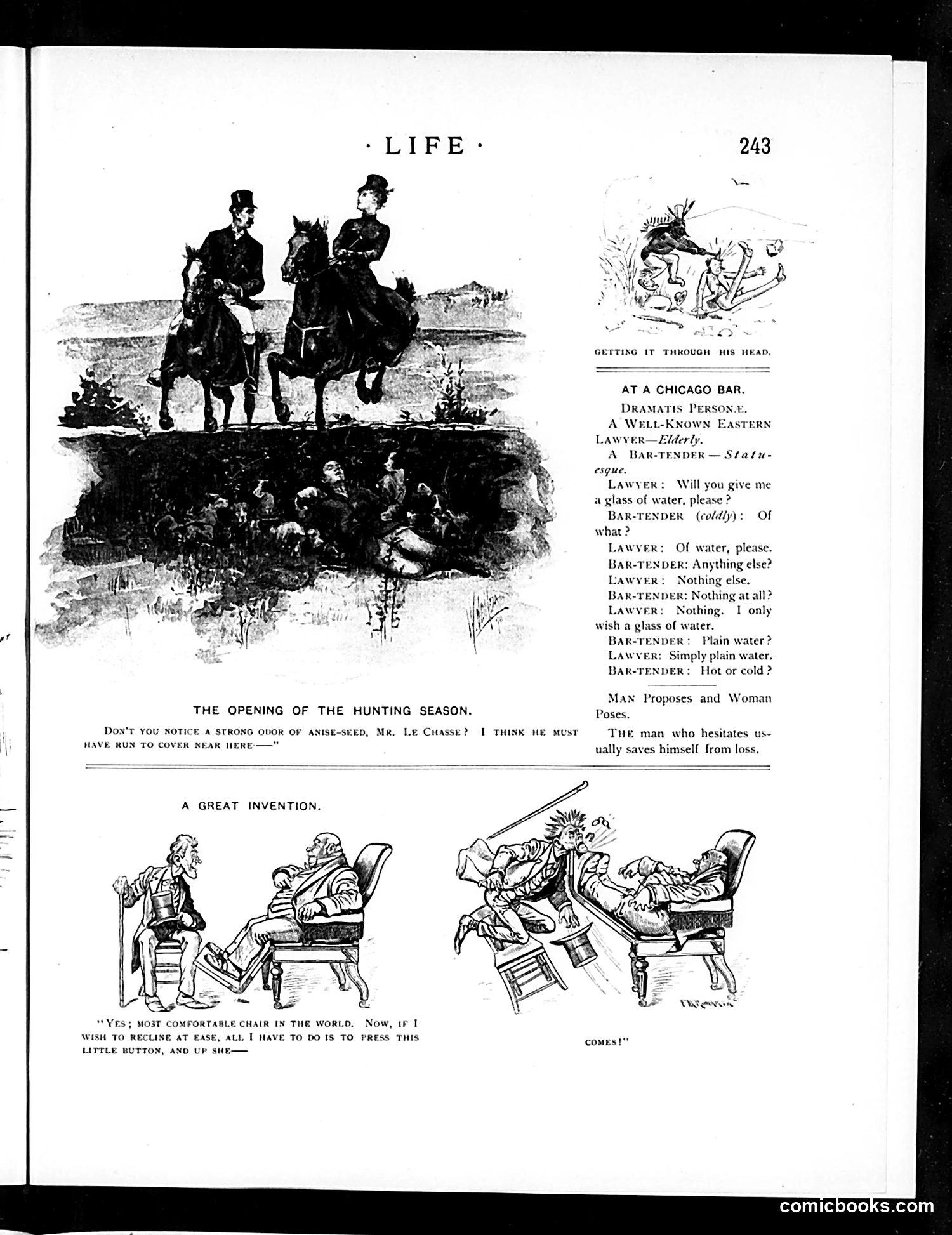
This page contains three separate humorous cartoons typical of Life's satirical style: 1. **"The Opening of the Hunting Season"** (top): Depicts mounted hunters discussing the scent of anise-seed, suggesting game is nearby. The joke likely satirizes pretentious or incompetent hunters. 2. **"At a Chicago Bar"** (right): A lawyer requests plain water from a deliberately obtuse bartender who keeps asking clarifying questions ("Of what?" "Hot or cold?"). This mocks either lawyer verbosity or bartender obstinacy, playing on Chicago's rough reputation. 3. **"A Great Invention"** (bottom): Shows a man demonstrating a "comfortable chair" with a button that somehow propels occupants upward in chaotic fashion. This satirizes overly complex mechanical "improvements" that backfire—a common target of period satire about industrial-age gadgetry. All three employ visual exaggeration and absurdist humor characteristic of early 20th-century American humor magazines.
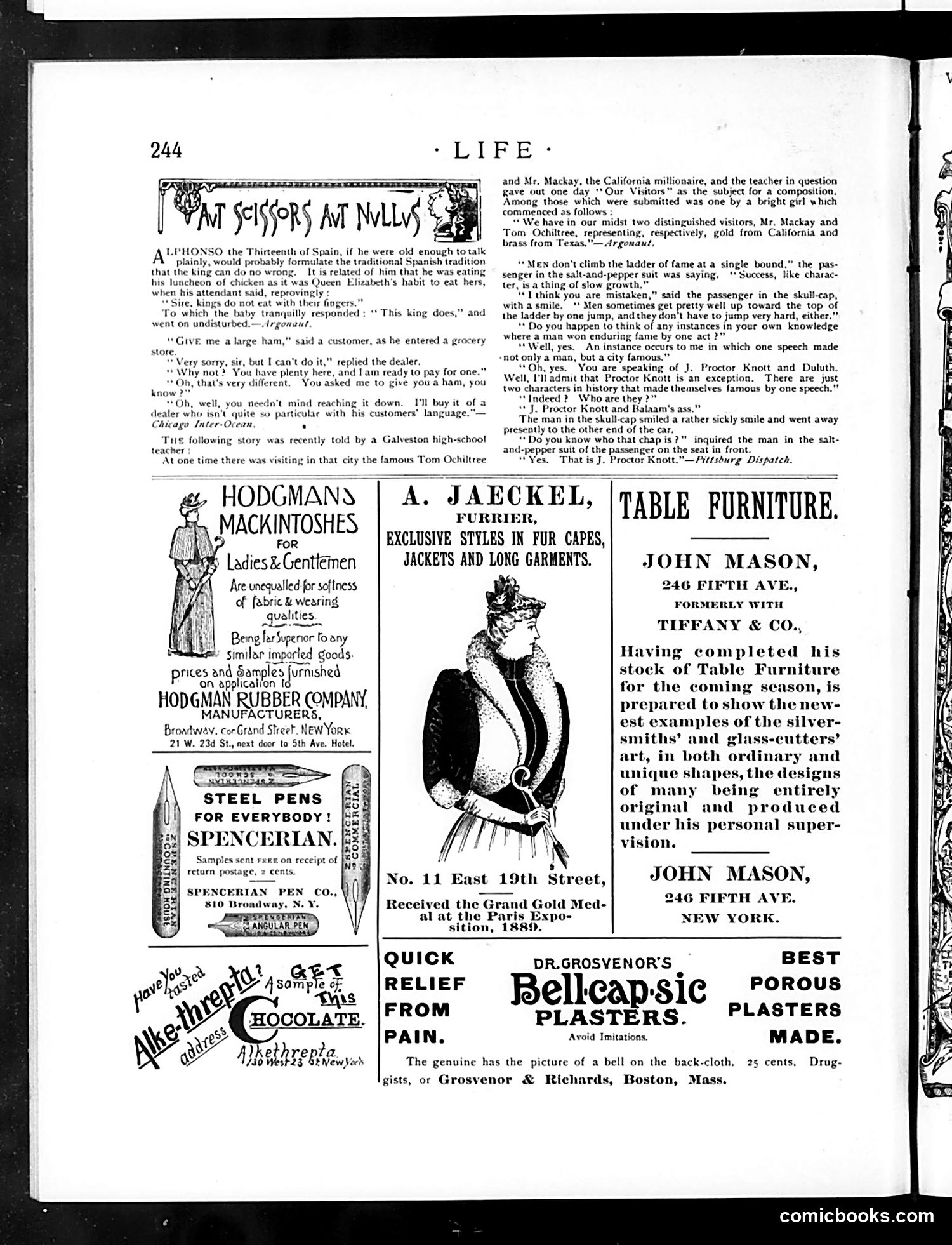
This page from *Life* magazine contains primarily **humorous anecdotes** rather than political cartoons. The main content consists of three brief satirical stories: 1. **"At Scissors at Nulls"** (top): A story about Spain's King Alfonso XIII, referencing the traditional Spanish phrase that "the king can do no wrong" by showing an infant prince eating chicken with his fingers despite courtiers' objections. 2. **Two grocery store jokes**: One about a customer's awkward phrasing ("give" vs. "buy"), and another mocking someone's pedantic correction. 3. **The Ochiltree anecdote** (center): Describes a witty exchange where J. Proctor Knott demonstrates how a single famous speech made him—and the city of Duluth—renowned. The joke's punchline mocks his companion by comparing Knott to "Balaam's ass" (a biblical reference to a donkey that spoke), then reveals Knott himself was present to hear this insult. The remainder of the page contains period advertisements for mackintoshes, steel pens, furs, furniture, and patent medicines—typical of late-19th-century magazine content.