
Life, 1890-10-30 · page 6 of 14
Life — October 30, 1890 — page 6: what you’re looking at
What you’re looking at
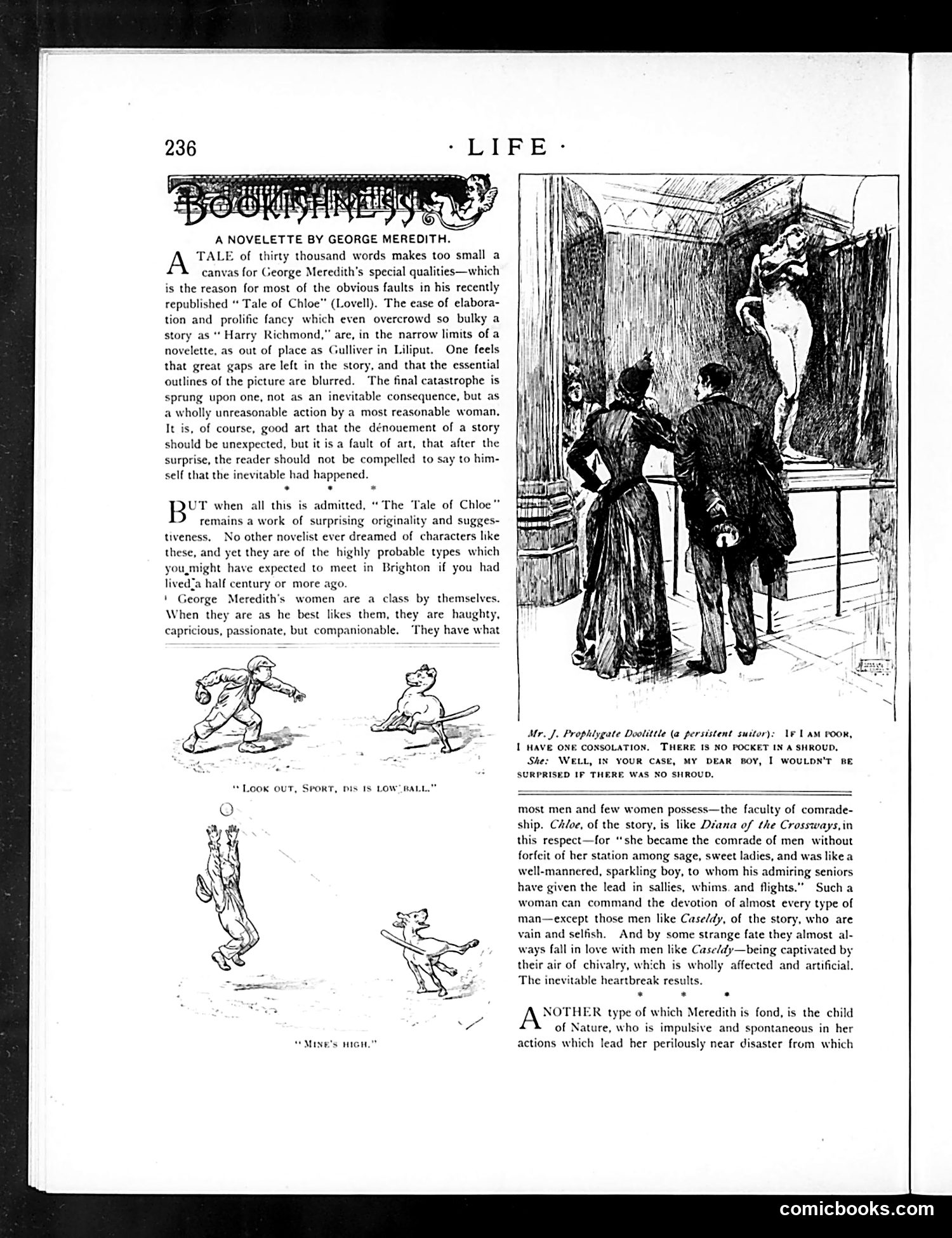
This page reviews George Meredith's novelette "The Tale of Chloe." The critic praises Meredith's ability to create memorable female characters, noting that his women are "haughty, capricious, passionate, but companionable." The small illustrations (captioned "Look out, Sport, his is low ball" and "Miss's high") appear to be unrelated sporting or humorous vignettes—possibly from a different feature—showing figures in physical action or exaggerated poses, a common filler element in Life magazine. The review focuses on literary merit rather than satire. It discusses Meredith's characterization of women like Chloe, who command devotion from men, and warns that women of "impulse and spontaneous" nature risk romantic disaster. The content is literary criticism rather than political commentary.
📄 Transcribed text from this page (OCR, searchable)
Machine-transcribed from the original scan — historical spelling and the odd misread are preserved.
A NOVELETTE BY GEORGE MEREDITH. A TALE of thirty thousand words makes too small a canvas for George Meredith's special qualities—which is the reason for most of the obvious faults in his recently republished “ Tale of Chloe” (Lovell). The ease of elabora- tion and prolific fancy which even overcrowd so bulky a story as“ Harry Richmond,” are, in the narrow limits of a novelette, as out of place as Gulliver in Liliput. One feels that great gaps are left in the story, and that the essential outlines of the picture are blurred. The final catastrophe is sprung upon one, not as an inevitable consequence, but as a wholly unreasonable action by a most reasonable woman, It is, of course, good art that the dénouement of a story should be unexpected, but it is a fault of art, that after the surprise, the reader should not be compelled to say to him- self that the inevitable had happened. } UT when all this is admitted, * The Tale of Chloe” remains a work of surprising originality and sugges- tiveness. No other novelist ever dreamed of characters like these, and yet they are of the highly probable types which you,might have expected to meet in Brighton if you had lived’a half century or more ago. ' George Meredith's women are a class by themselves. When they are as he best likes them, they are haughty, capricious, passionate, but companionable. ‘They have what Mr. J. Prophiygate Doolittle (a persistent suitor): Ue Las POOR, 1 HAVE ONE CONSOLATION. THERE IS NO POCKET IN A SHROUD, She: WELL, IN YOUR CASE, MY DEAR Boy, I WOULDN'T RE SURPRISED IF THERE WAS NO SHROUD. most men and few women possess—the faculty of comrade- ship. Chloe, of the story, is like Déana of the Crossways,in this respect—for “she became the comrade of men without forfeit of her station among sage, sweet ladies, and was like a well-mannered, sparkling boy, to whom his admiring seniors have given the lead in sallies, whims. and flights.” Such a woman can command the devotion of almost every type of man—except those men like Case/dy, of the story, who are vain and selfish. And by some strange fate they almost al- ways fall in love with men like Case/dy—being captivated by their air of chivalry, which is wholly affected and artificial. The inevitable heartbreak results. . * . A OTHER type of which Meredith is fond, is the child of Nature, who is impulsive and spontaneous in her “Mine's HicH.” actions which lead her perilously near disaster from which comicbooks.com