
Life, 1890-10-30 · page 4 of 14
Life — October 30, 1890 — page 4: what you’re looking at
What you’re looking at
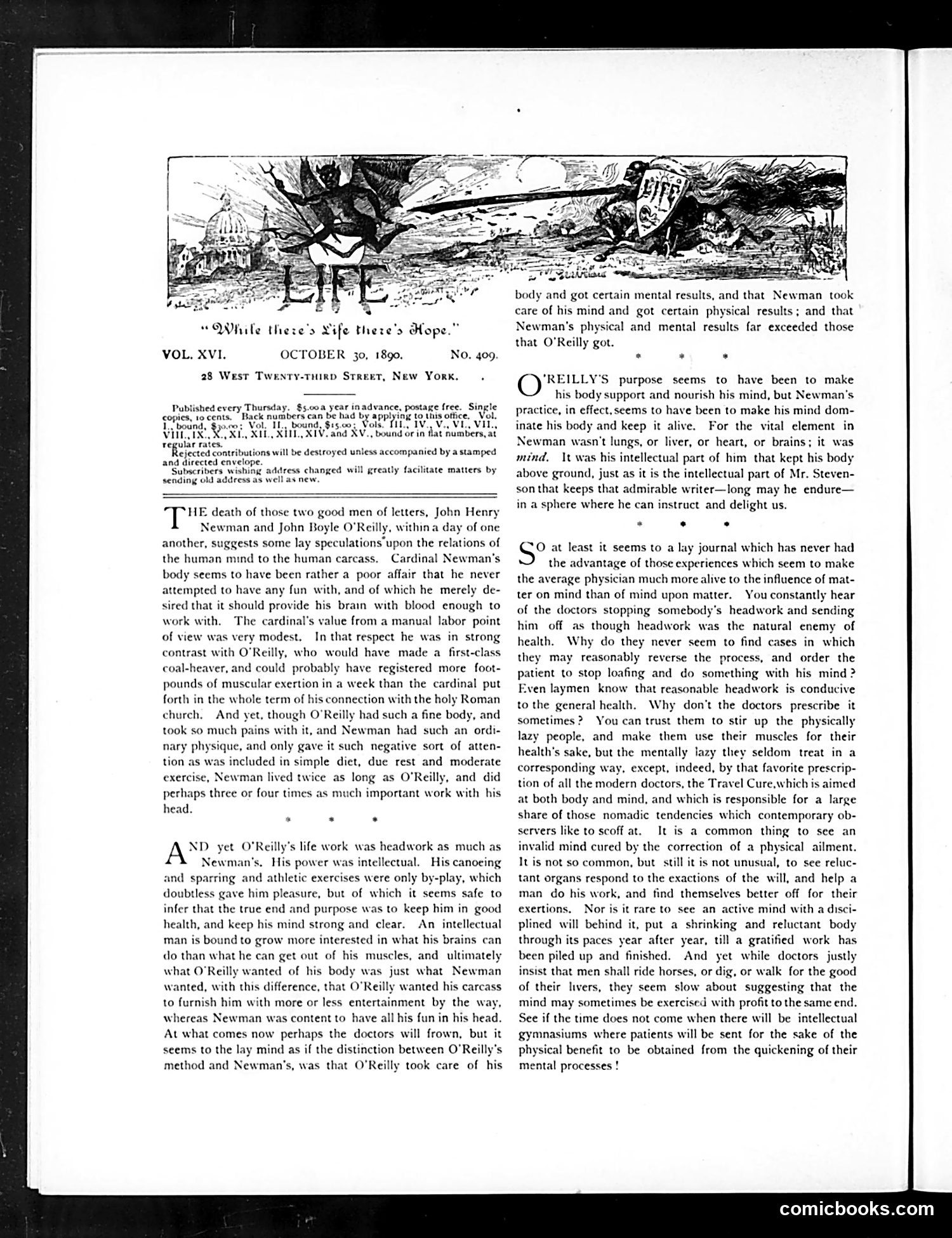
This page contains an article mourning two prominent figures: **John Henry Newman** and **John Boyle O'Reilly**, both recently deceased. The text compares their life philosophies—Newman's intellectual focus versus O'Reilly's balanced approach to physical and mental health. The *Life* masthead illustration shows a figure contemplating a landscape with a classical dome (likely St. Peter's Basilica), referencing Newman's prominence as a Catholic Cardinal and theologian. The article's central satire critiques contemporary medical practice: doctors prescribe exercise for physical ailments but ignore mental health's role in overall wellness. *Life* suggests this represents a false dichotomy—that intellectual and physical well-being should be treated as interconnected rather than separate concerns. The piece advocates for a more holistic approach to human health than Victorian medicine typically offered.
📄 Transcribed text from this page (OCR, searchable)
Machine-transcribed from the original scan — historical spelling and the odd misread are preserved.
VOL, XVI. OCTOBER 30, 1890. 28 West Twenty-tTHirp Street, New York. Published every Thursday. $s.coa year inadvance, postage free. Single copies, to cents. “Back numbers can be had by applying to this office, Vol, 1, bound, $30.00; Vol. IL, bound, $15.00; Vols. M1, 1V.. V., VIL. VIL, VIL IX SSE MT. NUIT: X1Voand XV., bound orin fat humbers, at regular rates. ‘ejected contributions will be destroyed unless accompanied by a stamped and directed envelope. Subscribers wishing address changed will greatly facilitate matters by sending old address as well as new HE death of those two good men of letters, John Henry Newman and John Boyle O'Reilly, withina day of one another, suggests some lay speculations upon the relations of Cardinal Newman's body seems to have been rather a poor affair that he never attempted to have any fun with, and of which he merely de- the human mind to the human carcass. sired that it should provide his brain with blood enough to work with. The cardinal’s value from a manual labor point of view was very modest. In that respect he was in strong contrast with O'Reilly, who would have made a_ first-class coal-heaver, and could probably have registered more foot- pounds of muscular exertion in a week than the cardinal put forth in the whole term of his connection with the holy Roman church, And yet, though O'Reilly had such a fine body, and took so much pains with it, and Newman had such an ordi- nary physique, and only gave it such negative sort of atten- tion as was included in simple diet, due rest and moderate exercise, Newman lived twice as long as O'Reilly, and did perhaps three or four times as much important work with his head. ND yet O'’Reilly’s life work was headwork as much as Newman's. His power was intellectual. His canoeing and sparring and athletic exercises were only by-play, which doubtless gave him pleasure, but of which it seems safe to infer that the true end and purpose was to keep him in good health, and keep his mind strong and clear. An _ intellectual man is bound to grow more interested in what his brains can do than what he can get out of his muscles, and ultimately what O'Reilly wanted of his body was just what Newman wanted, with this difference, that O'Reilly wanted his carcass to furnish him with more or less entertainment by the way, whereas Newman was content to have all his fun in his head. At what comes now perhaps the doctors will frown, but it seems to the lay mind as if the distinction between O'Reilly's method and Newman's, was that O'Reilly took care of his body and got certain mental results, and that Newman took care of his mind and got cer s Newman's physical and mental results far exceeded those that O'Reilly got. * * * "REILLY'S purpose seems to have been to make his body support and nourish his mind, but Newman's practice, in effect, seems to have been to make his mind dom- inate his body and keep it alive. For the vital element in Newman wasn’t lungs, or liver, or heart, or brains; it was mind, twas his intellectual part of him that kept his body above ground, just as it is the intellectual part of Mr. Steven- son that keeps that admirable writer—long may he endure— in a sphere where he can instruct and delight us. * ° . —O at least it seems to a lay journal which has never had the advantage of those experiences which seem to make the average physician much more alive to the influence of mat- ter on mind than of mind upon matter. You constantly hear of the doctors stopping somebody's headwork and sending him off as though headwork was the natural enemy of health. Why do they never seem to find cases in which they may reasonably reverse the process, and order the patient to stop loafing and do something with his mind? en laymen know that reasonable headwork is conducive to the general health. Why don’t the doctors prescribe it sometimes ? You can trust them to stir up the physically lazy people, and make them use their muscles for their health’s sake, but the mentally lazy they seldom treat in a corresponding way, except, indeed, by that favorite prescrip- tion of all the modern doctors, the Travel Cure,which is aimed at both body and mind, and which is responsible for a large share of those nomadic tendencies which contemporary ob- servers like to scoff at. It is a common thing to see an invalid mind cured by the correction of a physical ailment. It is not so common, but still it is not unusual, to see reluc- tant organs respond to the exactions of the will, and help a man do his work, and find themselves better off for their exertions. Nor is it rare to see an active mind with a disci- plined will behind it, put a shrinking and reluctant body through its paces year after year, till a gratified work has been piled up and finished. And yet while doctors justly insist that men shall ride horses, or dig, or walk for the good of their livers, they seem slow about suggesting that the mind may sometimes be exercised with profit to the same end. See if the time does not come when there will be intellectual gymnasiums where patients will be sent for the sake of the physical benefit to be obtained from the quickening of their mental processes ! comicbooks.com