
A complete issue · 14 pages · 1890
Life — September 18, 1890
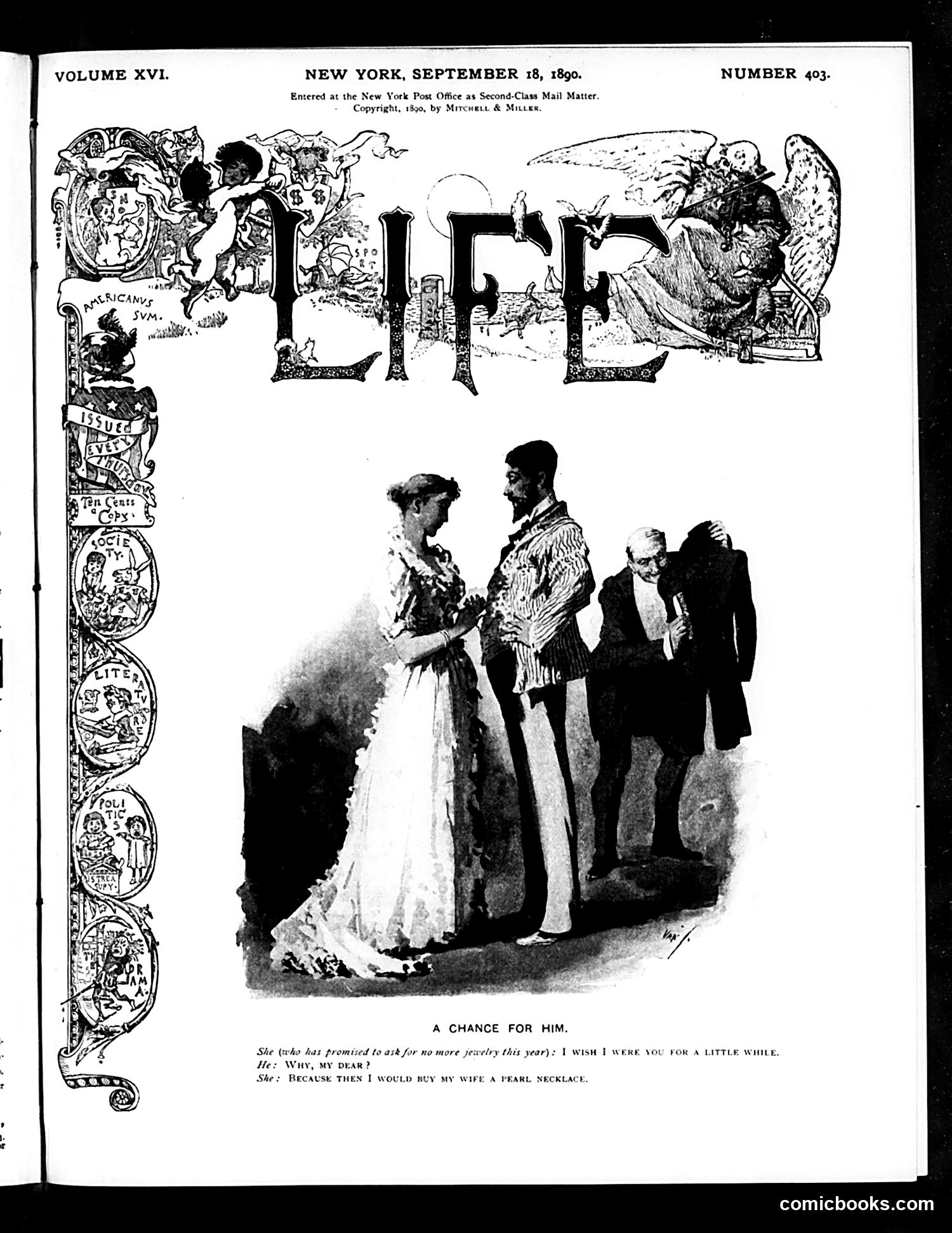
This cartoon satirizes a domestic conversation about jewelry and marital promises. The caption reveals the joke: A wife reminds her husband he promised to ask for no more jewelry "this year." The husband asks why this matters, and she responds that if he would buy her a pearl necklace, she could then buy *him* a wife. The satire targets the husband's apparent inadequacy or undesirability as a spouse—suggesting the wife would trade him for someone better if given the financial means. It's a joke about marital dissatisfaction and the transactional nature of 1890s marriage, where jewelry and material goods were central to spousal relations. The humor relies on the wife's cutting retort implying she'd replace him entirely.
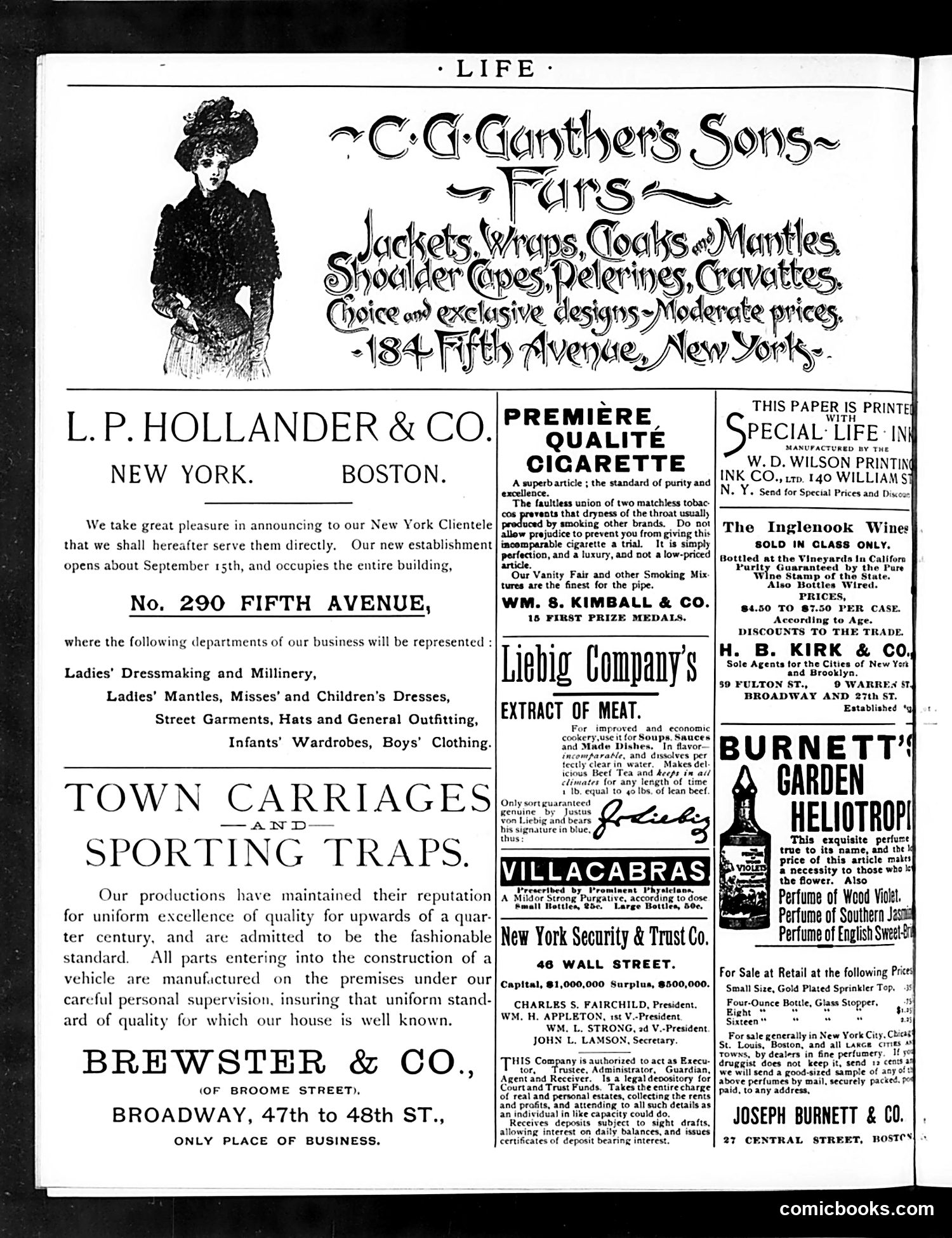
This page is primarily **advertising content**, not satire or political commentary. It features ads for various late 19th/early 20th-century commercial products and services: - **L.P. Hollander & Co.** announces a new NYC location selling women's clothing and accessories - **Town Carriages and Sporting Traps** by Brewster & Co. advertise fashionable vehicles - **Liebig Company's Extract of Meat** promotes a soup/cooking ingredient - **Villacabras** advertises a Spanish wine - **New York Security & Trust Co.** lists banking services - **Burnett's Garden Heliotrope** and other perfumes are featured The only non-advertising element is a decorative header for **C.G. Ganthers Sons' Furs** showing a fashionably-dressed woman in early 1900s attire. This is a commercial, not satirical, publication page.
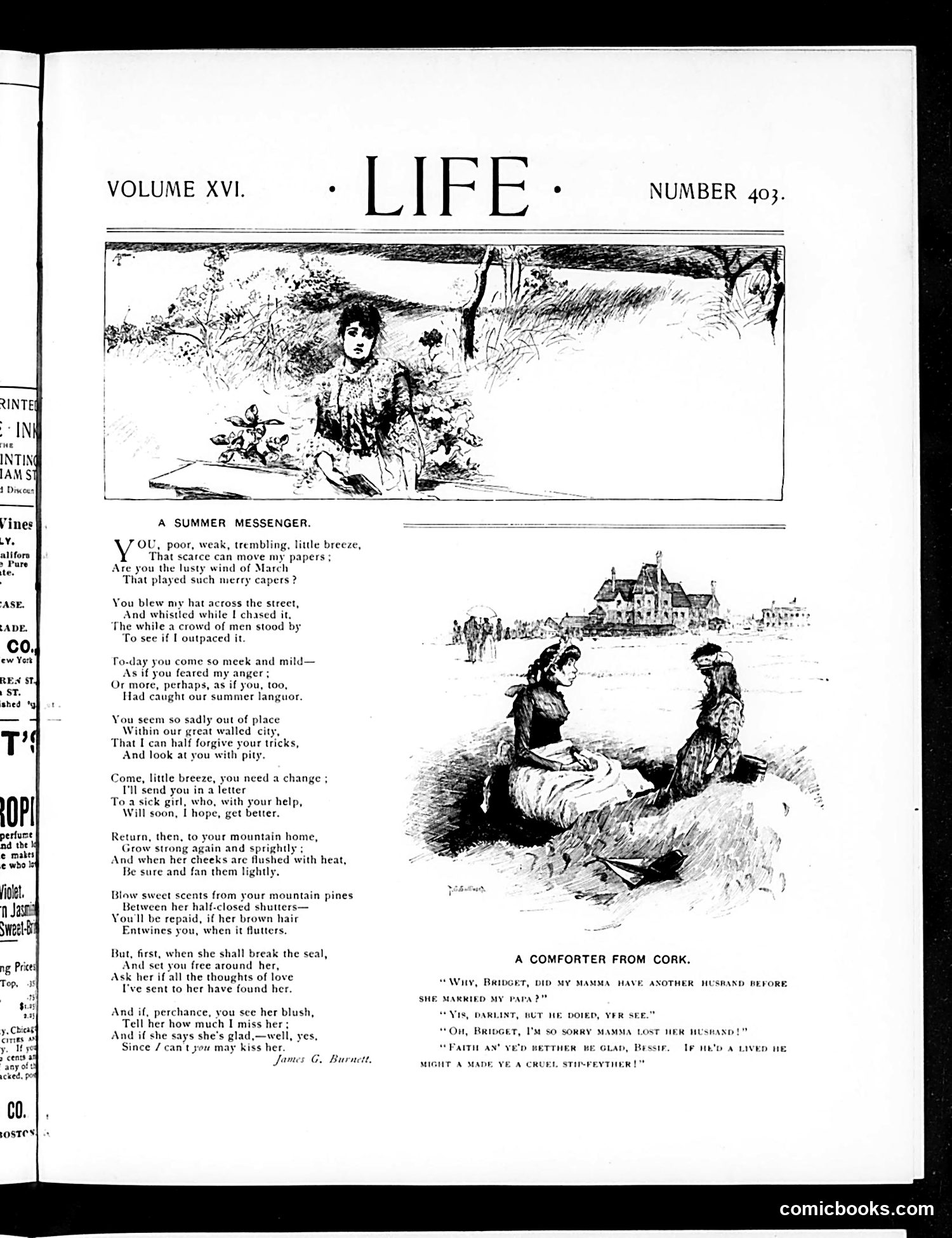
This page contains two distinct pieces: **"A Summer Messenger"** is a poem by James G. Huneker addressing the March wind personified as a "poor, weak, trembling, little breeze." The accompanying illustration shows a woman in summer dress amid flowers, seemingly affected by wind. **"A Comforter from Cork"** presents a dialogue between two women (one appears to be from Cork, Ireland, based on the title). The conversation discusses hardship—one woman mentions her husband's death and lost opportunities, while the other offers sympathy and encouragement about future prospects. The illustration depicts two women in conversation outdoors. Both pieces appear sentimental rather than satirical, focusing on emotional themes of loss, consolation, and seasonal change typical of early-20th-century literary magazines.
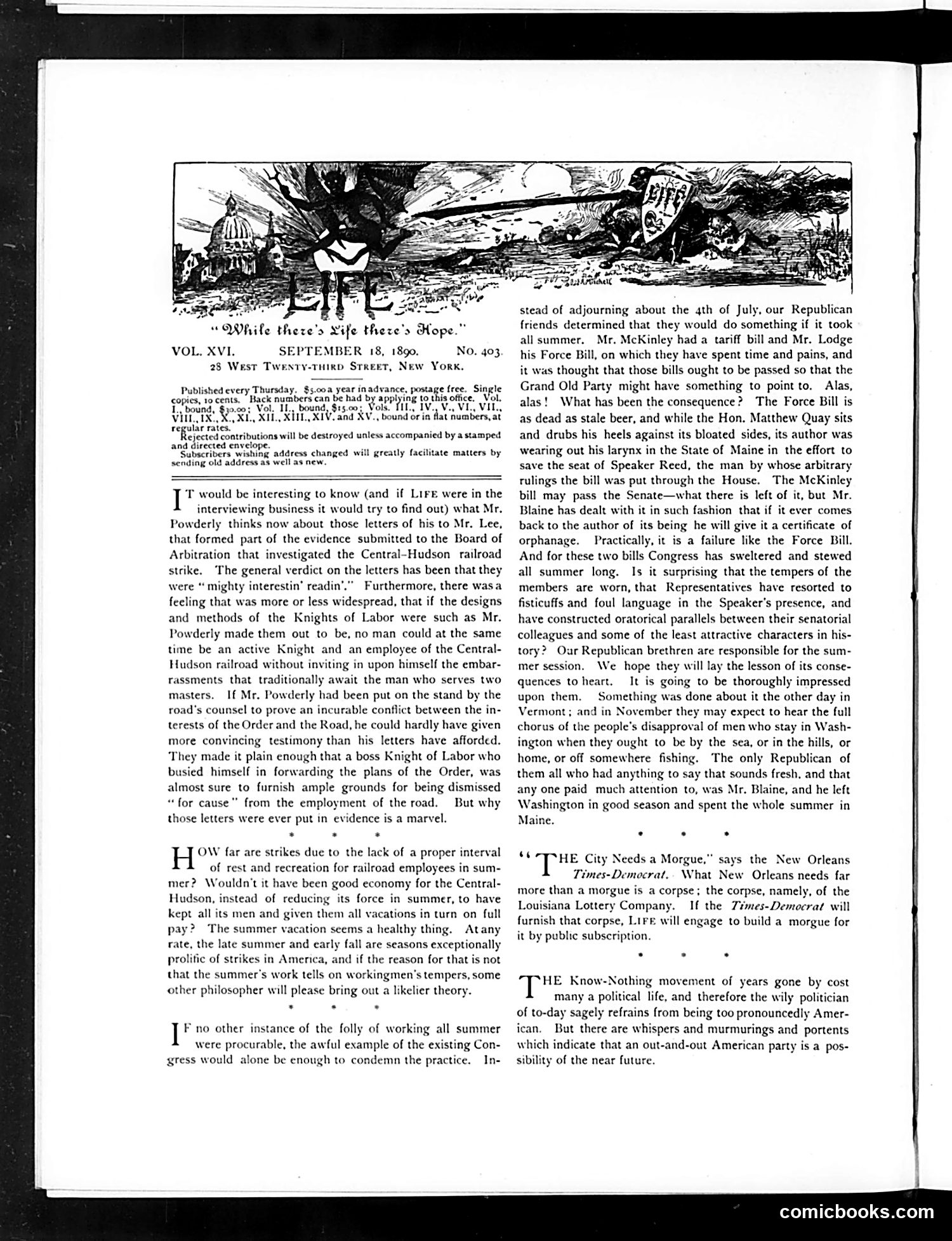
The header cartoon depicts a figure labeled "While there's life there's Hope," appearing to show political desperation or resilience during an uncertain period. The main text discusses congressional failures during summer 1890, specifically criticizing Republicans for their inability to pass legislation—notably the Force Bill and McKinley Tariff Bill. The author sarcastically notes these bills died "as dead as stale beer" despite Republican control. The piece mocks Republican leadership's summer inactivity and suggests voters will punish them in November elections. There's particular criticism of Representative Blaine for leaving Washington early. A brief item mentions the "Know-Nothing movement" as historical precedent for a potential future "out-and-out American party," suggesting contemporary anxieties about political realignment and nativist sentiment.
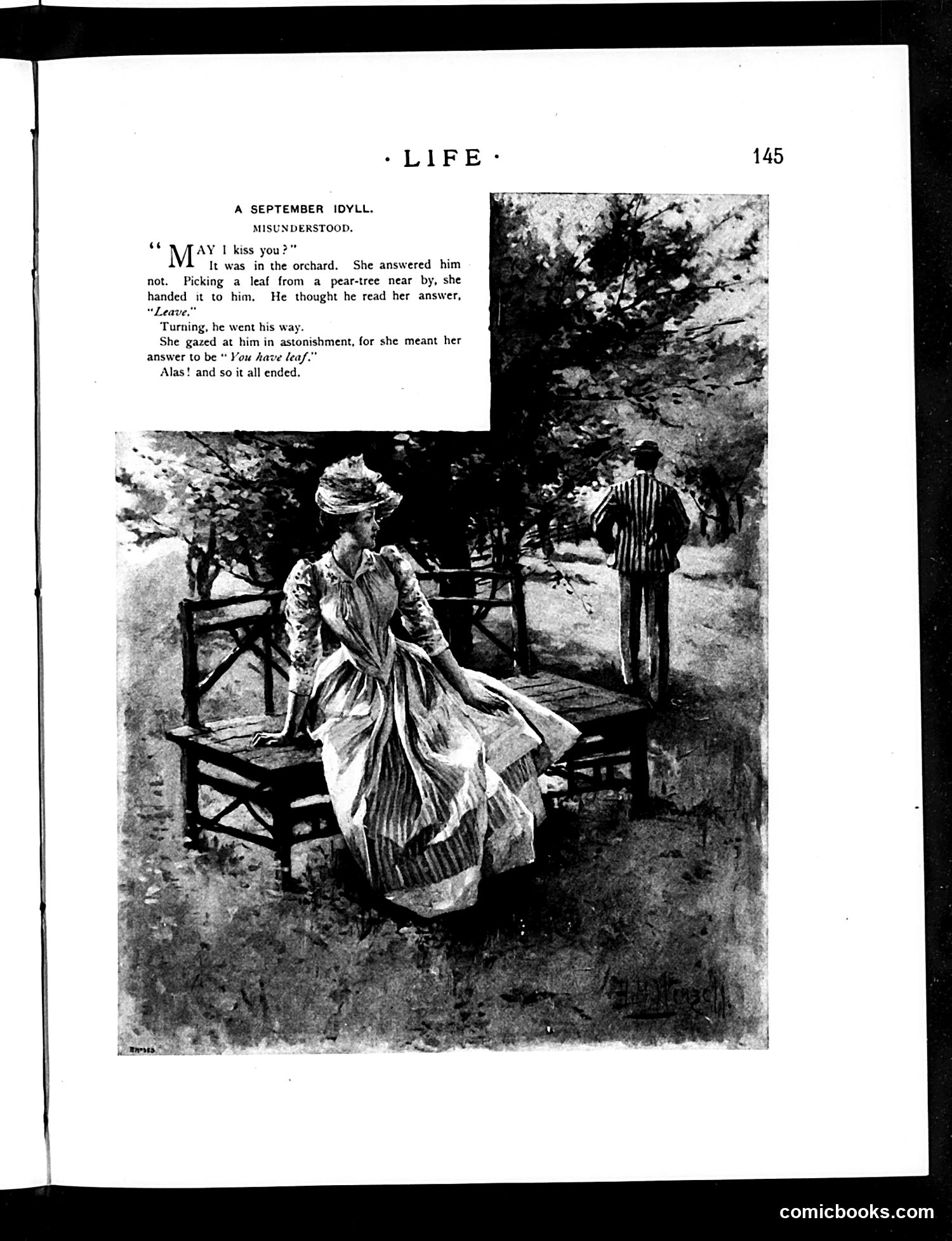
This is a romantic comedy sketch about miscommunication. A man asks "May I kiss you?" in an orchard setting. The woman, intending to be clever, picks a leaf from a nearby pear tree and hands it to him instead of answering verbally—meaning "You have leaf" (a pun on "you have leave," granting permission). The man, however, misinterprets this literal gesture as rejection and walks away. The woman watches in astonishment as her wordplay backfires completely. The humor relies on the audience understanding the homophone joke while sympathizing with the man's literal interpretation of her confusing response. It's a gentle satire of romantic miscommunication and failed attempts at wit between courting couples.
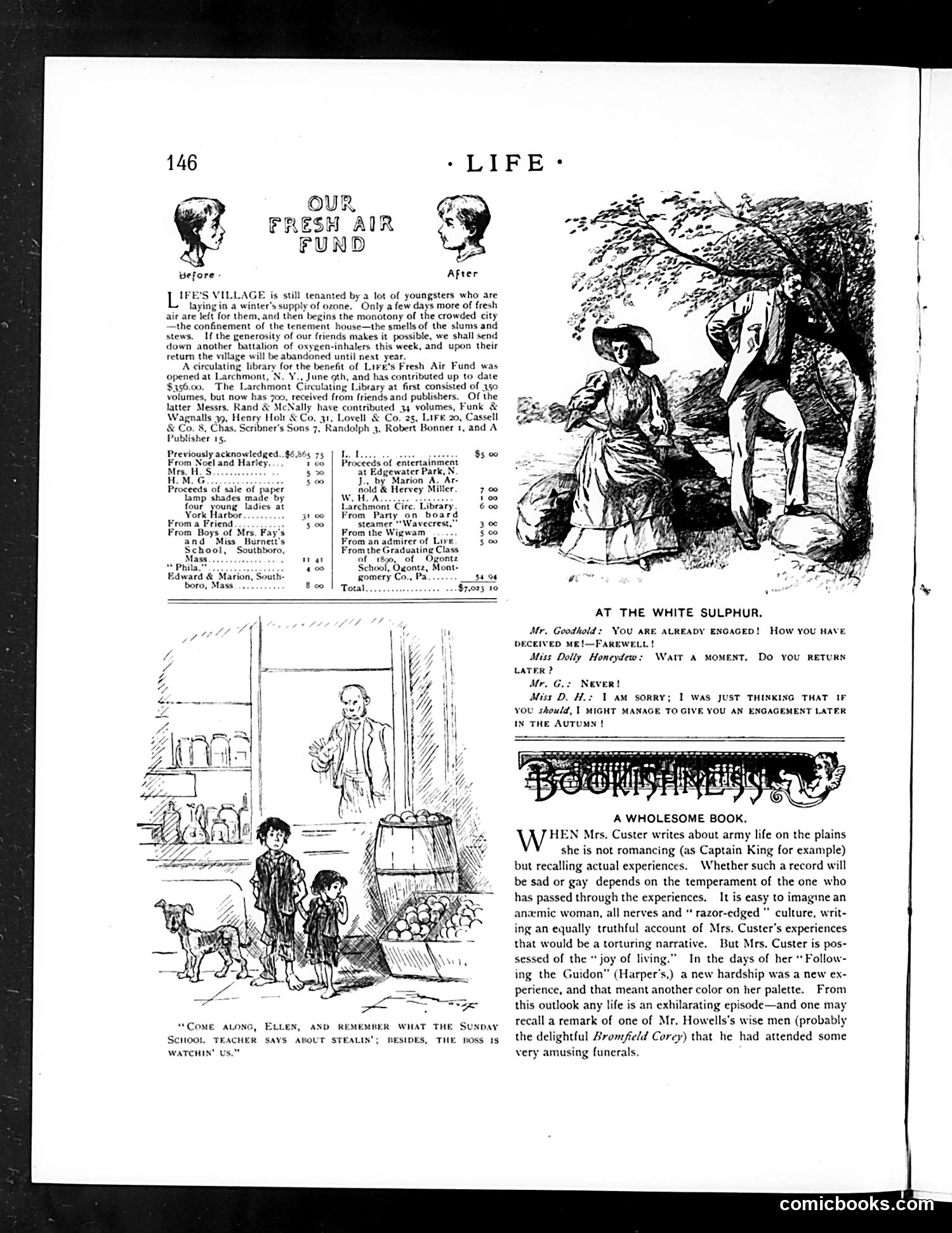
This page contains two main sections: **Upper section:** "Our Fresh Air Fund" describes Life's charitable initiative sending underprivileged children from crowded tenements to the countryside for fresh air. The illustrations show a "before" (sickly urban child) and "after" (healthier rural child). This reflects Progressive Era concern for urban poverty and child welfare. **Lower section:** A sketch depicts children and a dog near a tenement building, with dialogue about Sunday school lessons on stealing. The caption's ironic tone—noting the "boss is watchin' us"—satirizes the gap between moral instruction and survival necessity in poor urban communities. **Right section:** A book review of "Bromfield" (likely Willa Cather's work) discusses realistic portrayal of frontier life and women's experiences. The page reflects early 20th-century American social reform advocacy.
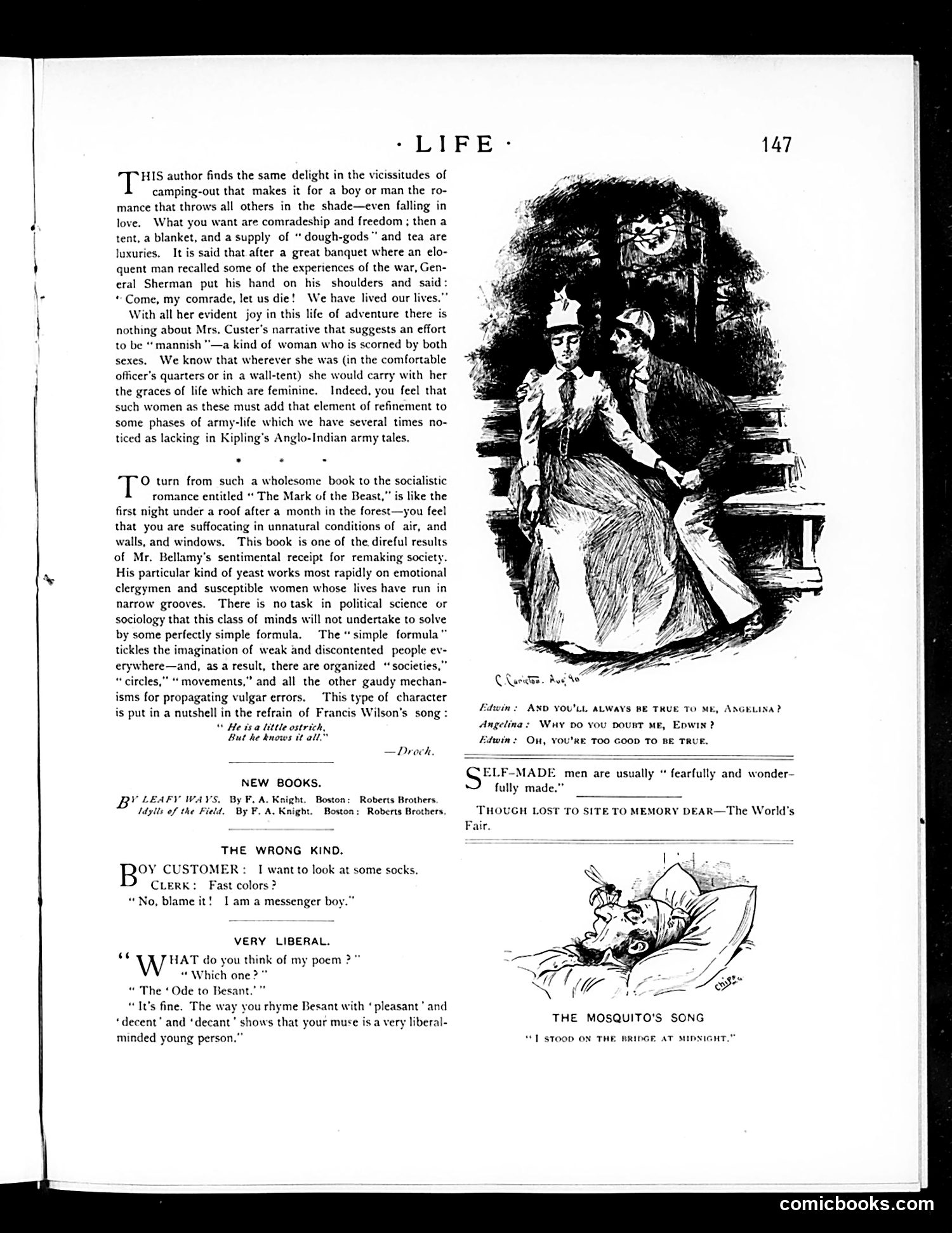
This page contains three unrelated items: 1. **Literary review** (top): A critique of Mrs. Custer's book about military life, praising its depiction of women as refined despite army hardships, then dismissing a "socialistic romance" called "The Mark of the Beast" as emotionally manipulative fiction promoting "vulgar errors" to susceptible readers. 2. **"The Wrong Kind"** (middle): A brief joke where a boy asking for socks is mistaken for a messenger boy—simple wordplay humor. 3. **"The Mosquito's Song"** (bottom): A sketch captioned "I stood on the bridge at midnight"—appears to be a humorous illustration, likely a pun or reference to a well-known poem or song, though the specific reference is unclear without additional context.
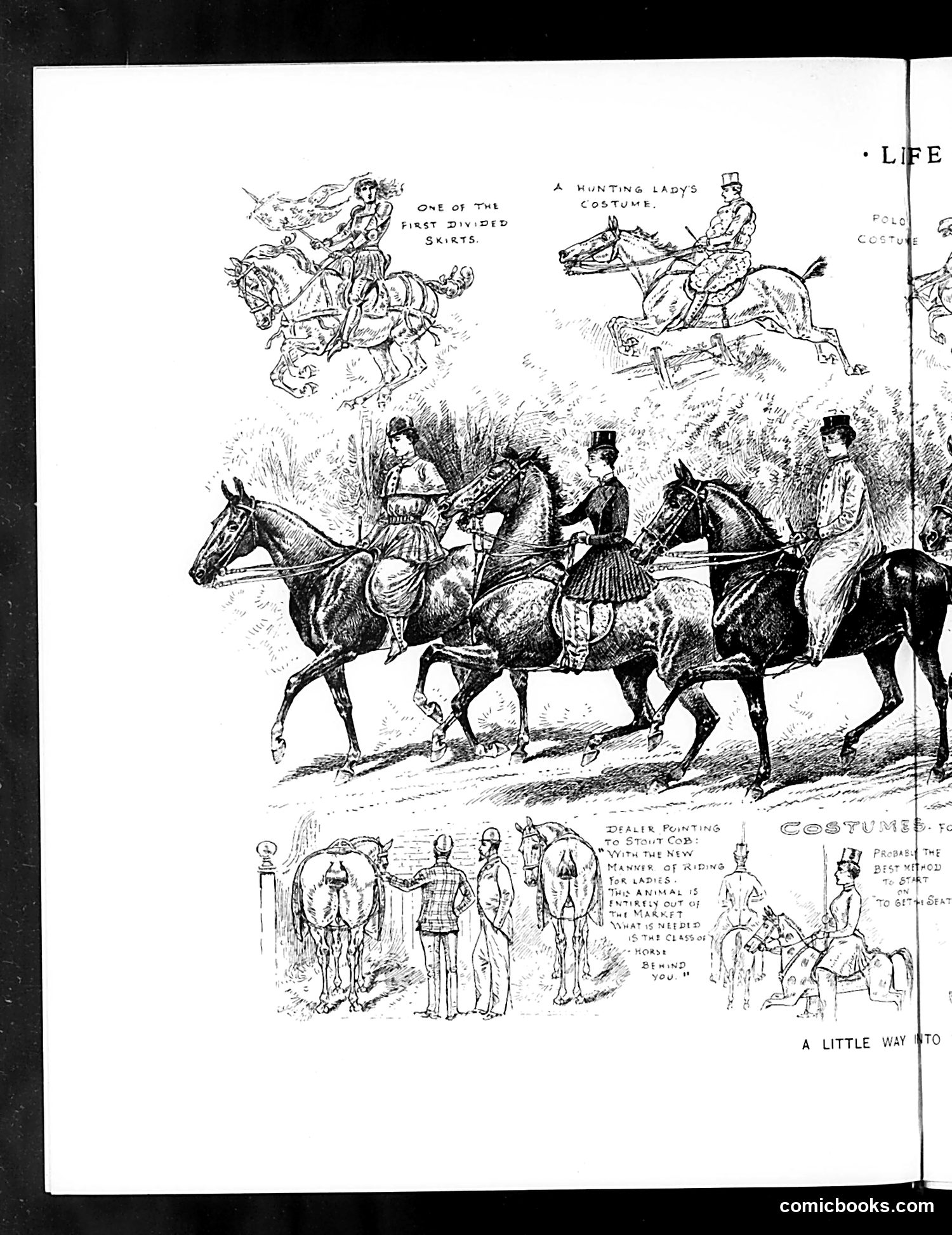
This Life magazine page satirizes women's riding fashion and etiquette from the late 19th or early 20th century. The top panels show "one of the first divided skirts" and "a hunting lady's costume" — innovative but controversial clothing that allowed women to ride astride horses rather than sidesaddle, which was traditionally considered proper. The central scene depicts fashionable riders in a parade or procession, while the lower panel humorously illustrates the practical problem: dealers pointing out "stout cob with new fangled riding habit for ladies" and noting what's "entirely out of the market" — the horses themselves become afterthoughts to the costume debate. The satire mocks society's obsession with appearance and propriety over practical functionality in women's riding attire.
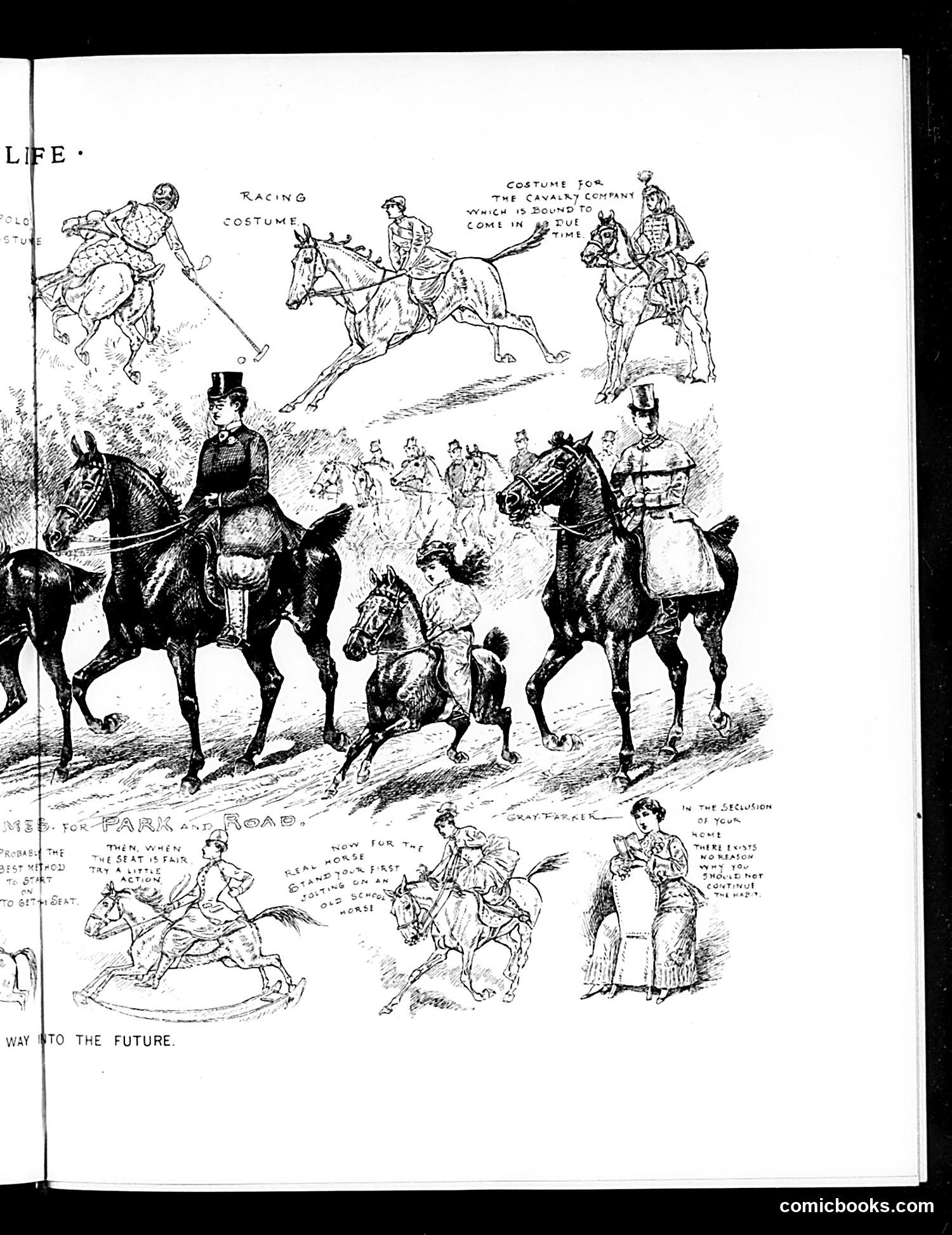
This page satirizes equestrian fashion and social riding culture of the era. The sketches show various riding costumes and scenarios: **Upper section:** Depicts different styles of riding attire—a "racing costume" and a "cavalry company" costume—showing how fashionable dress varies by the type of horseback activity. **Middle section:** Illustrates genteel park and road riding, with well-dressed riders in formal attire, suggesting the social prestige of horsemanship among the upper classes. **Lower section:** Shows rocking-horse play and children's riding toys, connecting adult equestrian pretension to childhood amusement. The satire appears to mock the elaborate, sometimes absurd distinctions in riding costumes and the vanity of fashionable society's obsession with proper dress for every social activity. The title "Way to the Future" suggests ironic commentary on these supposedly refined pursuits.
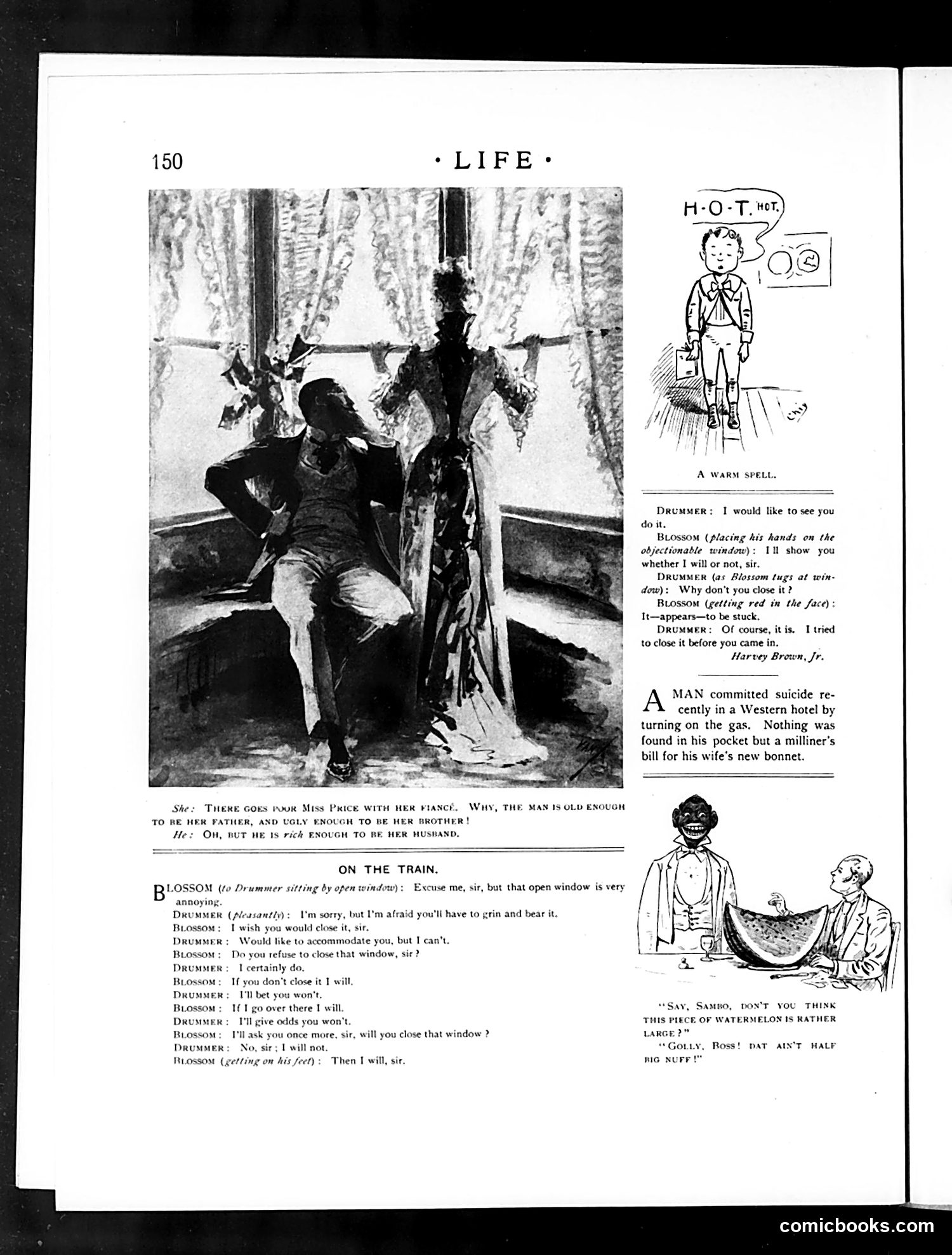
This page contains three separate humor pieces typical of early Life magazine's satirical style. **"A Warm Spell"** (top right): A simple comic about a child noting that weather forecasts ("H.O.T. wet") are inaccurate—likely poking fun at the unreliability of meteorological predictions. **"On the Train"** (bottom left): A dialogue between two men where one (Blossom) persistently refuses to close an open window despite repeated requests from the other (Drummer). The joke satirizes stubbornness and social rudeness—a common frustration on public transportation. **Bottom right cartoons**: Two separate gags about food/dining—one involving watermelon and another about portion sizes ("Golly, boss! dat ain't half big nuff!"), likely using period dialect humor. The page reflects early 20th-century American humor focused on everyday social irritations and class observations.
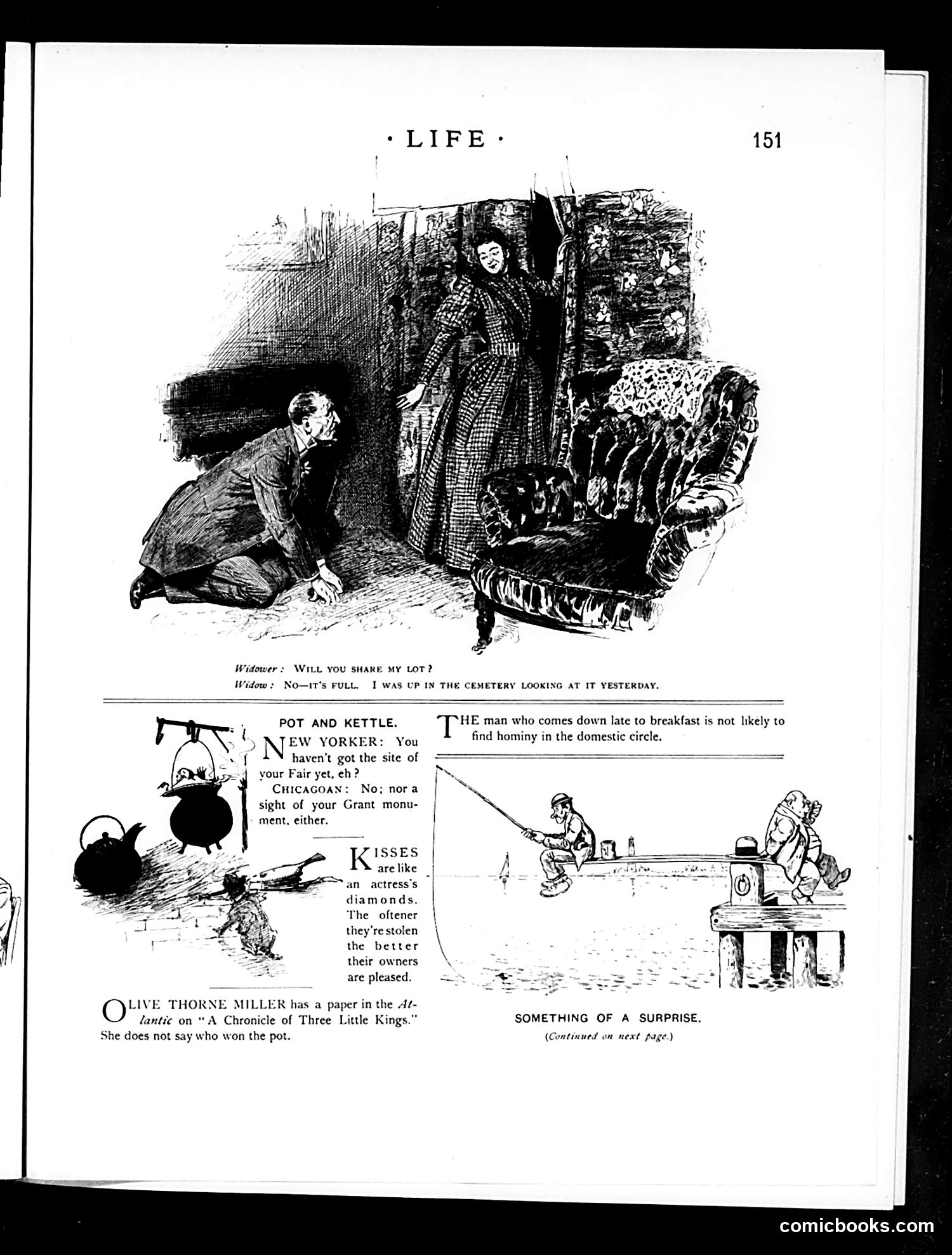
This page contains three separate satirical pieces: 1. **Top cartoon**: A domestic scene where a woman refuses to share her lot with a widower, claiming she spent yesterday in the cemetery looking at it. The joke mocks Victorian sentimentality and property disputes. 2. **"Pot and Kettle"**: A dialogue between a New Worker and Chicagoan debating which city lacks a World's Fair site and a Grant monument. This likely references competition between cities during the Gilded Age over hosting major expositions. 3. **"Something of a Surprise"**: An illustration (continued next page) showing what appears to be a domestic or romantic scenario. The page also includes a note about Olive Thorne Miller's "Chronicle of Three Little Kings," though the text ambiguously avoids stating who won the pot.
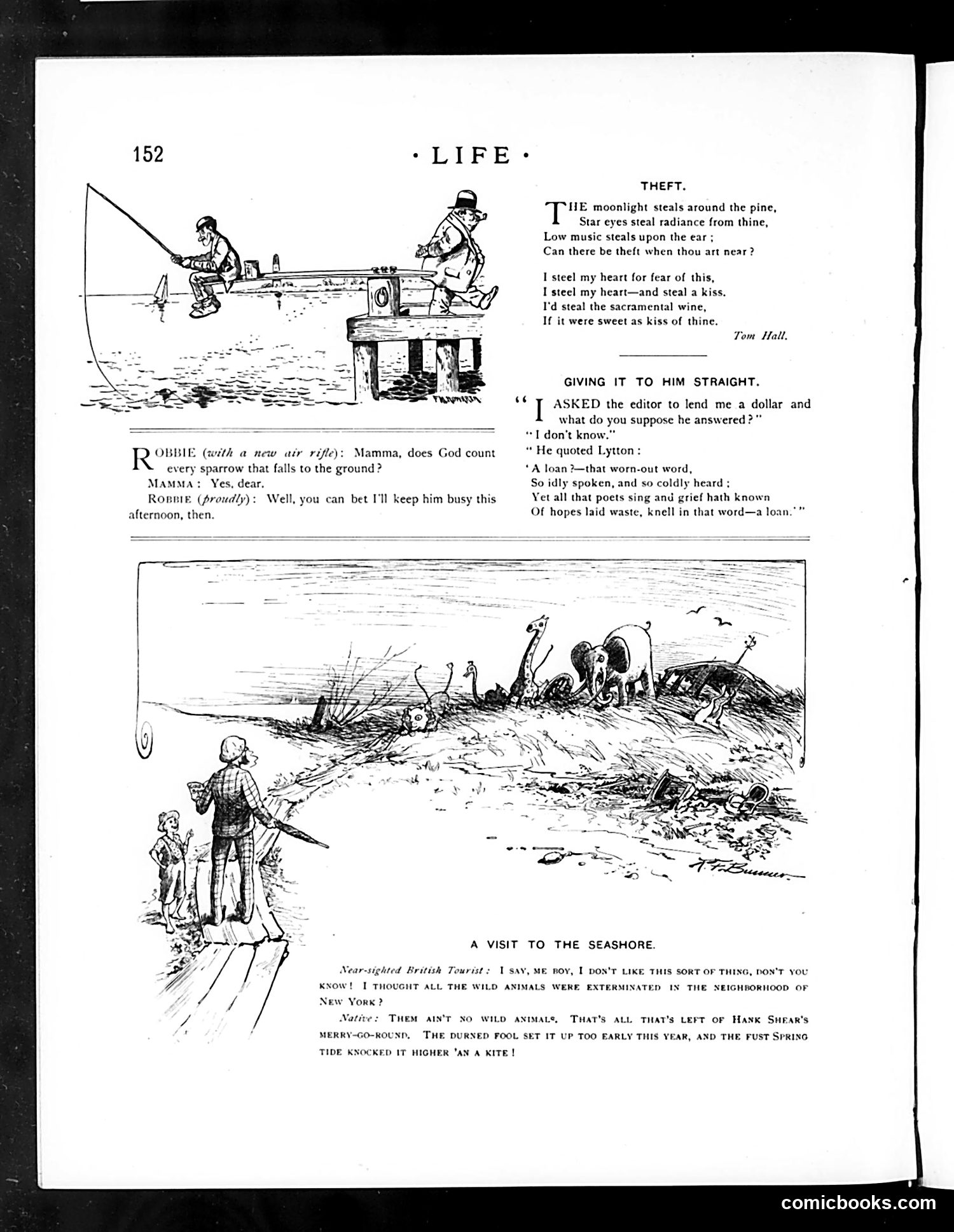
This page contains three separate humorous pieces typical of early 20th-century American satire: **"Theft"** is a romantic poem playing on the word "steal"—comparing poetic/natural "thievery" (moonlight, music) to romantic affection and kissing. **"Giving It to Him Straight"** shows a child with a new air rifle asking his mother if God counts every sparrow that falls, then smugly noting he'll "keep him busy" shooting them that afternoon—dark humor about casual animal killing, likely commenting on childhood cruelty or indifference to life. **"A Visit to the Seashore"** features a British tourist (marked as "near-sighted," suggesting obliviousness) mistaking debris for "wild animals," asking a local why he thought animals still existed near New York. The local explains it's actually wreckage from someone's merry-go-round destroyed by spring tides—satirizing both the tourist's naïveté and Americans' poorly-maintained amusement infrastructure. The humor relies on period-specific assumptions about class, observation, and rural American practicality.
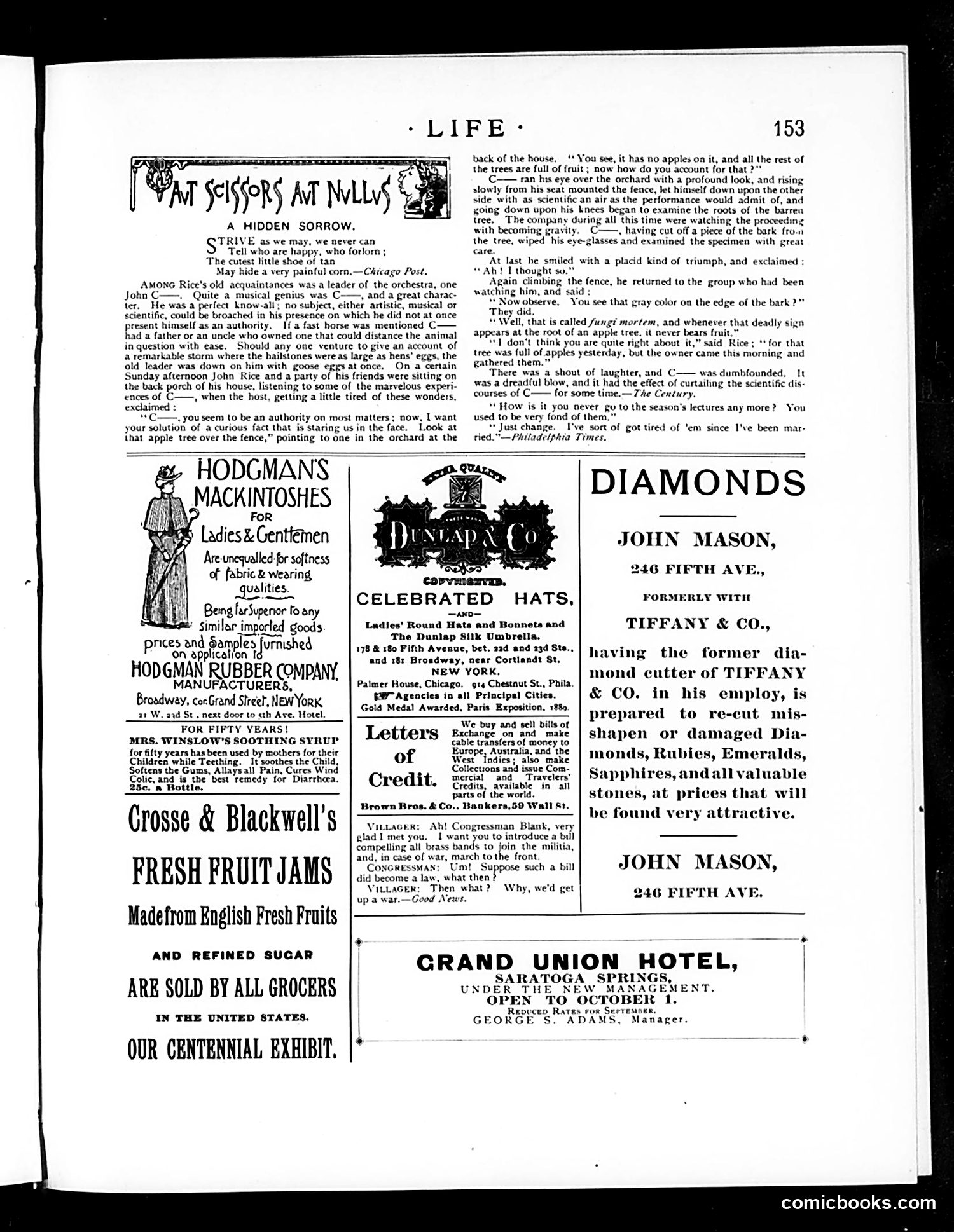
This page contains a humorous anecdote satirizing the archetypal know-it-all. The protagonist, orchestral leader C—, is established as someone who claims expertise in every subject and constantly one-ups others with bragging stories. The satire culminates when Rice points to a barren apple tree in his orchard and asks how C— explains its lack of fruit while neighboring trees flourish. C— conducts an elaborate pseudo-scientific inspection, climbing the fence and examining the bark "with becoming gravity." He pronounces the tree afflicted with "fungi mortem"—a condition that prevents fruit-bearing. The punchline: Rice reveals the tree bore abundant apples *yesterday*; the owner simply harvested them that morning. C— is completely "dumbfounded." The joke mocks pretentious false authority and scientific bluffing—someone confidently diagnosing a nonexistent problem. The text notes C— subsequently curtailed his boastful "scientific discourses," humbled by public embarrassment. The page is otherwise filled with period advertisements for mackintoshes, jams, hats, and diamonds.
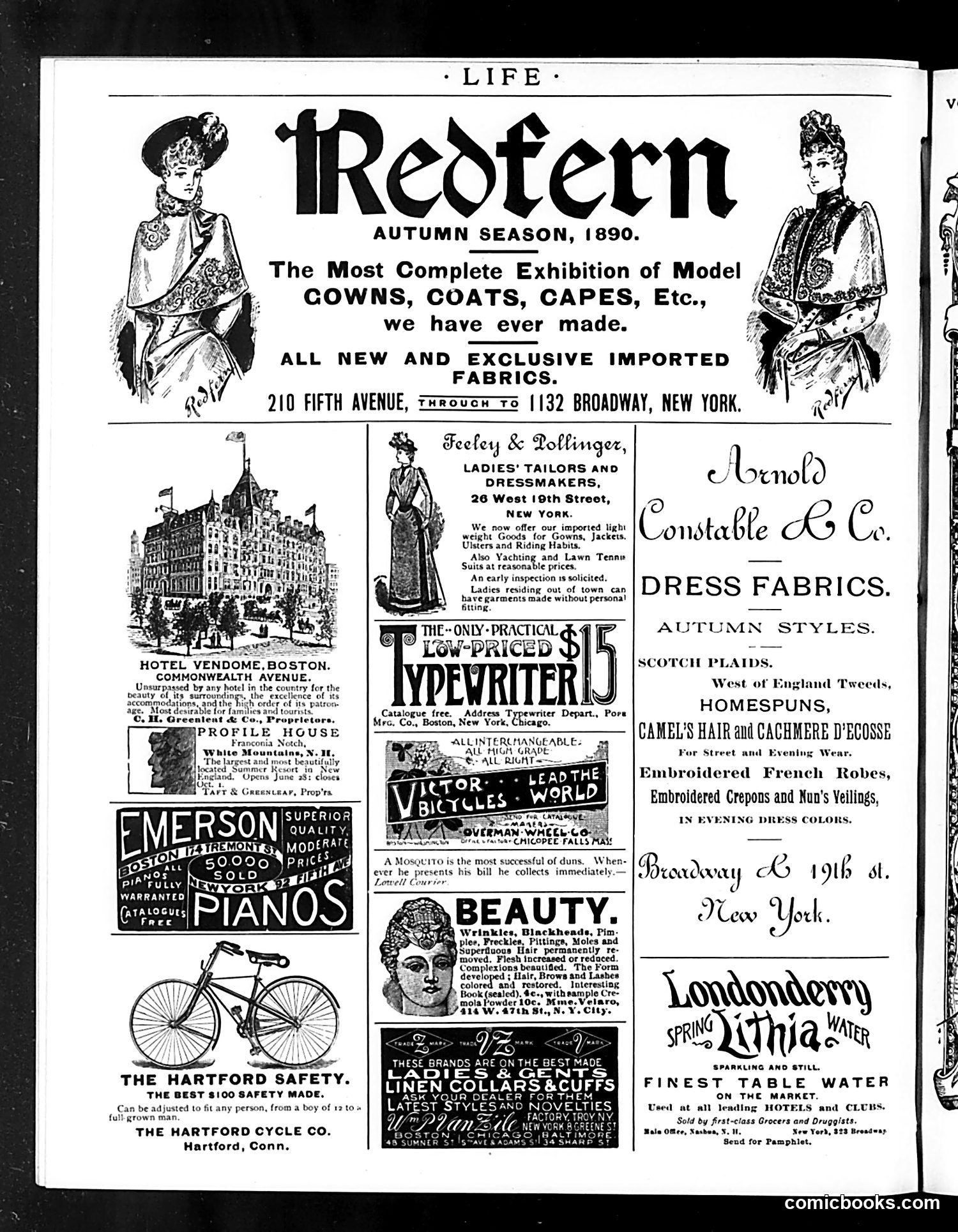
This is primarily a **commercial advertising page** rather than a satirical cartoon page. The dominant content is fashion and consumer goods advertising for the 1890 autumn season. The main feature is **Redfern's clothing advertisement** (top), promoting their "most complete exhibition" of women's gowns, coats, and capes with imported fabrics—typical high-end department store marketing. The page includes various other period advertisements: pianos, bicycles (Hartford Safety bicycle), typewriters, beauty treatments, and Londonderry spring water. One small item jokes that "a mosquito is the most successful of duns"—a light gag suggesting mosquitoes collect their "bills" (fees) immediately, unlike human creditors. The two fashion illustrations flanking the Redfern header show the elaborate 1890s silhouettes (corseted waists, puffy sleeves, ornate trim) that defined the era's women's fashion. This reflects Life's dual nature as both satirical magazine and advertising vehicle for affluent urban readers.