
Life, 1890-09-18 · page 4 of 14
Life — September 18, 1890 — page 4: what you’re looking at
What you’re looking at
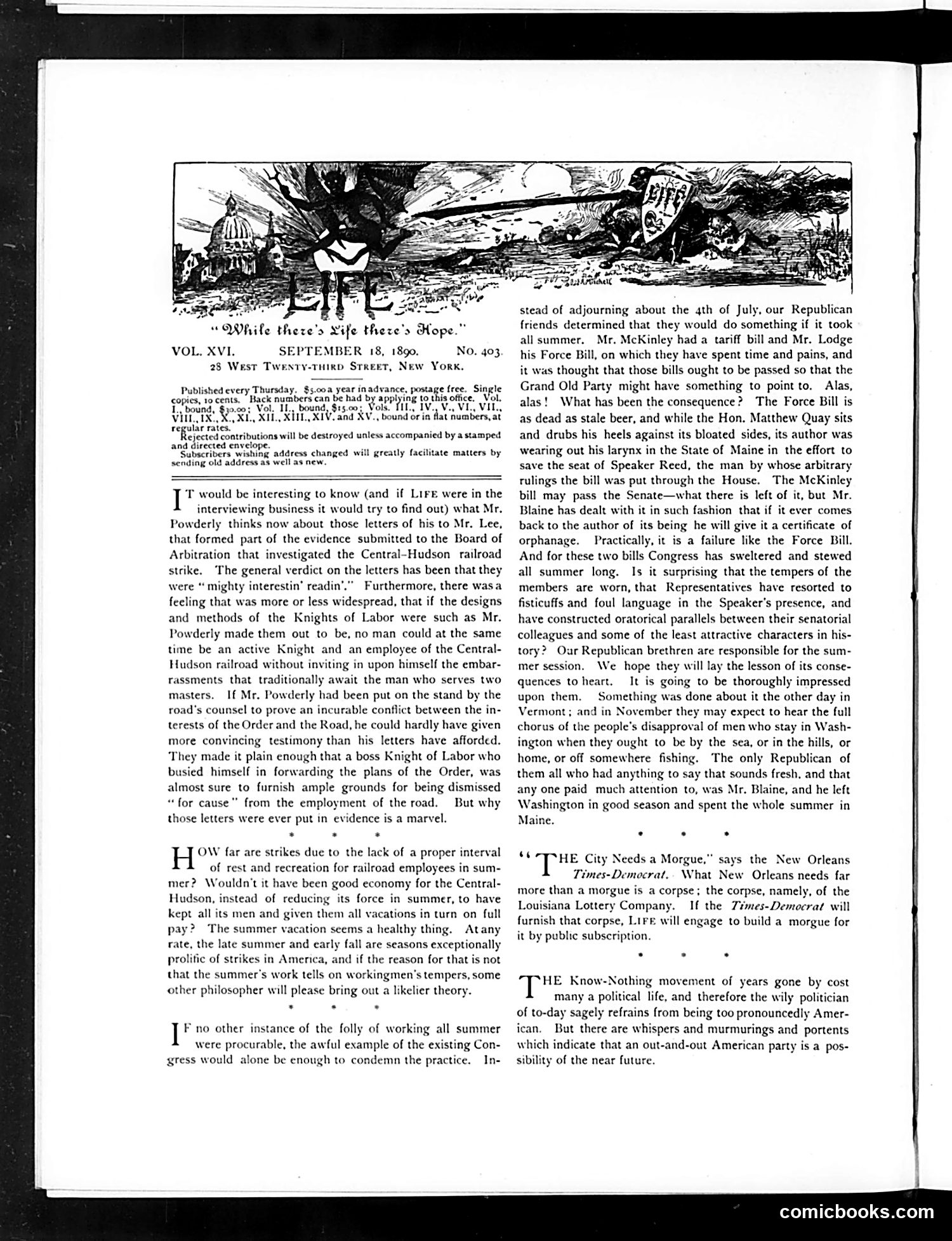
The header cartoon depicts a figure labeled "While there's life there's Hope," appearing to show political desperation or resilience during an uncertain period. The main text discusses congressional failures during summer 1890, specifically criticizing Republicans for their inability to pass legislation—notably the Force Bill and McKinley Tariff Bill. The author sarcastically notes these bills died "as dead as stale beer" despite Republican control. The piece mocks Republican leadership's summer inactivity and suggests voters will punish them in November elections. There's particular criticism of Representative Blaine for leaving Washington early. A brief item mentions the "Know-Nothing movement" as historical precedent for a potential future "out-and-out American party," suggesting contemporary anxieties about political realignment and nativist sentiment.
📄 Transcribed text from this page (OCR, searchable)
Machine-transcribed from the original scan — historical spelling and the odd misread are preserved.
“While there's Life there's Hope.” VOL. XVI. SEPTEMBER 18, 1890, No. 403 28 West Twenty-tHirp Street, New York. Published every Thursday, $s.oa year in advance, postage free. Single copies, tocents. Back numbers can be had by applying to this office. V IL, bound, $15. ‘ols. Xr, x1Veand X IV. V VIL, und, $39.00; Vol ig LV Vos bound or in flat numbers, at 1. bound, $30.00; Vol. VIL, IX. X., X01, XID, regular rates. . Rejected contributions will be destroyed unless accompanied by a stamped and directed envelope. . Subscribers wishing address changed will greatly facilitate matters by sending old address as well as new. J ’ would be interesting to know (and if Lire were in the interviewing business it would try to find out) what Mr. Powderly thinks now about those letters of his to Mr. Lee, that formed part of the evidence submitted to the Board of Arbitration that investigated the Central-Hudson railroad strike. The general verdict on the letters has been that they were “ mighty interestin’ readin’.” Furthermore, there was a feeling that was more or less widespread, that if the designs and methods of the Knights of Labor were such as Mr. Powderly made them out to be, no man could at the same time be an active Knight and an employee of the Central- Hudson railroad without inviting in upon himself the embar- rassments that traditionally await the man who serves two masters. If Mr. Powderly had been put on the stand by the road's counsel to prove an incurable conflict between the in- terests of the Order and the Road, he could hardly have given more convincing testimony than his letters have afforded. They made it plain enough that a boss Knight of Labor who busied himself in forwarding the plans of the Order, was almost sure to furnish ample grounds for being dismissed “for cause” from the employment of the road. But why those letters were ever put in evidence is a marvel. OW far are strikes due to the lack of a proper interval of rest and recreation for railroad employees in sum- mer? Wouldn't it have been good economy for the Central- Hudson, instead of reducing its force in summer, to have kept all its men and given them all vacations in turn on full pay? The summer vacation seems a healthy thing. Atany rate, the late summer and early fall are seasons exceptionally prolitic of strikes in America, and if the reason for that is not that the summer's work tells on workingmen’s tempers, some other philosopher will please bring out a likelier theory. I' no other instance of the folly of working all summer were procurable, the awful example of the existing Con- gress would alone be enough to condemn the practice. In- stead of adjourning about the 4th of July, our Republican friends determined that they would do something if it took all summer. Mr. McKinley had a tariff bill and Mr. Lodge his Force Bill, on which they have spent time and pains, and it was thought that those bills ought to be passed so that the Grand Old Party might have something to point to. Alas, alas! What has been the consequence? The Force Bill is as dead as stale beer, and while the Hon. Matthew Quay sits and drubs his heels against its bloated sides, its author was wearing out his larynx in the State of Maine in the effort to save the seat of Speaker Reed, the man by whose arbitrary rulings the bill was put through the House. The McKinley bill may pass the Senate—what there is left of it, but Mr. Blaine has dealt with it in such fashion that if it ever comes back to the author of its being he will give it a certificate of orphanage. Practically, it is a failure like the Force Bill. And for these two bills Congress has sweltered and stewed all summer long. Is it surprising that the tempers of the members are worn, that Representatives have resorted to fisticuffs and foul language in the Speaker's presence, and have constructed oratorical parallels between their senatorial colleagues and some of the least attractive characters in his- tory? Our Republican brethren are responsible for the sum- mer session. We hope they will lay the lesson of its conse- quences to heart. It is going to be thoroughly impressed upon them. Something was done about it the other day in Vermont; and in November they may expect to hear the full chorus of the people’s disapproval of men who stay in Wash- ington when they ought to be by the sea, or in the hills, or home, or off somewhere fishing. The only Republican of them all who had anything to say that sounds fresh, and that any one paid much attention to, was Mr, Blaine, and he left Washington in good season and spent the whole summer in Maine. ‘©THE City Needs a Morgue,” says the New Orleans Times-Democrat,. What New Orleans needs far more than a morgue is a corpse; the corpse, namely, of the Louisiana Lottery Company. If the 7rmes-Democrat will furnish that corpse, LiFe will engage to build a morgue for it by public subscription. HE Know-Nothing movement of years gone by cost many a political life, and therefore the wily politician of to-day sagely refrains {rom being too pronouncedly Amer- ican. But there are whispers and murmurings and portents which indicate that an out-and-out American party is a pos- sibility of the near future. comicbooks.com