
Life, 1890-09-18 · page 7 of 14
Life — September 18, 1890 — page 7: what you’re looking at
What you’re looking at
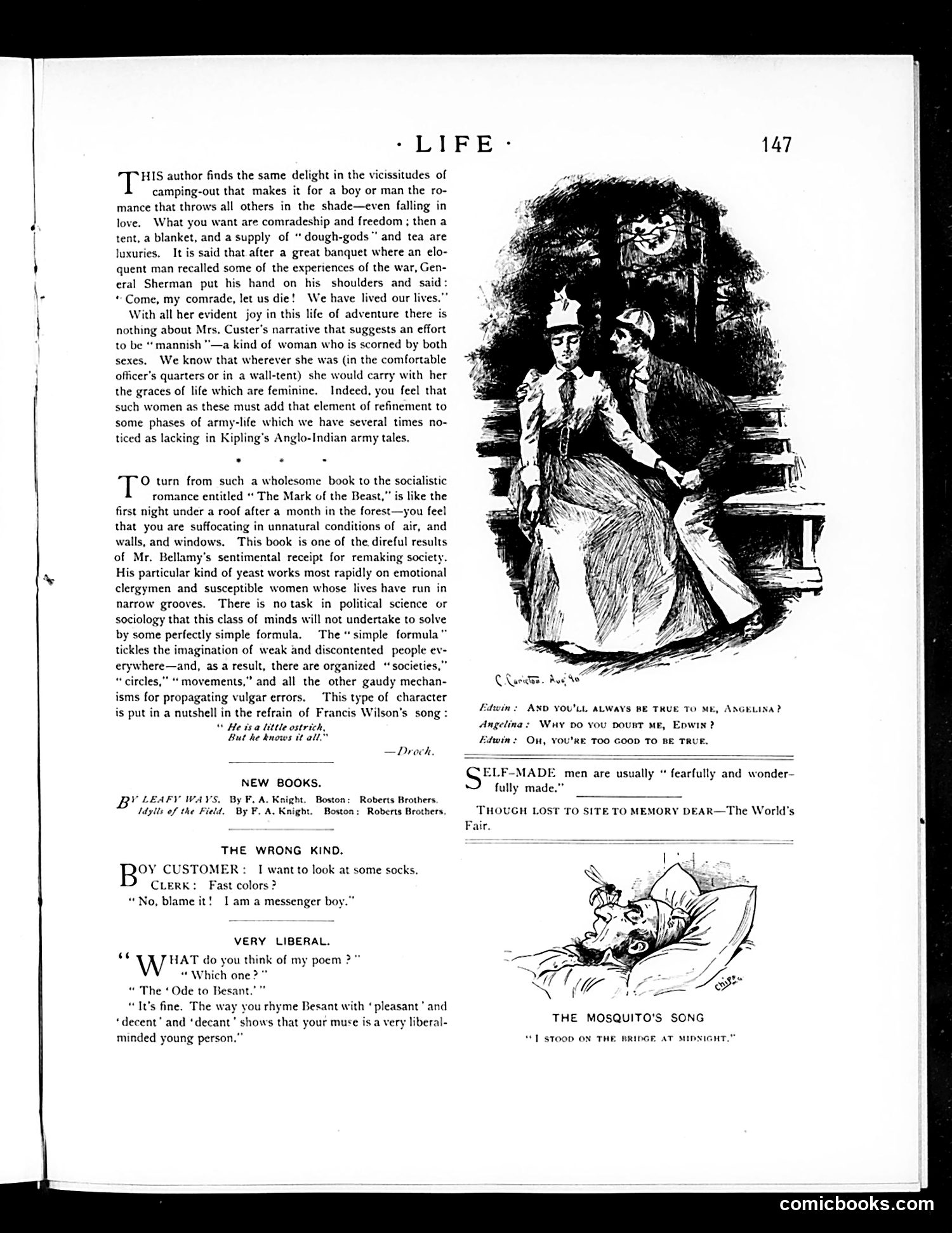
This page contains three unrelated items: 1. **Literary review** (top): A critique of Mrs. Custer's book about military life, praising its depiction of women as refined despite army hardships, then dismissing a "socialistic romance" called "The Mark of the Beast" as emotionally manipulative fiction promoting "vulgar errors" to susceptible readers. 2. **"The Wrong Kind"** (middle): A brief joke where a boy asking for socks is mistaken for a messenger boy—simple wordplay humor. 3. **"The Mosquito's Song"** (bottom): A sketch captioned "I stood on the bridge at midnight"—appears to be a humorous illustration, likely a pun or reference to a well-known poem or song, though the specific reference is unclear without additional context.
📄 Transcribed text from this page (OCR, searchable)
Machine-transcribed from the original scan — historical spelling and the odd misread are preserved.
“LNF'E HIS author finds the same delight in the vicissitudes of camping-out that makes it for a boy or man the ro- mance that throws all others in the shade—even falling in } love. What you want are comradeship and freedom ; then a | tent, a blanket, and a supply of ‘ dough-gods” and tea are luxuries. It is said that after a great banquet where an elo- | ' quent man recalled some of the experiences of the war, Gen- i eral Sherman put his hand on his shoulders and sai r «Come, my comrade, let us die! We have lived our lives.”’ With all her evident joy in this life of adventure there is } nothing about Mrs. Custer’s narrative that suggests an effort to be “ mannish "—a kind of woman who is scorned by both sexes. We know that wherever she was (in the comfortable officer’s quarters or in a wall-tent) she would carry with her the graces of life which are feminine. Indeed, you feel that such women as these must add that element of refinement to some phases of army-life which we have several times no- ticed as lacking in Kipling’s Anglo-Indian army tales. O turn from such a wholesome book to the socialistic romance entitled ** The Mark of the Beast,” is like the first night under a roof after a month in the forest—you feel that you are suffocating in unnatural conditions of air, and walls, and windows. This book is one of the. direful results of Mr. Bellamy’s sentimental receipt for remaking society. nS His particular kind of yeast works most rapidly on emotional clergymen and susceptible women whose lives have run in narrow grooves. There is no task in political science or sociology that this class of minds will not undertake to solve by some perfectly simple formula. The “simple formula” tickles the imagination of weak and discontented people ev- erywhere—and, as a result, there are organized “societies,” “circles,” “ movements,” and all the other gaudy mechan- C Raced. Rud Ae! isms for propagating vulgar errors. This type of character . is put in a nutshell in the refrain of Francis Wilson's song : Fdwin: ASD YOU'LL ALWAYS BE TRUE TO ME, ANGELINA? Angelina: Waxy vo you pount Me, Epwix ? * He tsa little ostrich But he knows it all.” ‘dwin: ON, YOU'RE TOO GOOD TO BE TRUE. —Droch. a: NEW BOOKS. S VY LEAFY WAYS, By F.A. Idylls of the Field. By F. A, MADE men are usually “ fearfully and wonder- fully made.” ht. Boston; Roberts Brothers. ——— ight. Boston: Roberts Brothers. ‘THOUGH LOST TO SIT Fair. ‘O MEMORY DEAR—The World's THE WRONG KIND. OY CUSTOMER: I wantto look at some socks. CLERK: Fast colors ? “No, blame it! I am a messenger boy.” VERY LIBERAL. HAT do you think of my poem ?” “ Which one?” “ The ‘Ode to Besant.’ ” “It’s fine. The way you rhyme Besant with ‘pleasant’ and ‘decent’ and ‘decant' shows that your muse is a very liberal- THE MOSQUITO'S SONG minded young person.” “1 STOOD ON THE BRIDGE AT MIDNIGHT.” “ comicbooks.com