
A complete issue · 18 pages · 1890
Life — September 11, 1890
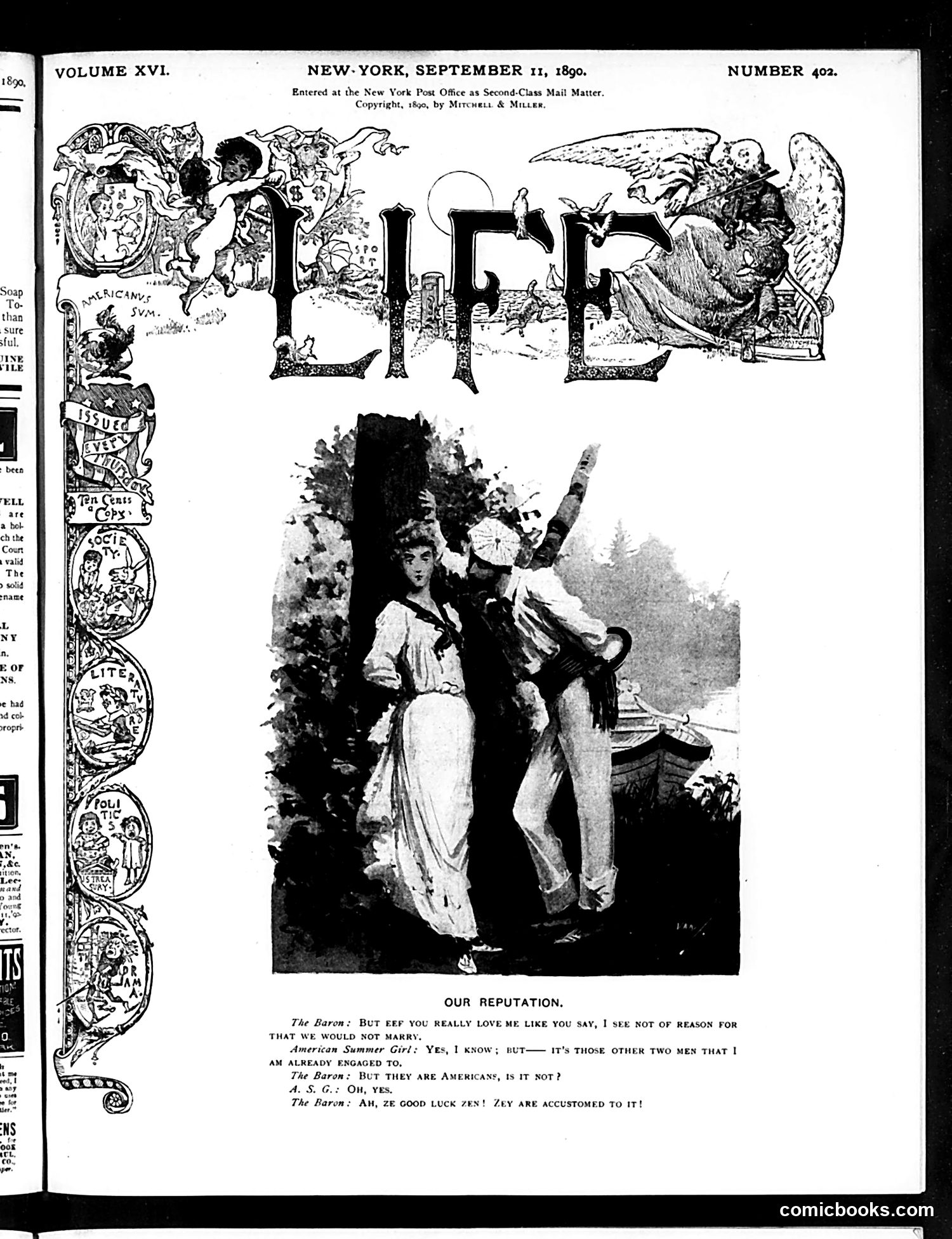
This satirical cartoon depicts a romantic/marital scandal involving an American woman and what appear to be European men (suggested by "The Baron" title). The dialogue reveals the social anxieties of the era: an American girl has broken an engagement to marry foreign aristocrats instead. The Baron justifies this by claiming Americans are accustomed to such behavior ("good luck zen! Zey are accustomed to it!"), suggesting wealthy American women frequently abandoned American suitors for titled European men—a common source of period satire. The joke mocks both American women's perceived social climbing and Europeans' opportunistic marriages to American heiresses, while lamenting America's international reputation for loose morality.
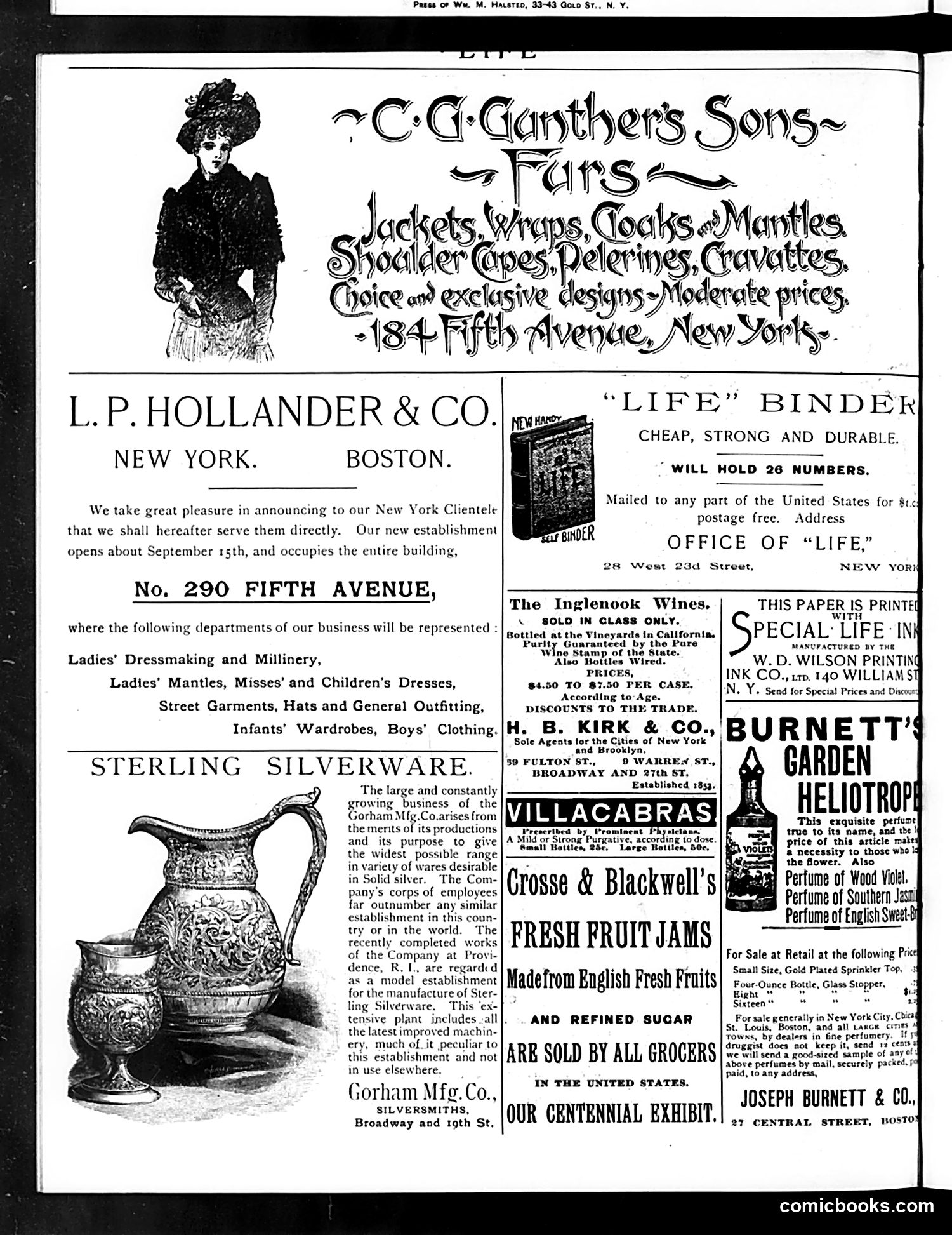
This page is **primarily advertising** with no discernible political cartoon or satirical content. The advertisements showcase late 19th-century New York businesses: C.G. Ganthers Sons advertises women's furs and cloaks at 184 Fifth Avenue; L.P. Hollander & Co. announces a new dressmaking establishment; and various product ads appear for silverware, wines, jams, and perfumes. The only illustration is a decorative image of ornate sterling silverware (pitcher and goblet) accompanying the Gorham Manufacturing Company advertisement—purely commercial, not satirical. While this *is* from Life magazine, this particular page contains no social commentary, political satire, or humor. It represents Life's reliance on advertising revenue typical of periodicals from this era.
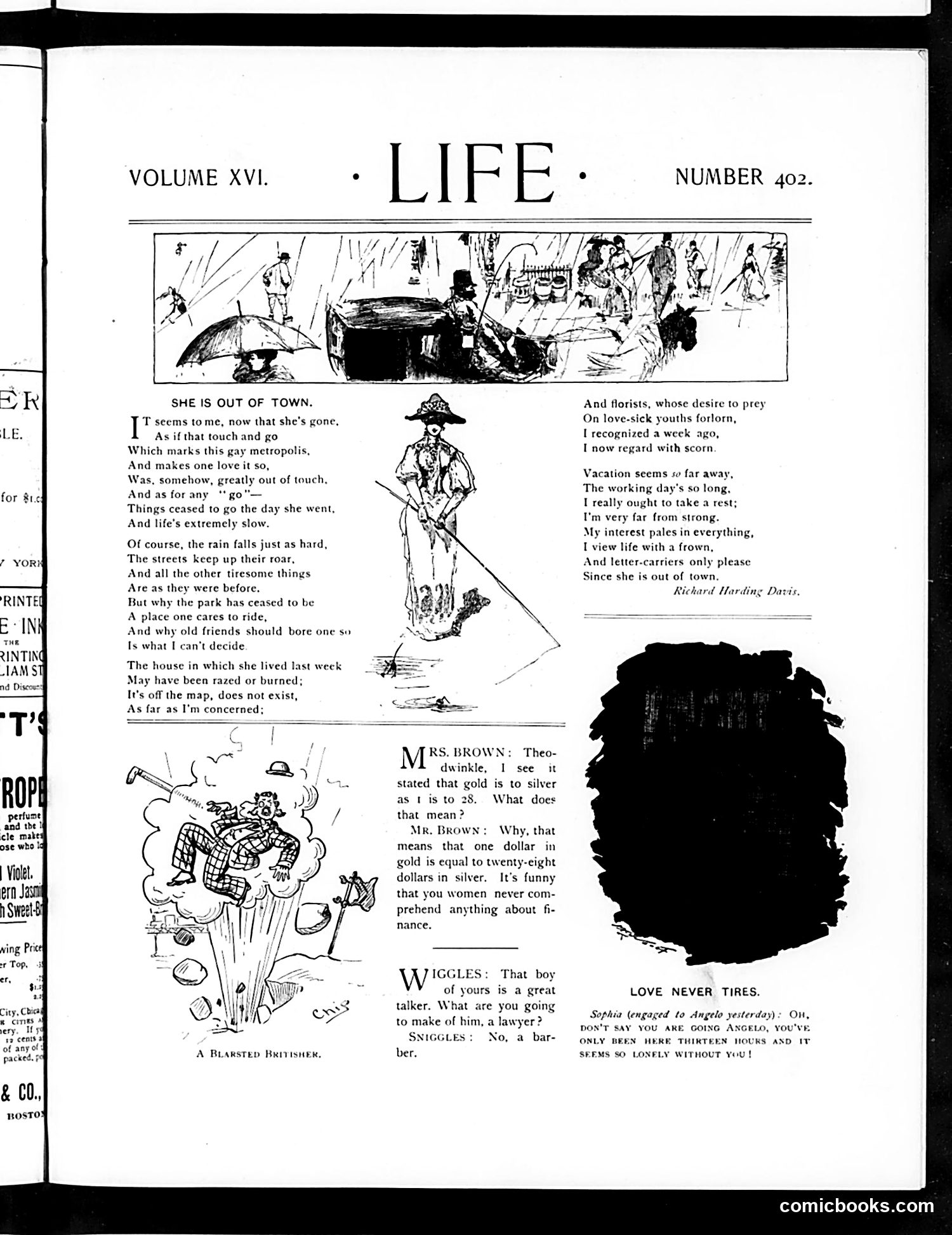
This page contains poetry and light humor rather than political satire. "She Is Out of Town" is a poem lamenting a woman's absence from the city, with the speaker noting how the metropolis feels empty and lifeless without her presence. The accompanying illustration shows a woman with an umbrella in rain. Below, "A Blasted Britisher" depicts a humorous dialogue between Mr. and Mrs. Brown about gold-to-silver currency ratios, with the husband explaining financial concepts to his bewildered wife. The cartoon shows the husband in an explosion of frustration, suggesting his exasperation at her lack of comprehension. The page concludes with social commentary about romantic relationships, featuring "Love Never Tires"—a brief romantic exchange. These are genteel, domestic humor pieces typical of early 20th-century Life magazine's lighter content.
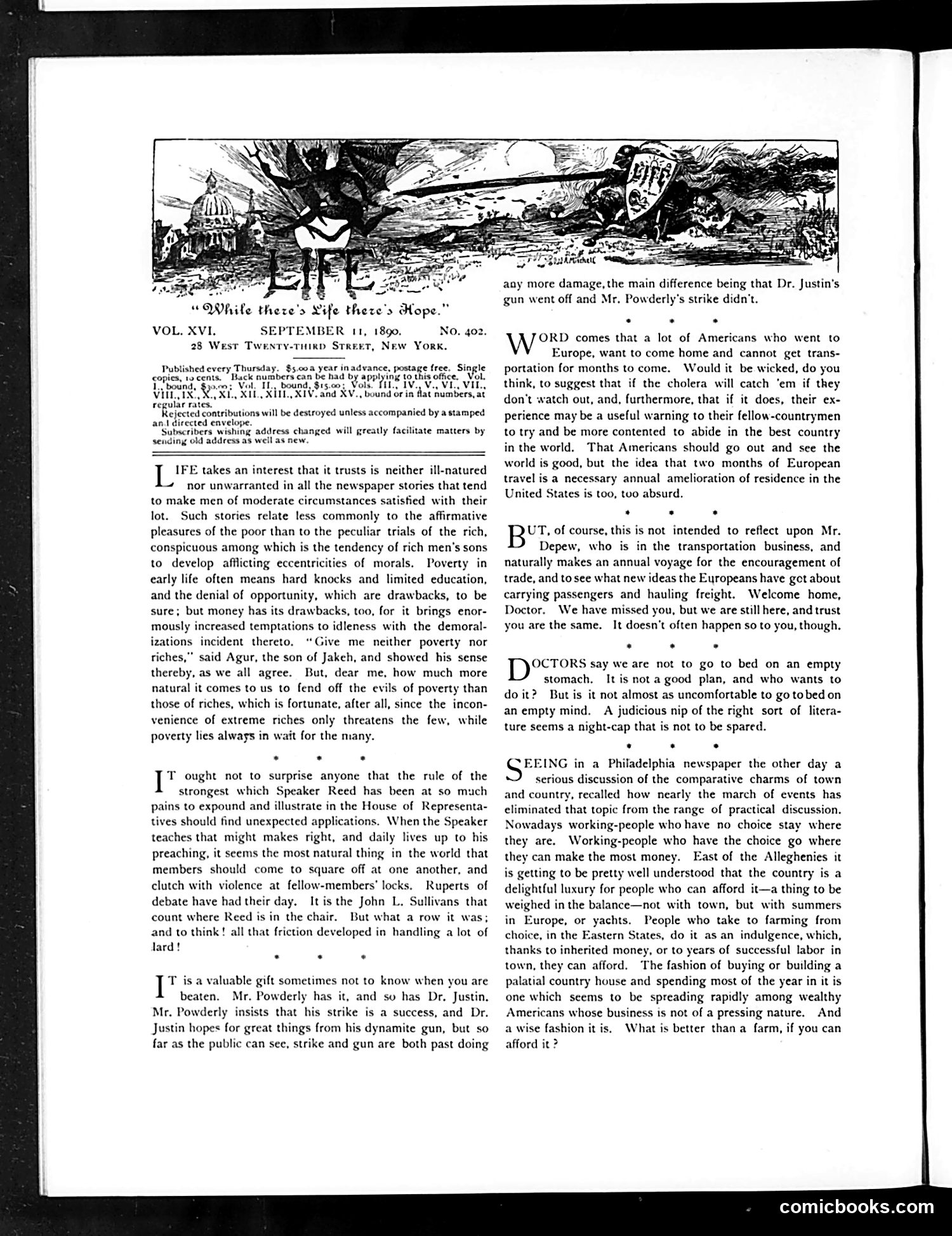
The masthead cartoon depicts a chaotic European scene with figures engaged in conflict—likely referencing contemporary European political tensions or military conflicts of 1890. The editorial text discusses Americans traveling to Europe for extended stays, suggesting this was becoming a notable trend among wealthy Americans. The writer debates whether such extended European residence is beneficial or corrupting to American character and values. The piece references specific figures: Speaker Reed (John L. Sullivan appears mentioned in political context), Dr. Justin, Mr. Powderly, and Mr. Depew—all apparently involved in contemporary debates about labor, transportation, or trade. The satire critiques wealthy Americans adopting European leisured lifestyles while ordinary working Americans lack such luxuries, questioning the social and moral implications of this class divide.
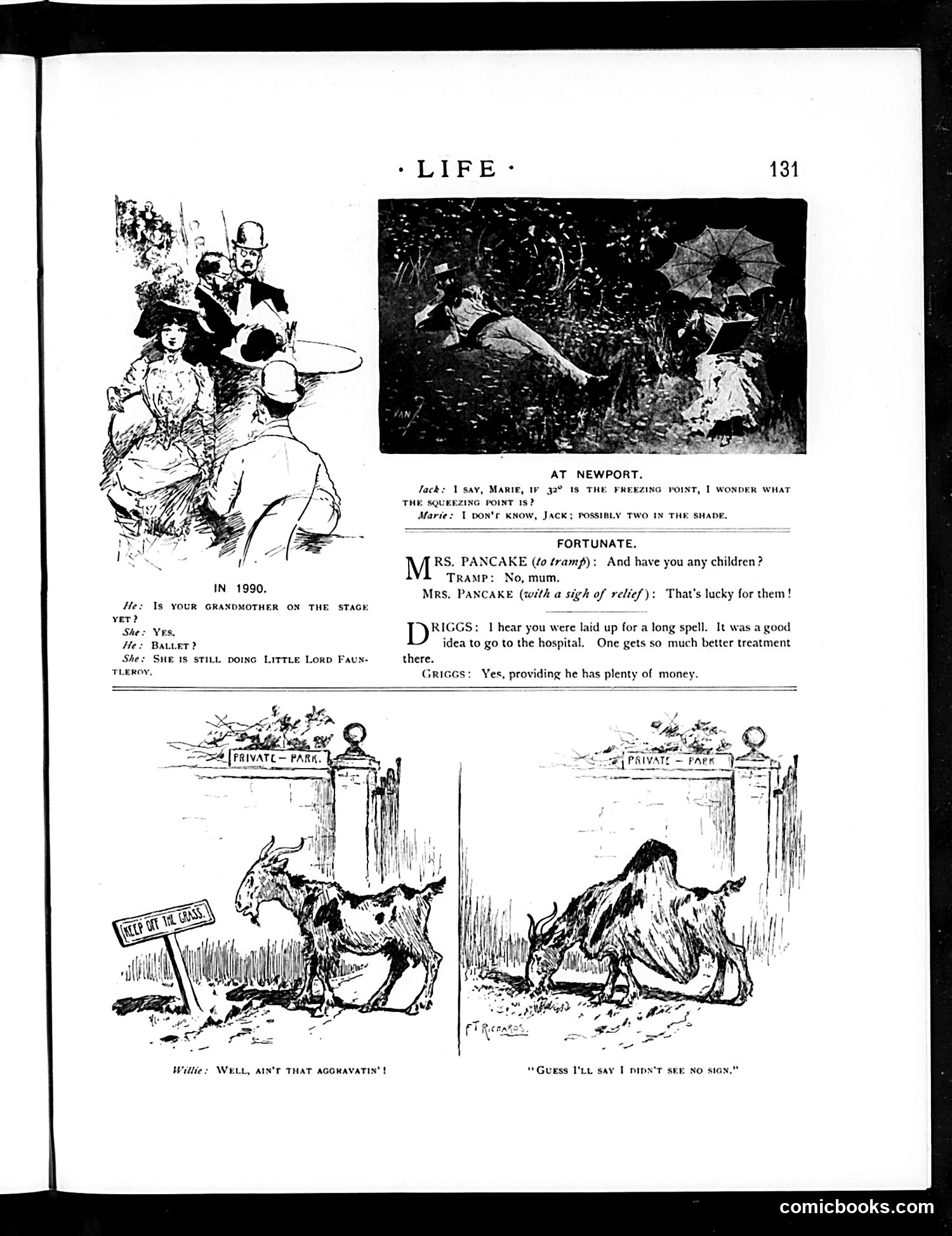
This page contains three distinct satirical items: **"In 1890"** (top left): A sketch-based joke about stage grandmothers, playing on the theatrical trope of elderly female characters in performances. **"At Newport"** (top right): A photograph with dialogue about determining social status at Newport, Rhode Island—then America's most exclusive seaside resort. The joke concerns identifying which person has money (the "freezing point"). **"Fortunate"** (middle): A dialogue where Mrs. Pancake expresses relief that an ill tramp has no children, and Griggs notes hospitals provide better treatment if one has money—satirizing class-based healthcare disparities. **Bottom cartoons**: Two goat illustrations titled "Keep off the Grass" show a goat violating park rules, with captions playing on the animal's stubbornness and inability to read signs. The page satirizes class distinctions, wealth-based privilege, and social hypocrisy typical of 1890s-era American Life magazine content.
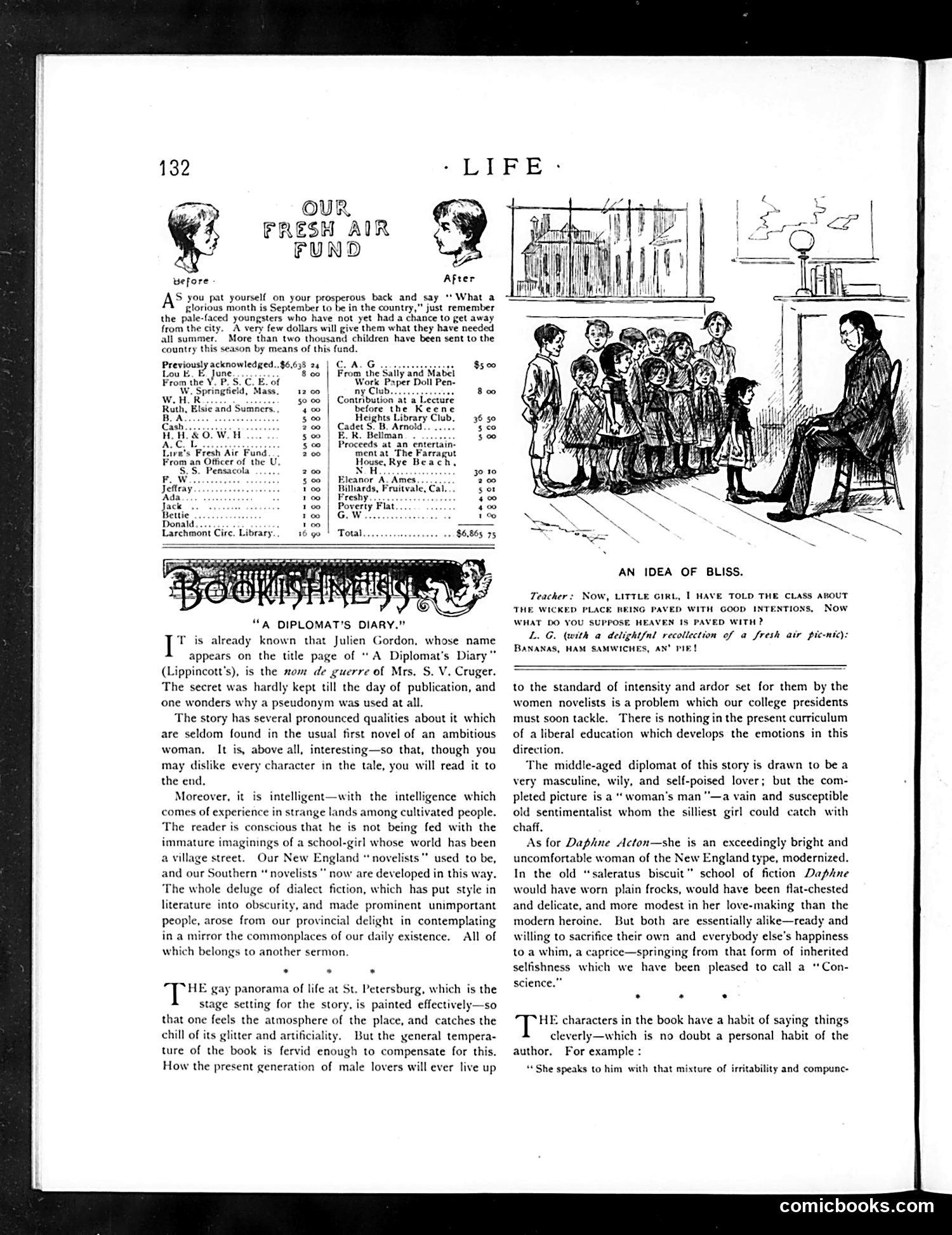
This page contains book reviews and a charitable appeal rather than political cartoons. The main content includes: **"Our Fresh Air Fund"** — a fundraising appeal for sending poor urban children to the countryside for summer relief. The before/after illustration shows the physical transformation of city children after exposure to fresh air and nature. **Book reviews** discuss "A Diplomat's Diary" by Julien Gordon and works by Daphne Acton. The reviewer praises these novels' intelligence and realistic portrayal of feminine characters, though notes the somewhat dated "sentimental" quality compared to modern heroines. The satirical element appears subtle—mainly critiquing women's fiction conventions and college curricula's underdevelopment of emotional education. The cartoon emphasizes Progressive Era concerns about urban poverty and child welfare.
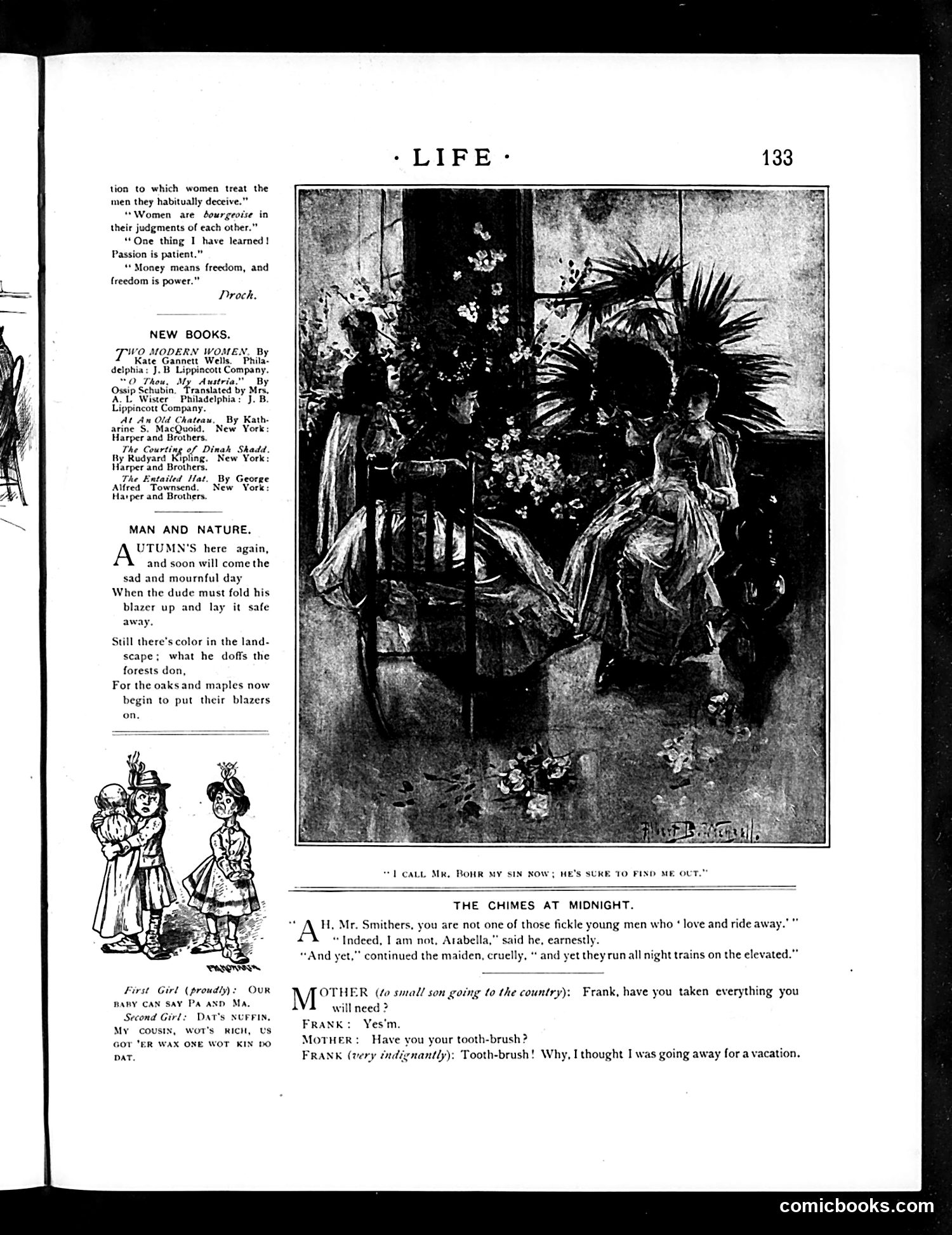
This page from *Life* magazine contains two distinct sections: **Upper left**: Book reviews and quotations about women's nature and passion, reflecting early 20th-century literary discourse. **Main illustration**: "The Chimes at Midnight" depicts a domestic scene with women in a conservatory or sitting room with plants. The caption reads, "I call Mr. Bohr my sin now; he's sure to find me out," suggesting romantic intrigue or social scandal—likely satirizing upper-class courtship rituals and the constraint women faced in proper society. **Lower section**: A humorous domestic dialogue between a mother and son "Frank" about vacation preparations, where she insists he pack a toothbrush. This satirizes the friction between maternal concern and youthful impatience—a timeless family comedy. The page targets genteel society's social conventions and family dynamics through gentle satire rather than sharp political commentary.
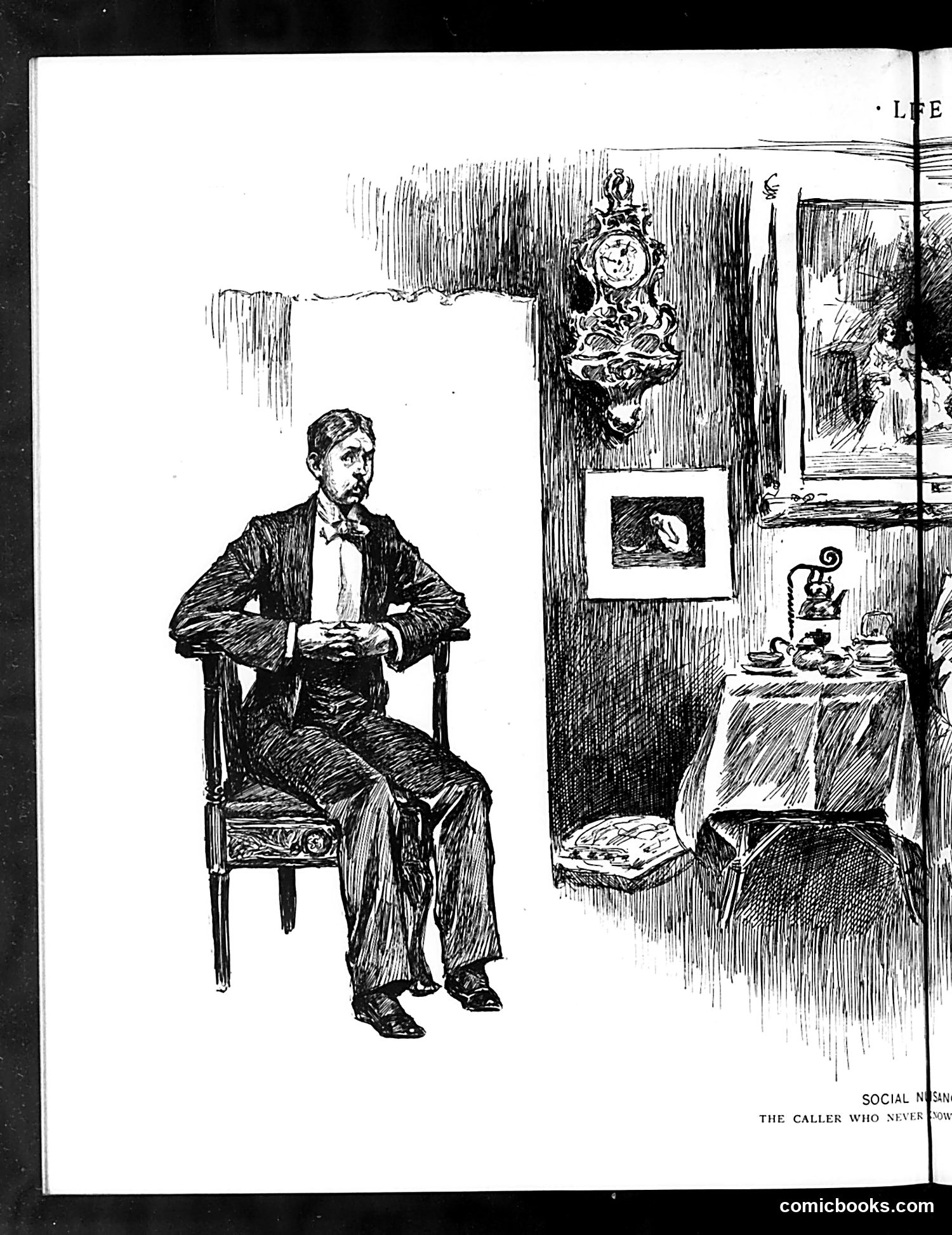
This appears to be a satirical illustration from *Life* magazine depicting a social situation. The image shows a well-dressed man in formal attire (suit and bow tie) sitting in an elegant parlor, looking somewhat anxious or expectant. The room contains period furnishings including a decorative wall clock, framed artwork, a small table with tea service, and fine upholstery. The incomplete caption "THE CALLER WHO NEVER..." suggests this is part of a series satirizing social etiquette or dating customs. The gentleman's formal dress and the refined domestic setting suggest commentary on Victorian or Edwardian social calls—likely mocking either men who fail to make proper romantic advances, or those perpetually waiting to receive visitors who never arrive. The satire targets social awkwardness or romantic hesitation among the genteel classes.
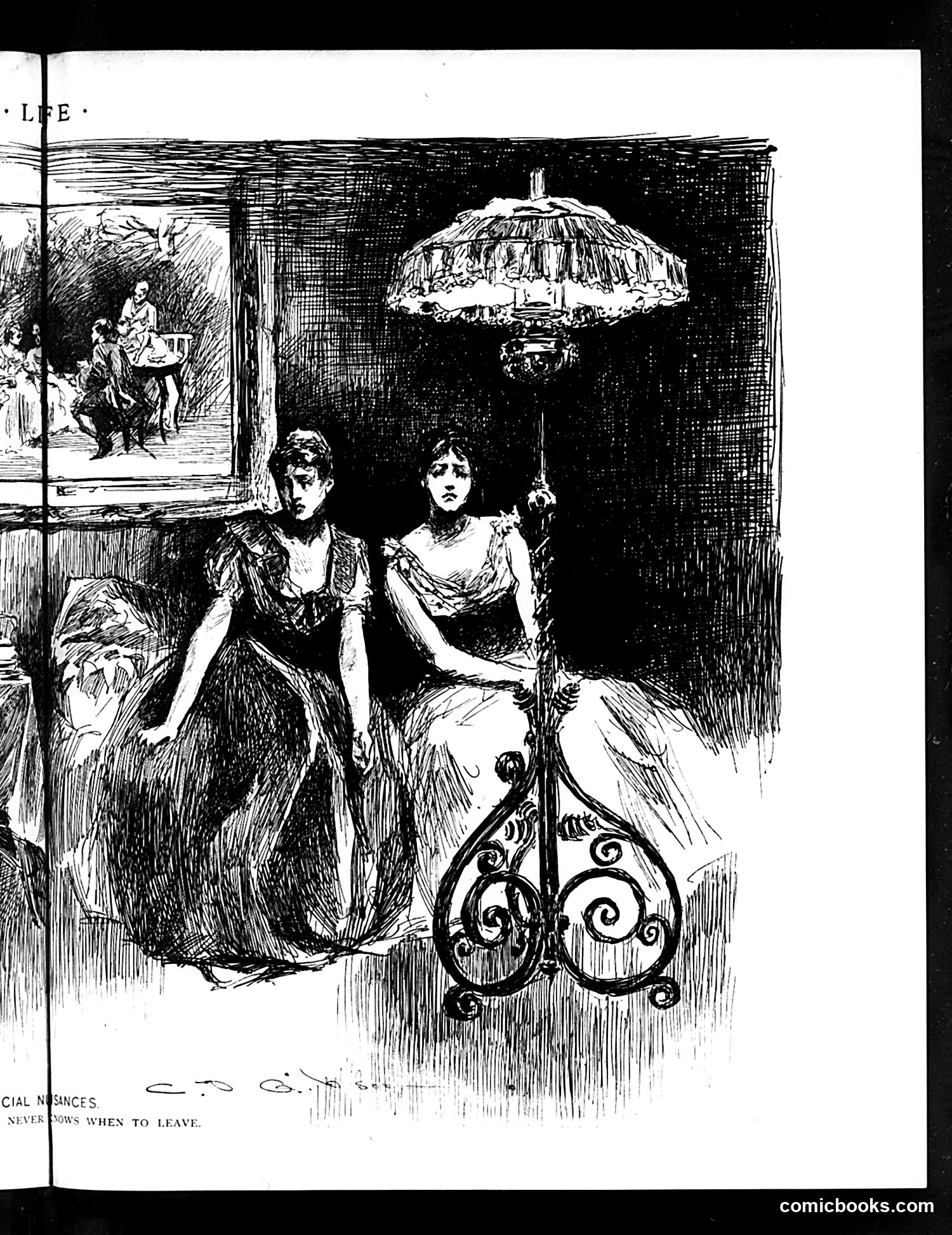
This appears to be a satirical illustration about social etiquette, specifically regarding when guests should leave social gatherings. The visible text fragment reads "SOCIAL NUANCES: NEVER KNOW WHEN TO LEAVE." The cartoon depicts two women in evening dress at what appears to be an indoor social event, with an ornate standing lamp between them. One woman holds a decorative parasol. In the background, a third figure can be seen, suggesting an ongoing party or gathering. The satire targets the social awkwardness of overstaying one's welcome at formal events—a relatable problem for upper-class society. The women's expressions suggest tension or discomfort, implying the humor lies in the difficulty of gracefully ending social visits according to Victorian-era etiquette standards. The "nuances" referenced are the unspoken social rules about appropriate departure timing.
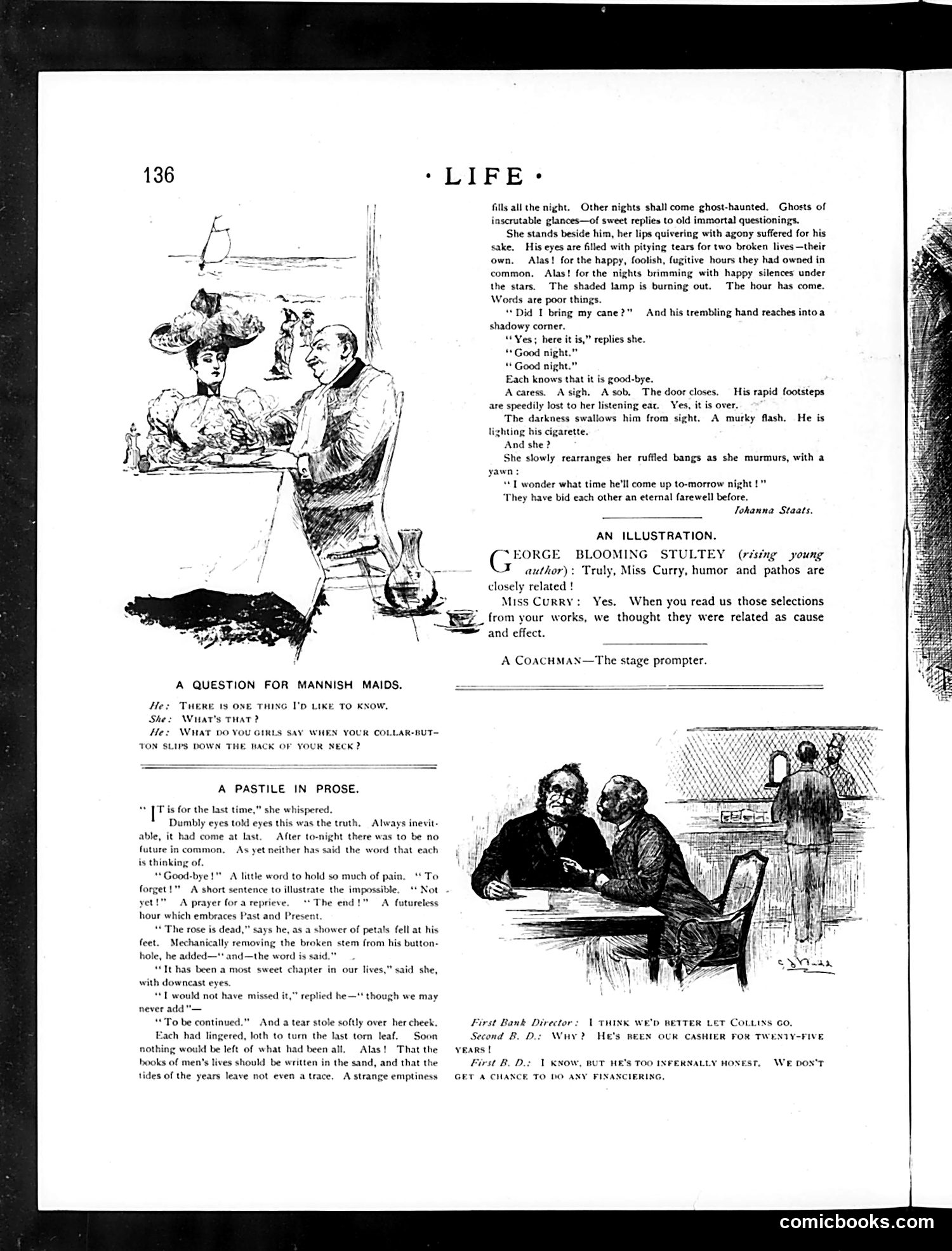
This page contains three separate satirical pieces: 1. **"A Question for Mannish Maids"** - A brief dialogue joke about women's fashion, specifically collar buttons on the back of necks—mocking what appears to be an unflattering or impractical women's fashion trend. 2. **"A Pastile in Prose"** - A sentimental short story about a couple's final goodbye, using flowery language to describe the bittersweet nature of endings and forgotten memories. 3. **"An Illustration"** (bottom right) - Features two men at a desk interviewing a woman, with dialogue about a bank director and a cashier named Collins. The joke appears to mock workplace incompetence or financial mismanagement, though the specific reference is unclear without additional context. The page demonstrates Life's mix of fashion satire, romantic sentiment, and workplace humor typical of early 20th-century American periodicals.
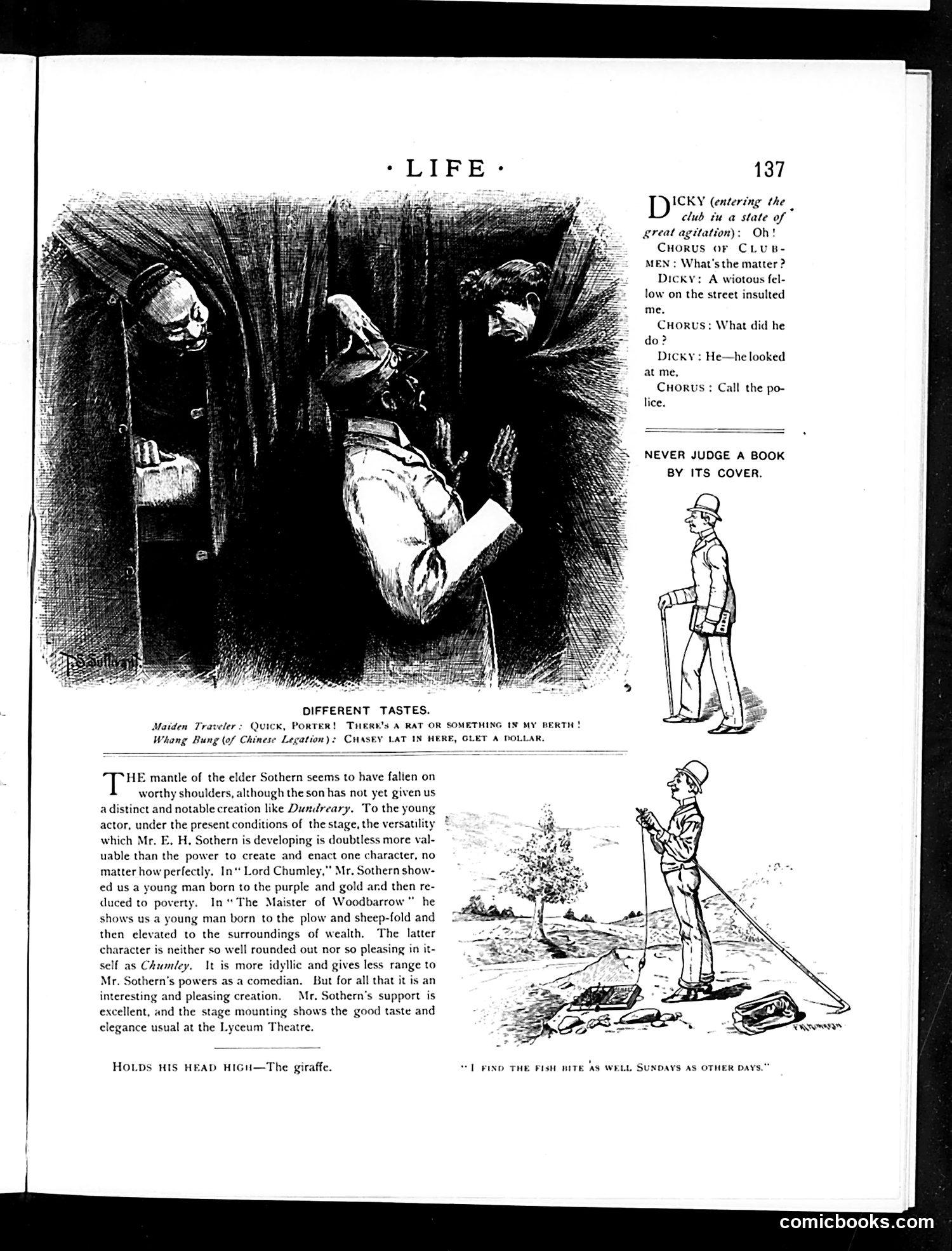
The main cartoon depicts a street confrontation between a well-dressed man ("Maiden Traveller") and what appears to be a working-class character ("Quick, Torter!"). The dialogue suggests the traveler has insulted the working man, who threatens violence in response. The accompanying text discusses E.H. Sothern, a prominent actor of the era, praising his range in dramatic roles—from tragic characters like King John to comedic ones like Chumley. The page includes multiple illustrations of well-dressed gentlemen and a fisherman, reinforcing themes about social class distinctions and different "tastes." The satire appears to mock class conflict and differing social standards between the educated elite and working people.
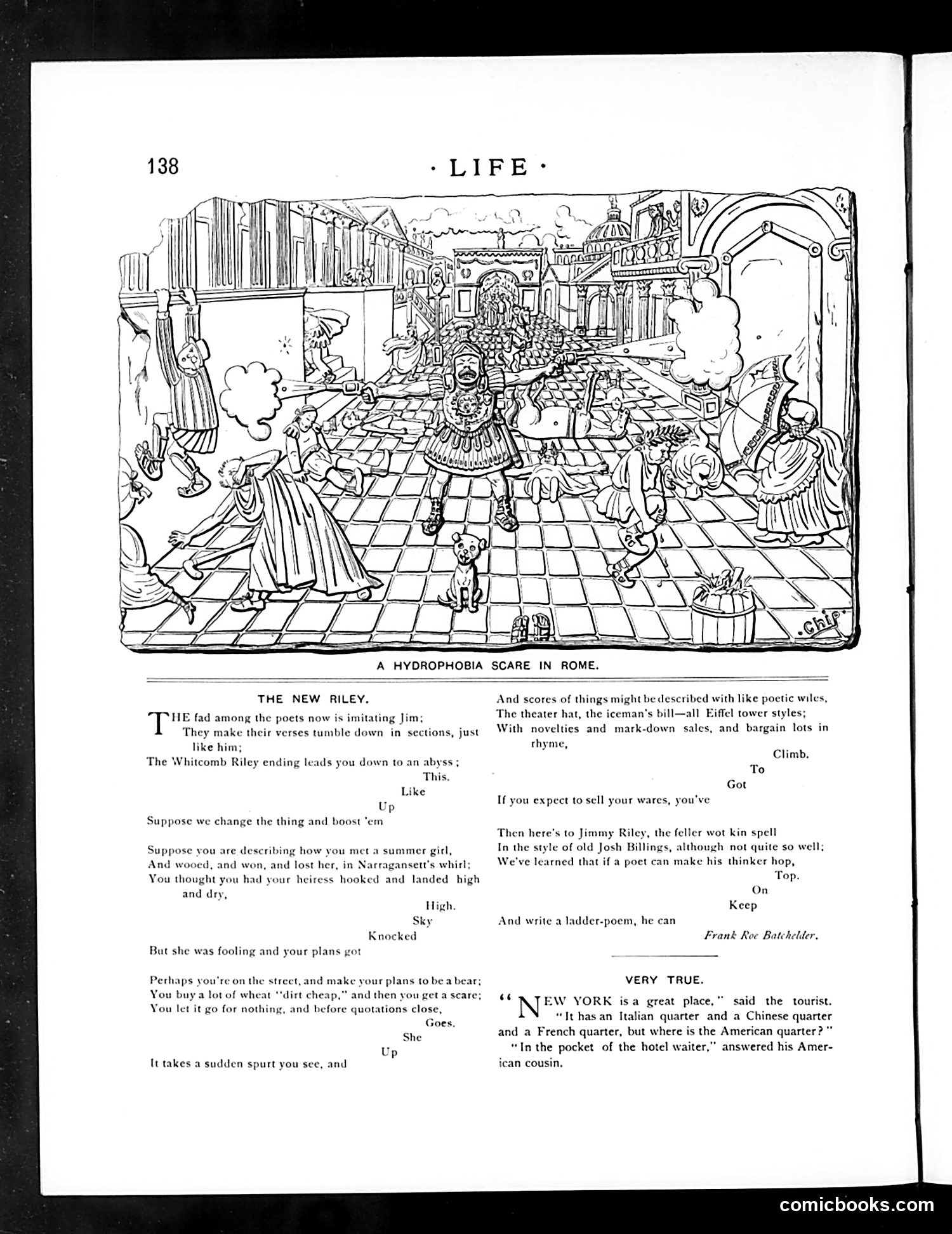
**Main Cartoon:** "A Hydrophobia Scare in Rome" depicts a chaotic street scene with people fleeing in panic—likely responding to a rabid dog or similar threat. The elaborate architectural setting and crowded composition satirize how trivial or exaggerated fears can cause mass hysteria in urban centers. **"The New Riley":** This poem parodies James Whitcomb Riley, a popular contemporary poet known for his folksy, colloquial style and distinctive line-break technique (the "ladder-poem" structure visible here). The satire mocks how Riley's style—while charming—had become a fad among imitators, who mechanically apply his whimsical approach to mundane topics (wheat speculation, theater hats, bargains) that don't warrant poetic treatment. **"Very True":** A brief joke about New York's ethnic neighborhoods and immigrant hotel workers, suggesting that despite the city's diverse quarters, profit extraction by service workers represents the true "American" element. The page satirizes both literary pretension and urban social dynamics of early 20th-century America.
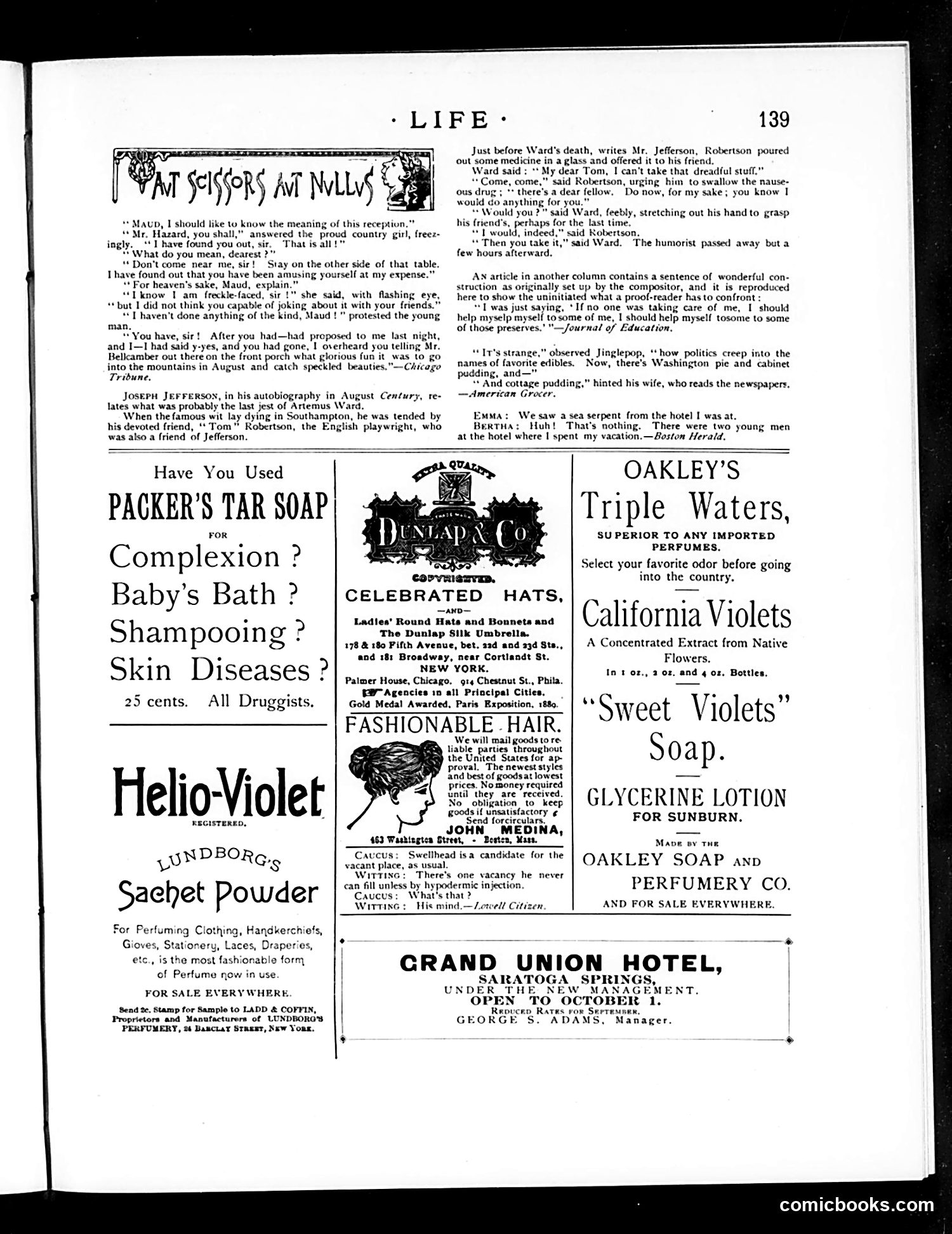
This page primarily contains **fiction and advertising** with minimal visual satire. The main textual content includes a short story about a misunderstanding: a country girl named Maud overhears her fiancé, Mr. Hazard, joking with a friend about catching "speckled beauties" in the mountains—which she mistakenly believes is mockery about her freckles. The humor lies in this miscommunication. There's also an anecdote about humorist Artemus Ward's deathbed, where his friend Robertson offers him medicine, and Ward turns it back on him with the line "Then you take it." A brief joke contrasts sea serpent sightings with attractive young men at hotels. The remainder of the page is **period advertising** for beauty and grooming products (Packer's Tar Soap, Helio-Violet powder, Dunlap hats, Oakley's perfumes) and a hotel notice—typical of Life magazine's revenue model. There is **no significant political or social satire** on this particular page.
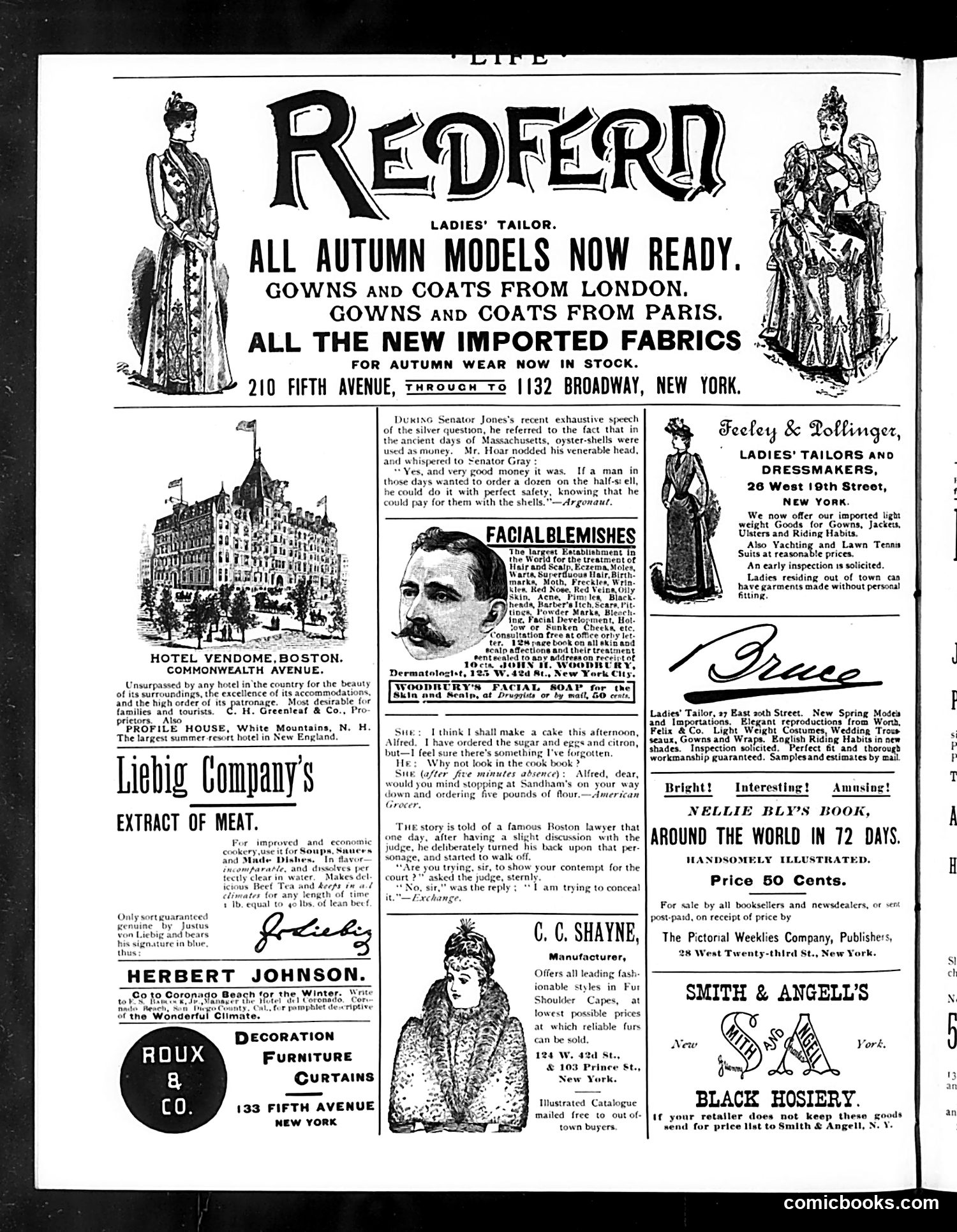
This is primarily an **advertising page** from Life magazine, not a satirical cartoon page. The dominant content consists of commercial advertisements for clothing tailors, hotels, meat extract, furniture, and other goods typical of the 1890s. However, the page includes **three brief satirical anecdotes** (short jokes): 1. A senator's pun about oyster shells as currency in Massachusetts 2. A wife's forgetfulness requiring a cookbook to remember flour 3. A Boston lawyer's deadpan response when accused of showing contempt for court These are mild humor pieces, not political satire. They rely on wordplay and situational comedy rather than commentary on contemporary events. The only notable non-advertising item is a **small advertisement for "Nellie Bly's Book: Around the World in 72 Days,"** referencing the famous journalist's 1889-1890 circumnavigation race. This represents a significant cultural moment but appears here simply as a book announcement, not satirical content.
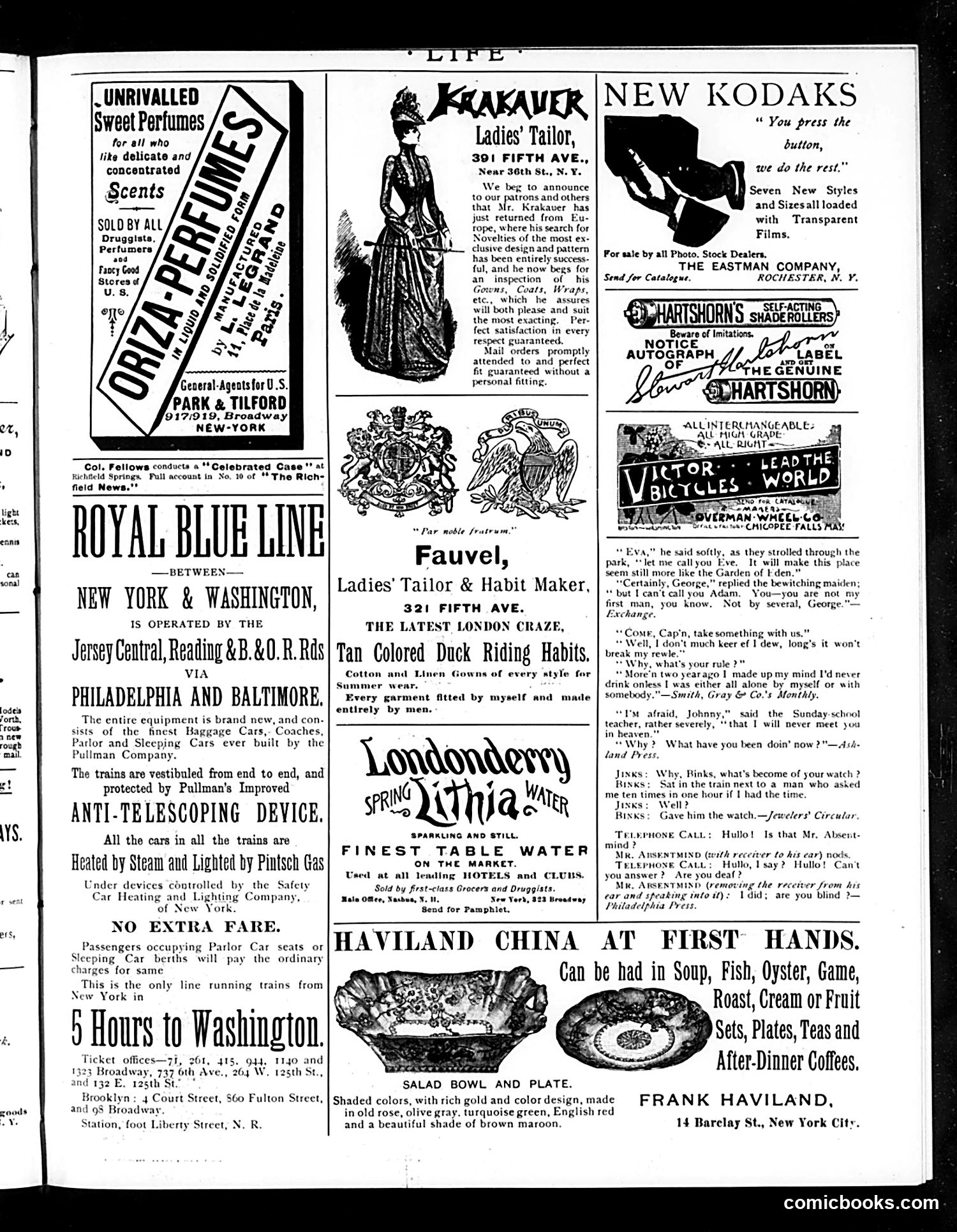
This page is primarily **advertisements** from the early 1900s, with scattered brief comedic anecdotes rather than political cartoons. The ads showcase period consumer goods: perfumes, tailoring services, Kodak cameras (with the famous slogan "You press the button, we do the rest"), bicycles, train service between New York and Washington, china dinnerware, and bottled spring water. The small comic exchanges are domestic humor typical of the era—flirtation jokes ("Adam" reference to a woman's dating history), humor about drinking rules, a Sunday-school child's misbehavior, and a pun about someone giving away their watch to an annoying man on a train. There is **no clear political satire** visible. The page reflects consumer culture and social conventions of the Edwardian period rather than commenting on politics or events. The humor is lighthearted and personal rather than satirical.
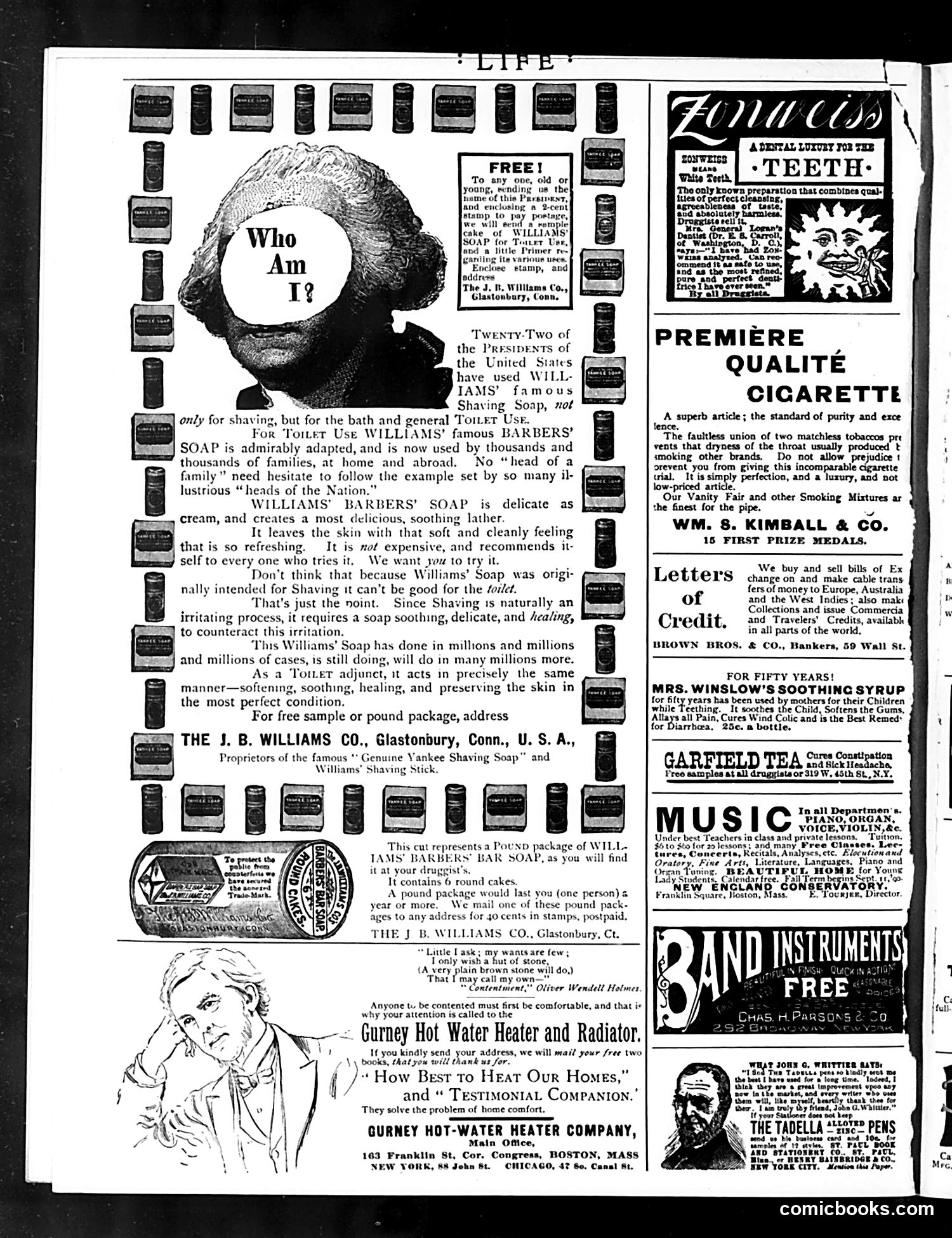
This is primarily an **advertising page** from *Life* magazine, not a political cartoon. The dominant feature is a large advertisement for **Williams' Barbers' Soap**, which ironically asks "Who Am I?" while prominently displaying the product and manufacturer's name—the joke being that despite the mystery framing, the identity is immediately obvious. The advertisement claims that 22 U.S. Presidents have used Williams' soap, appealing to social status and authority. It emphasizes that though originally designed for shaving, the soap is "soothing, delicate, and healing"—suitable for general toilet use. The remainder of the page contains **unrelated period advertisements**: a Gurney hot water heater, Premiere Qualité cigarettes, Brown Bros. banking services, Mrs. Winslow's Soothing Syrup for teething children, and other products. There is no coherent satirical content—this is a commercial product-driven page typical of *Life's* revenue model.
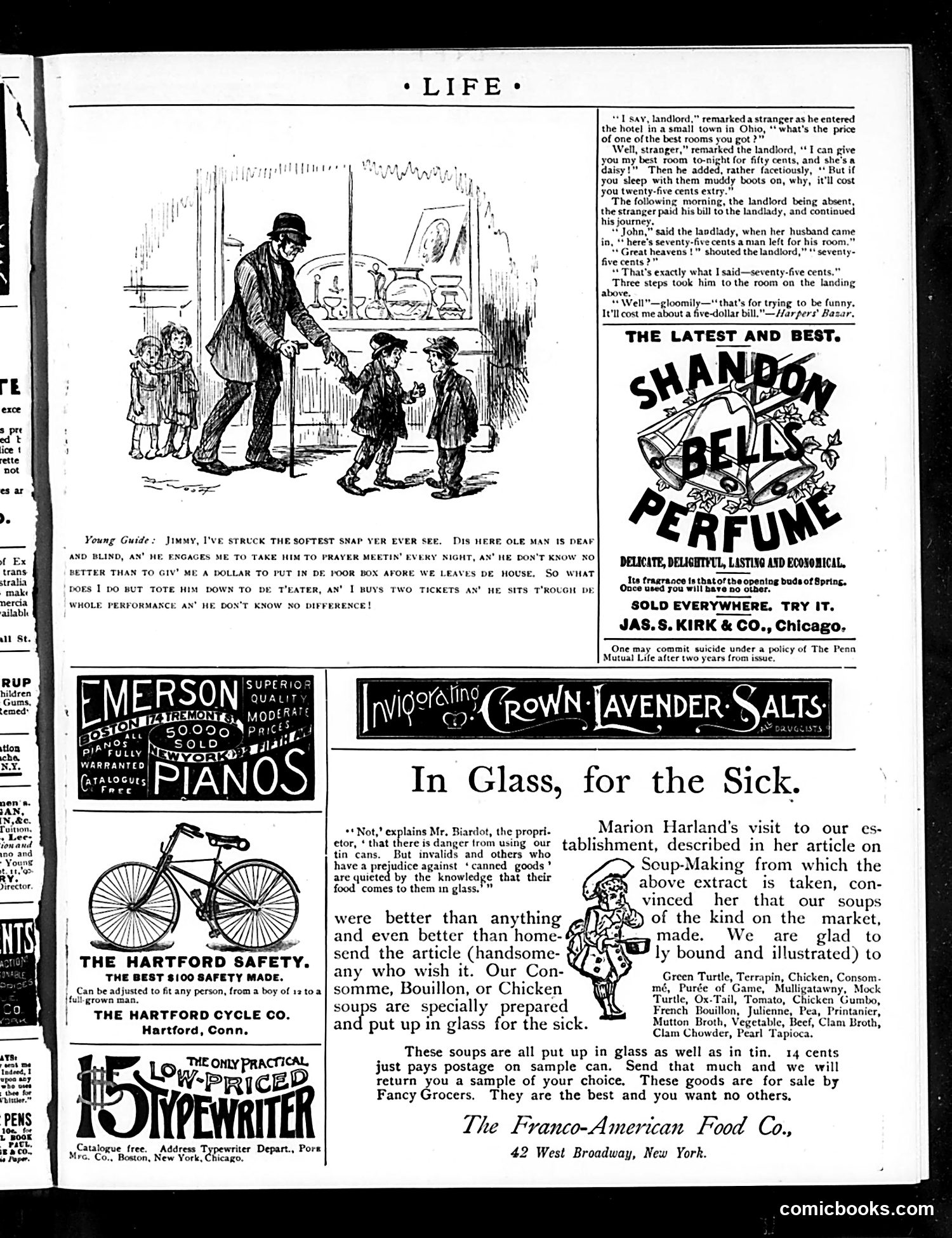
This page contains **two distinct cartoons** separated by advertisements. **Top cartoon**: A dishonest hotel proprietor scheme. A stranger pays 75 cents for a room, and the landlord jokes about charging extra if he sleeps in muddy boots. The next morning, the landlady collects 75 cents total—she didn't realize the landlord was joking. When he discovers this, he's furious because he lost a five-dollar profit, having charged far below his usual rate as a "funny" jab at the guest. The satire mocks small-town innkeeper greed and bad humor backfiring. **Middle cartoon**: A street urchin's con. A young guide exploits a blind, deaf elderly man by claiming to escort him to prayer meetings, then takes him to the theater instead, pocketing the dollar meant for the poor box. The man never knows the difference. This satirizes both child criminality and the exploitation of vulnerable elderly people. Both cartoons reflect Progressive Era concerns about urban poverty, petty crime, and moral corruption among working classes.
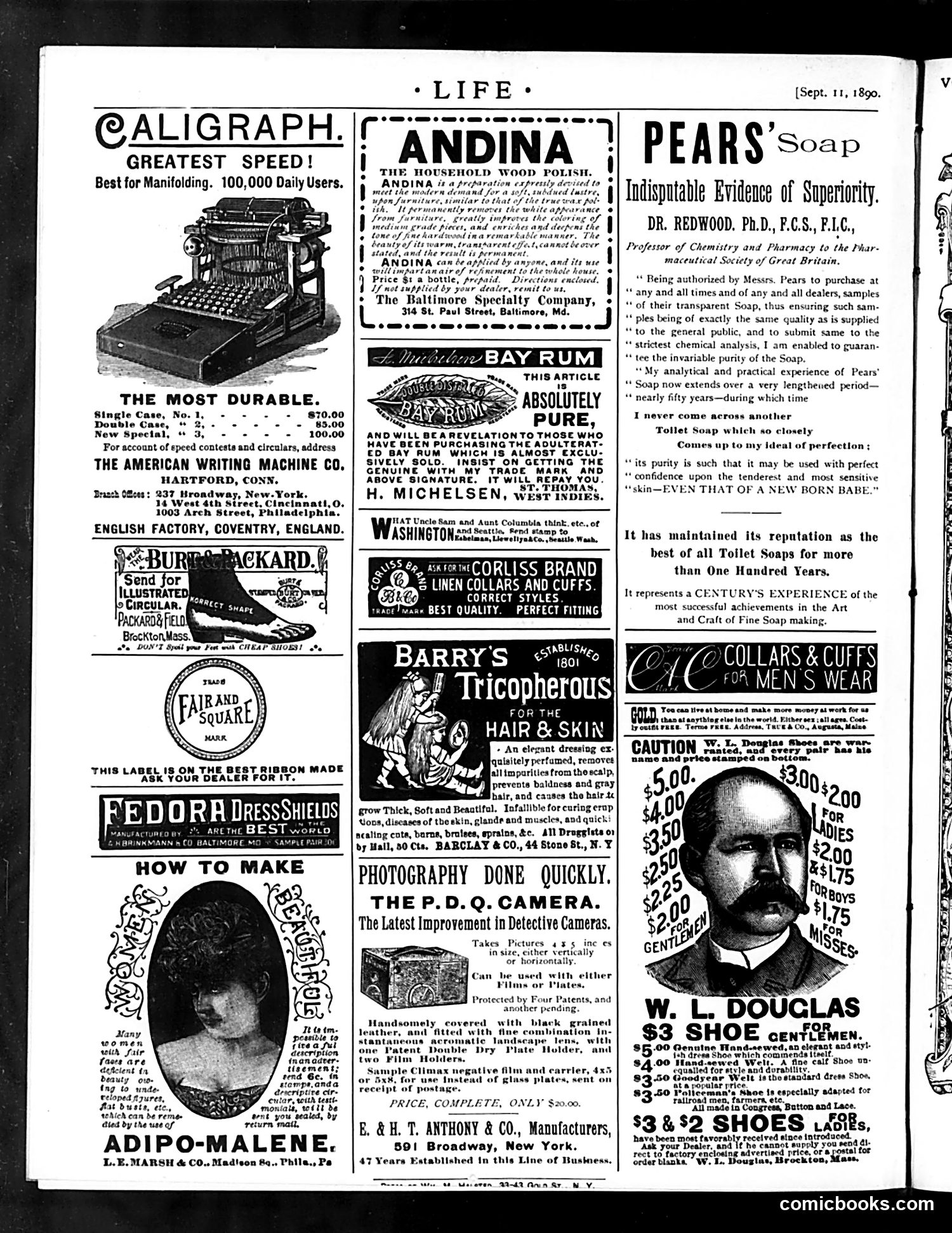
This is primarily a **advertisements page** from Life magazine (September 11, 1890), containing no political cartoons or satire requiring historical context. The page features mostly commercial ads for period products: typewriters (Caligraph), furniture polish (Andina), soap (Pears'), hair treatment (Barry's Tricopherous), photography equipment (P.D.Q. Camera), and clothing (collars, cuffs, shoes). One notable ad uses a large photograph of a **bearded man** (W.L. Douglas) advertising shoes—typical product endorsement of the era using a respectable male figure's image. There is a small illustrated ad for "Adipo-Malene" showing a woman's face, promoting beauty enhancement for women with "underdeveloped figures"—reflecting period beauty standards and cosmetic marketing practices. The ads collectively illustrate **1890s consumer culture and commercial messaging**, with emphasis on quality claims and scientific endorsements (note Pears' soap citing a pharmaceutical society professor), rather than satire or political commentary.