
Life, 1890-09-11 · page 4 of 18
Life — September 11, 1890 — page 4: what you’re looking at
What you’re looking at
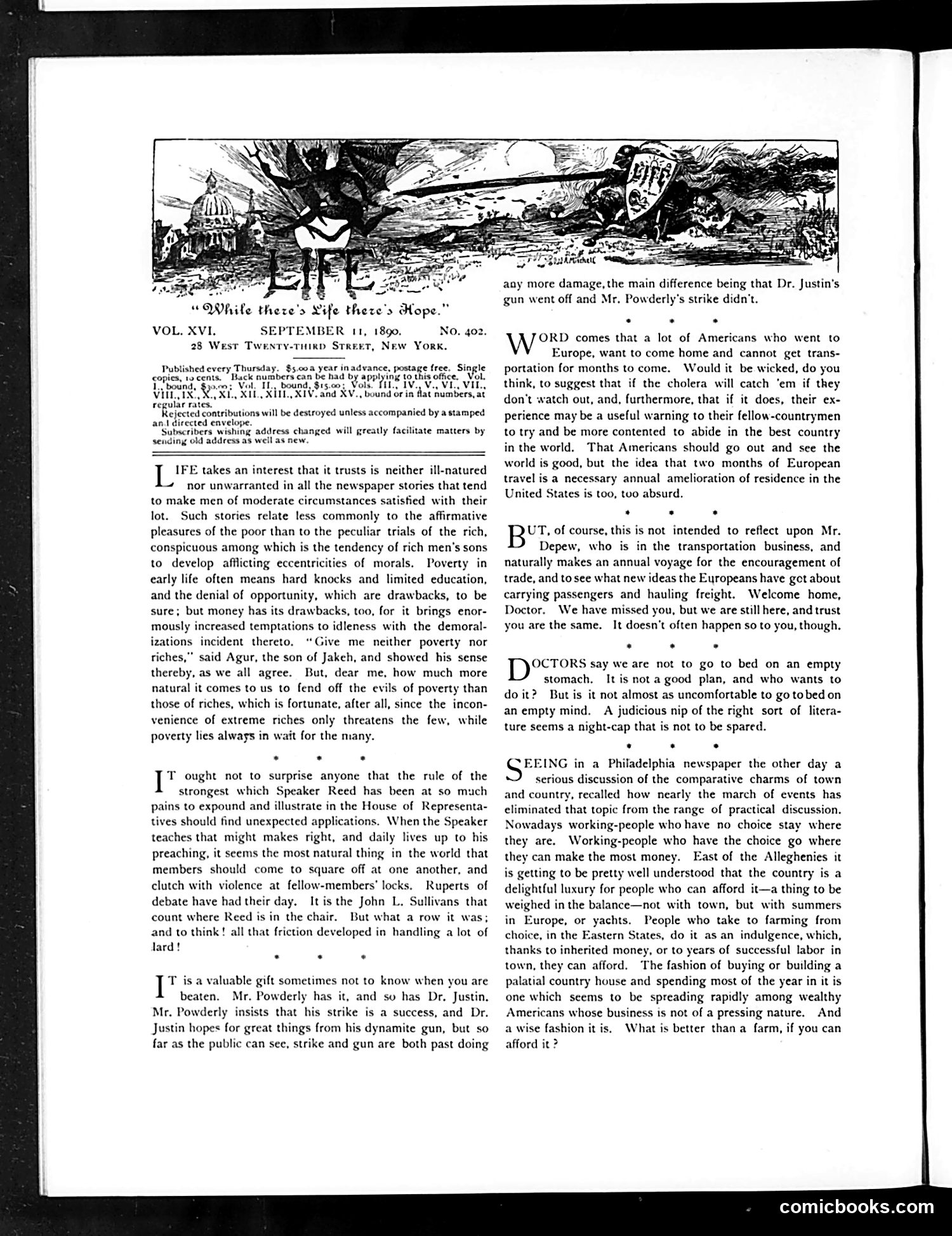
The masthead cartoon depicts a chaotic European scene with figures engaged in conflict—likely referencing contemporary European political tensions or military conflicts of 1890. The editorial text discusses Americans traveling to Europe for extended stays, suggesting this was becoming a notable trend among wealthy Americans. The writer debates whether such extended European residence is beneficial or corrupting to American character and values. The piece references specific figures: Speaker Reed (John L. Sullivan appears mentioned in political context), Dr. Justin, Mr. Powderly, and Mr. Depew—all apparently involved in contemporary debates about labor, transportation, or trade. The satire critiques wealthy Americans adopting European leisured lifestyles while ordinary working Americans lack such luxuries, questioning the social and moral implications of this class divide.
📄 Transcribed text from this page (OCR, searchable)
Machine-transcribed from the original scan — historical spelling and the odd misread are preserved.
e's Hope.” VOL. XVI. SEPTEMBER 11, 1890. No. 402. 28 West Twenty-rHikp Street, New York. Published every Thursday. $5,008 year in advance, postage {ree. Single copies, 1ocents. Buck numbers can be had by applying to this office. Vol. 1, bound, $50. ol. IL, bound, $15.00; Vols. fil., 1V., V., VI. VIL, VEIL IX!, XX, XUL, XHTML, XIV. and XV., bound or in fat humbers, at regular rates. . Rejected contributions will be destroyed unless accompanied by a stamped an.l directed envelope. Subscribers wishing address changed will greatly facilitate matters by sending old address a5 weil as new. IFE takes an interest that it trusts is neither ill-natured —~ nor unwarranted in all the newspaper stories that tend to make men of moderate circumstances satistied with their lot. Such stories relate less commonly to the affirmative pleasures of the poor than to the peculiar trials of the rich, conspicuous among which is the tendency of rich men’s sons to develop afflicting eccentricities of morals. Poverty in early life often means hard knocks and limited education, and the denial of opportunity, which are drawbacks, to be sure; but money has its drawbacks, too, for it brings enor- mously increased temptations to idleness with the demoral- izations incident thereto, “Give me neither poverty nor riches,” said Agur, the son of Jakeh, and showed his sense thereby, as we all agree. But, dear me, how much more natural it comes to us to fend off the evils of poverty than those of riches, which is fortunate, after all, since the incon- venience of extreme riches only threatens the few, while poverty lies always in wait for the many. . . . T ought not to surprise anyone that the rule of the strongest which Speaker Reed has been at so much pains to expound and illustrate in the House of Representa- tives should find unexpected applications. When the Speaker teaches that might makes right, and daily lives up to his preaching, it seems the most natural thing in the world that members should come to square off at one another, and clutch with violence at fellow-members’ locks. Ruperts of debate have had their day. It is the John L. Sullivans that count where Reed is in the chair. But what a row it was; and to think! all that friction developed in handling a lot of lard! . . . T’ is a valuable gift sometimes not to know when you are beaten. Mr. Powderly has it, and so has Dr. Justin, Mr. Powderly insists that his strike is a success, and Dr. Justin hopes for great things from his dynamite gun, but so far as the public can see, strike and gun are both past doing aay more damage, the main difference being that Dr. Justin's gun went off and Mr. Powderly’s strike didn’t. ORD comes that a lot of Americans who went to rope, want to come home and cannot get trans- portation for months to come. Would it be wicked, do you think, to suggest that if the cholera will catch ‘em if they don't watch out, and, furthermore, that if it does, their ex- perience may be a useful warning to their fellow-countrymen to try and be more contented to abide in the best country in the world. That Americans should go out and see the world is good, but the idea that two months of European travel is a necessary annual amelioration of residence in the United States is too, too absurd. * . . UT, of course, this is not intended to reflect upon Mr. Depew, who is in the transportation business, and naturally makes an annual voyage for the encouragement of trade, and to see what new ideas the Europeans have got about carrying passengers and hauling freight. Welcome home, Doctor. We have missed you, but we are still here, and trust you are the same. It doesn’t often happen so to you, though. . . ° OCTORS say we are not to go to bed on an empty stomach, It is not a good plan, and who wants to do it? But is it not almost as uncomfortable to go tobed on an empty mind. A judicious nip of the right sort of litera- ture seems a night-cap that is not to be spared. >EEING in a Philadelphia newspaper the other day a serious discussion of the comparative charms of town and country, recalled how nearly the march of events has eliminated that topic from the range of practical discussion. Nowadays working-people who have no choice stay where they are, Working-people who have the choice go where they can make the most money. East of the Alleghenies it is getting to be pretty well understood that the country is a delightful luxury for people who can afford it—a thing to be weighed in the balance—not with town, but with summers in Europe, or yachts. People who take to farming from choice, in the Eastern States, do it as an indulgence, which, thanks to inherited money, or to years of successful labor in town, they can afford. The fashion of buying or building a palatial country house and spending most of the year in it is one which seems to be spreading rapidly among wealthy Americans whose business is not of a pressing nature. And se fashion it is. What is better than a farm, if you can afford it? awi comicbooks.com