
A complete issue · 16 pages · 1890
Life — September 4, 1890
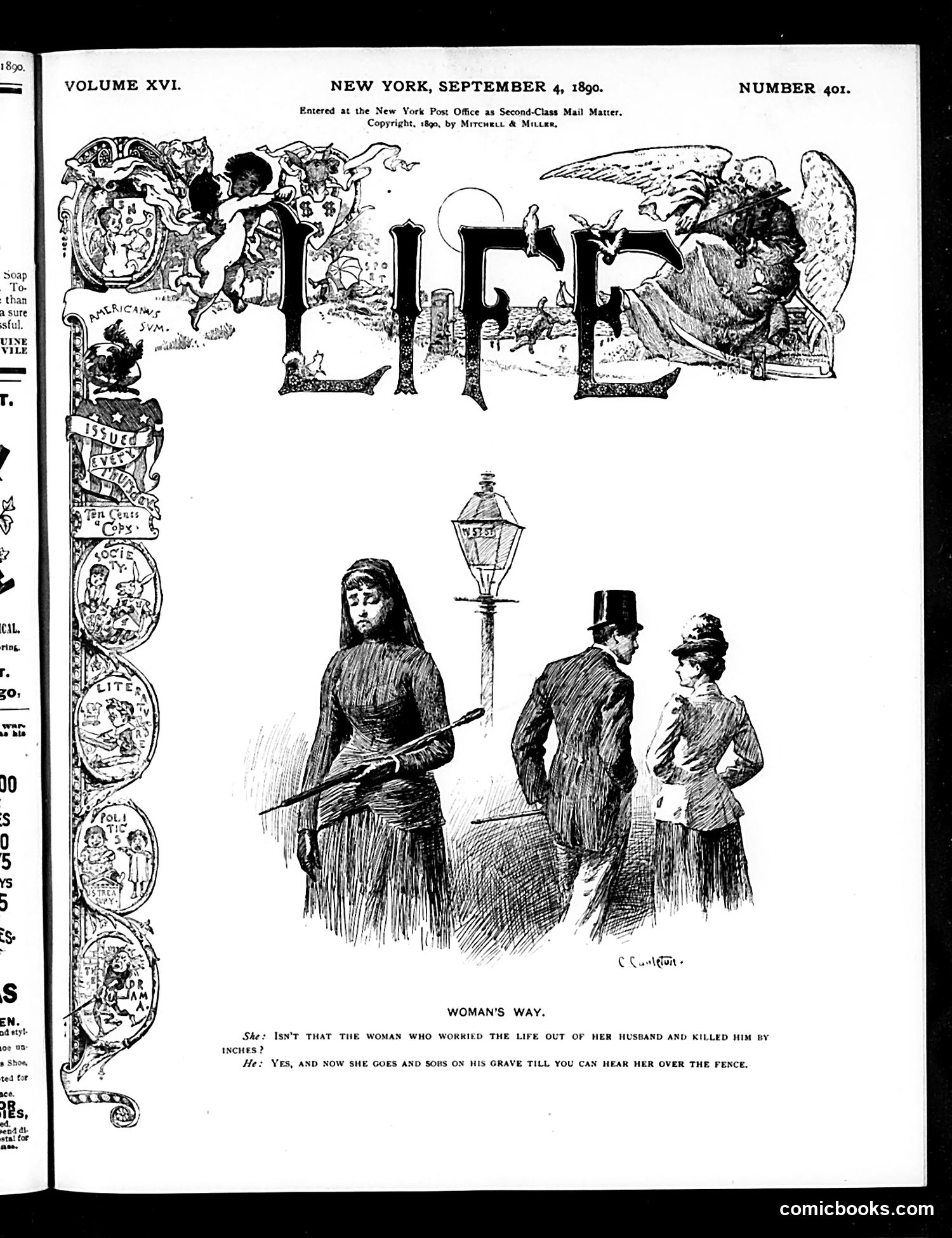
This cartoon satirizes a woman who murdered her husband through relentless nagging and emotional abuse ("worried the life out of her husband and killed him by inches"). The dark humor suggests that while she escaped legal justice for his death, social punishment follows: she must now visit his grave regularly and endure public scorn ("sobs on his grave till you can hear her over the fence"). The cartoon appears to mock both the woman's cruelty and the gossip-driven social consequences she faces. It reflects late-Victorian anxieties about female power within marriage and the period's preoccupation with women's moral failings. The gentleman and fashionable woman observing represent proper society judging her transgression.
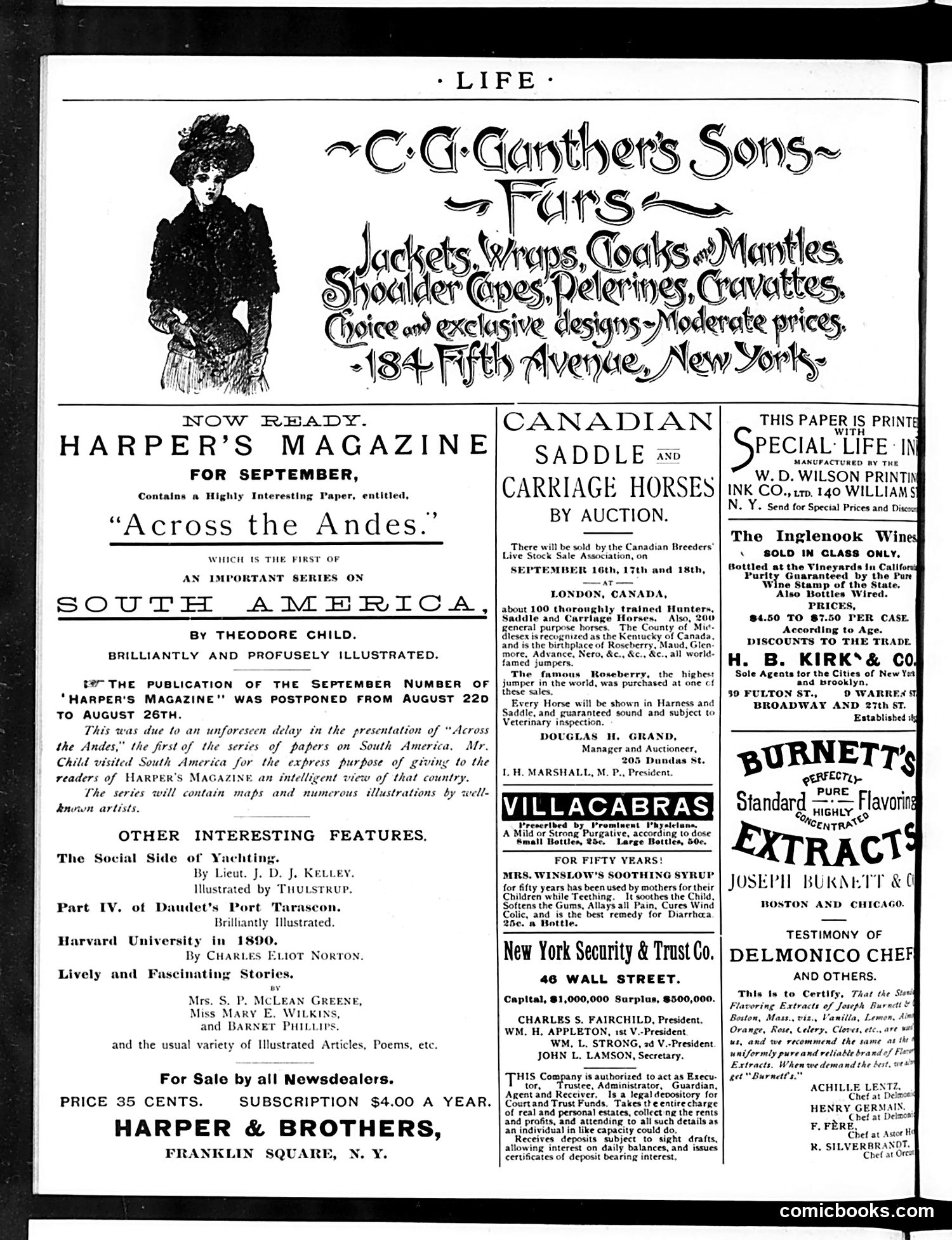
This page is primarily **advertising and announcements** rather than political satire or editorial cartoons. The content includes: 1. **C.A. Ganthers Sons** advertisement for women's furs and cloaks (top) 2. **Harper's Magazine announcement** for an upcoming September issue featuring Theodore Child's "Across the Andes" — described as the first of an illustrated South American series 3. Multiple product advertisements (Canadian horses, wine, extracts, financial services) The single illustration shows a fashionably dressed woman in period clothing, typical of magazine advertisement imagery from this era. There is **no apparent political cartoon or satire** on this page — it's a standard turn-of-the-century magazine layout mixing editorial promotion with commercial advertising.
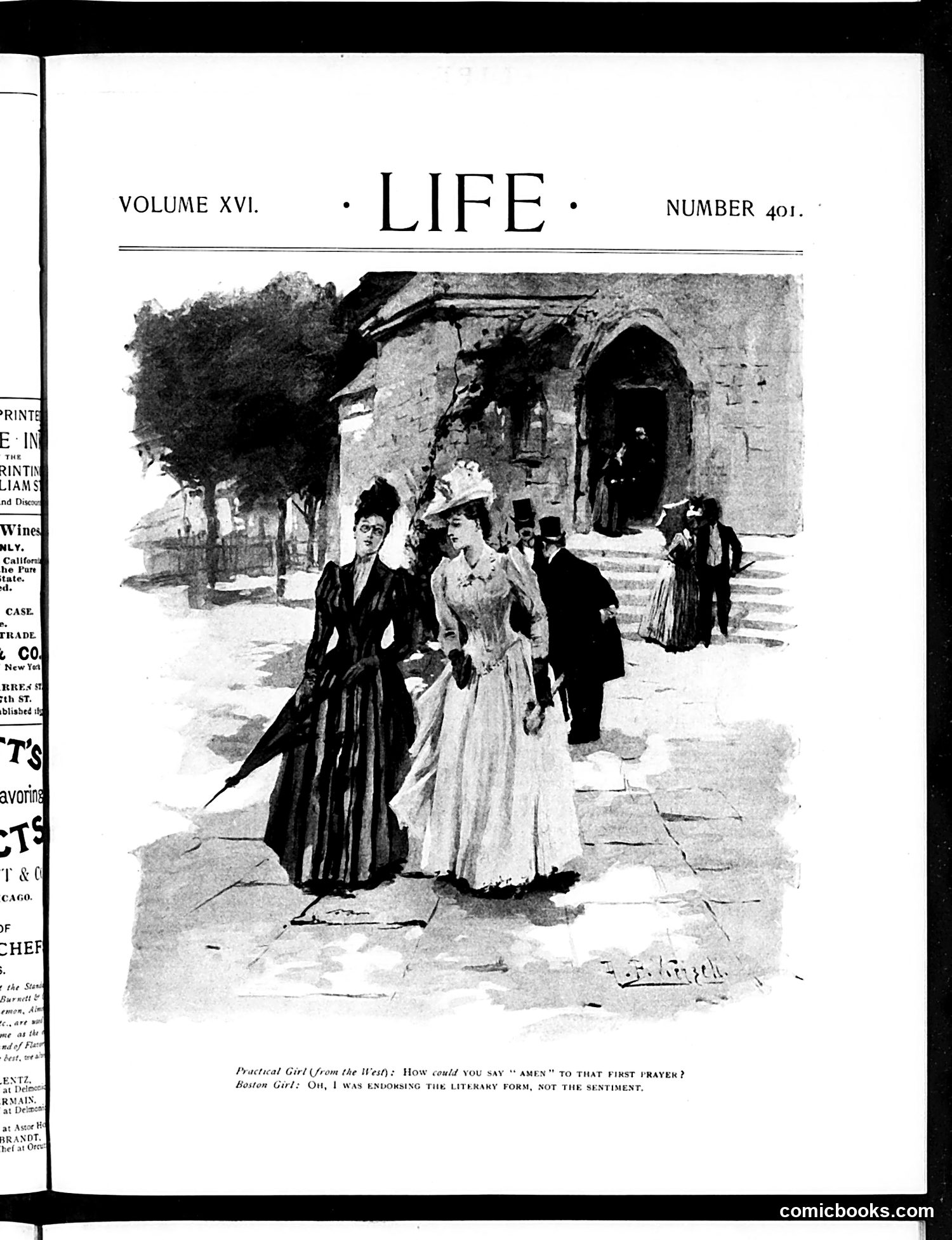
This is a humorous illustration captioned "Practical Girl (From the West)" depicting an exchange between two young women outside what appears to be a European church or historic building. The joke contrasts regional American attitudes toward literary and religious propriety. A "Boston Girl" (representing the educated East Coast establishment) corrects a "Practical Girl" (from the West) for saying "amen" to a prayer instead of using proper literary form. The Western girl's response—that she was "endorsing the literary form, not the sentiment"—satirizes the pragmatic, no-nonsense attitude stereotypically associated with Western American women versus the more formal, sentiment-driven Eastern establishment. The cartoon reflects early 1900s regional cultural tensions about how women should conduct themselves and prioritize substance over superficial propriety.
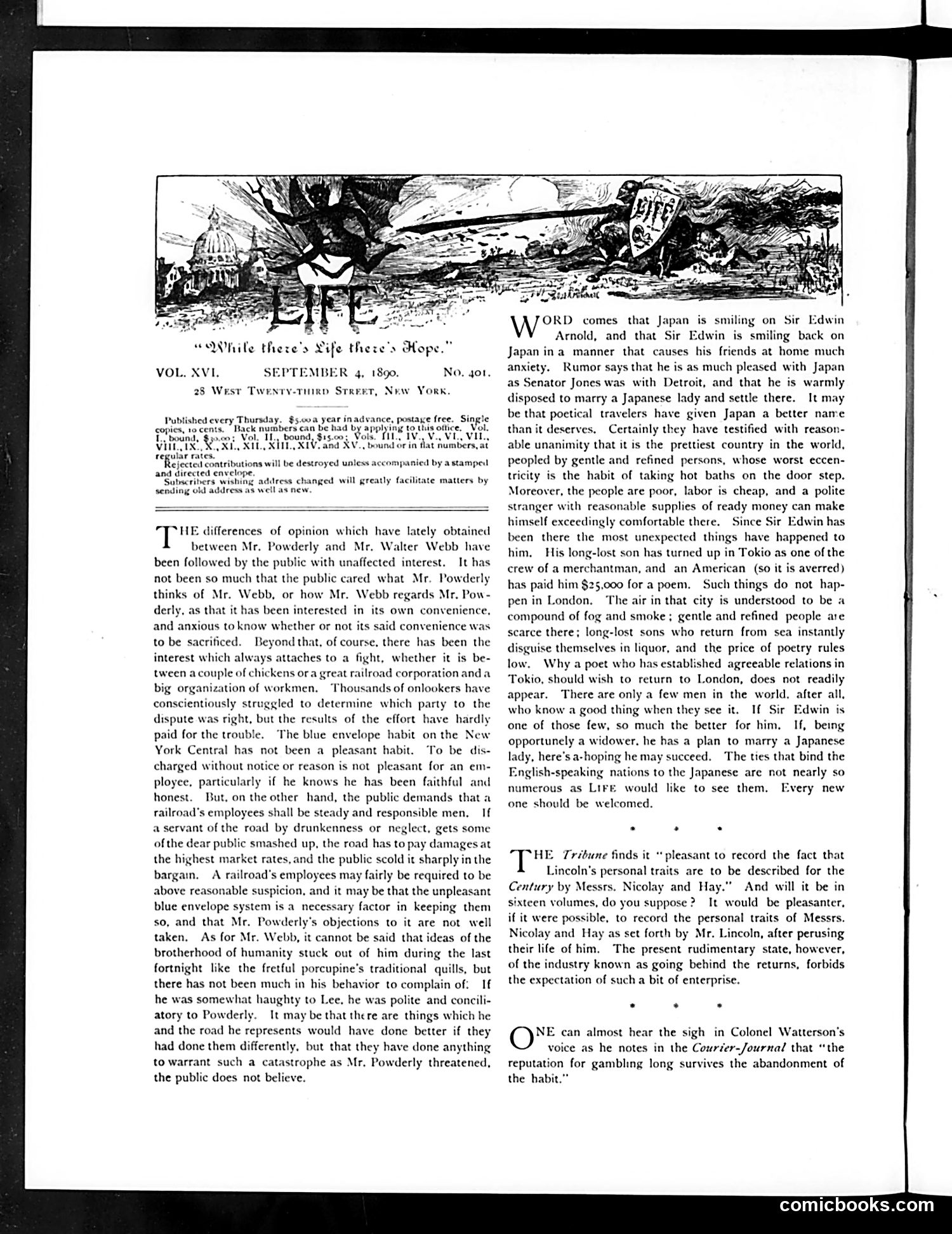
This page contains three separate editorial pieces rather than political cartoons. The header illustration depicts a landscape with classical architecture, but the main content focuses on written commentary: 1. **"While there's Life there's Hope"** - Discusses Sir Edwin Arnold's favorable views of Japan and rumors he may marry a Japanese woman and settle there. The piece praises Japan as a "prettiest country in the world" with refined people, though noting high costs and foggy climate. 2. A piece about railroad labor disputes between Mr. Powderly and Mr. Webb, debating employee conduct and corporate responsibility—apparently a contemporary labor controversy. 3. **The Tribune** comment references Lincoln's personal traits being documented by Nicolay and Hay in a forthcoming biography. The page emphasizes social commentary over visual satire.
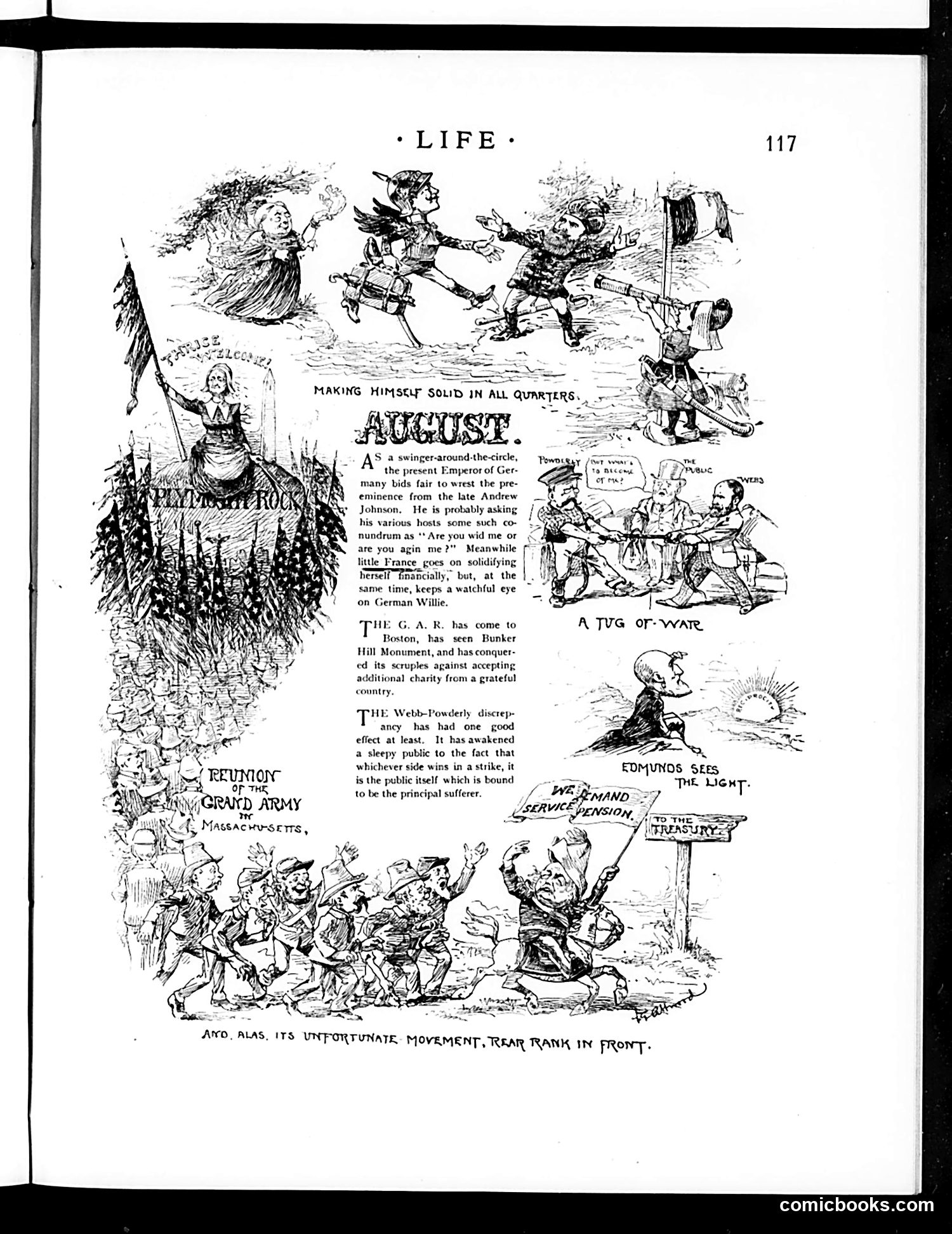
This page satirizes American politics and military affairs during what appears to be World War I era. The main cartoon titled "Making Himself Solid in All Quarters" depicts the German Emperor competing for support. "A Tug of War" shows politicians struggling over national priorities. "Edmunds Sees the Light" appears to reference a political figure gaining new perspective. The "Reunion of the Army in Massachusetts" section mocks military pension/service demands, with the final caption "And Alas, Its Unfortunate Movement, Rear Rank in Front" suggesting criticism of disorganized military management or pension administration. The satire targets competing political interests pulling the nation in different directions while military concerns take a back seat. The cartoons employ exaggerated caricature typical of early 20th-century political commentary.
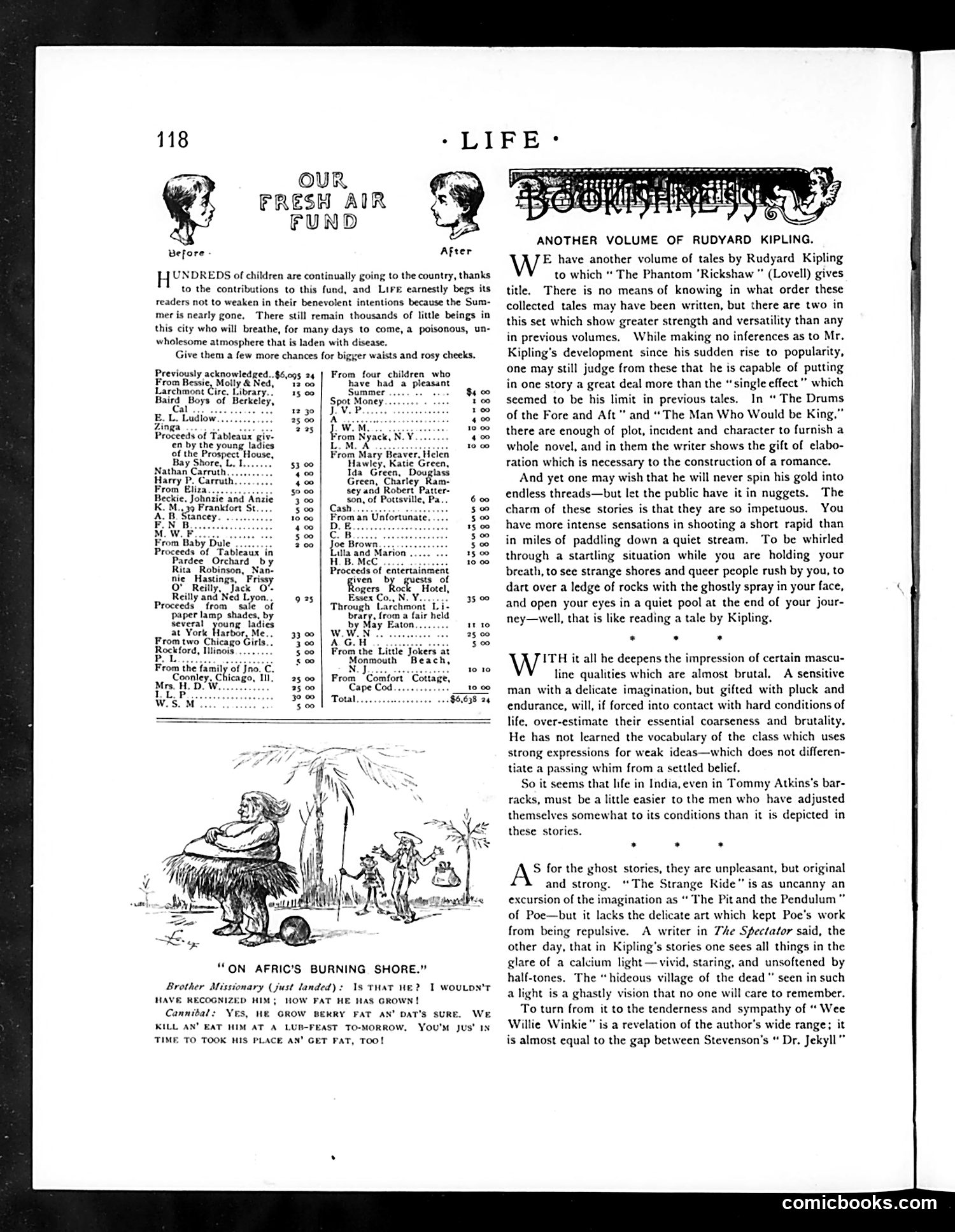
This cartoon appears to be a satirical dialogue between a "Brother Missionary" (just landed) and a "Cannibal" about missionary work in Africa. The joke plays on the contrast between the missionary's idealistic purpose and harsh colonial-era realities. The missionary asks if the cannibal recognizes him, suggesting previous contact. The cannibal's response—that he "grow berry fat" and will "kill an' eat him at a lub-feast to-morrow"—uses racial dialect stereotyping common to early 20th-century American satire. The humor targets both missionary earnestness and perpetuates caricatured depictions of African peoples. The cartoon reflects Life magazine's satirical approach to contemporary colonial and religious themes, though by modern standards it relies heavily on offensive racial stereotypes typical of that era.
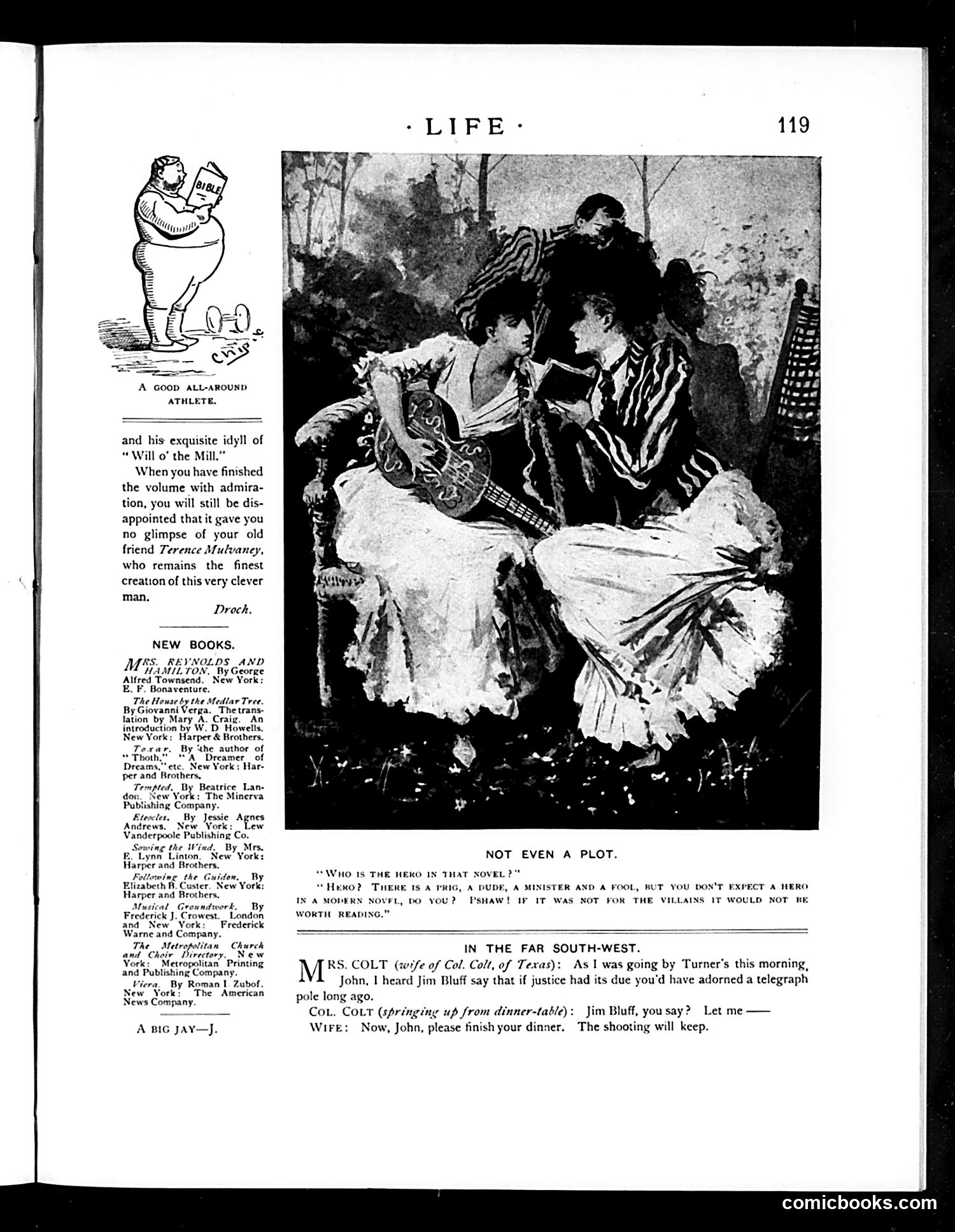
The page contains two distinct elements: **Left side:** A small cartoon titled "A GOOD ALL-AROUND ATHLETE" depicting a rotund figure reading, with text mocking someone named Terence Mahoney as "the finest creation of his very clever man" (likely a literary character reference). **Right side:** A photograph captioned "NOT EVEN A PLOT" with accompanying dialogue between Mrs. Colt and Col. Colt regarding Texas justice and a telegraph pole execution. The caption questions whether a novel with only "a frog, a dude, a minister and a fool" qualifies as literature without a proper plot. The satire appears to critique both literature lacking substance and frontier justice. The Texas setting and casual reference to lynching reflect period attitudes, though presented here as social commentary on crude justice and poor storytelling. The humor relies on readers' familiarity with contemporary novels and frontier culture.
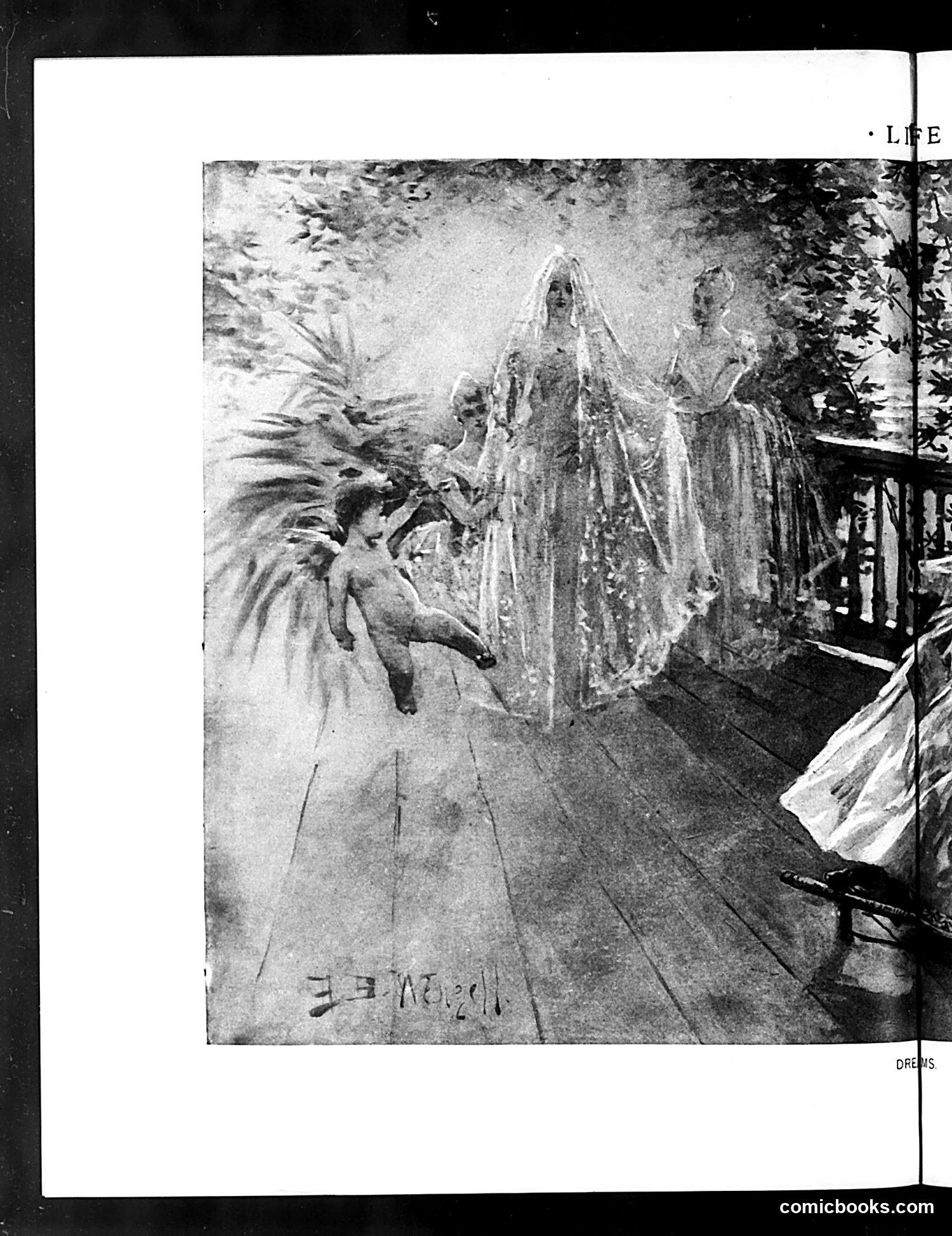
This appears to be a page from *Life* magazine featuring a photograph rather than a cartoon. The image shows women in elaborate, flowing dresses or robes with veils or head coverings, posed in what appears to be an elegant interior setting with plants and furnishings visible. The word "DRENS" appears at the bottom right, though its meaning is unclear—possibly a partial word or OCR error. Without clearer OCR text or additional context clues, I cannot definitively identify the specific social commentary or satire intended. The elaborate costume and theatrical staging suggest this may be satirizing fashion trends, theatrical productions, or social pretension of the era, but I cannot assert the precise target or point of the satire with confidence.
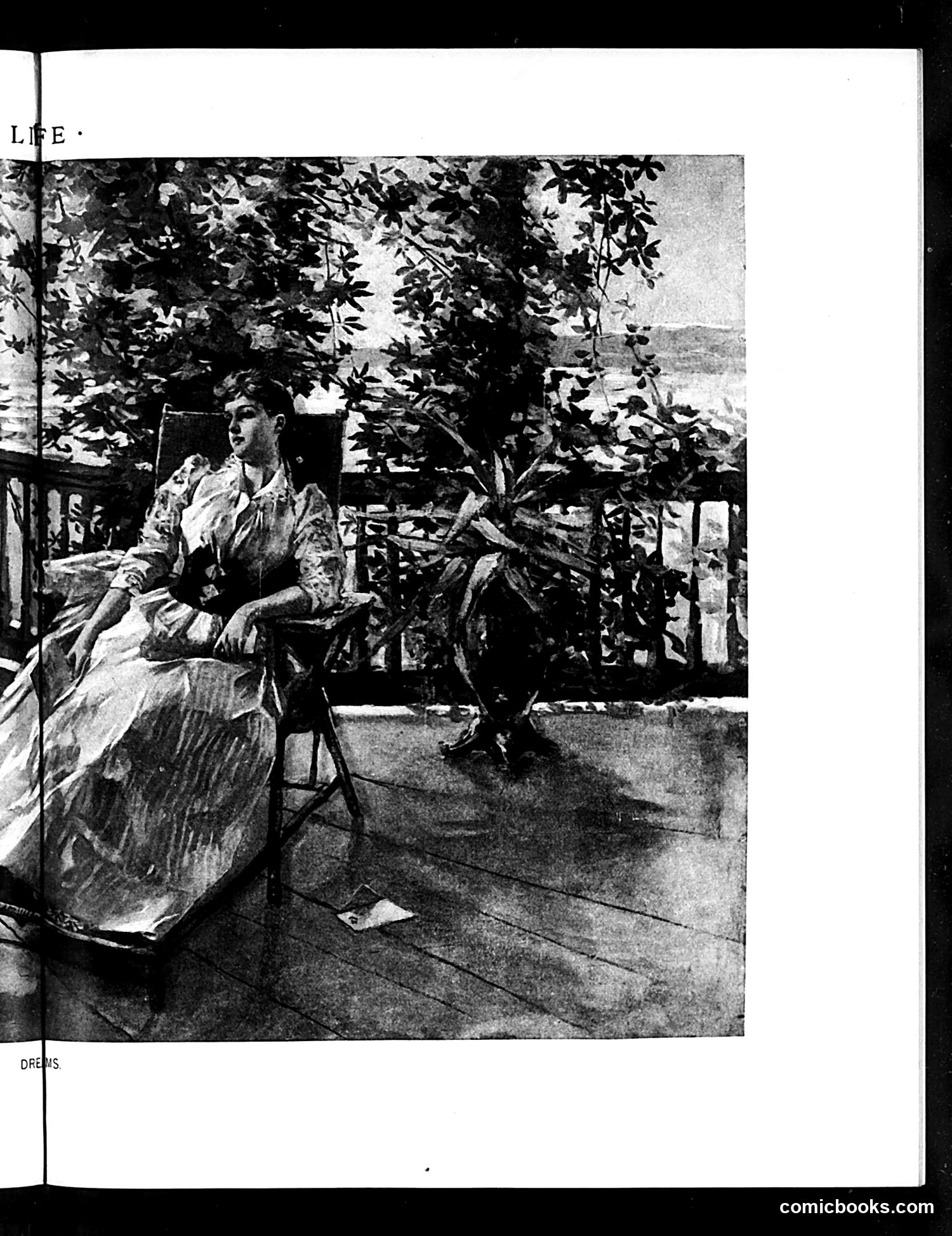
This page from *Life* magazine shows a black-and-white photograph labeled "LIFE" at top and "DRESS" at bottom. The image depicts a woman in an ornate patterned dress seated outdoors beneath flowering vines or climbing plants on what appears to be a porch or veranda. A landscape is visible in the background. The photograph appears to be a fashion or lifestyle feature rather than a political cartoon. Without additional context or caption text visible, the specific satirical point—if any—remains unclear. It may showcase contemporary women's fashion, leisure activities, or domestic aesthetics of the era, presented as exemplary of refined taste. The "DRESS" label suggests this is part of a fashion or style section.
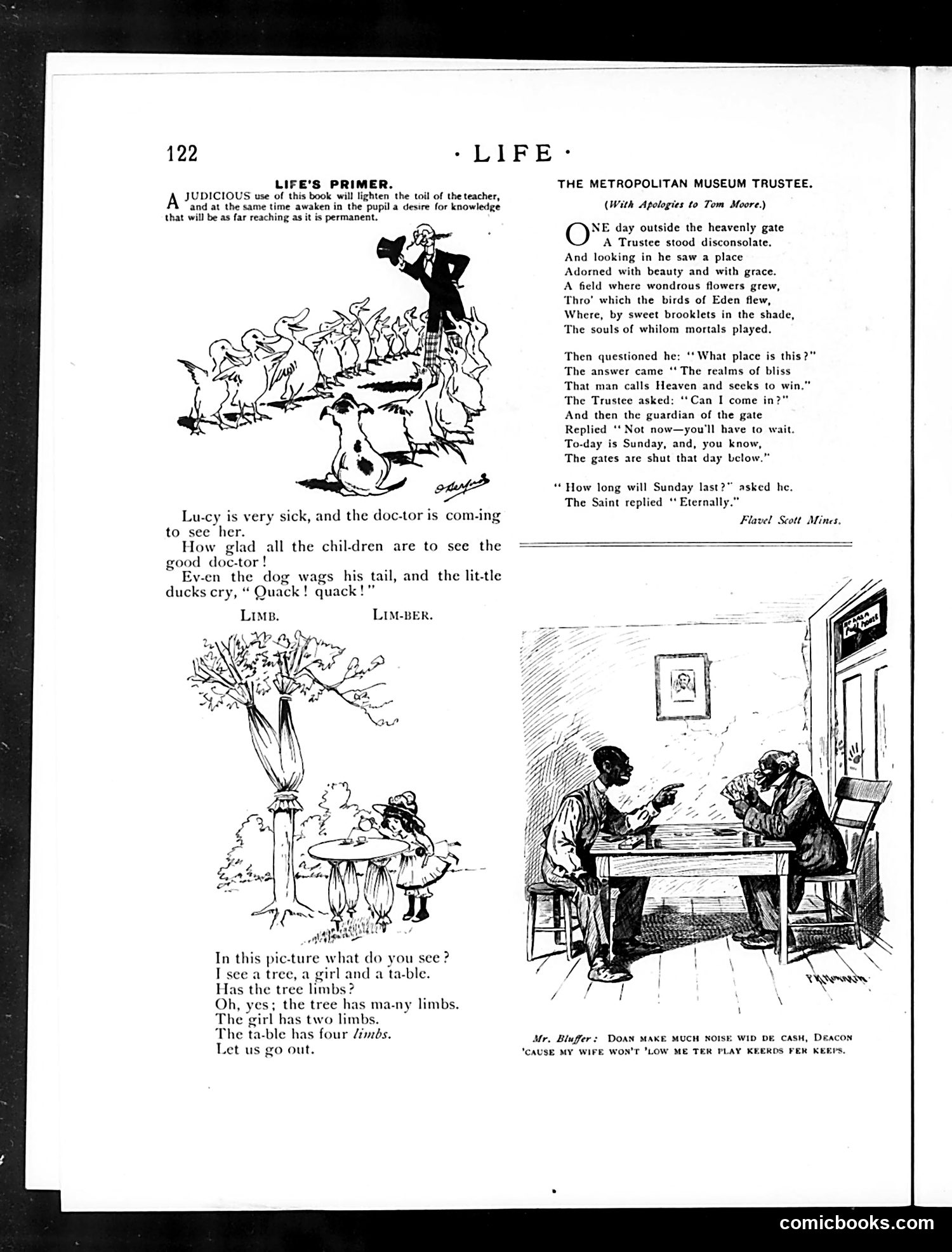
This page contains three distinct pieces: 1. **"Life's Primer"** - A children's educational rhyme with illustration showing a teacher instructing young animals (ducks, rabbits), teaching basic concepts like cause-and-effect. 2. **"The Metropolitan Museum Trustee"** - A poem (credited to Ulsa/Tom Moore) depicting a heavenly gatekeeper denying a wealthy Museum Trustee entry to paradise because it's Sunday and "the gates are shut that day below." The satire suggests that such wealthy patrons, despite their cultural contributions, may face divine judgment—a commentary on materialism versus spiritual worth. 3. **"Limb/Limber"** - An illustrated language lesson asking children to identify body parts ("limbs") in a drawing of a tree, girl, and table. 4. **A cartoon** showing two men at a table, with a caption about domestic noise complaints. The page mixes educational content with gentle social satire typical of Life's approach.
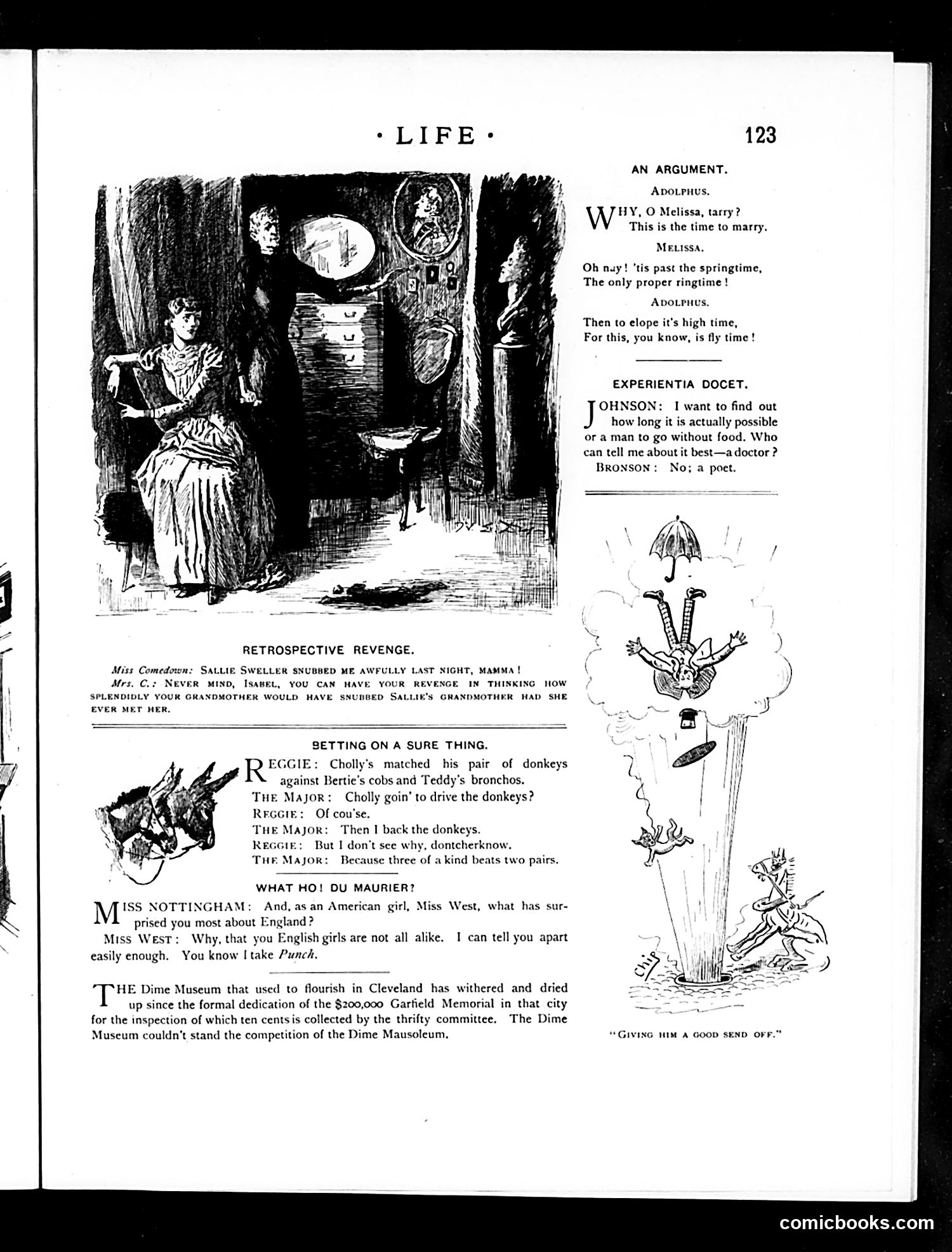
This page contains several brief satirical sketches typical of Life's humor section: **"An Argument"** depicts a romantic disagreement between Adolphus and Melissa about marriage timing—she claims spring is "the only proper ringtime," while he argues elopement is "fly time." The joke plays on seasonal courtship conventions. **"Experientia Docet"** presents a dialogue where Johnson asks a doctor about surviving without food; Bronson quips that a poet would be better suited to answer—mocking poets as impractical or disconnected from reality. **"Betting on a Sure Thing"** features dialogue about donkeys in a race, with Reggie confidently backing three donkeys against two pairs of horses, relying on the logical fallacy that "three of a kind beats two pairs." The page also includes miscellaneous social commentary and an illustration labeled "Giving him a Good Send Off."
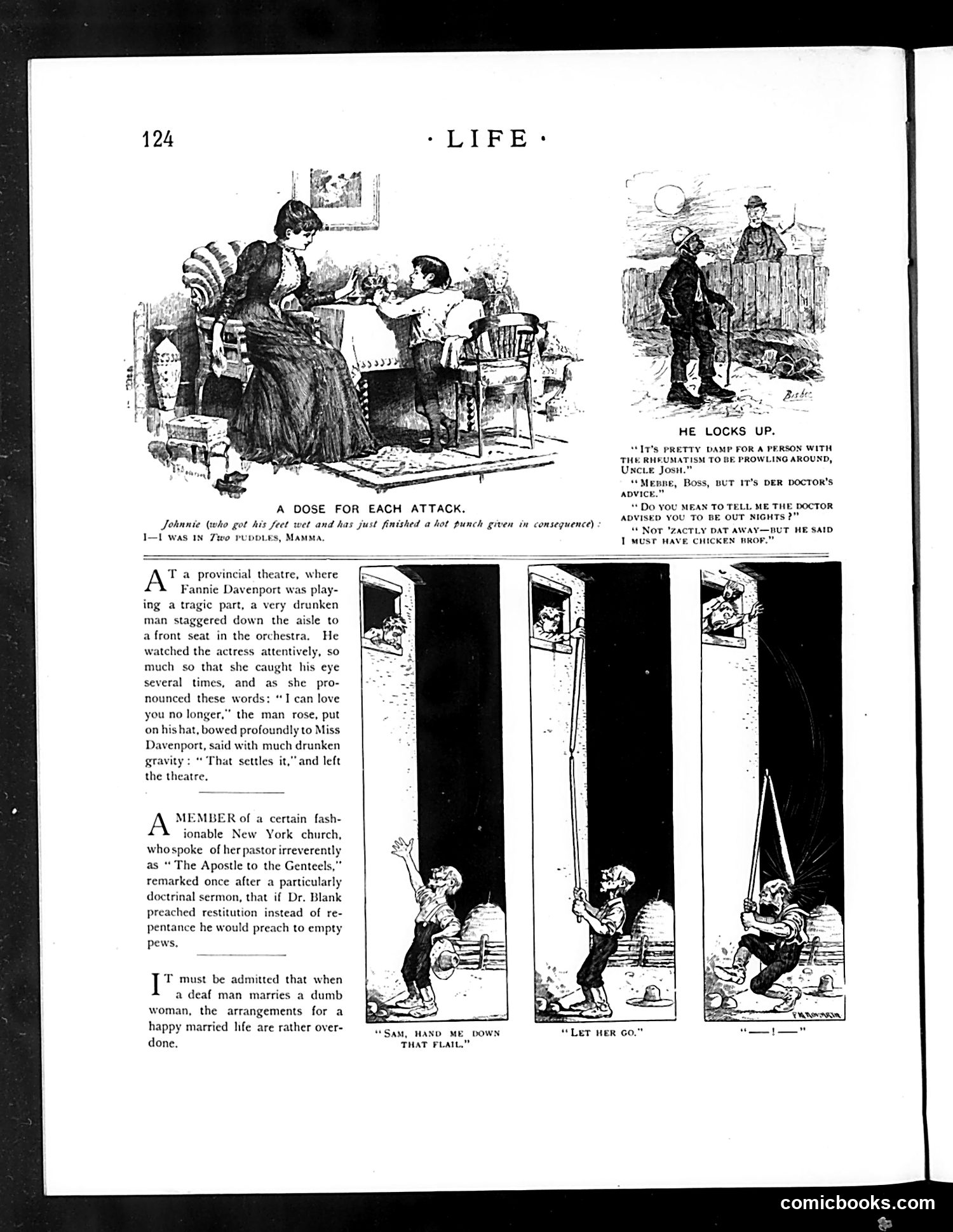
This page from *Life* magazine contains three separate humorous anecdotes with accompanying illustrations, typical of the publication's satirical format. **Top section**: A boy caught sneaking out at night claims his doctor advised outdoor air for rheumatism, but admits he's been wading in puddles—exposing the transparent lie parents recognize immediately. **Middle section**: A drunk man at a provincial theatre watches actress Fannie Davenport perform a tragic scene about lost love. When she declares "I can love you no longer," he takes it as a dismissal, tips his hat, and leaves—satirizing how alcohol impairs judgment and social awareness. **Bottom anecdotes**: A church member mocks her pastor as "The Apostle to the Genteel," suggesting his preaching prioritizes wealthy parishioners over genuine Christian values. The final joke plays on the marriage of deaf and dumb partners, treating their disabilities as punchline material in period-typical fashion. The illustrations by various artists provide visual humor supporting each verbal joke. The satire targets social hypocrisy, drunkenness, religious pretension, and human folly generally.
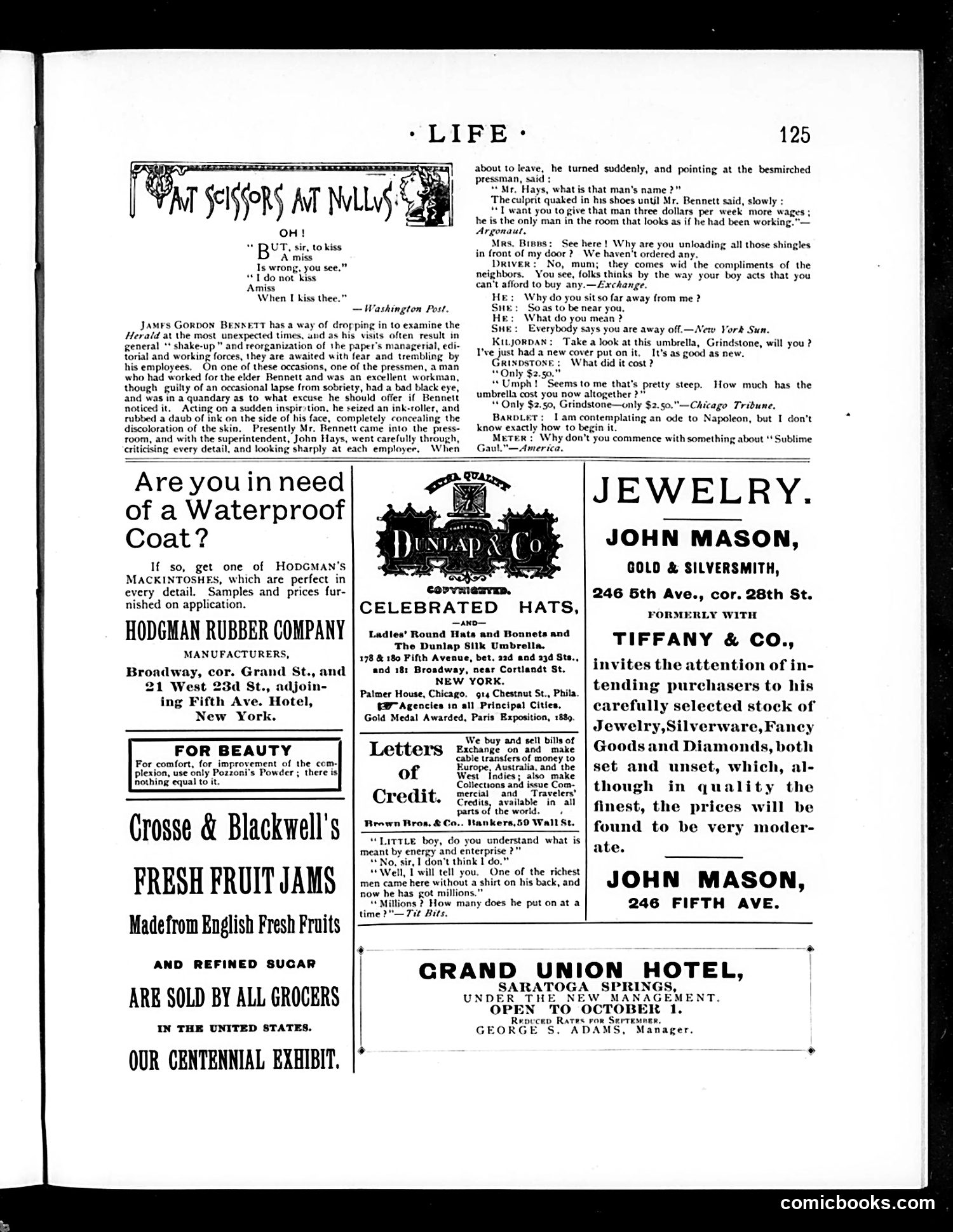
This page is primarily **advertisements and brief humorous anecdotes**, not political satire. The cartoons are absent; instead, there are several short comic stories. The main content piece describes **James Gordon Bennett**, publisher of the New York Herald, making surprise inspections of his newspaper's pressroom. The joke: a pressman with a black eye cleverly disguises it with printer's ink before Bennett arrives. Bennett, seeing the ink-stained face, assumes the man has been working so hard he hasn't cleaned up—and rewards him with a raise. The satire targets Bennett's reputation for sudden, feared visits and his unpredictable management style. Other brief anecdotes joke about domestic life, courtship, umbrellas, and ambition—typical period humor with no specific political references. The remainder is **period advertising**: rubber coats, fruit jams, jewelry, hats, and banking services—standard commercial notices typical of 19th-century magazines.
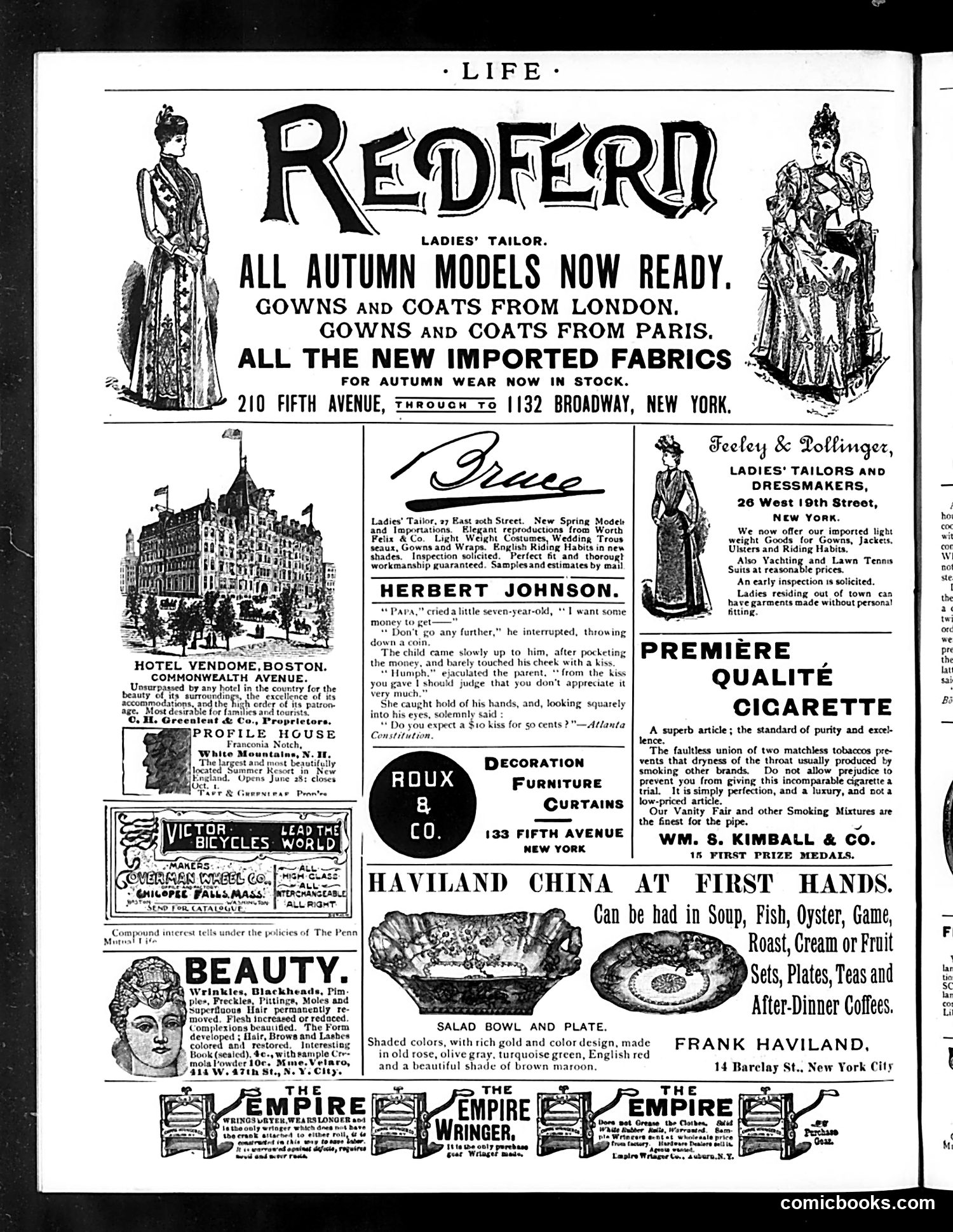
This is primarily an **advertising page** from Life magazine, not a satirical cartoon page. It contains various commercial advertisements for late 19th/early 20th-century products and services. The only narrative content—a brief anecdote by Herbert Johnson titled "Peace"—is a sentimental story about a father giving his young son money for a kiss. When the boy gives only a perfunctory peck, the father scolds him, saying "Do you expect a $10 kiss for 50 cents?" The child replies he doesn't want to "spoil" his parents' kisses by putting a price on affection. It's a morality tale about commercialism versus sentiment. The advertisements showcase period concerns: women's fashion tailoring (London and Paris imports), hotel accommodations, beauty treatments (removing freckles, developing the figure), furniture, chinaware, and cigarettes—positioned as luxury items. This reflects the aspirational consumer culture of the era, particularly targeting affluent urban readers in New York and Boston.
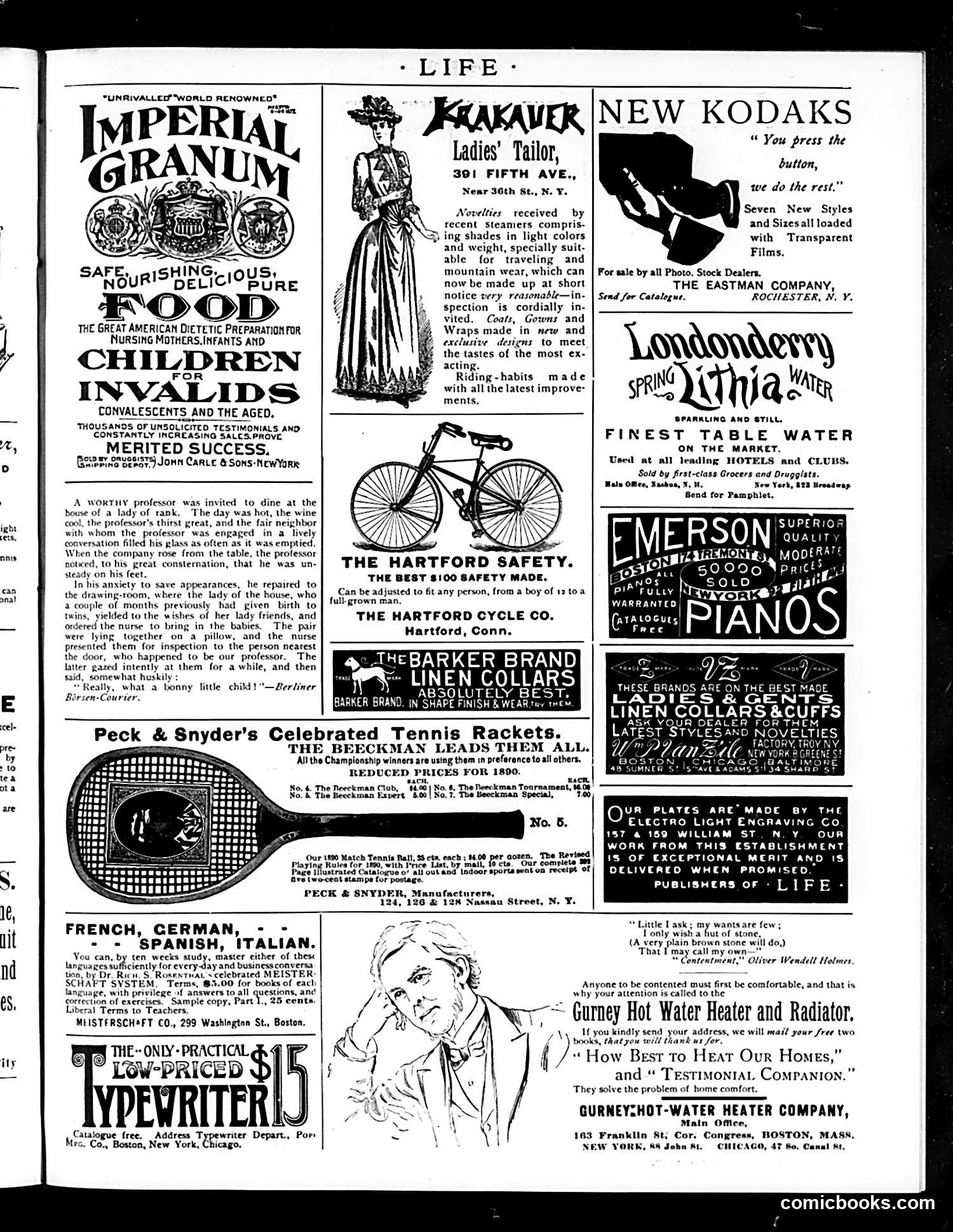
This is primarily an **advertisements page** from Life magazine (circa 1890, based on references to "1890" in tennis racket pricing). The page contains no political cartoons or satirical content—it's a collection of period product advertisements. However, one **humorous anecdote** appears mid-page: A professor, invited to dinner at a lady's house, drinks heavily and becomes intoxicated. To hide his unsteadiness, he asks to see the newborn twins the hostess had recently delivered. The joke's humor relies on the era's social propriety—the implication being that viewing infants provides a dignified excuse for his wobbly condition. This reflects Victorian-era anxieties about public decorum and social embarrassment. The advertisements themselves showcase 1890s consumer goods: bicycles, pianos, typewriters, cameras, and patent medicines—reflecting turn-of-the-century American commercialism and technological optimism.
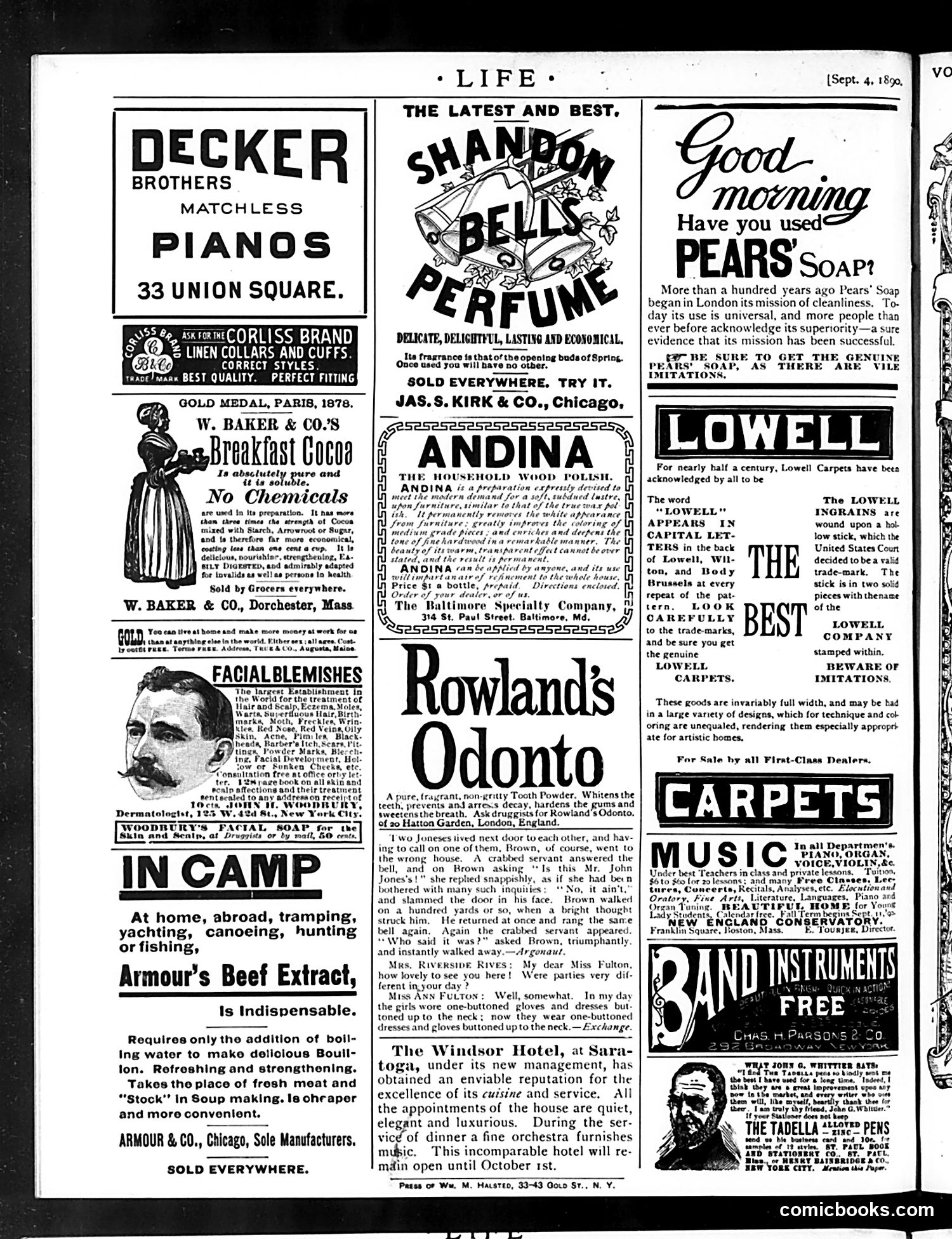
This is primarily an **advertising page** with minimal editorial content. The page features Victorian-era product advertisements (pianos, cocoa, tooth powder, carpets, etc.) typical of 1890s magazines. The only substantive non-advertisement content is a brief **humor section** featuring two short anecdotes: 1. **"Two Joneses" joke**: A man named Brown rings a doorbell at the wrong house, gets rebuffed by a crabby servant, returns to the same house, and triumphantly asks "Who said it was?" — suggesting the servant was wrong about him being at the wrong address. The humor relies on petty vindication. 2. **Fashion comparison joke**: An elderly woman (Miss Ann Fulton) notes that fashion hasn't changed—only that women now wear one-buttoned gloves and one-buttoned dresses instead of the reverse. It's gentle satire about cyclical fashion trends and how modernity claims novelty while repeating the past. Neither contains political content or caricature. The page reflects late-Victorian advertising culture and light domestic humor typical of the era.