
Life, 1890-09-04 · page 4 of 16
Life — September 4, 1890 — page 4: what you’re looking at
What you’re looking at
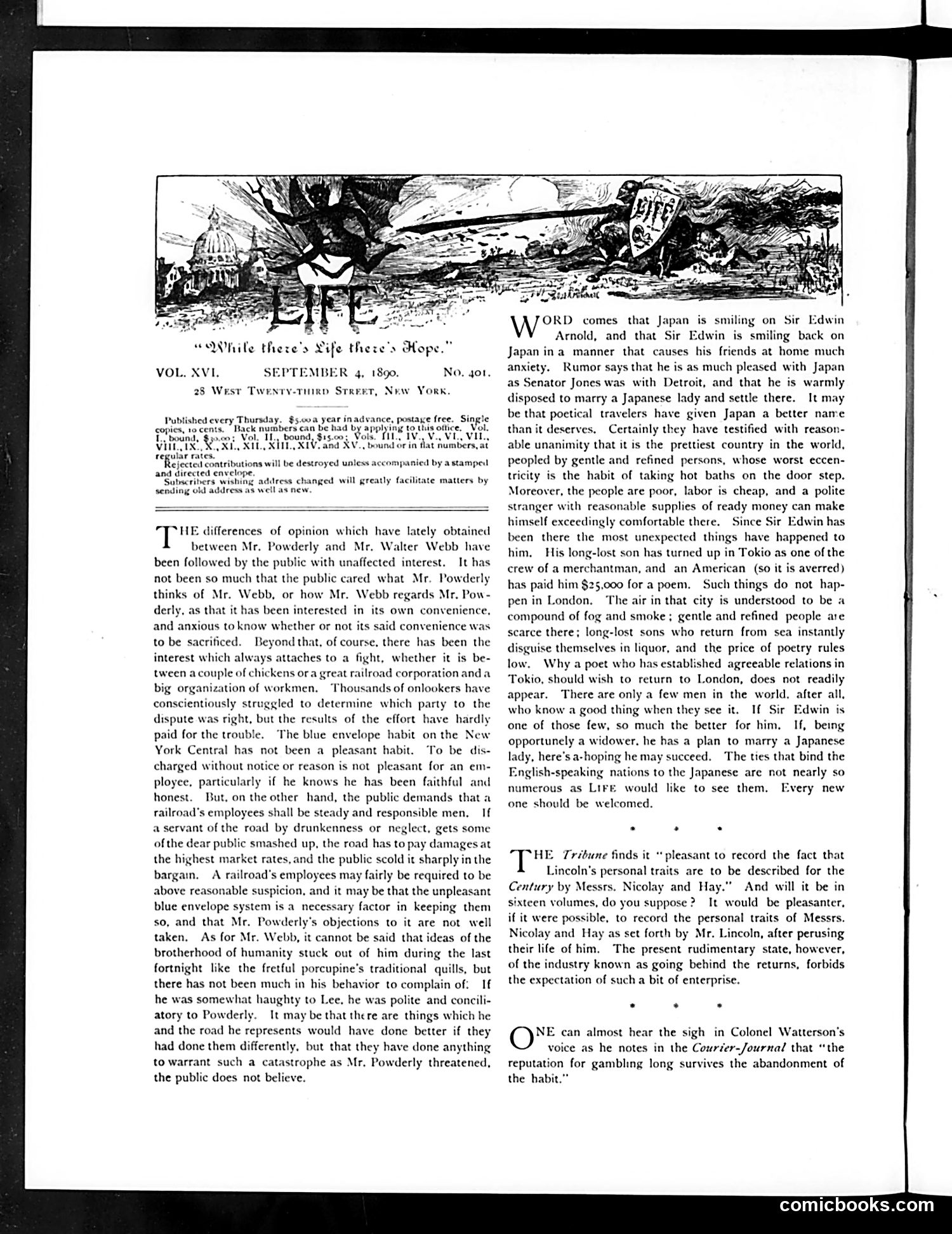
This page contains three separate editorial pieces rather than political cartoons. The header illustration depicts a landscape with classical architecture, but the main content focuses on written commentary: 1. **"While there's Life there's Hope"** - Discusses Sir Edwin Arnold's favorable views of Japan and rumors he may marry a Japanese woman and settle there. The piece praises Japan as a "prettiest country in the world" with refined people, though noting high costs and foggy climate. 2. A piece about railroad labor disputes between Mr. Powderly and Mr. Webb, debating employee conduct and corporate responsibility—apparently a contemporary labor controversy. 3. **The Tribune** comment references Lincoln's personal traits being documented by Nicolay and Hay in a forthcoming biography. The page emphasizes social commentary over visual satire.
📄 Transcribed text from this page (OCR, searchable)
Machine-transcribed from the original scan — historical spelling and the odd misread are preserved.
While there's Life there's Hope.” VOL. XVI. SEPTEMBER 4, 1890. 28 West Twenty-tuirp Street, New York. No, gor. Published every Thursday, §5.00a year inadvance, postaxe free. Single . Back numbers can be had by applying to this ottice. Vol. . 11., bound, $is.c0; Vols. TL. 1V.. V.. VL, VIL, Xt, HL, X1Vland XV., bound rin fat numbers, at regular rates, ejected contributions will be destroyed unless ac and directed envelope. Subscribers wishing ad i, OW) address as w mpanied by a stamped ress changed will gre as new ly facilitate matters by HE differences of opinion which have lately obtained between Mr. Powderly and Mr. Walter Webb have been followed by the public with unaffected interest. It has not been so much that the public cared what Mr. Powderly thinks of Mr. Webb, or how Mr. Webb regards Mr. Pow- derly, as that it has been interested in its own convenience, and anxious to know whether or not its said convenience was to be sacrificed. Beyond that, of course, there has been the i st which always attaches to a fight, whether it is be- ens ora great railroad corporation and a big organization of workmen. Thousands of onlookers have conscientiously struggled to determine which party to the dispute was right, but the results of the effort have hardly paid for the trouble. The blue envelope habit on the New York Central has not been a pleasant habit. To be dis- charged without notice or reason is not pleasant for an em- ployee, particularly if he knows he has been faithful and honest. But, on the other hand, the public demands that a railroad’s employees shall be steady and responsible men. If a servant of the road by drunkenness or neglect, gets some ofthe dear public smashed up, the road has to pay damages at the highest market rates, and the public scold it sharply in the bargain. A railroad’s employees may fairly be required to be above reasonable suspicion, and it may be that the unpleasant blue envelope system is a necessary factor in keeping them so, and that Mr. Powderly’s objections to it are not well taken, As for Mr. Webb, it cannot be said that ideas of the brotherhood of humanity stuck out of him during the last fortnight like the fretful porcupine’s traditional quills, but there has not been much in his behavior to complain of: If he was somewhat haughty to Lee, he was polite and concili- atory to Powderly. It may be that there are things which he and the road he represents would have done better if they had done them differently, but that they have done anything to warrant such a catastrophe as Mr, Powderly threatened, the public does not believe. ORD comes that Japan is smiling on Sir Arnold, and that Sir Edwin is smiling back on Japan ina manner that causes his friends at home much anxiety. Rumor says that he is as much pleased with Japan as Senator Jones was with Detroit, and that he is warmly disposed to marry a Japanese lady and settle there. It may be that poetical travelers have given Japan a better name than it deserves. Certainly they have testified with reason- able unanimity that it is the prettiest country in the world, peopled by gentle and refined persons, whose worst eccen- tricity is the habit of taking hot baths on the door step. Moreover, the people are poor, labor is cheap, and a polite stranger with reasonable supplies of ready money can make himself exceedingly comfortable there. Since Sir Edwin ha been there the most unexpected things have happened to him, His long-lost son has turned up in Tokio as one of the crew of a merchantman, and an American (so it is averred) has paid him $25,000 for a poem. Such things do not hap- pen in London. The air in that city is understood to be a compound of fog and smoke; gentle and refined people are scarce there; long-lost sons who return from sea instantly disguise themselves in liquor, and the price of poetry rules low. Why a poet who has established agreeable relations in Tokio, should wish to return to London, does not readily appear. There are only a few men in the world. after all. who know a good thing when they see it. If Sir Edwin is one of those few, so much the better for him, If, being opportunely a widower, he has a plan to marry a Japanese lady, here’s a-hoping he may succeed. The ties that bind the English-speaking nations to the Japanese are not nearly so numerous as LiFe would like to see them. Every new one should be welcomed. HE Trébune finds it “pleasant to record the fact that Lincoln's personal traits are to be described for the Century by Messrs. Nicolay and Hay.” And will it be in sixteen volumes, do you suppose? It would be pleasanter, if it were possible, to record the personal traits of Messrs. Nicolay and I s set forth by Mr. Lincoln, after perusing their life of him. The present rudimentary state, however, of the industry known as going behind the returns, forbids the expectation of such a bit of enterprise. NE can almost hear the sigh in Colonel Watterson’s voice as he notes in the Courser-Journal that “the reputation for gambling long survives the abandonment of the habit comicbooks.com