
Life, 1890-09-04 · page 6 of 16
Life — September 4, 1890 — page 6: what you’re looking at
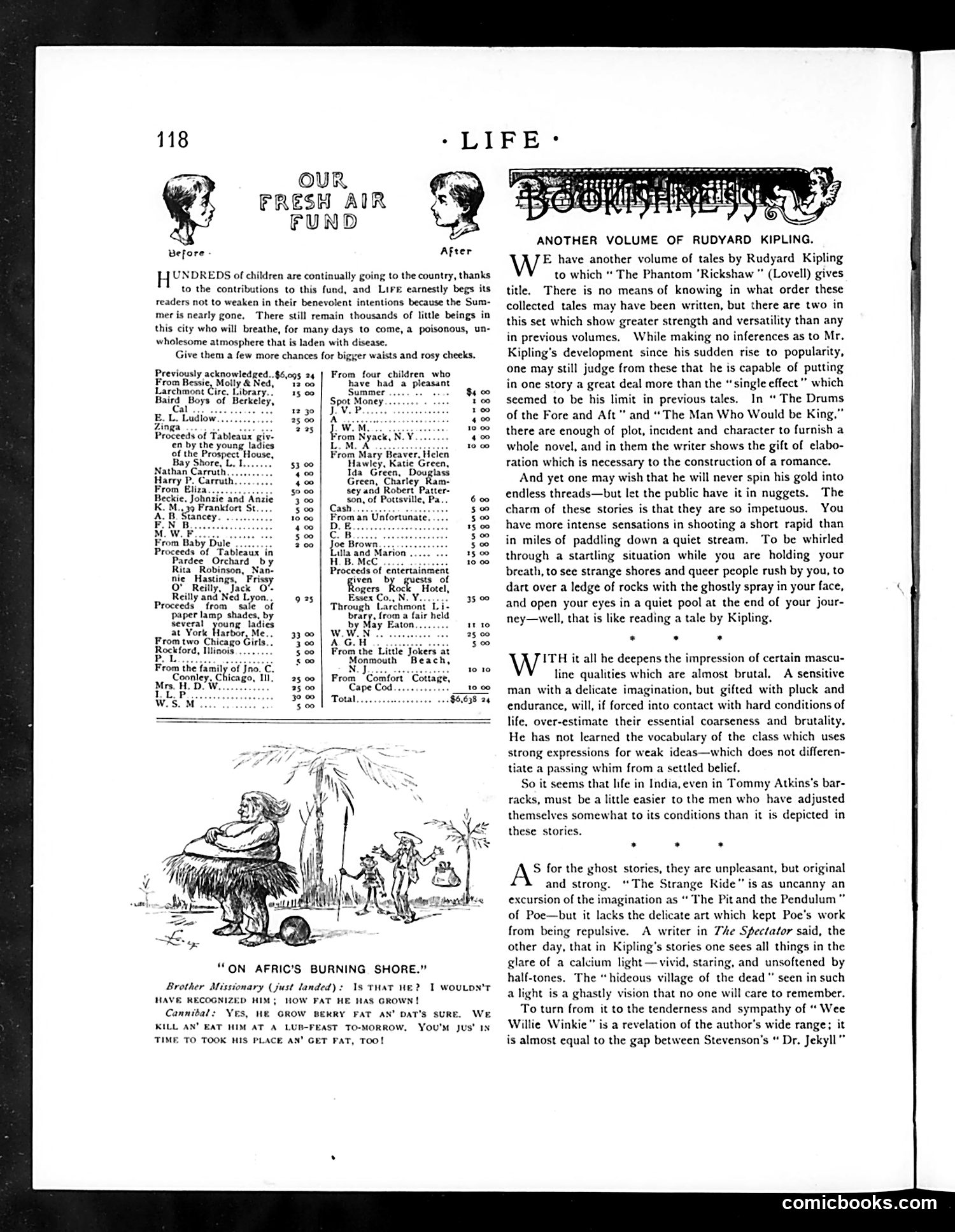
What you’re looking at
This cartoon appears to be a satirical dialogue between a "Brother Missionary" (just landed) and a "Cannibal" about missionary work in Africa. The joke plays on the contrast between the missionary's idealistic purpose and harsh colonial-era realities. The missionary asks if the cannibal recognizes him, suggesting previous contact. The cannibal's response—that he "grow berry fat" and will "kill an' eat him at a lub-feast to-morrow"—uses racial dialect stereotyping common to early 20th-century American satire. The humor targets both missionary earnestness and perpetuates caricatured depictions of African peoples. The cartoon reflects Life magazine's satirical approach to contemporary colonial and religious themes, though by modern standards it relies heavily on offensive racial stereotypes typical of that era.
📄 Transcribed text from this page (OCR, searchable)
Machine-transcribed from the original scan — historical spelling and the odd misread are preserved.
OUR FRESH AIR FUND Before - After HUNDREDS of children are continually going to the country, thanks to the contributions to this fund, and LIFE earnestly begs its readers not to weaken in their benevolent intentions because the Sum- mer is nearly gone, There still remain thousands of little beings in this city who will breathe, for many days to come, a poisonous, un- wholesome atmosphere that is laden with disease, Give them a few more chances for bigger waists and rosy cheeks, From four children who have had a pleasant Summer 2 Sadane 888sess abl s Proceeds of Tableaux en by the young indies of the Prospect Hou Bay Shore, L. Nathan Carruth Mary Bea’ Hawley, Katie Green, Ida Green, Douglass Green, Charley Ram- sey and Robert Patter- son, of Pottsville, Pa CARD tos csenyensenee From an Unfortunate, wusduw S888888sss Bauuduua 8883888 Pardee’ Orchard by Rita “Robinson, Nan- nie Hastings," Friss O" Reilly, Jack O- Reilly and'Ned Lyon... Proceeds from sale of Paper lamp shades, by Several ladies at York, Harber, Mest w ws From two Chicago Girt. Rockford, Iiinois H.B.McC ..... een Proceeds of entertainment iven es oe of ‘ogers, Rock | Hotel, Essex Co., N Through Earchtoose brary. from a fair held May Eaton —_ the Little Jokes i Monmouth Beach, From tie fa 0, C, Cooniey, =e im Mrs. H, D. 9 From “Comfort Cottage, MoH Cape Cod...eseeeeee W.S. M 8888 8888 aBae ““ON AFRIC’S BURNING SHORE.” Brother Missionary (just landed): 18 THAT WE? HAVE RECOGNIZED HIM; HOW FAT HE HAS GROWN! Cannibal: Yes, Wk GROW BERRY FAT AN’ DaT'S SURE. WE KILL AN’ EAT HIM AT A LUB-FEAST TO-MORROW, YoU'M JUS" IN TIME TO TOOK HIS PLACE AN’ GET FaT, TOO! I woutoy't ANOTHER VOLUME OF RUDYARD KIPLING. W* have another volume of tales by Rudyard Kipling to which “ The Phantom ‘Rickshaw " (Lovell) gives title. There is no means of knowing in what order these collected tales may have been written, but there are two in this set which show greater strength and versatility than any in previous volumes. While making no inferences as to Mr. Kipling’s development since his sudden rise to popularity, one may still judge from these that he is capable of putting in one story a great deal more than the “single effect” which seemed to be his limit in previous tales. In “ The Drums of the Fore and Aft" and “The Man Who Would be King.” there are enough of plot, incident and character to furnish a whole novel, and in them the writer shows the gift of elabo- ration which is necessary to the construction of a romance. And yet one may wish that he will never spin his gold into endless threads—but let the public have it in nuggets. The charm of these stories is that they are so impetuous. You have more intense sensations in shooting a short rapid than in miles of paddling down a quiet stream. To be whirled through a startling situation while you are holding your breath, to see strange shores and queer people rush by you, to dart over a ledge of rocks with the ghostly spray in your face, and open your eyes in a quiet pool at the end of your jour- ney—well, that is like reading a tale by Kipling. ITH it all he deepens the impression of certain mascu- line qualities which are almost brutal. A sensitive man with a delicate imagination, but gifted with pluck and endurance, will, if forced into contact with hard conditions of life, over-estimate their essential coarseness and brutality. He has not learned the vocabulary of the class which uses strong expressions for weak ideas—which does not differen- tiate a passing whim from a settled belief. seems that life in India,even in Tommy Atkins’s bar- racks, must be a little easier to the men who have adjusted themselves somewhat to its conditions than it is depicted in these stories. . . . AS for the ghost stories, they are unpleasant, but original and strong. “The Strange Ride” is as uncanny an excursion of the imagination as “ The Pitand the Pendulum ” of Poe—but it lacks the delicate art which kept Poe's work from being repulsive. A writer in The Spectator said, the other day, that in Kipling’s stories one sees all things in the glare of a calcium light —vivid, staring, and unsoftened by half-tones. The “hideous village of the dead” seen in such a light is a ghastly vision that no one will care to remember. To turn from it to the tenderness and sympathy of * Wee Willie Winkie” is a revelation of the author's wide range; it is almost equal to the gap between Stevenson's “ Dr. Jekyll” comicbooks.com