
A complete issue · 16 pages · 1890
Life — August 28, 1890
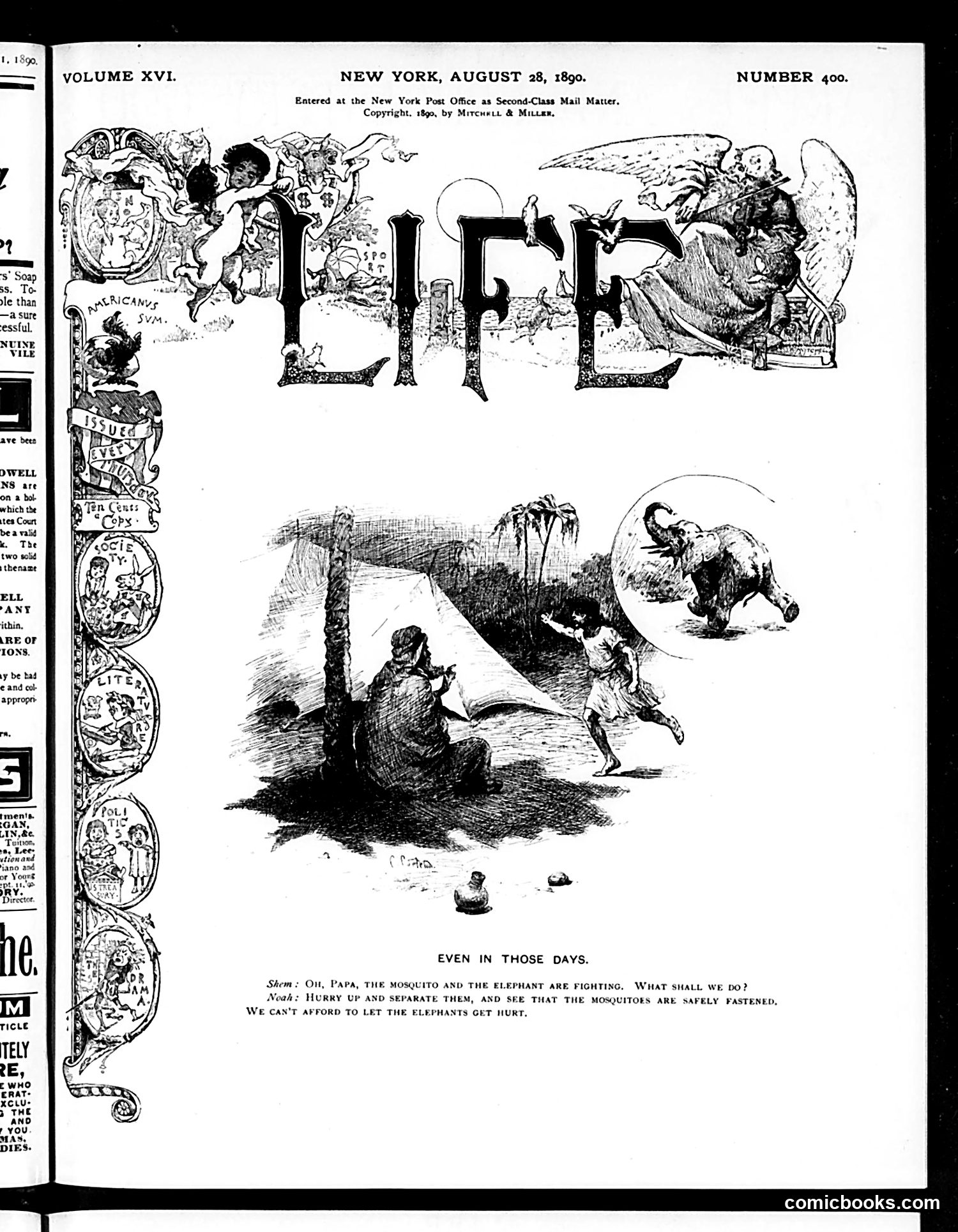
This cartoon depicts a domestic scene where children are playing with toys—an elephant and mosquito. The caption presents dialogue between "Mamma" (Mother) and "Noah," referencing the Biblical Noah's Ark narrative. The satire appears to target contemporary anxieties about pest control and animal management. By invoking Noah's story of preserving animal pairs during the flood, the cartoon humorously suggests that even in Biblical times, people faced the practical problem of controlling dangerous creatures like mosquitoes while protecting valuable animals like elephants. The joke likely comments on the difficulty of managing conflicting interests: protecting livestock and property while dealing with disease-carrying insects—a genuine public health concern of the 1890s when mosquito-borne illnesses were poorly understood.
This page is primarily **advertising**, not editorial content or political cartoons. It contains commercial advertisements for various products and services typical of late 19th or early 20th-century America: - Carpets and upholstery goods from John H. Pray, Sons & Co. (Boston) - Wine and champagne imports - Cigarettes and tobacco products - A "Life" binder - Fresh fruit jams - Perfumes and garden products The only illustration visible is a small portrait of a woman's head in profile (labeled "FASHIONABLE HAT"), which appears to be a fashion advertisement rather than political satire. There are no discernible political cartoons or satirical commentary on this page—it functions as a standard classified advertising section of the magazine.
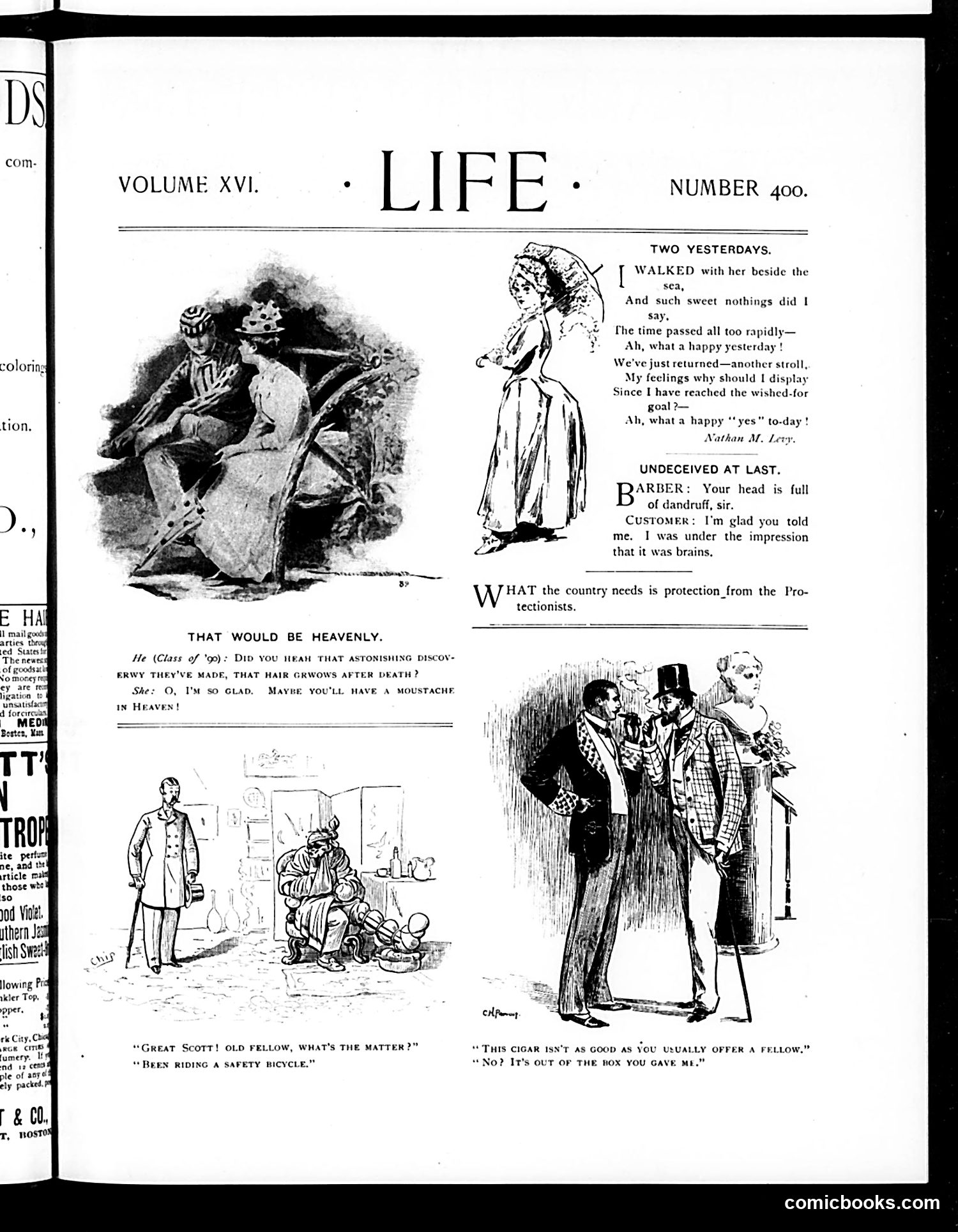
This page contains several unrelated humorous sketches typical of Life's satirical format: **"Two Yesterdays"** (top right): A romantic poem contrasting yesterday's pleasant seaside walk with today's engagement happiness. **"That Would Be Heavenly"**: A joke about an afterlife with hair growth, playing on Victorian-era vanity about facial hair. **"Undeceived at Last"**: A barber-customer exchange where the customer admits mistaking dandruff for brains—a crude insult joke. **Political reference** (center): A single-line critique: "What the country needs is protection from the Protectionists"—likely satirizing tariff/trade policy debates of the era. **Bottom cartoons**: Humorous domestic scenes, including one about a safety bicycle and another about inferior cigars. The page reflects typical turn-of-century American humor: personal vanity, class humor, and light political commentary.
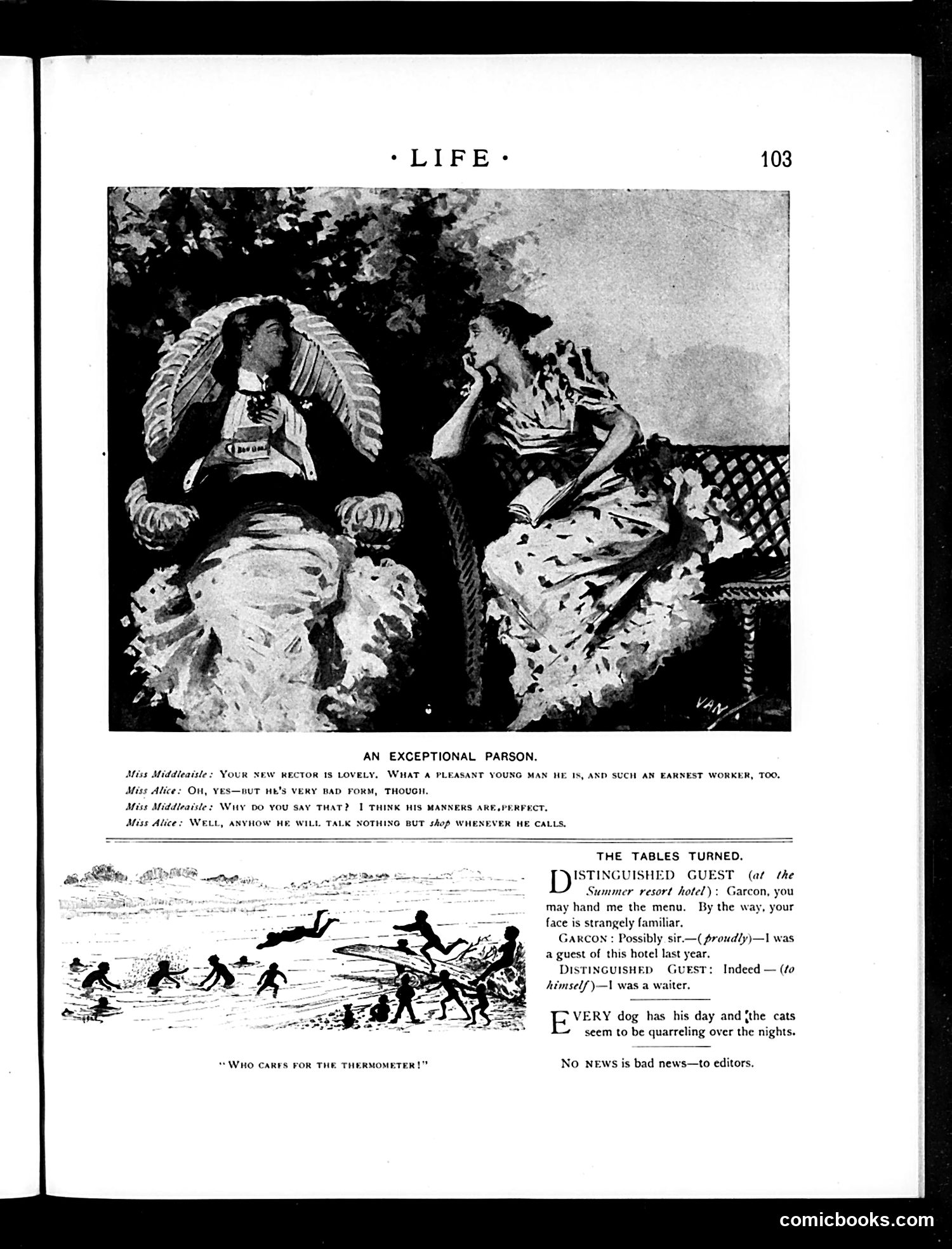
**Top cartoon: "An Exceptional Person"** Two women discuss a new rector (church official). Miss Middlestate praises him as "lovely" and "an earnest worker." Miss Alice counters he has "very bad form" but adds he'll "talk nothing but shop whenever he calls"—meaning he'll only discuss church business. The satire mocks social pretension: the women value his ministerial dedication less than his conversational manners, suggesting shallow concern with propriety over substance. **Bottom section: "The Tables Turned"** A brief humorous anecdote about hotel service: a "Distinguished Guest" learns the menu-carrier is actually a former waiter, reversing their social positions. The joke plays on class mobility and ironic role reversals common to period humor. The page exemplifies *Life* magazine's satirical focus on American social conventions and class dynamics.
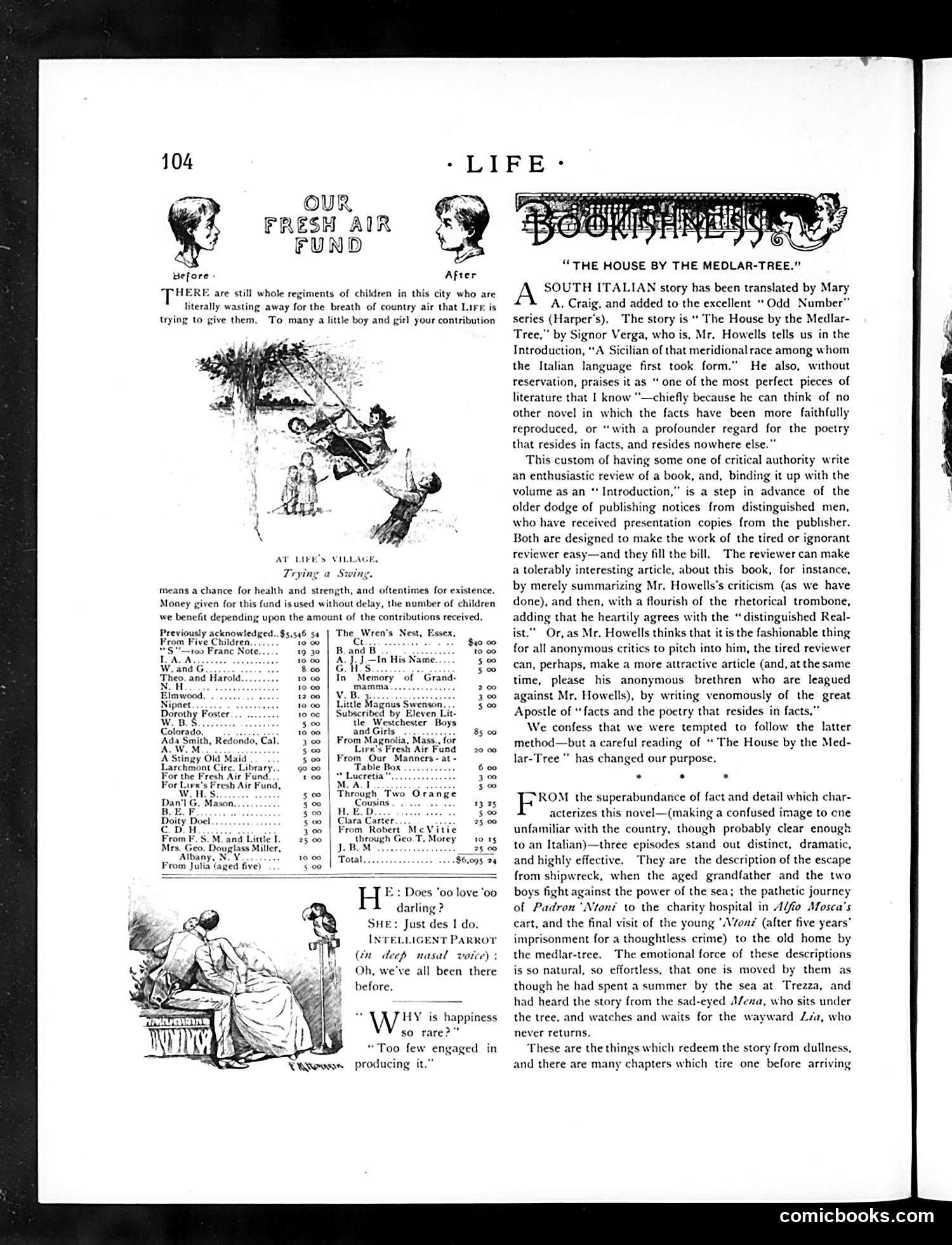
This page contains two distinct sections: **"Our Fresh Air Fund" (left):** A charitable appeal featuring illustrations of impoverished urban children. The text solicits donations to send sick city children to the countryside for health and "strength." A list of donors and contribution amounts follows, representing typical early 20th-century philanthropic fundraising. The illustration depicts children in need, visually reinforcing the appeal's emotional message. **"Books Being" (right):** A book review of "The House by the Medlar-Tree," a translated Italian novel by Signor Verga. The reviewer discusses the work's literary merit, facts-versus-poetry balance, and emotional effectiveness. A humorous dialogue exchange appears below, contrasting perspectives on happiness. The page balances charitable advocacy with literary criticism, reflecting Life magazine's mix of social commentary and cultural content.
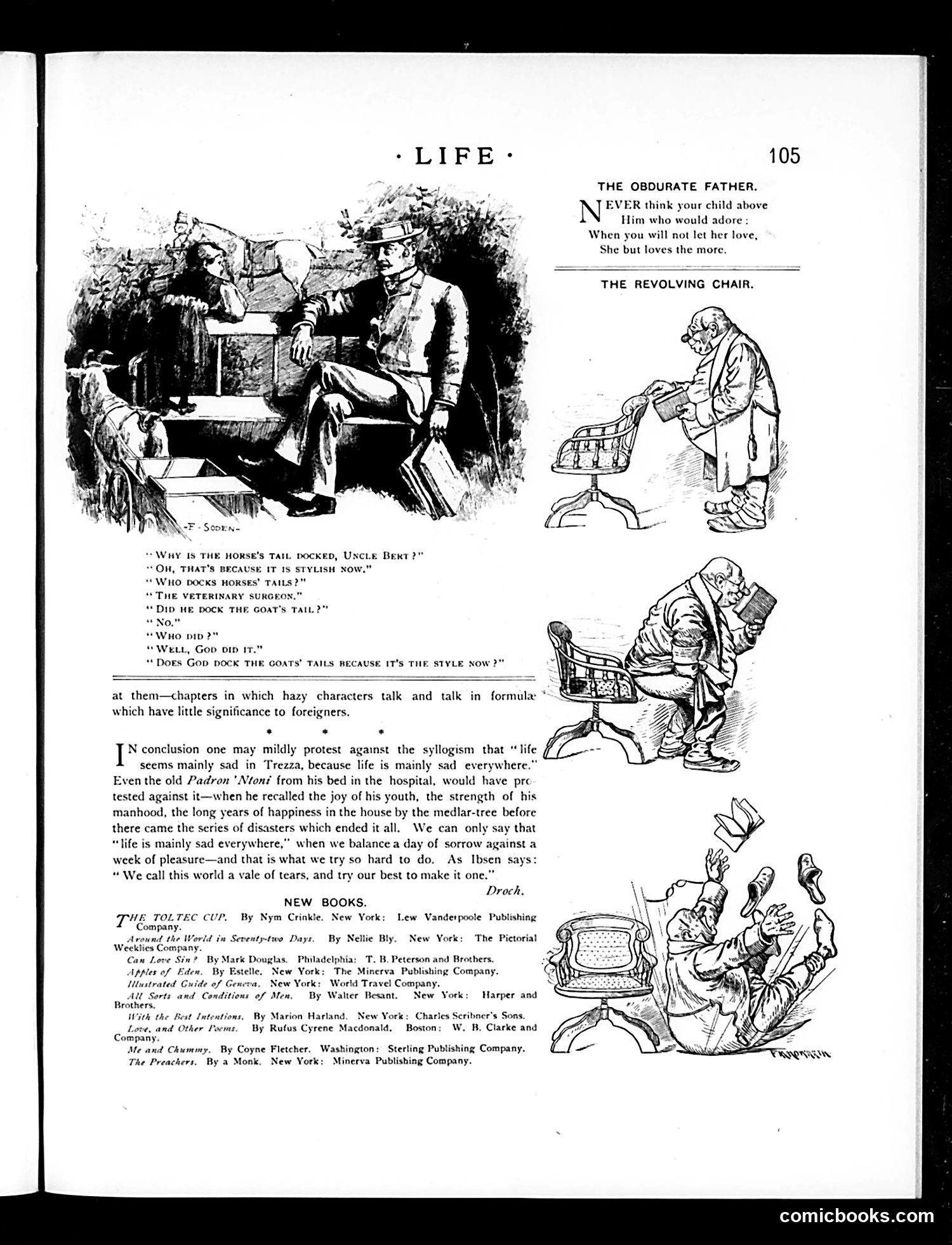
**"The Obdurate Father"** (top left cartoon): A dialogue joke about why a horse's tail is docked. Uncle Ben explains it's "stylish now," but the humor derives from the absurdist logic—the veterinary surgeon docks horses' tails, so people assume it must be fashionable. This satirizes blind conformity to arbitrary trends without questioning their origins. **"The Revolving Chair"** (right panel): Three sequential cartoon panels showing a man attempting to use a revolving chair, apparently struggling with or being comically defeated by this piece of furniture. This likely mocks the newfangled office technology of the era, suggesting modern innovations could be impractical or ridiculous. Both cartoons employ gentle satire typical of Life's humor style.
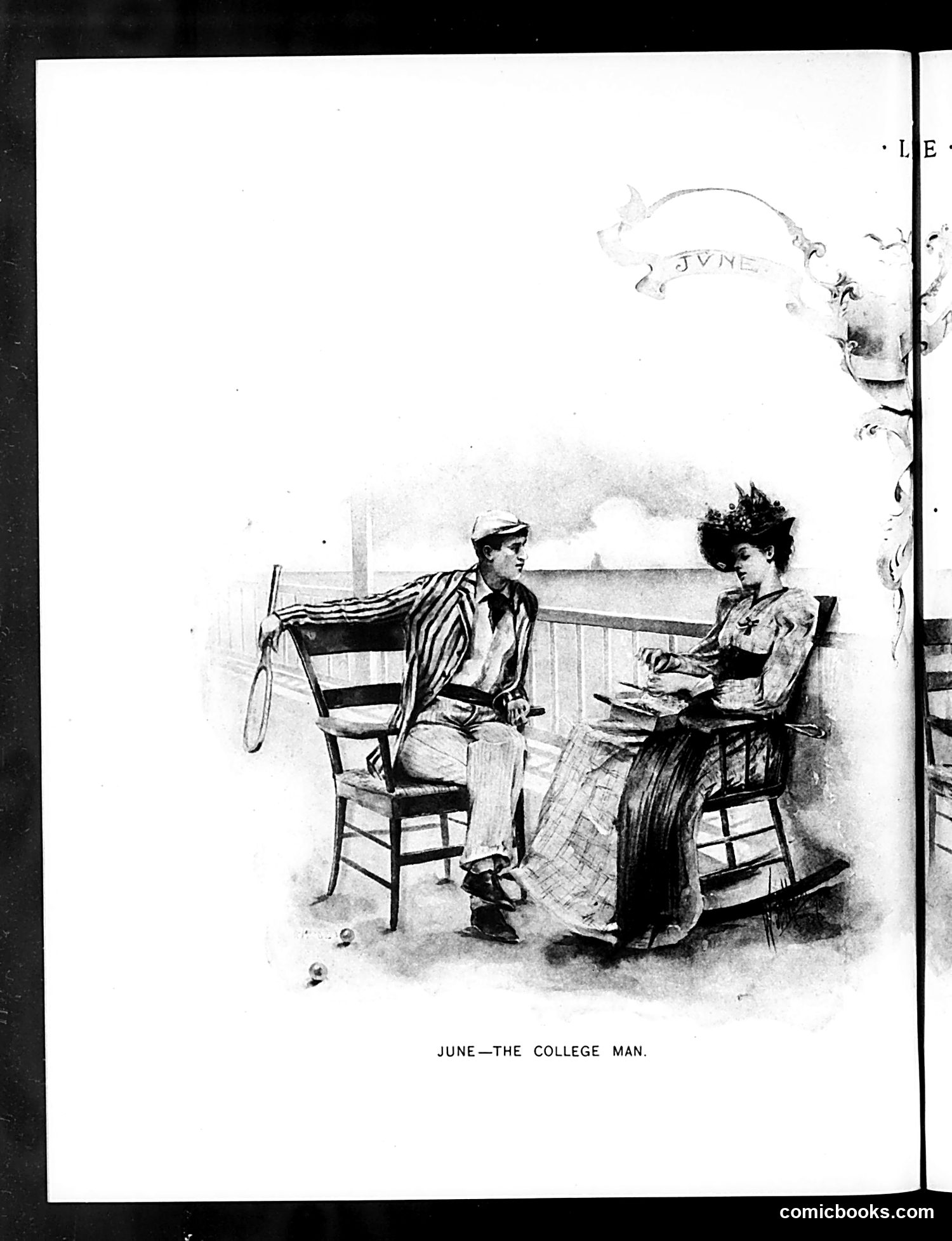
This satirical illustration depicts a young man in a boater hat and striped jacket sitting with a woman by what appears to be a seaside railing. The caption identifies him as "the college man." The satire likely mocks the idle leisure lifestyle of college-educated men during this period. The scene suggests romantic flirtation or courtship rather than productive activity—the man appears to be relaxing and socializing rather than working or pursuing serious endeavors. His fashionable attire and casual demeanor, combined with the romantic seaside setting, suggest he represents a privileged class enjoying summer leisure. The joke appears to critique the college man as more concerned with social pleasures and romance than meaningful work or contribution to society.
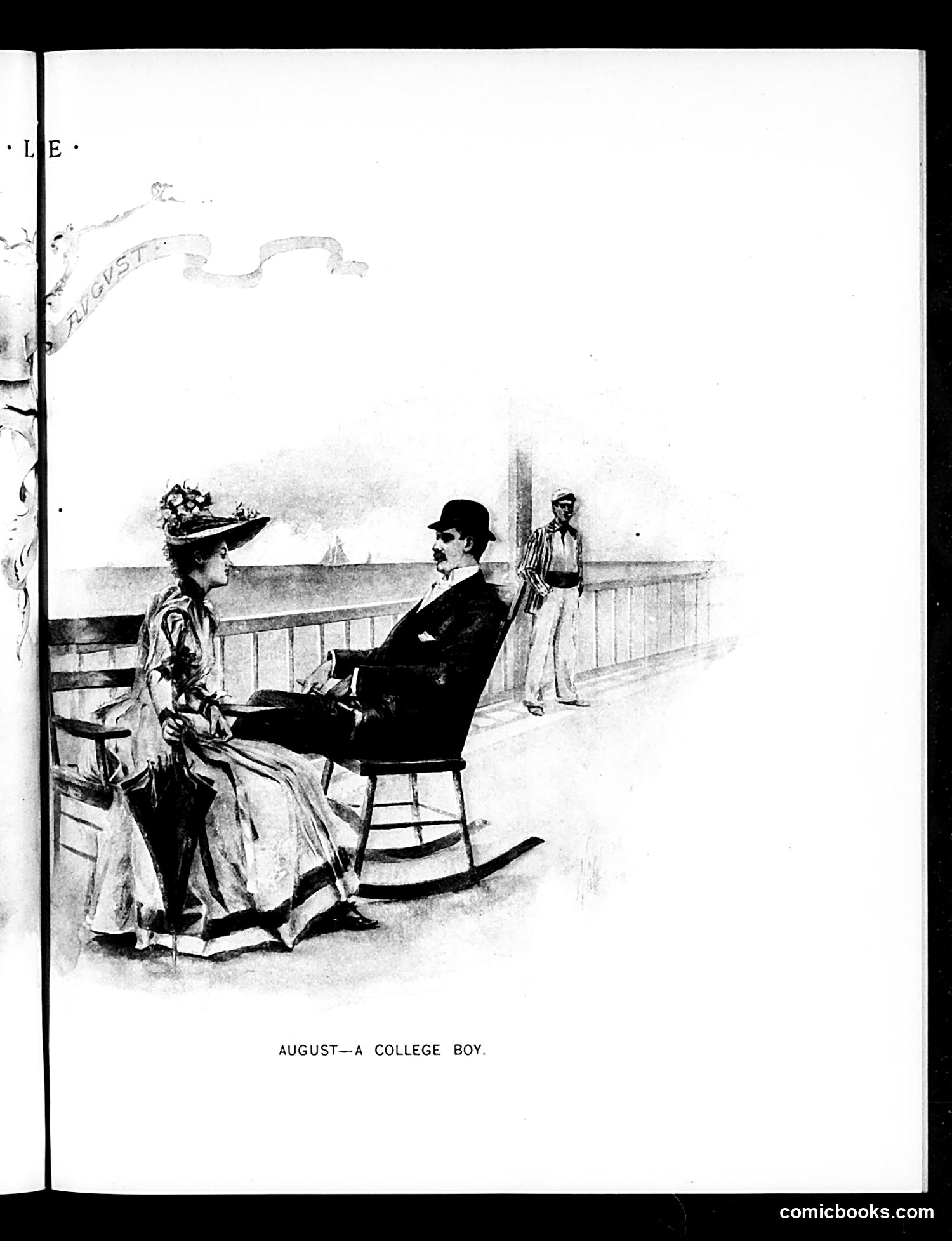
This illustration depicts a scene set at what appears to be a waterfront or seaside promenade, with a woman in an elaborate hat standing beside a man in a rocking chair. A third figure stands in the background. The caption "August—A College Boy" suggests this is part of a monthly series. The satire likely mocks the leisure and idleness of college-aged young men during summer vacation. The man reclines passively in a rocking chair—traditionally associated with elderly retirees—implying that college boys spend August in lazy inactivity rather than productive pursuits. The well-dressed woman appears to be his companion, possibly suggesting romantic distraction or social frivolity as another form of summer occupation for the privileged class.
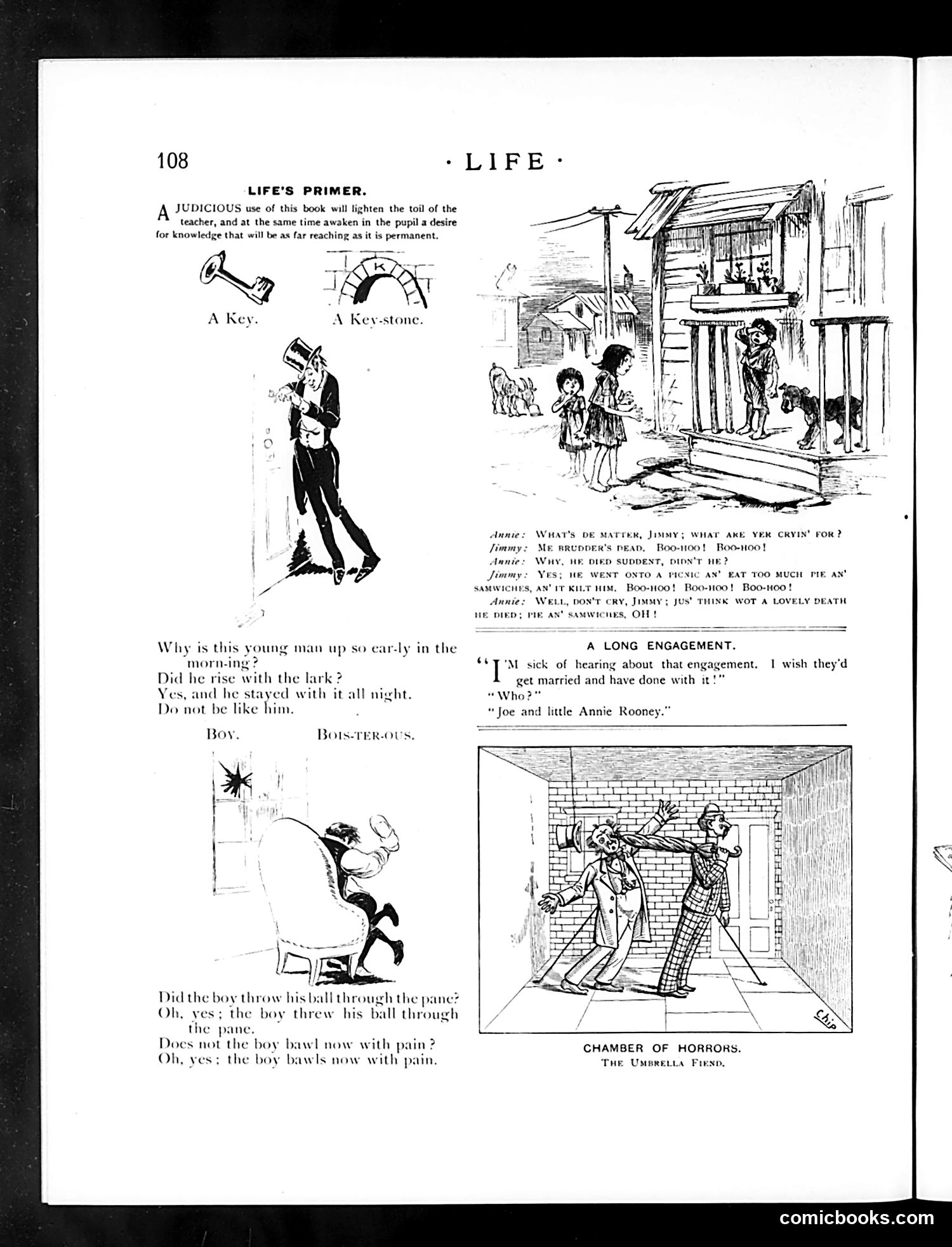
This page contains several unrelated humorous sketches typical of Life's satirical format: **"Life's Primer"** teaches through architectural/structural puns (a key, a keystone). **"Boy, Boisterous"** depicts a mischievous boy who threw a ball through a window pane, now suffering consequences—a gentle moral lesson about boyish pranks. **"A Long Engagement"** quotes Joe and Annie Rooney expressing frustration with prolonged engagement, suggesting commentary on marriage customs of the era. **"Chamber of Horrors: The Umbrella Fiend"** shows someone wielding an umbrella recklessly in an enclosed space, satirizing inconsiderate public behavior. The overall tone is lighthearted domestic satire targeting recognizable social annoyances and childhood misbehavior, without specific political references. These are generic observations on manners and social conduct typical of Life's humor circa early 20th century.
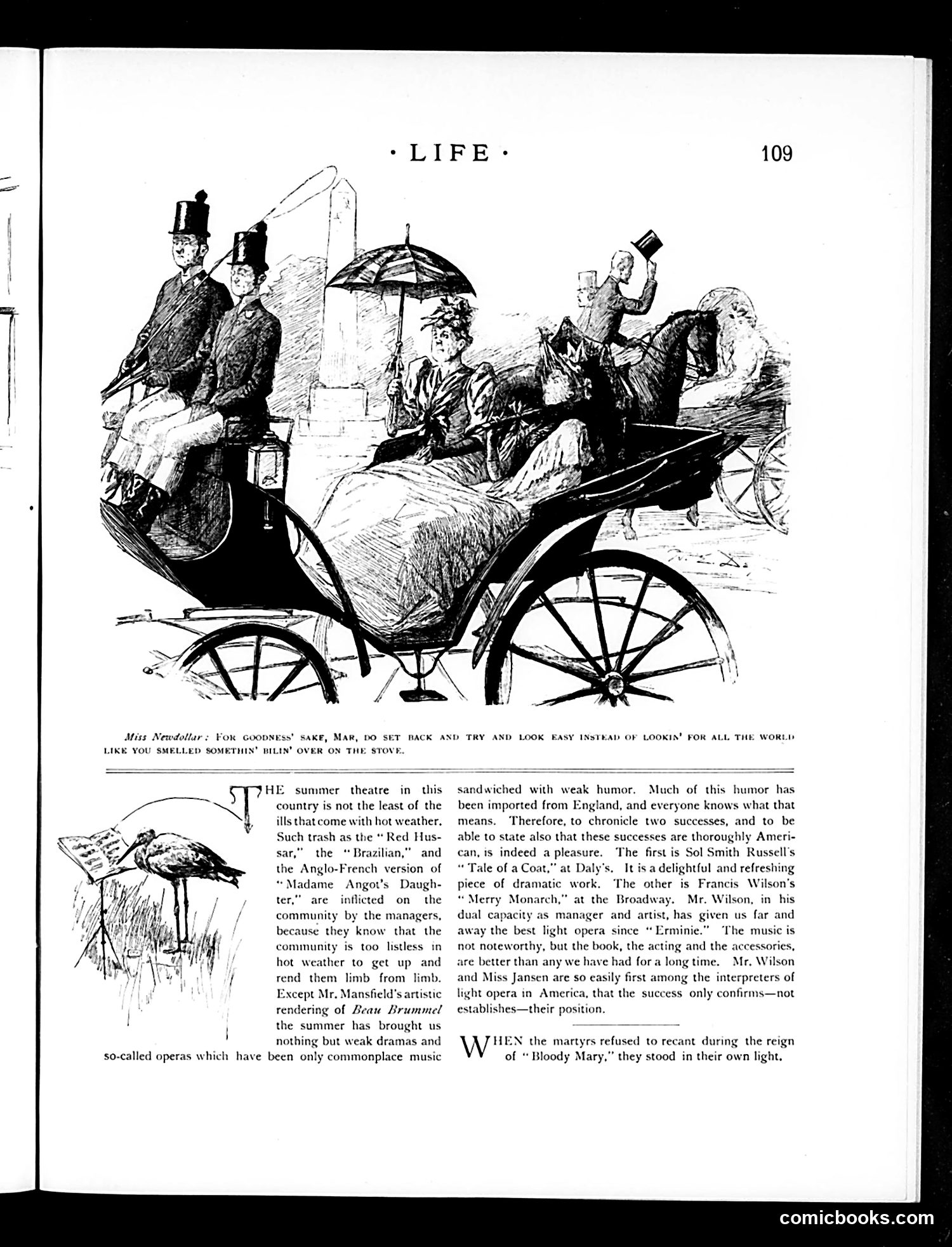
The top cartoon satirizes Victorian-era carriage etiquette and social pretension. It depicts fashionable passengers in an open carriage—two men in top hats alongside elegantly dressed women with parasols. The caption mocks "Miss Noseblier," advising her to "set back and try and look easy" rather than craning her neck to gawk at the world "like you smelled somethin' bllis over on the stove." The satire targets upper-class affectation: the pretense of refined, composed behavior while actually being intensely curious about street life and gossip. The contrast between the performers' elaborate dress and their undignified nosiness exposes the gap between social aspiration and human nature. The accompanying text discusses summer theater productions, mentioning works like "Boan Drummel," light opera successes, and performers Mr. Wilson and Miss Jansen—context for contemporary entertainment references.
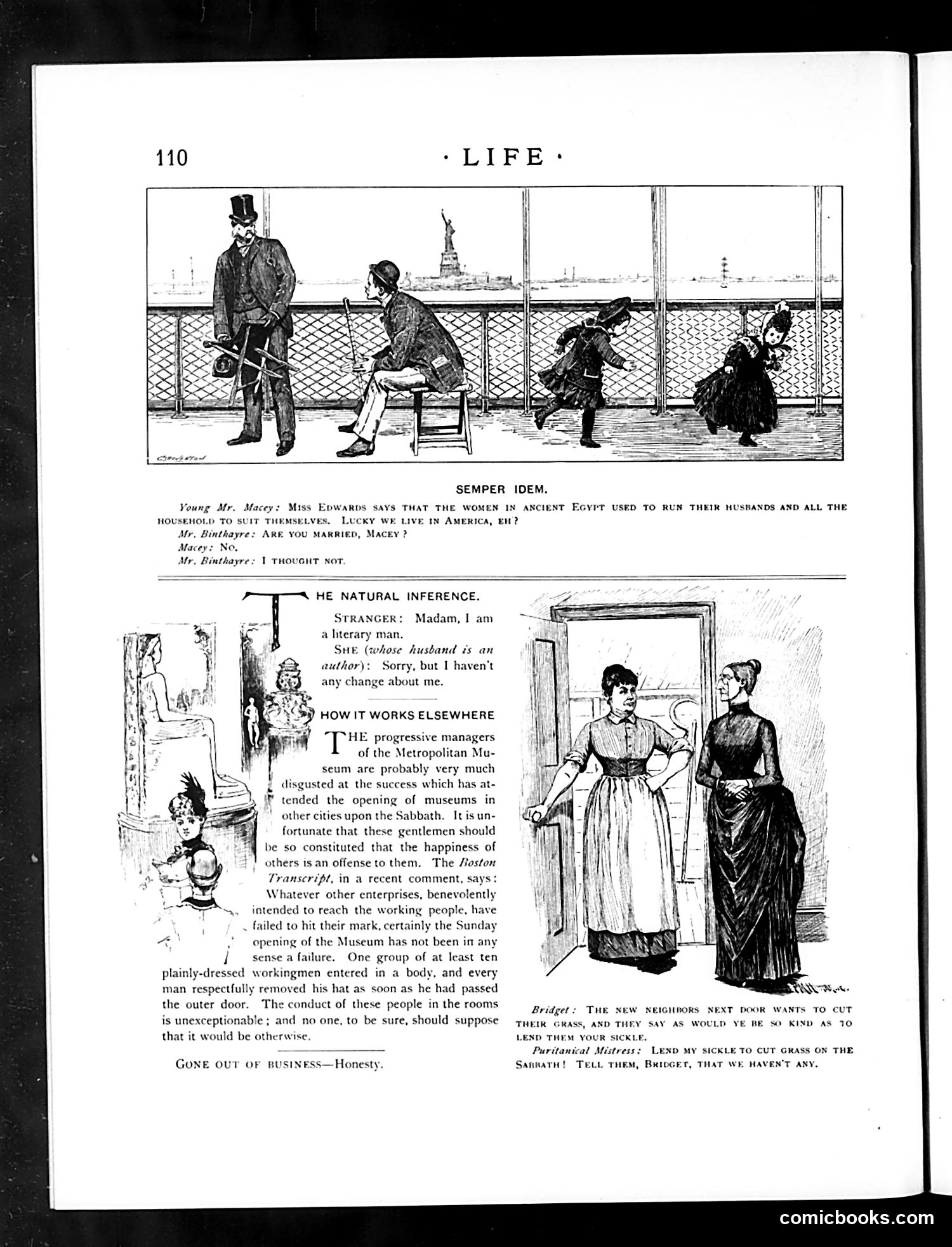
This page contains three satirical pieces mocking Victorian social hypocrisy: **"Semper Idem"** (top): A conversation between Mr. Macey and Mr. Birthaye on a ship. Miss Edwards mentions ancient Egyptian women managed households; Birthaye asks if women do this in America. The joke: Macey, unmarried, assumes this means women "run" (control) their husbands—implying wives dominate American marriages, contradicting the era's ideology of male authority. **"The Natural Inference"** (middle): A woman assumes a self-described "literary man" is poor and has no money to give. The satire: authors were stereotyped as impoverished, making the woman's snap judgment darkly humorous. **"How It Works Elsewhere"** (bottom right): A Puritanical mistress refuses to lend her sickle for neighbors to cut grass on the Sabbath, claiming she has none. The satire targets rigid religious observance—she lies rather than violate the Sabbath, exposing how "honesty" (the section header) vanishes when piety is involved.
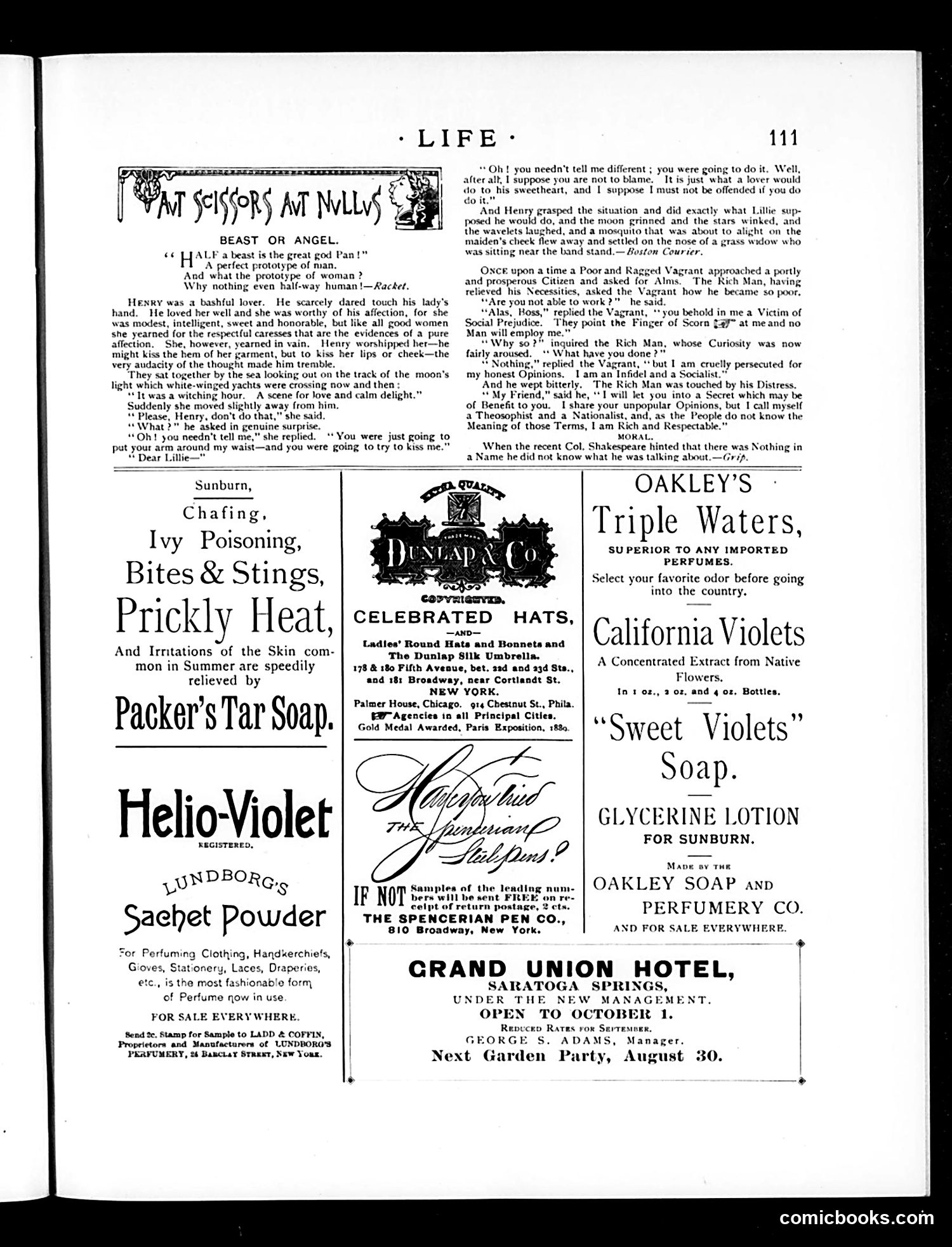
This page from *Life* contains two satirical stories that critique social hypocrisy and gender relations. **"At Scissors At Nulls" (top):** A sentimental love story where shy Henry finally kisses his modest sweetheart Lillie after she practically grants him permission—mocking Victorian courtship conventions and the tension between "respectable" restraint and actual romantic desire. **The vagrant story (bottom):** A poor man explains his persecution results from being an "Infidel and Socialist." A wealthy man sympathizes, then reveals his own secret: he holds identical radical beliefs but calls himself a "Theosophist" and "Nationalist" instead—terms the common people don't understand. The moral satirizes how the wealthy escape social prejudice through linguistic camouflage while the poor suffer for honest speech. Both pieces mock respectability, hypocrisy, and class double standards. The rest of the page is period advertisements for beauty and grooming products (soaps, perfumes, hats).
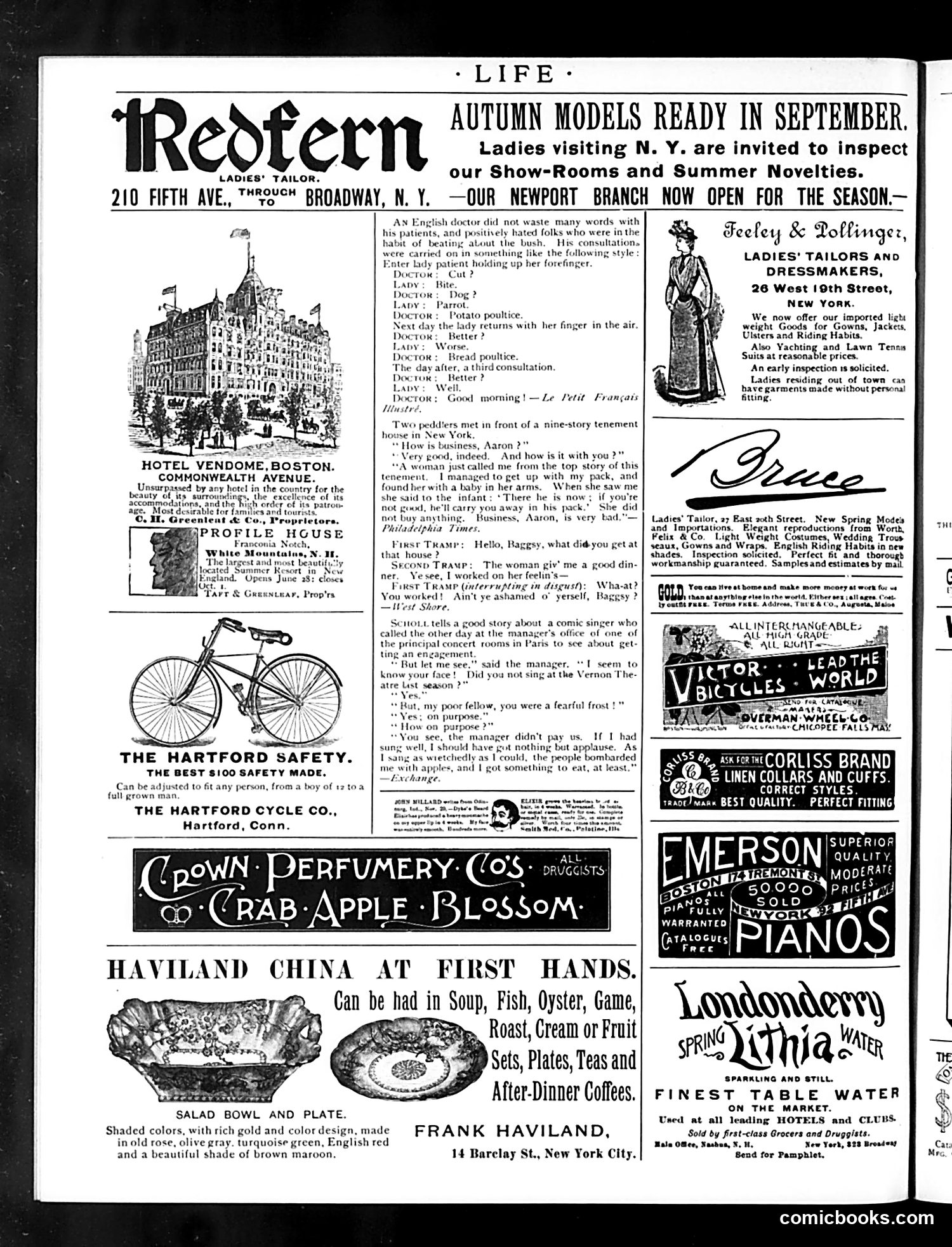
This is primarily a **fashion and advertising page** from Life magazine, not a political cartoon. The page announces autumn fashion collections from New York tailors (Redfern, Feeley & Lollinger) and promotes their Newport branch opening. The page includes several **humorous short stories** in the satirical style Life was known for: 1. A Scottish doctor who prescribes absurd remedies (potato poultice, bread poultice) with minimal consultation 2. Two street peddlers comparing business; one was told by a mother he'd "carry away" her misbehaving baby 3. A tramp who deliberately performed badly as a singer so audiences would pity him and give money rather than applaud 4. A comic singer who was a "fearful frost" (flop) but got paid because sympathetic audiences threw money These jokes satirize **class dynamics, survival hustle, and the absurdity of human behavior**—common Life magazine themes. The remainder comprises straightforward advertisements for bicycles, pianos, china, perfume, and water.
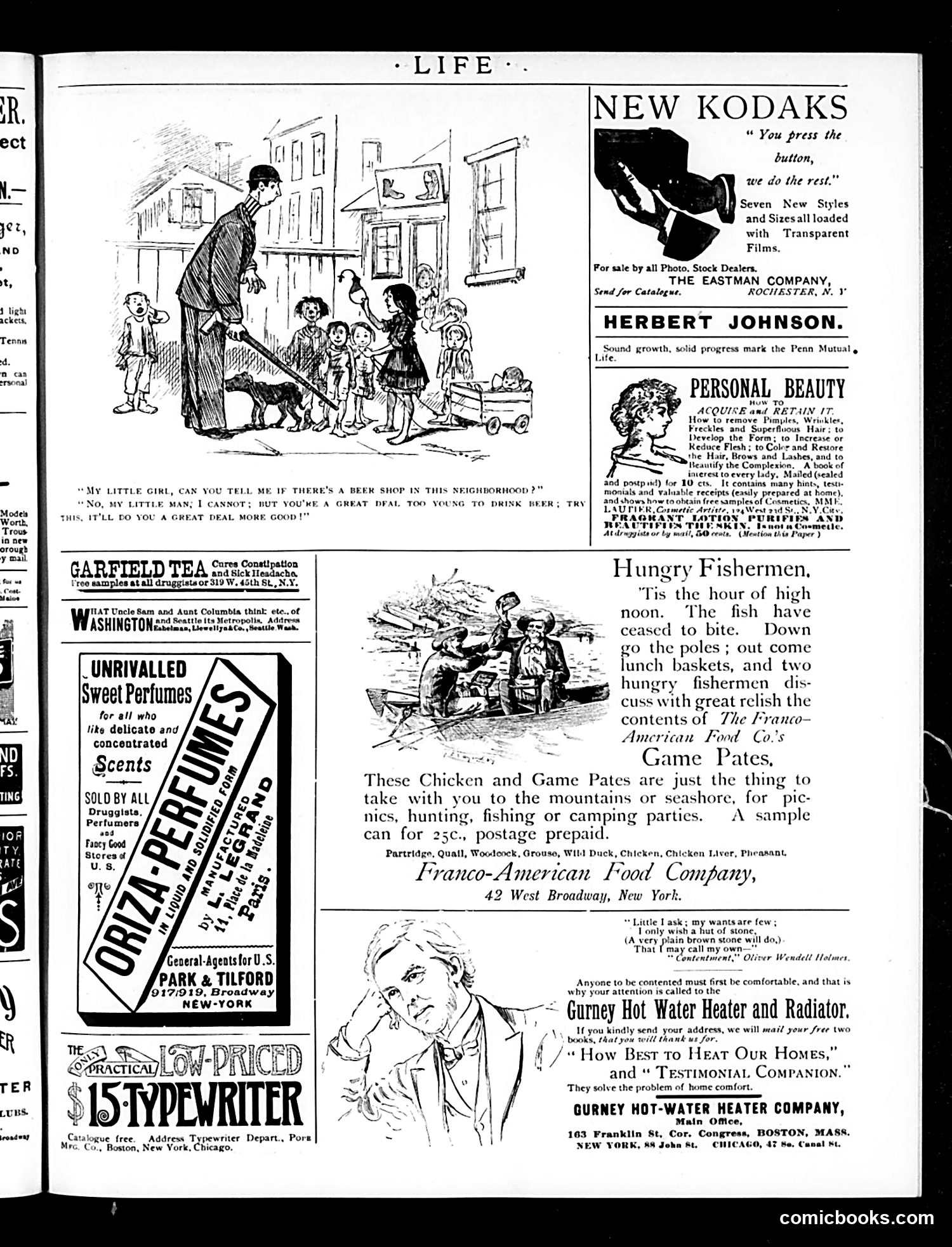
The main cartoon depicts an adult man asking a young child if there's a beer shop nearby—a joke about the child's small stature and the adult's questionable judgment. The caption's response ("You're a great deal too young to drink beer; try this, it'll do you more good!") is satire: the adult suggests the child drink something else instead, mocking both the original inappropriate question and advertising practices of the era that promoted patent medicines and tonics as cure-alls for all ages. The page is primarily **advertisements** for products typical of the period: Kodak cameras, typewriters, beauty treatments, perfumes, canned foods, and hot-water heaters. These ads reflect turn-of-the-century consumer culture and product marketing strategies. The "Hungry Fishermen" section advertises Franco-American Game Pates as portable lunch food for outdoor activities—reflecting the era's emerging leisure culture among the middle class.
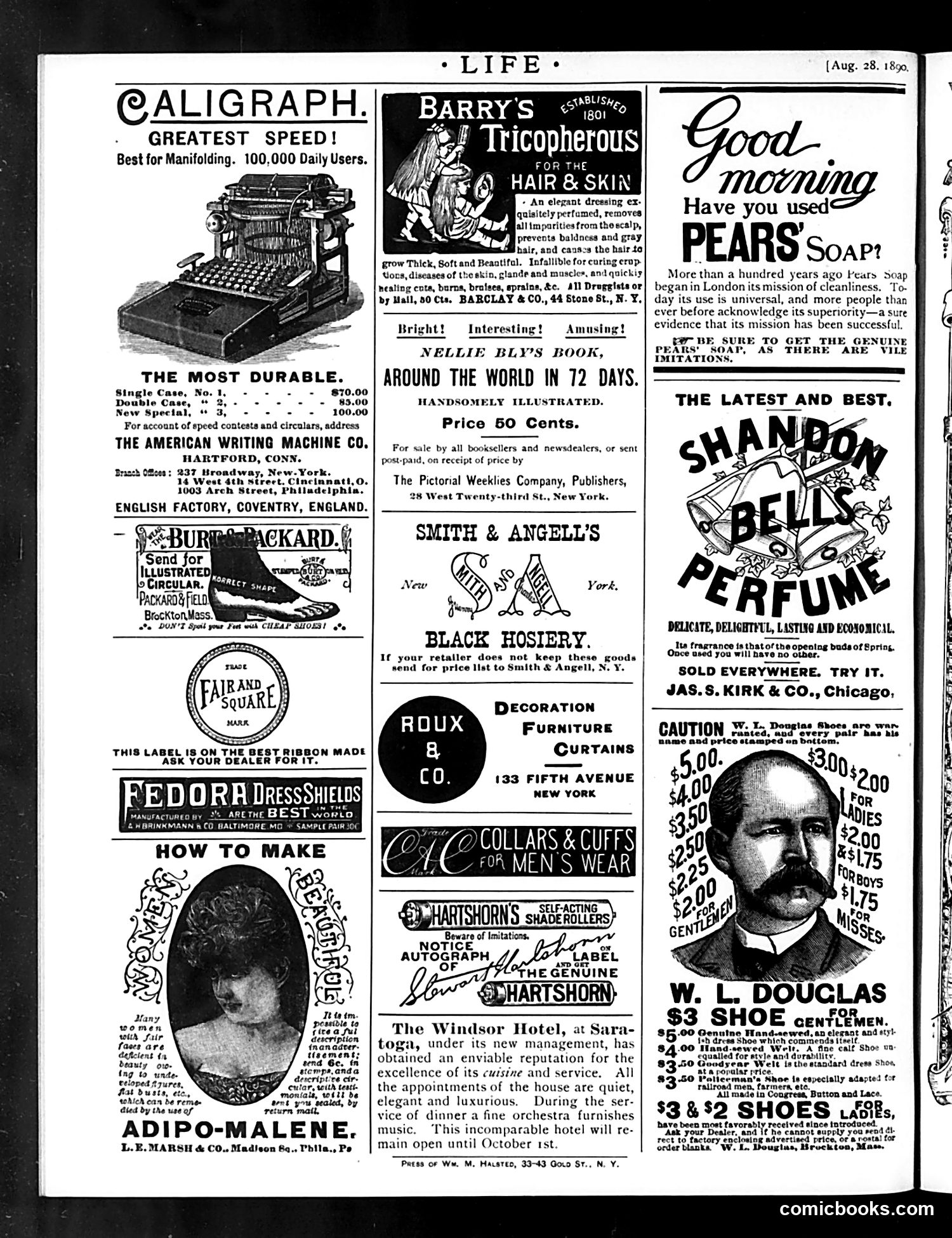
This is primarily an **advertising page** with no political cartoons or satire. The content consists entirely of commercial advertisements typical of the 1890s. Notable ads include: - **Caligraph typewriter** — marketed as fastest for business use - **Nellie Bly's book** — "Around the World in 72 Days," referencing the famous journalist's 1889 circumnavigation race - **Patent medicines** — Adipo-Malene (weight loss) and Barry's Tricopherous (hair/skin treatment), representing the era's unregulated health product market - **W.L. Douglas shoes** — a major brand of the period - **Pears soap** — emphasizing British heritage and "cleanliness" - **Luxury goods** — perfume, furniture, collars, hotel services The page reflects 1890s consumer culture and advertising conventions. The "Adipo-Malene" section includes an illustration of a woman's face, typical of beauty product marketing of the era. No satire or political commentary is evident.