
Life, 1890-08-28 · page 4 of 16
Life — August 28, 1890 — page 4: what you’re looking at
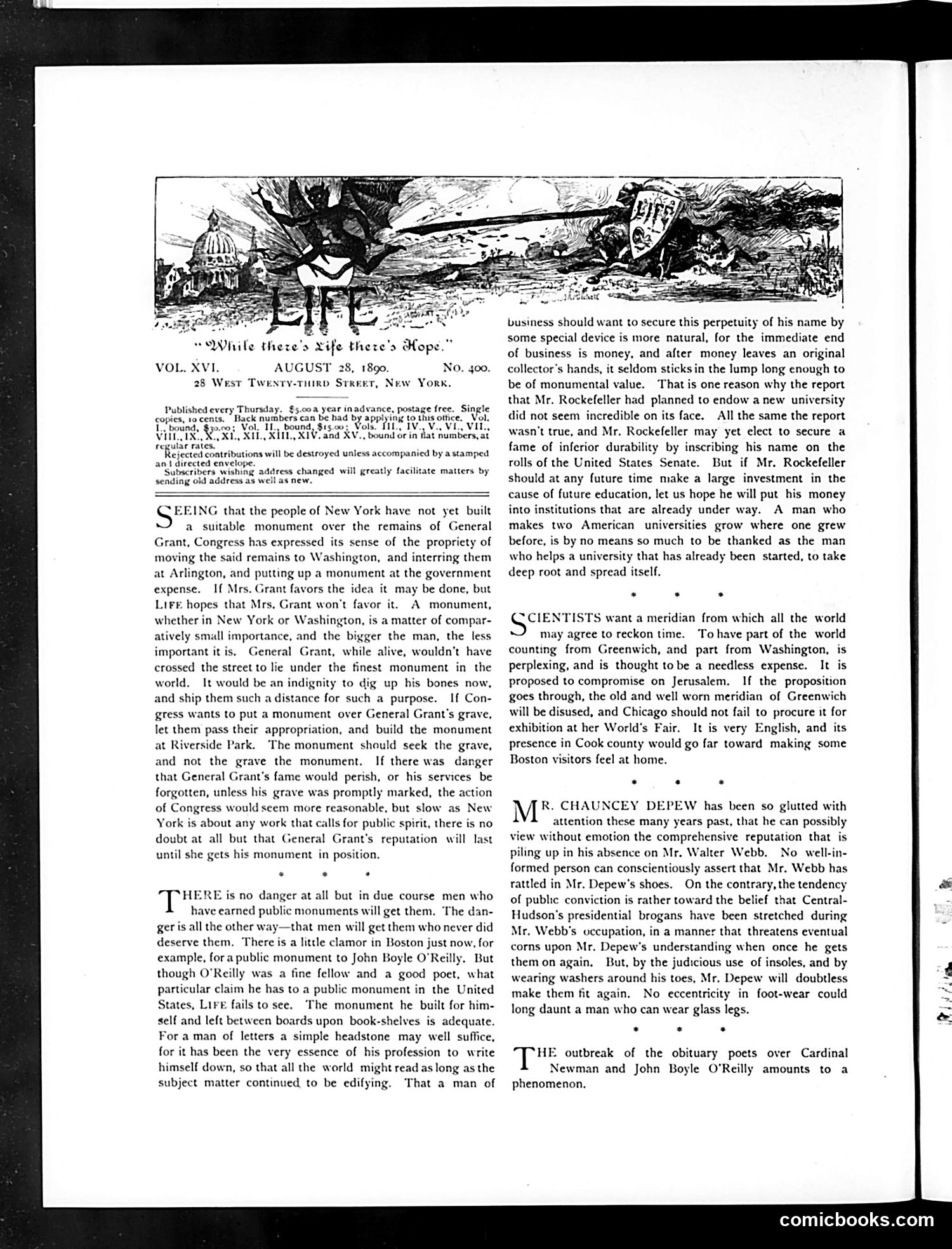
A restored page from Life, 1890-08-28. Page through the whole issue in the reader above.
📄 Transcribed text from this page (OCR, searchable)
Machine-transcribed from the original scan — historical spelling and the odd misread are preserved.
“Wirile there's Life there's Hope. XVI. No. 400. 28 West Twenty-Tiirp Srreer, New Yor. Published every Thursday. 5.00 year inadvance, postage free. Single copies, 1o cents. Back numbers can be had by applying tothisottice. Vol. I., bound, Soo; Vol. IL, bound, $15.00; Vols. ML, IV. V., VE. VE NXT. XUL, XHIL, XIV. and XV., bound or in flat numbers, at regular rates, Rejected contributions will be destroyed unless accompanied by a stamped an J directed envelope. Subscribers wishing address changed will greatly facilitate matters by ig old address as well as new, ZEING that the people of New York have not yet built a suitable monument over the remains of General ant, Congress has expressed its sense of the propriety of moving the said remains to Washington, and interring them at Arlington, and putting up a monument at the government expense. If Mrs. Grant favors the idea it may be done, but Lire hopes that Mrs, Grant won't favor it. A monument, whether in New York or Washington, is a matter of compar- atively small importance, and the bigger the man, the less important it is. General Grant, while alive, wouldn't have crossed the street to lie under the finest monument in the world. It would be an indignity to dig up his bones now, and ship them such a distance for such a purpose. If Con- gress wants to put a monument over General Grant's grave, let them pass their appropriation, and build the monument at Riverside Park. The monument should seek the grave, and not the grave the monument. If there was danger that General Grant's fame would perish, or his services be forgotten, unless his grave was promptly marked, the action of Congress would seem more reasonable, but slow as New York is about any work that calls for public spirit, there is no doubt at all but that General Grant's reputation will last until she gets his monument in position, i I *HERE is no danger at all but in due course men who have earned public monuments will get them, The dan- ger is all the other way—that men will get them who never did deserve them, There is a litdle clamor in Boston just now, for example, fora public monument to John Boyle O'Reilly. But though O'Reilly was a fine fellow and a good poet, what particular claim he has to a public monument in the United States, Lire fails to see. The monument he built for him- self and left between boards upon book-shelves is adequate. For a man of letters a simple headstone may well suffice, for it has been the very essence of his profession to write himself down, so that all the world might read as long as the subject matter continued to be edifying. That a man of business should want to secure this perpetuity of his name by some special device is more natural, for the immediate end of business is money, and after money leaves an original collector's hands, it seldom sticks in the lump long enough to be of monumental value. That is one reason why the report that Mr. Rockefeller had planned to endow a new university did not seem incredible on its face. All the same the report wasn't true, and Mr, Rockefeller may yet elect to secure a fame of inferior durability by inscribing his name on the rolls of the United States Senate. But if Mr. Rockefeller should at any future time make a large investment in the cause of future education, let us hope he will put his money into institutions that are already under way. A man who makes two American universities grow where one grew before, is by no means so much to be thanked as the man who helps a university that has already been started, to take deep root and spread itself. . . . ~ CIENTISTS want a meridian from which all the world may agree to reckon time. To have part of the world counting from Greenwich, and part from Washington, is perplexing, and is thought to be a needless expense. It is proposed to compromise on Jerusalem. If the proposition goes through, the old and well worn meridian of Greenwich will be disused, and Chicago should not fail to procure it for exhibition at her World's Fair. It is very English, and its presence in Cook county would go far toward making some Boston visitors feel at home. . . . R. CHAUNCEY DEPEW has been so glutted with attention these many years past, that he can possibly view without emotion the comprehensive reputation that is piling up in his absence on Mr. Walter Webb. No well-in- formed person can conscientiously assert that Mr. Webb has rattled in Mr. Depew's shoes. On the contrary, the tendency of public conviction is rather toward the belief that Central- Hudson's presidential brogans have been stretched during Mr, Webb's occupation, in a manner that threatens eventual corns upon Mr. Depew’s understanding when once he gets them on again, But, by the judicious use of insoles, and by wearing washers around his toes, Mr. Depew will doubtless make them fit again. No eccentricity in foot-wear could long daunt a man who can wear glass legs. . . . HE outbreak of the obituary poets over Cardinal Newman and John Boyle O'Reilly amounts to a phenomenon. comicbooks.com