
Life, 1890-08-28 · page 6 of 16
Life — August 28, 1890 — page 6: what you’re looking at
What you’re looking at
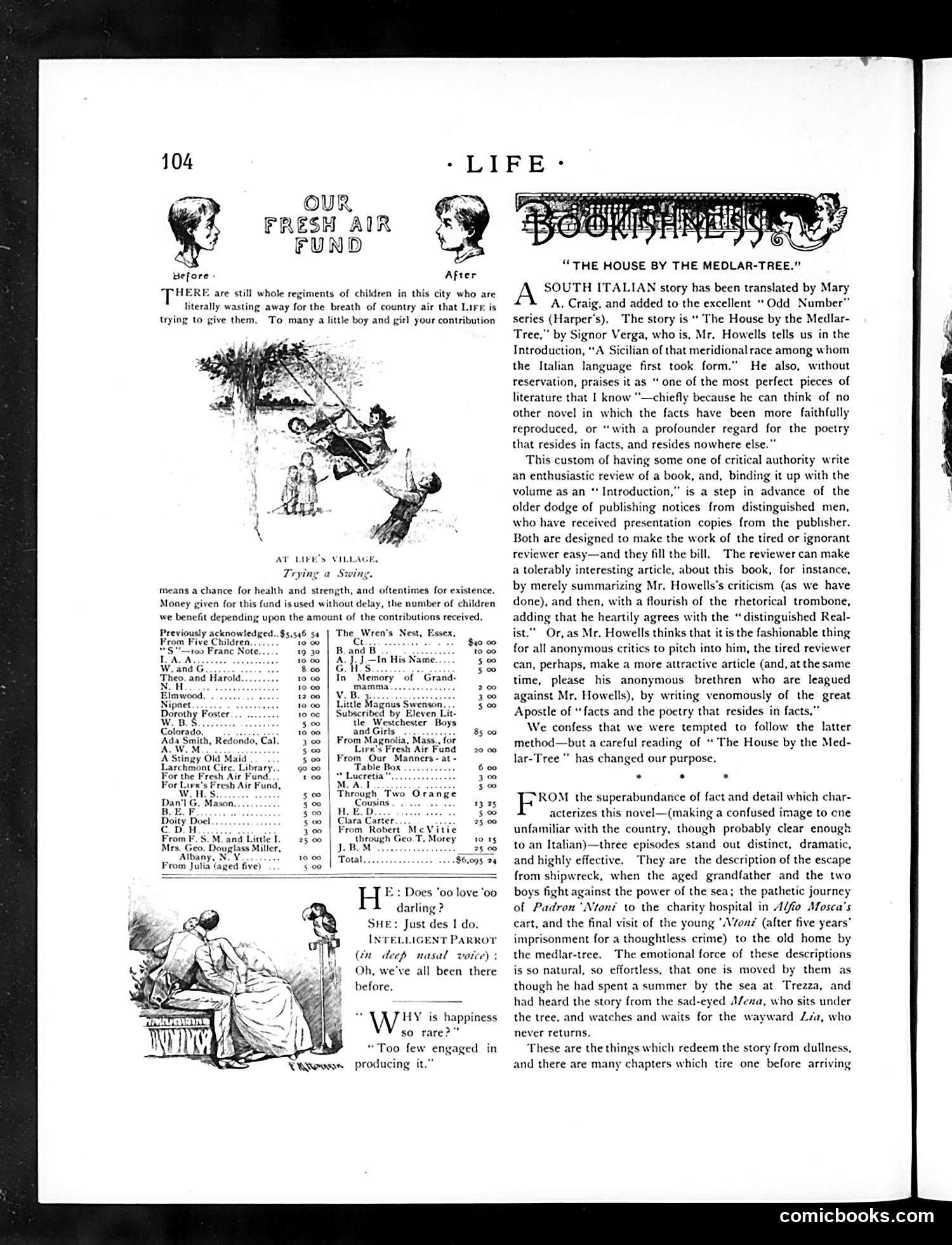
This page contains two distinct sections: **"Our Fresh Air Fund" (left):** A charitable appeal featuring illustrations of impoverished urban children. The text solicits donations to send sick city children to the countryside for health and "strength." A list of donors and contribution amounts follows, representing typical early 20th-century philanthropic fundraising. The illustration depicts children in need, visually reinforcing the appeal's emotional message. **"Books Being" (right):** A book review of "The House by the Medlar-Tree," a translated Italian novel by Signor Verga. The reviewer discusses the work's literary merit, facts-versus-poetry balance, and emotional effectiveness. A humorous dialogue exchange appears below, contrasting perspectives on happiness. The page balances charitable advocacy with literary criticism, reflecting Life magazine's mix of social commentary and cultural content.
📄 Transcribed text from this page (OCR, searchable)
Machine-transcribed from the original scan — historical spelling and the odd misread are preserved.
OUR FRESH AIR FUND After HERE are still whole regiments of children in this city who are literally wasting away for the breath of country air that Lire is trying to give them. To many a little boy and girl your contribution means a chance for health and strength, and oftentimes for existence. Money given for this fund isused without delay, the number of children we benefit depending upon the amount of the contributions received. The Wren's Nest, vet Band B A. J.J —In His Name. G.WS.... . In Memory’ of " Grand- MAMIE 6c csedsess Nipnet feeeeen ttle Magnus Swenson... Dorothy Fo: ; Subscribed by Eleven Lit- k ae tle Westchester Boys Colorado. ee and Girls mith, Redondo, Cal. From Magnolia, Mass. for A.W. Lirs’s Fresh Air Fund A Stingy Old Maid From Our Manners - at - Larchmont Circ. Library. Table Box . For the Fresh Air Fund. S Lucretia”, For Live's Fresh Air Fund, M.A.I Z WLS. : Through Two Orange Dan'l G. Mason Cousins... ee oe BLE. F : HE. D. Doity Doel see Clara Carter > CD. Hee... From Robert MeVitie From F.S. Mand Little 1. through Geo.T, Morey Mrs. Geo. Douglass Miller, B.M serene : Albany, N.Y or Does ‘oo love ‘oo darling ? SHE: Just des I do. INTELLIGENT PARROT. (in deep nasal votce) : Oh, we've all been there before, ‘ \ HY is happiness so rare?” “Too few engaged in producing “THE HOUSE BY THE MEDLAR-TREE.” SOUTH ITALIAN story has been translated by Mary A. Craig, and added to the excellent ‘Odd Number” series (Harper's). The story is ‘* The House by the Medlar- Tree,” by Signor Verga, who is, Mr. Howells tells us in the Introduction, “A Sicilian of that meridional race among whom the Italian language first took form.” He also, without reservation, praises it as “one of the most perfect pieces of literature that I know hiefly because he can think of no other novel in which the facts have been more faithfully reproduced, or “with a profounder regard for the poetry that resides in facts, and resides nowhere else.” This custom of having some one of critical authority write an enthusiastic review of a book, and, binding it up with the volume as an “Introduction,” is a step in advance of the older dodge of publishing notices from distinguished men, who have received presentation copies from the publisher. Both are designed to make the work of the tired or ignorant reviewer easy—and they fill the bill. The reviewer can make a tolerably interesting article, about this book, for instance, by merely summarizing Mr. Howells’s criticism (as we have done), and then, with a flourish of the rhetorical trombone, adding that he heartily agrees with the “distinguished Real- ist." Or, as Mr. Howells thinks that it is the fashionable thing for all anonymous critics to pitch into him, the tired reviewer can, perhaps, make a more attractive article (and, at the same time, please his anonymous brethren who are leagued against Mr. Howells), by writing venomously of the great Apostle of “facts and the poetry that resides in facts.” We confess that we were tempted to follow the latter method—but a careful reading of ‘ The House by the Med- lar-Tree " has changed our purpose, . . . FR the superabundance of fact and detail which char- acterizes this novel—(making a confused image to cne unfamiliar with the country, though probably clear enough to an Italian)—three episodes stand out distinct, dramatic, and highly effective. They are the description of the escape from shipwreck, when the aged grandfather and the two boys fight against the power of the sea; the pathetic journey of PadronNtoné to the charity hospital in Alfio Mosca’s cart, and the final visit of the young "Non? (after five years’ imprisonment for a thoughtless crime) to the old home by the medlar-tree. The emotional force of these descriptions is so natural, so effortless, that one is moved by them as though he had spent a summer by the sea at Trezza, and had heard the story from the sad-eyed J/exa, who sits under the tree, and watches and waits for the wayward Lea, who never returns. These are the things which redeem the story from dullness, and there are many chapters which tire one before arriving comicbooks.com —<- ~~ -| —_