
A complete issue · 14 pages · 1890
Life — August 14, 1890
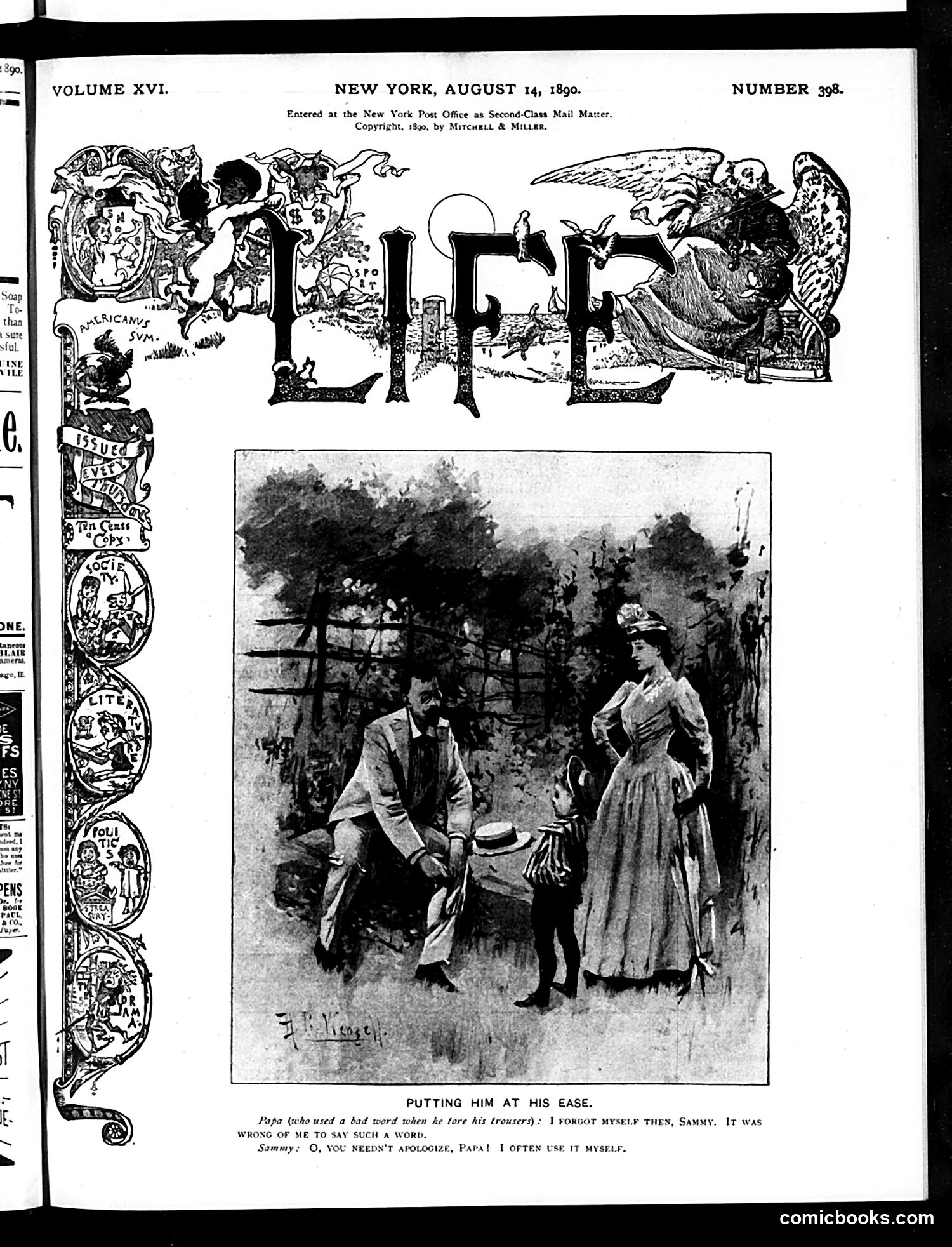
This page from *Life* magazine (August 14, 1890) shows an illustration titled "Putting Him at His Ease." The scene depicts a man and woman in what appears to be a garden or outdoor setting, with the woman standing assertively while the man sits. The caption references a child's accidental use of profanity ("Papa used a bad word when he tore his trousers"), establishing a domestic comedy scenario. The mother's response—telling the child not to apologize and that she "often uses it herself"—satirizes changing gender roles and women's increasing independence in the 1890s. The joke targets Victorian propriety by suggesting modern women were abandoning genteel restraint. The woman's confident posture and the man's seated position humorously invert traditional power dynamics, making this satire about emerging female assertiveness during the era of "New Woman" debates.
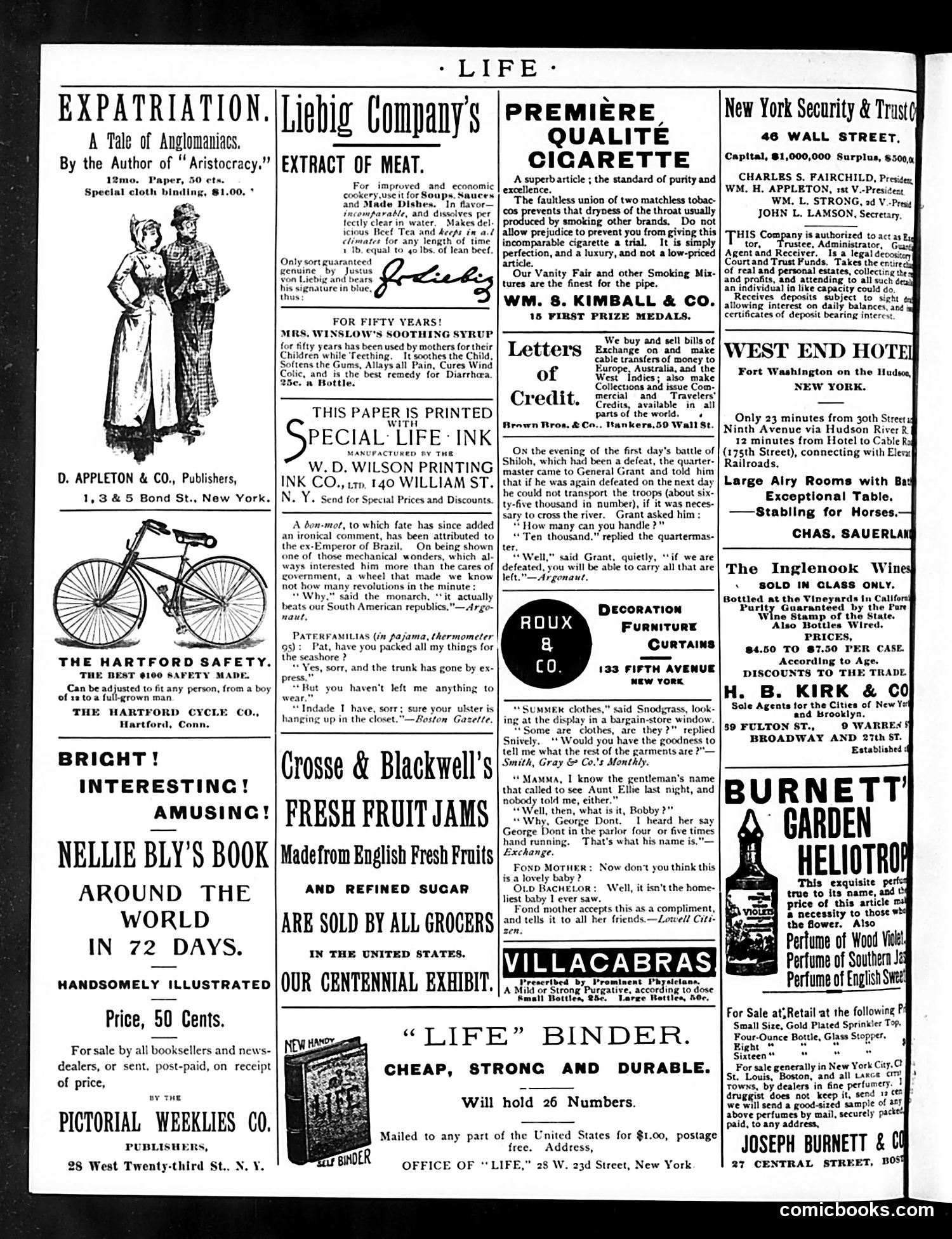
This satirical cartoon titled "A Tale of Anglomanias" depicts two figures—a woman in fashionable dress and a man in formal attire—illustrating American obsession with British culture and customs. The accompanying text references "Meadowcroft's" work, suggesting this mocks wealthy Americans who adopt English affectations and mannerisms. The satire criticizes anglophilia—the tendency of prosperous Americans to imitate British fashion, speech, and social practices as markers of sophistication. The cartoon's emphasis on their exaggerated clothing and poses suggests the pretentiousness of this behavior. The "expatriation" title implies these anglicized Americans were essentially renouncing American identity in favor of British cultural superiority, a common target of Life magazine's satirical commentary on American social trends and class pretension.
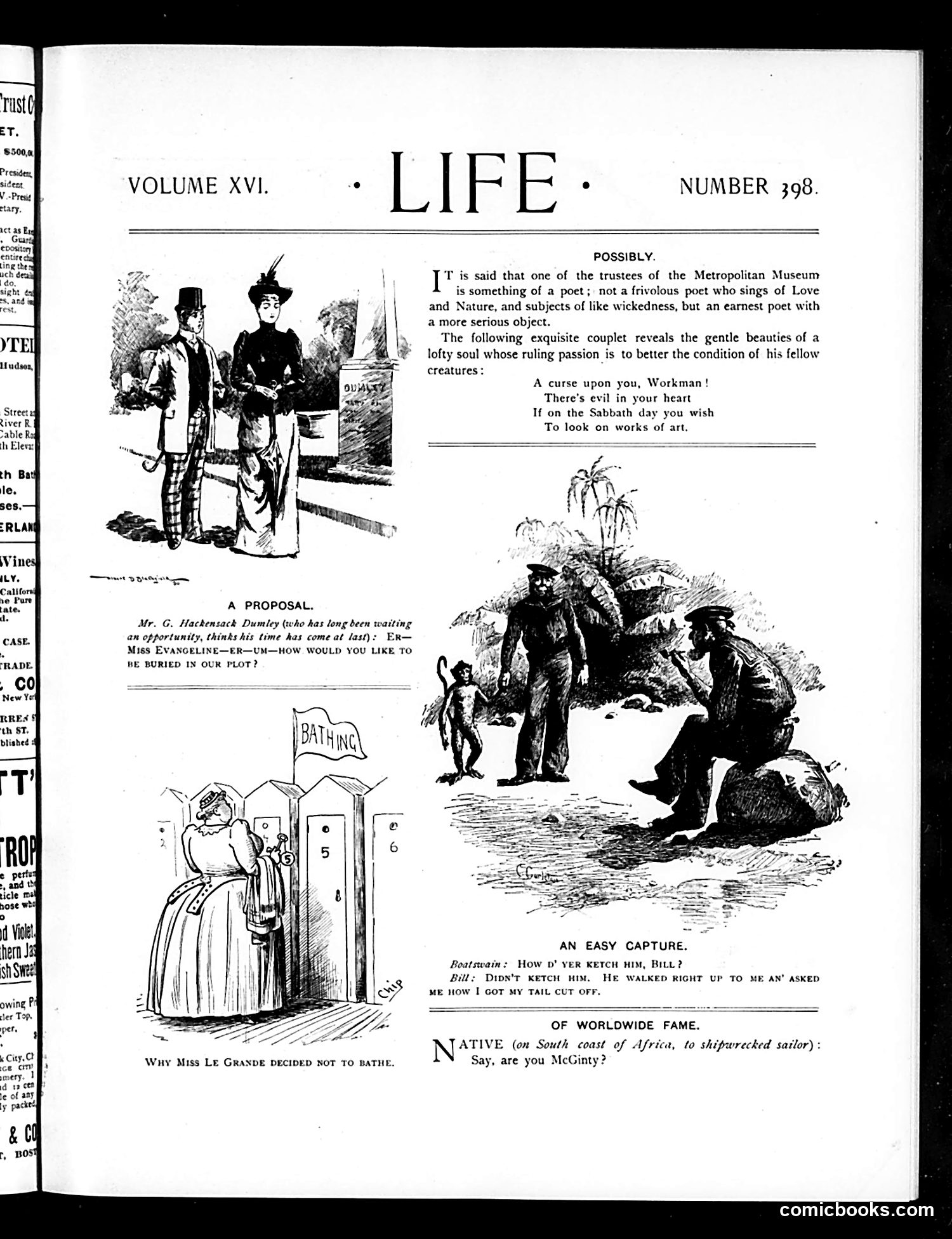
This page contains four satirical sketches with accompanying jokes typical of Life's humor: 1. **"Possibly"**: Opens with commentary on a Metropolitan Museum trustee who is "a poet" concerned with art appreciation, followed by a couplet mocking working-class disinterest in art. 2. **"A Proposal"**: Jokes about a man (Mr. G. Hockensmith Dumley) proposing burial arrangements to Miss Evangeline. 3. **"Why Miss Le Grande Decided Not to Bathe"**: A woman in a bathing facility declines to use changing rooms numbered 5-6, presumably due to modesty or privacy concerns—typical Victorian-era humor about women's bathing etiquette. 4. **"An Easy Capture"**: A boatman humorously explains how he caught someone by asking them to retrieve his severed tail. 5. **"Of Worldwide Fame"**: A brief joke about mistaken identity between a Native African and someone named McGinty.
The page is primarily text rather than a political cartoon. The masthead shows this is **Life magazine, Vol. XVI, No. 408**, published August 14, 1890, from New York. The article discusses **marriage and divorce reform**, specifically criticizing **Mona Caird's** theories on matrimony. Caird apparently advocated for easier dissolution of marriage contracts and reducing legal restrictions on unions. The author argues against her positions, particularly objecting to her proposal that courtship discussions precede marriage vows—viewing this as impractical and complicating established social custom. The piece also briefly addresses **Tolstoy's controversial books**, suggesting American readers shouldn't dismiss them as obscene simply because Russian religious doctrine condemns them. This reflects 1890s debates over women's rights, marriage law reform, and literary censorship.
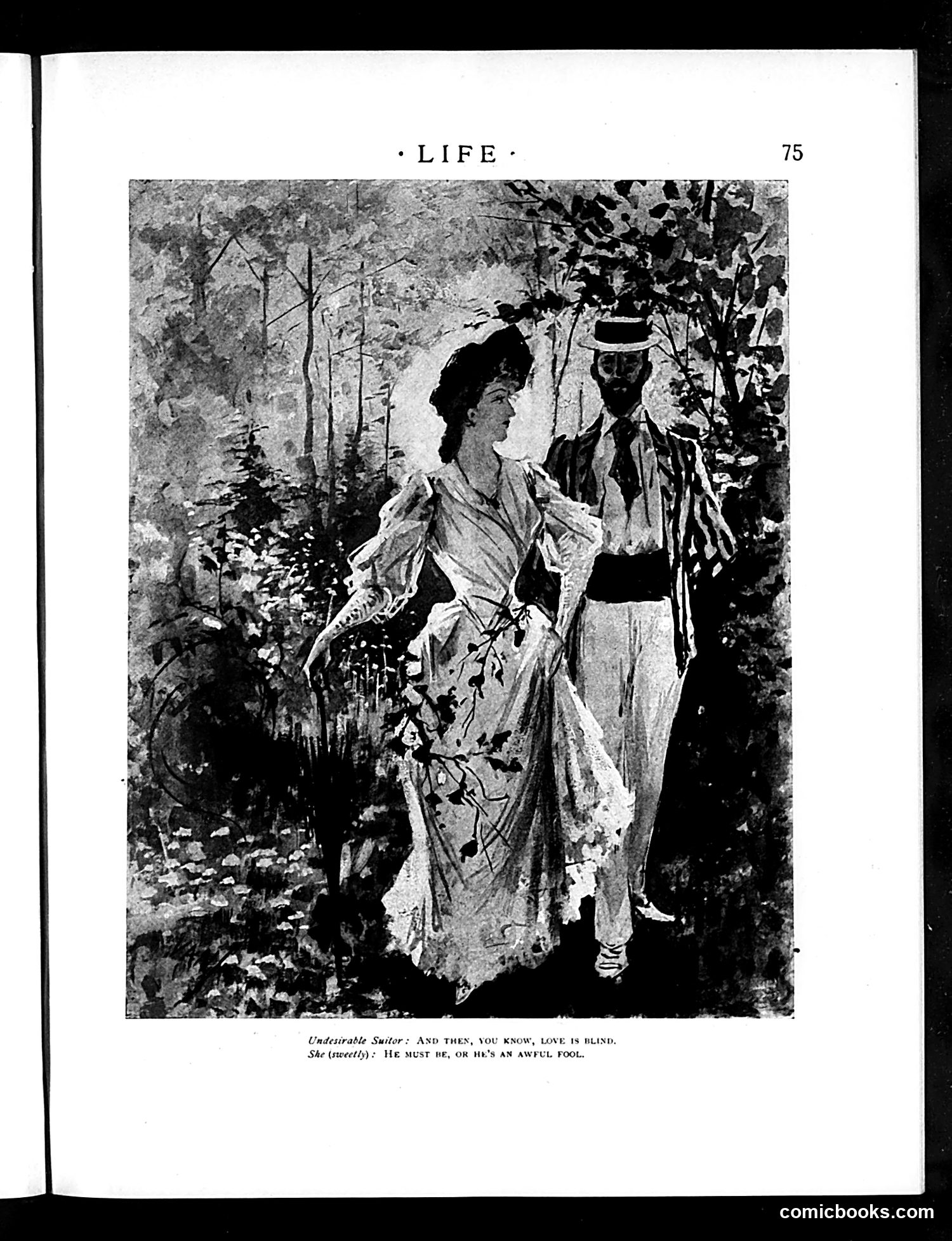
This page from *Life* magazine presents an illustration titled "Undesirable Sailor" with dialogue: "AND THEN, YOU KNOW, LOVE IS BLIND. SHE (MODESTLY): HE MUST BE, OR HE'S AN AWFUL FOOL." The image shows a woman in an elegant Edwardian-era dress encountering a man in sailor's uniform in a garden setting. The satire mocks an "undesirable" sailor—likely someone of lower social status or questionable character—courting a woman above his station. The woman's modest response suggests she's implying the sailor must be either blind (unable to see her superiority) or foolish (unable to recognize the mismatch in their social standings) to pursue her romantically. The joke reflects early 20th-century class anxieties about cross-class relationships, treating the sailor's romantic aspirations as inherently ridiculous.
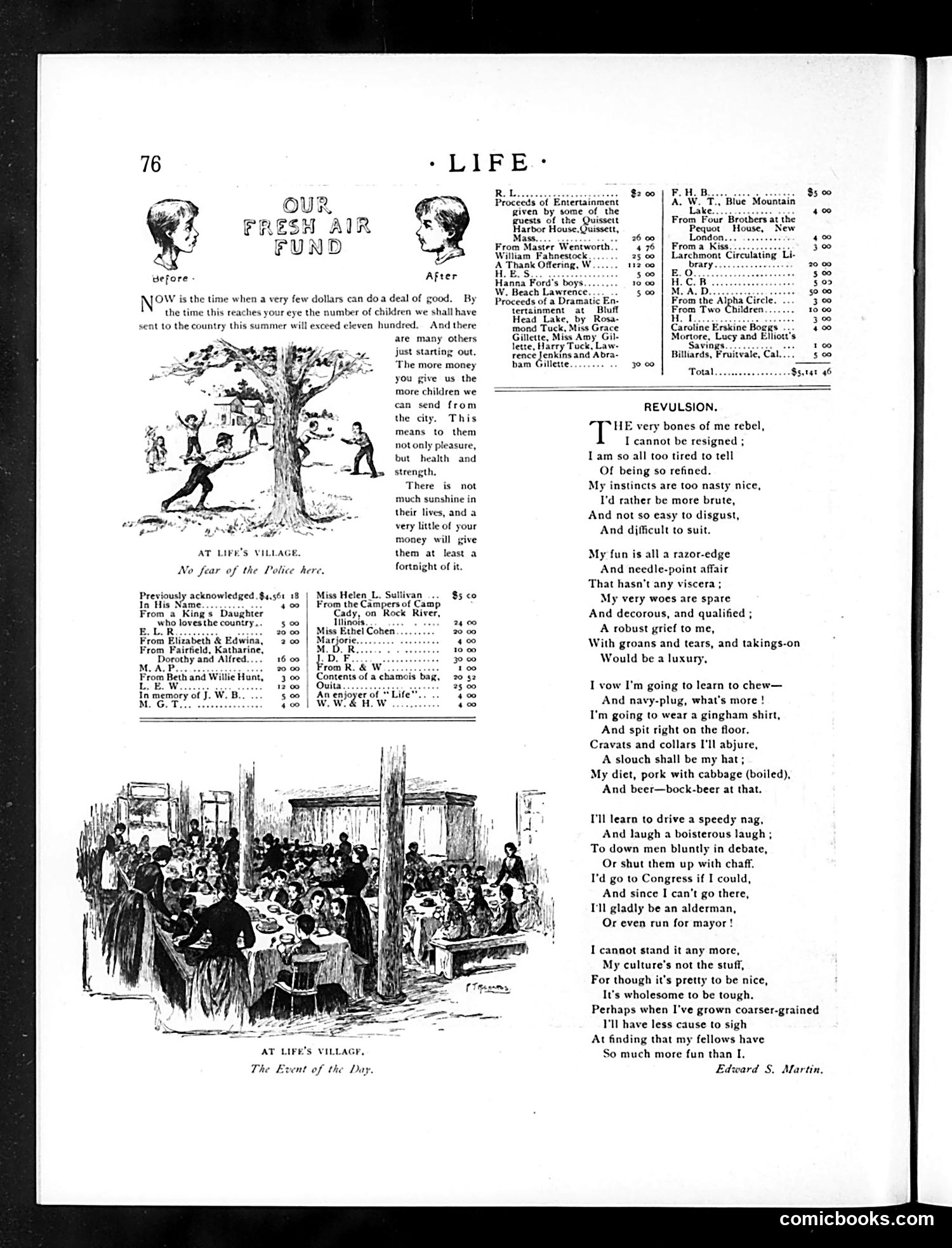
This page contains two distinct elements: **"Our Fresh Air Fund"** (left): A fundraising appeal for sending poor city children to the countryside for health and rest. The accompanying illustration shows children playing outdoors near a large tree, contrasting urban deprivation with rural wellness. The text emphasizes that even small donations provide children "at least a footlight of it"—implying sunlight and fresh air were luxuries for impoverished youth. **"Revulsion"** (right): A poem by Edward S. Martin satirizing refined sensibilities and social pretension. The speaker rejects polite culture—preferring crude behavior, plain food, and masculine excess—claiming refinement is exhausting. It's social satire mocking both artificial gentility and the rebellious posturing of those rejecting it. The page juxtaposes Progressive-era charity advocacy with satirical commentary on class and manners.
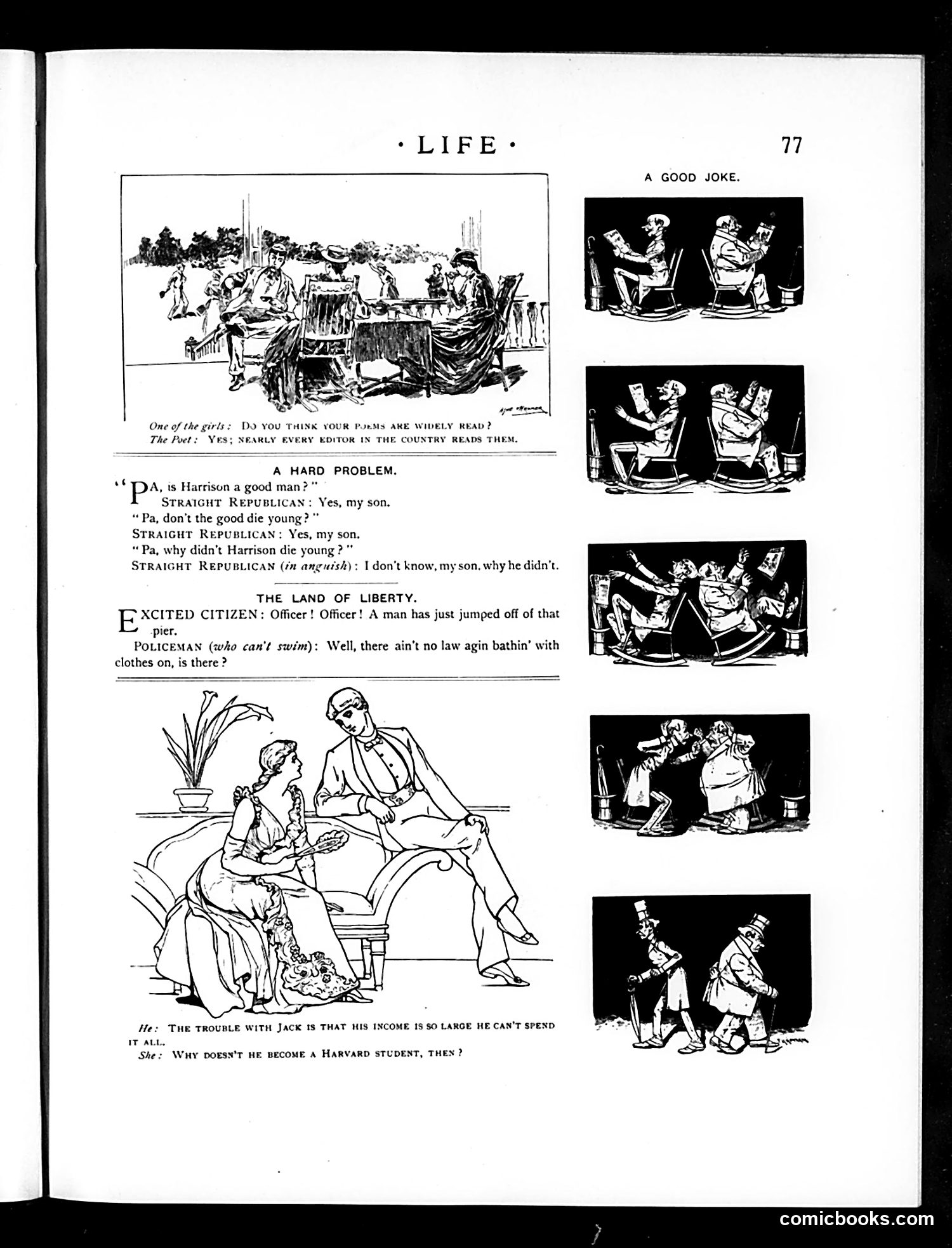
**"A Hard Problem"** satirizes Republican rigidity on political morality. A father asks if Harrison is "a good man"; the Straight Republican agrees twice, then when asked why Harrison didn't die young—presumably implying good men die young—the Republican admits ignorance. The joke mocks Republicans for blind party loyalty despite obvious contradictions. **"The Land of Liberty"** jokes about police hypocrisy: an excited citizen reports someone jumping off a pier; the police officer dismissively says there's "no law again bathin' with clothes on," implying the jumper was just swimming, not attempting suicide. It satirizes selective law enforcement. **"A Good Joke"** (right panel) appears to show figures sharing drinks in various poses, though its specific meaning is unclear without additional context.
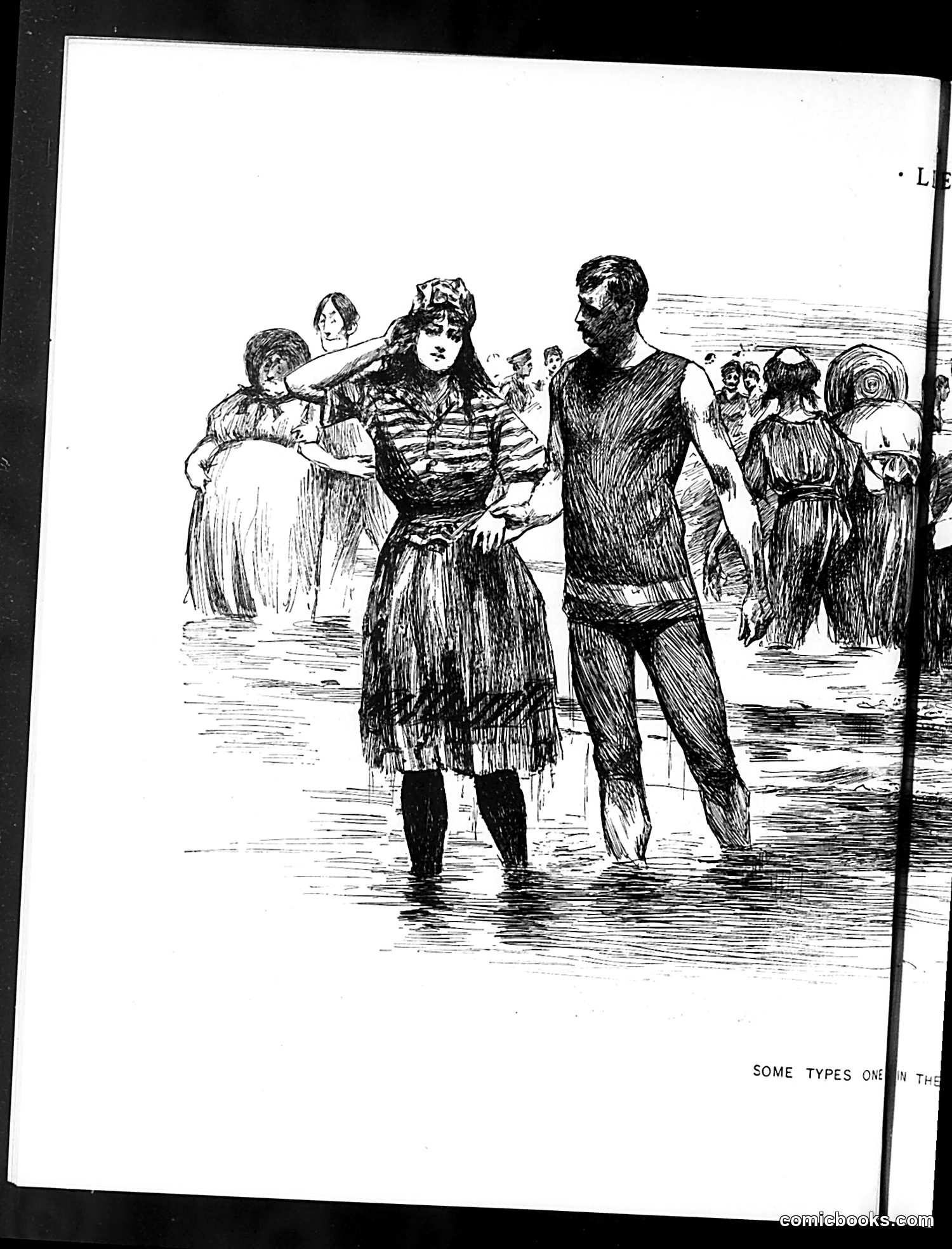
This appears to be a satirical beach scene from Life magazine, likely from the late 19th or early 20th century. The illustration depicts several figures wading in shallow water. The central figures include a woman in a striped bathing costume and a muscular man in minimal clothing, surrounded by other beachgoers. The incomplete caption "SOME TYPES ONE IN THE..." suggests this satirizes particular social "types" or classes of people encountered at beaches during this era. Given Life's satirical nature, this likely mocks contemporary beach culture, fashion choices, or social behavior—possibly poking fun at nouveau riche visitors, pretentious bathers, or the contrast between different social groups sharing public beaches. The sketch style is typical of Life's editorial cartooning.
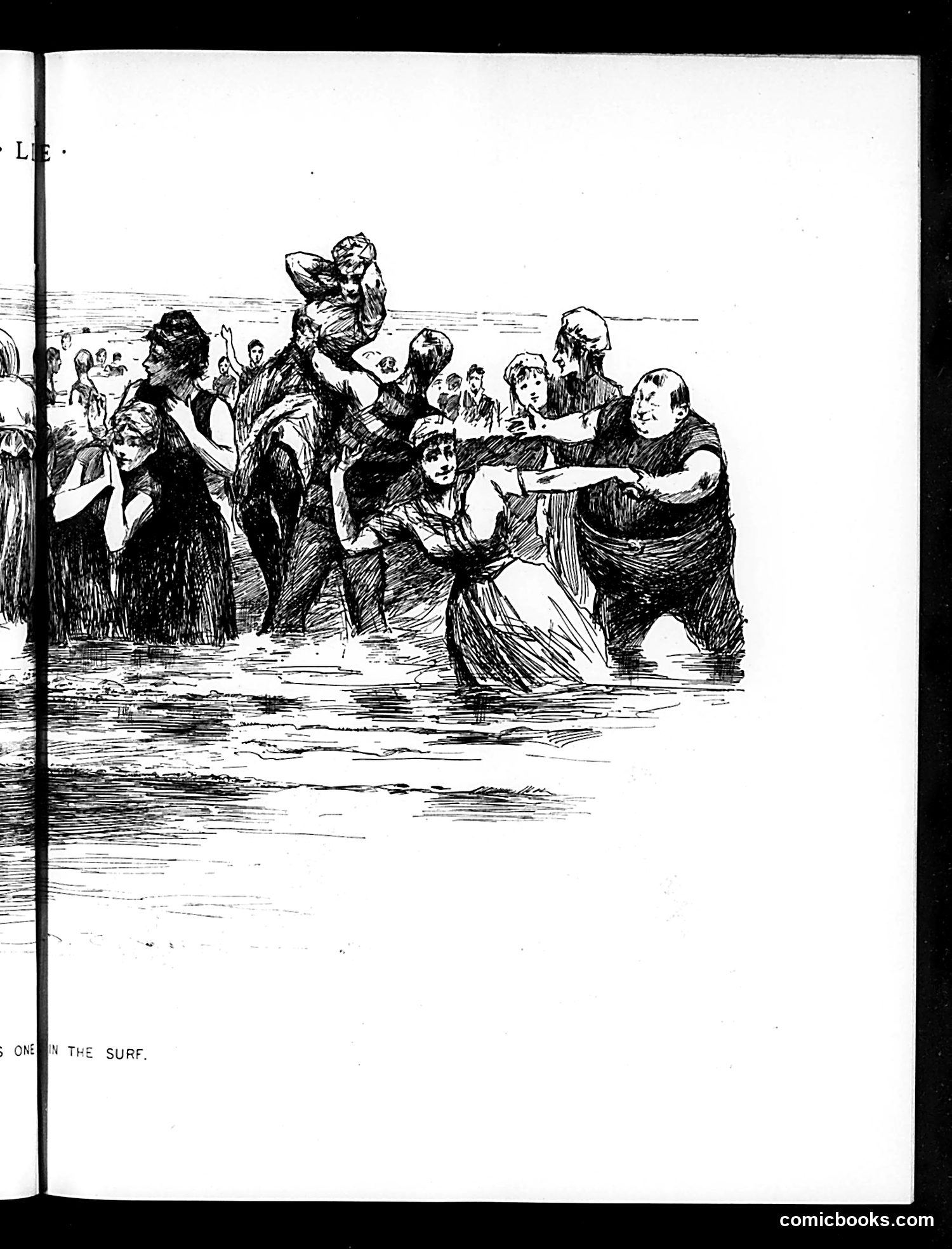
This appears to be a Victorian-era satirical illustration titled "IN THE SURF." The image depicts a beach scene where a woman in a bathing dress is in the water while a portly man appears to be assisting or accosting her, surrounded by onlookers on the beach. The satire likely concerns **Victorian bathing customs and gender dynamics**. The crowded scene and the woman's apparent distress suggest commentary on the awkwardness of mixed-gender bathing or the invasiveness of public beach culture. The man's prominent positioning and the woman's posture imply a critique of impropriety or unwanted attention at bathing establishments—a topic Life magazine frequently satirized in the 19th century regarding social etiquette, modesty standards, and changing leisure culture. The specific identities of individuals are unclear from the image alone.
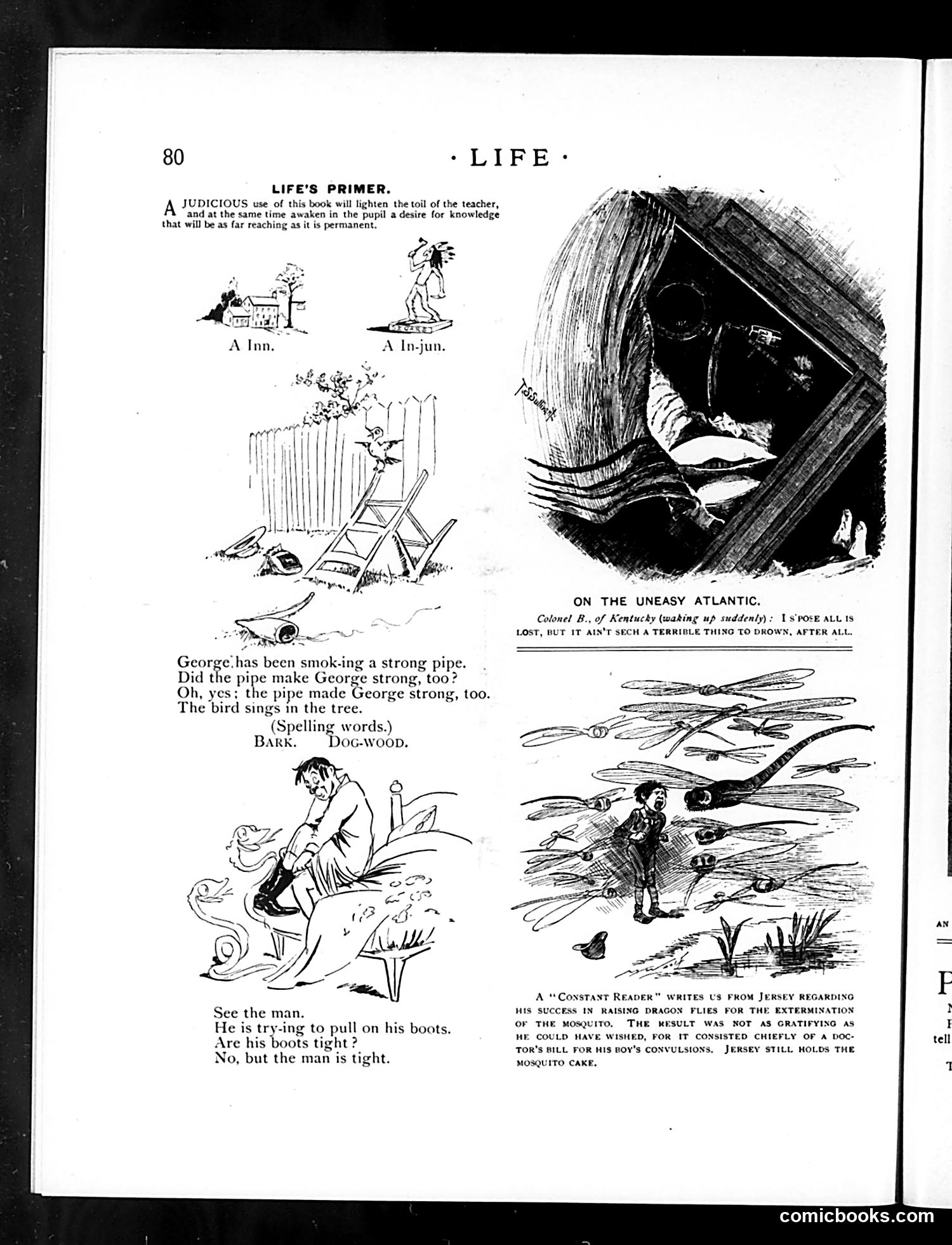
This page from *Life* combines educational material with satirical commentary. The upper left features "Life's Primer"—teaching tools with wordplay puns ("A Inn," "A In-jun") and a lesson about George and his pipe, designed to be educational yet humorous for children. The right side contains two wartime-related pieces: "On the Uneasy Atlantic" depicts a soldier or sailor in distress at sea, captioned with dark humor about drowning. Below, a "Constant Reader" describes someone successfully raising dragon flies to combat mosquitoes in Jersey—presented as practical wartime problem-solving, though the writer humorously notes the mosquito cake remains. The overall tone blends educational content with early-20th-century satirical commentary on contemporary life and wartime concerns.
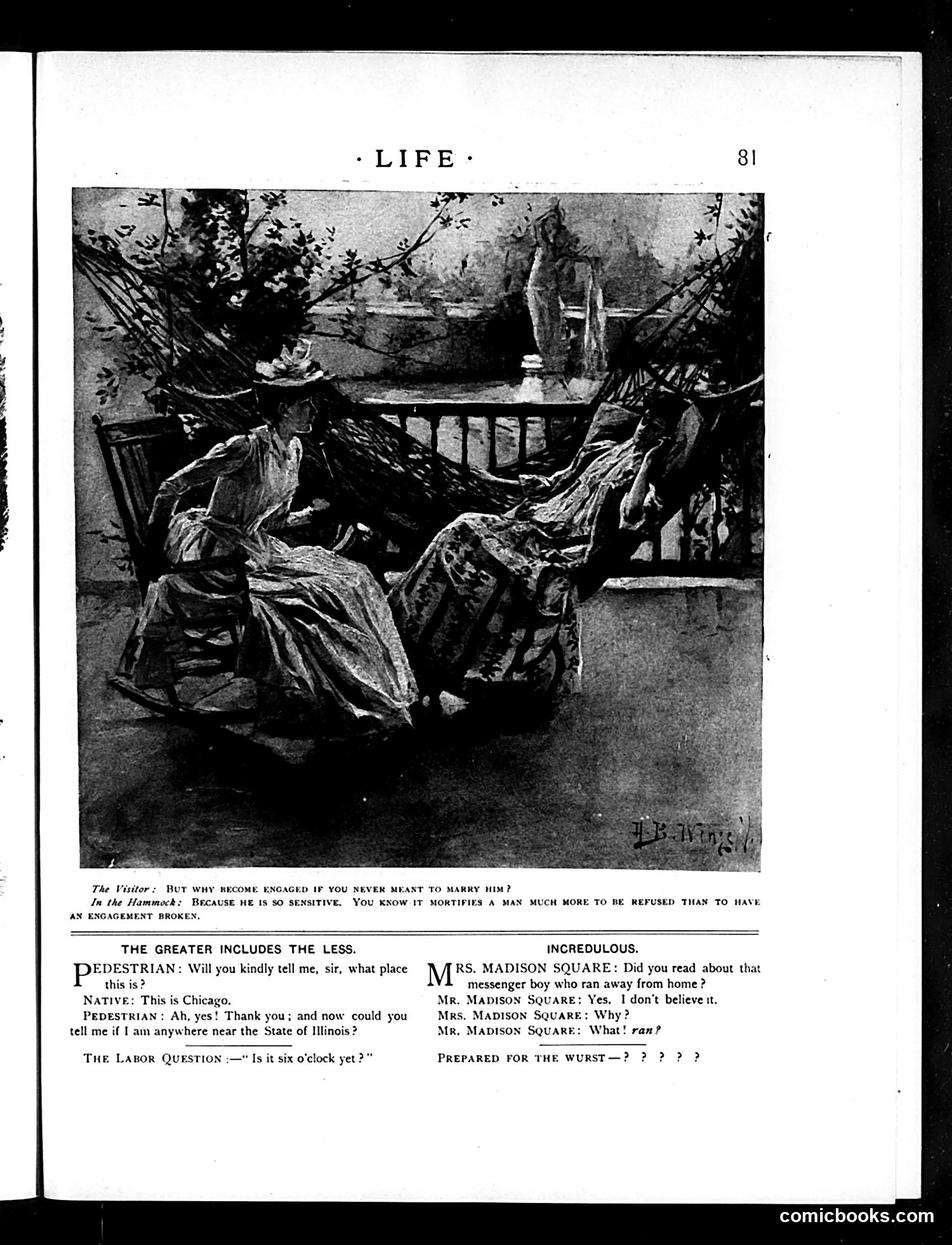
This page features a satirical illustration depicting a romantic scene with two figures in an ornate garden setting. The caption addresses a visitor questioning why someone wouldn't marry a sensitive man, with a response suggesting that sensitivity in men causes them more suffering when rejected—thus making broken engagements worse for the man than the woman. Below the illustration are three comedic vignettes: "The Greater Includes the Less" (a geography joke about Chicago and Illinois), "Incredulous" (dialogue about a messenger boy running away from home), and "The Labor Question" (a time-related joke). The page represents Life magazine's typical satirical humor about courtship, sensitivity in masculinity, and everyday social situations common to early-20th-century American life.
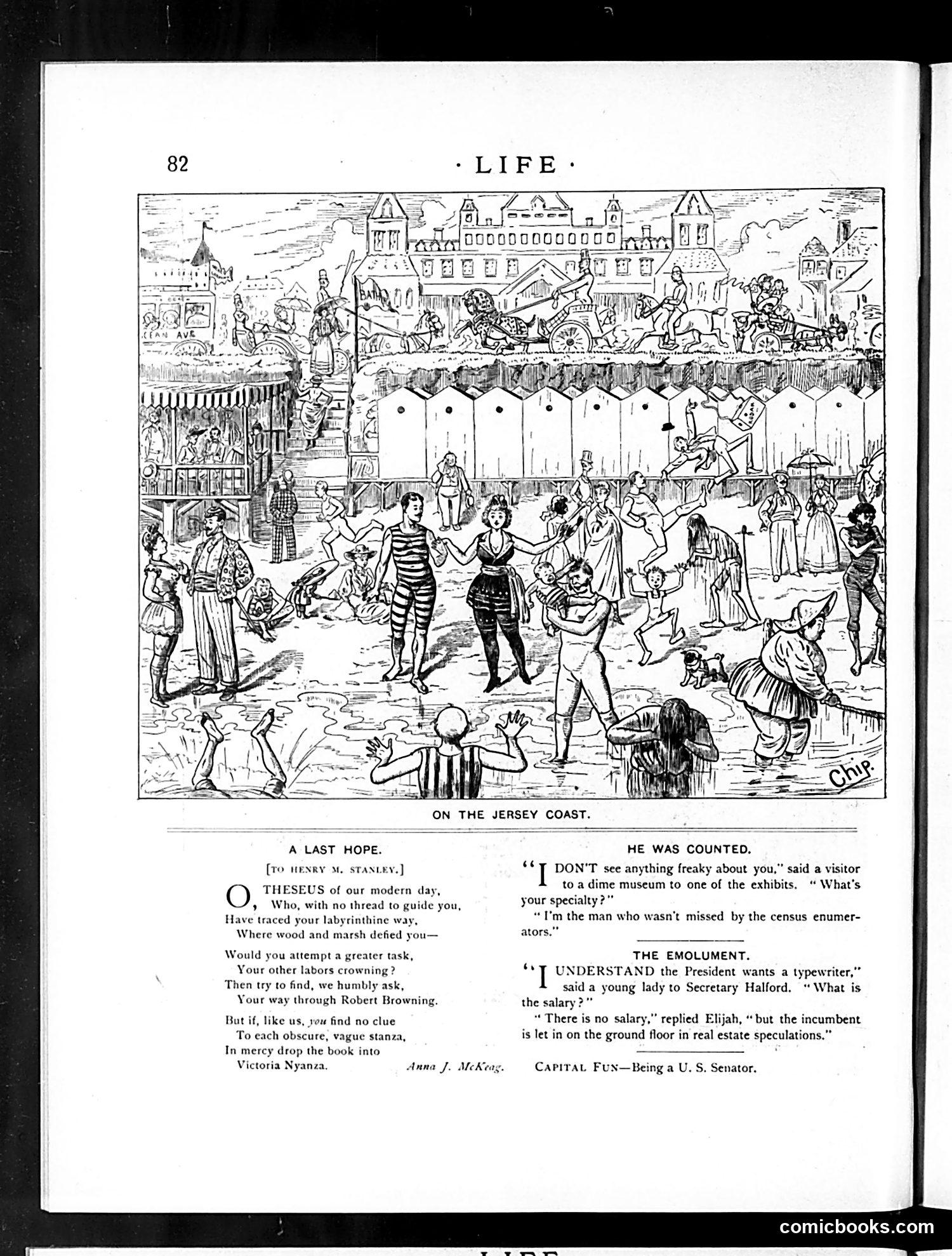
This page contains three satirical pieces about American public life: **"A Last Hope"** (poem to Henry M. Stanley): A humorous plea comparing reading Robert Browning's notoriously obscure poetry to Theseus navigating a labyrinth. The satire mocks Browning's complexity—suggesting his work is so difficult that readers need divine guidance, and recommending they simply abandon the book. **"He Was Counted"**: A joke about the U.S. Census, featuring someone claiming to be "the man who wasn't missed by census enumerators"—likely a vagrant or homeless person whose existence went unrecorded in official counts. **"Capital Fun—Being a U.S. Senator"**: Political satire suggesting senators gain wealth through "ground floor" real estate speculation rather than salary. The joke implies senators use insider knowledge and positions to profit from land deals—a common corruption accusation of the era. The beach scene illustration depicts leisure activities, contextualizing these jokes within Gilded Age American society and its absurdities.
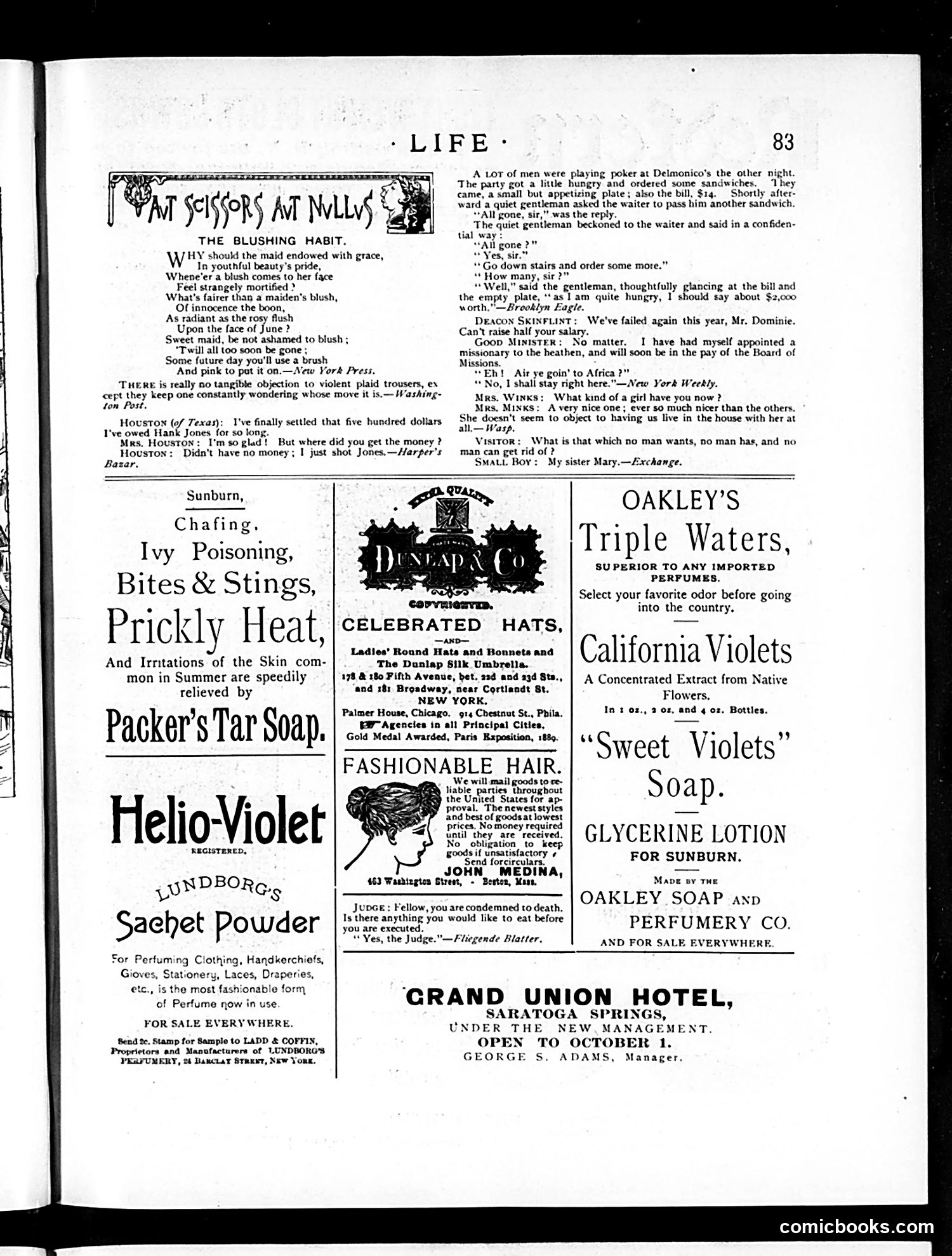
This page from *Life* magazine consists primarily of **short humorous anecdotes and advertisements**, rather than political cartoons. The jokes satirize everyday social situations: a poem mocks women's vanity about blushing (suggesting they'll eventually use makeup to fake it); a Texas anecdote darkly jokes that a man settles a debt by shooting his creditor; Delmonico's restaurant humor plays on expensive dining (a $2,500 sandwich bill); and domestic-help satire depicts a servant who doesn't object to her employers living in *her* house. The page's dominant content is **period advertising** for beauty and hygiene products—Packer's Tar Soap, Oakley's perfumes, Dunlap hats, and hair goods—typical of *Life*'s revenue model. **Context for modern readers:** These jokes rely on assumptions about class, gender roles, and commercial culture of the 1880s-1890s. The "blushing" poem and servant jokes reflect Victorian anxieties about women's propriety; the Delmonico's joke assumes readers recognize high-end dining's pretension.
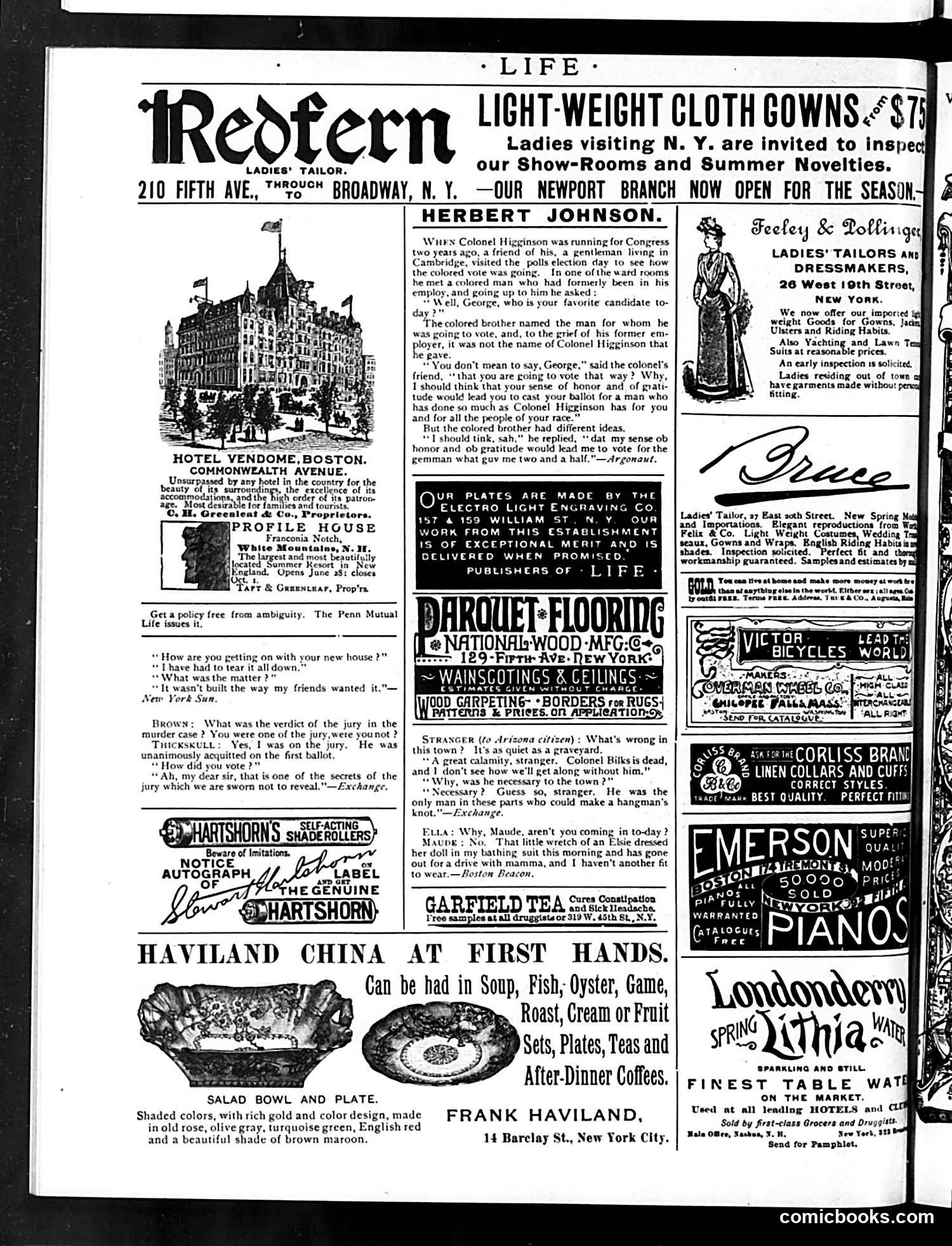
This page is primarily **advertisements and filler content** rather than political cartoons. The layout includes: **Main Elements:** - Multiple hotel and product advertisements (Redfern tailoring, Hotel Vendome, Haviland China) - Several **short humorous anecdotes** rather than visual cartoons **The Political/Social Content:** The most substantive piece is a story about **Colonel Higginson's Congressional campaign**. A freed Black man, when asked who he'll vote for, chooses someone else—saying his sense of honor leads him to vote for whoever "guv me two and a half" (implying he was paid). The joke satirizes **the limits of gratitude and patronage politics**, suggesting that even formerly enslaved people won't vote based on their former employer's wishes, and that financial incentives matter more than loyalty. Other brief jokes mock jury secrecy and marital home-building disputes—lightweight social humor typical of *Life* magazine's satirical approach. **No identified caricatures or major political figures are depicted visually.**